Category: Article

  • Cloud Software Development: Why It’s Worth Investing and Best Practices

    Cloud Software Development: Why It’s Worth Investing and Best Practices

    Cloud software development, once a trendy and somewhat distant technology, has become an integral part of any business that is serious about its future. Since the Covid-19 crisis cloud development market has witnessed even further growth. In its annual Internet Report, Cisco estimates that by 2021, 94% of workloads and compute instances will be processed by cloud data centers and only 6% by traditional data centers. Another mind-boggling prediction comes from the Data Attack Surface Report, which states that in less than 5 years half of the world’s data will be stored in the cloud.   

    data storage on cloud forecasts

    Another contributing factor to the ever-growing popularity of the cloud is the rise of remote work. Since spring 2020 with the pandemic, lockdowns, and social distancing, many aspects of our lives have changed. The way we work included. And today, almost 34% of employees say they prefer to work remotely and may quit their job if forced to return to the offices.   

    Among organizations that choose cloud software development, 92%  are at least “somewhat” in the cloud. Meaning they’re utilizing multiple cloud service providers, for instance, AWS and Google Cloud Platform. That way, if one of their services is temporarily unavailable, they can switch to a working backup for disaster recovery.    

    But with all the advantages, many enterprises face challenges when moving to the cloud, the top three being issues with the security, managing of cloud spending, and governance. In fact, according to Statista’s 2019-2020 report on the challenges and risks of cloud computing, 30% of business owners complain that roughly 30% of their cloud budget goes to waste. But it doesn’t have to. In this article, we will guide you through what is cloud computing and cloud native development how it differs from traditional software development, what are the key component of cloud-native development, its main advantages, and risks.   

    What is cloud computing, its types    

    Cloud computing refers to the delivery of a range of services, such as servers, storage, databases, software, networking, analytics, by the means of the Internet, via “the cloud” as a cost-saving, agile and flexible solution and to bring innovation.   

    But not all the clouds are made the same, to understand which one is the right solution for your business needs, you need to discern between various models, types of deployments, and services.   

    The three ways of deploying cloud computing services are by the means of public, private, or hybrid cloud.   

    cloud computing deployment types
    • Public cloud – with this cloud computing model, third-party cloud providers own and manage the computing resources such as servers, storage any hardware or software. The services that vendors offer might be free or subscription-based and are most suited for predictable computing needs, software development, or testing. It offers great technical agility for a good price. However, as a downside, the public cloud comes with a lack of security and cost control and pretty minimal technical control as well.   
    • Private cloud – refers to any cloud solution used exclusively by a certain business or an organization. With this model, the computing resources are located either on-premise or operated by third-party service providers. The private cloud is a perfect fit for government projects or highly regulated industries. For companies that require full control and security of their workloads or large enterprises. With this model, you can count on a dedicated and secure environment, flexibility, scalability, and efficient performance. But naturally, it comes with an outstanding bill.  
    • Hybrid cloud – combines both public and private cloud solutions, with data and applications shared between them. This gives the organization better flexibility, helps optimize existing infrastructure, scale with security, and takes into account compliance. Hybrid cloud is a good choice for organizations that operate. On various levels and face different compliance, security, or performance requirements. Or if you approach cloud investment with a strategic foresight in mind, trying to devise the best cloud service, delivery model. However, this approach adds a level of complexity, as you’ll have to manage and operate a mix of architectures. On top of that, navigating between the public and private cloud might result in some wasteful spending.   

    Cloud-based or cloud-native application development?  

    Another important aspect to consider, whether you want to go for a cloud-native or cloud-based development. Though often confused as they share some characteristics, the two differ in important ways.   

    Cloud development or cloud-based development refers to writing code in the cloud by the means of a browser or online interface connected to a cloud-based infrastructure.   

    While cloud-native software development is a specific type of cloud development that is container-based, dynamically orchestrated, and uses microservices architecture. The container-based and dynamically orchestrated nature of cloud-native applications makes them a subset of cloud-based apps. For instance, in such aspects as high availability or elastic scalability. While the microservices nature of cloud-native apps helps in delivering updates, some enhancements, or debugging. Thus, this approach nurtures the implementation of CI/CD processes and DevOps culture.   

    Types of cloud services   

    There’s a wide variety of cloud services available on the market. To have a clear picture of what exactly you need from cloud software development and how it can help you achieve your business goals, it’s important to know what these services are and how they differ. Generally, most cloud services fall into one of the following categories: infrastructure as a service (IaaS), platform as a service (PaaS), or software as a service (SaaS). Together they are often referred to as the cloud computing stack as they build on top of one another. 

    cloud services types
    • Infrastructure as a service (IaaS)
      Offers essential resources, such as storage, servers, network, on-demand on a pay-as-you-go basis. IaaS helps reduce on-premises data centers maintenance, as well as saves money spent on hardware. At the same time, it gives the flexibility you need to scale the resources on-demand and saves money by avoiding expenses on buying and managing physical servers and data center infrastructure. Each of these resources is offered as a separate service that you pay for as long as you need.   
    • Platform as a service (PaaS)  
      Provides complete development and deployment environment in the cloud. Much like IaaS, it includes the infrastructure resources (I.e. storage, servers, networking) but also middleware, development tools, database management systems, BI services, etc. It supports the complete development lifecycle, from building and testing to deploying, updating, and managing. Cloud services providers offer PaaS resources on a pay-as-you-go basis which helps to avoid unnecessary expenses related to buying and managing software licenses, app infrastructure, and other resources.    
    • Software as a service (SaaS)  
      Allows using a cloud-based app over the Internet without having to download, install or run it on the computer. The most widespread example of SaaS solutions would be Microsoft Office 365 or Gmail. It offers a complete solution for the end-users. For the business, it means renting the use of the solution that can be accessed over the Internet. The main advantages of this type of solution are compatibility, accessibility, and operational management. All of the underlying infrastructure, application software, data, and middleware are located in the cloud service provider’s data centers. The latter manages the hardware and software, as well as ensures the security of the solution.   

    Cloud application development best practices  

    Cloud-native application components  

    So what constitutes a cloud application? Here are some key components that together make up cloud-native development

    cloud native software development vs. cloud-based software development
    • Containers  
    • Microservices  
    • DevOps processes  
    • APIs  
    • Serverless architecture 
    • CI/CD pipeline  
    • Containers   
      Containers are a staple of cloud-native development. They provide the application with libraries, lightweight runtime, and dependencies that allow for application portability, meaning it can run as a stand-alone environment and be moved in and out of the cloud. Containers offer additional mobility and allow developers to effortlessly release and update apps, as well as focus more closely on the app itself, while the infrastructure is in hands of the operations team. Container orchestration is the management of these deployments across the enterprise.  
    • Microservices  
      With the traditional, monolithic application development, the development, deployment, and management of the app are easier at the initial stages. But the bigger the app, the harder it is to solve any problems or add new features. That’s where the microservice-based approach to software development comes in. It breaks down an app into the smallest components, microservices, that are independent of each other but work together towards the same tasks. Microservices usually run in containers which makes them an application payload for a container. This allows adding new features or functionality more quickly and easily, as well as minimizes the risks.  
    • DevOps  
      As with any application development, one of the important components is the people and the automation processes that help them work together. To make this collaboration more efficient, cloud-native development adopts a DevOps culture. DevOps as an approach to software development and a new management culture adopt certain practices and work environment that supported by tool allows organization achieves their business goals faster and without the compromising the high-quality standards. By automating the software development routine, it reduces the time and effort typically spent on manual tasks.  
    • APIs  
      Application programming interfaces (APIs) are sets of tools, definitions, and protocols that integrate, communicate and connect application software with services with simplicity, flexibility, safety, and control and without having to build new connectivity infrastructure. APIs can be private (only used internally), partnered (shared only with specific partners), or public (allow third parties to develop apps and interact with your APIs).   
    • Serverless  
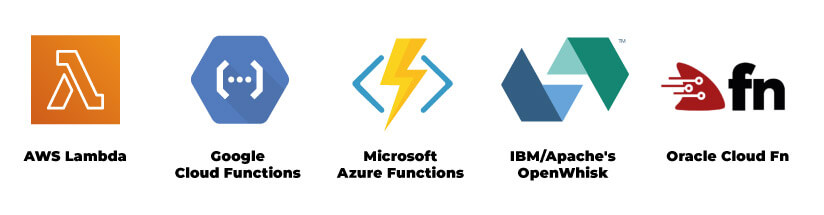
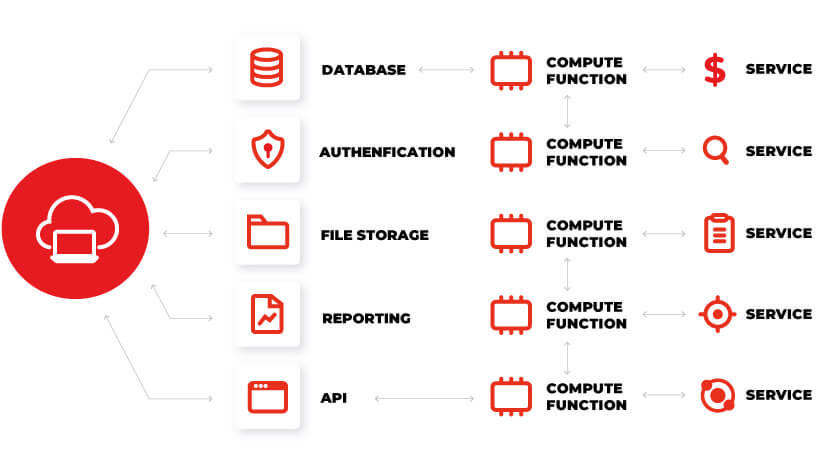
      Serverless architecture means that you don’t have to manage any servers, virtual machines, or containers. Despite what the name might suggest, there are still servers, of course, but the task of handling them falls on your cloud infrastructure provider. This allows you to execute the code in a form of functions at automatically provisioned infrastructure and environment. Any major cloud provider offers serverless nowadays: AWS Lambda, Google Cloud Functions, Microsoft Azure Functions, IBM/Apache’s OpenWhisk or OpenFaaS which is opensource under Linux Foundation governance.   
    • CI/CD  
      Establishing continuous integration and continuous delivery processes is the essence of DevOps and cloud-native development. With a CI/CD pipeline, a series of steps are performed to deliver a new version of the software. It introduces automation and monitoring to improve application development, at the integration and testing stages, as well as delivery and deployment. The main advantage of this approach is in the better quality of applications, and faster and more stable updates.   

    Choosing cloud vendors  

    Another important step on your cloud journey is choosing a reliable cloud services provider. Luckily, there’s plenty to choose from. The ‘big three’ are Amazon Web Services (AWS), Google Cloud Platform (GCP), and Microsoft Azure.   

    major cloud services providers

    AWS has been on the market the longest and currently dominates it with a 32% market share, followed by Microsoft which has 18%, and Google – 6%, as a recent report suggests. Other reliable cloud providers worth considering are IBM Cloud, Oracle, Heroku, Rackspace.   

    With so many to choose from, today companies often opt for using additional cloud providers, not to replace one with another but to cover different requirements, such as costs, managing risks, etc.   

    Why go for cloud software development: key advantages  

    As more and more organizations choose to adopt cloud, here are some of the deciding factors for opting for cloud software development:   

    • Reduced cost  
      As cloud application development operates on the pay-as-you-go model, it means that you will be paying only for the cloud services that you are using. This allows to control expenses and not overspend where there’s no need. At the same time this approach requires to take into account carefully cost modelling during solution architecture design. 
    • Increased flexibility   
      With cloud software development, cloud scalability is a part of the package, which means that you can easily scale up or down if need be.   
    • Better agility  
      Another innate feature of cloud development – CI/CD means that developers can rapidly test and introduce new features in mere minutes or hours, not weeks or months, which nurtures innovation and helps beat the competition.   
    • Fast disaster recovery   
      Cloud’s ability to bounce back rapidly in case of meltdown adds up to the business’s ability to be more competitive and offer a better quality of services for their clients. To have this advantage in full, solution should follow IaC(Infrastructure-as-Code) principles which means that all the IT infrastructure components to be deployed in programmatic way. 
    • Effective collaboration   
      Communication and sharing within the organization are also sufficiently improved with cloud computing, as anyone related to the project can easily access the same files from any location. This, in turn, improves collaboration and internal processes.   

    Before you move to the cloud: challenges of cloud software development   

    But with all fairness, it is also important to note the challenges that might come up on your cloud transformation journey. Here’s what you need to be aware of:  

    • Security concerns 
      Although most of the security heavy lifting is done by the cloud services provider, security is still a top priority and concern. Depending on the domain you are operating in and the level of sensibility of your data, you might need to consider a hybrid or multilevel type of cloud, with workloads being split between public and private clouds.  
    • Culture shift  
      Cloud software development brings a lot of relatively innovative ideas to what you’d consider a standard approach to software development, for instance, the adoption of DevOps culture. This inevitably leads to some reorganization within the structure, shifting of some roles and responsibilities which will require strong management skills.   
    • Compliance  
      Another top concern when moving your product to the cloud is meeting GDPR and other security regulations that you will have to look closely into. At the same time such regulations valid for on-premises traditional solutions as well. 
    • Finding the right talent   
      If your team hasn’t got previous experience in working with cloud development, you might want to consider looking for a software development partner that will help you handle all the issues and challenges that might arise on your way and help with an efficient time and cost-effective transition to the cloud.   

    Conclusion 

    Cloud native development has been the talk of the town and one of the leading tech trends for several years now and with everything happening in the world and the continued need for businesses to go online and digitalize, it will remain that way. This can be easily explained, cloud software development comes with numerous benefits such as extended flexibility, scalability, effective use of the resources, and speed of innovation. However, it comes with some challenges as well. You will have to be prepared to deal with various APIs integrations, planning of data architecture, as well as dealing with security and compliance.  
    Symphony Solutions, as a trusted cloud software development partner, can help you make the most out of this technology and make your cloud adoption a smooth journey.   

  • Accelerate Time to Hire: 4 Solutions for Vetting Technical Talent

    Accelerate Time to Hire: 4 Solutions for Vetting Technical Talent

    Your company is expected to move more quickly than ever before in order to remain ahead of your competitors. With countless priorities to juggle, allocating time to source, onboard, build and scale an engineering team that will get you where you need to go can feel like a daunting project. Add in the fact that the current market is extremely volatile and your challenges have increased by a quantum factor. 

    The state of the hiring market, especially when it comes to recruiting software engineers, has been shifting with the onset of pandemic restrictions as many qualified software developers opt to work remotely and experience more freedom to choose companies and what they are offered. What may seem like a lucrative career prospect for talent, poses a risk for recruiters who suddenly find themselves fighting over candidates and struggling to fill positions. In fact, CodinGame surveyed 15k developers and HR managers and discovered that 61% of recruiters have said that finding tech talent is their biggest challenge for recruitment in 2021. 

    CodinGame’s research
    61% of surveyed HR managers say finding tech talent is the biggest challenge for recruitment in 2021. 
    Source: CodinGame’s research 

    Modern-day market software developer hiring challenges 

    The tech hiring market of 2021 is volatile as demand for talent is rising higher than ever. Here are just some of the challenges that recruiters face on a daily basis: 

    • Each potential candidate is being approached by many different recruiters every week. Even if you are able to engage candidates and make them interested in the role and the company, it is a challenge not to lose them. 
    • The longer the process the more likely candidates are to drop off. It’s important to optimize the process and make it as fast as possible, especially when it comes to final decisions. 
    • The more steps in the process, the higher the risk of losing candidates. Every step increases the time it takes from approaching a candidate to making a decision about hiring them. Take too long and by the time that you’re ready to make an offer they will have been picked up by another company. 

    Expanding on the challenge of the multi-step hiring process, it’s often the case when another company has to be involved. Once the client company comes into the picture and wants to take an active part in hiring, it adds to the number of steps and makes the process even longer. Then you may run into issues with scheduling; interviewing takes time, especially if there are several rounds. All the while the risk of the candidate dropping out increases. 

    In the current climate, a protracted multi-step process is no longer a viable option. If you really want to succeed, you need to take a different route in the hiring process. 

    Setting your team up for success is a challenge of its own. But first, you need a team that is up for the challenge. Let’s go over a few ways how you can optimize your software developer hiring process reflecting on the current realities. 

    Solution 1: Fewer steps 

    The reality of the hiring market is that if you start off the recruitment process with ten candidates, by the end of the first week you will lose two of them. By the end of the second week, another two will be gone. And by the end of week 3, you’ll be lucky to have even one left. It may be tempting to keep a big pool of candidates and have something to choose from. But with how fast people now tend to move from one position to another, you have to think fast and not keep your candidates waiting, lest someone else will snatch them right from under your nose. 

    One way to deal with this is to have team interviews instead of multiple rounds of interviews for your candidate with each department or interviewer. 

    Pros: 

    • It’s a faster process if instead of four separate interviews you have one with different interviewers. 
    • Involving more people in the interview helps reduce or entirely avoid bias in the hiring process. 
    • Team interviews help make the hiring process more streamlined and consistent. 
    • Candidates are introduced to company culture. 

    Cons: 

    • Each interviewer has a limited time to talk to the candidate and cannot go deeper on some topics. 
    • More stress inducing for the candidate and may result in poor outcomes. 
    • Team interviews require more preparation make sure they are well-structured and questions aren’t overlapping. 
    • Interviewers see other interviewers react to the candidate and this may influence their judgement. 
    Candidate drop-off rate

    Solution 2: Speed it up 

    The hiring process may consist of multiple steps, each one requiring feedback on the candidate’s performance. It’s often the case that it takes days if not weeks to hear back from all people involved, since interviewers and hiring managers are already as busy as it gets. This may be addressed by building awareness in the company so that everyone knew the importance of fast feedback, perceiving it as part of the company culture. 

    As practice shows, this is something absolutely realistic and achievable once you set up the process. We see more and more companies making the offers within one day, so that is something to consider. 

    Pros: 

    • Fast turnaround means lesser risk of losing a valuable candidate in the process. 
    • More efficient and productive hiring. 
    • Quick feedback provides good candidate experience as it shows your commitment and that you treat them as a partner. 

    Cons: 

    • If the hiring process is rushed, there’s always a risk of hiring someone who isn’t the right fit for the project or the company. 
    • Risk of miscommunication. 

    Solution 3: Efficiency 

    Be efficient and make sure there is no time wasted in the process. During the interview, interviewers should only ask questions that matter and that help them assess the candidate. Make sure it’s not some casual chit-chat about nothing. Interviewers should be properly prepared to talk to the candidate, i.e. they know the role, get familiar the candidate’s CV upfront, etc. 

    Pros: 

    • Interviews are more to the point, so you may discuss the position and the project in more detail and nuance.
    • Interviewee gets a more realistic impression of the company and what the role is about. 

    Cons: 

    • Some candidates may prefer a more personal approach to interviewing and may view your to-the-point attitude as cold or robotic. This way you may deter talented candidates from your project and opt for a better cultural fit. 

    Solution 4: Trust the vendor 

    As you are looking to find your “dream team”, you may want to get involved in the hiring process and get to know what people you are going to be working with. However, this will mean extra steps and longer process. Realistically, there are no companies that can do it all within one week if the client must be involved. 

    There is another way to efficient recruitment with fast turnaround. Essentially, you will get the best results and most impact if you trust your vendor to handle the process. If fully responsible for the hiring process, their first priority is to put together a team that is efficient and just right for your needs, and they will not let exceptional talent slip past them. 

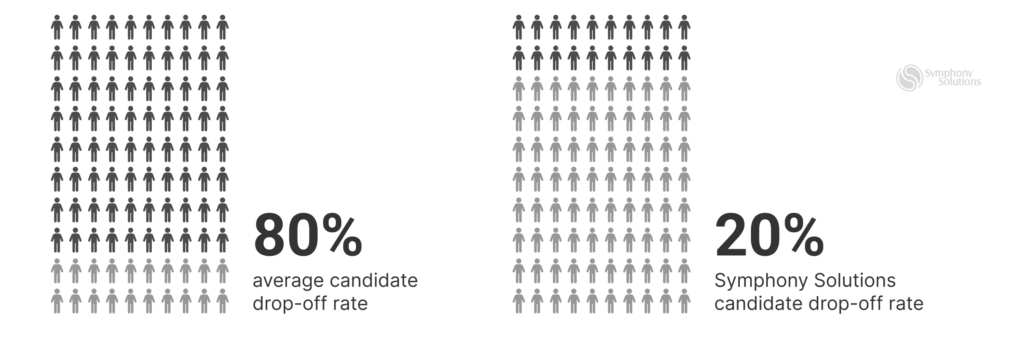
    In a 2019 article, Glassdoor touched on some woes of recruitment and noted that the average candidate drop-off rate can be as high as 80%. All of this is attributed to the slow and complicated hiring process paired up with a high number of applicants. An optimized process where the vendor takes the lead shows a completely different picture. Summing up the last quarter of 2021, we saw a drop-off rate of 25%. 

    Pros: 

    • It’s the fastest way to set up your team and start on the project. 
    • Significantly reduced candidate drop-off rate. 
    • You are not losing potential strong hires. 
    • Vendor with strong experience in hiring engineers can provide great candidate experience that strengthens your employer brand. 

    Cons: 

    • You don’t get to control the entire process and may find it difficult to completely rely on someone else to make final hiring decisions. This can be addressed by finding a vendor that you can truly trust with the process and know to deliver on their promises. 

    In conclusion 

    All things considered, the point stands. When starting on a new project, it’s best to let your vendor handle the entire hiring process from start to finish. This way they can quickly put together a team that will work well together. That is what brings the best results in a fast-moving market with vigorous competition. 

    Finding just one right person can be tough, setting up a whole team is a challenge not for the faint of heart. At Symphony Solutions we want to give you the experience of getting on board with a team that is right for you. Read more about our services or contact us to inquire about how we can help you build your dedicated team fast. 

  • Agile Implementation in Team: Methodology, Models, Processes & Tools

    Agile Implementation in Team: Methodology, Models, Processes & Tools

    The more companies testify to the benefits of implementing the Agile ways of working into their daily life, the more popular and mainstream it grows. It has become the new corporate lifestyle and comfortably found a place in many industries. The positively new mindset manifested in the Agile workflow gives companies that competitive edge that defies traditional project management and methodologies. If you’re not Agile, are you even trying? 

    Organizational transition to Agile makes your business flexible to customer’s needs and requirements. It helps you churn out ready-to-use projects fast without a loss in quality. In fact, with this approach, you can give the clients just what they desire all the while building a strong bond. And, when it comes to team management, it is aimed at nurturing self-sufficient teams with a high level of personal responsibility and commitment to a common cause. 

    Principles and practices to implement your Agile methodology right 

    The efficient implementation of the Agile methodology in the team starts with the understanding that all further practices should be centered around and designed with the right mindset in tow. If your team has already adopted the Agile mindset, you’ll find this part easy. First, you’d want to have set up some of the main keystones based on Agile values and principles: 

    • Transparency. The team greatly benefits from being well-informed about the state of the project at any stage of development.  
    • Responsiveness to change. Adaptability and flexibility is the essence of Agile. The team needs to remain flexible to any changes that may be requested by the client. 
    • Team Collaboration. As many people are involved in the development of the product and there are dependencies that can hinder someone’s work, close collaboration is a must. 
    • Improvement loop. One of essential Agile practices is having a continuous feedback loop that allows the team to improve the product upon each iteration by implementing relevant feedback from the client and always keeping the product quality in check. 

    How to implement Agile in a team 

    When you are new to Agile and consider transitioning your team to this new way of working, start by introducing your team to the concepts and help them adjust while you are on your way of Agile implementation. 
    As your team settles in, you may run into some issues and challenges. Most commonly when an issue arises it’s because there is a communication gap somewhere in the team and you’re not properly following the rules that you’ve set for yourself. 

    Here are a few quick tips that will help you address this:  

    • Educate the team. Introduce your team to the basic concepts and principles of the Agile iterative process, team roles, events and ceremonies, artifacts and tools to use in their daily work. 
    • Involve the team in creating the Product Backlog, so that they understand the scope of work ahead of them, be realistic in their planning, take into account delivery times and dependencies. 
    • Communicate clearly within the team, keep all the processes transparent and support efficient flow of information and knowledge. Anything that’s going on in the team that in any way affects the delivery of the project needs to be communicated and addressed. Whatever blockers or hindrances come up, they need to be sorted immediately to avoid escalation of any issues and failed delivery. 
    • Take responsibility. Agile teams are different from traditional ones in the way that they are self-sufficient and don’t require excessive management from the top. As a team member, you should not only be interested in delivering your part of the work. There are dependencies and a lot of collaboration involved. Think about how you are going to deliver the product as a whole and work from there. 
    • Improve the process continuously. This is exactly why you hold Retrospective meetings after each sprint. Make good use of this time and dig deep into why your team is performing as it is. Encourage everyone to participate and bring new ideas to the table on how you can improve as a team. Always seek to improve your performance, gain new knowledge and valuable insights, apply new knowledge to your work. 
    • Implement feedback loops as an essential part in creating your efficient Agile workflow. You want to receive regular feedback on the completed work and adjust accordingly. It helps make sure that you keep a clear vision of the goal you are pursuing at all times. This way you will know that the team will deliver exactly what the client wants. 
    • Choose the right tools. There is an abundance of tools that can accommodate the work of an Agile team and facilitate Agile ceremonies. Pick the ones that work best for you. 

    It’s all in the word. If you want to be Agile, first you’ll have to be agile – in your work and communication, responsibilities and initiatives. Create a team that lives by these same principles and truly commits to what they are doing.  
    So, what do we mean when referring to Agile project management? How do you get on with it? How do you even get started? Let’s explore your options. 

    Scrum and Kanban: The two main Agile frameworks 

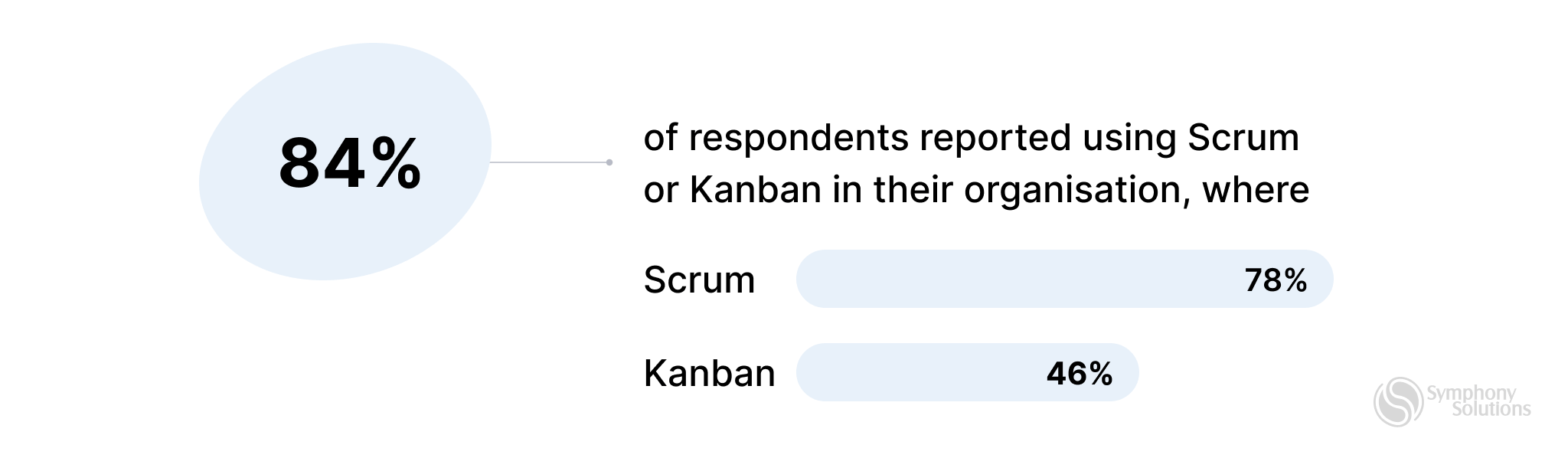
    Agile can be regarded as an umbrella term for different frameworks, models and methodologies that have the team work in an iterative way and put a stress on flexibility and frequent delivery. Two of the main Agile frameworks are Scrum and Kanban. Your Agile team can stick to using one framework or combine a few as it suits their work process. In fact, in the State of Agile report 2021 the overwhelming majority of responders, namely 66%, reported using Scrum as their preferred framework and 15% use some combination of Scrum and another model.

    Agile methodology statistics

    Scrum is your go-to framework if you can expect a lot of change in requirements as the project progresses. It gives a lot of room for change and flexibility with some usable part being delivered every few weeks, or a sprint. At the end of each sprint, the client gets to see some results of the work done and give feedback to be implemented going further.
    The Kanban framework presents complex information in a visual manner and is focused on evolutionary process improvement. It helps visualize the scope of work and avoid potential bottlenecks by managing the flow and limiting the work in progress. 
    Let’s take a closer look at what the two frameworks constitute and see how your team can implement them to better manage their workflow. 

    Getting started with Scrum: ceremonies and artifacts 

    To have your workflow run smoothly in Agile, the team coordinates its work around Agile ceremonies and artifacts that tend to set the tone for productive team collaboration. 
    Agile artifacts, which inherently belong to the Scrum framework, represent the value that the team commits to create and deliver: 

    • Product Backlog. The initial stage of every product development is creating a backlog of tasks that cover the scope of the work to be delivered. As you progress in your work on the project, the product backlog may expand and change, with the ideas being fleshed out reflecting the client feedback. It’s important to be precise in defining the items in the backlog, know the scope of work that needs to be done, and have the project manager set priorities. 
    • Sprint Backlog is a list of tasks that the team commits to completing in a sprint. The items are selected from the general Product Backlog. The team sets a goal for the sprint and has an action plan for how to approach the scope of work determined. Achieving the Sprint goal is a team effort and requires everyone to be on board. This means that everyone needs to be aware of their dependencies and focus on avoiding or eradicating blockers and bringing the tasks to completion rather than only keeping your personal to-do list in check. 
    • Increment is a single step in achieving the Product goal. Each increment builds up to the entire project. It needs to be usable for the client and provide a certain value. The team may work on multiple Increments within a single sprint, and several Backlog items constitute an Increment. 

    The ceremonies used in Agile are formally organized events purposed for the team to check the progress on the current Increment, detect and address blockers, adapt Scrum artifacts and adjust their processes contained within a sprint. 

    scrum process on project

    These are the Scrum ceremonies, as follows: 

    • Standups are daily Agile meetings that are a check-in point for the team when they can communicate and review the current status of tasks. This is the time to address any blockers or dependencies that need to be accounted for.
    • Sprint Review and Planning are two events in Scrum that are closely correlated. Sprint Planning is when the team picks up the backlog items for the upcoming sprint and determines their goal, whereas Sprint Review is the team reporting on a sprint well-done. Or, more realistically, reporting on any issues that may have come up in the sprint and determining how to avoid them in the future. At this point, Product Backlog may be adjusted.  
    • Retrospective meetings are another type of Agile ceremonies held regularly for the whole team. The meeting is aimed at reviewing the team’s performance in the finished sprint, acknowledging what was done right, detecting possible issues and finding solutions to be implemented in the future to improve the team’s output. 

    Getting started with Kanban: ceremonies and artifacts 

    The Kanban system doesn’t generally mandate any specific ceremonies that are characteristic of the framework, but rather uses a customized mixture of ceremonies. Kanban works well when it is used alongside Scrum. It is meant to optimize the flow of work in the value stream, which is done through a set of practices, some of which are the following: 

    • Presenting the flow in a visual way. This is done with the aid of a Kanban board, a physical or digital board that helps visualize the scope of work and see the progress on the project at any given moment. The Kanban board is used by moving cards containing items of work through the stages of “To-Do”, “In Progress” and to “Done”. This way, you can see the workload, level of completion, bottlenecks, etc. 
    • Limiting the work in process (WIP). This means setting a limit on the number of work items the team is working on at any stage of the project. Limiting WIP allows the team to better manage their workload, detect and mitigate bottlenecks, and complete the tasks faster. 
    • Striving to improve the process. As Kanban is used in a fast-paced work environment with rapidly changing priorities, the team will need to continuously improve their processes to keep up with the pace. The team will greatly benefit from using metrics like throughput, lead or cycle time, etc. 
    • Implementing a continuous feedback loop. This can be done in the form of meetings (Kanban Cadences) where your client get to share their input regarding the project, areas of concern and see what can be improved. The team then can analyse the input and decide on what steps to take to implement the client feedback. 
    • Establishing explicit process policies. A Kanban team should have set rules for their work processes and agree on how to determine if a work item is ready to be moved to the next stage. 
    kanban process

    As you can see, the Kanban methodology in practice has minimal requirements to make it work. Within the Kanban framework, there are no explicitly predefined artifacts. Arguably, some consider an artifact anything that is generated as you are implementing the methodology and there’s some discussion on what is an artifact in Kanban exactly, but the methodology itself doesn’t specifically identify any of such requirements. 
    When it comes to ceremonies, there are no fixed time slots to be used for planning or reviewing tasks and the workflow. There are however Kanban Cadences, a proposed series of meetings at different levels (team level or service-oriented). The team can decide on what cadences will be beneficial to their workflow, organize them regularly or on demand. 
    Having said that, Kanban would fit best a mature team that feels comfortable working with all the flexibility that the framework provides, and in fact benefits from it due to the nature of its work. A Kanban team is a self-sufficient entity that evolves and progresses in its processes organically. 

    Agile tools for successful methodology implementation 

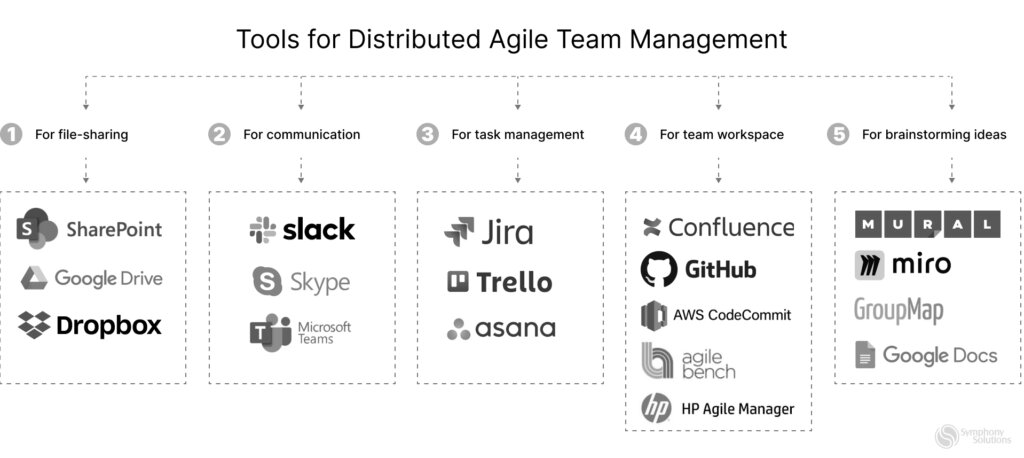
    It may be helpful to use Agile workflow tools to accommodate your team. These can be web applications and services to facilitate efficient team communication, task tracking, file sharing and storage that allows multiple team members to work on files simultaneously. Generally, the team picks a combination of tools and leverages it to get the most out of available functionality and streamline the work processes. 
    Here is a comprehensive list of tools that you might want to consider using for your team. Of course, you may discover that your team prefers something different and stick to that. 

    • Jira is a task management tool that is widely used for tracking progress in a sprint. It has a Kanban board where the team can visually show their status with basic workflow states like To Do, In Progress, Under Review, Done. 
    • MS SharePoint is a web-based platform for team collaboration that is integrated with MS Office.  
    • Google Docs is similar to SharePoint but it’s powered by Google and can be used independently with your already existing Gmail account. 
    • Bugzilla is a bug-tracking tool specifically targeted at assisting in the development process, mostly used by test and software engineers.
    agile tools in agile workflow
    Source: the 14 Annual State of Agile Report by Digital AI 

    Even if your team is fully or partially remote, Agile is probably the best model to be chosen for team workflow. Read more about helpful tools and tips for distributed Agile project management.  

    Summary 

    Establishing an Agile development workflow can become the competitive advantage that will help you get more business and increase the satisfaction of your already existing clients. Developing workflow processes with Agile at heart, helped Casumo to get better results through improving collaboration with technical teams and being consistent when delivering value to the customer.  

    With the integrated Agile in practice, the teams are able to create a product that hits just the right spot when it comes to customer’s needs and wants and they do it fast. If you want to follow the lead and turn your team Agile, consider inviting an expert to provide Agile implementation consultancy and mentoring to help you get the processes going and support you through the transitional period. You may find yourself at the start of an exciting journey that will eventually come to change the core essence of the way you work. It takes only a few days or weeks to establish the Agile process but it takes months or even years to master it and make the team fluent in operating within it. But once you’ve got it, you’ll never want to go back. 

  • Stress-Free Cloud Migration: Creating a Cloud Readiness Assessment Plan

    Stress-Free Cloud Migration: Creating a Cloud Readiness Assessment Plan

    As more organizations see the value of scalability, agility, and security that the cloud offers, the decision to move to the cloud becomes more common. According to the latest Gartner, Inc. forecast, the worldwide end-user spending on public cloud services will grow by 23% in 2021 to a total of around $332 billion, from $270 billion in 2020.   

    But with all the popularity of the cloud, a recent survey reveals that a strategy of moving to the cloud simply for the cloud’s sake, but without a clear vision or even answering to oneself why your company or organization needs the move, is destined for a failure. But it doesn’t have to. Consider adding one small but crucial step in your cloud migration journey – cloud readiness assessment. It will help you understand where you are at on your cloud adoption and help you prepare for all the possible pitfalls on your way to the cloud.

    cloud migration journey roadmap

    What Is a Cloud Assessment?

    It’s a process a company undergoes to determine their system’s capabilities and find out whether it’s ready to migrate to the cloud. It gives the organization a clear understanding of what needs to be done and ensures a seamless move to the cloud.  

    Cloud readiness assessment encompasses the following activities:

    • Organization processes readiness. 
    • Application landscape discovery.
    • Infrastructure assessments. 
    • Security and Compliance requirements. 
    • Future scaling aspects.  

    During the assessment, an organization examines its resources and processes, as well as the current IT environment to see if it’s capable of moving to the cloud. The assessment phase also takes into consideration some security and compliance requirements for the move, as well as future scaling prospects. It provides a company with a deep analysis of the organization, finds some gaps in the infrastructure (if there are such), and answers the ultimate question – whether the whole IT infrastructure or some applications are ready to migrate.   

    An application readiness assessment is deemed the best practice and something not to be overlooked by a company that is thinking of moving its infrastructure to the cloud. The cloud migration itself is considered a substantial investment. By spending some time and money on making all the necessary preparations and creating a solid plan, the company not only makes the move smooth sailing but also reduces time and money spent on the migration process itself.   

    A Checklist for a Successful Cloud Readiness Assessment Plan for Migration 

    To make your migration to the Cloud a stress-free experience, we’ve prepared a cloud readiness assessment checklist that is a part of the cloud migration strtegy and which you need to put a check next to and your infrastructure is ready to be moved to the Cloud.   

    • Define business objectives for cloud migration and desired outcomes  

    First things first, step one on your cloud journey should be clearly defining what kind of business objectives you hope to pursue by moving to the cloud. The strategy ‘cloud for the sake of the cloud’ is doomed for failure.   
    Instead, set clear goals and outcomes that have to come out of migration. What is equally important, they need to be aligned with stakeholders to avoid any confusion and miscommunication. On top of all of this, objectives help to measure the success of your venture.   

    • Evaluate workloads  

    This stage focuses on assessing and planning the workloads to be migrated to the cloud. To get the full scope of your migration, you need to understand how many assets, such as applications and hardware appliances exist in your current environment, their dependencies and whether they are compatible with your chosen deployment model.  

    • Assess infrastructure and security requirements  

    Evaluating your IT environment and infrastructure is essential at this point. This will help you understand what part of your assets make sense to move to the cloud and what needs to stay on-prem. It is equally important to plan how your applications will be moved to the cloud as it will give you an understanding of what kind of alterations in your apps are to be made for the new architecture.   
    Another important aspect – considering your security requirements. This involves taking a closer look at government and industry regulations, checking if your cloud provider is compatible with these requirements, as well as their GDPR readiness. There might be some additional level of assessment depending on the industry you are in. For instance, for cloud adoption in healthcare, you will also need to check if the provider is also HIPAA compliant.    

    • Define technologies to be used and check if you have the right people   

    Next on the agenda to see if you are ready for the cloud migration – checking your current tech stack, architecture, and deciding on the technologies to be used. Cloud migration is a complex process that often needs to account for such factors as security requirements, sensible data, or apps that are built using somewhat outdated technologies.   
    Another thing to be factored in – whether you have enough in-house resources and if your IT team has enough skills. It goes without saying that to ensure a stress-free migration that effectively uses your time and budget, you need the right skillset. The inexperienced team may cause delays and will need some educating. If there’s a lack of in-house experts, it makes sense to invite external specialists to fill the gaps and handle the job professionally.   

    • Establish cloud operating model  

    Moving to the cloud is also a good opportunity to reconsider your operating models for technology systems. So, before you start deployment of your cloud architecture, it’s important to have a clear understanding of how you want to operate in the cloud, what are your organization’s strategic objectives, governance risks, and compliance. Based on that you can define your cloud operating model and your cloud provider can provide architecture and implementation options for supporting your operating model.   

    • Make inventory and gap analysis of current IT infrastructure   

    It includes the evaluation of infrastructure, network, database evaluation. Google’s Cloud Architecture Center suggests that the detailed inventory should include the dependencies of each app and other components, services that support your infrastructure, servers, and physical appliances (network devices, firewalls, and other hardware). The information gathered on each item at this stage has to include source code location, deployment method, network restrictions or security requirements, and licensing requirements.  

    • Run time & budget estimation   

    Another important step – overviewing your budget and setting time estimates you want to meet. Start with a calculation of the total cost of ownership. The estimation should include both the cost of migration and cloud operations that will follow. Calculation of TCO is important if you want to meet your budget.   
    Your budget might vary depending on the various aspects such as the size of your assets and some additional expenses, for instance, license costs, additional hardware expenses, etc.   

    The “lift and shift” or “rehosting” approach to cloud migration is considered the relatively fast and inexpensive way of adopting cloud. With this strategy, the exact copy of an app or workload is migrated from one IT environment (on-premise) to another (public or private cloud). As it doesn’t involve any changes to application architecture, and practically, or sometimes no changes to application code, “lift and shift” offers a faster and less cost and effort-consuming way of migration.  
    Another approach – “big bang”. As the name suggests, it involves migrating all the systems and services at the same time by immediately switching from one environment to another. This strategy works well for the smaller environment and saves cost and resources. However, with numerous systems and databases, the “big bang” might be challenging.   

    • Draw a dependency map  

    No cloud readiness assessment checklist will be complete without making a full account of what servers are used to run applications and assessing the levels of complexity of each application and infrastructure. By creating a dependency map, you can then categorize them by priority or complexity of migration.   

    • Run tests  

    And lastly, don’t forget about testing. Several tests should be done on application migration as well as data in a cloud-hosted staging environment. On top of that, you should always have a disaster recovery plan in case of any unforeseen issues that might delay your migration. Have a backup plan ready and always make backups of all data and applications so that you won’t be forced to go on with the migration if the issue arises.  
    Cloud migration can be daunting, to make it a stress-free experience, make sure you have a cloud readiness assessment checklist in place. It will prepare you for the unexpected and help you avoid bumps on your road or holes in your budget. Our team of dedicated professionals can help you create a thorough application assessment for cloud migration and consequently, turn your cloud adoption into smooth sailing.   

    FAQ on Stress-Free Cloud Migration

  • Mobile Game Design in iGaming: Creating UX That Stands Out

    Mobile Game Design in iGaming: Creating UX That Stands Out

    As of 2023, mobile games account for about 60% of the global gaming market revenue, underlining the dominant role of mobile platforms in the gaming industry. 

    The importance of mobile game apps design in the online casino and gambling sector cannot be understated. It is essential to create an engaging and fun user experience. When we talk about game development, we think about the visual part and the gameplay (that is game engine e.g. backend part) first. But this is not always enough to create a rewarding user experience and make the player come back to your game time and time again. That’s where the UX work comes into play. Before we continue, let’s outline what mobile game UI/UX is exactly and why UX  is important?  

    Although UI and UX are often mentioned together, the two are completely different elements of a game. A mobile game User Interface design, also known as UI refers to the pathways the end-user will utilize to navigate the game. This includes the usability of all visual game components like individual buttons, menus as well as the in-game graphics, e.g. backgrounds and character design. On the other hand, User Experience design, referred to as UX covers how people interact with the game. UX design focuses on stimulating cognitive processes that provide gamers with meaningful experiences, meeting their expectations. 

    With good UX design you create cues for the players to better understand and interact with the game, thus allowing for a more enjoyable experience. This way the UI doesn’t get in the way of the player enjoying the game. Also, you can determine and address friction points in the game where players would otherwise give up and stop playing because it gets too difficult, frustrating, or, even worse, boring. Design for gaming app needs to be intuitive enough for the player to quickly get the hang of it and understand how to play, whilst at the same time ensuring that the player is kept engaged and doesn’t get bored.  

    Why good UX design for mobile gaming apps is important 

    When creating mobile applications for gaming and betting, good UX design is important as strong user engagement has a direct bearing on gaming revenue and the life time value. iGaming products cater to a broad range of bettors, whether they want to place a few bets while waiting in line or are a dedicated long-time player. However, there are still specific challenges that come with the industry, as gaming app presents more stakes and at the end of the day your app user wants to get the enjoyment for their money’s worth. 

    In an abundance of online gaming and gambling apps presented in a pool of competition, proper and thoroughly thought-through UX design impacts much of the app’s success as it affects customer engagement, conversions and retention. 

    Mobile game app design process 

    All games, whether they are free to play social games or real money gambling products typically pass through a similar series of steps from the inception of the idea to when it’s ready to be released ´into the wild´ to be used by customers. Casino game app design is no different in this regard. Here are the essential steps of the mobile game design process for any kind of the app: 

    • Research the market and competitors. The mobile app market is already over saturated and competition may be fierce. Proper market research is the first essential step in your game design journey. Know what is presented on the market, what is popular, what is trending, who is your competition, etc. 
    • Who are your players? Researching the target audience is an important step, even more so in UX design for mobile games. Get to know your potential players and understand their needs and wants, expectations, how they may interact with the game. User-centered design is what makes the game more enjoyable and desirable. It keeps your players coming back and makes them stay. We’ll talk more about it later on, but first you need to know how to attract them. To do that, you can create personas that would represent different types of player audiences  and help analyze how they perceive information and think.
    • Game style concept and branding. You want your game to be stylish and visually pleasing. The design should be consistent and aligned with the branding, including but not limited to colors, typography, logo, etc.   
    • Wireframing, prototyping, and analyzing user feedback. Designing mobile apps for iGaming is an iterative process that goes through the steps of wireframing, creating and testing prototypes, collecting and incorporating initial user feedback, and continue doing it on a regular basis. 

    Tips to create exceptional mobile game UI/UX 

    Now, let’s go over some tips and tricks on how to create an exceptional UX for your mobile gaming app. 

    1. Adopt a player-centric approach right from the beginning of development. The game or app you are creating is for the players first and foremost. Everything that you add on to the UI and UX design, should be aimed at satisfying a certain need, addressing friction points, or enhancing the UX of your product. While maintaining your focus on the player, you also need to account for your business objectives, consider possible legal and ethical restrictions. Thus, you can create an iterative and adaptive framework.

    player centric approach for game design

    2. Simplicity and Ergonomics. Mobile game UI design may be tricky because you have a very limited screen space to work with. Consider the space available on a small mobile device screen and make it work to the benefit of the user. Clear and simple, straightforward UI is preferable (text, images, icons, and other elements). You don’t want it to be complicated and confuse the player. Remember that your mobile game interface design is for a hand-held device – the player’s hands shouldn’t obscure any UI elements during gameplay; it should be comfortable for right-handed users (by default), with an option to flip the user interface elements for a left-handed user; consider how the user will hold the device and their hand positioning.  

    how users play game on mobile

    3. Seamless UX. The way the user interacts with the interface should be the continuation of the user’s actions. The mobile game UX should be all about a seamless in-game experience in a way that the player can understand what is happening on the screen and what should be their next step at any point in the game. E.g., game sprites are used in video games to add on the screen elements and objects that the player can interact with. To create a seamless UX, your game designers should focus on developing user flows detailing all user interactions, what they want to achieve, what steps have to be taken. Keep in mind that too many steps may overload your app and cause the user to drop out at any point when it gets “too much”. In the case with Ladbrokes Coral application, radically cutting down the onboarding user journey helped improve conversion rate. 

    seamless ux

    4. Consistent in-game navigation that is intuitive to users makes it easier to start playing and progress through the game. Make sure that game navigation is always in one place. Even if the player switches between screens with different functionalities and purposes, the navigation should always stay the same. Otherwise, it would be a very poor design choice. Basic navigation is more or less the same, so keeping it consistent should be a no-brainer. 

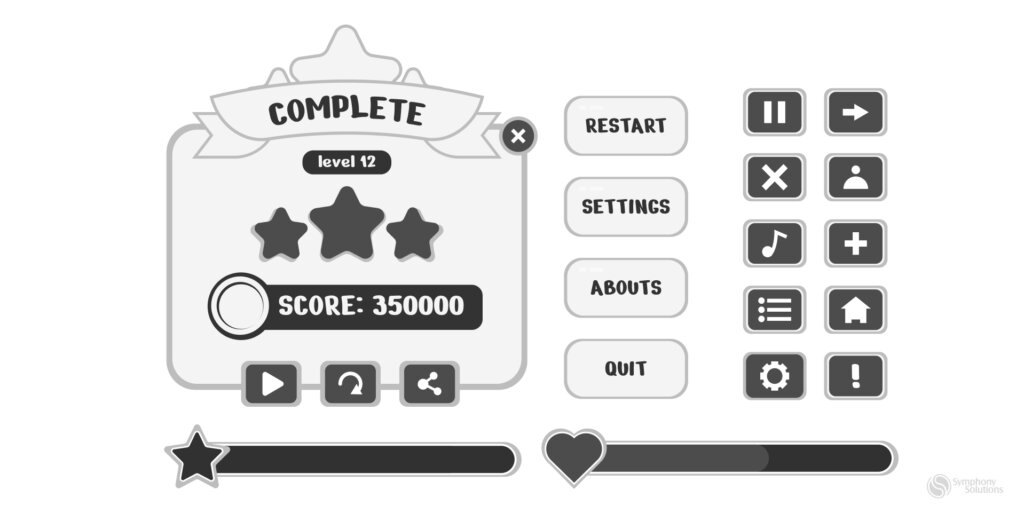
    common buttons types for mobile games

    5. Interaction design UI that reacts to the users’ actions makes for a great UX. This means that as the player is going through the game, any of their actions should trigger some response from the app, such as highlighted buttons or areas, animations, pop-ups, actions, etc. All clickable elements of the UI design should have a response every time a user interacts with them. Otherwise the user may think that the game freezes up or isn’t working. It’s the goal of the UX designer to ensure that the user receives feedback after acting. 

    buttons interactivity in apps

    6. Keep the users engaged. You want your mobile game UX design to keep the user engaged from the moment they start the app. Proper user onboarding, user guides and on-screen instructions, clear game UX design to help navigate the app are some of the examples of must-have functionalities in your game app. Furthermore, consider introducing content personalization for enhanced user experience that would allow your player not only engage but fully immerse themselves in the game, receive custom recommendations and have the game cater to their specific needs. This will not only improve user engagement but increase satisfaction and retention. 

    7. Be smart with pop-up windows. Pop-up windows are an integral part of any mobile game that shows the player his progress in the game, yet if you’re not careful with their design they can also be very annoying. Think about the dreaded ad pop-ups that you rush to close asap and do the opposite in your design. The pop-up windows should be consistent in their design with the rest of the game app. All functional elements, like buttons, should be well visible and easy to click. There shouldn’t be any hidden or obscure elements. A good idea is to make the background behind the pop-up a little darkened to indicate that the game is paused. Button placement on the pop-up window should be consistent and not confusing. E.g., if you place desirable options on the right and vice-versa, don’t switch it up to manipulate the player into clicking. Make the pop-up window part of the player experience and not a distraction. 

    pop-up example for mobile app

    8. User re-engaging. If you even played a game on your phone, you know well how there can be a dozen distractions throwing you out of the flow at any moment. Notifications, incoming calls, bad network connection – all this can distract the player from the game and make him close the app to take a call or check a message, etc. To avoid this you have to apply game design techniques. Make the app show the notifications or calls without making the player leave the game, e.g., show it as a small pop-up at the top of the screen without stopping the game – the player can choose to continue the game or take a call. Also, for whatever reason the player may leave the game, keep it running in the background so that they can come back to it some time later without losing the score. UX design is there to plan around such instances and make sure that the user can re-engage with the app no matter the distractions. 

    9. Playability. The UI and UX design jointly determine the playability of a game. Playability refers to the characteristics of the in-game experience that make it enjoyable and the game itself usable. The game’s ease of use, quality of sound, sound, game mechanisms and even strategy are all elements that determine playability. The better the player experience, the more playable the game is, and the more users will enjoy the game.

    accessibility example for mobile game

    10. Gather and incorporate user feedback. There are different kinds of feedback that you can collect and use to improve your mobile game app. First off, you can conduct user testing, visitor intent polls, user feedback and customer satisfaction polls. This way you ask your user directly what they think of the app, what they like or dislike, and what could be improved. This kind of feedback may be somewhat subjective but otherwise, you get direct input from your target audience and know exactly what they think. Other ways of collecting feedback is to use scrolling and click behavior heatmaps. Analyzing this data can be useful to see exactly how the player interacts with the app and where they focus most of their attention.  Collect in-game analytics to further analyze user behavior, see what parts of the game the users get stuck or come back to frequently, at what point in the user journey they lose interest and stop using the app, etc. You can go even further and apply customer and service design approaches into your research and analysis and see the overall customer experience with your brand and not just the app.

    Challenges in UI/UX for Gaming App 

    When it comes to gaming and sports betting apps, a UI/UX designer may face certain niche-specific challenges. If you are researching how to design a gambling game, here are some things to keep in mind: 

    • Visual vs Functional. When it comes to designing gaming and gambling apps, less is more. The bettor downloads the app with a specific purpose, so all the elements of design should facilitate them in that. The designer needs to find a balance between creating a visually pleasing product and catering to immediate user needs. 
    • Performance and battery life. A properly designed mobile game’s UX will help make the app performance better while saving battery life. An app that is overloaded with heavy animations and transitions, will take a toll on the user’s device. Functionality and practicality of the app should come first. A balanced and smooth design will enhance app performance and also reduce the number of errors. That was the case of Betwinner, when they encountered issues with performance during in-house prototyping and needed to have these friction points addressed. 
    • Keeping up to date with the latest technologies. The technologies nowadays are progressing and changing by the hour, therefore, the UX designer should be aware of all the latest technologies in gaming design and findings in the tech world. That way they will be able to deliver solutions that fully correspond with the client’s requirements. Also, make sure you keep an eye on business industry trends in iGaming.  
    • Hardware compatibility. Clients may not always know about what hardware the betting app should be compatible with. Likewise, they may have specific requests to cater to a certain market that may pose compatibility issues. As in the case with GOAT Interactive, the gambling app UX was designed to be compatible with low-end mobile devices and slower network connection in the region. 
    • Compliance with regulations and standards. When operating internationally, you have to account for differences in regulations country to country, as each jurisdiction may set their own standards, like the time when UK banned the use of credit cards for payments in gambling from April 2020. The International Association of Gaming Regulators (IAGR) works on unifying the efforts of gaming regulatory organizations around the world, bringing the best practices to the iGaming industry. 

    Summing up, proper UX design may be what sets your app apart from the competition and gives it a leg up in the saturated market. Although the visual component and functionality are important, proper UX is what ties them together to create an exceptional product and drive customer satisfaction. 

    Symphony Solutions experts have substantial experience in the iGaming industry, developing mobile designs for gaming and gambling applications. We offer sports betting and gaming software development services that are specifically tailored to the domain that thrives on innovation, high stakes, fast-paced solutions, and continuous delivery to meet user demand for new betting applications and experiences.  So whether you are looking to re-skin an existing game, be it slots, casino games, table games, skill games, social games, pari-mutuel games or online lottery games, or indeed to create something unique, do get in touch. 

    FAQs on Mobile Game Design in iGaming

  • eLearning App Development: Must-have Features and Technologies to Succeed

    eLearning App Development: Must-have Features and Technologies to Succeed

    The online education sector is expected to grow to $350 billion by 2025, and the overwhelming majority will be dedicated to mobile learning. This trend has fueled the demand for elearning app development. Whether through mobile or web apps, educational platforms and applications are rapidly gaining ground in the online market. This shift towards digital education was already well underway even before Covid rendered in-person learning troublesome. 

    eLearning platforms introduce a vast selection of educational and professional proficiency courses, available with certification and even credits from major universities. Such platforms as edX, Coursera, FutureLearn, are growing with each day and this has been the case for at least a decade.   

    Mobile elearning app development is even more relevant now that over 50% of all downloaded apps are used for learning. You want to be able to learn on the go, be it waiting in line at the dentist or a ten-minute learning session before bed. This applies to students and established professionals who want to acquire new skills and knowledge, get a certification, or change their career path. Businesses understand this and see eLearning as a great way to facilitate upskilling for their own employees and, moreover, offer it as a service, seeing how eLearning platforms have become a profitable business endeavor.  

    the state of mobile learning for 2021

    Mobile eLearning applications types and purposes 

    Mobile learning apps can be of all kinds and varieties depending on target demographic, purpose and characteristics, like academic apps for schools and universities, corporate and commercial apps. It’s important to note that many eLearning applications can be accessible both via web and on mobile, while some are developed for mobile users only. More often than not, if an application was originally web-based, later on it introduces a mobile version to accommodate and attract more potential students. Let’s look over some of the common types of platforms and applications for education to give you some eLearning app ideas: 

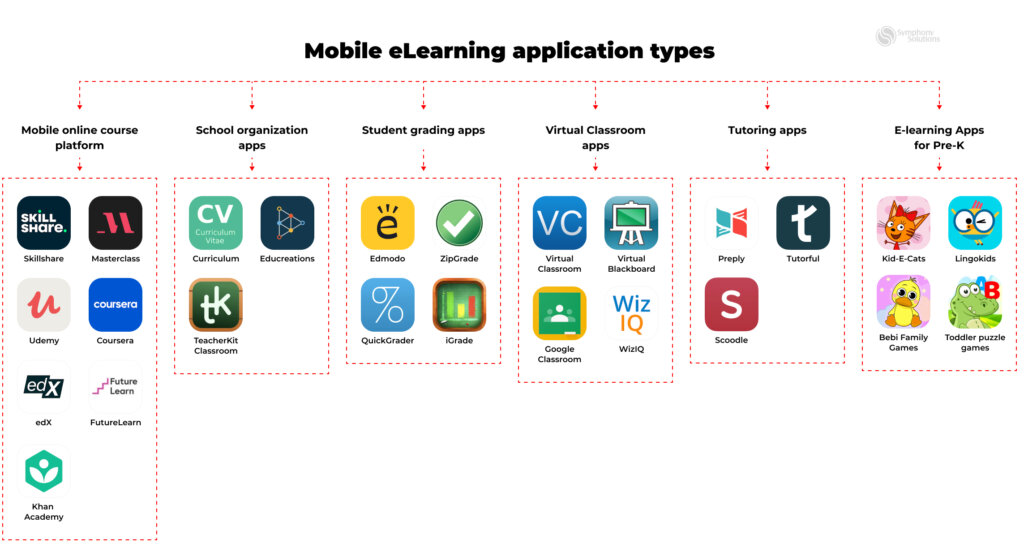
    • Mobile Online courses platform. This is a platform for online courses that operate largely as a marketplace, where accredited educators and educational institutions may offer their learning courses that include video lessons that are usually complemented with reading materials and assignments, and a discussion forum where the students can engage with one another and the course instructor. E.g., Skillshare, Masterclass, Udemy, Coursera, edX, FutureLearn, Khan Academy. Some platforms have presented courses from the leading universities, such as Stanford, Yale, MIT, Johns Hopkins University. However, these eLearning platforms are not strictly catering to the Ivy League and the like. There are courses provided by organizations and companies, as well as individuals who are professionals in their field and want to present a personal learning course on their area of expertise. Online courses platforms also often provide certification.  
    • Schooling apps. These are school organization apps or any apps to accommodate formal education. The apps offer solutions that help teachers with organization of the learning process like Curriculum, Educreations, Classflow. Then there are also student grading apps and performance assessment apps, e.g., Edmodo, ZipGrade, QuickGrader, iGrade. The latter ones focus on a specific feature, i.e. grading, and are tailored to suit the teacher’s needs in this regard. 
    • Virtual Classroom apps are the “thing” now with the Covid rendering impossible attending a physical classroom. These are apps that recreate the experience of in-person classroom learning, aiming at engaging students in the learning process and simulate the aspects of learning that are missing in a remote setting, e.g., live discussions, in-person interactions, the ability to ask the teacher a question on the spot. With the right tools, like online whiteboards, chat rooms and file sharing, the experience of a virtual classroom can be the same or enhanced compared to that of an in-person one. The examples of this might be Virtual Classroom, Virtual Blackboard, Google Classroom, WizIQ. 
    • Tutoring apps. Online tutoring platforms carry out the purpose to connect students and personal tutors and accommodate their further relationship: scheduling classes, payment, tracking attendance, assignments, etc. Some platforms require the tutor to show proof of qualifications like a diploma or a teaching license. E.g., Preply, Tutor House, Tutorful, Skooli, Lessonface. 
    • Language learning apps. Language learning is a very popular niche for commercial eLearning mobile apps that is relevant for all demographics. After all, who doesn’t have an ambition to learn a new language? It’s probably one of the most popular New year’s resolutions and something that everyone sets as a goal at least once in a lifetime. Some popular language learning apps are Duolingo, Lingualeo, Babbel, Lang-8, LingQ, Memrise, Busuu. 
    • E-learning Apps for Pre-K is a completely separate niche of mobile apps that focus mostly on creating an engaging and visually attractive game-like experience while introducing the child to basic concepts of math, reading and spelling, colors, etc. E.g., Kid-E-Cats, Toddler puzzle games, Bebi Family Games, Lingokids. 
    • Others. Then there are apps that were not exactly developed with the learning purposes in mind, but have since been adopted and frequently used by both learning institutions, businesses and individuals to deliver webinars, knowledge sharing, learning sessions, manage schoolwork, etc. These are:
    • video conferencing tools (e.g., Skype, Zoom, Circuit, Join.me)
    • task management apps (e.g., Todoist, Trello, Asana) 
    • time blocking and management (e.g., Brain Focus, Forest, FocusBooster). 
    mobile eLearning application types with examples

    Functionalities & Features for mobile learning platform to have 

    Although there are eLearning platforms that offer to host your online course or you, still many companies opt to develop their own learning applications. This way they have full control over what features and functionalities the app provides, set their own standards, scale it if needed, make it recognizable with branding, choose how to monetize it. This is even more so applicable to mobile learning apps as they are becoming a hot niche in the market with far going prospects in the future. 

    Let’s look over some of the must-have eLearning mobile app features that one should consider when creating their educational product: 

    Personal user account

    A personal user account makes it possible for the user to sign up for the app and have their own dashboard that opens access to many features like tracking progress, messaging, collecting badges. These can be user accounts of different types – student, teacher, admin, parent. A student account will have different features from that of a teacher or parent, depending on what the user aspires to accomplish when using the app. Teachers may need to create courses, add files to share with students, use screencasting features to conduct online classes, while students need to get access to the learning materials and submit completed schoolwork. A user account of a parent would be more limited in regards to features as they will most likely be interested in seeing progress stats and being able to message the teacher if needed. Either way, allowing the users to create personal accounts gives the developer an opportunity to add many new features, making it as simple or as complex as they want, ultimately creating a comprehensive interactive learning environment. 

    Course details

    Course details offer a general description of the course as well as additional information such as who is the lecturer, subtitles available, length, complexity level, certification. 

    Content management

    Content management is a must-have feature because eLearning apps are heavily loaded with content of all kinds and complexity. These may be video lessons, audio files, articles, PDF downloads, etc. The teachers may need to manage content while creating or updating their courses, and students need to upload and submit course work for assessment. Thus, it’s important to have proper functionality for file storage and sharing withing and outside the app for both teachers and students.  

    Lesson notes 

    Lesson notes help the student make highlights and take notes on the learning material while taking a course and later use them for revision. Adding that as a feature takes away the need to take physical notes on paper or use another application for the same reason. The student may find it more convenient to have all the learning materials, including their own notes, stored all in one place. 

    Text chat and forums 

    Text chat and discussion forums can be used for any type of app as an additional way to let the students and teachers interact and learn through discussing and further examining the topics presented in the course. 

    Interactive assessments

    Education quizzes and other interactive assessments are a quick way to allow the students to check if they have grasped the main points of a lecture or reading material. These can be checkpoints dispersed throughout a video or a general quiz at the end of a segment. 

    Personalization

    Personalization can be introduced for any type of application but it carries a lot of benefits for eLearning. Thus, a student can have a personalized dashboard and recommendations that would show him which further courses to take to continue learning, and what materials are relevant to their preferences. AI-driven personalization helps analyze student activity, notice patterns, and come up with suitable recommendations creating a unique and rewarding learning experience. 

    Social network elements

    Social network elements like sharing to social media, sending out invites to friends, and private messaging, can be a good addition to any app as it adds an element of socialization, resembling the experience of a regular offline course where you learn alongside other people. This helps boost motivation for those who prefer learning in groups, as well as creates engagement, helps understand what kind of courses and learning materials the students like and want to share. Likewise, if the students like your eLearning application, they will invite their friends and friends of friends to join, creating a snowball effect. 

    Chatbots

    Chatbots help the user learn how to navigate the application and resolve any occurring issues, whether a student needs a consultation regarding the curriculum or course enrollment, etc. 

    Analytics

    Analytics help track and analyze the attendance, performance, and engagement of the students. When developing and later maintaining the app, you want to know how the users are interacting with it, how often they use the app and engage with the materials. For the teacher, having stats and analytics of student performance and engagement helps with assessment. On the part of the student, they may want to keep track of their stats in cases when they account for some percentage of the final grade.

    Apps used for children’s formal education make such analytics available for parents who are interested in how their children are doing in school. 

    Offline access 

    Offline access to lessons and lesson notes allows users to have access to the app materials on the go and study or work when or where it’s most comfortable for them. Having this feature is an instant plus for your app. 

    Notifications

    Notifications are applicable for any type of app. These may be notifications of new courses added, upcoming deadlines, work submitted (for teachers), messages. Notifications can be automated or, for example, students may want to set a schedule and get reminders to check the app and do the tasks multiple times a week, on certain days or times of the day, which helps them be consistent in their studies. 

    Specific features for eLearning solutions 

    • Search and filters are useful features that help the student navigate the courses if there is a big selection to choose from. This is a must-have for learning platforms that store massive heaps of information of various complexity and fields of interest. For example, a student may need to sort courses by subject, for Intermediate level, and with English subtitles available. 
    • Video conferencing for lessons or training discussions for Virtual Classroom app and tutoring apps. This includes video encryption and optimizing video and audio to the users’ connection speed. This feature allows the teacher or tutor to hold online lessons with the class or individual students, very much like the offline experience of a classroom. 
    • Whiteboards and collaborative whiteboards are used in  Virtual Classroom apps for presenting the information, brainstorming, or working on a group assignment. 
    • Screen sharing is used during an online lesson in a Virtual Classroom platform. The teacher shares the screen to show a presentation or the assignment. Likewise, students can take turns in sharing their screens to show what they are working on. 
    • Breakout rooms for Virtual Classrooms allow the teacher to split the class into groups for a learning activity like a project or discussion. The students can work on the task in a smaller group, e.g., practicing speaking in a language class. The teacher has the option to join each breakout room to check on the students and see how they’re doing with the assignment. 
    • Hand raise button is a feature for Virtual Classroom apps. It helps students ask a question or share some information during an online class without interrupting, and take turns when answering a question or during a discussion. 
    • Ratings and reviews for courses app help the users pick the courses that suit their needs from a big selection of learning materials on the same subject. This feature can be useful for an app which allows teachers to sign up and create their own personal courses (e.g., Domestika, Udemy, Skillshare), or for tutoring apps so that students could rate their tutors. 
    • Gamification elements add an element of fun into the learning process. These can be awards and badges that help the students feel more accomplished and motivate them to do more work. It can be something playful as making the Duolingo owl proud for keeping an ongoing strike of using the app daily, or awards of accomplishments for reaching certain milestones or completing a course. Furthermore, the students may compete for the top score, do challenges. 
    gamification in elearning software
    • Scheduling functionality comes in handy for Virtual Classroom and tutoring apps where teachers and tutors need to set up certain times for their learning sessions with the class or individual students. For tutoring apps, this also allows the student to see the tutors availability and request a time for a lesson. 
    • Payment is a functionality relevant for all commercial educational apps as one of the ways to monetize your app. There can be different ways to incorporate this feature, e.g., freemium, subscription, pay for a course with limited or lifetime access. 

    Technologies for eLearning app development 

    When developing an eLearning mobile app, you want to choose your technology stack in accordance with the requirements.  

    • Programming languages that would be the best options for custom mobile eLearning app development are Kotlin (for Android native apps) and Swift (for iOS native apps). If at some point you need to adapt your mobile learning app for the web, consider using PHP or Python, as these are most commonly used for web eLearning systems. 
    • Architecture for your eLearning app may depend on your requirements. Microservices architecture is the preferable option as it allows to update or scale its elements not depending on or breaking the integrity of the entire application. 
    • Cloud storage and services offer a secure and efficient solution for eLearning application development as learning apps may require handling massive amounts of information and easily scaling when it’s needed. It’s the go-to solution with apparent benefits, such as pay-as-you go, scalability and security. As in case with choosing cloud for the eLearning solution our team developed for Mindmarket, the company is now able to deliver training content on major smartphone and web platforms worldwide.  

    The most widely used cloud computing vendors are AWS, Microsoft Azure, Google Cloud Platform. Cloud databases may be used for cloud architecture as CloudSQL database for  GCP that supports MySQL, PostgreSQL, and SQL Server. Then there are specific “purpose-built” databases that operate in the cloud and are designed to serve a certain business need. 

    • Video Processing tech stack is a must-have for any mLearning app. WebRTC or Streaming Media System are some examples of what can be used for video conferencing in the app. Transcoding services are what makes it possible to turn a video file into multiple size versions for learners to watch even on slow devices with poor internet connection. Live transcoding allows to do live streaming sessions. 
    • AR/VR may be used for gamification and creating unique opportunities for the learner where they engage with the learning material they develop the right skill set in a virtual environment.  
    • AI and Machine Learning – for chatbots, content personalization. AI-driven personalization creates a customized learning environment for the student.  
    • IoT and Wearables. Consider what devices are available to your potential students and how they can facilitate their learning. Smartphones, interactive displays and tablets, smart watches, VR headsets – these devices can be integrated with your eLearning system to create a comprehensive learning experience. With the help of IoT and wearable devices, you may shift beyond the limitations of a single mobile application and enhance the learning process. 

    The right tools may determine a lot of what you can realize and how time-consuming and costly the development will end up being. That being said, there’s a lot more to eLearning app development than that. In fact, you need to go through the entire process – choosing your niche and fleshing out the idea, conducting user research, design prototyping, MVP, development, testing, deployment, gathering and incorporating feedback, marketing, etc. 

    User research is a crucial step in this process as you want to know exactly that you are developing a product that will satisfy the needs of your target audience. That’s why content mapping for user profiles and objectives was one of the first steps when developing the eLearning app for Intuition. With so many features you can offer, this is no place for speculating – know exactly what you’re doing. Then, you’d want to have the MVP ready as soon as possible so that you could collect actual feedback and see how your vision and research match the actual picture. eLearning completely revolves around the student’s needs. Hearing from your users directly will give you the best idea of whether you are moving in the right direction. 

    When it comes to eLearning, students want engaging apps that provide the knowledge and experience, with the option to get proper certification – all the features rolled into one app. Once you have an app that your ideal of a student wants, there are many options to monetize it and ultimately make it a success. 

    Future Trends in eLearning App Development 

    The landscape of eLearning app development is continuously evolving, driven by technological advancements and changing educational needs. Predicting these emerging trends in eLearning app development is crucial for developers and educators alike. Let’s delve into the key trends that will shape the future of eLearning app development. 

    1. Integration of AI and Machine Learning 

    One of the most exciting developments in eLearning app development is the integration of AI and machine learning. These technologies are revolutionizing the way learners engage with educational content. AI can analyze user behavior and preferences in eLearning app development, providing personalized recommendations and content. Machine learning algorithms enhance adaptive learning, allowing apps to adjust content and difficulty levels based on individual progress. This level of personalization is a game-changer in eLearning app development, creating more effective and engaging learning experiences. 

    2. Immersive Learning with Virtual Reality (VR) and Augmented Reality (AR) 

    Incorporating VR and AR technologies into eLearning app development is set to redefine the learning experience. VR immerses learners in realistic environments, ideal for training simulations and hands-on experiences. AR, on the other hand, overlays digital information onto the real world, enhancing the learning process. These technologies add an exciting dimension to eLearning, making complex subjects more accessible and engaging. Developers exploring eLearning app development should consider the potential of VR and AR for creating immersive educational content. 

    3. IoT Integration for Enhanced Learning 

    The Internet of Things (IoT) is making its way into eLearning. Smart devices like wearables and interactive displays can track learner activities and provide real-time feedback. For example, wearable devices can monitor heart rate and stress levels, helping learners manage their well-being during study sessions. Interactive displays offer collaborative learning experiences. As eLearning app development evolves, integrating IoT technologies can enhance learner engagement and provide valuable insights into study habits. 

    4. Microlearning and Mobile-First Design 

    The trend of microlearning, which involves delivering short, focused lessons, is gaining traction in eLearning app development. These bite-sized lessons are designed for mobile devices, allowing learners to access content conveniently. Mobile-first design principles ensure that eLearning apps are optimized for smartphones and tablets, aligning with the on-the-go nature of modern learners. Embracing microlearning and mobile-first design is essential to meet the demands of today’s learners in eLearning app development. 

    5. Blockchain for Credential Verification 

    Blockchain technology is poised to revolutionize credential verification in eLearning app development. It offers a secure and transparent way to verify educational certificates, degrees, and badges. This technology ensures the authenticity of learners’ achievements, enhancing trust and recognition. Developers in eLearning app development should explore blockchain solutions to enhance credential verification processes within their platforms. 

    6. Gamification and Social Learning 

    Gamification elements, such as badges, leaderboards, and interactive challenges, motivate and engage learners. Social learning features, including discussion forums and collaborative projects, foster a sense of community. Incorporating gamification and social learning aspects into eLearning app development can increase learner participation and create a more dynamic and interactive learning environment. 

    7. Accessibility and Inclusivity in eLearning App Development 

    Accessibility and inclusivity are becoming central considerations in eLearning app development. Apps must cater to diverse learners, including those with disabilities. Ensuring that content is accessible to all learners improves inclusivity and widens the reach of eLearning platforms. Developers should prioritize accessibility standards to create a more inclusive eLearning experience. 

    8. Continuous Learning and Upskilling 

    The concept of lifelong learning and upskilling is gaining prominence, driven by rapidly evolving industries. eLearning apps are well-positioned to support professionals seeking ongoing education and skill development. Developers should focus on creating content and features that facilitate continuous learning and career advancement, meeting the demands of a changing job market. 

    9. Data-Driven Insights for eLearning App Development: 

    Enhanced data analytics will provide deeper insights into learner behavior and performance in eLearning app development. These insights enable data-driven improvements, leading to better instructional design and personalized learning pathways. Developers should invest in robust data analytics tools to gather actionable insights from user interactions, optimizing the eLearning experience. 

    Embracing these future trends in eLearning app development is essential for staying competitive in the ever-evolving world of online education. Leveraging AI, VR, IoT, and other emerging technologies, developers can create eLearning apps that meet the evolving needs of learners and educators. 

    Summing up 

    Creating your own eLearning app instead of using a ready-made solution or a subscription service is better because you can build something that suits your specific needs. If a company has established practices and processes (e.g. onboarding, etc.), you don’t have to make compromises and changes to adapt to an LMS that is available. Instead you get to create an app that does precisely what you need and corresponds exactly to your requirements. Furthermore, with your own mobile learning application you are not limited in what you can offer to your students. You can create a your own unique learning environment with a dedicated community of people striving for knowledge. 

    FAQ on eLearning App Development

  • Managing a Distributed Agile Team while Overcoming Challenges & Risks

    Managing a Distributed Agile Team while Overcoming Challenges & Risks

    As the current trends show, this is just the right time to get on board with remote work for your software development teams. If in the past, you would usually hear of distributed teams in terms of outsourcing, with the way the world is turning in the new Covid reality, working remotely is becoming part of the new normal and is likely here to stay. And with Agile becoming the preferred way of working in many companies both in IT and other industries, the next logical thing would be to implement its principles for setting up distributed Agile team management. 

    Agile and distributed teams incompatible? 

    So, what is a distributed Agile team anyway? From the sound of it, the phrase may just as well be an oxymoron. However, practice shows that even such things as Agile team management and distributed teams can be quite compatible, as long as you know what you are dealing with. 

    Agile derives a lot of its strengths from the principle of continuous interpersonal communication. The flow of information never stops within an Agile team. You want all team members to be aware of the project status, possible blockers and dependencies. Product Owner keeps stakeholders informed. Whatever goes south in a team, there is someone ready to pick it up and carry on with the tasks, by all means necessary, and with their eyes on the shared goal of continuous delivery, constant improvement and growth. 

    Agile is big on clear communication and teamwork. It’s what makes it possible for the team to quickly show results of their work, be it an MVP or a prototype. In some cases, like with MVP for SpoedTest Corona project, the client was able to see the first useable version of the project within just two and a half weeks since the start of the collaboration with our remote development team. Fast information exchange, mutual responsibility and commitment to a common cause – all this makes Agile development possible. 

    In this case scenario, one should think, is it then even possible to have an Agile team when the people are not always in close proximity to one another?  

    The answer is simple. Of course, it is possible and it’s happening all around the Agile world. Adopting Agile for traditional teams just as for distributed teams is feasible, as long as you set up your processes right, know what pitfalls to look out for, look at the example of companies that are already doing it successfully and adapt it to your company’s and project’s needs. Adjust for the specifics that come with being “distributed” and you’re good to go. 

    Benefits of Agile for distributed team management 

    Using Agile for distributed teams may be just the thing that sets them up for success. Implementing it is more than just ticking the right boxes off the list. It’s about adopting an Agile mindset that is the driving force in the company’s transformation eventually leading to business agility. 

    Agile puts an emphasis on self-sufficient and organized teams. Every team member takes responsibility for the project’s successful completion and delivery to the client instead of solely focusing on their personal tasks. This is one of the key factors for distributed agile success. 

    An Agile team is set to continuously improve and evolve. Each person looks at the bigger picture with one goal in mind – timely delivery of a working product. The trick is to remember that you are working in the context of distributed Agile delivery, but as practice shows, this is not only manageable but comes with its own perks and advantages. 

    How to organize distributed Agile development 

    Managing a remote team in most cases is not drastically different from working in co-located teams. It’s mostly about finding the balance, setting clear goals and deadlines, and accommodating an uninterrupted information flow between teams to manage dependencies. 

    Remote Agile team roles and responsibilities 

    The optimal team size in Agile is 3 to 9 people, which is equally applied for both distributed and non-distributed teams. The reason for this being that Agile heavily relies on constant information flow and communication and in big teams it tends to become complicated. 

    biggest struggle with work remotely

    Team roles in a remote team are no different than team roles in a traditional Agile team. 

    Although, it is recommended to put some thought into balancing out team composition across locations. Generally, it is not advised to divide the distributed teams by function but rather by feature. This means that you shouldn’t keep all developers in one place and testers somewhere completely different. This would make it more difficult to consolidate different lines of work. It’s good to have a team that is able to operate as an independent unit when the need should arise. 

    Also, different countries have their own regional differences in terms of public holidays, as well as unforeseeable situations when you may find an entire office from a certain location unable to work due to a natural disaster or political instabilities. 

    Tasks and backlog management 

    When working with both in-house and remote teams, the workload should be evenly distributed. Remember, that remote teams are not an appendix to the main office, but treat them as equals and show appreciation for their contribution to the project. 

    When it comes to distributed agile development, it’s important to ensure that there are no delays with co-dependent teams in delivering on their part. The team should be realistic about the user stories they commit to in terms of dependencies and on-time delivery. Because of this, it may be advisable to reconsider committing to complex user stories that may require a lot of input and contribution from remote team members. These complex stories may be broken down into smaller and more manageable sizes. 

    A self-manageable team should be able to continue working on tasks without major delays. The backlog should be created with this in mind. 

    Agile activities and events for distributed teams 

    In order to accommodate the work of a remote team, extra effort goes into organizing the Agile workflow and introducing tools to facilitate communication, planning and collaboration. Properly organized, these ceremonies work great for managing workload with distributed teams. 

    Daily stand-ups are just a routine for co-located teams but become a crucial point of contact when you are working remotely. This is the time when team members report on their tasks in progress and communicate issues or blockers. To make the best of this time, you can also talk about other tasks that you have planned for the sprint or in your backlog. Team members should be asked some “burning” questions: 

    • Do you need input? Who can assist you with that? 
    • Do you have any blockers? Are you blocking someone else’s work? 
    • Will you be able to pick up these tasks once done with the current work? 

    Keep in mind that if you need someone else’s contribution to continue working on your tasks, the person might not be immediately available, so address these moments beforehand. 

    To accommodate Agile ceremonies, remote teams may use video conferencing software and screen sharing. Of course, it helps to have an uninterrupted internet connection and good quality sound equipment.  

    This works just as well for daily meetings, as for weekly sprint reviews and even retrospective meetings, with the difference being in the scope of work that you are looking back at. It may require some time to set up virtual tools, whiteboards and breakout rooms, etc. But in the long run, teams often opt to switch to using these tools for all their work and planning even if they’re co-located. It is more convenient and you don’t end up doing double the work, like when you do your planning on a wall with sticky notes only then to transfer it into a spreadsheet. 

    An interesting fact is that some companies have even successfully conducted full-on PI plannings for distributed teams with remarkable results. This doesn’t go to say that in-person events are redundant. Socialization is usually a big part of PI planning as it helps establish good relations within the team and for distributed teams that are brought to the location specifically for the event. But if meeting in-person is not an option, it is possible to get it done with a virtual agile team without too many losses. 

    Agile events and activities and goals

    Tools and practices for distributed Agile development 

    File-sharing 
    Coming back to the daily grind, distributed teams benefit from setting up a file-sharing network. Multiple people should be able to access and work on the files if necessary, so it makes all the sense to use a cloud-based storage service. 

    Tools to check out: 

    • MS SharePoint 
    • Google Drive 
    • Dropbox 

    Communication 
    For communicating throughout the day, teams can use instant messengers. This can be either person-to-person or group chats, conference calls, etc. With some tools like MS Teams, you can schedule calls in advance and even see the other person’s available time slots. 

    Tools to check out: 

    • Slack 
    • Skype 
    • MS Teams 

    Task management 
    Agile teams regularly use services to track tasks in a sprint and manage the workload on a weekly or bi-weekly basis depending on how long is the sprint. 

    Tools to check out: 

    • Jira 
    • Trello 
    • Asana 

    Team workspace 
    The team can create something like a wiki to be the single source of information and all updates on the project. Code documentation, although not a priority according to the Agile manifesto, for distributed teams may replace the need for in-person communication or calls and meetings to discuss the code. Another important purpose of a shared team workspace would be source code management and version control. 

    Tools to check out: 

    • Confluence 
    • GitHub 
    • AWS CodeCommit 
    • Agile Bench 
    • Agile Manager 

    Brainstorming Ideas  
    The tools for idea brainstorming and collaboration are a must for any distributed team. They serve as a whiteboard where anyone can add ideas, map different items, comment, and offer many more features that make remote collaboration more effective. There are a bunch of tools that can serve this purpose: 

    • MURAL 
    • Miro 
    • GroupMap 
    • Google Docs 

    A good practice is to use a combination of tools that best suits your project’s purposes and the teams’ needs. This way you can greatly improve your output and the quality of work. For instance, having proper documentation and governance for QA and software development process in place allowed VirtualStock team to deliver new product release every two weeks

    Tools for distributed Agile team management

    Distributed vs Traditional team management: Challenges and risks 

    Working with distributed teams may pose some challenges and risks compared to traditional teams, which should be addressed to help remote team members ease into the work process and avoid unnecessary clashes due to inherent differences. 

    Communication gaps come as the most commonly occurring issue for remote teams. When not working in-person, it takes effort to organize efficient communication. You’ll have to schedule a call instead of just walking by your coworker’s desk. You may get delayed replies to your emails or messages. Worst case scenario, you’ll have a time-sensitive task or an urgent question and won’t be able to contact your colleague on the spot. The more people are involved in communication, the more complicated it becomes. Efficient communication for remote teams requires diligence and time management, collaboration and at times compromises. 

    Cultural differences is another challenge that may seem unlikely but good to account for when managing distributed teams. This may manifest itself in how people with different cultural backgrounds approach their tasks if they have respect for deadlines, subordination and formal or informal communication. There are nuances in different situations and it’s important to respect other cultures. However, the best practice would be to find a common ground that could be expressed in the company culture shared across locations. 

    Time zones come as a big challenge for the effective organization of team communication. A difference in time may mean that your team member from the other end of the world may be getting valuable input from you on the project when they are already done for the day, while you are just up and about to start the day. If any urgent issues occur, it may be hard to get a hold of people at short notice, unlike with traditional teams when you can walk right up to your coworker’s desk. 

    This can be helped by excessive planning around different time zones and finding time slots with overlapping working hours that are suitable for everyone involved. Consistency with schedules, timely communication ahead of the deadline, making sure that there is a time bumper for unforeseeable situations, clearly communicating your needs may be helpful as well. 

    Tips for distributed Agile team management 

    We have mentioned and suggested possible solutions for all the big-picture issues that may come in the way of the efficient work of your team. Here are a few more quick tips that you might find helpful for managing your distributed Agile teams: 

    • Build a team that works well together. Your team should bring together people who show a high level of professionalism, who are motivated and committed to the common goal, etc. 
    • Build trust and transparency. This can be obtained with proper reporting and efficient information flows. 
    • Make communication as easy as possible. This means efficient time management and scheduling, finding the right tools and encouraging your team to use them. 
    • Co-locate development teams with their Product Owner. As mentioned above, teams work best if they are able to be self-sufficient and function without any restraints or major dependencies. A Product Owner can play a big role in achieving this for your remote development team. 
    • Get training from an Agile coach not when you’re in the bottleneck, but on the start. Training for all teams helps to understand for every member Agile practices better, his/her role within Agile process and act better as a team then. Also, the neutral view and recommendations from a third-party expert can reveal for you many insights and points to improve your team efficiency. As it was in the case when our Agile experts conducted training for Casumo’s team that helped them achieve more efficient collaboration.  
    • Organize offline activities and events. If possible, find the time to bring your team together. Let them mingle and build a relationship. 
    • Minimize delays and wait times. At daily stand-ups address not only your work for the day but issues that may hinder your work tomorrow and further down the week. Be aware of possible dependencies and blockers. 

    Summary 

    Although designed originally for close in-person cooperation, Agile gives distributed teams the means to manage their workflow and address all the shortcoming of working remotely. Distributed development best practices correlate with many Agile principles and when equipped with the right tools, remote Agile teams are empowered to accelerate development and put out top-quality software on the market as fast as co-located teams with a bonus of smart budgeting and saved costs from engaging teams from other countries. 

    So don’t hesitate to step into Agile, as its benefits are obvious. Even in case, you feel struggling with implementing it, check our Agile consulting services that help to implement Agile in your team and organization considering the specifics of your project and industry. 

  • Cybersecurity in iGaming: Webinar Overview

    Cybersecurity in iGaming: Webinar Overview

    In iGaming cybersecurity matters not just from the compliance perspective but challenges also include fraudulent activities, data leaks and general hinderances to long-term innovation  

    Symphony Solutions, as a company that offers iGaming software development services, partnered with UnderDefense, a leading US cybersecurity firm, to address real Cybersecurity challenges the Technology industry faces today. The discussion was led by Eduardo dos Remedios, VP of iGaming at Symphony Solutions and a true industry’s veteran, Nazar Tymoshyk, a founder of UnderDefense and an ethical hacker with over 20 years of experience, and Giannella Borg, Information Security Team Lead at Catena Media.  

    The webinar focused on cybersecurity challenges in iGaming and two main topics on the agenda were: 

    • Cyberattacks and security in iGaming  
    • How developing products secure by design can mitigate the risks  

    The relationship between IT and cybersecurity 

    Very often in iGaming business whether it’s new or well-established, IT and product development are key drivers for business success. However, it is quite frequently a case in this domain, that at the initial stages, cybersecurity tends to be undervalued. Which is a fatal mistake, because sooner or later security may create a dramatic situation for a business. The right way of approaching things is actually factoring in the security from the beginning. iGaming is a huge and tempting domain for hackers, as fines and compliance are critical here. One day of business interruption for major iGaming operators may cost $ 42-50 million on average, not to mention a reputation loss. And none of these things are to be trifled with. 

    Much like the industry itself, the IT vs cybersecurity relationship is a team sport. Here you have various roles like defenders, attackers, and the builders from the security side. And as in any team, to be successful, you obviously have to collaborate in order to get things done.  

    Essentially, from the security side you need to have a good communicator, the Jack-of-all-trades, that can collaborate well with other groups and other organizations. Because often there is an incorrect perception between CIO and product development team that security just has to make sure that the product releases secure. That’s why they heavily rely on just pentesting. But security often depends on the rest optimization and there should be someone who’s in control of it.  

    A case when one compromised user account in Azure Cloud created a situation when the attackers were able to take down the whole customer infrastructure in the Cloud is sadly quite common.  As iGaming providers believe that if they shift everything to the Cloud it will be a solution to every and each of their problems.  

    The important thing about the Cloud is having the right skills and the right team to be able to operate in the Cloud. But before actually doing that, you have to look back and ask yourself whether your business meant be on the Cloud and whether the business model is made for the Cloud. The next step would be skilling up your team to be able to support the Cloud. Because being on the Cloud just for the sake of it is a just about the brand waste of time and money.  

    Cyber resilience and where to start  

    • Cyber resilience is not a one-time thing  
    • Achieve the right balance between the people, processes, and technology 
    • Tools often do not solve real issues, people who know and use tools effectively – make an impact 

    Building cyber resilience is a process. It’s not something you can do and be done with it. It’s achieved slowly over time. And even if a business is in a comfortable position, it has to continue working towards it. Resilience improves over time. But it’s not just about the technologies, you also need people behind it who will run the tools, extract the information. And then using that well-informed skillset of people, you can create processes to continue the good work that you’ve done. It’s a long-term work. But it’s essentially about achieving the right balance between those three components – people, processes, and technology.   

    Building their cyber resilience program 

    secure product development process
    • Create a mindset. To really embrace it and make sure that security is embedded into the product design and software development lifecycle, it has to be a mindset. You need to be thinking about that as a company and you need to educate the people that you already have. And during this process you may identify that you are actually missing some key roles. Make sure that it is here in your head, cybersecurity is something that you need to be thinking of all of the time.  
    • Pentesting. In iGaming penetration testing is a part of a regular IT process. But many companies treat it just like a tick of the box. In reality, it’s only a one-time idea of what your products look like. The important thing is to do it more frequently, as a part of a holistic application assessment process. It might identify some gaps in the way you do things but ultimately, it’s just a snapshot of what is happening. It should be a part of an information security strategy. But you shouldn’t depend on it completely. 
    • Think like a hacker. The problem is that developers are very often just engineers who are told what to do and what functionality has to be achieved. Getting products secure by design means that there should be someone who will think from the very beginning of the ways the product might be misused, and consequently, how the customers must be protected. There should be someone who will set these security requirements and educate the developers to build secured products.  

    With the development of the DevOps culture and with DevSecOps, it is much easier because now security has a place at the table and it is shifting from the reactive to a proactive approach.  

    secure SDLC & DevOps

    Getting started  

    A word of advice: 

    • Analyse current practices; 
    • Define your maturity level; 
    • Ask yourself, where you are with security awareness training 

    The later you are in your production cycle, the harder it I for you to fix any architectural issues.  

    cost of remediation of issues during release

    Make sure your attention is focused sooner rather than later. If something is already live, in production, and you have an incident there, the cost of remedying that can be vastly higher than the cost associated with remedying it at the beginning, when you are creating the requirements for your software.  

    Key takeaways 

    New paradigm of 2021 when we witness numerous businesses getting hacked, shows that the main difference between successful and unsuccessful companies is how ready they are to deal with the incident. This can be achieved through regular practices and simulations of attacks. As well as constantly learning.  

    When the breach does happen, how we communicate from the marketing and legal perspectives to all our consumers is essential. Cyber resilience is about building the readiness, preparing for the worst-case scenarios. And good companies think ahead about such issues, hiring security professionals to drive this process, to share their thoughts with the board and realize the risks.  

    To be as proactive as you can be and to seek input from people. Get specials that know more about security than you do. Ensure that you are as secure as you can be. Because at the end of the day you have a responsibility before your customers. And that’s the key thing.  

    Summing up

    • Every company can be hacked. The difference is in the way how they are prepared and how they react to an incident.  
    • Building products secure by design – is way more cost-efficient and we recommend to apply SDLC and DevSecOps best practices to your product  
    • To get the most of it, work with specialised companies 
    • Monitoring and understanding your assets and users is critical. Small anomalies also matter and if you don’t watch your infrastructure, this blindness will be costly 
    • Make cybersecurity as part of your Dev and IT/Sec team mindset. It makes far more sense to be proactive 

    Make security your priority and take the right steps to protect yourself from security breaches and hack attacks. Symphony Solutions provides Pentesting and Secure SDLC as part of the Application Security Assessment and DevOps services

  • Custom LMS Development: Why to Invest and Key Features to Have

    Custom LMS Development: Why to Invest and Key Features to Have

    With online learning becoming more relevant than ever, many companies jump on the opportunity to introduce a new way of upskilling their employees while maintaining the remote mode of work. You may say that alright, you know all about it. After all, everyone is using Zoom for everything right now. However, this goes beyond Zoom which can’t realistically provide the proper functionality to create a full-fledged learning environment and give the students or employees the experience of in-person learning. What you really need is a learning management system, or LMS for short.

    Learning management systems aren’t a completely new concept, they have been around for a while as facilitation for online learning. As eLearning has been gaining in popularity over the decade, they are being used alongside regular classes in educational institutions or for in-company training. Moreover, using these specialized systems has long been common in the niche for self-education and life-long learning. The tendency is going to continue as the share of eLearning grows by 10% annually and is expected to reach over $25bln by 2025.

    eLearning industry growth statistіcs 2020-2025

    Benefits of having an LMS for your business

    LMS creates a multifaceted learning environment that facilitates the employees in their journey from providing the learning materials to testing and evaluation of retained knowledge. A system as such can be used for a multitude of purposes in an organization: employee onboarding, personnel or customer training, compliance and security awareness training, reskilling, certification training. 

    It’s an interactive online portal that recreates the learning experience with many additional perks, like 24/7 availability and the possibility to learn on the go. Moreover, an LMS may provide advanced features and functionality to enhance the learning process and help develop new skills and retain knowledge. A properly developed LMS system allows providing the learning experience akin to that of a classroom at a fraction of the cost. 

    So, the main benefits of using an LMS for your organization would be as follows: 

    • Time-efficiency that benefits both the employees and the company. 
    • It saves the company costs in the long run. 
    • The system is easy to update and scale
    • Improves team performance and increases knowledge retention. 
    • Learning is targeted and therefore more efficient, meaning that your team gets the skills that they actually need. 
    • May be used both internally or offered as a service. As in case of our client, Intuition, creating an LMS helped them grow client base and increase revenue.

    Must-have custom LMS features 

    When developing a custom LMS, some features will be common for all systems, as there are many functionalities that are considered a must-have, so they will surely be of use for different business verticals when delivering training and courses. Let’s look at some of the must-have features that a developer should consider when creating a learning management system. 

    Cross-platform accessibility 

    Cross-platform accessibility allows for users to access the LMS on any device, no matter the software platform or operating system. For example, this means that the mobile version of the learning app should be available for both Android and iOS. If the LMS is web-based, you want it to be compatible with most browsers, like Chrome, Opera, Safari, etc. 

    Intuitive UI

    Intuitive UI is a must-have as it helps the user to quickly get familiar with the functionality of the learning management system. You want the user to actually learn rather than try to figure out how to access the learning material or take a test. A UI should be simple, visual and intuitive. 

    That means building a system that is easy to download on any operating system, as well as supports a stress-free startup process. In fact, if possible, users should be able to log in with one tap, whether with a one-time password (OTP) or a biometric verification system for advanced security.  Moreover, the system should be reliable and glitch-free once users are logged in. 

    Admin dashboard

    Admin dashboard that provides automation of basic functions where possible so that admins don’t have to spend time on mundane tasks like enrolling users into a course, making reports, any bulk actions, etc. 

    Real-time insights into such areas ensure that employees truly benefit from the learning programs in place. For instance, an admin can access a user’s panel once they notice an irregular pattern in their normal learning behavior. This could help a business know whether it needs to enhance its experience so that users can resume their normal learning patterns, or even perform better.

    Personalized learning roadmap

    Personalized learning roadmap to track the learning process, obtained certifications, skill level. This should be individual for each student. With the help of AI technologies you can go far with personalizing the learning experience. 

    Course content and catalogue management

    Course content and catalogue management. Create a marketplace where the users can browse the available courses, filter to their preferences, and choose what courses they want to enroll to. Likewise, the mentor should be able to add and edit courses, manage the materials, have access to the work submitted by users for review, etc. 

    Compliance with standards and specifications

    Compliance with standards and specifications. These are technical standards and specifications for eLearning software (e.g., SCORM,  AICC, WCAG, xAPI (Tin-Can), IMS). They allow creating learning content that is compliant with different eLearning software products. You’ll need to comply with these, if you want to introduce outsourced learning materials into your LMS, or decide to monetize your LMS by offering your courses to other companies. 

    Other standards and specifications that a custom LMS solution should comply with include: 

    • General Data Protection Regulation in the EU 
    • Section 508 of the Rehabilitation Act of 1973 in the US 
    • Web Content Accessibility Guidelines (WCAG) 
    • The Americans with Disabilities Act (ADA) 

    Licensing and certifications

    Licensing and certifications. Certification management feature in an LMS allows the users to get proper accreditation for their accomplishments. If you ever consider providing your LMS to other companies, this feature can become a strong selling point. 

    Gamification

    Gamification – point system, badges and prices, levels to make the learning experience more game-like and stimulating. As an element of gamification, the learner could track their progress and celebrate achievements on the way. 

    gamification in elearning software

    Accessible for mobile devices.

    Accessible for mobile devices. Mobile learning is the talk of the town with people often having to learn on the go and always having the learning materials at hand. As you sneak out minutes out of your busy work day to study, you’ll want to have the learning platform as easily accessible as possible. 

    Take custom LMS 365 as an example, which allows users to deploy it in the cloud or on-premise via mobile apps for both iOS and android platforms. 

    Moreover, it will help if you introduce offline capabilities to enhance the experience of the learners even if they don’t have access to a reliable internet connection. LMS 365 users can simply log into the system and browse an extensive catalog of readily available offline learning materials. 

    Microlearning

    Microlearning is another idea that can be implemented in a LMS for quick learning at the point of need but it may not necessarily be regarded as a must-have. 

    Analytics and reporting

    Analytics and reporting, tracking metrics and learner activity, how it impacts the organization.

    Socializing and group activities

    Socializing and group activities. This can be both formal and informal, discussion forums, mentorship programs, tools for collaborations on the platform. Another way to make the learning experience more social would be to integrate social media apps into the platform, like, for example, allow users to share their achievements and badges on their social media accounts. Instant messaging, chats, and calls are another way to make the platform more interactive. These can be used both as an element of learning and for interpersonal communication for users and mentors. 

    Branding

    Branding. You can create a unique platform with distinct branding, something that makes you recognizable and lets you stand out. 

    Globalization

    Globalization. With an LMS you can learn from anywhere and at any time. To make it even more accessible and expand globally, consider adding language localization, global payment gateways for e-commerce, etc. 

    languages studing app interface

    Third-party integration

    Third-party integration may enhance the overall learning experience of the user. Consider creating a platform that can be integrated with other plugins, tools, or platforms (e.g., videoconference tools, SSO, API and plugins, CRM, e-commerce, calendar integration, etc.). 

    LMS software development process 

    Now that you know what enterprise LMS stands for and why you need one, you can proceed with designing and developing a learning management system for your company or organization. Generally, the process doesn’t drastically differ from that of any other software development. The LMS development comprises the following steps: 

    • Market research is a step that cannot be overlooked if you want to create something that will be relevant to the current eLearning industry. You don’t want to reinvent the wheel or use methodologies and tools that have become obsolete. That’s why market research is important to discover what products and tools are available and what you can use to your benefit. There may already be easier ways and better solutions that you can apply to your product. Or research what is presented on the market to get even better ideas, deliver more efficient product and become the innovator in the eLearning niche. Then again, if you ever decide to roll out your LMS as a product or service that you offer to customers, you want it to be competitive. That’s why market research is so essential.  
    • Assessment and estimation is a necessary preparation step before you start building anything. As an LMS can become a complex and scalable project, there are many aspects of it to account for, going beyond budget and deadlines. Proper assessment and estimation is a must. 
    • Requirements gathering comes as the next essential stage for any project. It determines what next steps you’ll have to take in the development process. As you’ll be investing time and money in learning management system development, you also need to account for your budget and deadlines. Fleshing out the idea and gathering all the requirements helps with planning and setting milestones for the development team. Later on the requirements can be adjusted, but this first step is still important and can’t be skipped. 
    • Choosing a tech stack based on requirements comes as the next step in the development process. Tech stack consists of front-end, back-end parts and additional technologies you might consider to integrate into your eLearning platform. Many technicalities need to be considered here, as you’ll be working with data storages, large amounts of data, and sensitive information. 

    Front-end. The popular options for web development in the eLearning industry are web  frameworks, such as AngularJS, ReactJS, Laravel. 

    Back-end. Speaking about the backend of your LMS platform, the best-choice solution is  cloud architecture, namely serverless, as it offers a vast range of benefits: pay-as-you-go,  easier maintainability and scalability, security at scale. It’s a proven versatile solution with  decreased TTM and improved latency and geolocation. The most popular public cloud  provider that you can choose from are Amazon Web Services (AWS), Google Cloud,  Microsoft Azure and others, that may suit the main part of requirements for eLearning  software development on cloud. 
    But in case that databases of cloud providers don’t suit your requirements, then you can  choose a dedicated database instance. When choosing it, it is very important to consider the  type and volume of data stored and other mandatory requirements for the system, such as  performance, security, the cost of storage, etc. There are relational, hierarchical, network,  object-oriented, graph, ER model, document and key-value databases. The choice, as you  can see, is not as simple as it seems at first glance. 

    Additional technologies. As your LMS evolves, you might want to introduce more complex  features: 
    – AR/VR integration introduced into your app can be the gamification element in eLearning to make the studying experience much more engaging.  
    – AI personalization and ML algorithms collect and use data to improve the eLearning experience of the user and create a custom learning environment. 

    All these require custom front-end and back-end infrastructure development for sure, but rewards with cutting-edge user experience. 

    • Prototyping and wireframing. Next, when you’re done with choosing the tech stack and have all the requirements prepared for your eLearning platform development, it’s time to proceed with prototyping and wireframing. LMS platforms may be content heavy and provide many different functionalities which inevitably renders them complex. Wireframing helps create the screen blueprint, which means structuring and laying out all the content and functionality. And a prototype is essentially an advanced wireframe which is visual and interactive. 

    Still in the initial stages of the SDLC, after the prototyping is done, you will want to create an MVP which is the very first usable example of software that you will get in the course of your project. A minimum viable product, or MVP,  has some minimum set of features that makes it something that can already be used and tested by the actual user, for whom the LMS is intended. It can show you if your idea is foolproof and if you are ready to move onto UI and full development. 

    • UI/UX is immensely important when it comes to how to create an LMS website or app that’s engaging and interactive. The learning experience that you provide should capture the interest of the users and have them coming back for more. The LMS platform should be easy enough to use and provide the kind of experience that is both educational and entertaining. This is why gamification and socializing are now often considered must-have features for LMS. 
    • Development is when you do all the coding and create all parts of the LMS. The development team meticulously goes through the list of features that you want your platform to have and does all the programming. 
    • Testing is another important part of the SDLC. As you are working on development, adding new features and functionality, you need to make sure that it’s working in accordance to requirements. You want your product to be bug free and do what it’s supposed to be doing. Apart from that, you also need to test all the content and visuals, compliances, compatibility. Then, whenever you make a change or add something new, you need to run regression testing to see that you haven’t broken anything. So make sure to implement QA practices and expect it to be an integral part of your process right up until the launch of the LMS. 
    • Deployment is making your software system or application available to the user. When it’s running mostly bug-free and has all the necessary functionality to provide the proper experience to the user. After you have launched your product, deployment can happen as often as every two weeks, when you roll out new features, bug-fixes, or improvements. 
    • Maintenance and updates follow the project for as long as its viable and marketable. This is not just about fixing whatever gets broken. As the time passes, there will be new advancements in technologies that you may want to implement for your LMS. It’s not likely that a product like an LMS can be done and over with, which stems from the specifics of the eLearning industry. Also, at some point, you may want to scale the project and so it will need adjustments and revamping. In this regard, you may want to opt for managed services for your product where your development service provider carries on maintaining your LMS for as long as you need it.  

    As an LMS is developed in an Agile SDLC, this tends to be an iterative process and loops on the development-testing-deployment steps whenever a new functionality or feature is introduced. This allows the development team to make sure that the system works in its entirety and provides the proper functionality to the admin and users. 

    custom learning management software development process

    Implementing Agile practices when developing an LMS, such as continuous improvement of the product and frequent releases, is crucial to the integrity of the eLearning system as it cannot be built start-to-finish in one go. That would go against what learning stands for in its essence. An LMS evolves with time and needs to keep up with the outside world, reflecting its changes and new findings. Otherwise, it would become obsolete in a couple of months if not weeks. As the world is overloaded with information and knowledge is the force that drives progress, if anything, a product that serves to provide this knowledge should always strive to remain relevant and provide proper information and resources. 

    The cost of building an LMS 

    The budget you may require to build a custom LMS varies depending on the scope of features that you want to have, what tools you choose, are you intending to scale it up in the future, etc. Generally, when discussing costs of development, you need to ask yourself a few questions. 

    • Is it going to be local or cloud? 
    • What is the expected load on the system? 
    • What is the scope of work? 
    • Will you need to scale up in the foreseeable future? 
    • Will it require continuous maintenance? 

    Depending on these aspects and more, the cost of building a custom learning management system may start at $5000 for an MVP and go as high as $50,000. Then you may also need to pay extra for any additional features that you want to add later on, and of course there’s the fee for maintenance and continuous support. 

    With online learning trending it has all the potential to become an integral part of our life. Symphony Solutions is specializing in custom software development and has experience in building eLearning platforms for our clients. 

    FAQ on custom LMS development

    Custom LMS Benefits Vs. SaaS LMS 

    Custom LMS SaaS LMS 
    High investment cost but with a better ROI Relatively affordable 
    Easy accessibility Can be accessed from any device 
    Scalable, depending on business needs Infinite scalability 
    Integration with third-party systems Integration with third-party systems 
    Better security by the in-house development team Greater flexibility in the cloud 
    Takes time but is worth it in the long haul Easy to get started with 
    Automated maintenance Contract-based maintenance and updates  
    Own LMS as a product Own LMS as a service 
  • What’s in a Skill: Periodic Table [Matrix] of Scrum Master Competencies

    What’s in a Skill: Periodic Table [Matrix] of Scrum Master Competencies

    Going through my personal Agile journey as a Scrum Master led me to some conclusions that this role (accountability according to the new Scrum Guide) is a combination of soft and technical skills. Some of them you can learn and develop from the courses and books, and some are very hard to acquire and it might take ages to master them. I would like to share my findings in the form of a Periodical Table. Similarly to Mendeleev, it came to me in my night dreams and those competencies started popping up and taking their respective places.  

    A competency or a skill is a very far-reaching concept. Does It mean technical or soft skills? Is it something inherent or can it be developed over time and with effort? And what about personality traits? Where do they fall in the equation? 

    When it comes to Scrum Master competencies, you can distinguish them by placing the skills and traits into three categories, i.e. Behavioral, Contextual, Technical. A good set of well-developed competencies will have the Scrum Master right in place in a team. Depending on specifics of your company or team, your list of SM skills and competencies may vary and you may have a different focus for your particular needs. However, a rule of thumb would be to strive to be a well-rounded personality with a good grasp on each of the categories. Find your balance and figure out what works for you and your team. 

    You can see a general overview of the core competencies for a Scrum Master in the “periodic table” of Scrum Master Competence Elements. 

    scrum master skills & competency matrix

    Let’s take a closer look at the elements that make up the Scrum Master competency matrix and what they constitute, which ones you may be lacking and what you can do to further develop your skills to become successful in your role as a Scrum Master. 

    Behavioural 

    Any Scrum Master’s job largely revolves around communication and resolving issues that come up in the working process. In this regard, it helps to have a strong set of personal traits and values that help the Scrum Master become the beacon of reason in the team. The trusty leader that looks out for the team’s best interest. Someone who is trusted and can be relied on. Behavioural competencies mostly result from your personality – a combination of nature and nurture. However, you can strengthen these skills with self-reflection and personal development. 

    1. Leadership skills are a requirement that comes with Scrum Master responsibilities. Although they are not in the position of a project manager, the team still strongly depends on efficient leadership from the Scrum Master in following the Agile practices and managing workload or any conflicting situations that may arise no matter the nature. 
    2. Trust building. Since the Scrum Master acts as a mediator between the team, the Product Owner, and the stakeholders, it’s important for him to be able to build and maintain trust. This will build up to other skills required to manage a Scrum team. Essentially, any efficient communication and collaboration should start with trust. 
    3. Motivation is good to have when you want to get your work done. Even more so, if you want to get other people to do their work. 
    4. Assertiveness constitutes how you express your confidence remaining respectful, yet not being a pushover. This is an important trait in a professional setting, especially for navigating stressful situations. 
    5. Openness is an essential trait for a good leader. It means that you acknowledge different opinions and experiences and don’t restrict yourself to only what you know to be fact. It is crucial when it comes to introducing change and innovation. 
    6. Creativity is a tricky skill to have. Is it innate or something that you can learn? Hone your creative mind, use it for problem-solving and to inspire others. 
    7. Efficiency is valued in any team member. A Scrum Master that knows how to accomplish their tasks efficiently, will know how to require the same from their team. 
    8. Growth mindset in an Agile setting is the force that drives positive change and helps take any difficulty as an opportunity to learn. This is what a Scrum Master would want to transmit to their team by their own example. 
    9. Ethics in business appropriate the practices and behaviors to confront any possibly controversial subjects. Scrum Master exhibiting strong business ethics sets the standard for the whole team. 
    10. Values make up a person. Having strong personal values helps you earn people’s trust and respect and become a good leader for the team. 
    11. Body language can say a lot about a person. It can be a strong and expressive tool for non-verbal communication expressed with posture, facial expressions, hand gestures. As a Scrum Master, you should be aware of what signals you are sending with your body language, just as well as be able to read the room and pick up on these signals coming from your team members. 
    12. Empathy and Emotional Intelligence help you build personal connections with people and it can be learned by observing people, initiating conversations, being an active and attentive listener, recognizing their emotional needs. 
    13. Courage can be expressed in your ability to introduce change that some may find risky, make judgement calls and take responsibility whatever the outcome. 
    14. Respect is the backbone of all teamwork that goes both ways. A Scrum Master needs the team’s respect, and just as well should show respect for any individual team member.  

    Contextual 

    A Scrum Master is only as good as their team is. It’s important for them to establish good relationships within the team, encourage open communication and facilitate their work. Contextual competencies focus on the role of the Scrum Master as the leader and facilitator. So let’s see what elements in the Scrum Master skills matrix are helpful for this: 

    1. Servant Leadership. Lead by example, be leveled with your team, and they will follow. Ask yourself what you can do for your team right now and do it. 
    2. Leading Change may come as a tricky endeavor. Not everyone wants to leave their comfort zone and risk failing. As a Scrum Master, you should be able to deal with that and introduce change to your team as an exciting opportunity. 
    3. Impediments removal required the Scrum Master to handle the team’s dependencies and blockers. They should be able to address these issues in a team and help rearrange workload or handle any communication with the people involved to find a solution. 
    4. Mentoring means becoming a good role model and encouraging your team to overcome any hardships, either by offering sound advice, sharing your own experience, or providing support. 
    5. Coaching in the context of Scrum Master’s duties constitutes prompting the team to discover their potential, improve collaboration, develop their skills and knowledge, and learn how to be self-sufficient. 
    6. Teaching means that you can put aside your personal experience and opinion and share the knowledge remaining objective and unbiased. 
    7. Team Building is something that a good Scrum Master will encourage and facilitate to establish interpersonal relationships in the team, teach them trust and improve teamwork. 
    8. Facilitation is probably one of the most important responsibilities of a Scrum Master. Your top priority should always be to create the right kind of environment for sharing ideas and finding solutions to problems. 
    9. Communication should always be efficient and timely. It’s a competency that is crucial for a Scrum Master as they not only need to approach their own team members, but act as a bridge for them and stakeholders or teams they are dependable on. 
    10. Active listening is one of the essential traits of a good leader that helps create good communication. However, don’t use that as just a trick, lest it may backfire on you. Engage in the conversation without judgement or offering unsolicited advice. Not just listen, but hear what the other person is saying. 
    11. Conflict resolution comes with the job description. Whenever the team starts to get entangled in drama, Scrum Master has to sense the conflict before it starts to escalate or sometimes initiate one when avoiding conflict gets the team stuck in a rut.

    Technical

    In this regard, you can distinguish between competencies that have to do directly with practicing Agile and those related to software development. Generally, the Scrum Master isn’t required to have a background in software development but if they do, it only works to the benefit of the team and their own. Thus, the Scrum Master should be proficient in the following: 

    1. Agile values and principles defined in the Agile Manifesto, are the foundation of the Agile philosophy that sets up the standard for teams who want to practice Agile. 
    2. Lean thinking provides a purposeful way of thinking regarding the team activity in terms of value streams and flows, aimed at achieving sustainable growth, elimination of waste, and client satisfaction.  
    3. Scrum accountabilities. Each Agile team member carries accountability within their role. For the Scrum Master this would be the team’s good understanding and efficient application of Scrum principles and practices. 
    4. Scrum ceremonies are the events that help the team plan their workload, review the job done, and act as checkpoints in between. The Scrum Master’s job is to ensure that this time is used efficiently and with purpose. 
    5. Scrum artifacts are the Product Backlog, Sprint Backlog, and Product Increment. Scrum Master assists Product Owner with the Product backlog and helps the team manage the workload through applying Scrum principles. 
    6. Kanban is a popular framework that encourages transparent communication and uses visual aids for streamlining work processes. Kanban elements are widely used in Agile teams to better manage backlog and work in progress.
    7. XP or extreme programming is a type of Agile software development that advocates for short development cycles with frequent releases. There are many XP practices and SM has to know the best cases for their successful implementation. 
    8. Scaling Agile comes into picture when the organisation is growing exponentially and thus requires an altered approach and new process dynamics for Agile to remain efficient large-scale. Scaled Agile Framework (SAFe) is used for large enterprises. This introduces new levels of collaboration for the Scrum Master, e.g. Scrum of Scrums. 
    9. SDLC or Software Development Lifecycle is the process used for software development that typically encompasses planning, design, development, testing, and deployment with further maintenance. Different SDLC models should be distinguished (Waterfall, Agile, RAD, etc.). 
    10. Estimation gives the team an idea of the scope of work to be done. A Scrum Master looks to it that task estimation is realistic and the workload manageable. 
    11. Stakeholder relation is of utmost importance when the team relies on their input or feedback to efficiently complete their tasks. Although, mostly the communication with stakeholders goes through Product Owner, the Scrum Master plays an important supporting role. 
    12. Metrics, such as velocity, throughput, sprint burndown, code coverage, etc., are collected and analyzed in order to identify the team’s weak spots and improve the processes. 
    13. Reporting is necessary for keeping track of the work processes and results, it promotes continuous improvement. Scrum Master is responsible for reporting within the scope of the team’s efficient application of Agile practices. 
    14. Tooling. There is a broad selection of tools to support the Agile way of working. Scrum Master makes sure that the team has the right Agile tools and uses them with sufficient benefit to their work process and staying true to Agile principles. 
    15. Business domain knowledge for Scrum Master assists in better understanding of the business processes, how it should translate to the team’s commitments and interactions with stakeholders. 
    16. Customer centricity is important on any level of an organization. See to it that your team remembers that the end goal of any project is ultimately to achieve customer satisfaction. 
    17. Design Thinking is an approach to problem solving that has distinct user-centric practices in its heart. Design Thinking and Scrum show great potential when used in tandem.

    Conclusion 

    Whether you are only contemplating how to become a Scrum Master or already have some experience in the role, you should know your strong sides and what could use some improvement. The Scrum Master skills and competencies that make up a truly great Scrum Master, offer up a broad range of possibilities for personal and professional development. It takes a strong personality and proficiency in both technical and soft skills, great communicational skills and the ability to analyze and see your own faults, being self-critical enough to know where and how to make a change.

    If you’ve really got what it takes, your opportunities are beyond comprehensible. You can get a nice boost through passing professional training or obtaining Scrum Master certification, and it only gets more exciting from there on out. The world is changing. Industries and markets are changing. And so are companies and people. The role of a Scrum Master perfectly encompasses what it means to be the driving lever in this change and facilitate and accommodate teams to succeed.

    FAQ on Scrum master roles and responsibilities 

  • 21 Agile Metrics: Why You Should Care & Tips to Make them Work

    21 Agile Metrics: Why You Should Care & Tips to Make them Work

    Companies left and right are leveraging the Agile approach for their business. In this regard, Agile metrics play an important role in keeping track of progress and ensuring that the implemented principles bring positive change in the software development life cycle (SDLC).  

    These are a set of standardized measurements that help assess team productivity on different stages of the SDLC. Furthermore, the metrics in Agile software development are essential in monitoring product quality. A well-managed efficient team puts out high-quality software that fully meets the client requirements and does that in a timely manner. That is the essence of software development that brings client satisfaction and drives profits. 

    Agile metrics and measurements help keep in check: 

    • Team performance.
    • Product quality.
    • Delivery time.
    • Dependencies, and more. 

    Measuring the metrics in Agile is equally important to help the team be accountable for the work being done, keep the client informed, streamline the processes, and manage blockers and dependencies better, with the ultimate goal to deliver a high-quality product and maximize client satisfaction. 

    Types of Agile Metrics  

    We can distinguish three types of Agile metrics: 

    • Lean metrics – used to monitor and optimize processes in physical manufacturing of products (continuous quality, eliminate waste, etc.). 
    • Kanban metrics – these are Agile software development metrics to manage team performance and on-time delivery. 
    • Scrum metrics – most common to use in software development to measure performance and deliverables. 

    Agile metrics may deal with completely different aspects of a project life cycle. That’s why it makes sense to group various metrics into categories:  

    • project management.
    • product quality.
    • team performance.
    • customer satisfaction.
    • Agile productivity metrics, and so on.  
    Agile metrics types

    Having some kind of structure makes it easier to collect and analyze the results, and subsequently, use these metrics to help promote better quality work and higher productivity for the team. 

    The combination of metrics you will be measuring and processing depends on your objectives – what conclusions are you seeking to draw from your analysis? It’s important to understand the end goal to not only pick the right metrics to measure, but also make the best of the results of the analysis. Let’s look at some Agile metrics examples, and you decide what works best for you. 

    Agile Project Management Metrics 

    In project management, Agile metrics help keep track of how efficiently the team is managing the workload on the given project, team productivity and time management. Or, in simple words, how much work in what amount of time can be done to show tangible results. 

    • Cycle and Lead time are Lean metrics that help measure the speed of delivery. Lead time is from the moment the company receives an order to the time of delivery, including all the processing time. Cycle time improves on that metric and helps get a precise insight on the process as it includes the time from when the task is active to review. Teams with short cycle time are highly effective. Consistency is also important as it helps predict and plan out future work. 
    • Agile Velocity measures how much work a team is able to complete within a sprint on average. It is measured in hours or story points. Velocity tends to improve with time. This metric also shows how efficiently the team is able to work with the backlog. Tracking velocity helps understand when team performance starts suffering and take action in order to address any problems that may arise. 
    • Control chart shows the cycle time of a single task, meaning how much time passed from the moment the task was taken “in progress” to when it was “complete”. Short cycle time means a high throughput and consistency helps predict deliveries with precision. In the best-case scenario, the team strives to have short and consistent cycle time in every sprint. 
    • Throughput otherwise known as deployment frequency helps assess how many tasks can be processed in a specific time period, or story points per iteration. It shows team productivity and helps understand how it relates to business performance. This metric works best when combined with other metrics. 
    • Work In Progress (WIP) tracking helps keep in check delivery speed and keep the team’s focus on tasks that need to be completed before new ones can be started. This helps improve  delivery time and better manage dependencies. 
    • Work Item Age shows how much time a task spends in progress, from start to completion. It helps understand and analyze your performance on your tasks, how fast the work progresses. It’s measured using the aging work in progress chart. 
    • Flow Efficiency helps detect where the task is stuck and take measures to reduce waiting periods that may occur between different stages of a task. 
    • Blocked time accounts for blockers on tasks due to dependencies. If a team member cannot proceed with the task for some reason, a blocker is put on the task until it is resolved. 
    • Sprint Burndown Report measures the time and work left to complete a task during a sprint. It is presented in a simple chart showing time on X-axis and the work progress on Y-axis. The workload is estimated at the beginning of a sprint and is measured in hours or story points. The team works on completing the estimated workload by the end of the sprint. Similarly, Epic and Release Burndown metrics help track the progress of the team with the focus on the larger picture. Working with these metrics will be more complicated as there are many epics in a sprint and multiple versions of a product. 
    • Cumulative Flow Diagram shows the number of issues that the team is working on over time. It illustrates how consistent the workflow is across the team. Ideally, the flow should be smooth. Any ideations may indicate where bottlenecks are formed or that the team’s workflow capacity is higher than expected. Analyzing this data helps better manage workflow and eliminate bottlenecks. 
    • Value Delivery. Each requirement has an assigned value to it that is expressed in dollars or points system and determined by the project manager. High value features are top priority for the team in the development process. The team should work on delivering the most value to the client. Otherwise, the product won’t have the functionality that the end-user needs and makes use of. This not only has an adverse effect on client satisfaction but is a direct cause for a decrease in expected profits. 
    • Cost Estimation. To make it worthwhile for the client, the cost of production should be taken into consideration. This means, how the planned budget compares to costs actually spent. How it changes over time. Tracking this metric helps understand if the client is overspending, will he be able to make profit once the product is released. Generally, the cost of production decreases with each consecutive phase of the project, while the value added goes up. 

    Agile Quality Metrics 

    Frequently releasing products and hitting all the milestones won’t mean much if the quality of the product is lacking. That’s why it’s important to efficiently apply QA approaches with proper Agile metrics in mind for the project’s overall success. First and foremost, they help determine if the developed product is free of errors that may render it unusable or cause any disruptions in user experience. Agile development quality metrics help predict whether or not the client will derive satisfaction from the product. 

    • Code Coverage metric shows what percentage of the code is covered in unit tests. It is a good indicator of the team’s progress. However, it should be mentioned that high code coverage doesn’t equal high quality. Use a combination of metrics to reliably assess the quality of the software. 
    • Static and Dynamic Code Analysis lets you evaluate the quality of the source code with the difference being in whether or not you are running the software. Analyzing the code allows you to detect bugs and security soft spots, and build a product with clean code. This process can be partly or completely automated. Analyzing static code plays a major role in assuring code quality, however, dynamic code analysis shouldn’t be dismissed as it helps detect defects that appear when the software is running. 
    • Failed Deployments helps assess the overall number of deployments in relation to testing and production environments, the reliability of these environments. This metric is valuable in determining when the release is ready to go into production. 
    • Escaped Defects metrics help assess the quality of the product by stating the number of bugs in a build that is in production. Bugs, although inevitable, pose a risk if they are not addressed prior to release. 
    • Automated Test Coverage metric is similar to code coverage, however, its sole focus is on automation. The metric measures the percentage of code that is covered by automated tests. Test automation is important in providing continuous delivery and reducing time required for testing. 
    • Net Promoter Scores helps assess customer satisfaction and loyalty. It measures how willing the customer will be to recommend your service or product on a scale from -100 to 100. 

    If you still hesitate whether or not you should spend time and efforts on applying all these metrics, read about the case on how implementing QA metrics and processes radically improved product quality for PLM Solutions and helped them get new clients.  

    Agile Team Metrics 

    Agile team metrics help monitor performance and see where Agile team structure and efficiency can be improved. Many of these overlap with Agile project metrics. Looking over the team’s wellbeing can also help in addressing issues when it comes to team morale and motivation. 

    • Agile Performance Metrics can be roughly narrowed down to productivity, quality, stability and predictability measurements, which, in turn, are expressed through some of the above-mentioned metrics, like escaped defect rate, planned-to-done ratio, cycle time, etc. All the metrics combined help assess the team performance and output, or to say it simply – Is the job done? Is it delivered on time? and, Is it any good? If the answer is “yes” to all the questions, the team is performing well. As already mentioned, many metrics tend to overlap and should be looked at in a broader context. This is especially the case with team performance, as product quality and delivery directly rely on the team output. 
    • Happiness Metric and Team Morale. There is no one certain way to measure team happiness or do it in an objective and unbiased way. What you can do is to ask the team members to rate their level of happiness on a scale from 1 to 5 and offer a few open questions regarding what they like or dislike about team dynamics, what could be done to improve the situation, and the like. Arguably, it could be more effective to measure team morale, as in how team members fit in the team, are they proud of the work they are doing, are they enthusiastic and motivated to come to work every morning, do they see a purpose in what they do. 

    What makes the metrics work 

    As you can tell, there is a lot to measure in a team’s work but this does not necessarily mean that all these numbers are required to help the team be successful. The general overview of Agile metrics touches upon all possible project and team composition specifics. Naturally, not all will apply to your case in particular. You only really need to track those metrics that apply to the team and project that you are working on. 

    Having said that, once you know what to look for, metrics are easy to calculate and understand. It’s enough to set up the process once and keep up at it. But regular assessment and analysis of the collected data greatly accommodate the team’s work. And while some metrics may be hit or miss, there are some that will work for your benefit no matter the scope or industry. 

    The annual State of Agile report delved into the question of what indicates that an Agile project is successful. Out of an extensive list, the actual value delivered to the client and customer satisfaction are the two Agile metrics most often cited by respondents, year after year. This makes all the sense, as the entire point of a commercial project is to drive profits and engage users that will like the product enough to stick with it for years to come. 

    Сommonly used Agile metrics
    Сommonly used Agile metrics in project management

    Source: State of Agile

    Once you know that you are building the right product, something that your customers will actually like and buy, you can focus on improving team performance in terms of quality, timely delivery and cost-efficiency. 

    Here are a few more tips to help you leverage tracking metrics for Agile projects: 

    • Record context as well. Without context, metrics are nothing but a bunch of lifeless stats. As we work on real projects with real-life people, it’s understandable that there will always be a bigger picture behind the numbers. Inquire about the context that comes with the measured results and draw your conclusion from that. 
    • Use metrics in tandem. One isolated measurement doesn’t show the full picture. That’s why it makes sense to observe metrics and how they behave in tandem with one another. You may notice how metrics correlate and work together, what combination of factors may apply to change in team performance or product quality. 
    • Cause-effect bias. It’s also important to remember that correlation does not imply causation. So, stay critical in your analysis, don’t jump to rushed conclusions, and understand what you are looking at. 

    To conclude 

    When implementing a new Agile way of working, it’s wise to try and be meticulous in what changes you are introducing into your work processes and how they affect the team and the quality of their output. That is the purpose of Agile metrics, whether these are Agile performance metrics, project management and quality, or even team happiness. All that can be measured and analyzed, brings orderliness and regularity into your day-to-day work, ultimately reducing chaos. Plan for future successes step by step, know that you have it under control, and use the advantages of being an Agile organization to the fullest. However, if you are still in the early stages of adopting the ways of Agile and feel overwhelmed, don’t hesitate to seek some guidance. Professional consulting of our SAFe certified experts can help you implement Agile in your team and set up the processes for metrics analysis in your business practices to make it work for you. 

  • A Webinar on Leveraging Cloud Native Technologies in Healthcare: An Overview

    A Webinar on Leveraging Cloud Native Technologies in Healthcare: An Overview

    Symphony Solutions partnered with one of its clients, Spoedtestcorona to host a healthcare webinar dedicated to discussing the best ways to gain maximum benefits from Cloud native technologies in healthcare sector, especially when faced with an urgent social needs and strict deadlines.  

    As a leading Cloud solutions provider, Symphony set down with the founder and CEO of Spoedtestcorona, Jeroen de Jong to share their experience of building a solution faster, in a cost-effective and scalable way, safe in the knowledge that their patients’ data is secured and protected.   

    The webinar mainly focused on the challenges Spoedtestcorona had to overcome when faced with the task to bring a cross-platform web application for Covid-19 rapid testing on the market in two weeks. The discussion was led by the healthcare and cloud solutions experts: 

    • Jeroen de Jong, Founder and CEO of Spoedtestcorona Nederland 
    • Oleg Chekan, Service Delivery Manager and Cloud Solution Architect at Symphony Solutions 

    Making Covid-19 testing affordable and accessible 

    Spoedtestcorona project kicked off in the beginning of October. Back then the main issue in the Netherlands with the rapid testing was that it was too expensive and cost around 150-250 euro. The first thing to do was investigating the market to see if the testing could be made more affordable. Then the company partnered with Symphony to introduce technologies, digitalize the whole experience of getting tested and make it more automated.   

    In a very short period, 2 weeks, MVP was ready.  For the get go, Spoedtestcorona started with a partnership with Van der Valk, the largest Dutch hospitality chain. They are providing the locations for testing facilities. At the start there was one and there are around 13 locations.  

    The success of the project was further proven when in the beginning of 2021 Spoedtestcorona was contacted by the people from the Dutch government, namely the education department. They requested a pilot for secondary schools where students were tested in a targeted manner. The project is aimed to show whether testing is effective in combating the number of infections. Later on, they also started a project at primary schools.  

    Overcoming business challenges and key success factors 

    business challenges overview

    One of the biggest challenges to overcome was a very short time to market, there was a need of a quick possibility to scale, and, government’s security demands to consider, because of the cases of data leaks of some other companies.  

    The key factors that contributed to the success were: 

    • Pricing. The company aimed to give the best service for the most competitive price. Soon after Spoedtestcorona entered the market, competitors dropped their price. 
    • Cooperation with van der Valk. An opportunity to start testing streets at Van der Valk meant having a good ambassador there as well as scaling up the locations. 
    • Making a positive impact. In the state of a global pandemic,  contributing to the general situation was an important factor. That’s why Spoedtestcorona also offered free tests for non-profit organisations. 
    • Proactive approach. The founder, Jeroen de Jong sent out letters to Ministry not expecting their reply. But with luck, eventually it came to the right person which resulted in the cooperation with the Dutch Government.  
    • Flexibility. In a crisis mode you can’t act differently because you will miss out on opportunities. A lot of investment was put in the platform and processes to make the success happen. 

    Building a solution in two weeks: some technical challenges  

    technology challenges

    The initial challenge was to come up with the solution very quickly. By its design, Spoedtestcorona was created to help combat the global pandemic, so the team had to respond to the urgent client’s need to roll out the system as fast as possible. 

    But to build something quickly, you have to think where you can borrow some of the code, use third party solution, open source or look for some other options how to develop everything yourself. But obviously, building something in a couple of weeks or creating a new team from scratch that will be delivering the solution is quite a big challenge to take on.  

    Another challenge was supplying an ability to react and adapt to the changes in the scope which were happening every day at the beginning of the project. And to respond quickly to these changes and priorities.  

    Another important challenge to consider that from the beginning was the fact that the client is dealing with the data of EU citizens, with data connected to their health which is a subject of strict regulations. That’s why making sure that the system to be designed and components to be used will deal with data properly, in a safe and secure way, with built-in encryption. Also, to make sure that data will remain locked within the system and will not leak outside.  

    approaches for development

    To get the application delivered in record short time, the team reduced the scope of work as much as possible to limit the amount that had to be done. Since the idea was to build a custom solution, the focus was on the business process that had to be supported for Spoedtestcorona. The business process was decomposed into user stories, focused on the user experience and service design. Another solution was to build PoCs quickly and follow the fail-fast approach where the devolvement team was producing extremely easy and fast to deliver prototypes tested and confirmed with the client and received feedback rather than generating ideas that would not work.  

    Moving forward, the team followed lean and MVP approach where they were building only features that were vital for business to run and collected feedback every day to focus the efforts on things that were needed most. This allowed to compromise on the scope at the very beginning and deliver essential functionality by the time it was needed.  

    Using this approach, the team was capable to achieve about 40 releases which had been done in the last half a year. With about half made in the first months. 

    Delivering all the necessary capabilities when others in the industry have struggled 

    To succeed where others have failed, it was equally important to make the right technology choices. That’s why the decision was made to go with the FaaS solution where you can borrow as much as possible of the functionality from the ready to use cloud native services and use them as building blocks to build your own solution. This allowed developers to focus on business logic implementation rather than working on infrastructure and building boilerplate code which would support all the needs.  

    So instead, from the very beginning they were focused on delivery of the business logic and all the complexity for the classic tasks such as infrastructure provisioning, user authentication, multifactor authentication, sending email and SMS notifications, or making sure all the data is encrypted falls on the shoulders of the Cloud provider. The only thing left to do was put them together in the proper way.  

    Symphony in-house expertise allowed to accomplish that and as AWS partners, the team was able to come up with the solution quickly with proper services used. This allowed to save a lot of time on preparing first demo solution. 

    Choosing the right tech stack had numerous benefits. From the business perspective this meant: 

    • Readiness to scale on the country level.
    • Remote diagnosis functionality, which sufficiently cut costs for the end user and meant that the company could process more tests.

    From the technological perspective, the main benefits were: 

    • Pay as you go that required no upfront investment into infrastructure.
    • Enterprise grade security, performance and reliability built-in in the infrastructure.
    • Compliance with the standards like GDPR, HIPPA/HITECH etc. 

    Innovative solutions and future plans 

    The most challenging and interesting part of the whole project was that there was an unusual problem to solve – to enable remote access to the test facility but make sure that the doctors would be able to make diagnosis in the asynchronous way. Of course, the easy way out would be installing web cameras and stream video from the test lab to doctors but it would not have been convenient and still doctors would have had to check things in real-time.  

    So instead, within our healthcare software development expertise, Symphony Solutions team has implemented the solution that allowed capturing the state of the test at the required time intervals as per testing process and to securely store this data and make it available for doctors located remotely to diagnose it.  

    To achieve this, they have conducted PoC research where two different solutions had been tested, one which was hardware based using IoT technologies and second one software based which could be installed on any mobile device. 

     Eventually, when the design had been completed, they were able to quickly identify which solution worked better in the environment. They went with the software-based solution that was mobile and fast to rollout which was especially important for Spoedtestcorona.  

    As for the future of the project, the two important directions it is planning to take is further security hardening and making sure that it goes even beyond security requirements presented by the government or other partners. Which means implementing even better security where the access to the system will be managed both on a device level and on user level to make sure data leakage even in the light of our system getting compromised is still impossible. Another important plan is creating SaaS mode and giving the possibility to run multi-tenancy in the system so anyone else can instantly connect to the system and use it for their benefits. 

    Key takeaways  

    In the face of an urgent social need, especially when the wellbeing of humans is at stake, which is often the case in the healthcare industry, you need to react quickly. Cloud native development can become your reliable technical partner that can not only bring innovation and rethink some standard approaches but also help you achieve your goals faster, in a cost-effective and scalable way, safe in the knowledge that your patients’ data is secured and protected. 

    To leverage the full capability of cloud computing in healthcare, here are some of the most important lessons to learn from Spoedtestcorona’s experience: 

    • Focus on the business process.
    • Cloud native services are ready to use building blocks for any application.
    • Put infrastructure maintenance, security, and performance requirements on shoulders of cloud provider. 
  • Why Cloud Computing Scalability Matters for Business Growth

    Why Cloud Computing Scalability Matters for Business Growth

    In the first quarter of 2020 cloud spending rose 37% to $29 bn, reports PwC in one of their recent findings. The trend that moved steadily to 2021, for both businesses and their customers are benefiting from scalability, security, and flexibility that comes with going off-premises. Among the numerous virtues of the cloud, cloud computing scalability is one of the main. It helps companies adapt to unforeseen change swiftly and most importantly without affecting their customers. Cloud computing scalability is actually a lot closer than you might think. With the extra load put on Cloud due to the pandemic, it is thanks to the scalable infrastructure that we were able to switch to working, studying, or getting a fair share of our entertainment from home without any interruptions.  

    A system that lacks scalability is vulnerable to any unprecedented events and what 2020 has taught businesses big or small is that they can’t afford it. Here’s how scalability in cloud computing is related to business success.   

    What is scalability in cloud computing and how it affects business scalability?   

    In business, scalability is the ability to grow and withstand the pressure of developing or increasing production without being held back by such factors as structure or resources. A system that scales well can cope with a larger workload and at the same time maintain or improve its effectiveness.  

    Similarly, from the cloud computing perspective, scalability means the ability to either increase or decrease the number of infrastructure resources needed to sustain the growing or decaying customer demand.   

    Scalability, being one of the main advantages of cloud computing, is also something that makes it especially appealing and popular with businesses. Cloud’s innate ability to scale up or down, in turn, affects business scalability as well. For it allows you to increase your existing resources to match your growing needs. Thus, allowing you to grow without having to invest in expensive changes in your IT infrastructure.  To put it in simple words, if your business lacks scalability, you start losing money the minute everyone wants your services, which sadly you can’t deliver. Or in the opposite scenario – when you’ve invested in the infrastructure no one’s using. Cloud computing scalability means your users trigger the growth of your infrastructure. If there’s no need to grow, you save money by scaling down.  

    Types of Scalability in Cloud Computing

    In order to understand how you can fully leverage the scaling potential on cloud computing, let’s try and discuss the main types of cloud scalability. 

    types of scalability in cloud computing

    Traditionally, there are two main scenarios of scaling, that differ in the way they approach adding resources to the existing infrastructure:  

    • Vertical scalability, or scaling up or down, is the increase of the capabilities of your server by adding extra resources, such as memory, storage, processing power. Vertical scaling enhances the server without altering the code but at the same time, it can only go as far as the size of your server. It is easy to implement, reduces software costs, and is savvy in other aspects, such as licensing fees, power consumption. On the downside, vertical scaling, as stated above, is pretty limited, and has a greater risk of outages and hardware failures.   

                  MySQL and Amazon RDS are examples of vertical scaling.   

    • Horizontal scalability, or scaling out or in, is enhancing the performance of the server by adding more processing units or instances of a server to the existing pool of servers. So instead of changing the capacity of an individual server, with horizontal scaling the load on the server is being reduced and equally distributed. It is achieved via a distributed file system, clustering, and load balancing. Horizontal scaling is widely used by giants Google, Facebook, Amazon, and eBay.   

                 Cassandra and MongoDB are examples of horizontal scaling.  

    Additionally, in terms of how cloud scalability is achieved, there are three main ways: manually, automatically, and by scheduling.   

    • Manual Scalability presumes collecting the app performance feedback manually and scaling based on the information gathered. This can be done in mere seconds and sounds pretty straightforward. However, the downside is that in this case, your app requires a close inspection as you will need to react instantly to avoid any UX malfunction.   
    • Automatic Scalability makes a suitable option if the spikes occur gradually. It takes into consideration such important metrics as CUP, memory, and disk usage, as well as queued requests and scales in the needed direction.   
    • Scheduled Scalability presumes that the increase in demand can be predicted and by scheduling scaling you can stay ahead of any issues. But be prepared for unforeseen situations and be sure to have a backup plan for these events.  

    What means scalable cloud computing 

    So what does it mean a scalable cloud solution? Here are key features:   

    • Adjustable storage – the first and most essential, scalability in cloud computing means both either increased or decreased storage which is crucial for any growing business. It can use cloud computing as a way to adapt its storage to the current needs but also be safe in the knowledge that if the business expands or needs to roll back, data storage can be easily adjusted.   
    • Fast deployment – both when it comes to development, testing, and updating security. For businesses, this faster speed of deployment allows them to respond quickly to growing business needs and keep the infrastructure up-to-date.   
    • Effective IT operations usage that is possible with cloud computing consequently leads to minimal downtime. Since scaling is about adding rather than substituting the resources, it can be done with minimum downtime which is always good news for the user experience of your app.   
    • Fairly easy implementation – with relatively little or no inventory at all, scalability is pretty easy to implement and with no delay in services, which is also an important feature for companies that are planning to grow.   
    • More freedom – with cloud computing you can easily adapt and adjust your infrastructure to the changing business environment without being tied to outdated resources and equipment. This feature is especially valuable to the growing businesses that can be sure that their infrastructure is up-to-date and ready for new challenges. 

    Cloud computing scalability benefits  

    A lot has already been mentioned about the numerous virtues of scalability in cloud computing, but let’s summarize what you can expect and how cloud scalability advantages translate for your business and customers:  

    • It supports a better user experience   

    As already been stated above, scalable architecture is crash-proof when it comes to a sudden increase or decrease in traffic. In the light of such events. It can react accordingly without any fallback or compromising the user experience of your app.  For example, powered by Salesforce and cloud computing, our client in the banking industry was able to maintain a superior level of customer relationships and even increase the use of their bank services.  

    • It’s a time and cost-saving solution   

    Cloud computing doesn’t require large upfront investments in costly equipment, you are only paying for what you’re using. This approach not only saves resources but eliminates risks that come with rapid growth. Moreover, in many cases configuring additional infrastructure takes a couple of clicks and is available immediately. In the bigger picture, this cost and time-saving approach is also an investment in your business growth, as you can spend your time, money, and efforts on business-critical aspects instead.   

    • It increases time to market, flexibility, and adaptability  

    The time-efficient benefit that comes with scalability also means faster time to market, more room for flexibility and adaptability, as adding new resources doesn’t take as much time as it used to. For instance, using cloud development for Vivino application, we were able to increase its growing database of wines and users by scaling up fast and easily.   

    • It helps to avoid costly migration thanks to hybrid Cloud 

    Scalability helps serve your growing business needs and increased workloads. If yours is a legacy product built with traditional, non-Cloud approach, you can opt for the hybrid cloud to start improving your infrastructure agility. This means shifting variable loads to the Cloud, in order to have reliable scaling capabilities, while high-security and compliance-depended workloads can be left on-premises. 

    • It offers effective disaster recovery  

    Traditional disaster recovery entails building a secondary data center site to store copies of critical data which later will require maintenance and support. This on-premises approach to disaster recovery and data protection is more time-consuming, not to mention expensive. While cloud computing offers a more effective way of dealing with this problem. First of all, you don’t need to build any secondary site or investing in equipment. The only thing you’ll need is a device with an internet connection and you can perform disaster recovery in a matter of minutes. And with a pay-as-you-go pricing model, you will only be paying for the cloud computing services you use.  

    Conclusion  

    Cloud scalability is a lot closer than you might imagine. It’s there when you update your Google storage plan or decide to stock up on your favorite T-shirts during sales without running into a crashed website. For businesses that are data-drive, operate, and heavily rely on data scalability is one of the deciding factors of opting for cloud-native application development that when executed wisely, reaps a bountiful harvest. Contact us and our team of cloud experts will help you get the most of the Cloud.   

  • Agile Team Structure in Software Development

    Agile Team Structure in Software Development

    As the market and industries progress and evolve, more companies tend to adopt the Agile way of working with a positively new approach to project management which allows them to reap many benefits, such as being more responsive to immediate client needs, optimizing product development process, decreasing time to market, and the like. If done right, the company gets a highly efficient Scrum team that delivers real tangible results fast.

    Agile software development team structure balances out the talents, creating a close-knit and result-oriented team that works towards achieving a common goal. Such a team may become the market advantage that places the company above competitors that are sticking to the old ways of working or are still in the transition period in their transformation. 

    Agile software development team structure balances out the talents, creating a close-knit and result-oriented team that works towards achieving a common goal. Such a team may become the market advantage that places the company above competitors that are sticking to the old ways of working or are still in the transition period in their transformation. 
    What makes a team Agile? What is the best composition for the team? What roles and responsibilities are carried out by each member? Let’s look into the topic of what makes up an Agile team. 

    Approaches to Agile Team Structure 

    Before talking about Scrum team structure, we have to remember that the end result is to get together people who will work well together, not requiring excessive support or control. At the end of the day, the team has to be self-manageable and self-sufficient. It’s a good idea to involve experts for coaching in the early steps of the team’s Agile journey if the need may arise. As example, our Scrum experts provided an Agile coaching training for Casumo team, that allowed a large cross-functional team to develop and start implement an action plan for becoming more collaborative and focused on one goal.  

    Scrum team composition undergoes change as the team matures and evolves in its Agile adoption. The longer people work as one team, the better they become, the more defined the team structure becomes. Depending on skill levels and expertise of each member, a few approaches to how an Agile team may be structured are defined: 

    • Generalist Team consists of people with broad skill sets and experience, responsibilities including end-to-end product development. This approach is common for outsourcing companies. A generalist team usually consists of people highly competent and independent in their work. On the contrary, it may lack experts in a narrow field, which means sometimes an expert has to be involved from outside the team as development is already in progress. 
    • Domain Specialist Agile Team has expert specialists with specific skill sets in narrow fields. Every team member is responsible for one part of the project. This is common for software development teams where the team can quickly build complex products because they have experts with profound knowledge in the subject. Components are built individually so there may be a lack of alignment. Some other difficulties the team may face are lack of general knowledge, communication gaps. 
    • Hybrid Team is a combination of generalist and specialist. This is a high-quality separate component, integrated system. A hybrid team is high-performing and effective in development. However, it may be difficult to coordinate. Using hybrid teams for software development may be time-consuming and expensive. 

    Then there are teams which are still in the process of transitioning to Agile. For big teams there may be sub-teams that operate as independent units. As observed, most companies are generalist teams which tend to create an environment in which people thrive, become self-sufficient, and learn how to take up responsibility.

    Agile Team Key Characteristics

    In order to understand how an Agile team differs from a traditional software development team, it’s good to take a look at some characteristics that are specific to an Agile team: 

    • Self-managing  

    In an Agile team, responsibilities are clearly defined, each member of the team equally contributes to the tasks and takes responsibility for the successful and timely delivery. There is no hierarchical order in the team composition or management. Solutions are achieved with joint effort and so that everyone involved is satisfied with the solution. Scrum master usually guides discussions and sees to scrum ceremonies being performed in a proper way, that everyone adheres to established rules and procedures. The team comes to a solution that everyone agrees with. Product owner sets priorities. 

    • Cross-functional  

    It should have sufficient knowledge to deliver a working product. This includes UX/UI, QA, integration, etc. This means not that any one member of the team should be able to deliver the product start to finish entirely on their own, but rather that all team members should work as a team, complement one another in skills and knowledge and work towards achieving the goals set for the team. This is not always realistic, especially if you are working with a small team, so introducing an SME may be a solution. 

    • Co-located or Distributed 

    If a team is in the same location at all times, communication is immediate and adept. A team distributed across locations may face some difficulties but this is not at all uncommon. With proper tools and preparation, they can work just as efficient, starting from online PI planning for distributed teams to daily work on the project. 

    • Dedicated  

    Every member of the Agile team should be fully dedicated to the project. It’s preferable to have all team members work exclusively for one project. This helps avoid distractions and delays in delivery of the product as developers don’t have to manage multiple projects at once. Focused undivided attention to the project results in better quality product and timely delivery, it helps with self-management and urges to take up responsibility for the project’s success. 

    • Long-lived 

    A team that has been together for a long time, works well together. Newly formed teams may need training and time to get fully aligned. Each change in its composition may also mean time for adjustment. 

    • Compact 

    The recommended size of an Agile team is within the range of 3 to 9 people. This minimizes the number of moving parts, making working in sync easier. Each team member is responsible for critical tasks and supports each other to meet deadlines. 

    How Traditional Software Development Team Differs from Agile Software Development Team

    Traditional software development team Agile software development team 
    1.Business analyst (BA), Project Manager (PM), UX Designer,
    Developers (front-end, back-end), Quality Assurance Engineer (QA) 
    Product Owner (PO), Scrum Master (SM), Developers 
    2.top-down project management self-managed and self-organized 
    3.PM responsible for the project completion every team member takes up responsibility for completing tasks 
    4.multiple projects simultaneously one project at a time
    5.individual performance team performance 
    6.big teams (size not strictly limited)preferably small teams of 3-9 people
    7.distinct roles and job titles cross-functional teams with diverse skill sets
    8.employees are human resources employees are talents
    9.team metrics not clearly defined or not tracked at allcommon Agile metrics to track team performance, product quality, etc.

    Agile Software Development Team Roles and Accountabilities

    In Agile development, a typical Scrum team size should be 3 to 9 people. Scrum defines three major roles in an Agile team, that of Product Owner (PO), Scrum Master (SM), and Product Development team. Then you also have your Stakeholders, Business Analysts (BA), and Subject Matter Experts (SME). All the people involved share different roles and take responsibility for some part of the delivery process. 

    agile team roles and responsibilities

    Let’s take a closer look at what should be the Scrum team roles and accountabilities: 

    • Product Owner manages the stakeholders and is responsible for making sure that the product meets all client requirements. PO manages the product backlog. 
    • Scrum Master is the process owner. The role of the SM is to make sure that everyone on the team abides by Scrum rules and procedures. 
    • Developers. These are in-house or dedicated developers working on the project in close cooperation including front-end, back-end developers, QAs, UX designers. 

    The specificity of the product that is being developed may dictate what additional project team roles need to be introduced. SME is invited to work on a project if their specific skills or qualifications are required but the involvement is not substantial or long enough to justify a full-time hire on the team. SME may be a member of a different Scrum team, and any member of your team may be an SME for another team on a different project. SMEs are involved in a project but all responsibility for the project’s success lies on the team doing the work. It’s preferable that an SME is dedicated to one team instead of getting involved with multiple teams simultaneously. 

    Business Analysts may also be of use for a Scrum team as they help gather requirements and may have the knowledge and experience that a Scrum team may find useful. However, the team should closely work with business, therefore a BA may come as a hindrance to smooth collaboration. In a Scrum team, the person responsible for the requirements is the PO. BA can support the PO and the team. 

    In Scrum, it’s highly undesirable to have temporary team members as it creates confusion and risks. Try to keep the team small and simple, introduce change gradually. This way you will get a process that is fine-tuned to work well together and efficiently carry out their Agile team roles and responsibilities. 

    What Benefits You Get from Having Agile Software Development Team on Your Project 

    The benefits of having an Agile team working on software development stem from the Agile mindset adoption which determines how the team approaches the project and takes responsibility for the job well done. It’s all in the values and principles that ingrain a certain feeling of personal responsibility and have each team member interested in a successful delivery. 

    Some benefits of having an effective Agile team are as follows: 

    • Good communication and effective collaboration are important parts of teamwork. Team members make it clear what they are working on and inform of any blockers. As the delivery is dependent on many people, continuous communication assures that dependencies are well managed and any issues are immediately addressed. 
    • Common goalSpecifics of an Agile team is that all team members are focused and work hand-in-hand on achieving the same goal. It goes beyond making sure that your own part of the job is done. An Agile team manages dependencies and oversees that there is good collaboration and tasks that involve multiple people are completed and don’t become stagnant. 
    • Well-defined responsibilities. Every member of the team knows their scope of work and what part of the project they are responsible for. Roles and expectations are clearly defined from the start. 
    • Strong team culture. This is what Agile is all about. It’s values and principles lay out the foundation for a company culture that is healthy and goal-oriented. Adopting the Agile approach and being part of the Agile culture creates an atmosphere of mutual respect and support. It is the recipe for efficient teamwork. 
    • No need to be overbearing and controlling as the team is interested in doing the job right and delivering good results. This helps save time and focus on business objectives. 
    • Flexibility and responsiveness to change. The essence of Agile is being flexible to change and making adjustments to the project as new client requirements arise. This being the norm in an Agile development process, the team is responsive to client feedback and needs less time to adapt. Such flexibility positively affects product quality and delivery time, saves money – the later on in the development process, the harder and more expensive it is to introduce changes – making this a big business advantage. 
    • Better product quality. Since an Agile team is ready to implement change and conducts quality testing all throughout the development process, this makes the end-product high-quality and corresponding to requirements and industry standards. The team achieves that by creating an efficient feedback loop and maintaining continuous communication with the client – upon each iteration the client is presented with a built increment and gives feedback which is then used to adjust the work. 
    • Saved expensesWith an Agile team everyone has a clear understanding of what should be done and alongside iterative development and frequent delivery, all major changes to the project can be done early on in the development process. This greatly saves expenses as compared to cases of miscommunication or when requirements are not properly set from the very beginning and can’t be overviewed prior to the end of development, as is the case with traditional software development model.

    Summary 

    An Agile team is sleek and streamlined in structure, with every member of the team like a gear that fits right inside the mechanism – nothing more and nothing less. This ensures that the job is being done in accordance to all requirements and delivered on time. At the same time, team resources are used wisely and not wasted, which translates to time, effort and skill. Knowledge sharing is greatly encouraged, thus, creating a dynamic environment of constant growth and support where each team member gets to bring something to the table and grow in their own expertise.  

    If you’ve decided to implement Agile for your software development or even a non-tech team but are hesitant where to start, feel free to reach out to us. Our experts with help you with Agile consulting and coaching or set up an Agile training session to establish the process best suitable for your team. 

  • Turn-Key, Hybrid, White Label or Custom Platform Development for Sportsbook

    Turn-Key, Hybrid, White Label or Custom Platform Development for Sportsbook

    I am often asked the question of whether one should use an ‘off the shelf’ white label sports betting, a turn-key sportsbook development approach or should one take a hybrid or custom design and development approach. I have most recently been asked this question by iGaming operators seeking to move into the African and Latin American Markets.

    My answer to this question starts with a question. “How much do you value the experiences your customers will have when engaging with your brands?”

    Naturally, most operators will say they value the experiences of their customers a great deal – almost everyone recognizes the benefits of good customer experiences. Note that I use the plural here – there are many experiences to be had when interacting with a Sports betting or Casino Operator – from being on the receiving end of an online (or offline) campaign to signing up, to depositing funds, to finding and enjoying the right content (be it a sports event or a casino game), to withdrawing your winnings. The list of experience touch-points is a long one.

    How to Choose the Best Software for Sports Betting 

    When selecting sports betting software, consider scalability, customization, and user experience. Look for software that can handle high volumes of transactions, offers customization to cater to specific markets (like localization for language and currency), and provides an intuitive user interface. It’s also crucial to ensure the software supports a wide range of betting options and complies with your target market’s regulatory standards. Additionally, integration capabilities with various payment gateways and data feed providers are essential for a seamless operation. 

    How to Create a Sports Betting Platform 

    Creating a sports betting platform involves several strategic steps, from understanding your audience to ensuring legal compliance. Here’s a structured approach: 

    • Market Research: Understand the demographics, preferences, and legal requirements of your target audience. This includes studying the popular sports, betting habits, and the technology used by your audience. 
    • Software Selection: Choose between White Label, Turn-Key, Hybrid, or Custom solutions based on your market research, budget, and desired level of control. 
    • Licensing and Compliance: Acquire the necessary licenses and ensure your platform complies with the legal standards of the jurisdictions you are targeting. 
    • Payment Integration: Implement diverse and secure payment methods, considering the popular payment options in your target market. 
    • User Interface Design: Design a user-friendly interface that is easy to navigate, with a focus on mobile optimization given the increasing trend of mobile betting. 
    • Security Protocols: Implement robust security measures to protect user data and financial transactions, including encryption and fraud detection systems. 
    • Feedback and Iteration: After launching, actively seek user feedback and use it to make continuous improvements to your platform. 

    What are the typical differences between ‘White Label, Turn-Key, Hybrid or Custom Sportsbetting Platform’?

    The table below serves to highlight a few key differences between typical white label, hybrid, turn-key sports betting platform development with that of a fully customized approach to sportsbook development. It is important to note that the product and services offerings of platform providers vary a great deal and there are different features and attributes available on the market. So, with that caveat, here are some of the most common differences. 

    What is a White Label Sports Betting Solution? 

    A white label sports betting solution is a fully supported product that can be rebranded for your business’s use under the provider’s license. Apart from branding, it offers ease of entry with lower initial investment and quicker market access, but with less control over the product and potential dependency on the provider’s technology and updates. 

    What is a Turn-Key Sports Betting Solution?

    A Turn-Key Sports Betting Solution is a flexible and comprehensive product for which you get your own license to use. This is opposed to a white label solution where you use the provider’s license. The product can be customized further although with limitations on changes to the front end based on the geographical location. Turn-Key solutions are suited for operators who require a unique brand identity but still need foundational software infrastructure.

    What is a Hybrid Sportsbook Solution?

    A Hybrid Sportsbook Solution allows a high degree of customisation on the front end with your business also awarded full ownership of the product through its own license. Limitations are only on features run by the provider, otherwise things such as customer facing channels and native apps can all be rebranded for the businesses.

    What is a Custom Sportsbook Platform?

    A Custom Sportsbook Platform is a fully customizable product with your business having its own licensing and responsible for its own regulatory reporting. You can decide which integrations to make with your sportsbook solution to personalize your platform. Custom platforms are best for established operators aiming for complete control and differentiation in the market, offering a unique user experience tailored to their audience. 

    White Label vs Turnkey vs Hybrid vs Custom Sports Betting Platform 

      White Label    Sports Betting Solution  Turn-Key Sports Betting Solution   Hybrid SportsbookSolution   Custom SportsbookPlatform    
    Definition  Economical ‘off the shelf’ solutions designed to launch quickly but with limited flexibility.    A ‘self’ owned solution provided by a 3rd party with increased levels of customization compared to White Label Solutions  A self-owned solution with, for example a Player Account Module provided by a 3rd party with everything else customized – high levels of flexibility and control of the user experience  Self-owned completely bespoke solution with the ultimate in terms of system flexibility, scalability and personalization of user experiences.  
    Licenses and Compliance   Platform provider responsible for license and reporting. Limited to jurisdictions that provider has in place.   Operator responsible for own licenses and compliance reporting.  Usually, Operator already has a license in place and performs reporting. Freedom to apply for any jurisdictions.  Operator has licenses and carries out reporting to regulators. Freedom to apply for any jurisdictions.  
    Level of Customization  Extremely limited levels of customization due to constraints of provider software & system.   Limited by available templates and features of 3rd party CMS system.  High level of customization across all customer facing channels, native apps, responsive web, kiosk.  Front end.  Constraints will depend upon areas of the system that are not owned by the Operator and that are provided by a 3rd party.  Highest levels of personalization and customization with full ownership of user data both structured and contextual data. Ability to offer true 1:1 level of personalization along with unique innovative offerings.  Personalization available via integration with Symphony Graphyte AI SaaS service.  
    Data Feeds  All data feeds and commercial agreements in place with 3rd party provider who provides these to Operator.   Selection of common data feed from 3rd party provider. Commercial agreements are between operator and feed provider.  Operator owns relationships with feed providers and has choice of which feeds to integrate.  Operator owns relationships with feed providers and can choose which feed to integrate.   
    Features Set  Sportsbook Feature Set is set by 3rd party provider.    Sportsbook Feature Set is set by 3rd party provider.  Sportsbook Feature Set can be rolled out for different brands/geographical regions and devices limited by parts of the system operated by 3rd party.  Fully Customized Sportsbook Feature Sets and content for each user across multiple devices.  “The Netflix of Sports betting”.  
    Revenue share  Typically, in range of 40% for ‘operator’ 60% to platform provider  Typically, in range of 84%-90% for ‘operator’ and 10%-16% for platform provider Replaced by monthly fees for 3rd party system areas with new feature development either in-house or with development partners.  No revenue share. Billed only solution dev and for on-going system maintenance or ongoing new feature innovation and build.  
    Geographical Location constraints  Geographical Location constraints   Geographical Location constraints, front end may not be optimized for some locations  Freedom to deliver exceptional experiences in any jurisdiction subject to having a license in place  Freedom to deliver exceptional experiences in any jurisdiction subject to having a license in place   
    Payment Integrations  Limited to those offered by the platform provider   Limited to those offered by the Platform Provider  Freedom to add additional payment providers – risk of constraints due to, for example, not owning player account management module Full custom allows for choice of multiple payment providers for each brand/jurisdiction  
    Trading and Risk management    Trading & Risk Management Tools are confined to those features offered by the platform Provider. Risk can be managed by white label own team.  Management functions are covered by Platform Provider.   Option to be managed by operators own team. Full customized tools can be developed to meet growth needs.   Managed by operators own team. Fully customized tools can be developed to meet growth needs.   

    Consider Geographical Areas

    the role of Geo-targeting in sports betting platform development

    Almost all ‘white label’ or off-the-shelf offerings will require significant amounts of software customization and configuration before launch. Let’s take the African market as an example. 

    At Symphony Solutions, we are currently working with a large operator that is keen to offer an excellent online experience for its customers. They operate in a large number of African countries. Each with its own unique culture, its own set of rules, regulations, taxes, languages and preferences for content. 

    The vast majority of customers in Africa will be accessing your sportsbook and casino via a low-end Android mobile phone using a much slower network than that of your European customers. 2G and 3G is common. 5G is but a distant dream. 

    Yomi Kazeem of Quartz Africa reported that by 2025 it is projected that 5G usage will only account for 3% of the total mobile connections in Africa and that 58% will still be using 3G in 2025. 

    At Symphony Solutions, we recognize the impact that this has on the online experience and are working closely with our client to ensure that the mobile experience for their African customers is optimized for these slower mobile networks. 

    User Experience & Content Strategy

    specifics of sports betting platform development and launch

    Speed and efficiency alone will not ensure that your customers are delighted. The content needs to be relevant; the user experience touchpoints need to deliver on the needs and expectations of the audience. Having to swipe and scroll through sports and games that are of no interest to find the ones you want will not create a memorable experience. Making sure your African customers can place accumulator bets easily is important as this is a very popular bet type in the region. Having a researched and clearly articulated content strategy is important.  Do this for each country you plan to launch in and ensure that your marketing department is closely engaged in the planning and delivery and not just the pre-launch activities. 

    The benefits of creating a flexible and intuitive user interface and serving and manage content via an efficient and easy-to-use content management system are not to be underestimated. Our teams have been designing and developing content management systems for many years from nimble open-source systems suitable for smaller businesses right the way through to large enterprise-level content management systems designed to address the specific multiple or ‘omnichannel’ needs of the iGaming sector. 

    In order to best address the diverse needs of a continent as vast as Africa, we leverage our experience in producing bespoke solutions. We work with new operators and with existing operators to help them reimagine their products to create new increased levels of value. Typically, this means customizing what was once a turn-key or a white label solution in order to provide the experience their customers expect. In short, we acknowledge that a one-size-fits-all approach does not work well in iGaming and that providing an innovative and enjoyable customer experience is key. 

    Finally, do ensure that you capture feedback from your customers, use insights to drive product development, and be sure you are aware of cutting igaming industry trends.

    Strategies for Success in Sports Betting 

    To succeed in the competitive sports betting market, it’s crucial to adopt effective strategies that cater to your target audience and leverage technological advancements. Here are key strategies: 

    • User-Centric Design: Develop a platform that offers a personalized and engaging betting experience, with features like live betting, in-play statistics, and easy navigation. 
    • Agile Operations: Stay flexible to adapt to changes in market trends, customer preferences, and regulations. 
    • Data-Driven Decisions: Utilize analytics to understand user behavior, tailor marketing strategies, and refine betting options. 
    • Mobile Optimization: Ensure that your platform is optimized for mobile devices, providing a seamless experience for users on-the-go. 
    • Customer Support Excellence: Offer comprehensive customer support through multiple channels like live chat, email, and phone support. 
    • Effective Marketing: Develop marketing campaigns that resonate with your target audience, utilizing social media, email marketing, and other digital channels. 
    • Regulatory Compliance: Regularly update your platform to comply with changing laws and regulations, maintaining a good standing in all operational jurisdictions. 

    Conclusion 

    Developing a sports betting platform demands a strategic blend of technological acumen, market insight, and user-focused design. As the landscape of sports betting evolves, operators must navigate complex decisions around software selection, platform creation, and strategic implementation to ensure they offer an experience that resonates with their audience and stands out in a competitive marketplace. Embracing innovation, prioritizing user experience, and adhering to regulatory standards are essential for success in this dynamic industry. 

    Contact us if you would like to find out more about our customer-focused bespoke iGaming Solutions or ready-made sportsbook platform.

  • Definitive Guide to Building Agile Transformation Roadmap

    Definitive Guide to Building Agile Transformation Roadmap

    Agile is steadily spreading its ideology through business and industries, going beyond IT and software development companies.

    A recent study by McKinsey & Company on over 2,000 global respondents shows that a successful agile transformation delivers up to 30% gains in employee engagement, operational efficiency, and customer satisfaction. At the same time, organizations that take an agile approach to projects can deliver 5-10 times faster, turbocharging innovation to match or beat the competition. In other words, a successful agile transformation puts your business in a better position of being a top-quartile performer, especially among competitors who are yet to take the approach.

    From these trends, it’s evident that an agile organization stays on track, while making the customers happy—the ingredients of running a competitive organization. But how do you get started with this approach and transcend to new working cultures? Here is an elaborate guide on implementing a successful agile transformation roadmap in 10 simple steps. Keep reading to learn more.

    What is Agile transformation 

    Agile transformation entails transitioning an entire company’s ideals and nature to a nimble, reactive culture that is based on agile principles to stimulate business change. Contrary to what many people think of an agile approach, the strategy goes beyond implementing agile software development technologies in an organization. The goal of any agile transformation is to revamp the whole company mindset and environment to embrace creativity and innovation, as well as reduce unnecessary management layers by empowering employees to think independently.

    Some companies start out as Agile. For some, it takes a journey to come to the point where they can truly be an Agile company. Agile transformation journey takes a traditional company through a series of steps to adopt new Agile ways of working, which sometimes implies as much as changing the mindset by which the company exists, putting Agile values and principles at its core.

    Where there’s a journey, there’s a road to be taken

    An Agile transformation roadmap may help a traditional company set out on its way to adopting the Agile principles. A roadmap is not entirely a plan, but it lays out the milestones to head toward and roadblocks to try to avoid. Tailored to the specific needs of any given company, a transformation roadmap defines Agile steps to give the company an idea of how to approach its transformation. If done right, it helps align the teams involved and smoothly roll out the Agile transformation plan.

    Reasons to adopt Agile in an organization 

    A company should consider introducing some Agile steps in optimizing its work if it:

    • can’t keep up with customer demands and industry trends
    • doesn’t have an effective method of implementing customer feedback
    • product delivery or service takes too long

    However, as good as it may sound, change in the ways the company is working may disrupt the usual workflows and be a cause for concern. It is especially the case for large enterprises which consist of dozens of departments and have thousands of people whose livelihood depends on the profitability and competitive advantage of the company.

    Some companies may want to try out Agile by first introducing it on a smaller scale: on a department, team, or individual level. If proven successful, this may expand to the entire company. The further Agile transition depends on how efficiently it’s implemented and operating in pockets.

    Agile transformation should be done meticulously and through meticulous assessment and analysis. Upon examination, an Agile consultant may advise which course to take in the company’s Agile transformation. As an example of this, when Symphony Solutions Lean Agile Center of Excellence (LACE) office accommodated Casumo introducing the Agile approach on all levels of the company, they took the already existing Scrum basics course and adjusted it to the specific company needs. As the case study suggests, the company had a series of practical training courses carried out for teams, product management and leadership. This ensured a deeper approach and a more wholesome and all-encompassing transformation journey.

    To stay on top of the competition, a company needs to continuously learn and improve, adapt to change, and keep a steady focus on the goal, which should always be client satisfaction. This flexibility to change and adaptability stands at the core of the Agile approach.

    Agile transformation real benefits in practice 

    The Agile approach is quickly extending to companies and industries beyond IT with SAFe being a popular methodology to apply for scaling business. The business benefits of embracing the Agile mindset are unprecedented as it shows to directly impact how companies grow in business value, increase customer satisfaction and subsequently drive profits. In the next few years, Agile approach implemented on an enterprise level is expected to grow to 32%, as noted in KPMG Global Agile Survey 2019.

    Companies stated that they pursue the transition to Agile approach to benefit from:

    • It strains to keep up with the prevailing customer demands and industry trends
    • It takes longer than necessary to deliver products and services to end users
    • It can’t garner customer feedback effectively to draw insights
    Agile transformation real benefits in practice -image

    A cultural shift is recognized as the main challenging factor in an Agile transformation by over 59% of those surveyed. However, taking into account that most of the respondents (81%) only started their Agile journey within the last three years, the tendency may be expected to improve over time. Noteworthy is that among these respondents an overarching majority plan to implement Agile on enterprise level in the foreseeable future.

    agile-transformation-article-image

    Overall, it’s a generally well received and desirable approach that companies strive to adopt. It’s safe to say that the majority recognizes the benefits that are brought about by the introduction of the Agile approach, so it’s here to stay in the long run.

    10 Steps to building an Agile transformation roadmap

    10 Steps to building an Agile transformation roadmap-image

    The complete transformation journey may take a lot more than ten steps, but you need to start somewhere. Here are some essential tips to get you set up and running.

    Do an assessment 

    Analyzing where the company stands in terms of structure, workflows, performance, etc., helps determine the starting point in the transformation process and come up with an Agile transformation strategy. 

    Adjust your mindset 

    For an established company, it may be hard to jump right into the new way of running things. Taking upon an Agile mindset may help make the transition smoother. 

    Address employees’ apprehensions 

    Before you can even start implementing the roadmap, Agile concepts and principles need to be well-received and accepted by the people who will be doing all the work. That’s why it is important to address any concerns and questions coming from employees. This comes hand in hand with adopting an Agile mindset – Agile can only work on company level if every person involved understands the principles and is guided by Agile values. 

    Invest in coaching 

    If you want to engage all company levels in the Agile transformation, it makes sense to invest in expert coaching. An Agile coach can be of much help, starting from introducing each team to the basics of Agile and Scrum, to setting up the processes, to assisting in Agile activities up until the team is self-sufficient and capable of taking up more initiative and responsibility for the successful completion of the project. Moreover, investing in Agile coaching helps you save expenses in the long run. For example, having timely applied Agile coaching allowed Ladbrokes Coral to reduce time to market by 32 days and have efficient, cost-effective delivery. 

    Narrow down your vision 

    A distinctive characteristic of Agile thinking is being able to set your eyes on a concrete goal of completing the task and delivering usable results to the client. This means that having one task with dependencies brought to completion is oftentimes more important than focusing on multiple of your personal tasks. So, the question is not “How do I finish my tasks?” but “How do we finish and deliver this task to the client?” 

    Seek competent guidance 

    Efficient leadership and guidance are important for the successful implementation of the Agile approach. The leadership needs to have a clear vision, define where the company is heading in the transformation journey. Likewise, competent guidance from an Agile coach is what can boost the company in the initial steps of its transformation and see to it that the team is well-equipped, aligned, and able to further operate independently. 
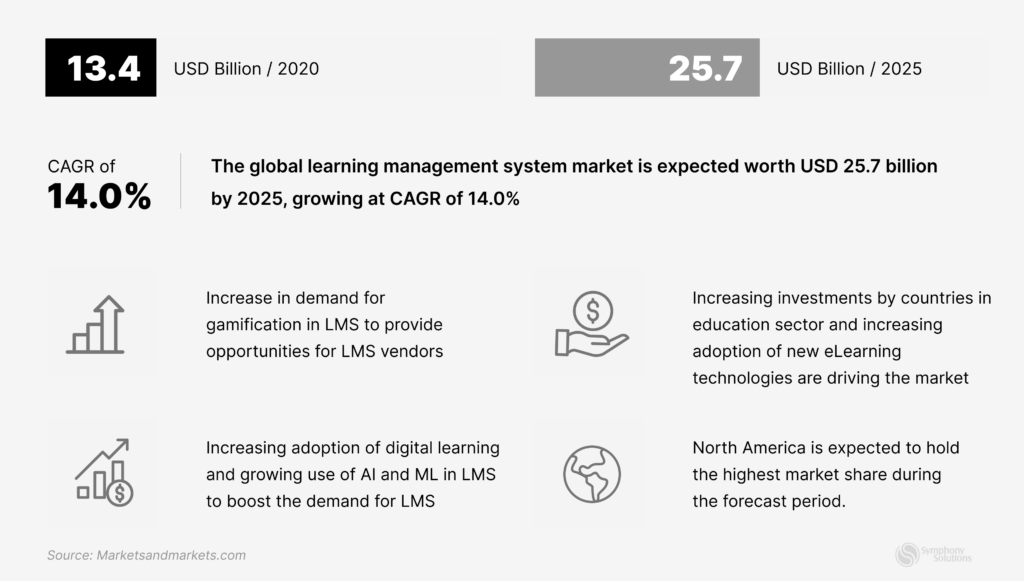
    Empower team self-governance 

    Having teams reach self-sufficiency is one of the goals of Agile coaching. The Agile mindset promotes democratic decision-making and effective self-management. 

    Continuous communication 

    This should be achieved within the team, for distributed teams, and with the customer. As the Agile approach means high responsiveness to change, flexibility to customer feedback and fast delivery, effective communication is a way to achieve this. Daily stand-ups, retrospective meetings, sprint demos, online PI planning for distributed teams: all these are Agile events that contribute to effective communication in Agile teams. 

    Here are some tips on how to improve communication across your organization in preparation for a successful Agile transformation project: 

    • Start your communication with the “Why” to be clear and honest about the strategy’s expectations 
    • Set up multiple communication channels to accommodate employee preferences, as well as increased volume of communications 
    • Display formidable agility throughout internal communications 
    • Apply “MVP” thinking in your daily meetings and routine FAQ (frequently asked questions by employees) sessions 
    • Communicate more frequently with leaders, so that they can pass the same trend down the management hierarchies 

    Change management strategy 

    An Agile management differs from that in a traditional company, in a way that a greater role is given to self-organization, accountability and responsibility of each member of an Agile team

    Accountability and remediation 

    There should be clear metrics to measure progress and analyze the efficiency of the implemented changes. Each team member should take on a proactive role in self-organization and increasing value-added to the common goal. 

    Roadblocks and pitfalls to avoid on your journey to Business Agility

    Any change rarely comes easy, so it’s important to be aware of difficulties that the team may face in the process. Generally, all that may get in the way of a company’s transformation journey, comes down to a few main roadblocks: 

    • Culture. A set of values and principles build up the core of the Agile approach. The transformation is a lot about embracing the specific mindset, way of thinking in different categories. So, problems may arise if the company has a strong culture that opposes the very principles of the Agile approach. 
    • Lack of alignment. Teamwork and accountability play a big role in adopting the Agile approach. The more teams are involved, the more dependencies, the more important it is to have good alignment within the team and across teams. 
    • Unclear vision. To get to your goal, you have to set your eyes on it and know how to get it. Clearly defined goals and a transformation roadmap may help in this regard. 
    • Availability of tools. Lack of proper tools may hinder the teams from successfully completing tasks, efficiently communicate, track progress. An Agile coach may introduce the teams to the right tools and train you how to make good use of them. 
    • Scaling beyond team level. Whenever there’s a need to scale up, difficulties are expected. SAFe is a framework that helps bring alignment across organization and guides the company in scaling Agile practices. 

    These and other difficulties, however, are possible to overcome as long as the team has good guidance and is set to succeed. With the prevalence of the Agile approach and its future prospects, there is no reason for resistance in the company’s transformation. At the end of the day, everyone who want to stay relevant on the market, will have to learn to adapt and embrace the new world. 

    To conclude

    With Agile, everything needs to be better and faster. The sooner the clients get to see and make use of what they’re paying for, the better. The Agile approach empowers the contractor to deliver tangible results to the client in mere weeks, creating minimum viable products sometimes as soon as two weeks into development. The company that has successfully completed its Agile transformation, bears a great competitive advantage in the rapidly changing and highly demanding market.

    With optimized processes and maximized efficiency, the journey from an idea to an actual product now takes weeks, instead of months or years.

     Just about any company can achieve such astounding results by resorting to Agile Transformation services, that encompass all the phases of the transition, leading a company through assessment, to training and implementation, certification, up until the point when the teams become self-sufficient. 

    FAQ on Agile Transformation 

  • Symphony Solutions – payments optimization and integration project for Ladbrokes Coral

    Symphony Solutions – payments optimization and integration project for Ladbrokes Coral

    Symphony Solutions looks back at one of their successful project executions in 2020.  

    When Ladbrokes Coral Group, one of the Symphony Solutions’ clients, was acquired by GVC Holdings, one of their initial goals was to try and standardize some of the operations they had. The first on the list of priorities was systematizing payments. 

    From a technical standpoint, the project involved the integration on the application level. The earliest steps included the architecture review of Ladbrokes Coral application to see what had to be modified and then adjustment of CI/CD process for successful integration with the part of GVC responsible for payments.  

    The results were cutting costs and saving a sufficient part of the revenue. On top of that, the GVC framework offered some additional features and opportunities for application configuration which allowed the Ladbrokes Coral app to customize and add some extra, out of the box components provided by the framework.   

    For Symphony Solutions this project meant creating new teams fully dedicated to implementing the GVC framework. The first step was getting on the same page with the GVC side and learning architecture to understand how the product works. Once the general picture was clear and the roadmap was set, new teams had to be assembled that would be fully committed to this project. 

    The work involved close collaboration between diverse development teams across several countries: Ukraine, Poland, India, Austria, and UK. GVC team was helping with general architecture and all the implementations, as well as adjusting the third-party components of the application so it met the standards and requirements. From the Symphony side, it was very important to introduce Agile methodology to the project, to make sure that there was clear communication between teams and set up processes in an efficient way to meet the fixed deadline.  

    testimonials on the project

    Overall, the project took a bit over a year, from the setting up and getting the main requirements from the architectural perspective to releasing it last month. It proved to be a good example of how the communication had to be build up. Another outstanding achievement was the level of engagement of everyone on the project that made it possible to release both desktop and mobile applications on time. People were extremely involved and motivated to release the best product in the end. They were constantly looking for better, faster and more efficient ways to deliver. 

    One of the biggest challenges of this project was creating a steady flow of communication, where everything is relayed properly, and all the tasks and moves are clear for everyone involved. Additionally, the communication flow had to be built in a way that made sure the important message reached everyone who needed to get it but at the same time omitted people for whom it was redundant. To build this communication infrastructure from scratch, various approaches were applied and tested just to find the right one.  

    With this successful integration Ladbrokes Coral app received its own payment solution, as well as numerous additional features for their users. For the company, this move meant more security and optimization of work, as well as resources. 

  • How to Make Your Agile Transformation Process Right: Tips from Experience with Multiple Clients

    How to Make Your Agile Transformation Process Right: Tips from Experience with Multiple Clients

    LACE team knows a lot about change. LACE is the Lean-Agile Center of Excellence in Symphony Solutions, an IT company that provides software development services to our clients. LACE is the cross-functional Lean-Agile change management team. We work by SAFe. Our team is being involved to support our clients’ transformational initiatives towards Lean-Agile ways of working. We cover the full cycle of organizational shift to Lean-Agile – from assessment, training, process, technology, tooling, to culture and governance changes needed to achieve the business benefits of Agile transformation. 

    We have walked the talk of Agile transformation with many clients that operate in gaming, e-learning, healthcare, e-commerce and other. Below are described the critical things that we believe make the success of Agile transformation.  

    Agile is about small iterative rounds of change. Yet integral approach is as important as ever

    Agile transformation is the change process. The process, not a one-time event. If you wish to achieve profound progress in Agile adoption in your teams, don’t do training first. Develop a broader roadmap. 

    Though Agile is about short iterative series of changes, these have to happen within a defined streamline.  

    For us in LACE transformation team, the approach that we use with our clients and that has proven to work the best – is the Agile Transformation roadmap, described below. 

    agile transformation process for organization

    This roadmap has served us and our numerous partners well in our journeys to Agile transformation. This said, below you will see that application of this roadmap may vary depending on the client’s needs, business operating reality, internal practices and compliance requirements, and last but hugely important – on our clients’ organizational culture. 

    Clear problem definition saves tons of money, and sets up a vision of success

    We always recommend our clients to start with assessment of their organizational readiness for Agile transformation. Beginning with the end on mind, that is what a good assessment helps us achieve. 

    On the stage of assessment, we define what are the key impediments of Agile transformation in a given organization, both known to company leadership and the hidden ones. We also map the low-hanging fruit that may be utilized as first wins in the transformation journey. 

    What exactly do we research on assessment stage?

    Our typical list of questions that we ask cover the areas below.  

    When we conduct discovery phase with the client, together we define how deep the investigation should go in each of the chapters below. Our usual assessment tools are interviews, questionnaires and focus groups.  

    Depending on the client and on their particular change agenda, we may choose to go as deep as ‘anthropological studies’ with the teams, where we participate to team meetings across the business that is about to undergo Agile transformation.  

    We collect the insights below not from the words of executives and team leads, but rather from our real-life observations on how teams create added value and achieve on goals.  

    agile assessment parts

    We know we have done a good job in assessment, when we understand how Agile practices may be applied to the work of the concrete business that we are now helping transform. 

    Surprisingly enough, or maybe not so surprisingly any longer, leaders only cannot provide the most crucial insight that LACE team needs during Assessment stage. So our deep and sincere call to all professionals developing the Agile transformation roadmap – don’t stop on executives’ level! Leaders know a lot, they decide on success of Transformation efforts.  

    Yet the success itself is defined by Agile transformation adopters that live outside the board rooms. Knowing their pain points, motivations, hopes and struggles – this is the insight that will define your Agile transformation success. 

    Setting the common ground by proper education of involved stakeholders

    Agile is such a buzzword in the modern world. It is being used so frequently that everyone is already having their own interpretation of Agile. The very common risk that we in LACE transformation team have faced regularly, is different stakeholders having different common grounds and meanings when talking about principles of Agile transformation. That is why we recommend to train all the stakeholders and to set the common grounds for the change that we want to do. 

    LACE works by SAFe, an Agile methodology that has been the first to adopt a well-rounded approach to stakeholders’ education.  

    We not only provide classic Agile training to Scrum masters and Product owners. In our training portfolio, we have trainings for teams that are shifting to Agile, as well as to Agile leaders.  

    The latter education of leaders proves to be immensely important. More often than not Agile Leadership is the bottleneck in an organization wishing to undergo Agile Transformation. As usually the urge and energy to go Agile, comes from a particular business unit, some area of organization that is usually on frontiers of the VUCA world. In almost every organization we see business divisions that do not follow or interpret differently the Agile philosophy. When not addressed timely, misalignment in leadership team results in a bunch of roadblocks later in Agile Transformation journey.  
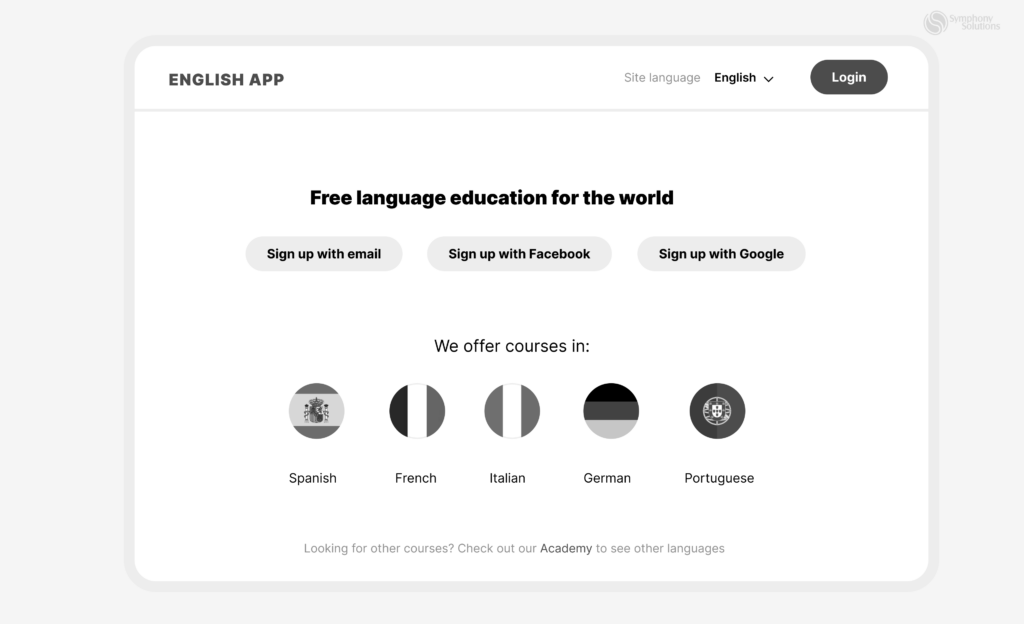
    In LACE, our standard Agile training portfolio consists of the following trainings below. Depending on our clients’ needs, we either deliver training ‘from the shelf’ (yet less frequently these days) or tailor our programs to the clients’ needs. We do practice collabs with the third-party training providers, as well as with internal L&D departments on the client’s side, in order to set up training programs that address exact needs for Agile transformation. 

    Agile certifications

    As to the format, we offer both online and on-premise training. Below you may find more detailed information on learning options available.

    ON-LINE

    1. Agile Basics, duration 4 hours.
    2. Scrum Basics, duration 1 day.
    3. Organization Agility training for Business), duration 6 hours.
    4. Agile Product Management, duration 5 hours.
    5.  Organizational Agility Course, duration 2 days.

    OFF-LINE

    1. Scrum Basics.
    2. Agile Fundamentals (with certification). 
    3. Leading SAFe (with certification).
    4. SAFe for Teams (with certification).
    5. SAFe PO/PM (with certification).
    6. SAFe SM (with certification).
    7. Management 3.0 (with certification).

    Remember, the training is important, as it sets the common ground for further change. If there is one most valuable step to consider in training Agile – consider this. Always make sure that all of your key stakeholders are properly trained and equipped with knowledge for the Agile Transformation journey. 
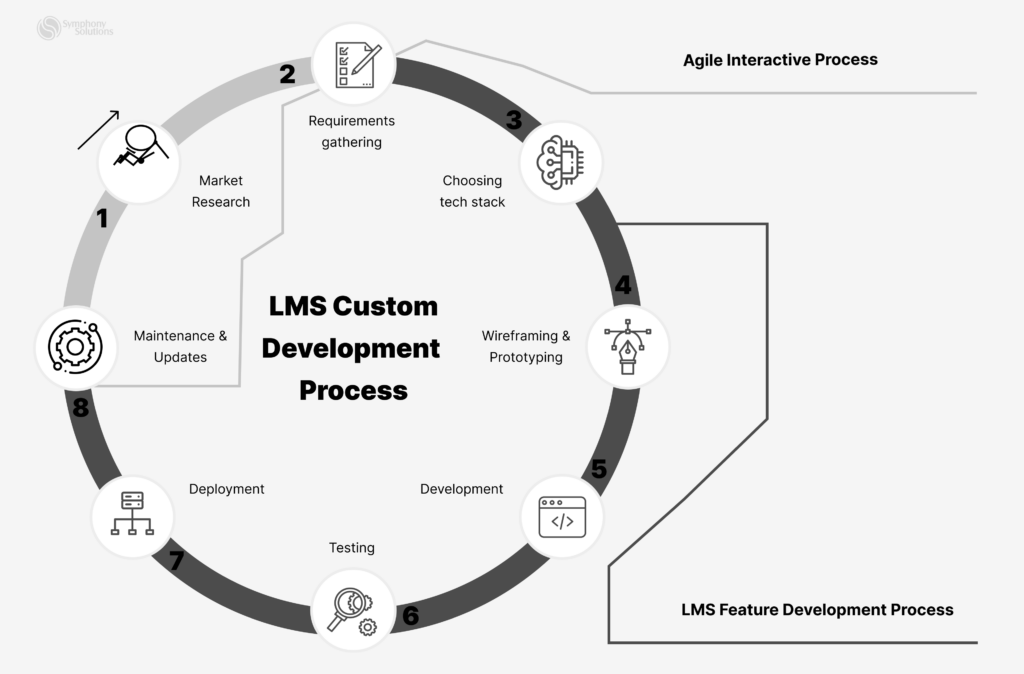
    Knowledge provides the mental capacity to do change, tools empower the actual change

    The essential part of Agile transformation is for LACE team to audit and adjust tools that are available in the organization, to serve the needs of the new Agile teams. The very first thing that we do, is we explore the tools that are already adopted and being successfully used by our client’s organization. 

    Agile can be practiced even with the whiteboards, or so the prophets say. In our experience, it is frequently possible to utilize the client’s existing toolset, in order to get Agile transformation going. In case it is not possible, we do help the client to properly select and set up the tooling that will serve their Agile transformation needs. 

    Tooling is the driver of successful Agile transformation. There is a ‘yet’ here, though. Transformation results are to serve the common business goals, which are usually being planned, tracked and achieved with the set tools. Whenever possible, try to utilize the existing tools for Agile Transformation goals. Don’t run for funky new tools just for the sake of novelty, this is our advice here. 

    When the elements are set, it is time to get the process going

    We think that the entire meaning of Agile transformation boils down to how effectively the Agile processes are being adopted by the teams that are in the transformation process. The results of previous steps – assessment, training, tooling, can be seen on this stage very vividly. 

    On the process setting stage, LACE team takes care of setting up the Agile rituals, Agile meetings like PI Planning even for distributed team, on making sure that teams practice what they have learned and the tools are being used in the way they have been intended to.  

    In our experience, for organizations that undergo fundamental Agile transformation, Retrospective is the hardest process innovation that they go through. The teams that have never practiced Agile before, need the most careful nurture from LACE team, on the way they learn from own experiences.  

    Though not always the case, yet with majority of our clients it has been necessary to set up team space and time to reflect on past performance; it took most daring efforts to help the team start using the time and space to reflect on their performance; and most of the struggles and proud achievements we have had with the empowered teams that grasped the meaning of iterative improvement and the true ‘by the book’ value that Agile brings. 

    In essence, process setting provides sense to all previous steps in Agile transformation, making sure that the individual puzzles of the Agile journey are put together and start functioning. 

    Culture eats everything for breakfast

    The topic of organizational culture deserves a whole separate post by itself. In the experiences with our clients, LACE team has always paid very deliberate attention to the way in which things are being done in organization. As the strongest wind that propels the success of Agile Transformation efforts, as well as most difficult impediments – they all come from the hidden and unwritten norms that exist in the company. 

    To tell the truth, there has yet never been a client for which we did not do change initiative. Yet for some of our clients we did have to change the scope, or amount of educational and communicational activities, in order to get change going.  

    The culture thing is the most difficult to understand for an external consultant. So it has always been one of the most deeply researched questions on the assessment stage of Agile transformation. 

    Remember, culture eats the strategy for breakfast. Or frankly, it eats everything for breakfast. Make sure that you navigate well in organizational culture of your client, as this may be the question of life or death for your Agile transformation initiatives. 

    Blossom comes from a good seed, properly planted, and deliberately cared for

    We have started this article with one fundamental truth that has proven so many times for us – transformation is the process, not a one-time event. In order for Agile transformation to work, it needs to be deliberately, attentively and resourcefully nurtured.  

    Having set up all the processes well brings a great level of enthusiasm to the teams. This in return brings early wins and fuels more adopters of Agile transformation. Yet we have noticed that with time the energy level drops, and there is a risk (at least for some categories of Agile adopters) to come back to the old ways of doing things. 

    That is why the crucial step for Agile transformation happens actually after the Agile transformation. We in LACE call it Agile coaching. This is a very individualized process of our consultants supporting the concrete use cases and challenges that concrete teams face when gaining their first experience with Agile.  

    We know, no systematization on this stage. Our coaches come back to every team individually, empathize with their particular struggles and support their unique successes, with the aim to obtain a side-view on how the teams may sustain the Agile transformation for achieving results on their level.  

    As LACE team has experienced this multiple times with our clients: when Agile becomes the way we do things over here, when Agile is not the way we do things, when it is a philosophy of ours – the change has been achieved. And the organization of yours is equipped with Agile ways of creating the value, which is the competitive advantage in the VUCA world we live. 

    To conclude, big changes are difficult, costly and very consuming exercise. In the modern world, changes are inevitable. Agile Transformation provides a toolkit to your business that may help you to have change not as a grand costly project, rather to have change as an on-going iterative evolutionary process. This, in essence, may help your firm to stay in line with the market changes and to deliver the best possible product or service to your clients in every given point of time. 

  • 10 Benefits of Service Design for Product Launch

    10 Benefits of Service Design for Product Launch

    Lean Agile Service Design is about identifying the problem, finding the solution, and building the things right. As it is a customer-centered approach, you want to implement the solution in a way that is most valuable and beneficial for the client.  

    The purpose of service design is designing services that meet the needs and expectations which can be defined as follows: 

    • From the user perspective – useful, usable, and desirable. 
    • From the provider perspective – efficient, effective, and different from competitors. 

    The benefits of using this approach are apparent, as, at the end of the day, it helps build a sustainable business and leads to business agility. 

    Some other practical service design benefits, which are worth mentioning, are that it helps improve existing features in the backlog, quick test your ideas, improve customer retention and perform service audit. Efficient service design helps double the odds of success and saves you the time and money that would otherwise be spent on solutions without any market potential. 

    Engage new clients and retain existing users. Develop new features or improve old ones. Analyse what your competitors have got to offer, and how you can use that for your own benefit. Adjust your work based on customer and user feedback. Achieve all this and more by adopting Design Thinking and Lean Agile in your day-to-day work. 

    The cycle of Service Design in a project

    Service design, Lean and Agile are similar in nature but these are all different approaches that aim to accomplish something different in a project. However, having them combined, we can achieve great benefits. 

    design thinking, lean and agile approaches in software development

    Service design comes at the start of each cycle of the project. We begin by exploring the problem, generate insights and ideas. When that part is finalized, we go into prototype and start the Lean phase, and after that comes the Agile part. When the cycle starts over, we find ourselves back to service design where we review what is going on and at what stage our product is in its lifecycle. Thus, the process continues until we have a finished product. 

    Lean Agile applied to Service Design

    Agile implementation introduces a positively new approach to delivering the product. Agile teams work in sprints and divide the workload into smaller chunks. This makes it easier to efficiently track the work being done, consolidate efforts, cooperate, and manage dependencies. But most importantly, it allows the team to create a ready–to–test product that can be delivered in small increments. 

    It’s important to distinguish what perks come out of applying service design in Agile environments. As mentioned above, agile teams thrive when they have the flexibility to manage the project with all its dependencies and keep in close collaboration both within the team and with the client. 

    Lean agile is even more so beneficial when we start scaling up. Scaled agile means aligning several teams that are working on one product but probably on different features. The teams have different stakeholders and product owners but they all share a common goal. 

    Summing up, we can say that, as an agile team, you can find many benefits in applying Service Design and Lean Agile to your work process. Symphony Solutions LACE office provides interactive webinars on Lean Agile Service Design, the next online event coming up on December 10, where our experts will first-hand talk about the practical benefits of adopting the approach, share service design best practices and case studies, and answer your questions if any may arise. Also, Symphony Solutions offers Service Design consulting services for when you are ready to take your business to the next level with expert guidance and support.

  • Agile Mindset to Drive Your Business Results

    Agile Mindset to Drive Your Business Results

    Agile mindset, also referred to as a “growth mindset”, is a system of beliefs applied to a working environment that appeals to the notion of continuous change with the main focus on delivering value to the customer. In contrast to a “fixed mindset”, when you are set in your ways as an expert and do what you know to give predetermined results, agile is all about embracing the change and facing whatever challenges arise on every stage of the project lifecycle. 

    Incorporating agile thinking into your core beliefs opens you up to the idea that you will always continue to learn and grow as a professional. It encourages you to discover alternative and better ways to deliver results, eradicates the stigma of making mistakes and introduces you to the option of learning from your failures instead. 

    Why does it matter to be “agile”?

    It’s all about flexibility, creativity and commitment. 

    To put things into perspective, imagine the following scenario. You start off with a new client, determine requirements for the project, agree on a budget and set a deadline. All is well, until you meet again when the time of the delivery comes and suddenly all sorts of questions start popping out seemingly out of nowhere. 

    The client wasn’t entirely definite in their wants for the project when you first started out. Now, seeing the delivered product, they realise that they want something different. 

    Upon delivery, turns out that the client wanted more or different functionality, all of which tugs on the budget limits. 

    The client is no longer enthusiastic about this project, but wouldn’t mind working on something else. 

    The list can go on, but the point is that there was a big leap from the start till the end of the project, and the client couldn’t control what was going on in between and come up with better ideas on the go. 

    As a result, the client isn’t happy, you have to start over, and the team is demotivated, because all of their hard work went to waste. These examples uncover the pitfalls in project management, team alignment, client communication, and so on. 

    In short, you want to be agile because it makes you: 

    • Flexible to change 
    • Resistant to uncertainty and/or failure 
    • Deliver value to the client early and consistently 
    • Motivated and responsible to get the job done 
    • Self-organized and mindful of your input in the project 

    To sum up, according to PwC research Agile projects are 28% more successful than traditional projects which is a substantial difference. 

    Key Agile values and principles

    Whether you’re just considering a switch to agile ways of working, or you’ve been in the game for a while, you’ll want to incorporate some changes into your day-to-day work life. 

    A group of software development practitioners took it upon themselves to define the agile values and principles in the Agile Manifesto. These rules, however, are not supposed to be perceived as set in stone. They can be used as guidance for those who are still finding their way to agility. 

    The four values of Agile Manifesto:

    • Individuals and interactions over processes and tools. 
    • Working software over comprehensive documentation. 
    • Customer collaboration over contract negotiation.
    • Responding to change over following a plan. 

    These values lay out the foundation of an agile working environment and address the way you interact with your team or customers, how you go about accomplishing what needs to be done and set priorities for the project. Perceive them as the stepping stones on your company’s way to business agility. These are the essence of what it means to be agile, setting the precedent for your further Agile Transformation. 

    Furthermore, the Agile Manifesto outlines the twelve principles as a fundamental guidance to teams in pursuit of business agility. 

    The 12 Agile principles to follow:

    1. Early and continuous delivery of value to satisfy the customer.  
    2. Responsiveness to changing requirements on all stages of development. 3.
    3. Frequent delivery of working product. Strive to deliver results in increments in a short timeframe of a few weeks to months. 
    4. Daily collaboration of business and developers. 
    5. Motivation and individual responsibility. Create the environment, support, trust people to get the job done. 
    6. Face-to-face communication. 
    7. Working software is the measure for progress. 
    8. Sustainability. 
    9. Technical excellence and good design. 
    10. Simplicity. 
    11. Self-organizing teams. 
    12. Reflecting on the work done and adjusting accordingly. 

    A team that adheres to these principles, is focused on a common goal to satisfy the customer and builds a relationship with both clients and within the team, based on mutual respect and active cooperation. 

    Seeking for the optimal way to deliver results, the team is constantly improving and growing with time and experience. The process is organic because you improve in small increments. The team is encouraged to learn from their mistakes. As a team member, you learn to be accountable to yourself and the team. 

    And, of course, the main focus is to deliver value, therefore when the need arises, the team needs to be flexible to change and focus on the main priority. 

    Agile vs. Waterfall

    Agile is often places as opposite to the traditional Waterfall methodology. The waterfall model is linear and predominantly deadline-based, which means that the project is broken down and executed in a sequence of consecutive steps which are all performed one after the other. The client can see the working product only at the end of the entire cycle, as opposed to agile, where usable output is delivered upon every sprint and making changes as the project progresses is allowed and encouraged. 

    However, it’s important to recognize when agile is appropriate in any given situation. Agile works great for startups where it’s important to keep a fast pace and remain flexible to changes as the team’s main objective is to create a minimal viable product (MVP). On the contrary, big companies that operate using the waterfall method, may not be as quick to accept agile as the main methodology on scale. However, it may show positive results when introduced in small teams or individually. 

    Agile may be adopted on an individual, team or organizational level. If you are not sure if this approach is suitable for your company, try starting small with one team and test how they are able to adapt their work to the agile principles. This may be the case for big companies, which traditionally operate in the Waterfall methodology. 

    Finally, to assure that Agile should be continuously implemented in the team regardless of size or type, look over the statistics according to the Standish Group Chaos Study: 

    Agile vs. Waterfall methodologies comparison

    Benefits of adopting an agile mindset for your organization

    The many benefits of lean agile make it a desirable model of working that goes beyond software development – starting from agile modeling which precurses effective development, to agile management that is applied to management processes and project management in particular, and even agile learning that puts into use agile concepts of iterative delivery for learning. 

    • Reduced risk and better decision-making. The team works in sprints, evaluating and responding to feedback at each point. This allows for less risk, quick and democratic decision making. 
    • Transparency and visibility. Improved tracking and visibility of the project. 
    • Continuous improvement. An agile team is ever-changing and growing its experience over time. Learning from mistakes is greatly encouraged. 
    • It’s all about adding value. The main focus of this mindset is to deliver value to the customer. 
    • Collaborative work. In Agile, team works towards a common goal. Communication is very important both within the team and with the customer. 
    • Cost-effective. The methodology allows to reduce the cost of change that is implemented early on in the project and not when the work is almost or completely done. As result, it saves a lot of expenses for the business. Moreover, Agile approach in the organization increases its revenue, as the team is more efficient and the product has higher quality. Additionally, read the case of the assessment and Agile implementation for BleXr and how it helped them to achieve double-digit revenue growth.

    How to develop an agile mindset on personal and team levels?

    Are you now considering making a change in your work environment and benefit from introducing some agile concepts into your daily work and project management? If so, here are some tips to get you started: 

    1. Analyze where you are standing and find opportunities to introduce the agile approach where possible. Let go of old ideas and concepts that aren’t working or could be replaced with more efficient ways.
    2. Accept change and adapt quickly. Consider possible consequences and act accordingly.
    3. Reflect on your experience to gain insight.
    4. See how you can make agile a part of your company culture.
    5. Remember that customer comes first! Stay in touch with them and be responsive to their needs.
    6. Make transparent reporting a priority. Encourage your team to take responsibility, admit to their struggles and shortcomings and see it as a learning opportunity. Let the team see their progress over time.
    7. Define team milestones and comprehensive Agile transformation plan.
    8. Build a highly collaborative relationship within the team. An agile team is eager to share knowledge and help other team members be fully equipped to deal with problems and tasks.
    9. Welcome diversity of thought and perspective. Create cross-functional teams where each member of the team adds unique value to the project.
    10. Continually deliver usable output – the product should deliver value from the onset.
    11. And don’t forget to have fun! Effective communication outside of work boosts motivation and makes a tight-knit team that works well together. 

    To conclude

    Over the last decade we are observing a great uprise of a new philosophy of the workplace which is designed to make the team maximize the value that they bring to the customer, as the central figure of business. As the marketplace changes, so do the key players. Agile mindset is what can help the team continuously improve and be responsive to the needs of the customer.  

    If you consider switching your business to Agile, but don’t know where to start, reach out to us. We have years of domain experience with different company types and can provide you with Agile consulting service and a plan to implement Agile smoothly for your business purposes. 

  • From Agile Coach to taking on the COO role

    From Agile Coach to taking on the COO role

    There are these tipping points in our lives that push us to the edge, roller coast us to dare things we couldn’t have dreamt of, and drive us to leave our comfort zone. These are very uncomfortable moments. These are incredible moments. They open the door for deep self-exploration, for setting the new limits to our possibilities.   

    About 8 months ago, such a tipping point moment happened in my career. I am an Agile coach with a long history of transformational projects for clients all over Europe. Being the Vice President of Agile Transformation in Symphony Solutions, I have always been brave to try things out and known to work dedicatedly for the goals of company’s clients, driving the value of an Agile mindset to address their business challenges. My career was bumpy at times, yet always steadily progressing, logical, and highly fulfilling.    

    As I look back at that moment, I see myself sitting on a leather sofa of the meeting room, discussing forthcoming changes in Symphony structure of the leadership team. And then this moment happens. I am offered the role of Chief Operating Officer at Symphony Solutions, the company I’ve been working for many years, the company I have helped grow, alongside other people who are my friends not simply work colleagues. My first thought: “If I take it, my family is going to see me even less, with all the travels and personal time sacrifices that it takes to be a COO”. But what I actually say is: “But I am a woman…” It seems this reply has been anticipated, as Theo Schnitfink, the founder and visionary of Symphony Solutions, replies that having a woman that leads the organization – is a great asset of an organization. The respect of gender differences, and appreciation of diverse viewpoints that Symphony Solutions practices, have always been our competitive advantage. And something I couldn’t agree more with. As the thing that I value so deeply about Symphony – is the opportunity to be myself, which I have experienced throughout all my career with the company. Gender stereotypes should never impede growth.    

    My second thought is how much I need to learn, as I want to do the role right. I suggest that I first enroll in an MBA program. Again, this answer seems to have been expected. Instead, I am offered a mentorship with the CEO of a major Tech Company in the USA. And so I decide to give it a try.   

    From that moment, my entirely new journey starts. I spend hours and hours with my mentor. I bring up lists of questions to discuss. Even more questions arise during our sessions. The time spent with my mentor: a pragmatic, straightforward, seasoned leader that has experienced growth and shrinking, mergers & acquisitions, and transformations – is my personal MBA that is an invaluably important life experience. Being a C-Suite member himself, he has always found time for me, he has been fully present and dedicated to my questions and dilemmas. He was fully invested in the mentorship we have had. And I am deeply grateful to him for the time, energy, and wisdom that he has shared while helping me develop for the responsibility I was about to take.    

    Interestingly enough, my prior experience as an Agile Transformation consultant helps a lot in the preparation for a new role. A major chunk of questions that we discuss with my mentor, is how to respond quickly to the needs of clients, customers, and the markets, by listening to the voices of employees, partners, and external stakeholders. With time, my long list of questions that I bring to the mentoring sessions dries out. I have a plan. I feel ready to step into this new stage of my career journey…   

    I took over the COO role at Symphony Solutions on February 25th, 2020.    

    And then, only after 2 weeks of me stepping into the new role, the Covid-19 crisis burst out. Suddenly, all plans, preparations, and expectations turned upside down. An entirely new reality emerged, for which no one has been quite prepared. When I glance back at it now, this looks ironical enough, as I have actually found myself in the shoes of a leader that has to walk the talk in living an Agile approach for driving the organization forward. For years I have consulted companies to apply Agile methods in times of change. 8 months ago I became the one to do this, for Symphony Solutions.  

    We had the tough times and went through the challenges that stretch the most mature leadership teams. With our biggest clients cancelling and delaying the projects, with the need for optimization of support teams, with rounds of brainstorming for cost management measures, solidarity cut discussions, and whatnot. That period has probably been the most challenging time in the life of the company and my personal career journey.   

    I remember one evening before a major painful decision that we had to take, and how it made me feel that night. The decision was going to impact negatively lives of many people. I was the one to make the decision, and bear responsibility for it. I was the one to listen to the stories of broken careers caused by that decision. Even now, the wave of empathy rises when I think of my colleagues impacted. It was the time of enormous stretch. And I still remember the words of my mentor, “Doesn’t matter what option you will choose, be ready to be hated right now. As a leader, you do impact the destiny of many people. In the situation that we are in now, your impact is breaking people’s well-being and disrupts their stable life. Accept it.  

    While doing so, I may say that we took care of every story we have heard. We brought on the table not simply Symphony operational struggles, but the struggles of the people who were impacted by our decisions. At that time, I had to consider the personal backgrounds, life stories, family situations of those colleagues that dedicatedly worked with us for years. Many of these stories impacted the way we made decisions about optimization measures. And this is yet another leadership lesson that I have learned from this period. These struggles that we have had, they stay invisible. Most of the painful fights for balancing the interests of people and business are known only to a very narrow group of the leadership team. 

    Now when we through with the crisis, and when things have returned to the growth track, I can look back and reflect on how we did it. We have definitely proof-tested on ourselves the Agile Transformation approaches, for which Symphony Solutions is known on the market. We practice what we preach, as Agile has been the strategic choice for Symphony Solutions for years already. The consistent application of Agile has paid us off. It helped us make mistakes, learn, and adapt fast. It helped us see the opportunities in limitations. Among few examples to mention, we transformed our experience of geographically dispersed teamwork into a new remote business model; we used the opportunity of work from home to re-evaluate employee journey and to structure our processes. We go forward with new hopes, aspirations, and plans. We go forward with formidable baggage of experience.    

    I personally go forward with huge gratitude to those many people who have constructively challenged, helped listen to the crucial voices from the field, from employees, clients, and most important for leadership team; as well as to people who have joined collaboratively to drive the changes in Symphony Solutions that we have lived through.    

    And one last insight that I have encountered on the way. Interestingly enough, I now spend more time with my family than ever, with all the flight bans and work from home modes.  

  • Tech Trends That Will Impact iGaming Industry In 2021

    Tech Trends That Will Impact iGaming Industry In 2021

    AI engineering, distributed cloud, business agility, and anywhere operations are some of the technology trends that are likely to impact the iGaming market in 2021.

    As I write this, we have now been seven months into the Covid-19 pandemic. The iGaming industry has not been immune to the disruptors that have appeared as a result of the wide-spread impact the pandemic has had on people, companies, and governments.  Sporting events are still being cancelled or postponed.  Many land-based casinos are still closed or have re-closed due to the second wave of Covid-19 cases sweeping across the globe.

    The iGaming industry trends mentioned above existed prior to the pandemic, however, in most cases they have been accelerated out of a necessity to respond quickly.

    In the first few months of the pandemic, most operators were reeling from the speed at which the initial effects were being felt. The cancellation of sporting events forced operators to quickly launch new online products, whilst in parallel, they focussed their attention on adapting their operations to cater for a remote workforce, to their suppliers working remotely, and to the rapidly changing needs and behaviours of their own customers.

    iGaming suppliers had to react quickly. Trade shows and events were cancelled, there was a rapid move to online webinars and virtual events. Across the whole iGaming value chain, there was a general belt tightening. Pre-covid product roadmaps were torn up and re-prioritized. In many cases, initiatives were ‘put on hold’. “Let’s sit tight and see how things are in a couple of months” was a phrase often repeated.

    Time has ticked by and we are now seeing businesses start to move again. Sitting still and maintaining a holding position isn’t an option for most. Covid-19 is driving changes that can’t be ignored and a realization that this isn’t something that is going to disappear in a couple of months has hit home. Companies have moved past the Covid-19 response phase and are now focussing again on growth.

    At Symphony Solutions we were forced to pivot quickly and accept that things were changing quickly. 

    Anywhere Operations 

    We launched our own Symphony Anywhere Operation and within six weeks has hired our first staff member under the new remote operating model. I myself moved from Barcelona to Gran Canaria on the 17th of September; I was keen to avoid being in a large city and having to endure a second wave of Covid related restrictions, the ones that indeed we can now see being implemented across mainland Spain. 

    I have spoken to numerous iGaming companies; most have accepted work from home through until at least Q1 of next year remote working and ‘anywhere operations’ will be the norm. I strongly believe that many companies will not return to previous ways of working at all. Social distancing bubbles are being implemented across Europe. Some companies are considering a ‘bubble shift’ system with the workforce being split into cross-functional bubbles that come together in the office on certain days, with the majority of time being spent working from home. I suspect this will continue well into next year. 

    Remote operations have become one of the gaming market trends too. Anywhere Operations drive many technology changes and open up value add experiences across the area of collaboration, secure remote access, cloud infrastructure, automation, and the online experience required to support an iGaming remote operation.  

    Investments in these areas are already taking place and will continue to be more highly prioritized than BC (Before Covid). 

    At Symphony our teams are in constant discussion with our customers, helping them to add value in response to the shift to Anywhere Operations. 

    Distributed Cloud For iGaming Products 

    The distributed cloud approach is an important change in how networks are planned and implemented. At a high-level, a distributed cloud refers to the distribution of cloud services to different geographical locations as opposed to a more common centralized cloud model in which services are centralized in one location. 

    In the distributed cloud model, system workloads can be shifted between a central cloud, regional, and even an ‘edge cloud’. In addition, workloads can also be distributed between both private and public clouds, such as Amazon Web Services (AWS) or Microsoft’s Azure Products. 

    The benefits for iGaming operators of a distributed cloud model are that it can reduce latency, network congestion and minimize data loss while improving product quality user experience and increase customers base as in the case of cloud-based sportbook app for Ladbrokes Coral we developed. This is important to those with mobile users in rapidly developing gambling areas such as Africa and Latin America where latency is a common issue. 

    Special care and attention should be paid to ensure applications reside in the best location and where and how they are processed.  

    Symphony Solutions is a premier Amazon Web Services Partner; our cloud services teams are actively helping our customers ensure they make the right choices. 

    Closing Summary & Future Gaming Technology Predictions 

    iGaming operators will need to ensure they focus on not just one of the gaming industry trends mentioned above, but also on choosing the best platform fit for their igaming project firstly. Those that succeed will need to focus and act on a combination of the points mentioned above. Resiliency will be central to the ‘new normal’. 

    We are living through a turbulent time. We will no doubt look back on this time with sadness and deep regret about the loss of life and the profound economic hardship endured. In addition, we will look back on this period as a time that propelled us to new ways of working, to embrace new technologies. A time that gave rise to entirely new operating models that became the ‘norm’ in the future.   

    The leaders of iGaming companies, their CIO’s and CTO’s will need to look for opportunities to design next-generation digital platforms. Ones that will modernize and rationalize applications and infrastructure whilst implementing extremely flexible capabilities to design and deliver new products, better services, and experiences to both their own employees and their iGaming customers. This will be Covid’s IT legacy. If you want us to help you create that legacy, please look over our igaming platform development services and get in touch. Together we deliver cutting-edge products to the market. 

  • The way we live, the way we work now

    The way we live, the way we work now

    Being an HR leader in the year 2020 is an experience of a lifetime. One that has been stretched to its limits. The new world we live in has introduced changes into the way we work now and has put   the capacity for HR organization’s agility to test, and thus bringing a new level of meaning to the term ‘human’ in Human Resources profession. 

    Many of us have been previously reluctant to embrace the idea of our core business being entirely done from home. What has been WFH for organizations, really? Well, traditionally, WFH has been viewed as a benefit, rather than an operational model. Covid-19 has imposed a reality that we, as HR leaders, have not planned to happen any time soon. This reality is difficult to be massively adopted otherwise, in the world without Covid-19.  

    As Shelly Kramer states it in her article “How Coronavirus COVID-19 Is Driving Change In HR Operations”: “In the pre-COVID-19 days, many companies were just starting to explore work from home policies — mostly in a “toe in the water” sort of way. Now, because we have no choice, it’s just how we operate” 

    And well, looking back on the 8 months of experience operating WFH…it seems to be working perfectly fine for Symphony Solutions. 

    And the experience the company have gained in the process is immense. We came to terms with the now cliché ‘new normal’ state of affairs, juggling multiple incompatible assignments like presenting at a meeting while connecting kids to their remote classroom, wearing a formal jacket and a favorite pajama all at the same time. 

    work from home

    We remained the same culture, same focus – although now in an unexpectedly all-remote mode in everything

    Our teams had to stay well-informed so we placed a strong focus on our internal communications. We shared real-time updates in our corporate channels, as well as via weekly TownHalls with CEO and Leadership Team members. This has shown unprecedented rise in the interest of our teams, and at some point, we realized that it sparked a new culture in our company – when office–based employees were gathering in one big room, with pizza and snacks to listen to the live TownHalls.  

    The first two months of quarantine were rough for Symphony Solutions, like for many businesses out there on the market. We had to address operational efficiency, optimize the teams and reconsider a number of policies. On the upside, our clients were content with how we handled the official shift to virtual, although it has been a no-new experience for some of the teams.  

    Initially, there were concerns about the productivity and efficiency of full WFH mode. As Adam Hickman from Gallup puts it, “The stigma of remote work is that it inhibits collaboration and productivity, which together may cost companies money” But eventually, with trying things out and adjusting on the go, WFH turned out to be the opposite. Ironically, WFH mode brought the different challenge – the challenge of over-working. At some point, one of our customers addressed us with a concern that their team is burning themselves by overworking and losing the precious work-life balance, as the lines of corporate and personal became blurred.  

    We handled the problem through a set of solutions already available even before  – 1:1 coaching with People Partners, corporate psychologists and conversations with LM as well as by developing a new wellbeing program. 

    work from home

    Ironically, wfh mode brought the opposite challenge – the challenge of over-working

    During regular 1:1s and internal surveys, we found out that people see benefits of returning to office. People said that working in office brings better team cohesion, and helps to get things done faster. On the other hand, many people have found a great range of benefits in working from home: from choosing the place from which they work, to better harmony in managing important aspects of their life besides work. 

    In these surveys, people talked about all kinds of things: safety in times of danger, appreciated the opportunity of being asked about work either from office or home, talked a lot about their family reality, as well as benefits and restrictions of getting their homes as a workplace. People shared how their teams were getting used to working remotely. Many moaned about looking forward to getting back to office. Some  talked about missing office banter and the like. On the other hand, people also mentioned depression, anxiety and feeling of uncertainty about the future.  

    The next period, starting late spring was that of expectation that the quarantine will end soon and the scenario of coming back to the office should be put in place. Following the WFH survey where 78% of respondents said they appreciate the chance of WFH during pandemia and are ready to go on like that up to 6 months or more and 92% claimed that their performance was 75-100% or above. So Symphony Solutions has officially renewed access to the office space for a third of our team following the official guidelines and sanitary norms. 

    sanitary norms

    We could say we found the right balance between those who insisted (yes insisted!) on working from office, and those whose concerns about their or family members’ health let them appreciate all the opportunities that are there – unlimited WFH for the time being with the full list of benefits available, which Symphony Solutions has always been known for on the market. We also supported our office-based employees with free Covid diagnosis either at a company expense or covered by the corporate medical insurance.

    This was also the time when our agility and insights from the market trends gave birth to our new business model – Symphony Anywhere. And we can now speak of 7 new hires within this business unit since then. The clear advantage is that the best talent is now within easy reach, the satisfaction level grows as people can work from virtually anywhere in the world. 

    We understood that our new way of working called for availability, better structure and transparency of company processes and opportunities. This has initiated another HR initiative in WFH era – we have launched on-line Symphony handbook to make sure our processes are accessible from anywhere and for everyone.

    Speaking of the near future, bringing our teams back to our workspaces will be easy for some, yet a personal dilemma for others.  People will want assurance that the space is safe, disinfected, following the strictest guidelines. Thus, we already have a checklist to go through, should the decision be made to return to the office. This includes, lesser people in the office than before, physical distance norms, working hours regulation etc. Although we have lived in this mode since March, hybrid workplace is the model which is most likely to be implemented. Under its new “hybrid workplace” guidance, employees will be allowed to spend less than half their working hours out of the office. We will continue with flexible approaches where possible and will definitely proceed nurturing physical and psychological well-being initiatives. Those team members who opt to stay home even when things roll back to normal will most probably have to give up their assigned desks, and will work in common spaces if they decided to pay the office a visit and see their teams. 

    work from home

    Looking into the future, hybrid workplace is the model which is most likely to be implemented

    Going forward, we will be exploring new exciting business models as the size and flexibility of our business allows us to adjust quickly and actually become the trend setter. Wellbeing and overall support for the business will stay a clear HR priority. A bigger focus will be placed on team work in virtual, with front line leads, scrum masters and team leads being the center of the business vortex. New tools will be explored to serve as a communication platform. And a whole range of initiatives is underway for us to stay the same Symphony culture despite the actual location of our team members. While balancing business needs, we will offer as much flexibility as possible to accommodate the workstyles of every employee group to make sure they stay safe and productive to deliver the best quality service, and build a fulfilling and successful career with Symphony Solutions!  

  • Say  NO MORE  to Domestic Violence 

    Say  NO MORE  to Domestic Violence 

    About NO MORE Foundation

    Symphony Solutions joined SHE.community in an initiative to spread awareness on the dreaded topic of domestic violence in the wake of the quarantine crisis. As it’s been noted by many social services, there is a rapid increase in home violence cases due to women often being stuck in lockdown and unable to seek help from abuse. Statistics show that every fourth woman in Ukraine at some point in her life becomes a victim of domestic abuse. In Poland about 250,000 people are victims of domestic violence every year. Since the lockdown, the number of incidents increased by 50 to 60%. These are only the reported cases.

    NO MORE is a social awareness initiative that aims at giving the voice to those women who were left defenceless and vulnerable living in an abusive environment. Symphony Solutions and SHE. community are always standing at the forefront in the fight for gender equality and supporting women in their career and professional development. NO MORE social initiative strongly resonates with our values so this collaboration was an anticipated step, this time bringing light to the acute issues of home violence and women’s rights.

    SHE. community was founded 2 years ago to promote gender equality. The goal of the community is to motivate everyone to change in society and help create a culture of security, equality and respect. That is why  SHE. community started researching the problem of domestic violence together with public organizations in three countries: Ukraine, Poland, and North Macedonia. These are three countries that the She. community has been focusing on since its foundation.

    What Does Statistics Say?

    •  Ukraine. The classic gap in the Ukrainian law enforcement system is imperfection or lack of a system for recording calls and keeping statistics, which is why it is often impossible to have an exact number of complaints from victims. Although the Ministry of Internal Affairs reports that there were no jumps in the number of appeals during the quarantine,  however,  the hotline provides information that the number of complaints has doubled.  
    • Poland. The statistics show that about 250,000 people are victims of domestic violence every year. With the beginning of quarantine, the “hot line” here also recorded an increase in the number of appeals by 50%.  
    • North Macedonia. With the onset of the COVID-19 pandemic, authorities say that there is no increase in reports of domestic violence,  however, human rights organizations insist that this is not the case. 
    NO MORE

    What Was Done?

    Symphony Solutions and SHE. community aim to give a chance for a better life to women who have found themselves in dire circumstances.As a part of NO MORE campaign, the following activities have been done:  

    • Company leaders recorded a video message that addresses the common problem of making up excuses for the abuser and blaming the victim. The initiative has been developed in collaboration with the NO MORE Foundation.
    collage-she-article

    About NO MORE Foundation 

    NO MORE is the world’s largest domestic violence and sexual assault awareness initiative that’s ever been created in the history of women’s rights movements. It connects people from all kinds of backgrounds and diverse communities in a common goal to educate society and start a dialogue on the struggles victims of abuse and sexual assault. 

    Read the full article on the topic here.

  • QA Approach and Best Practices

    QA Approach and Best Practices

    Quality Assurance is an inherent part of the Software Delivery Life Cycle (SDLC). A well thought out QA approach performed by experts can help detect errors early on in the development process, or better yet, prevent them from happening in the first place – all to deliver outstanding value within the SDLC. 

    Industry best practices dictate that the products we are developing are of high quality and satisfy the client’s requirements, meeting and exceeding expectations. A development team strives to deliver services and products devoid of errors in the shortest time possible. To do that, every company has its own approach and set of principles. 

    By quality assurance standards, the testing should start early on in the development process. This is highly important, as introducing software testing as soon as possible allows us to save time and reduce the cost of fixing errors later on in a mostly done product. 

    Symphony Solutions has embraced a comprehensive set of practices to ensure top-quality product delivery and client satisfaction. 

    QA strategy parts

    How to achieve excellent product delivery – main principles 

    The end goal of every development team is to make sure that they are delivering an excellent product. This accounts for many criteria, software testing being an integral part of the process that brings about positive results. For example, establishing a QA system for Neo PLM helped our client to improve overall product quality and get new customers. So, what makes a good product in software and web development? Here are the principles that we firmly stand by in our commitment to achieve customer satisfaction and loyalty. 

    Quality Objectives 

    Every project starts with an idea. The trick is to get to what’s behind it to know what objectives the client is pursuing. The product not only has to do the job – it has to do it right. An excellent product will perform well in the long run, meet user expectations, bringing value to the end-user, and, what’s probably of most interest for the company developing the software, make a profit. 

    The first step in the product design is engaging with the client in order to understand their quality expectations. All this helps establish proper processes and design adequate KPIs and metrics aligned with business needs. 

    Team commitment and Agile Test strategy 

    In the Agile philosophy, the whole team commits to producing a high-quality product and therefore bears responsibility for product quality. To achieve this, cross-functional teams are built that include QA engineers embedded within the Scrum feature team. Dedicated teams focus on automation, functional and non-functional or regression testing. This allows us to capture a broader scope of testing and ensure positive results in every instance. 

    Team commitment is a necessary part of the process which puts individual responsibility on par with that of a whole team. Each one needs to be a team player and commit to one mutual goal to deliver the best product possible. Only in this way, the team can achieve the desired level of commitment and take on the responsibilities.  

    Quality attributes 

    One of the important points to consider is to have QA engineers involved in the SDLC as early as possible. This way, when working out backlog stories and architecture blueprints, the QA team will make sure to consider such product quality attributes as testability, usability, maintainability, performance, and security. Usually, this happens during the planning stage and is aimed mainly at assisting Technical Leads and Architects in making proper architectural and technical decisions. Involving QA at an early stage enables significant savings on redevelopment or refactoring efforts due to design issues later on.  

    Defect management 

    The whole of the testing process can be boiled down to two instances: defect prevention and defect detection in already existing products. 

    Defect prevention may be achieved by measuring different KPIs, analyzing results, taking improvement actions, as well as assessing the process on a regular basis. Aiming at preventing defects from the very start of the development process helps significantly reduce the cost of defects. At this stage, defect preventive actions are performed by developers and QA engineers. For instance, developers perform unit testing and code review as an important software engineering practice. QA engineers are involved in requirements and review sessions to make sure those are clear and testable. 

    On the side of QA engineers, defect prevention is achieved by setting clear and testable requirements. 

    The next stage would be defect detection in an already implemented product.  

    Testing pyramid 

    Test automation is another way to help maximize the effectiveness of the QA process. This involves writing scripts for executing repetitive tasks that are tedious or difficult to perform manually but still necessary for ensuring the overall quality of the software. The approach to automation depends on the product specifics, duration and complexity. 

    Automation strategy is based on the test automation pyramid concept that originated from “Succeeding with Agile” by Mike Cohn. The pyramid model is divided into levels based on how much time and effort goes into implementing a certain test and generally looks like shown in the graph.  

    test automation pyramid concept

    The bulk of all automation tests should be unit tests made by developers. A regular approach is to automate regression scenarios because they are less frequently changed and require less maintenance. Automation is, however, necessary as regression scenarios are very time-consuming to run manually every sprint. Generally, the QA Manager identifies the most time-consuming test-sets in order to understand the effort needed to automate them. Those that are giving best time/cost savings with less automation effort are the best candidates for automation. 

    Some automation testing should be devoted to component/integration/API tests, and very little UI/E2E tests as they are most frequently changed and the cost of maintenance could be high. Such a testing system is beneficial to build, especially for a complex solution, as in the case when we developed the QA process for Vivino cloud-based application that included backend (API) testing, frontend, and UI testing, mobile testing for Android and iOS.

    The results of such analysis are then presented to the client with clear ROI outlined. Upon the delivery of the automation pack, a retrospective is conducted to see if the goal was reached within the estimated budget, and the results are presented back to the client.  

    Quality control process 

    Quality control is aimed at detecting and rectifying defects before the release to production and is performed mostly by QA engineers. Usually, it’s a combination of manual and automated testing activities that cover both functional and non-functional (usability, performance, load, security, etc.) requirements of the product in development. 

    In quality control, a huge focus is on defects retesting and performing regression testing after the product has been debugged. This is to make sure that the existing stable functionality hasn’t been broken and new defects didn’t appear as a result of fixing previous defects.  

    Root cause analysis 

    An important part of the software testing approach is conducting a retrospective analysis of the development bugs and production incidents. Testing team analyses failed releases and other issues which might give valuable insights and pinpoint an area for improvement of the processes and documentation. Runbooks are prepared and updated in order to minimize the impact in the future.  

    Exploratory testing 

    Alongside classic regression and in-sprint quality control tests, exploratory testing is infused into software testing flow to avoid pesticide paradox. With exploratory testing testers discover those bugs that survived previous runs of testing before they will be seen by the end-users.  

    Time-boxed exploratory testing session approach is applied to help manage cost and maximize return.  

    Risk-based testing 

    Risk-based testing approach is utilized when there is a high need to prioritize tasks based on the risk of failure and its possible impact. It is frequently used for projects with hard deadlines and limited time for QC. The QA Manager defines the testing scope based on analyzed risks, highlights the probability of risks occurrence and prioritizes QC activities based on it. This type of testing approach allows the best test coverage in a limited time for testing. 

    In risk-based testing, the QA Manager and Service Delivery Manager are responsible for risks mitigation and contingency plans.  

    Quality gates

    Well-documented and strictly followed quality gates allow for quick decision-making, ensure high quality, and prevent rework. Usually, all stakeholders take part in defining the quality gates. Once those are approved, all the parties involved commit to following the defined policies. Quality gates are the milestone that makes it possible for the development process to move forward. The transition between phases cannot happen unless the quality gates are met. 

    Example of a process with defined quality gates:  

    quality gates in quality assurance

    QA process monitoring 

    QA process is continuously monitored and assessed by the QA Manager. Moreover, all team members are encouraged to suggest enhancements. 

    The test strategy document specifies the types of metrics that are used for tracking the QA process which are considered when correcting and improving the process. This is done on a regular basis to ensure that the QA process corresponds to the client’s quality requirements and expectations. Action items are agreed on team retrospective meetings.  

    Quality assistance Approach 

    A move from quality assurance to quality assistance has a positive impact on the overall efficiency and independence of the team, as well as shows improvement in quality. This approach is aimed at preventing rather than detecting defects in the software.  

    Best results can be achieved when functions in the Scrum team have a good understanding of all processes. With a quality assistance approach, developers go an extra mile and do more testing at the ‘design and build’ stage to ensure that more bugs have been captured before the code goes to testers. This requires a paradigm shift and some time, as developers will have to pay more attention to the quality of their work.  

    Project Audits 

    Regular internal audits are an integral part of the overall software development process. It ensures that:  

    • all processes and practices are successfully implemented and followed by everyone in the teams.  
    • all communications and information sharing are timely and efficient. 
    • delivery outputs correspond to SDLC standards.  

    We explore every function and interview all key team members, as well as recently onboarded engineers to see if their understanding of processes is similar. It’s essential for the team to understand the business needs and translate them into quality indicators. It’s also investigated if the team members put all possible and reasonable efforts to achieve the highest possible quality. This internal service is provided by the functional office, Service Delivery Organization.  

    To conclude

    In a race for maximum client satisfaction, as an inherent part of our QA services, we apply software testing methodologies and effectively use QA best practices that have proven to drive real and imminent results. We take on a comprehensive look at the software development process and strive to introduce software testing practices early on in the SDLC. This allows to ensure the quality of the product that is in development on every step of the process. 

  • Vivino App: A Digital Wine Experience

    Vivino App: A Digital Wine Experience

    Who could have guessed that wine would ever become a digital experience?

    Whether you want to enjoy a relaxing evening of trivia games with your group of friends or prepare a dinner date with that special someone, the right choice of wine can make all the difference. And Vivino App is there to help you pick just the right wine to complement your meal and a good company. With Vivino, you’ve got the world’s biggest wine database at your fingertips that not only lets you browse the extensive choice of wine options but takes your previous experience and preferences into consideration to suggest you your next wine adventure. 

    Vivino first started out over a decade ago as just a vision. The creators Heini Zachariassen and Theis Søndergaard weren’t wine experts in any way, shape or form. Vivino was something created for ordinary people and by ordinary people. It started out and still is a place where wine enthusiasts can bond over their love for good wine. And although the people behind the company may not have known much about wine, they had a big vision for an app that would soon revolutionize the wine market across the world. 

    Vivino coming into the spotlight

    A great deal of work was done before even the official launch of the company in 2010. The team developed a website with basic functionality allowing users to upload pictures of wine and leave reviews. The development team initially uploaded 5000 photos to the database to get the website going and encourage other users to do the same, even running contests of who’d upload the most pictures and presenting the winner with a corkscrew. The website quickly went on the rise and in 2014 would receive up to 250 000 pictures of wine per day from users from all around the world. 

    Vivino App was launched in 2011 and immediately started garnering attention. With a massive database in your pocket, it was as easy as ever to pick a bottle of wine while doing your regular shopping at the supermarket. The app was steadily growing in popularity and evolving. Every new picture meant more valuable information about the wine, what the users liked or preferred. A more extensive database allowed the development team to add new functionality and features, and eventually an online marketplace that is currently operating in 14 countries. 

    wine scanning app

    It’s fair to say that Vivino app is the go-to choice of a wine app. It’s being featured in the app store as the App of the Day or Editor’s choice time and time again. Like this Valentine’s Day, when Vivino App garnered this recognition in 95 countries. 

    Symphony joins the game

    In 2013 Vivino got its first big investment and, after some consideration, it was decided to bring together a team in Lviv and get Symphony Solutions on board as the company’s primary software development contractor. 

    Symphony Solutions’ development team works on adding new features into the Vivino app, such as backend and frontend, database modeling, as well as integrations with new services. All the while, current data pipelines and processes are being supported to ensure that the app works without a hitch, delivering value to users at all times. As the app grows, its performance and response times need to be improving as well. And then there’s the yearly busy season when the app is experiencing high load for Christmas and New Year’s. Our engineering team is refining the Vivino app in preparation, mainly within our cloud native development services, to ensure that the app works at its highest performance and Vivino users don’t experience any inconveniences. 

    The Vivino development team is dedicated to delivering high-quality code, testing and fine-tuning the app, covering all steps of the development process. This way, Vivino users get to enjoy a great and functional app. 

    Symphony Solutions Vivino team is located in Lviv office, Ukraine. Tightly knit together and dedicated to the cause, Vivino guys are working hard on making the best wine app possible.  

    vivino software development team

    The world’s largest wine community

    Vivino app is available for download in the app store and has over 45 million users worldwide. The biggest share of the market is in the United States, with around 9 million users. France, Brazil and Italy are caught up in a race for the second and third places with 3.7, 3.4 and 3.3 million users respectively. It’s easy to tell from the stats that Vivino app is well received all around the world, with the majority of its users comprising the US and Europe.

    Vivino app is available in 15 different languages with more being added as the market share grows in other countries. 

    Vivino database has more than 1470 grapes, the most popular based on the number of wines in the database being Cabernet Sauvignon, Chardonnay, and Pinot Noir – all originally from France. The app offers its users an exquisite choice of 12 162 845 wines across 227 174 wineries in 3199 wine regions. Vivino’s home-grown wine connoisseurs have rated almost every wine you can think of from every corner of the world, except for maybe Antarctica. 

    Vivino Wine Style Awards

    Vivino opens up a whole world of delectable wines from budget-friendly to outrageously expensive. Whether you’ve got the taste buds of Antonio Galloni or the palate of a five-year-old, they’ve got you covered. 

    What makes it even better is that the soul and driving force of the app are the people using it. After all, it is a rating app, so it’s all about people sharing their piece of mind, recommending wine, and discovering new brands and tastes. 

    The people have spoken and thus, since 2016, Vivino has been celebrating the best wines of the year with Vivino Wine Style Awards. Top ten highest rated wines are chosen across the most unique wine style categories sorted by country, some of them being Bordeaux Pomerol, Chilean Cabernet Sauvignon, Tuscan Red, Uruguay Tannat, Italian Barbaresco, Austrian Zweigelt, and many more. 

    Vivino Wine Style Awards showcase the latest trends on the market, based solely on the voice of the people. A wine has to get at least 50 reviews in a year prior to get on the list, and those that make it are quite literally top of the crop. 

    Vivino app: How it works

    Adding much to the popularity of Vivino, the app operates similarly to a social network. Users can follow one another, post photos to their feeds, like and comment – the same way it works on Instagram, Facebook and any other social media platform. You can also like and comment on other user’s wine ratings, add wine to your wishlist or share it with your friends. 

    So, you’ve downloaded the app and set up your account. What’s next? You can use wine-explorer to browse the already existing massive database of wines or start building your own collection using something that is called labelscan. Take a picture of a wine bottle label that you’d like to add to your account or get more information on. An image recognition engine processes the labelscan and compares it with the other pictures in Vivino’s back-end database. Once there’s a match, the app will show you the information about the wine: rating, taste characteristics, price. 

    The database as it now is, allows for automatic recognition of 97,5% of scanned labels. The rest of the labelscans are handled by the data team who manually match and add the wine to the database. This way around 200-500 new wine labels are added to the database daily. 

    Vivino app can give you an idea of what kind of wine you’re purchasing as well as the average price for your region. Average prices are collected across retail shops in the region and through feeds. Data is updated regularly, for some merchants twice a day, and usually is no older than three days. The app then shows you the average price of the bottle based on the collected data. 

    Vivino wine rating system

    Vivino grades wines on a scale of 1 to 5 which is different from the traditional Robert Parker’s 100-point system that is used for rating wines. This was a deliberate choice to make something that the consumer is already familiar with. A 5-star scale is used to rate hotels, restaurants, stores. It’s the go-to rating system used online for rating business pages, mobile apps in the app store, products on e-commerce websites. However, when it comes to the accuracy of the ratings, the average user rating is perfectly aligned with that of professional critics. The average Vivino rating is 3.6 stars. Anything above that means the wine is good and a rating of 4 stars and more is extremely good. 

    Vivino app wines database and ratings

    Vivino Market: One click to order

    In 2017 Vivino Market was launched and is now a perk that can be enjoyed in countries with the most activity, while the team is working on adding more locations. This digital marketplace allows merchants and consumers to find one another. Going beyond mere wine recommendations, Vivino now offers its users in select countries to purchase their wine of choice in the app and get it delivered to their home. 

    If you’re browsing the wine selection and notice a green button next to available wines, you’re lucky to live in one of the 14 countries where Vivino Market is up and running. Go ahead and tap that button! It’s been a long day – get yourself a nice bottle of Chianti. 

    The dedicated Vivino team makes sure that all orders pass quality control. All the while, the app opens up a sea of opportunities for sellers with an option to target customers in certain locations as well as discover new market possibilities and grow business as a Vivino Merchant Partner. 

    Vivino dataset & database  

    Today,  Vivino’s  database has a whopping  15 million wines,  61 million users who contribute to 100,000 ratings per day and 20,000 new users who download the app each day. To manage these massive loads of data, Vivino leverages Amazon Web Services (AWS), notably Amazon Redshift to ensure top-notch data analysis so that their team is fully equipped to meet the user’s needs.  

    It’s also worth mentioning that Vivino recently built artificial intelligence (AI) on top of all their profile and review data.  This allows them to create algorithms that can generate a personalized match score for each user and a matching bottle of wine or more. 

    The data is the key to Vivino’s business and over the past decade they have continued to innovate and get the best out of their 100% community powered data, making them the biggest wine community in the world. 

    What’s next for Vivino?

    So, what can be next in store for the greatest wine app as viewed by wine lovers around the world? Vivino team is beaming with ideas and is working on delivering exciting new features and functionality with the user in mind. 

    As the app grows and more and more people join the wine community, Vivino team will be working on localization for the largest audiences and making the marketplace available in even more countries. 

    One of the major new perks currently being implemented is User Preferences which is partly already available for a “test drive”. The feature lets you create your own personalized Taste Profile based on your previously rated wines, purchases and even pageviews. With enough information gathered, the feature then analyzes your personal likes and dislikes and creates a Preference Profile. It accounts for such wine characteristics as taste, grape, style and type. Then your preferences are analyzed by region and price. As a result of this thorough analysis, you’ll get personal recommendations delivered right to your inbox and notifications. What better way to discover your next favorite? 

    This is the latest trend with many companies that came about as a way to stay unbiased and let the users make decisions on factors other than objective opinions of a handful of random “critics”. It’s all about that personal touch now, whether it comes to custom products and services or personalized in-app recommendations. 

    Symphony Solutions and Vivino recently celebrated their 7th anniversary of business partnership. Symphony Solutions has spent seven amazing years working with Vivino and is ready for at least seven more. 

  • Quarantine 2020: Mission in Progress

    Quarantine 2020: Mission in Progress

    “Media Stress” is what we feel when the quantity and/or negativity of news has increased. COVID-19 and its far-reaching effects have garnered more media coverage than anyone can reliably recall. It is intensified because of its worldwide presence, as well as its direct effect not only on our health but on the economy and on politics, resulting in further outcomes and issues. 

    Perhaps one such issue is the nature of lockdown and quarantine, definitely stress-producing and spreading uncertainty. Companies, small and big alike, are going out of their way to adjust to the new “normal” in their management of this unexpected, unanticipated and unruly situation, and they are sharing their practices and difficult decisions. 

    Crisis and Quarantine

    Theo Schnitfink, Founder and CEO of Symphony Solutions, said in one of his early, highly popular weekly Town Hall broadcasts.

    “During times of difficulty and crisis, our bonds are strengthened – bonds with each other, with our clients, and within our communities. As a result, we come away with tighter relationships.”

    That is what is happening at Symphony Solutions. People and clients responded positively to the new model of work that we were able to quickly introduce due to the flexible nature of Symphony Solutions and our ability to motivate and remain Agile in the face of circumstances. And throughout all the scrambling, the company signed two contracts with new clients and increased regionality with an existing client. 

    Taking Action

    Symphony Solutions faced the newly surfaced problems head-on and jumped right into action, shifting its focus that’s been knocked out of balance with the unexpected change brought upon by COVID-19. 

    To make sure that all Symphonians are regularly updated on the current situation in the company, we’ve started conducting weekly town halls for all office locations using MS Teams. The Leadership Team informs all Symphonians on the current state of the matter regarding the COVID-19 lockdown, updates in company policies as well as the business side of things. All Symphonians are encouraged to send their questions and concerns to the town hall email, which are promptly being addressed. 

    We have engaged all of our means of internal communication to ensure that every Symphonian is well-informed and knows what to expect. 

    Safety in the office

    Symphony Solutions management went above and beyond in ensuring that Symphonians are safe and not exposed to the risk of getting infected. In the wake of the COVID-19 pandemic, it’s been decided to make a shift to work from home mode for all of the offices, strictly limiting the number of people allowed in the office, giving priority to those in essential roles. 

    However, even in lockdown, there were people who preferred to work in the office. The Facility team of Symphony Solutions took on the responsible mission to make the office a safe and comfortable place for them.

    symphony mascot

    Coming to the office is completely voluntary and Symphonians are strongly recommended to work from home. This especially applies to those who have small children, elderly parents, or are in a group of risk themselves. 

    A list of protective measures and recommendations has been developed. A limit has been set on the number of people allowed in the meeting rooms. Social distancing is strongly encouraged. Stickers and informative material have been designed to remind people of the safety measures. Symphonians who come to the office are provided with protective masks, gloves, and hand sanitizers. The offices are regularly cleaned and disinfected.

    Supporting Symphonians working from home

    While the offices are taken care of, the majority of Symphonians have quickly adjusted to working from the safety of their homes. The shift to WFH happened in a matter of one day and proved to be very efficient. 

    This has probably to do with Symphony Solutions being an international and multicultural company. Symphony Solutions has always had people from different countries working on the same teams. In terms of software and equipment, everything has long been covered. 

    The sudden shift in scale stirred uncertainties in those first days of lockdown. Adapting to the new way of life may have seemed challenging at first, but in practice showed good potential and positive results. 

    In fact, the clients have been so impressed with the way Symphony Solutions handled the situation, that they adapted many of our practices in organizing remote work and coordinating teams. 

    Symphony Academy

    Major changes had to be implemented in the way Symphony handled its numerous internal and external events. 

    Symphony Academy was quick to adjust and moved to virtual education conducting its trainings online from the very first week of quarantine. In just two months, there were 45 events for Symphonians – tech hubs, soft skills trainings and upskillings. With all the trainings being conducted online, more people than ever were able to join, and so, even at this time, we continued to learn and grow professionally. 

    Symphony Solutions Academy

    In the time of quarantine, Symphony English teachers launched the English for Specific Purposes course for all Symphonians eager to improve their professional language skills. And more tech-oriented Symphonians were able to accomplish a 16-class React Course. 

    SHE. events

    SHE. community took on a proactive role in supporting the community in this uneasy time, focusing on educating people on the current situation. 

    We invited healthcare professionals to speak on the topics of keeping your physical and mental health in check, as well as leveling up your at home well-being practices. 

    How we have changed our approach during COVID-19 quarantine at Symphony Solutions

    A series of webinars were dedicated to managing stress levels when working from home, and even a quarantine “boot camp” for parents with small children. 

    Lifting the spirits of Symphonians in lockdown

    One of the challenges in this quarantine is certainly that people were now devoid of the social aspects of working in the office. 

    As a reminder, that we’re all in this together and that we’ve got one another’s back, the marketing team started a flashmob on social media, asking Symphonians to post pictures of themselves working from home with the hashtag #SymphonyWFH. Symphonians from all locations enthusiastically participated and sent pictures from Lviv, Rzeszow, Krakow, Skopje, Belgium and the Netherlands. Many posted pictures with their children and even pets, which was a flashmob in and of itself. 

    Symphony Solutions work from home during COVID-19

    A lot of work has been done in improving communication since the start of lockdown. Understanding how detrimental isolation may be for mental health, we are encouraging Symphonians to be active in our channels of communication and participate in the social life of the company even if it has to be shifted to online for now. 

    We share because we care

    Even in these dire times, Symphony Solutions never forgot about our charitable initiatives. Some pioneered by Symphonians themselves, others taken upon in our good will to give back to the community. We are always ready to respond to requests from NGOs and participate in community projects and initiatives that correlate with our core values. 

    In the wake of the COVID-19 crisis, we’ve taken an active position in the fight against the virus. Symphony Solutions in Lviv joined the emergency project United for Health by Lviv IT Cluster aimed at purchasing testing kits and working closely with the Coronavirus emergency operation center in Lviv. We’ve collected donations to purchase PPE and other essentials for local hospitals and ambulance substations. 

    Symphony Solutions helped hospitals and child houses uring COVID-19

    We’ve also responded to a request of a local NGO to help children from low-income families. We’ve donated computer equipment for the children to use to continue their studies online while the schools and learning facilities are closed for quarantine. 

    Not to forget about charity causes on a smaller scale, we are collecting donations to help out local animal shelters. On top of that, Symphonians at the Lviv office stepped up and rescued two stray kittens nearby the office building. The kittens have had a vet check up and are taken care of while waiting for a forever home. 

    In a time like this, our hearts go out to all those who are in need. A single drop makes an ocean. Being a part of this community, we take responsibility wherever it’s in our means to help. 

    The Light Ahead

    Symphony Solutions will continue its corporate social responsibilities, especially meaningful now, and will service clients in new and inventive ways. We will continue to reach and engage employees openly and frequently, but the predominant message throughout all of this is the coming together of people in heart, mind, and spirit. Just as Theo Schnitfink said, the bonds are stronger and so are we. 

  • iGB Webinar on AI-driven Hyper-Personalisation: Overview

    iGB Webinar on AI-driven Hyper-Personalisation: Overview

    Symphony Solutions together with its two clients, Graphyte and GVC, conducted a webinar entitled Driving Yield to Online Casino Business with AI-driven Hyper-personalisation. As a long-time player in the iGaming industry and a premier provider of custom iGaming software solutions, Symphony Solutions is standing at the forefront of innovations, introducing AI technologies that transform the essence of the bettor’s experience, going beyond bonusing and free spins. Seamless integration of smart technologies enhances the customer journey and makes it easy to create a hyper-personalised, targeted and customized customer experience, leading to increases in turnover, retention and GGR. 

    The webinar was delivered by expert panelists and the leading minds in the iGaming industry: 

    • Damien Evans, CEO and Co-founder of Graphyte AI.
    • Eduardo dos Remedios, VP of iGaming at Symphony Solutions. 
    • Maria Grigorova, Customer Journey Optimisation Manager for GVC Gaming  Brands. 

    Opportunities around personalisation

    With the introduction of AI technologies, online casinos are ready to take the next step in offering personalized experiences to their players. A lot of inspiration can be drawn from outside the industry, where personalisation has already become a significant factor in garnering traction. Steam, Amazon, Netflix, Spotify, and other streaming services and leading retailers are just some of the companies that are making good use of the innovations with personalised search, recommendations and relevant product placement on high traffic pages. 

    Many steps that make the experience of the player more personalised may seem obvious yet are often neglected. Addressing these will have immediate positive results. Competitor research shows that even simple improvements, such as showing trending games, generate increased engagement proving the importance of having personalised content. We have seen that many operators have been challenged in implementing true 1:1 personalization in-house. 

    With all the technologies and data at their fingertips, gaming operators have a solid opportunity to gain a competitive edge and leverage personalisation as the core engine of growth. 

    Benefits of AI hyper-personalisation in iGaming

    We cannot underestimate the benefits of personalisation in our dynamic time. Nowadays, people are bombarded with information every time they pick up their mobile phones. Playing on the go and subject to being easily distracted, the player is spoilt with the abundance of gaming opportunities, leaving the operators just a small window where they can grab the player’s attention and pitch their product. Furthermore, personalisation offered on non-gaming sites is becoming the norm, so naturally, the customers expect to see the same performance and quality of implementation when they go to Casino sites. 

    Another trend you may observe is that customers who play a higher variety of games are more likely to carry on playing for longer. This brings up the next challenge – how do you introduce new games to dedicated players? One way that you may notice lobby managers dealing with this issue is when they turn the home page into an enormous catalogue of games. However, quantity doesn’t always mean quality. 

    AI-driven Hyper-Personalisation in iGaming

    For once, gaming operators need to figure out how to deliver relevant types of games, display them where the player is most likely to see the recommendation, based on previous behavior and taking player preferences into consideration. Now that you’ve made sure that the players click on the recommended game, next you want them to like it enough to continue playing. If done correctly, you’ll notice a significant uplift in turnover and retention rate, as well as the variety of games played. 

    The benefits of personalised content are quite obvious. As a player, you don’t have to waste time going through the website and looking for games, as the algorithm has already learned your preferences – you are offered an easy to consume “menu” right upon login. Imagine it as a supermarket where you go to do your shopping every week. You always buy the same things and each time have to make the same route through the isles to get your shopping done. But what if you could walk into a supermarket and see all the products you usually buy right at the entrance? No more need to wander around the store to pick up bread in aisle 3 and milk in aisle 9. That’s what personalisation does. These are tools that learn and help predict customer behaviour. 

    Of course, a website or an online casino is different in a way that your customer doesn’t have an essential need to be there. If they find the website confusing, they’ll click away in a second and you may as well consider your customer gone for good. That’s what makes it so important to grab the potential client’s attention right from the very beginning. 

    Challenges when integrating AI personalisation solutions

    Integration of AI technologies is simpler than you might think, however, challenges arise when trying to connect various data points. Collecting data is just the first step. What you do with it next makes the difference. 

    • How do you transfer information about gameplay into your CMS tool to show recently played games? 
    • How long can you keep this information to make sure that you deliver the best experience to long tenure players? 
    • How quickly can you analyse behaviour and come up with recommendations? 
    • Can you predict the customer’s next action and prevent them from leaving the site? 

    Another challenge can be with resources. Most of the companies have a delivery road map and sometimes your projects for optimisation of the product don’t receive the level of prioritization they deserve. That’s why it’s easier in some cases to use external suppliers in order to deliver the desired project. 

    AI-driven Hyper-Personalisation in iGaming

    Integration typically takes only 4-6 weeks; this is due to the fact that Graphyte integration process has now been fine-tuned to the point when we can successfully integrate rapidly. Once you have it on site, you want to make sure that it’s working properly and you’re seeing what you want to see. Generally, the process is very straightforward and there are very few places where it can go wrong. 

    Financial upsides

    Personalisation allows for cross-selling players to new products with up to 70% uplift on turnover. For instance, if you have regular bingo players who stick to only that one product, you can try recommending them slots, which have a reference to their previous experience of bingo rooms. It will result in an initial uplift that will gradually drop down as the novelty wears off, bringing less impressive yet stable uplift. 

    Other important and co-related KPIs would be the variety of games played and retention rate. If the player likes the games you recommend, they are more likely to return to your casino site. After introducing personalised recommendations, Graphyte saw a 50% increase in conversion. Increased session duration comes as a nice bonus, as an engaged player will keep coming back to your site and staying for longer. 

    AI Personalisation in iGaming business values

    Another positive dynamic was observed in a significant reduction of the dependency on bonusing to engage players. When testing personalised recommendations with added bonus vs. no bonus, customers responded better when no additional perks were offered. The players who received recommendations with no offer were twice more likely to try a new game. Why is that the case? Let’s say that you offered a player to spend £15 on a game to get free spins. Other than the bonus, there’s no indication that the player will enjoy the game enough to keep playing and spend more than the initial £15, or even use the free spins for that matter. With no bonus, the player might spend £1 or £100 – the only thing that matters is if the game is fun to make the player want to keep coming back and voluntarily spend more.  

    With the implementation of personalisation for online betting apps, Graphyte showed a 1000% ROI and rising. Essentially, there’s no limit to the ROI you can generate with personalisation as there will always be new opportunities and new games to invest in. 

    AI-driven Hyper-Personalisation in iGaming

    Key takeaways

    Responsible gaming becomes a more and more significant factor, especially with regulations on gambling put in place in many locations. Content is once again king. Personalisation is the future solution for CRM and on-site campaigns. The benefits of introducing AI personalisation solutions are a no-brainer. Consider the cost of delay incurred by not implementing it. 

    If you want to make the best of AI technologies and leverage hyper-personalisation in your online gaming business, here are some of the points to keep in mind: 

    • Resist the temptation to try to build the software in-house, use an external resource instead. 
    • Personalise the lobby. Deliver a personalised home page with a dynamic lobby. 
    • Always have customer experience in mind.
    • Don’t try to resolve every problem at the same time, build a dedicated solution for each KPI you want to increase. 
    • Test and analyse your results to make sure you deliver the best possible experience for your players. 
  • Artificial Intelligence Services Transforming Business in 2020

    Artificial Intelligence Services Transforming Business in 2020

    Artificial Intelligence (AI) seems to be seeping into every aspect of our life with AI-powered solutions positively changing tech and trade, healthcare, education and even our personal everyday life. On the daily, we are challenging the usual order of things by automating the mundane routine work and having smart devices assist us with our tasks. The shift to smart technologies and intelligent workspaces goes even beyond that. Business giants across industries have recognized the limitless possibilities brought on by the innovative technologies and leverage artificial intelligence services to transform the way they work and deliver services to the market. 

    Artificial intelligence: an overview

    Artificial Intelligence covers a multitude of areas in technologies including but not limited to Machine Learning, Natural Language Processing, Robotics, Neural Networks, and Knowledge Representation. 

    Artificial Intelligence system components
    Artificial Intelligence components

    Companies using artificial intelligence have an obvious advantage that helps them stand out from the competition. AI introduces solutions for operating bigger data volumes faster with no need to factor in human error or inconsistencies, meaning that we are left with solid data and analytics stripped of any bias. This means that we can apply the data-based research with high accuracy which can be crucial if we are operating in the medical field and making predictions for patient outcomes or look into making an investment and need to analyze the stock market. 

    Just like that, AI can be applied to any field that operates on big data: medicine, environmental studies, socioeconomics, education and scientific research. Given a large database of information, deep learning can be applied – analyzing the data, finding patterns and making predictions based on the AI model. Smart technologies learn the more data they process meaning that the algorithms and output of the AI-driven systems improve with time and the more information you introduce into the system for analysis. 

    AI services

    Artificial Intelligence services can be applicable across industries and customized to meet the needs of the consumers. AI-based services largely depend on the type of data that you offer the system for analysis, so there’s a wide range of products and services, and ways that they can be applied in real life. AI systems may operate on all types of data: visual, audio, text, data and so on. 

    AI Vision Systems

    AI is used in image recognition which is applied in practice in the medical field (e.g. processing scans for diagnostics and planning treatment). A similar principle is used in face recognition systems that may identify a person from a digital image. These technologies, called Face unlock and Face ID, are already being used by Android and Apple appropriately to let you unlock your screen or certain apps on your smartphone by simply scanning your face. Face recognition technology is now in high demand so we may expect more advances in this area soon. 

    Speech recognition

    Speech recognition systems may seem on the other side of the spectrum but utilize similar principles and technology. It is used in speech-to-text software as well as for voice–operated home assistant devices like Amazon Echo or Google Home, and smart assistants Siri or Google Assistant for smartphones. 

    Dragon NaturallySpeaking developed by Dragon Systems, Massachusetts is another example of utilizing AI for audio data processing. It’s the most long-standing speech-to-text software on the market with over 20 years of experience in the industry. Dragon is used by doctors, lawyers, writers and other professionals for voice transcription and captioning. 

    ML and NLP

    Personalizing user experience is an example of AI service that’s particularly in demand now, becoming an integral part of technological progress and a driving factor in digital transformation in many industries. Heavily based on machine learning, AI-based systems analyze user behavior and come up with personalized recommendations aimed at enhancing user experience and creating a higher-quality product or service. As an example, we at Symphony Solutions, have developed an AI-driven personalized recommendations engine for the gaming industry for our client Graphyte. AI, that helps iGaming providers achieve higher conversions and user engagement metrics. All these personalization solutions utilize both machine learning and natural language processing. 

    As it often happens, ML and NLP go hand in hand and complement one another. Such is also the case in machine translation, where AI is used to analyze language patterns and produce a text equivalent in a foreign language. Neural machine translation is rapidly progressing and expanding to new areas. Whereas some fifteen years ago you would have to purchase pricey translation software, now all the functionality is easily available for free and without a drop in quality in online translation services like Google Translate. Moreover, companies like Facebook and Twitter are integrating this functionality applying the principles of machine learning to provide a better user experience and connect users across all continents, erasing the language barriers that stand in the way of communication. 

    Some other examples of AI services are chatbots, handwriting recognition, credit risk determination, spam detection, parsing of data, predictive analytics, etc. 

    Artificial Intelligence services for business
    Artificial Intelligence services

    Benefits of AI solutions for business

    Companies that incorporate Artificial Intelligence solutions in their core values reap the benefits of the technical progress and the informational revolution as we are all standing at the dawn of a new era of virtual transformation and automation.

    AI is indispensable in dynamic environments, requiring you to work with data on a large scale. It makes data processing faster and more efficient, as it’s specifically designed to work in a data-intense environment and learn through operating large volumes of data and analyzing information. Combining Artificial Intelligence services with Cloud Computing would be something to consider in this regard as it gives instant advantages in terms of data manipulation. Cloud environment allows you to store massive volumes of data and makes it easily accessible.

    With automating many tasks and reducing the need for human labor, companies can significantly lower operational costs. This means that funds may be redistributed or repurposed for further economic benefit.

    AI powered solutions operate large amounts of data and consolidate information that is later used to analyze the market and economic prospects of the company. All this directly affects and improves the decision-making process, making it more timely and precise with a better outlook for the future.

    Increased team productivity is another expected result of AI implementation. One may argue that it comes at a cost as human labor is being replaced with automated algorithms making many roles redundant. However, where some job titles become obsolete, new ones emerge. It’s all part of the technological and economical evolution of our society that can hardly be stopped or reversed. Teams that embrace AI are more efficient and keep their focus on the bigger picture.

    Utilizing intelligent workflows with AI services allows companies to enhance customer experience. This can be realized in a number of ways, like for example, chatbots with predetermined algorithms that analyze messages from the customer and give out a relevant automated response. This minimizes the time in which the customer gets a solution to their problem to mere seconds, leaving only the heavy-duty tasks to customer service operators. Integrating natural language processing gives a more personal touch to this semi-automated communication, making it seamless and natural. This hybrid customer service is time-efficient and effective.

    These are just some of the benefits of introducing AI services into business operations. As technology progresses, there will come new opportunities and applications with the potential to completely change the way we run our economy.

    Examples of companies using artificial intelligence

    IBM’s Cognitive Enterprise and Yara

    AI can help push for a drastic change in the way the company operates, making a complete transformation and stepping onto the forefront of innovation and technology. IBM is leaping forward in this regard with their concept of a Cognitive Enterprise. 

    Yara International is a farming company in Singapore that fully embraces digital transformation and, with the help of IBM, is steady on its way to becoming a Cognitive Enterprise. IBM and Yara have been working together since 2019 on a way to introduce data science into agriculture. They encourage using AI in analyzing the vast amounts of data collected from drones, soil testing, observing weather patterns, in predicting crop outcomes and planning for better yield. 

    With over 620 million families occupied in farming, it’s inevitable to see many sectors in agriculture become more and more fragmented. IBM helps Yara create AI technologies specifically tailored to suit the needs of agriculture and use the data that’s already available to create a more sustainable farming model. 

    Using AI solutions helps predict change in weather patterns and other factors conditioning the farming outcome. Equipped with data, farmers can produce better crop yields more consistently and meet the rapidly growing global market demand. The intelligent approach to farming also means that the soil won’t be exhausted in a matter of years because of neglect or overfarming. The crops are better quality as farmers can be more precise in zoning farmland for development, seed selection and sowing, using fertilizer, tending to the plants, and harvesting. 

    NHS and AI solutions

    The National Healthcare System in the UK is already set on its way to leverage artificial intelligence as the driving force in transforming its approach to early diagnostics and prevention of diseases. The UK government predicts that by the year 2030 the healthcare sector will be positively revolutionized with the use of AI technologies and big data. 

    When it comes to healthcare, the AI has seemingly unlimited possibilities. Given the sheer volume of data that flows through the system every day, it’s a data scientists’ dream come true. All the data available for analysis helps train AI systems and build algorithms for predicting disease, planning the best possible treatment, and improving the prospects of the patient. One of the examples of using AI in medicine is EMBRY, an AI-based app, that is able to predict diseases, personalize treatments, help medical staff to increase their efficiency, and has great potential in increasing IVF success rates.
    AI automates and streamlines mundane time-consuming tasks, leaving the healthcare professionals more time to spend on patient care and building a personal connection that gives back the healthcare system its humane face. 

    One of the AI solutions that has already made its way into the healthcare system in the UK is Google’s DeepMind AI technology. DeepMind has been working with the NHS since 2016 and developed technology for automatic detection of serious eye conditions like glaucoma or diabetic retinopathy. The system analyzes the scans of the patient’s retina in real-time and evaluates how progressed the disease is, giving it an “urgency score”. DeepMind is preparing to launch the system for commercial use, although it might take some time before the new technology gets a green light from the regulatory authorities and is ready for wide-spread use. 

    What’s next?

    Companies that are using AI right now, stand at the forefront of a new revolution. Our society and business are changing through innovative thinking and emerging technologies. 

    Many see the integration of AI technologies with cloud computing as the next step in this process. As already mentioned, cloud services are a tried and proven, cost-effective way to store massive amounts of data with instant access from any part of the world. Cloud makes it easier to get started with AI technologies that need to access and operate these large amounts of data. 

    It’s important to understand that cloud computing and AI solutions can greatly benefit the economy and the progression in tech, if they come hand in hand, combining the best of both worlds. 

    The question, whether or not to implement AI solutions in business or certain industries, doesn’t even arise. The answer is an obvious “yes”. This is the future we can see right before our eyes, and we’ve already dipped our toes into it. Those who have the wit and guts to take the next step will lead the way of the technological transformation with a complete shift in mindset. 

    The future is now. And it’s virtual, intelligent, and agile. 

  • Ai-Driven Hyper-Personalized Recommendations for the Betting and Gaming Industry

    Ai-Driven Hyper-Personalized Recommendations for the Betting and Gaming Industry

    Last year, Symphony Solutions’ partner, Graphyte successfully launched an addition to their product set – Intelligent Layouts. The product is a real-time personalization engine that helps lobby managers and customer experience teams deliver tailored content to their clients based on their preferences. The customization ranges from personalized navigation, menus, sport and game categories to promotions and banners.   

    The value of offering personalized solutions to iGaming industry is quite obvious. By leveraging machine learning, the solution gives operators control over the content and allows them to offer their players the kind of content they are interested in. The de-duplication feature solves another huge problem for iGaming providers – the issue with showing the same titles multiple times on the same page, additionally it brings order into regularly played and new titles and thus offers a unique experience for users, whichever outlet they choose for playing. All this achieved by a simple integration to the operators existing CMS.   

    Empowering the Lobby Manager with personalisation

    Casino lobby personalisation has been hovering somewhere between nascent and non-existent for the past couple of years, in spite of genuine strides forward in the tech space with bespoke products built to serve the niche. 

    The value of a highly-tuned and personalised lobby cannot be overstated. We all know that the lobby is the hub of any digital casino, seen by every user and responsible for the vast majority of game launches.  

    On the surface of it, the concept is simple – make it easy for players to find the games they love to play, whilst simultaneously surfacing the new games that keep players interested and drive so much – how hard can it be? 

    What are the blockers?

    The reality is more complex. Firstly (and wrongly), the core concepts, delivery and therefore understanding of the benefits of personalisation rarely sit within the operations teams that ultimately govern and manage which games go on the site, and where they sit on the lobby and category pages. 

    The tooling that drives personalisation is in almost every case not designed with gaming operations in mind, with many of the standard solutions built for e-commerce merchandisers in mind (at best), and quite often requiring developer-level knowledge of front-end site manipulation to bring in any real changes. 

    This lack of agility and usability can create an insurmountable barrier for fast-moving operations teams, all of whom are in a constant cycle of new releases and ongoing inventory management often at a frenetic pace and anything that adds to workload is never likely to be adopted. 

    Commercial Constraints

    Beyond the tooling and agility barriers are the often highly complex commercial arrangements around exclusivity and supplier coverage on the lobby, which create a constant headache for lobby managers across the entire gaming industry. Finding a way to integrate a personalised element alongside the commercial constraints can feel like a labyrinthian task at the best of times. 

    Our insight

    We’ve been working with multiple gaming operators over the last couple of years, in constant dialogue with customer experience and marketing teams for sure, and ever more closely with operations teams.  

    Hearing these challenges consistently across our customer base led us to understand that a) there has to be a better way to manage both an optimised customer experience that fits with the huge challenge of running a gaming site, and b) embedding personalisation into core operations is the absolute sure-fire way of generating additional yield from the core customer base without needing to ramp up marketing spend 

    contetnt personalisation for gaming

    What’s the solution

    Last year, Graphyte launched a product called Intelligent Layouts to do exactly that. The casino product is aimed squarely at solving all these issues in one package.  

    Designed specifically for lobby managers and customer experience teams, it brings the best of both worlds, allowing full control over content categories, exclusive and promoted content whilst at the same time driving deep personalisation wherever possible, all delivered through a simple integration to the existing CMS. 

    In-built de-duplication technology solves the very real problem of showing the same titles multiple times on the same page, and the inclusion of a mixture of regularly played and new titles across the lobby creates a genuinely unique experience for every player, whether they prefer live casino, slots or scratchcards (or all three). 

    Payoff

    We have seen in our client base, without exception, that deep personalisation of the lobby is the single biggest driver of core staking to the existing user base, with top-line staking increases of over than 5%. This from a technology that utilises existing CMS and back end platforms, therefore keeping costs to a minimum, and requires no change to the workflow for operations teams. 

    Symphony Solutions is happy to have taken part in helping its partner  turn this solution from the proof of concept to a full-fledged product successfully used by betting and gaming operators.   

    content personalization in gaming results

  • Remote PI Planning for Distributed Teams in Enterprise Level Company

    Remote PI Planning for Distributed Teams in Enterprise Level Company

    PI plannings are an integral part of the Scaled Agile Framework (SAFe) , even more so for big enterprises with teams distributed across multiple locations and time zones. In the business context, this means that the teams, alongside business owners and stakeholders, determine the scope of the project as well as its business value, discuss risks and dependencies, and plan out in detail their work for the next PI.

    The client would hold PI planning events in London, bringing together sometimes up to two hundred people from all around Europe and spending the whole of two days planning, establishing cross-team relationships, and not to forget having fun. However, in the wake of the Coronavirus crisis and complete ban on travel, we were presented with a new challenge to overcome.

    Remote SAFe PI Planning Event Preparation 

    A lot of effort went into the preparation of the online PI planning, which was a major factor in its success, allowing for smooth collaboration across all locations. It was a challenge in and of itself, as the remote teams had to be flexible and adapt to the situation with the news regarding the quarantine changing by the hour.   

    When talking about what exactly was done, first of all, there was a PI planning preparation checklist compiled of all the things necessary for the PI planning event. There needed to be an online alternative to whatever would usually be readily available offline – boards and artefacts, rooms for team breakouts, teamwork and face-to-face communication. Then the teams decided on who would be responsible for moderating the meetings, how to organize all the calls.  

    Luckily, there were online tools available that could be easily integrated with apps which agile teams use for project management or communication. Some needed minor adjustments, to set them up for the online event. For instance, a separate channel of communication was created for each individual team, as well as chats for product owners and business analysts. There was a list of virtual “rooms” so that you could easily navigate between team chats and be kept in the picture. Then there was the agenda with all the major meetings scheduled ahead of time.  

    Remote PI Planning Agenda and How it happened 

    The PI planning event took place over two days and followed the agenda that was sent out to all the teams ahead of time.  

    Agile team plaining

    Day 1: Draft Plans, MS Teams, and Big Agile 

    The first day of the PI planning started with an introductory word from the business owners, followed by the Strategy and Vision presentation, and an overview of the logistics of the day. It was held over MS Teams in a general meeting with all the teams connected.  

    The next six hours were dedicated to team breakouts which shifted to individual MS Teams channels. Each team worked with the program backlog, breaking down features into user stories, planning out the future sprints, constituting the Program Increment, and setting feature delivery dates for all the tasks. 

    A new addition in the online PI planning was the introduction of the Big Agile tool, which was integrated with Jira and allowed to work with all the individual team projects on one program board. The managers and product owners added all the features, PI objectives and priorities to the board.  

    Every two hours there would be a Scrum of Scrums meeting, a scaled agile practice allowing the Scrum Masters of all the teams to communicate their dependencies, check if everything was going according to plan, track the features being added to the general board in Big Agile.  

    The teams drafted the future sprints by the end of the first day. During the review meeting, the drafts were presented to the business owners and stakeholders who asked their questions and adjusted priorities.  

    Day 2: Final Plan, Presentation, and Vision for the Future

    The next day was dedicated to finishing up the draft plans, double-checking everything and making some last-minute changes according to the approved priorities. There was another program board presentation for teams who’d adjusted their plans, but for the most part, the main chunk of the planning was done on the first day.  

    The Gallery walk was realized in the form of a presentation, containing all the PI objectives, with upper management and stakeholders determining the business value for the project in alignment with the client’s strategic vision in the given business context.  

    Lastly, the teams looked at the potential program risks and assigned the owners to each blocker. The PI planning ended with a confidence vote, to see if everyone involved was on board with the plan and ready to commit to the scope of work, defined for the upcoming PI. 

    Tools used for remote PI Planning

    • Jira is the number one tool for project management and team collaboration, widely used as a way to introduce scaled agile principles in project execution. Agile teams are already using it daily to manage epics and features, keep a program backlog, and track their stories and tasks in each sprint. It’s visual, intuitive and easy to use. In Jira, you can see the whole scope of the work that needs to be done, know what your teammates are working on and see all the dependencies and blockers right away. If used correctly, Jira allows you to organize your workload and always be exactly on track with your tasks.  
    • Big Agile came into play as this is a tool that can be integrated with multiple Jira projects. It gives the complete picture on all levels, accumulating Jira projects from all the teams involved in PI planning and summarizing them into one program board. In real-time, teams can determine the PI objectives, plan for the upcoming sprints and manage dependencies across all teams. In the previous PI planning, Big Agile has already been considered as a tool to keep track of the results of the planning. However, with the need to transfer the PI planning event to online mode in its entirety, the teams ended up using the full functionality of the tool, which proved to be very effective and time-saving. 
    • MS Teams is a platform for team communication in chats and video meetings, with a multitude of other useful features and integrations, which can pretty much be the starting point of your every working day. Having used it before as a hub for teamwork, now MS Teams is even more relevant to help keep the teams in touch and aware of the current processes within the team and across the company. It was only natural to use it for video calls and meetings in the PI planning as every Symphonian is already an active MS Teams user (or should be, for that matter). For this PI planning, individual MS Teams channels were created for each team, that were used for conducting team breakout sessions.  
    • Voting Poker is a web application, introduced as a replacement for the confidence vote that usually takes place at the end of the PI planning and is aimed at determining how confident the teams are for the upcoming Program Increment and if the results are satisfactory, what concerns may be raised in regards to the successful implementation of the project plans.  

    Post PI Planning 

    All in all, the online PI Planning event was a success. With diligence and dedication, all the teams managed to coordinate their efforts and communicate effectively, even when separated by distance and circumstances.  

    SAFe PI Planning for Distributed Teams

    What Is the Goal of the PI Planning Event? And why Plan at All?

    PI planning is short for Program Increment planning. It’s an indispensable part of SAFe, aimed at bringing together distributed teams across all locations in a face-to-face event. The goal of the PI Planning event is to establish dependencies and open communication lines for distributed teams to iterate as much as needed. On top of that it harmonizes the project’s vision and updates the roadmap for faster product development and release.

    When conducting PI planning with SAFe for distributed teams, it’s preferable to bring all the teams to one location. If teams are dispersed across different locations, you need to account for differences in time zones, it makes the arrangements more complicated, and as a rule, we try to avoid all unnecessary complexity.  

    It’s common for the teams to travel to one destination for the duration of the PI planning event. However, resorting to online means of communication like calls and video-conferences during a PI planning isn’t completely unheard of. This can happen for a variety of reasons: difficulties with obtaining visas, financial constraints, travel restrictions, inability to coordinate transportation of large teams across multiple locations. Organizing and conducting PI planning completely in online mode is more relevant now than ever, with the restrictions and even complete travel bans in the wake of the Coronavirus crisis.  

    With the need to abruptly transfer the PI planning to online mode, the teams faced with a new challenge and had to think and act fast. At the same time, it was a chance to prove that SAFe PI planning could be done in such dire circumstances and that it can be not much different from an offline event.  

    PI Planning Online: Pros and Cons

    So, as you can see, there’s no need in discussing the need for a PI planning as per se, however, how you are going to conduct it may result in an array of challenges to overcome. Having successfully accomplished a remote PI planning, we can reflect on the experience. 

    Pros  

    • With proper pre-planning, remote PI Planning is just as efficient as offline events  
    • Fewer distractions. Easier to focus on work.  
    • Everyone is involved in the planning. When on-call, people don’t talk over one another and take turns to present their parts.  
    • It’s convenient to have all PI objectives summarized in a presentation.  
    • Teams have access to the program board all the time. They can see the whole scope of work, all the features and dependencies.  
    • Easy to follow the agenda and make sure you take everything into account.  
    • Using online tools made the planning process easier and more efficient – all the changes can be added online, no need to walk up to a board and fidget with sticky notes.  
    • Pre-planning alongside using online tools made for a faster and easier planning for the upcoming PI.  
    • No expenses for transportation, accommodation, catering. Everyone is working remotely from the comfort of their home.  

    Cons

    • The more teams are involved in PI planning, the more complicated it becomes.  
    • It may be hard to coordinate teams with many dependencies.  
    • You couldn’t clearly see the program risks from the board. 
    • If calls and meetings aren’t planned on the agenda, it may be difficult to get all the people on the call. 
    • No way to step aside to have a quick word with someone, every call needs to be agreed on or scheduled. 
    • Harder to conduct confidence vote with remote teams. 
    • Everything felt very casual, no after-party. 

    Lessons Learned

    Looking back at the conducted event and the PI plan that it resulted in, we can draw a conclusion:  

    • A bit of preparation goes a long way.  
    • It’s important to find the right tools that suit your needs.  
    • Collaboration and communication are of highest priority when working towards a common goal. 

    Of course, we’re not looking to completely replace a collocated PI planning. Being burdened by the current situation, we were happy to find a workaround and successfully carry it out. However, nothing can be quite the same as working side-by-side with your colleagues. 

    Interpersonal communication gives you a sense of belonging with other teams. You’re not only following out a plan but feel a strong responsibility to people, you’ve built quality connections with. This is a completely different level of professional relations that cannot be achieved solely through means of online communication. 

    All teams went to great effort to prepare the remote SAFe PI Planning. With a bit of quick wit and flexibility, the planning was conducted without a hitch and the teams are well-prepared for their next PI planning. 

    FAQ on Remote PI Planning

  • What is Service Design Thinking and How it is Different from Experience Design

    What is Service Design Thinking and How it is Different from Experience Design

    In the ever-changing design world, it’s sometimes hard to stay on top of everything that is going on. New ways, methods, and approaches for delivering a seamless and wholesome experience to the end customers keep emerging. It is no wonder that it is often hard to keep in touch with all the design trends and terms. One of the latest hot topics in the design community is ‘service design’ and its power to impact and improve not just the digital part of the customer journey but the overall experience. Let’s try and understand what is meant by Service Design thinking and how it differs from design thinking or experience design.

    The What, How and Why of Service Design

    First, let’s try and understand what service design is, where does it come from, what are the problems it tackles. How does it work and most importantly, how it’s beneficial to end–users and the business?

    What is Service Design?

    The term ‘service design’ goes way back to 1982 when it was coined by Lynn Shostack. Shostack’s idea was that organizations should try and understand how their behind-the-scenes processes work and interact with each other as opposed to leaving services to be managed as separate pieces, which consequently creates a service that reacts slowly to market needs and makes a company more vulnerable.  

    Nielsen Norman Group defines service design as “an activity of planning and organizing a business’s resources (people, props, and processes) in order to directly improve the employee’s experience, and indirectly, the customer’s experience.” 

    So what is ‘service design thinking’? An activity, a toolset, a mindset, a process, a cross-disciplinary language, or a management approach – there are different ways to interpret it. But all these versions have one ultimate common goal – which is to design services that are beneficial for both the customer and the business. From the customer perspective, these services have to be useful, usable and should be desirable by them. Whilst for the business they have to be effective, efficient and have a point of difference from that which is offered on the market by their competitors. It tries to find the sweet spot between what people need and what is technically feasible for the business strategy.

    How does it work?

    Service design draws the iceberg analogy and states that the product is just the tip of the iceberg while there’s plenty to discover beneath the surface, ln the same way that a user’s journey beyond the product affects the overall expectations toward the product; both digital and nondigital parts that impact the product; integration with other products, and business resources.  

    Just like experience design, that takes into account the design of multiple components like visuals, features, and information architecture, service design also has main components that need to be designed: 

    • People – anyone who either creates, uses the service or someone who may be directly affected by the service; 
    • Products – physical or digital artifacts required to perform the service; 
    • Processes – workflows, procedures or rituals that are performed either by an employee or a user throughout the service.  
    Customer Journey in Service Design

    Image Source: Nielsen Norman Group

    Why do businesses need service design thinking?

    • Service design breaks silos. There is a tendency of large organizations to form silo mentalities in some departments or around some people which means that little or no fresh perspective has a chance to break in, is something service design tries to change. It ensures that new ideas are exchanged, that there is a collaboration between departments and that the end–user is not adversely affected. 
    • It leads the way customers experience the company. Creating a great service or product is not enough anymore. What makes companies stand out for their clients is the image they create, their brand along with the service they provide.  
    • Enhancing your business by delivering value to the customer. Service design assumes that sweet spot between delivering value to your customers and taking into account their needs but at the same time keeping business goals and resources in mind.
    • Customer-oriented approach and positive customer experience. Saying you are a customer-oriented company and being one is not the same. Companies that genuinely care about the experience of their customers should involve them in the product development process and review the operations with the help of service design.

    Besides this, there are even more benefits of applying Service Design for product launch along with Lean Agile approach.

    Service Design vs. Customer Experience vs. User Experience

    For anyone working with digital products the question still remains – what is the difference between service design and user experience design? And if we want to dig even deeper, how about customer experience?  

    Let’s start by quickly establishing what is a user experience design and customer experience.  

    User experience design (UX) deals with anything that a user comes across, be it an app, a website, or something physical like a store. The significant difference here is that UX is about everything that customers interact with which is visible, while customer experience (CX) also includes what is beneath this line of visibility: backend supporting staff, systems, policies, and things that users don’t see.

    Difference between User Experience and Customer Experience

    Image Source: Nielsen Norman Group

    What about UX vs. CX differences it lies in that while UX focuses on usability, interaction design, sound and visual design, CX is also interested in marketing, brand perception, customer service, pricing models, etc. 

    Speaking about Service design vs. CX it’s obvious that service design goes even deeper. It is interested in how this end experience is created.

    While UX focuses on the design of a single customer touchpoint, service design is about creating a consistent, seamless experience through various touchpoints. It realizes that users don’t interact with these various touchpoints in silos and aligns them to create this end to end experience companies strive to provide.

    Service Design Thinking vs User Experience

    Establishing the difference between UX and service design is not about trying to find out who is better, it’s about understanding that they both should be practiced simultaneously. When companies think that they offer an outstanding user experience it often leads to what is known as the “delivery gap”. Which is when customers’ expectations of the services they are about to experience exceed what they actually get or what a company is able to offer.  

    Bain & Company, after surveying 362 firms, revealed that 80% of them believe they deliver a superior experience to their customers, while only 8% of customers agreed. This discrepancy occurred not because those companies were not focusing on their customers’ needs, it’s because they weren’t considering it as a whole. And this where service design steps in to fill the gap.

    Delivery gap and Service Design Thinking

    Image Source: Bain & Company

    Filling the delivery gap: how companies do it

    As was stated above, service design thinking covers both digital and non-digital experiences, which means it often moves from the digital product into the real world and tries to find a solution there to cover the notorious delivery gap. 

    In order to understand how service design shifts from thinking into doing, let’s look at some examples of successfully implementing it.  

    A great example of how service design can be applied is the case of a children’s museum in the suburbs of Chicago. The challenge here was to move past the museum wall and increase its awareness and visitor numbers, especially considering the suburban location and limited public transport. Through a mix of research, which included interviews, site visits, competitive analysis, and stakeholder mapping, several concepts emerged that involved moving past the museum walls.  

    The idea was to create a pop-up museum in one of the downtown streets that would replicate the exhibit experience at the museum. As a result, the museum was able to attract nearly 2500 visitors during one month only and although it had limited working hours and was open about 20 hours per week. (The case study originally appeared on the Service Design Network website).

    From the business perspective, the issues the company usually needs to address come from both digital and non-digital parts. This was the case for one company that planned to move its business model from selling software licenses to offering a subscription. By applying service design thinking and conducting both internal and interviews with customers they were able to anticipate all the main problems this business model shift would entail and actually reveal improvement opportunities. (The case study originally appeared on the Service Design Network website).

     Their initial assumption was that the low subscription cost, compared to the high upfront cost of buying the license would appeal to their customers. But the interviews revealed that not only customers found this model to be more expensive in the long run, but also since the monthly rate would vary based on the usage rate, they found it too unpredictable. For existing customers, another pain point was that the transition to the new plan was highly complex. At the same time, internal interviews showed that after products were launched it was the support’s task to fix any issues that might arise, but since support was not a part of the design process, they couldn’t impact product roadmaps but instead were fixing missing touchpoints post factum. By training them in service design principles and showing how to apply these methods to persona development, blueprinting workshops, the company would be able to not only avoid an increase in cost for the end customers but also increase their profit. By training service teams in service design, they were now able to evaluate the proposed subscription experience and identify points of friction. At the same time, for customers, the license management was simplified and allowed customers to roll their old contracts into new SaaS plans upon expiration and without much effort.  

    As a result of the work done customers found it very easy to transition to the new subscription model. And over a short period, the company saw high adoption and satisfaction rates for the new model.  

    So what is the unique point of service design and why should a business should be considering implementing it? Unlike experience design, service design takes into consideration not only one part or touchpoint of the customer experience (i.e. an app, a website, etc.) but all the touchpoints across all possible channels. Very often businesses think that redesigning their digital product or designing them in the first place will solve all of the problems their clients might have. While the intention is, by all means good, they forget that this is only a fraction of the journey and that misunderstanding or issues may arise in some other areas, for instance, customer service. While service design tries to take a more holistic approach and anticipate not only possible customers’ issues but also how a given company can improve its internal processes to improve the product or service they offer.  

    Interested in Service Design Thinking? Here’s how we can help you introduce service design within your company. 

  • Serverless Architecture: What Is It, Benefits, Databases and How It Works

    Serverless Architecture: What Is It, Benefits, Databases and How It Works

    Lately, there’s been a lot of buzz around serverless architecture. Some say it’s changing the way applications are built, deployed and consequently used. While others argue that serverless computing doesn’t really live up to the hype built around it. So which one is it?

    In this blog post, we’ve decided to take a closer look at what is serverless architecture, how you can benefit from it and what drawbacks you can expect from it as well.

    What is serverless architecture?

    Serverless computing or simply serverless is the type of Cloud architecture that doesn’t involve you managing any servers, virtual machines or containers. Despite what the name might suggest, there are still servers, of course, but the task of handling them falls on your cloud infrastructure provider. This allows you to execute the code in a form of functions at automatically provisioned infrastructure and environment. As for the serverless infrastructure providers, there are various options to choose from. Any major Cloud provider offers serverless nowadays: 

    • AWS Lambda
    • Google Cloud Functions
    • Microsoft Azure Functions
    • IBM/Apache’s OpenWhisk
    • Oracle Cloud Fn

    Leading serverless providers

    Serverless architecture top providers

    Google Cloud Functions

    Google Cloud Functions provides serverless databases for developers with added benefits like automated scaling, high fault tolerance and high availability. Google as a provider presents a stable environment for building serverless backends, doing real-time data processing for general applications. The platform is also associated with Firebase and lets you automatically run backend code in response to events triggered by Firebase features.

    Microsoft Azure Functions

    Microsoft Azure Functions has a lot in common with AWS Lambda as general purpose serverless infrastructure. It is mainly used for event driven applications providing numerous deployment options to suit the developers’ needs. With the multiple extensions supported for the platform, it is possible to run different workflows and integrations for a database in Azure Functions.

    IBM/Apache’s OpenWhisk

    IBM/Apache’s OpenWhisk is one of the notable open source serverless cloud platforms around. It is also quite common for event driven applications and impressively scalable for any amount of events. OpenWhisk manages the infrastructure, servers and scaling using Docker containers and can deploy locally and into the cloud. Integrations are fairly easy with popular services using Packages under the OpenWhisk family or part of Apache’s default Catalog.

    Oracle Cloud Fn

    Oracle Functions, is an open source, fully managed platform for serverless databases. The multi-tenant, highly scalable Functions-as-a-Service provides flexible serverless infrastructure. It also allows developers to automate their app using event types, rules, and actions. Oracle Functions is integrated with Oracle Cloud Infrastructure Identity and Access Management (IAM) allowing easy authentication with native Oracle Cloud Infrastructure identity functionality—a plus for developers.

    So what is and what isn’t serverless, you might ask. To classify something as truly serverless AWS uses the following 4 characteristics:

    • There are no servers to manage – as we’ve established, physical servers, virtual machines, and containers do exist but you neither manage nor have access to them.  
    • The price is based on consumption – you only pay for the resources consumed, not capacity, which means you don’t pay for the time your application is idle.
    • It scales automatically – as your application grows and meets new demands, it should be able to scale automatically. For example, our team proceeded with Vivino application migration to the cloud which allowed the app to meet the increasing load and grow to more than 36 million users now.  
    • Built-in high availability and fault tolerance – availability, recovery or fault tolerance are not your responsibility, as they should be built-in.
    How serverless architecture works
    How serverless architecture works

    Quite frequently it is referenced as “Function as a service” or FaaS. But is only partly correct. Serverless architecture implies that applications either rely on third-party backend services (Backend as a Service or BaaS) or custom code that is run in managed, ephemeral containers (Function as a Service or FaaS). This way, you no longer have to worry about server components. This task falls on your provider.

    How serverless computing works

    To clarify, serverless computing does not mean no servers are used. Unlike the term suggests, third-party infrastructure is used to develop and run applications. The external servers are operated and managed by a cloud service provider like Amazon who owns the infrastructure. Developers are freed from these responsibilities, allowing them to focus on writing the necessary application code.

    What are the benefits of serverless architecture?

    Apart from the already stated, there’s no server to manage, serverless architecture benefits for business are:

    • Reduced cost – on-demand pricing model of serverless means that you pay per function execution which is much more efficient than paying for server fixed price even if it not used. This and the fact that you don’t need to maintain servers 24/7 lower the development cost sufficiently.  
    • Low maintenance – from the developers’ perspective, the only thing they need to focus on is application code and business logic, the rest, like server maintenance, scaling configuration, monitoring or runtime environment, fall on the shoulders of the serverless provider.   
    • Shorter time-to-market – by removing unnecessary efforts in provisioning required infrastructure for development teams, serverless sufficiently reduces time-to-market. It provides the opportunity to release new functionality quickly by removing roadblocks. Thus making it an ideal solution for PoC or start-ups.  
    • Scalability – serverless architecture is easy to scale when needed, which is especially great for an unpredicted load. In cases when a new feature becomes suddenly popular, the serverless environment provides scale-up and scale-down capabilities automatically. So there is no need to worry or prepare upfront. 
    • Security and regulatory compliance – serverless providers are responsible for providing a secure infrastructure that is safe, free from hacking and attacks. Additionally, a serverless environment complies with most of the regulatory requirements like GDPR, PCI DSS, HIPPA, etc. Moreover, cloud providers may alert you to out-of-compliance situations, as was the functionality implemented by our team when working on compliance gap analysis and remediation steps for HPE GreenLake, a cloud provider, which manages cloud compliance and cost control in a company’s cloud transformation journey.
    • Focus on UX – serverless or not, infrastructure are not the things your customers care about. What they need are great, seamless experience and new features. So this is something you should be focusing on, thankfully serverless architecture allows exactly that.

    The downside of serverless computing

    But as tempting as serverless architecture might seem, there are also some drawbacks to be aware of:

    • Expensive for steady high-load. Unfortunately, serverless is not a silver bullet. When the load increases, serverless offering could become quite expensive. But usually, by this time most of the assumptions are confirmed and you should be quite sure if you want to keep it or not. When you get a steady load, it is time to move to dedicated infrastructure for cost-saving purposes. 
    • Vendor lock-in. Once your code is implemented and depends on several managed services, it could be hard to move out from the cloud to on-premise data center because you will need to build alternatives for managed services being used. Even migration from one cloud to another could be painful because of the differences in the API or functionality provided by different vendors.  
    • Serverless limitations. Serverless providers set some processing limits. And if you have too many tasks running at the same time, some of them could be blocked from running properly at the requested time. On top of that, serverless is a better fit for short, real-time processes like sending an email rather than long-running processes (like uploading a video) that might be better off on servers.  
    • Integration testing is a challenge. Another problem you might come across is an integration testing which is made tougher by serverless abstractions and ephemeral existence. You might also meet some challenges with deployment, versioning, and packaging.

    What is a serverless database & databases overview

    A serverless database enhances the features of a traditional database through flexible, scalable and resilient serverless architecture. It can be any database that leverages serverless computing. Common serverless databases include Azure Cosmos DB, Google Cloud Datastore and DynamoDB. Going serverless simplifies the database into a simple cloud-based API which in turn helps reduce an application’s time to market.

    Amazon serverless platforms and their use cases

    The most effective way of creating serverless architecture is to pick one of the many cloud platforms that offer numerous capabilities. The main game players on the market today are Amazon Web Services, Microsoft Azure, and Google Cloud Platform. With myriad options to choose from, these platform providers offer a solid foundation for the smooth serverless journey and fully developed serverless systems.  Let’s look into what Amazon, one of the leading serverless providers has to offer and full capabilities of using it to build a web application.

    Serverless computing use-cases 

    With the introduction of AWS Lambda in 2014, the concept of serverless computing has become widely popular. It was later quickly followed by IBM OpenWhisk/Bluemix, Google Cloud Functions, and Microsoft Cloud Functions. Serverless computing means that the task of application code execution is offloaded to a serverless computing platform for various benefits, such as: not having to worry about hosting runtime, letting the provider manage the security side, easy integration with other services and overall being a cost-effective and scalable solution. This is a winning solution for both a software vendor and business owner, as it allows to focus on code and leaves the execution part to a provider.  

    The first and most popular choice here is AWS Lambda. It can be used to build powerful websites and offers numerous benefits, such as faster development, scalability, lower operational cost, and easier operational management.  

    But when it comes to serverless time is money. And one of the biggest goals and challenges is avoiding paying for the time when Lambda is doing nothing. The best way to optimize time is to use asynchronous programming. When async is badly executed it creates controller functions that are waiting for AWS services to do something. And what would be a better use of time is to use events or Step Functions to find a better and cheaper solution. Good async can make a huge difference by executing parallelly.  

    For additional functions like the ability to throttle users or requests, protecting against Distributed Denial of Service attacks, or providing a caching layer to cache response from Lambda function, API Gateway can be applied, as we did it for in the case with the healthcare AWS cloud-based platform.

    For executing simple, time-based tasks like sending out the newsletter on a fixed time, cleaning up the database cache at the regular intervals or for websites running membership accounts with an expiration date, CRON or scheduled jobs can be applied.

    Serverless database use-cases

    When it comes to serverless computing, a serverless database is not only a prerequisite but also something that requires careful consideration. A rash decision that was not thought out well can cost you extensively either because of ongoing maintenance of the database or to migrate data to another solution. 

    The most database cases can either be resolved with SQL or relational databases (e.g. MySQL, PostgreSQL) or NoSQL or denormalized (e.g. Dynamo DB, MongoDB, Cassandra). The choice here depends greatly on your priorities. The normalized database offers more flexibility but at the expense of performance. For cases that require high performance and hyper-scalability, NoSQL is a better option.  

    For the applications running in AWS, the most popular choices of serverless databases are: DynamoDB or AWS Aurora.

    DynamoDB comes with a lot of benefits like automatic scaling in accordance with the application load, pay-per-use pricing model, low amount of maintenance and is generally considered easy to get started with. However, it should also be noted that DynamoDB makes migration to another solution very challenging with a lot of work involved. Its ideal case is an application with set access patterns that won’t change. If, however, you expect some changes in the future, you might need to look into other solutions.

    Amazon Aurora is MySQL and PostgreSQL-compatible relational database. It performs up to five times faster than MySQL databases and three times faster than PostgreSQL databases. Its on-demand, autoscaling configuration means that the database starts out, scales the capacity per app’s demand and shuts down if not in use. Since it’s fully compatible with MySQL and PostgreSQL databases, you can easily migrate these databases to Aurora serverless option. There’s no need to worry about management, setup, configuration or backups as it is fully managed. AWS Aurora is an ideal, highly secure and cost-effective solution for intermittent, infrequent or unpredictable workloads.

    Data processing use-cases

    Another popular use case is data processing that comes in handy when there’s a need to process some incoming requests between software components and thus they need to communicate and exchange information. With AWS, there’re three ways to do it:

    • Amazon Simple Queue Service (SQS) is a queueing service that enables decoupling and scaling of microservices, distributed systems, and serverless applications. SQS allows sending, storing and receiving messages at any volume without losing messages. This can be applied for sending out massive amounts of emails, transcoding video files after upload, analyzing user behavior. It works the following way:
    Serverless architecture: how Amazon Simple Queue Service works

    A producer sends tasks (messages) to an SQS queue when they are read by consumers in a queued manner.

    • Amazon Kinesis offers managed services for streaming data ingestion and processing. It can be used to ingest real-time data. Kinesis responds instantly, by processing and analyzing data as soon as it arrives instead of waiting until all data is collected to begin processing. It can be used to ingest real-time data such as audio, video, application logs or website clickstreams.
    Serverless architecture: how Amazon Kinesis works
    • To trigger multiple Lambda functions to process different functionalities, the fan-out technique can be used. A very popular choice here is Amazon Simple Notification Service (SNS). It’s a durable, secure messaging service that allows decoupling microservices, distributed systems, and serverless applications. Using SNS, publishers systems can fan out messages to a large number of subscriber endpoints for parallel processing (including SQS queues). It can also be used to fan out notifications to end users using mobile push, SMS, and email. 
    Serverless architecture: how Amazon Simple Notification Service works

    Analytics use-cases 

    But building highly scalable web applications is not enough. In order to improve the product itself and get some understanding of user behavior, you need to incorporate analytics. Amazon Serverless services can help with that as well.  

    To analyze analytics events and turn data into valuable insights you can use, Amazon Athena can be applied. It helps you analyze unstructured, semi-structured, and structured data and can be used to generate reports or to explore data with business intelligence tools. As a serverless solution, it queries large amounts of data and gets the results in mere seconds and you only have to pay for the data scanned.  

    As an out-of-the-box solution, it is integrated with AWS Glue Data Catalog, which allows to create a unified metadata repository across various services, crawl data sources to discover schemas. As a part of AWS serverless solutions Glue natively supports data stored in Amazon Aurora, which means less hassle.  

    The range of Amazon serverless platform offering shows that you can easily build and run serverless applications and they completely have your back. And this is just one provider, you can pick any other of the five leading market players and discover their equivalent offering.  

    Debating whether serverless architecture is what you really need? Contact us and our technology consultant will help you to make the right decision on cloud solutions for your product whether you need it for building a cloud-native application from scratch or for your legacy app modernization