Author: Ivana

  • Turnkey vs White Label vs No-Rev-Share Sportsbook and Casino: An In-depth Analysis

    Turnkey vs White Label vs No-Rev-Share Sportsbook and Casino: An In-depth Analysis

    In iGaming, platform choice is one of those decisions that feels harmless at the beginning, until it starts showing up in your P&L. You don’t notice it on day one. You notice it when margins get tight, when vendors push price changes, when product changes take longer than they should, or when scaling into new markets turns into a negotiation instead of a decision.

    What starts as iGaming platform infrastructure decision often turns into a structural advantage or a long-term constraint. Platform economics influence how much revenue you actually keep, how quickly you can adapt to market shifts, how exposed you are to vendor pricing and roadmaps, and how costly it becomes to scale across brands, regions, or verticals. 

    • White label typically optimizes for speed and simplicity, but can limit margin and strategic control over time.
    • Turnkey offers more structure and customization, while still tying growth to vendor priorities.
    • Ownership or no-rev-share sportsbook and casino demands more upfront investment, yet unlocks deeper control, flexibility, and long-term profit potential.

    This guide is built for operators at any stage. Whether you are actively running a sportsbook or casino, evaluating a platform migration, renegotiating commercial terms, planning multi-brand expansion, or simply pressure-testing your current setup, this is a practical deep dive into the real economics behind iGaming platform models. 

    Let’s break it down.

    How to Evaluate Vendors Beyond the Sales Pitch
    how to evaluate vendors

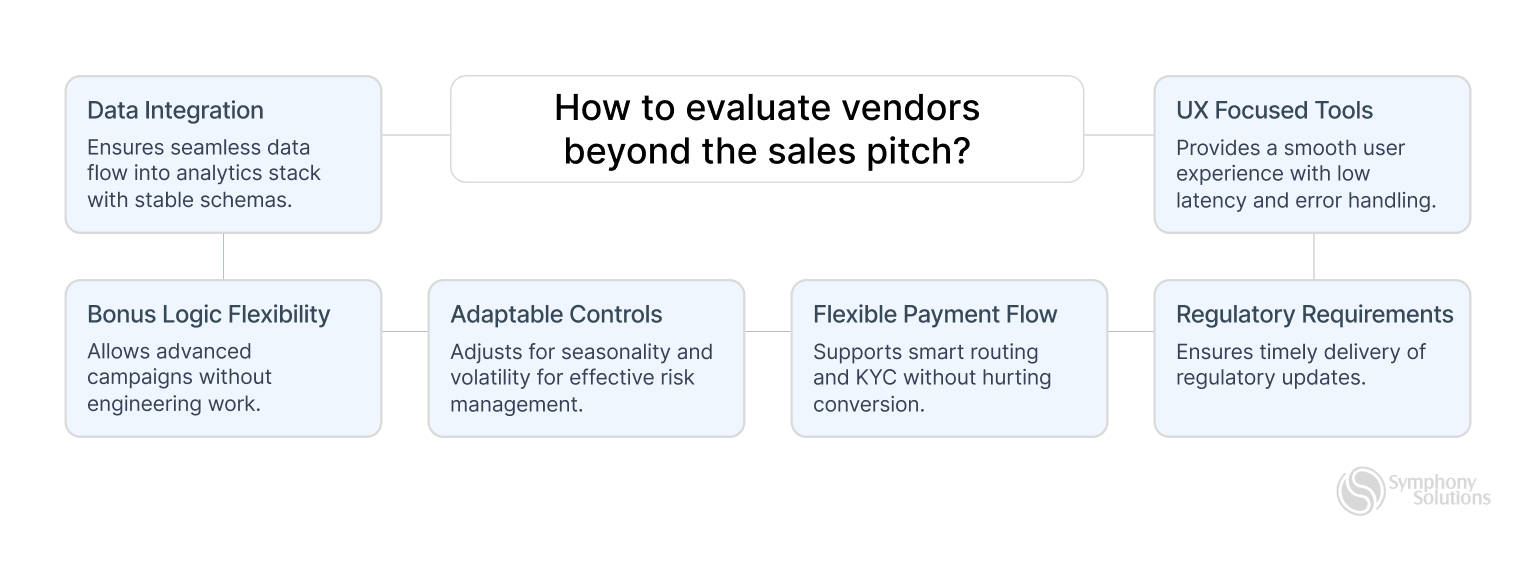
    Sales decks highlight features. Experienced operators look at execution, flexibility, and operational depth. Key questions worth asking include:

    • Does event data flow cleanly into your analytics stack with stable, well-documented schemas?
    • Will the platform integrate seamlessly with required tools, sports feeds, game providers, and other critical systems?
    • How flexible is bonus logic, can you run advanced campaigns without engineering work?
    • How adaptable are trading and risk controls to seasonality and volatility?
    • Is the payment flow flexible and configurable to your specific operational and regulatory needs?
    • Does the vendor have a proven track record of shipping regulatory updates on time?
    • Are UX fundamentals strong, latency, error handling, mobile flow, and friction control?

    In practice, small operational details often have a bigger impact on revenue and margin than headline features.

    White Label vs Turnkey vs Ownership: How Each Model Actually Works
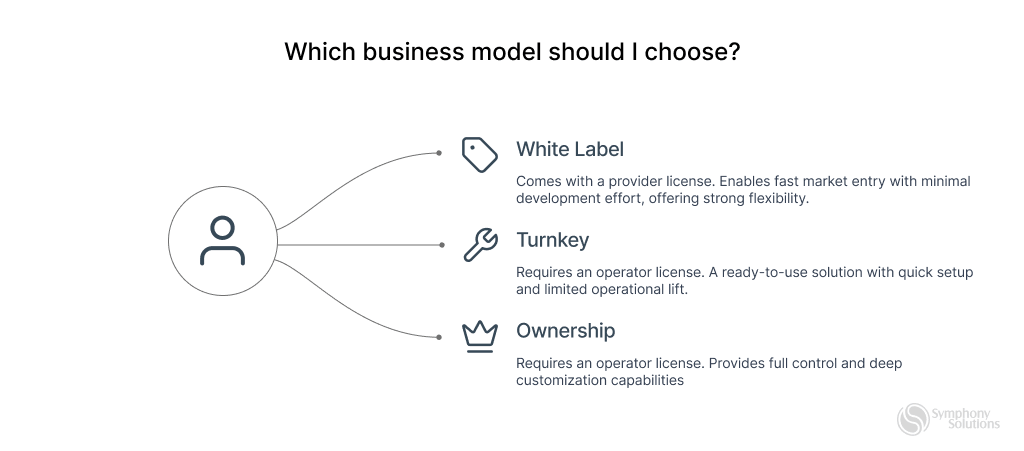
    business model

    Ownership / No-Rev-Share Sportsbook and Casino

    What no-rev-share sportsbook and casino Actually Means

    Under a no-rev-share sportsbook and casino model, the operator fully owns and controls the platform. This typically includes access to source code (or escrow), infrastructure, deployments, product roadmap, integrations, pricing logic, and player data. This removes reliance on vendor-imposed limits or embedded revenue share. 

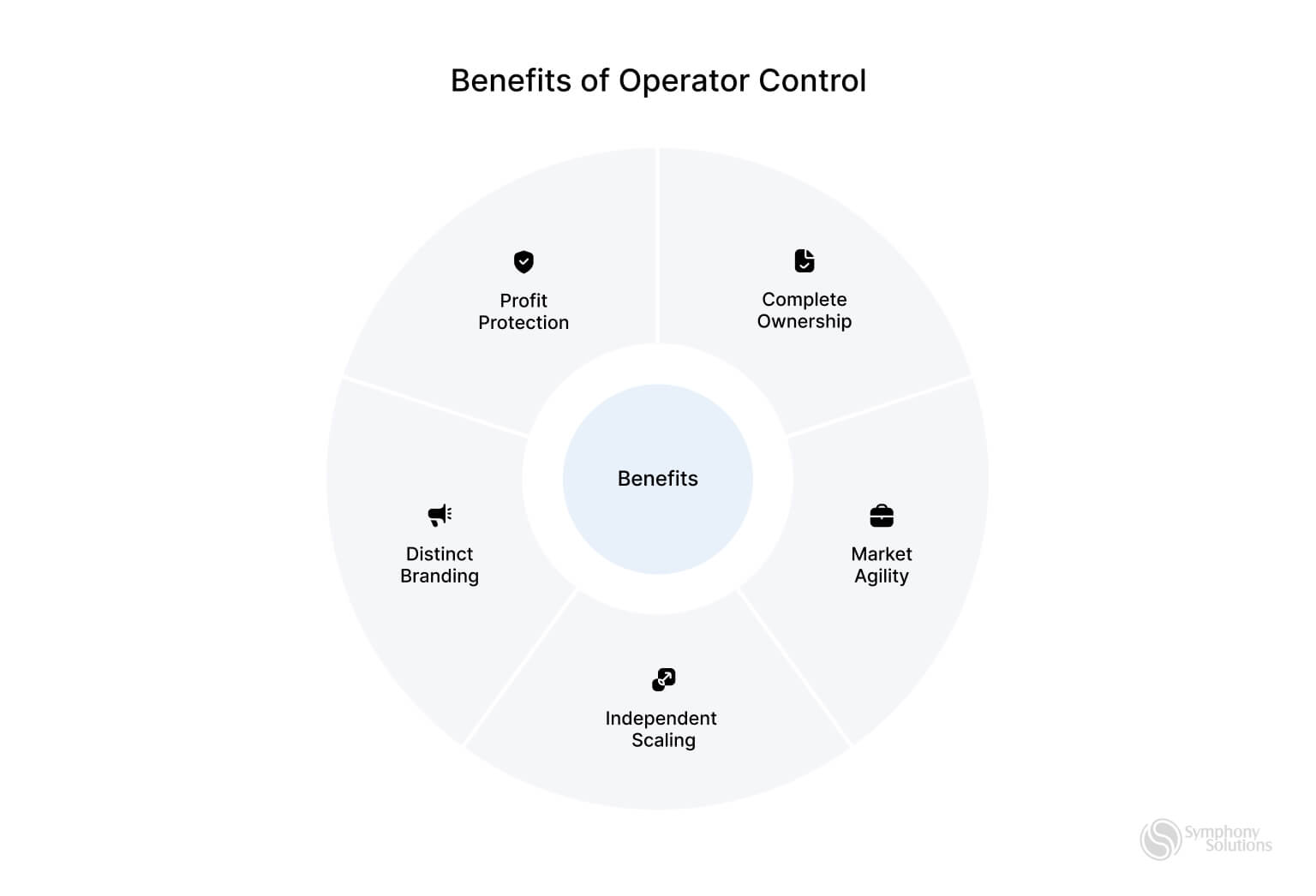
    Compared to white label and turnkey, ownership shifts more responsibility in-house, but unlocks greater margin control, deeper product flexibility, and long-term strategic independence. It empowers operators to build true market differentiation, stand out clearly from competitors, and shape a product experience that reflects their unique brand. The platform evolves from a rented tool into a core strategic asset that drives sustainable competitive advantage.

    Why Operators Choose Ownership

    Operators usually explore ownership when platform fees start meaningfully impacting profitability or when vendor constraints slow innovation or differentiation.

    Common drivers include:

    • Reducing long-term revenue share and improving GGR retention
    • Gaining control over sportsbook logic, risk, CRM, loyalty, and promotions
    • Building a more distinctive product and brand experience
    • Increasing leverage with suppliers and payment providers
    • Owning player data to improve retention, segmentation, and LTV (Lifetime Value)
    • Strengthening positioning for fundraising, M&A (Mergers and Acquisitions), or exit opportunities

    When paired with a clear roadmap, ownership becomes a lever for margin optimization, faster iteration, and long-term control.

    Ownership in Practice: Benefits vs Trade-Offs
    BenefitEnablesRequires
    Better margin retentionLower or no platform revenue shareManaging and operating the platform in-house
    Full roadmap controlShorter time to market and faster adaptation to market needsIn-house product expertise supported by clear, disciplined prioritization
    Deeper customizationProprietary trading, CRM, and loyalty systems tailored to your specific business needsOngoing dev & QA capacity
    Lower vendor dependencyGreater commercial leverageInternal accountability
    Stronger valuation narrativeHigher investor confidenceGovernance and cost transparency

    Who Ownership Is Best Suited For

    Ownership tends to work best for operators with scale, internal capability, and a long-term product vision, where deeper control translates into real business value.

    Operator ProfileFitWhy
    Established operators with revenueStrongPlatform costs impact EBITDA
    Product-led brands investing in differentiationStrongEnables proprietary UX and logic
    Multi-brand or multi-market groupsStrongGreater flexibility at scale
    Operators planning fundraising or M&AStrongPlatform control improves valuation
    Teams with mature product & tech capacityStrongBetter equipped to manage complexity
    Early-stage teams focused on speedWeakerHigher cost and longer timelines
    Teams with limited technical leadershipWeakerHigher execution risk 
    Note: Depends on the development partner. With an experienced domain team like Symphony Solutions, risks are minimized.
    Operators wanting fully managed platformsPoorOwnership requires hands-on control

    Top 3 Ownership / Source-Code Model Providers

    BETSYMPHONY

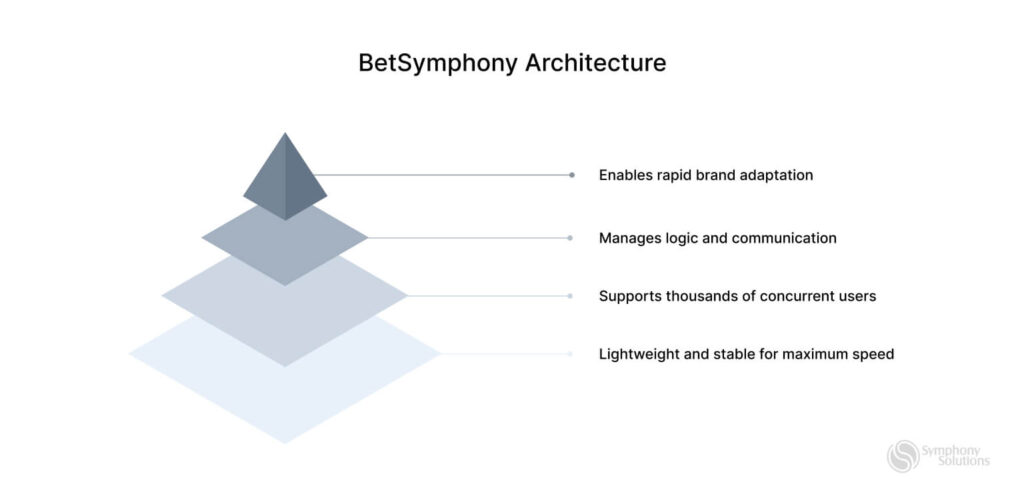
    BetSymphony is an ownership-focused iGaming platform with sportsbook and casino developed by Symphony Solutions, designed for operators who want full control over their technology, product roadmap, and margins.

    The platform is built around source-code ownership, zero revenue share, and deep customization, enabling teams to shape frontend experience, trading logic, integrations, and monetization without vendor constraints.

    While ownership models typically require strong in-house technical expertise, BetSymphony is backed by Symphony Solutions as a reliable technology partner. This ensures operators gain full control without carrying the entire technical burden alone.

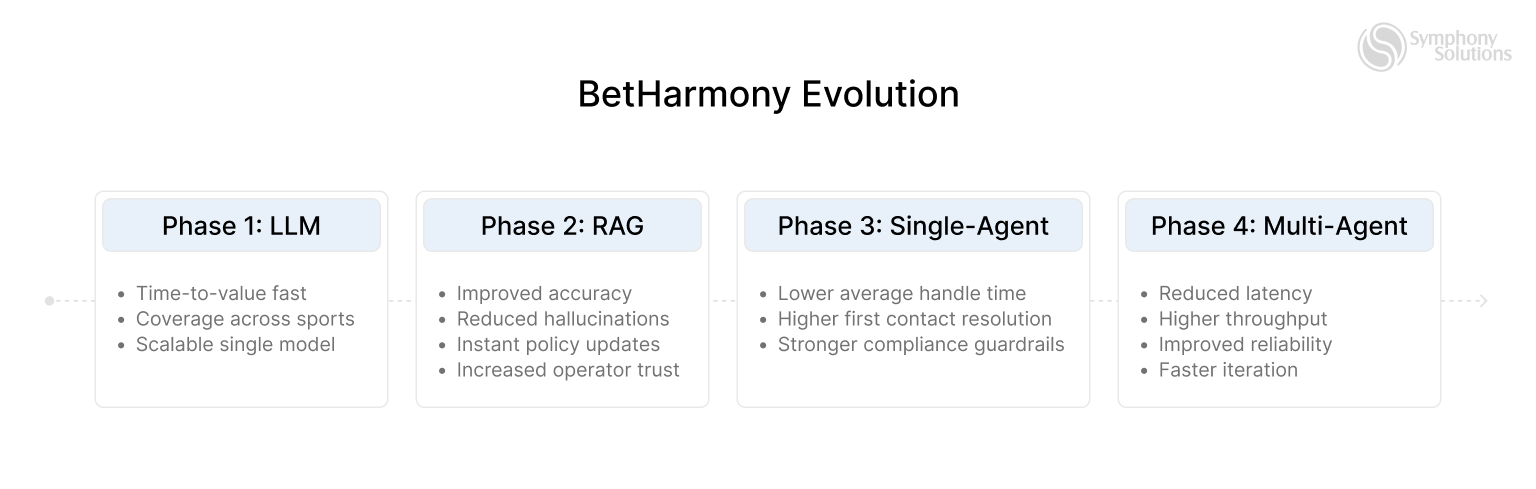
    • Key Features: Full source-code ownership, iGaming platform with sportsbook and casino. It comes with pre-match and live betting, customizable frontend and backend, multi-brand and multi-market support, bonus engine, and AI-powered engagement via BetHarmony
    • Licensing: Built to support regulated-market operations, with configurable compliance controls such as responsible gaming, limits, and jurisdiction-specific rules; licensing depends on operator and region. 
    • Strengths: No revenue-share model, full roadmap autonomy, deep customization flexibility, modern scalable architecture, strong positioning for margin optimization and long-term platform independence. 
    • Weaknesses: Requires stronger internal product and technical capability than turnkey or white label; higher upfront commitment compared to vendor-managed models. 

    Note: Product development and technical execution are covered by Symphony  Solutions, while licensing and operational management are handled by the operator. 

    • Ideal For: Operators seeking long-term ownership, margin control, and freedom to build a differentiated iGaming product without vendor lock-in. 
    • Pricing: License-based commercial model with custom pricing depending on platform scope, integrations, and ownership structure. 

    IQ SOFT

    IQ Soft is an Armenia-based iGaming technology provider offering casino, sportsbook, and multi-channel platform solutions with a strong focus on operator independence. The company positions itself around flexible business models, including turnkey, revenue share, and source-code ownership options, while supporting online, retail, and hybrid betting operations across multiple regions.

    • Key Features: Core iGaming platform, sportsbook solution with live and pre-match betting, casino engine and game aggregation (30,000+ games), agent and affiliate system, bonus and gamification tools, crypto and blockchain-enabled products.
    • Licensing: Supports operations across multiple jurisdictions and assists operators with regulatory and licensing requirements depending on market and business model.
    • Strengths: Strong focus on platform ownership and independence, broad product suite covering casino, sportsbook, and retail, extensive game and payment aggregation, flexible commercial models.
    • Weaknesses: Brand visibility is lower compared to tier-one global providers; platform documentation and onboarding experience may vary by region and project scope.
    • Ideal For: Operators seeking flexible platform ownership options, agent-based business models, or multi-channel betting solutions across online and retail environments.
    • Pricing: Custom commercial terms based on chosen business model, platform modules, integrations, and licensing needs.

    QUANTUM GAMING

    Quantum Gaming is an iGaming platform provider specializing in sportsbook-focused solutions, with additional casino and player management capabilities. The company emphasizes risk management, trading flexibility, and scalable infrastructure designed to support both emerging and regulated markets, with a focus on performance, customization, and operational control. 

    • Key Features: Sportsbook platform with pre-match and live betting, trading and risk management tools, casino integration and game aggregation, player account management (PAM), CRM and bonus systems, multi-currency and multi-language support. 
    • Licensing: Supports operators across various jurisdictions and can assist with compliance and licensing requirements depending on market and regulatory framework. 
    • Strengths: Strong sportsbook and trading focus, flexible risk and odds management, customizable platform architecture, scalable infrastructure for growth across multiple regions. 
    • Weaknesses: Smaller market presence compared to tier-one global providers; casino and non-sports modules may be less extensive than sportsbook-centric competitors. 
    • Ideal For: Operators prioritizing sportsbook performance, risk control, and platform flexibility, especially in growth-stage or emerging markets. 
    • Pricing: Custom commercial terms based on platform scope, sportsbook depth, integrations, and regulatory requirements. 

    Turnkey Model 

    What Turnkey Actually Means 

    A turnkey model means the operator runs the business, while the vendor runs most of the technology. The platform usually comes with sportsbook, casino, payments, CRM, hosting, and compliance ready out of the box, letting teams focus on branding, marketing, and growth instead of infrastructure. 

    turnkey offers a balanced approach to business operations

    Turnkey offers more control than white label, but less freedom than ownership. In practice, it’s a middle ground that prioritizes faster launch, reasonable flexibility, and shared responsibility without full platform ownership. 

    Why Operators Choose Turnkey 

    Operators typically choose turnkey when they want faster time-to-market than ownership but without giving up full business control like in white label. 

    Common motivations include: 

    • Launching faster without building a platform in-house 
    • Retaining control over bonuses, PSP routing, compliance, and promotions 
    • Expanding into multiple regulated markets with vendor-supported tooling 
    • Reducing technical overhead while keeping brand and commercial independence 
    • Accessing established sportsbook and casino ecosystems 
    • Scaling operations without fully internalizing engineering and DevOps 

    When aligned with the right growth stage, turnkey can offer a balanced mix of speed, structure, and control

    Turnkey in Practice: Benefits vs Trade-Offs 
    Operator Benefit What It Enables What It Requires 
    Faster launch Shorter implementation timelines Provider roadmap dependency 
    Moderate margin control Less rev share than white label Platform and supplier fees 
    Operational simplicity Vendor-managed infrastructure Limited deep customization 
    Multi-market readiness Easier regulatory expansion Reliance on vendor compliance updates 
    Lower technical burden Smaller in-house tech team Less control over platform internals 

    Who Turnkey Is Best Suited For 

    Turnkey tends to work best for operators who want to scale efficiently without fully owning the platform stack, especially when speed and regulatory readiness matter. 

    Turnkey Fit by Operator Profile 
    Operator Profile Compatibility Why 
    Growth-stage operator expanding across markets Strong  Faster rollout with vendor-supported compliance 
    Operator launching multiple brands Strong Shared infrastructure with lower overhead 
    Teams with limited engineering capacity Strong Provider manages platform complexity 
    Operator prioritizing speed and stability Strong  Faster launch with predictable operations 
    Mature operator optimizing for full margin control Weak Platform fees may limit long-term margins 
    Product-led brand seeking deep customization Weak Provider roadmap can constrain innovation 
    Operator wanting full platform ownership Poor Turnkey remains vendor-dependent 

    Top 3 Turnkey Platform Providers 

    Soft2Bet 

    Soft2Bet is a Malta-based iGaming platform provider offering turnkey and white label solutions for online casino and sportsbook operators. The company is known for its strong presence in regulated markets, its proprietary MEGA gamification engine, and a modular platform designed to support rapid multi-market expansion and localization at scale. 

    • Key Features: Turnkey casino and sportsbook platform, MEGA gamification engine for retention and engagement, large casino and sportsbook content coverage, multi-brand and multi-market support, advanced CRM and bonus tooling, broad localization and language capabilities. 
    • Licensing: Holds and supports operations across multiple regulated jurisdictions, including Malta, Sweden, Denmark, Greece, Romania, Italy, Ireland, Ontario (Canada), and others; assists partners with licensing depending on market. 
    • Strengths: Strong gamification and retention layer (MEGA), experience operating in regulated markets, scalable multi-brand infrastructure, solid sportsbook and casino coverage, growing global footprint. 
    • Weaknesses: Platform complexity may be higher for small or early-stage operators; some features and gamification layers may require additional integration effort depending on setup. 
    • Ideal For: Operators planning rapid multi-market expansion who value gamification, localization depth, and a platform built for regulated environments. 
    • Pricing: Custom commercial terms based on platform scope, licensing, content coverage, and operational requirements. 

    Uplatform 

    Uplatform is an iGaming platform provider focused on helping operators launch across multiple markets and scale quickly with both casino and sportsbook products. The platform emphasizes localization, content depth, and operational tooling designed to support expansion in regulated and emerging regions, with broad coverage across sports events, casino games, languages, and payment methods. 

    • Key Features: Turnkey sportsbook and casino platform, coverage of 1.5M+ pre-match and live sports events annually, 16,500+ casino games from 200+ providers, support for 65+ languages, 500+ payment methods, affiliate and agent scheme tooling for multi-market growth. 
    • Licensing: Supports operators entering regulated and emerging markets and may assist with licensing and compliance depending on jurisdiction. 
    • Strengths: Strong localization capabilities, extensive sportsbook and casino content coverage, large payment ecosystem, scalable multi-market infrastructure, useful affiliate and agent management tools. 
    • Weaknesses: Platform breadth and configuration options may feel complex for smaller teams; brand recognition is still developing compared to longer-established tier-one providers. 
    • Ideal For: Operators planning rapid multi-market expansion who need broad content coverage, strong localization, and scalable infrastructure for casino and sportsbook operations. 
    • Pricing: Custom commercial terms based on platform scope, integrations, content coverage, and regional requirements. 

    Gamingtec (GT Turnkey)  

    Gamingtec is an iGaming technology provider delivering a turnkey platform for launching and operating online casinos and sportsbooks. The company focuses on platform flexibility, broad game coverage, integrated payments, and back-office tools designed to streamline operations and support scalable growth. 

    • Key Features: Turnkey casino and sportsbook platform, large game aggregation library, integrated sportsbook module, CRM and bonus management tools, customizable frontend, multi-currency and multi-language support. 
    • Licensing: Commonly supports operations under Curaçao licensing and may assist with regulatory setup depending on jurisdiction. 
    • Strengths: Flexible platform configuration, balanced casino and sportsbook offering, strong user experience focus, relatively fast deployment timelines. 
    • Weaknesses: Brand recognition is still developing compared to long-established providers; regulatory depth in highly complex markets may vary. 
    • Ideal For: Operators seeking a modern, adaptable casino and sportsbook platform with a solid feature set and reasonable customization options. 
    • Pricing: Custom quotes based on platform scope, integrations, licensing requirements, and operational needs. 

    White Label Model 

    What White Label Actually Means 

    A turnkey model means the operator runs the business, while the vendor runs most of the technology. The platform usually comes with sportsbook, casino, payments, CRM, hosting, and compliance ready out of the box, letting teams focus on branding, marketing, and growth instead of infrastructure.
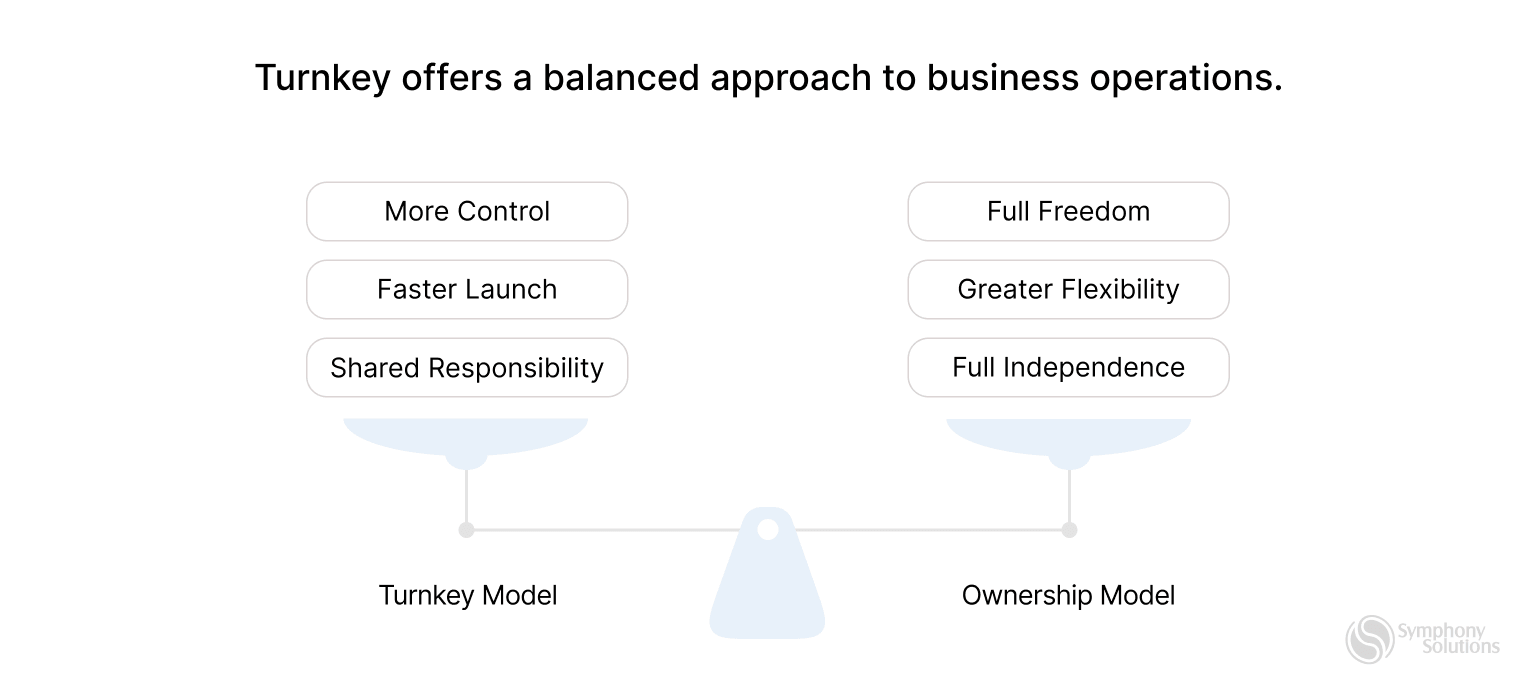
    Turnkey offers more control than white label, but less freedom than ownership. In practice, it’s a middle ground that prioritizes faster launch, reasonable flexibility, and shared responsibility without full platform ownership.

    Unlike a turnkey setup, where the operator receives a fully built platform and then owns and operates it, white label keeps the platform under the vendor’s control. In a turnkey model, the operator manages infrastructure, integrations, licensing strategy, and often the long-term technical roadmap. With white label, those responsibilities stay with the provider, while the operator focuses on branding, marketing, player acquisition, and basic configuration. 

    White label is the fastest and simplest way to go live, with low upfront effort. The trade-off is higher revenue share, limited customization, and strong vendor dependency, making it best for speed and simplicity rather than deep control or margin optimization. 

    Why Operators Choose White Label 

    Operators usually choose white label when they want to launch quickly, minimize operational overhead, or test market demand without committing to heavy upfront investment. 

    Common motivations include: 

    • Launching a casino or sportsbook as quickly as possible 
    • Avoiding the need to manage technology, hosting, and compliance 
    • Reducing upfront costs and internal technical requirements 
    • Testing new markets, brands, or acquisition channels 
    • Running media-led or affiliate-driven brands with minimal infrastructure 
    • Leveraging vendor-provided licensing or regulatory coverage in certain markets 

    When used strategically, white label can be an effective way to validate demand, enter new regions, or operate smaller satellite brands. 

    White Label in Practice: Benefits vs Trade-Offs 

    Operator Benefit What It Enables What It Requires 
    Fastest launch Go live in weeks, not months Limited product and UX control 
    Lowest upfront cost Minimal initial investment Higher long-term revenue share 
    Operational simplicity Provider handles tech and compliance Strong vendor dependency 
    Reduced regulatory burden Easier market entry in some regions Limited control over licensing setup 
    Easy market testing Quick validation of new brands or GEOs Migration can be complex later 

    Who White Label Is Best Suited For 

    White label tends to work best for operators who prioritize speed, simplicity, and low upfront risk, especially in early-stage or experimental setups. 

    Operator Profile White Label Fit Why 
    Early-stage startup testing demand Strong Fast launch with minimal investment 
    Media, affiliate, or influencer brand Strong Monetize traffic without tech overhead 
    Operator launching a short-term or niche brand Strong Quick setup with limited commitment 
    Team with limited technical or operational capacity Strong Vendor handles platform complexity 
    Growth-stage operator optimizing margins Weaker Revenue share limits profitability 
    Product-led brand seeking differentiation Weaker Limited customization and roadmap control, plus competitors use more or less the same product. 
    Operator planning long-term scale or ownership Poor Vendor lock-in can constrain future moves 

    Top 3 White Label Platform Providers 

    SoftSwiss  

    SoftSwiss is a well-established iGaming technology provider delivering a mature white label casino platform designed for scalability and performance. The company is recognized for its stable infrastructure, large-scale game aggregation featuring content from leading studios, a flexible bonus framework, and strong capabilities in cryptocurrency-based gaming. Its in-house game studio, BGaming, adds proprietary titles to its overall content portfolio. 

    • Key Features: Full-scale casino platform, extensive game content library, crypto-oriented payment support, advanced bonus and promotional engine, affiliate tracking system (Affilka), comprehensive back-office tools. 
    • Licensing: Solutions are commonly offered under Curaçao or MGA licenses (operators should confirm jurisdictional specifics). 
    • Strengths: Established market presence, broad game selection, crypto-native functionality, reliable platform performance, feature-rich ecosystem. 
    • Weaknesses: Entry costs may be higher for smaller or early-stage operators; high platform demand can occasionally affect onboarding timelines. 
    • Ideal For: Operators looking for a high-end, scalable white label casino solution with strong content depth and cryptocurrency support. 
    • Pricing: Tailored commercial terms depending on platform scope, licensing, and operational requirements. 

    EveryMatrix 

    EveryMatrix is a large B2B iGaming technology provider, with CasinoEngine serving as its flagship casino aggregation and management platform. The solution is widely recognized for its extensive game portfolio, modular architecture, and ability to support both white label deployments and integrations into existing operator stacks. 

    • Key Features: CasinoEngine game aggregator with thousands of titles, BonusEngine for advanced promotions, GamMatrix for player and gaming management, MoneyMatrix for payment processing, modular platform components, enterprise-grade infrastructure. 
    • Licensing: Supports operations across multiple regulated markets and can assist with licensing depending on jurisdiction. 
    • Strengths: Extremely large game library, advanced bonus and gamification capabilities, strong technical foundation, flexible modular design for scaling. 
    • Weaknesses: Enterprise-oriented structure can make setup more complex and costly; may be excessive for small or simple casino projects. 
    • Ideal For: Established operators or well-funded businesses seeking a highly scalable casino platform with deep content coverage and advanced tooling. 
    • Pricing: Enterprise-level pricing, typically based on platform scope and integration complexity; consultation required. 

    SoftGamings 

    SoftGamings is an established iGaming platform provider offering a full white label casino solution alongside sportsbook, game aggregation, and payment infrastructure. The company is known for its extensive content library, broad payment coverage, and flexible platform options that support both turnkey launches and API-based integrations. 

    • Key Features: Turnkey and API-based platform options, 10,000+ games from 200+ providers, loyalty and retention tools, bonus and promotional systems, crypto casino capabilities, multiple licensing pathways. 
    • Licensing: Can support operators with various licensing frameworks or provide solutions under its own licensing umbrella. 
    • Strengths: Extremely large game portfolio, wide range of payment integrations, flexible platform structure, strong emphasis on customization and scalability. 
    • Weaknesses: The breadth of features and configuration options may feel complex for newer operators without structured onboarding or guidance. 
    • Ideal For: Operators seeking a very large game catalog combined with deep platform customization and flexible deployment models. 
    • Pricing: Custom commercial proposals based on selected modules, services, and operational scope. 

    The Cost Conversation Operators Actually Need to Have 

    When operators ask about platform pricing, they often expect a simple number. In reality, costs are layered and structural. 

    White label tends to minimize upfront investment but embeds higher long-term revenue share. Turnkey typically combines setup fees, monthly platform costs, integrations, and supplier or sportsbook rev share. Ownership models often reduce ongoing revenue leakage but require higher upfront spend and more internal responsibility. 

    For operators thinking long term, the key metric isn’t launch cost, it’s marginal cost per additional brand or market, which often determines whether scaling actually increases profitability. 

    TL;DR 

    Model Best For Speed to Launch Control Vendor 
    Lock-in 
    Scalability Example Providers 
    Ownership / Source-Code Mature operators, margin optimization, differentiation Slowest (3–6+ months) Full Low Excellent BetSymphony
    IQSoft,  
    Quantum 
    Gaming 
    Turn key Growth-stage operators, multi-market expansion Fast (2–4 months) Limited–Moderate Medium Good Soft2Bet, 
    Uplatform, 
    Gamingtec 
    White Label Fast launch, testing markets, low upfront risk Fastest (weeks) Very limited High Limited SoftSwiss, 
    SoftGamings, 
    EveryMatrix 
    (WL) 

    The Takeaway 

    Choosing an iGaming platform is not a technical detail. It is a long-term business decision that shapes margin, speed, control, scalability, and enterprise value. The right model depends on an operator’s revenue stage, internal capabilities, risk tolerance, and strategic priorities, not on vendor promises or feature lists. 

    White label is best for fast validation and low-risk market entry, but rarely sustainable at scale. Turnkey works well for growth and multi-market expansion, but can introduce dependency and margin pressure over time. Ownership offers the highest level of control and long-term margin potential, but only works when the organization has the operational maturity to manage it. 

    The most successful operators treat platform economics as a profit lever, not an IT decision. They plan for migration before it becomes urgent, measure long-term margin impact instead of short-term cost, and align platform strategy with where they want the business to be in three to five years. 

    The best platform is not the one that launches fastest or looks best in a demo. It is the one that supports sustainable profitability, strategic flexibility, and long-term value creation. 

  • Symphony Solutions Becomes a Fully Registered ESA Partner

    Symphony Solutions Becomes a Fully Registered ESA Partner

    Charting New Orbits. Together, Beyond the Horizon. 

    We’re pleased to announce that Symphony Solutions Netherlands BV has become a fully registered partner of ESA, the European Space Agency. This collaboration brings together Symphony Solutions’ deep expertise in AI-driven IT transformation with ESA’s extraordinary goal to advance space science, Earth observation, and planetary exploration on behalf of Europe and humanity. 

    The partnership is a natural progression of Symphony Solutions’ work in mission-critical, high-availability systems. Our background in transforming complex airline IT infrastructure, where reliability and precision are non-negotiable, maps directly onto the demands of space operations. The same engineering discipline that underpins mission-critical aviation systems is precisely what ambitious space programs require to scale effectively and perform flawlessly. 

    ESA’s portfolio spans an impressive breadth of ambition: from the Orion Service Module powering NASA’s Artemis program, to the Hera planetary defense probe en route to an asteroid. These programs represent some of the most complex and consequential engineering challenges of our time, and they demand IT systems built to match. As a registered ESA partner, Symphony Solutions enters a collaboration framework designed to enable joint innovation and shared expertise across the future of European space infrastructure. 

    This partnership marks an exciting new chapter for Symphony Solutions, extending our commitment to mission-critical transformation into one of the world’s most demanding and inspiring domains. We look forward to contributing to the systems and infrastructure that will shape humanity’s reach beyond our planet. 

    About ESA  

    ESA, the European Space Agency, is Europe’s gateway to space. ESA develops and manages missions studying Earth, our Solar System, and the wider universe, advancing satellite technology and services that shape our understanding of the world and beyond. ESA’s programs span space science, Earth observation, navigation, and planetary defense, with landmark projects including the Orion Service Module for NASA’s Artemis mission and the Hera asteroid probe.  

  • Cloud Cost Optimization in 2026: How Organizations Are Tackling Cloud Waste 

    Cloud Cost Optimization in 2026: How Organizations Are Tackling Cloud Waste 

    In 2026, cloud waste has evolved from a simple IT nuisance into a direct hit on business performance. According to Flexera’s latest findings, a staggering 84% of organizations name cloud spend management as their number one challenge. And this goes beyond a headline, enterprises surpassing $12 million in annual cloud spend grew from 36% to 40% last year—and they expect that spend to climb by another 28% in 2026.

    This reality shows that while cloud adoption delivers powerful new capabilities, it also exposes deep overspending across compute, storage, and services.

    To get ahead of these rising expenses, leading organizations recognize that cloud cost optimization is no longer a reactive exercise. It must become a structured, ongoing discipline, woven into both engineering and financial decisions.

    What’s driving cloud waste

    Organizations early in their FinOps journey report waste levels approaching 30% of total cloud spend, according to the FinOps Foundation’s State of FinOps data. For many enterprises in 2026, that level of inefficiency remains the baseline rather than the exception.

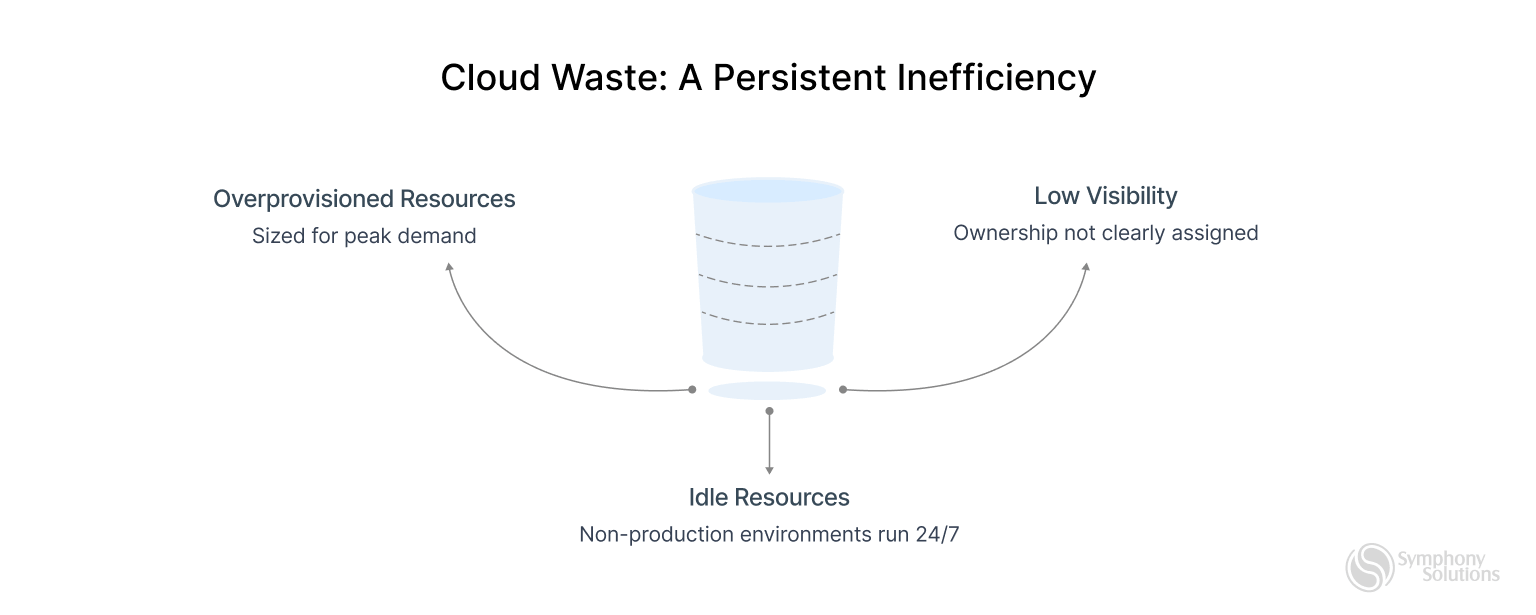
    cloud-waste

    Despite improved tooling and greater cloud maturity, waste continues to stem from a small number of recurring patterns.

    Overprovisioned compute and storage

    Teams often size infrastructure for peak demand and then pay peak pricing continuously. This results in oversized virtual machines, over-allocated databases, and storage tiers that are never revisited after deployment. Without continuous rightsizing, assumptions made during initial deployment become long-term fixed costs.

    Idle resources and underutilized services

    Non-production environments frequently run 24/7, even when development activity has stopped. “Zombie” resources (unused disks, orphaned snapshots, unattached IP addresses, and idle load balancers) accumulate silently because deletion feels risky. Over time, these small inefficiencies compound into significant recurring spend, especially when cloud performance issues go unchecked.

    Low visibility across teams and environments

    Cloud costs are often tracked at the account or subscription level, while product teams organize engineering delivery. When ownership is not clearly assigned at the workload level, accountability weakens. If no team is responsible for usage, optimization becomes optional, and waste persists.

    Understanding the sources of waste is only the first step. The next step is understanding how leading organizations address it in a structured and repeatable way.

    Cloud cost optimization strategies that actually work in 2026

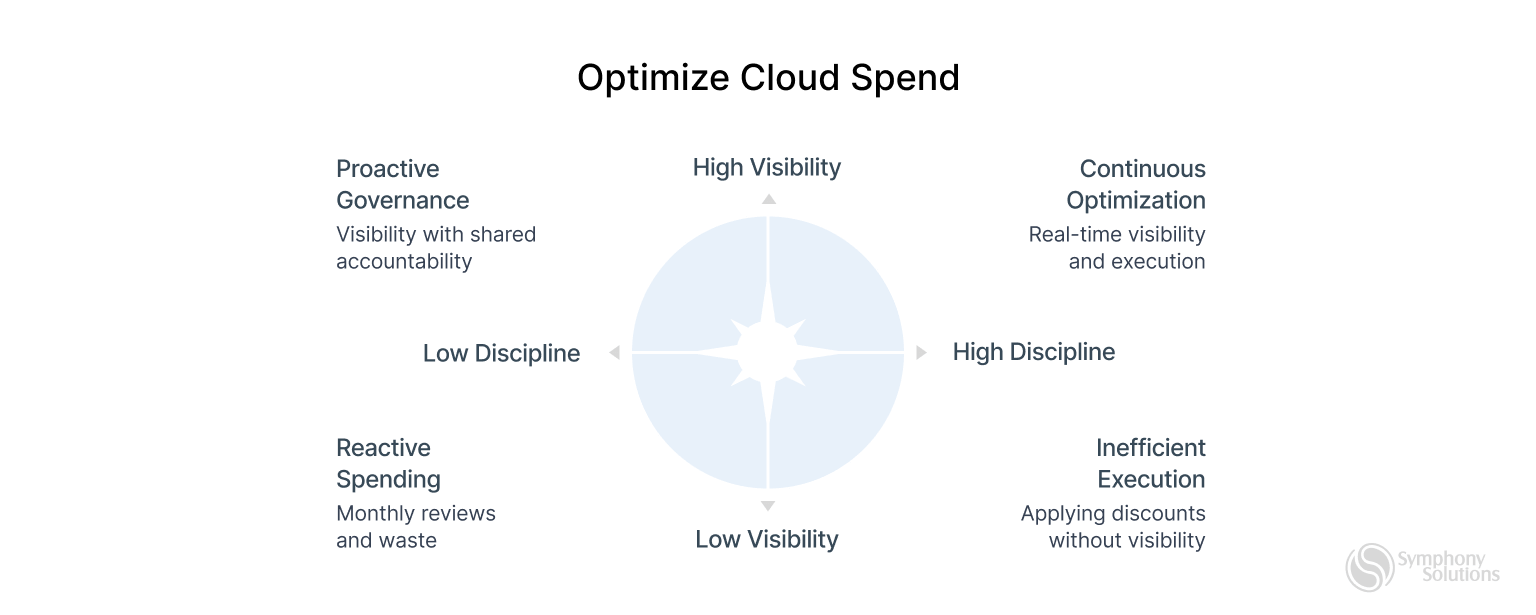
    The most effective cloud cost optimization strategies combine three elements: operating discipline, engineering execution, and governance. In 2026, cost control is not a one-time savings initiative. It is built into how cloud environments are designed, monitored, and improved.

    optimize-cloud-spend

    1. FinOps operating models that create shared accountability

    FinOps is no longer a monthly review of the cloud invoice. It is a structured collaboration between engineering, finance, and leadership. Together, they define how cloud costs are measured, allocated, and optimized.

    State of FinOps reporting shows that workload optimization and waste reduction remain top priorities for practitioners. The scope is also expanding. In 2025, 40% of FinOps teams were already managing SaaS spend, with that number expected to rise to 65% within a year. This signals that governance is extending beyond infrastructure into broader technology spending.

    Mature FinOps teams typically standardize:

    • Mandatory tagging for cost allocation (owner, product, environment, cost center).
    • Unit economics tracking (cost per customer, cost per transaction, cost per AI workload).
    • Weekly cost anomaly reviews owned by engineering.
    • Clear accountability for every production workload.

    When cost becomes a shared performance metric, optimization becomes continuous rather than reactive.

    2. Rightsizing, scheduling, and commitment optimization — in that order

    The fastest savings come from eliminating obvious waste before purchasing discounts. High-impact cloud cost optimization techniques include:

    • Rightsizing compute, databases, and Kubernetes resources based on actual utilization.
    • Automated shutdown schedules for development and test environments.
    • Storage lifecycle policies that move cold data to lower-cost tiers.
    • Commitment-based discounts (Reserved Instances, Savings Plans, committed use discounts) applied after workloads are correctly sized.

    Major cloud providers reinforce this approach. AWS’s Well-Architected Cost Optimization Pillar emphasizes continuous measurement and governance. Microsoft Azure promotes resizing and automated shutdown recommendations through Azure Advisor.

    Applying discounts before correcting usage simply locks inefficiency into long-term contracts.

    3. Real-time visibility and forecasting

    Cost optimization fails when it relies on monthly reporting. In 2026, leading organizations operate with:

    • Near real-time cost visibility.
    • Automated budget alerts and anomaly detection.
    • Forecasts that adjust as usage changes (product launches, traffic spikes, AI workloads).

    Google’s Cloud FinOps guidance highlights transparency and internal chargeback as foundations for accountability. Without ownership, optimization stalls. With ownership, cloud spend becomes predictable and controllable.

    However, defining the right strategy is only part of the equation. Sustained savings require operational discipline that extends beyond planning and into execution.

    Technology and governance enablers

    Optimization becomes durable only when it is reinforced by technical infrastructure and governance frameworks. In 2026, organizations that are reducing cloud spend do so by embedding cost discipline directly into platforms, policies, and delivery workflows.

    Cloud cost optimization solutions: tools, guardrails, and governance

    Tools do not replace discipline; they make discipline scalable. High-performing teams standardize the following categories of enablement.

    1. Cost monitoring and recommendation tooling

    Organizations combine provider-native tools with broader FinOps platforms to create centralized visibility. Common examples include:

    • AWS Cost Explorer and Compute Optimizer.
    • Azure Cost Management and Azure Advisor.
    • Google Cloud Billing and FinOps Hub.

    These platforms consolidate savings recommendations, track implementation progress, and surface anomalies early. The goal is not just reporting—but continuous visibility tied to accountability.

    2. Policy-driven guardrails

    Optimization cannot depend on manual effort alone. Mature cloud governance strategies embed cost control into policy. Typical guardrails include:

    • Blocking untagged resources from being deployed to production.

    • Enforcing automated shutdown schedules for dev/test environments.
    • Defaulting to autoscaling configurations where appropriate.
    • Restricting high-cost instance families unless justified and approved.

    These controls prevent waste from re-entering the system after initial cleanup efforts.

    3. Governance that prevents cost regression

    A common failure pattern is predictable: a major cost-reduction initiative delivers savings, then gradual inefficiencies return over the following quarters. Sustainable cloud cost optimization requires:

    • Continuous monitoring.
    • Executive visibility into cost KPIs.
    • Regular workload reviews.
    • Integration of cost metrics into architectural decisions.

    The objective is stability, not one-time savings.

    When complexity requires external expertise

    As cloud environments scale, architecture, platform engineering, and governance become inseparable. Infrastructure decisions directly impact cost control. Many organizations engage external expertise to ensure modernization initiatives align with FinOps guardrails from the start.

    Without this alignment, problems follow. Cloud-native transformation without governance invites waste. Managed services without visibility weaken accountability. External expertise (including specialized cloud cost optimization services) reinforces cost discipline instead of allowing inefficiencies to compound.

    Real-world examples: what “savings” looks like when it’s done right

    A persistent misconception is that cloud cost management produces only marginal savings. In reality, disciplined programs deliver material financial impact when executed systematically.

    A clear example comes from GE Vernova (AWS case study), where engineering teams reduced cloud costs by more than $1 million. The savings were not the result of a single discount or contract renegotiation. They came from a structured approach that combined automation, database optimization, lifecycle management, and systematic rightsizing. The takeaway is not vendor-specific; it is procedural. Effective optimization follows a repeatable sequence:

    Visibility > Rightsizing > Automation > Continuous Governance

    When organizations follow this progression, savings are not temporary. They become embedded in operational discipline.

    Final word

    Cloud cost optimization in 2026 is a continuous operating system, not a quarterly clean-up exercise. The organizations that control cloud spend do not necessarily spend less—they spend deliberately. They retain the flexibility to fund growth, absorb volatility driven by data and AI workloads, and make architectural tradeoffs with clear financial visibility.

    The pattern behind sustained efficiency is consistent. It begins with establishing ownership through FinOps. It continues with eliminating structural waste through rightsizing and intelligent scheduling. It is reinforced by governance guardrails and forecasting that prevent regression. Then it repeats, systematically.

    For organizations modernizing their cloud architecture or strengthening governance models, aligning engineering decisions with structured cost discipline often requires both technical depth and strategic oversight. This is where experienced cloud-native and technology consulting partners, such as Symphony Solutions, play a critical role. They embed cost optimization into modernization initiatives instead of approaching it as a standalone cost-reduction exercise.

    FAQs

  • Almost EUR 1 Million in Support for Mobilized Colleagues

    Almost EUR 1 Million in Support for Mobilized Colleagues

    Since 2022, Symphony and its customers have provided almost EUR 1 million for mobilized Symphonians while continuing to contribute to rehabilitation efforts in Ukraine.

    February 24 is not just a date in the calendar. For Ukrainians, it marks the moment life changed, and the moment resilience became everyday reality. At Symphony Solutions, we’ve learned one thing with absolute clarity over the past years: support is not a statement. It is consistency. It is action. And sometimes it is the quiet, practical decisions you keep making for your people, week after week. 

    This story is about that kind of support for Symphonians who were mobilized and continue to serve, and for the families and teams who carry that reality in the background. It is a record of what we did, and what we continue to do. 

    From the start, it was important for us to make sure mobilized colleagues knew three things: they have our full support and respect; they are welcome to return to work after service; and while they are away, we will help their families financially. We have stayed committed to that approach throughout these four years. Since the beginning of the full-scale war, Symphony and its customers have provided EUR 913,222 to mobilized Symphonians, and the total contribution has reached EUR 1.4 million.  We are grateful to the customers who chose to contribute and help us sustain this support over time. This support continues, shaped by real needs and the people behind them. 

    Voices from Within: what Support Looks Like in Real Life 

    When a colleague is mobilized, there is often an initial rush of messages, lists, and urgent needs. But service doesn’t last a week. It can last months and years. And what truly changes things is not one-time help but knowing you are not left alone. 

    Below are stories and interview excerpts shared by Symphonians connected to mobilization and service. One conversation happened while the colleague is still serving, so it was done whenever there was a safe moment to connect. The other reflects what it feels like to return to civilian life and back to work after service. Some details are intentionally generalized to protect privacy. 

    Sergii: “You remember actions, not slogans” 

    Sergii joined the Armed Forces of Ukraine on May 17, 2022 and continues to serve today. Before 2022, he says his military background was almost none. Like many, he had to adapt quickly and learn a new reality in a very short time. 

    We were able to catch Sergii when he had a brief window to connect. 

    Interviewer: Sergii, can you remind me when you were mobilized and how long you’ve been serving? 
    Sergii: May 17, 2022. 

    Interviewer: What military background did you have before that? 
    Sergii: Almost none. I did a military department course. 

    Sergii explains that later he retrained for the S-300, and that the learning curve was steep, but possible. When the interviewer asks what has been the hardest part, Sergii answers very simply. 

    Interviewer: What was the hardest part at the start? 
    Sergii: Daily life. Heat, cold, no proper place to wash, always in the field. That was more exhausting than the fact of war itself. 

    Interviewer: During active combat you weren’t working, which makes sense. But did you feel support from Symphony Solutions? 
    Sergii: Yes. There was support. 

    Interviewer: Let’s talk about money carefully and honestly. Was it a full salary or partial? 
    Sergii: Payments and support were there through almost the whole period. Overall, I received a certain amount through nearly the entire time I’ve been serving. 

    When asked about support, he remembers the moments when help arrived quickly and solved a real problem. 

    Interviewer: Do you remember a specific example of company support? 
    Sergii: Very clearly. At one point we had a problem with coolant. It was hard to find and replace quickly. Symphony Solutions helped and covered it for the whole column, and it truly saved the situation. 

    He also recalls support with basic essentials at the start of service. 

    Interviewer: How was it with gear? 
    Sergii: The company helped with the basics. Body armor, helmet, backpack. At that time it was high quality and very timely. 

    He also points to support that went beyond his own situation. 
    Sergii: In the unit, a guy I knew lost an arm. I know the company helped with a prosthetic. I remember it and I’m very grateful. 
    Interviewer: Do you feel you’ll be able to return to work after service? 
    Sergii: Yes, I’m not worried. I understand tech changes and I’ll need to refresh knowledge, but I’ve always felt I’ll come back and continue with the team. 

    For Sergii, the definition of support is straightforward: it is not words, but concrete actions taken at the right time. 

    Yurii: “coming back felt natural” 

    Yurii has been with Symphony Solutions since 2017. His mobilization happened suddenly. A notice came to his home, and within hours he was already at the unit. 

    Interviewer: How did your mobilization happen? What was the first day like? 
    Yurii: They brought the mobilization notice to my home. Everything happened very fast. That same evening, I was already at the unit, in the barracks. 

    At the start, colleagues supported him with essentials without him even asking. For Yurii, that mattered because it created one clear feeling: you are not alone. 

    Interviewer: Did you get any support from colleagues or the company at the start? 
    Yurii: Yes. Colleagues collected and passed on what they could, things like a sleeping bag, a first aid kit, and basic essentials. I didn’t ask for anything, but it really felt like I wasn’t left alone. 

    Yurii says he also knew his job would be kept for him. During his service, he continued receiving his salary, which gave him stability during a very uncertain period. 

    But the moment he remembers most clearly is the moment of return. 

    Interviewer: When were you demobilized, and how did your return to work go? 
    Yurii: I came back and almost immediately went to the office. The girls at reception kissed me, hugged me, and offered me coffee. It was very touching. 

    He admits he was nervous about coming back, but he was surprised by how natural everything felt. 

    Yurii: It felt like I hadn’t disappeared for years. The same people, a very warm attitude. I was worried how it would go, but they welcomed me normally and my workplace was there, without unnecessary questions. 

    For Yurii, that welcome mattered because it confirmed something simple: the team did not just “hold a position.” They truly waited for him. 

    Support Beyond Our Team 

    Support for mobilized colleagues is one part of a wider effort. Since the beginning of the full-scale war, Symphony Solutions and customers have also contributed to initiatives focused on recovery, rehabilitation, and support for people affected by the war.  

    Symphony Solutions has supported the UNBROKEN National Rehabilitation Center in Lviv since its founding, and was among the first companies to support this national program. In January 2025, our Founder, Theo Schnitfink, and Board Member, Valentina Synenka, visited the center and met with patients and staff. 

    The latest figures from 2025 show the scale of UNBROKEN’s work: over 64,000 surgeries and 500,000 patients treated. It is a place where recovery is made possible through consistent care and dedicated medical teams. 

    Alongside long-term rehabilitation support, Symphony Solutions, its customers, and Symphonians have continued contributing through additional initiatives over the past four years, including Distance for a Difference, SHE Community Initiatives, charity fairs and workshops, support for hospitals and recovery programs, and other fundraising and volunteer efforts for people affected by the war. Across these initiatives, the total contribution over four years is EUR 1.4 million. This includes company-led efforts, customer contributions, and initiatives driven by Symphonians, with support directed to rehabilitation, recovery, healthcare institutions and programs, rescued families, and other urgent needs that emerged over time. 

    Raised over four years through Symphony, customer, and Symphonian initiatives supporting Ukraine. 

    On February 24, we simply want to acknowledge the people behind these stories and the reality they live in every day. We are grateful we can provide practical support, and grateful to the colleagues, partners, and customers who make it possible to keep showing up in meaningful ways. We will keep this support practical, careful, and consistent. 

  • CSR Report 2025: Care in Action 

    CSR Report 2025: Care in Action 

    At Symphony Solutions, 2025 once again reminded us that the true measure of success is not only innovation and growth, but the care we show to people, communities, and causes around us. From continuing to stand with Ukraine to supporting children and families in vulnerable situations, empowering women, and investing in wellbeing and resilience, every initiative reflected our commitment to turning care into meaningful action.

    A defining focus of the year was our continued support for Ukraine and those affected by the war. Through ongoing collaboration with the UNBROKEN National Rehabilitation Center, we stood alongside individuals on their path to recovery, supporting long-term rehabilitation and resilience. With more than 64,000 surgeries and over 500,000 patients treated, the center remains a powerful symbol of hope. Witnessing the dedication of medical professionals and the strength of those rebuilding their lives reinforced why sustained support truly matters.

    We continued to stand firmly with our colleagues who have shown remarkable courage in defending Ukraine. Recognizing the extraordinary challenges faced by those serving, we remained committed to transforming solidarity into tangible support.

    In 2025 alone, Theo Schnitfink and Valentina Synenka also on behalf of Symphony Solutions we donated €148,000 to support mobilized Symphonians, with an additional €25,000 contributed by our client OMP. These funds helped provide financial stability during service, essential protective equipment,  and rehabilitation assistance for injured defenders.

    By combining practical support with consistent moral backing, we ensured that our colleagues felt valued, connected, and supported by their Symphony family throughout their service.

    Our commitment to care also extended to children and families in vulnerable situations. Together with the With an Angel on the Shoulder” Charity Foundation, we supported initiatives focused on medical care, hospice support, and everyday stability for families facing difficult circumstances. These efforts were not just about resources, they were about dignity, compassion, and peace of mind in moments that matter most.

    Community-driven action played a vital role throughout the year. Through the SHE Moves Charity Run, organized by the SHE. Community, Symphonians and community members came together to walk and run in support of Ukrainian women and families affected by the war. Together, these efforts raised over ₴350,000, transforming shared movement into meaningful, real-world support.

    At the same time, care extended inward through a strong focus on wellbeing, learning, and personal growth. In 2025, Symphonians engaged in mental health initiatives, wellbeing programs, and learning opportunities designed to build resilience, confidence, and long-term balance. From stress management sessions to structured learning paths and skills development programs, these initiatives reinforced a culture where people are supported not only in what they do, but in how they feel and grow.

    Across every initiative in 2025, one truth remained clear: meaningful impact is built through people, persistence, and partnership. Whether supporting rehabilitation, mobilizing communities through charity runs, or fostering wellbeing within our own organization, Symphonians consistently showed that care is most powerful when it is sustained and shared.

    These stories represent only a part of what we achieved together this year. We invite you to explore the full CSR Report 2025 to learn more about the lives touched, the partnerships strengthened, and the initiatives that continue to shape our commitment to positive social impact.

    Read the full report here.

  • Mobile-First iGaming: How to Build High-Performance Apps That Convert

    Mobile-First iGaming: How to Build High-Performance Apps That Convert

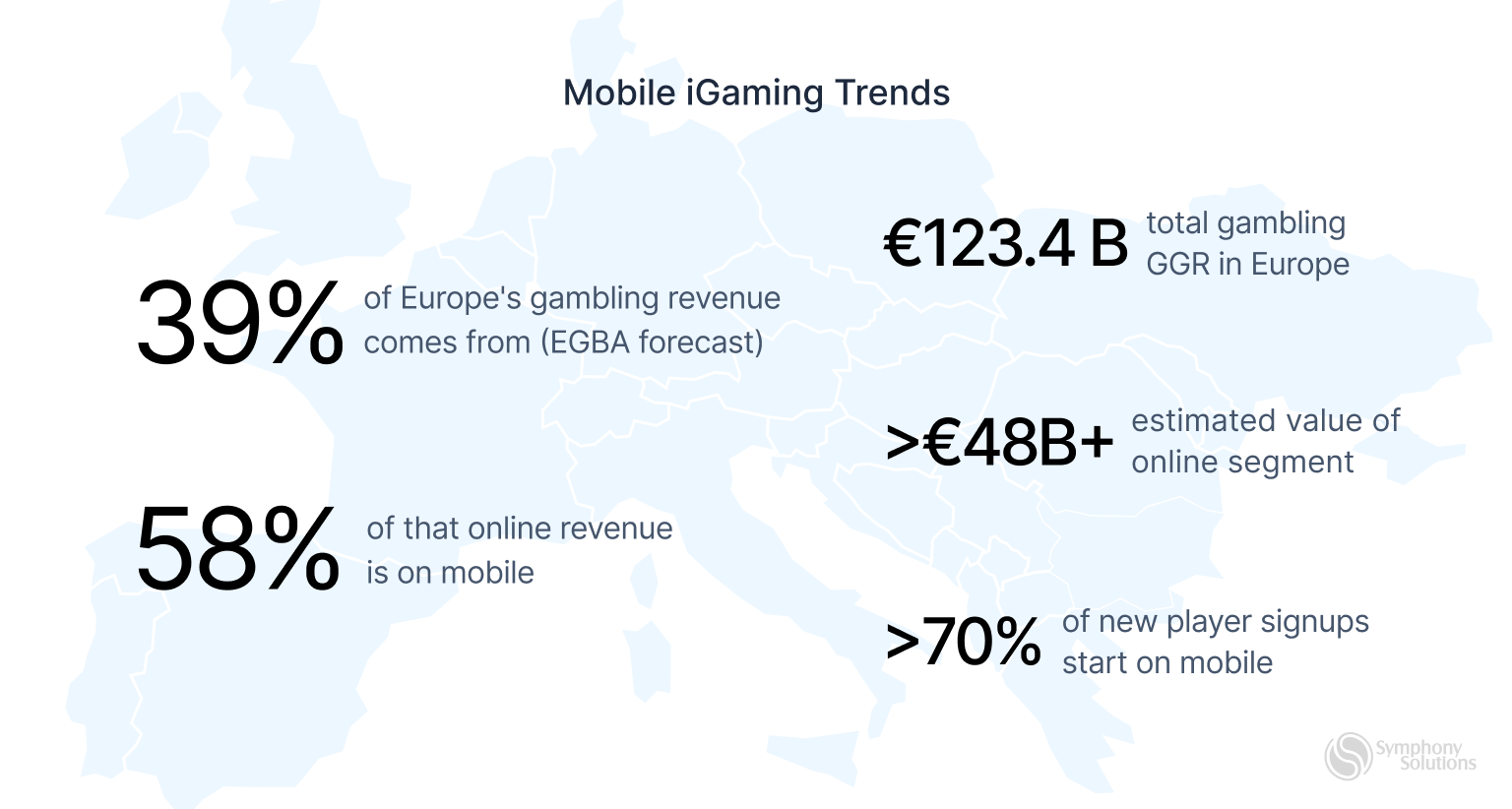
    Today, about 70% of iGaming activity now happens on mobile in most regulated markets, and that number keeps climbing. But the real story isn’t traffic share — it’s performance gap. Two apps can offer the same markets, the same games, the same bonuses, yet one converts noticeably better, keeps players longer, and monetizes more efficiently.

    If you’ve worked on a mobile app for iGaming, you’ve probably seen it firsthand: a small delay in loading odds, a slightly clunky bet slip, a payment flow that feels one step too long — and suddenly deposit rates soften, live betting engagement dips, or users quietly churn. No dramatic failures. Just slow, invisible revenue leakage.

    mobile iGaming trends

    What separates high-performing mobile betting apps from average ones usually isn’t a big feature launch. It’s execution at the margins: load times under real network conditions, how confidently players can place bets during live events, how instant confirmations feel, how little cognitive effort it takes to go from intent to wager.

    This isn’t a theoretical discussion. It’s about the practical decisions — product, UX, engineering, infrastructure — that turn a mobile iGaming platform into a conversion engine instead of just a content container.

    Let’s get into what actually drives performance.

    Performance as a Conversion Driver

    Most operators don’t lose players because the app is “slow.” They lose them because bet placement feels slightly uncertain, odds refresh feels half a beat behind, deposits take just long enough to trigger doubt, or the app hesitates at exactly the wrong moment — during live play, cash-out, or high-emotion events. In mobile iGaming, performance doesn’t fail loudly, it leaks revenue quietly.

    The best-performing mobile iGaming platforms don’t chase abstract speed metrics. They optimize the moments that directly influence bet confidence, deposit momentum, and live-betting flow.

    Speed, Stability, and Responsiveness: What Actually Matters

    “Fast” in iGaming doesn’t mean low lighthouse scores or pretty benchmarks.
     It means time-to-decision stays short under real load. High-impact performance areas typically include:

    • Bet slip latency → how long it takes from tap to confirmed state
    • Odds freshness → how quickly markets reflect live changes
    • Payment response time → how fast deposits feel “final”
    • App cold start time → first-session friction for new users
    • Crash frequency in money flows → deposits, withdrawals, cash-out

    Players don’t measure milliseconds — but they do notice when the product feels hesitant. In betting, hesitation reduces action.

    How performance issues translate into business impact

    Performance IssuePlayer BehaviorBusiness Impact
    Slow loading screensSession abandonmentLower conversion
    Delayed bet confirmationHesitation, fewer betsReduced bet volume
    Payment latencyDoubt during depositsLower deposit completion
    UI freezes or lagFrustration, early exitsShorter sessions
    App crashesLoss of trustHigher churn

    Individually, these may seem minor. At scale, they materially affect conversion rates, betting frequency, and lifetime value.

    Load Time, Latency, and the “Quiet Drop-Off” Problem

    Performance issues in mobile betting apps rarely cause dramatic churn. Instead, they show up as subtle behavior changes: fewer bets per session, lower live-betting activity during volatile moments, slower deposits, and players keeping the app installed but using it less as their main sportsbook. This kind of quiet drop-off often goes unnoticed in the short term, which is why performance should be treated as a conversion lever,  rather than an engineering metric.

    Live Betting: Where Latency Becomes Revenue

    Live betting exposes performance gaps faster than any other surface. During major events, in-play traffic can spike 2–5×, and even 200–500 ms of extra latency in odds refresh, bet confirmation, or cash-out recalculation can reduce wagering intensity. When odds feel behind or confirmations hesitate, betting slows — especially during goals, penalties, or final minutes. In live betting, milliseconds feel like missed opportunities.

    Stability Is a Trust Signal, Not a Tech Metric

    A crash in a casual app is annoying. A crash in a mobile app for iGaming is trust-damaging — especially if it happens during:

    • Deposits
    • Withdrawals
    • Bet placement
    • Cash-out
    • High-stakes moments

    The real cost isn’t the crash itself — it’s the lingering uncertainty:

    “Did my bet go through?”
     “Did my money move?”
     “Can I rely on this app?”

    Once that doubt appears, players often reduce stake size, avoid live betting, or gradually migrate volume elsewhere.

    What Strong Teams Optimize For (In the Real World)

    High-performing mobile iGaming teams typically prioritize metrics that map directly to money flow:

    MetricWhy It Matters
    Bet placement latencyPredicts bet completion rate
    Deposit confirmation timePredicts revenue realization
    Live update delayPredicts in-play wagering depth
    Crash rate in money flowsPredicts churn risk
    Session responsiveness under peakPredicts retention during major events

    Mobile UX That Drives Engagement and Bets

    If mobile performance sets the floor, UX decides how much players actually use the product.

    Most mobile sportsbooks don’t lose engagement because their UI looks outdated. They lose it because the product makes players think too much before they can act. Too many taps. Too many screens. Too many decisions before the bet is even placed.

    Strong mobile iGaming platforms feel effortless. You open the app, find what you want fast, place a bet without second-guessing, and move on. Weak ones slow you down in small ways that stack up over time.

    Navigation That Gets Out of the Way

    The fastest-growing mobile betting apps tend to optimize for one thing: getting players from intent to wager with as little detour as possible. In practice, that usually means:

    • Keeping core betting flows within one or two taps
    • Surfacing recent, live, and relevant markets before broad categories
    • Treating search and favorites as primary, not secondary
    • Avoiding overloading the screen with promos and low-conversion content

    A common pattern among underperforming apps is trying to show everything. High-performing apps take a more disciplined application development approach. They hide low-impact elements, prioritizing what converts, and reducing clutter so players reach bets faster.

    Different design priorities in the wild

    Typical ApproachMore Effective Approach
    Add more tabs and sectionsReduce paths to first bet
    Showcase the full catalogHighlight what converts
    Optimize for visual balanceOptimize for speed of action
    Promote everything equallyPrioritize high-impact markets

    The result doesn’t feel flashy. It feels fast.

    Thumb-Friendly Layouts Are About Speed, Not Aesthetics

    On mobile, ergonomics directly affect behavior, especially during live betting. Apps that convert well tend to:

    • Place key actions in easy thumb reach
    • Avoid critical buttons at the top of the screen
    • Use forgiving tap targets during high-pressure moments
    • Make bet slip actions quick and low-effort

    This matters more during in-play betting than most teams expect. When odds move fast, users don’t want precision tasks. If placing a bet feels fiddly or slow, they simply place fewer bets.

    Registration, Login, and Payments: Where Momentum Dies

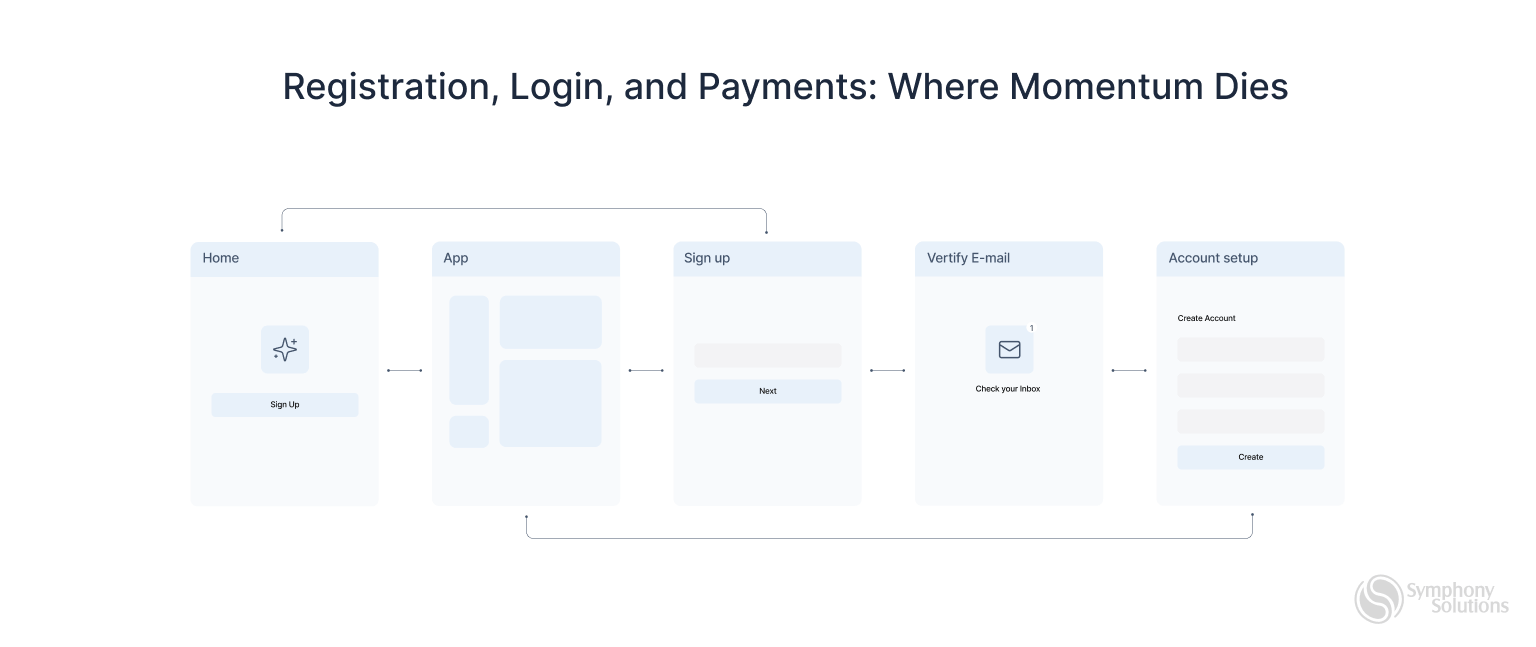
    Onboarding remains one of the biggest conversion leaks in mobile iGaming. Players rarely quit because they lose interest. They quit because sign-up feels slow, repetitive, or poorly timed, right when betting intent is highest.

    registration, login and payments

    Mobile online casino apps that convert better usually delay non-essential data collection, allow users to explore before forcing full registration, rely on progressive profiling instead of long forms, and keep repeat logins frictionless with biometrics. The smoother the path from intent to first bet or deposit, the more likely players are to stay active and fund early.

    Where conversion usually drops

    StepWhat HappensOutcome
    Long registration formPlayers abandon earlyLost acquisition spend
    Early KYC wallDeposits get postponedLower first-funding rate
    Slow loginUsers return less oftenLower retention
    Payment setup frictionPlayers hesitateLower deposit frequency

    The smoother the first funding experience feels, the more likely a player is to treat the app as their main betting destination.

    Bet Placement UX Shapes Confidence

    The bet slip is where trust is built or lost. If a player ever wonders:

    • “Did that bet actually go through?”
    • “Why did the odds change?”
    • “Why do I need to re-enter my stake?”

    …you’ve introduced doubt. And doubt lowers bet volume.

    High-performing mobile sports betting apps usually get a few things right:

    • Bet slips stay easy to access
    • Odds changes are visible and understandable
    • Stake edits feel instant
    • Confirmations are immediate and unambiguous
    • Errors don’t break the flow

    The smoother this feels, the more likely users are to place consecutive bets without hesitation.

    Live Content Needs to Be Easy to Spot

    In-play betting behavior is strongly shaped by what players can see at the first glance. Apps that drive higher live-betting activity typically keep live matches visible on the home screen, make in-play markets easy to access, highlight momentum moments like goals, penalties, or final minutes, and ensure live sections feel dynamic rather than static. When live events are harder to find, engagement might not suddenly drop, however, it fades gradually over time.

    UX That Converts Is Usually Opinionated

    The best-performing apps don’t try to cater to every possible use case. They guide behavior instead. That usually means emphasizing markets that consistently convert, downplaying low-engagement sections, reducing choices when fewer options speed up decisions, and shaping layouts based on real betting data rather than design trends. Over time, this creates a product that feels focused, fast, and intentional — not crowded or distracting.

    Technology Foundations for High-Performance Mobile iGaming

    Mobile performance problems almost never come from UI. They come from backend latency, real-time data pipelines, bet execution, payments, and systems that weren’t built for peak match traffic.

    If odds lag, bets confirm slowly, cash-out feels delayed, or deposits hesitate under load, players bet less. That’s a software architecture and backend engineering issue, not a UI or design problem. High-performing platforms invest in robust iGaming software development that keeps systems fast and stable when traffic spikes, odds shift rapidly, and real money is on the line.

    Native vs Cross-Platform: Where the Trade-Offs Actually Matter

    This debate rarely comes down to ideology. It comes down to latency tolerance, release velocity, and long-term maintainability. Here’s how it usually plays out in practice:

    ApproachWorks Best WhenStarts to Struggle When
    Native (Swift / Kotlin)Best performance, smoother animations, lower latency for live bettingTeam size and maintenance cost grow
    Cross-platform (Flutter / React Native)Faster time-to-market, shared logic, smaller teamsFrequent real-time updates stress UI
    HybridBalanced speed and costRequires strict engineering discipline

    Teams running high-frequency live betting often lean native or hybrid — especially when real-time updates, animations, and low-latency interactions start affecting bet volume and session depth.

    Cross-platform can still work well, but only when performance constraints are understood early, not discovered during peak Champions League traffic.

    Backend Scalability: Where Most Bottlenecks Actually Live

    Most mobile casino apps iGaming performance issues come from backend overload, not the app UI. During major sporting events, traffic can spike 3–10×, putting pressure on odds feeds, bet processing, payments, and live data streams. When systems aren’t built for these surges, odds updates slow down, bets take longer to confirm, deposits get delayed, and live screens start lagging.

    Everything may look fine on an average day, but peak moments expose weak infrastructure. Platforms that pair scalable backend engineering with strong mobile game design in iGaming stay responsive during sudden traffic spikes and protect live betting revenue — while others lose volume when demand is highest.

    Real-Time Data Delivery Is a Product Feature

    In mobile iGaming, real-time responsiveness directly affects betting confidence. Even a 300–800 ms delay in odds refresh, cash-out updates, or bet confirmation can reduce live-betting activity. High-performing platforms rely on event-driven pipelines, streaming updates, low-latency push (such as WebSockets), and frontends optimized for frequent refresh without freezing. As one sportsbook PM put it, “Players don’t need perfect speed — they need consistent speed under pressure.”

    Security and Compliance Without Breaking the Experience

    Security and regulation are unavoidable in iGaming. The challenge is implementing them without slowing down gameplay or deposits. On mobile, that usually means balancing:

    • Fraud prevention
    • AML and KYC checks
    • Geo-restrictions
    • Responsible gaming requirements
    • Payment verification

    The mistake many teams make is treating compliance as a blocking layer. Stronger platforms use integration services to embed fraud checks, KYC, AML, and responsible gaming controls progressively, applying them at moments that reduce friction and minimize disruption to betting and deposits.

    Practical examples of smarter enforcement

    RequirementNaive ImplementationMore Effective Approach
    KYCBlock deposits upfrontTrigger verification when risk rises
    AML checksManual review delaysAutomated risk scoring
    Responsible gaming limitsHard blocksGradual nudges + clear messaging
    Geo checksFrequent interruptionsSilent background validation

    This keeps users protected without turning regulation into friction.

    Responsible Gaming Features Need to Feel Natural

    Responsible gaming tools work best when they feel like part of the product, not warnings bolted on top. In mobile apps, that often means:

    • Limits that are easy to find and adjust
    • Cooling-off flows that feel supportive, not punitive
    • Transparent messaging around time, spend, and activity
    • Subtle nudges instead of aggressive pop-ups

    Players respond better when controls feel respectful and predictable, rather than disruptive.

    What Strong Teams Prioritize Under the Hood

    Teams running high-performing mobile iGaming software usually focus on:

    • Latency budgets tied to betting behavior
    • Real-time pipelines that degrade gracefully under load
    • Payment infrastructure built for regional PSP diversity
    • Observability across app, backend, and trading feeds
    • Release pipelines that allow fast fixes without downtime

    They don’t try to over-engineer everything. Instead, they stay deliberate about where milliseconds, reliability, and scalability actually impact revenue. Furthermore, they apply the same discipline when choosing a mobile iGaming supplier, partnering only with teams that can perform under real traffic, real-time load, and live betting pressure.

    Why Choose Symphony Solutions for Your iGaming Mobile App Development

    We help businesses build igaming mobile solutions that stay fast under peak traffic, convert better, and avoid match-day failures. Our work covers sportsbook, casino, payments, compliance, and personalization — with a focus on what directly impacts bet volume, deposit conversion, uptime, and retention.

    Symphony Solutions supports full-cycle delivery, from launching and modernizing mobile platforms to integrating odds feeds, PSPs, KYC/AML, fraud systems, and CRM, aiming for faster releases, fewer incidents, and stronger performance during traffic spikes. Because we also build our own products — BetSymphony and BetHarmony — our decisions are grounded in real production constraints, trading dynamics, and revenue pressure.

    Operator Outcomes We Focus On

    Operator PriorityWhat We ImproveBusiness Impact
    Live betting stabilityReal-time systems & scalabilityMore in-play revenue
    Mobile conversionUX + performance optimizationHigher deposits & bet frequency
    Platform reliabilityResilient integrations & backendFewer outages, lower churn
    Release speedModern DevOps & delivery pipelinesFaster go-to-market
    Retention & LTVAI-driven personalizationStronger player lifetime value

    The Takeaway

    At this point, mobile experience isn’t a design preference or a delivery channel. It’s a compounding business lever.

    Small improvements in speed, UX clarity, bet flow, and reliability rarely show up as dramatic wins in isolation. Instead, they stack. Faster load times increase bet completion. Cleaner navigation reduces drop-off. Smoother payments lift deposit frequency. More responsive live betting keeps players engaged longer during high-intent moments.

    That’s how mobile performance turns into revenue — not through one big feature, but through dozens of small, disciplined decisions that remove friction and preserve momentum.

    Mobile-first iGaming design becomes a strategic advantage when it’s treated as an operating principle rather than a layout choice. Teams that build around real mobile behavior — short sessions, time pressure, emotional betting moments, one-handed use, inconsistent networks — tend to make better product decisions across the board.

    Over time, those decisions compound into tangible outcomes: apps that convert more efficiently, retain players longer, handle peak traffic more confidently, and scale without constantly firefighting performance or reliability issues.

    High-performing mobile iGaming products don’t feel radically different on the surface.
     They just feel faster, clearer, more predictable — and easier to trust when money is on the line.

    That trust, built through consistent mobile experience, is what ultimately drives long-term growth.

    FAQs

  • FAQ AI: Hard Truths About Delivery – Costs, Risks, and Reality 

    FAQ AI: Hard Truths About Delivery – Costs, Risks, and Reality 

    You’ve seen the demos. You’ve heard the promises. But shipping AI in the real world is a very different story. Teams get excited, leaders approve budgets, pilots launch, and somewhere along the way reality shows up. Deadlines slip, data is messy, users resist, and the “obvious win” turns out to be anything but obvious.

    That gap between hype and reality is exactly why FAQ AI exists.

    This is a live Hot Seat conversation with founders, CTOs, and AI leaders who’ve been through it. Not theorists, not keynote speakers, not consultants recycling frameworks, but people who actually shipped AI and lived with the consequences.

    Watch the event on You Tube!

    Agenda

    Our speakers will answer curated questions in a 60-second Hot Seat format — sharp, direct, and practical. And your voice matters: you can submit questions in advance or ask live during the session.

    You’ll hear them tackle questions like:

    • What is the biggest illusion companies have about AI today?
    • What product assumption turned out to be wrong?
    • What would you never let a company build in-house?
    • What really changed in delivery speed?
    • Why do most AI pilots quietly die?
    • What do executives underestimate the most?

    Your voice matters

    Before the event, you can submit your own questions for the panel. During the session, you can also ask live in the chat, and we’ll address real cases from listeners on air.

    No slides.
    No rehearsed success stories.
    No buzzwords.

    Just a candid, fast-paced conversation about what actually happens when AI meets real teams, real budgets, and real users.

    Who this is for

    CTOs, CIOs, engineering leaders, product leaders, founders, and AI consultants shaping real systems.

    This session isn’t here to sell you hype.
    It’s here to sharpen your judgment.

    Whether you’re building products, leading teams, advising clients, or simply figuring out how AI fits into your work, you’ll leave clearer, wiser, and far more realistic about what AI can and cannot do today.

    Meet the Speakers 

    Bart Van Spitaels

    Founder, gutt

    Product leader focused on building AI systems that work in the real world, not just on paper. Bart openly reflects on the assumptions that didn’t hold up in practice, what went wrong, what was painful, and how those lessons shaped gutt’s strategy and product direction.

    Oleg Chekan

    CTO, gutt

    Engineering leader with deep hands-on experience scaling AI systems in production. Oleg speaks candidly about technical tradeoffs, delivery challenges, and what tends to break once AI meets real users and real environments.

    Igor Matrofailo

    AI Expert & Consultant, SoftServe

    Works closely with organizations deploying AI in real business contexts. Brings a market-facing perspective on failed pilots, executive expectations, budget overruns, and the practical barriers to adoption.

    When & Where

    March 05, 2026
    4 PM CET
    Online

    Register now

    Watch here!

    Price

    Free

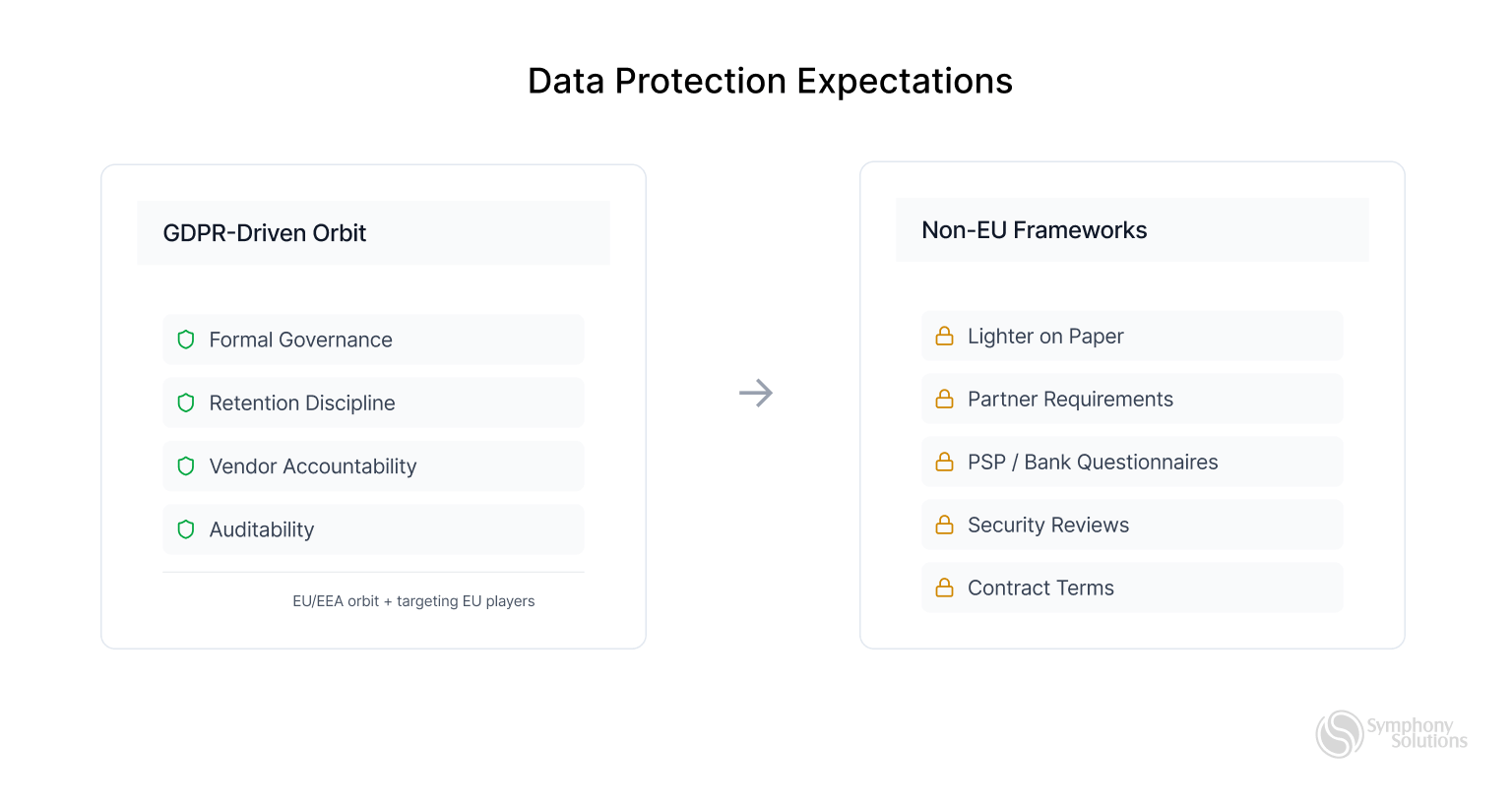
  • Online Gambling Licenses: iGaming Data Protection in 2026

    Online Gambling Licenses: iGaming Data Protection in 2026

    An iGaming license determines where you can operate, how quickly you can expand, and how seriously payment providers, partners, and players will take your gambling business. In other words, choosing one has very far-reaching consequences.

    The practical reality is that licensing is the compliance framework you’ll be living inside for years, including requirements around responsible gambling, AML/KYC, audits, reporting, and the way you handle player data.

    If you’ve ever typed “what is a gaming license” or “what is a gambling license” into Google, here’s the straight answer: it’s regulatory authorization to offer gambling products – like an online casino platform license or a sports betting platform – within a specific gambling jurisdiction. And it’s not a one-time legal hurdle, although many first-time operators tend to treat it as such.

    This article will provide an overview of the most prominent online gambling licenses in 2026 and explain how to pick them correctly.

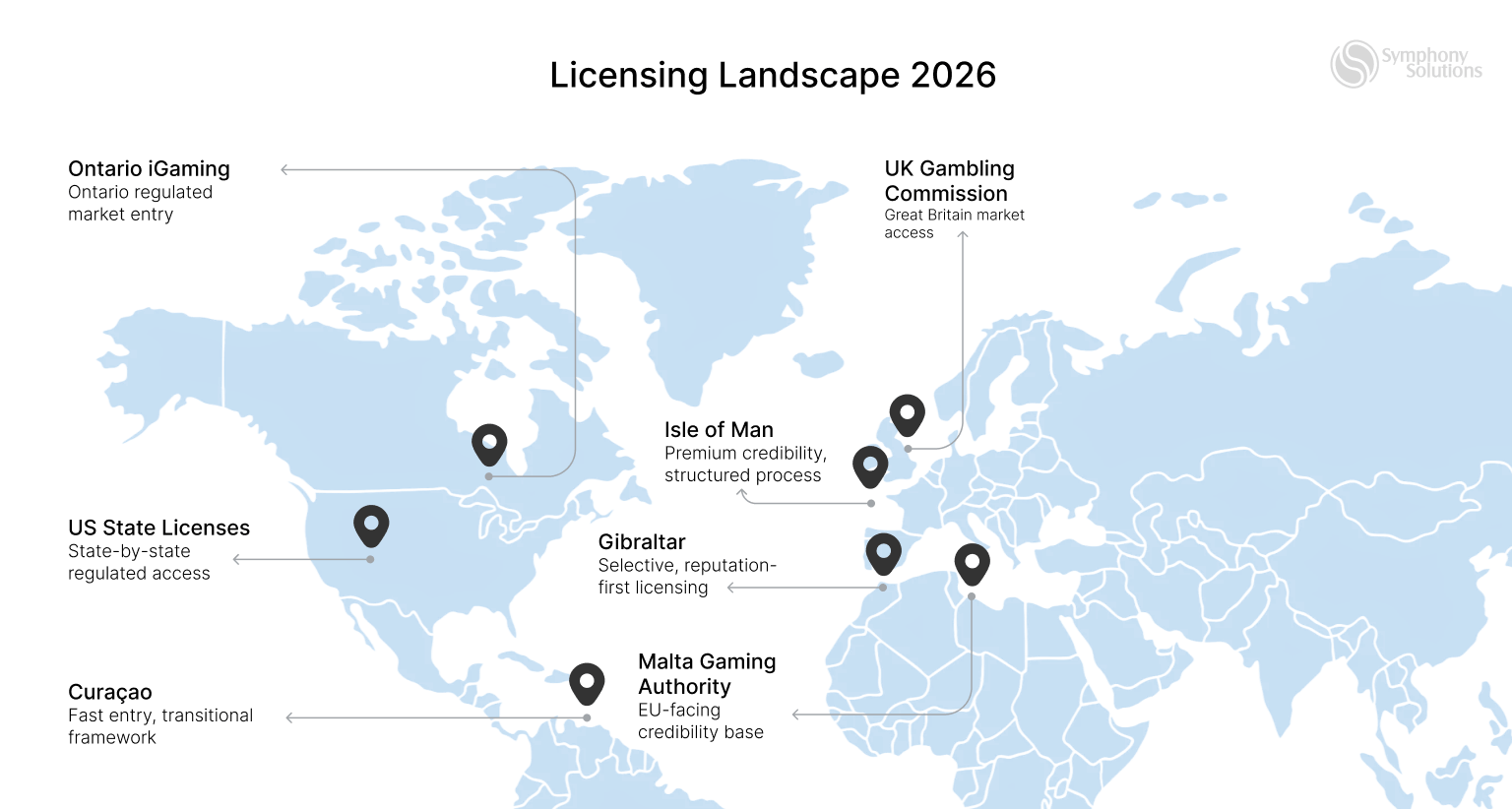
    Overview of Major iGaming Licenses

    Before comparing fees, timelines, and “trust value,” it’s worth being clear about one point that trips up a lot of teams: there is no single license that automatically unlocks every market. Most operators end up building a licensing portfolio over time – starting with one primary jurisdiction, then adding local authorizations where regulated market access is required.

    licensing landscape 2026

    Another important concept is that regulators often separate the types of gaming licenses by business model – operator-facing (B2C) versus supplier-facing (B2B). Malta’s ecosystem, for example, is commonly described through this B2C/B2B split, reflecting the reality that operators and critical suppliers may be licensed differently depending on their role in the chain.

    Here are the major licenses most operators benchmark against in 2026:

    Malta Gaming Authority (MGA)

    The MGA is one of the most widely recognized European licensing authorities. Malta is considered a structured, compliance-heavy foundation for EU-oriented businesses. The MGA’s guidance for remote gaming services – such as online casinos or sportsbooks –  states that a B2C Gaming Service Licence is required when an eligible entity wishes to offer a gaming service from Malta, to a Maltese person, or through a Maltese legal entity.

    UK Gambling Commission (UKGC)

    The UKGC is frequently treated as a benchmark for strictness and enforcement maturity. For operators, the key takeaway is that the UK regime is built around remote gambling offered to consumers in Britain through defined licence categories. If your product includes a casino, you’re looking at remote casino licensing; if it includes betting, you’re looking at the relevant remote betting categories. The UKGC also continues to update rules in areas like promotions, showing why “ongoing compliance” must be budgeted as part of your licence decision.

    Curaçao (Gaming Control Board / Curaçao Gaming Authority framework)

    Curaçao is historically associated with faster entry and lower cost, but it’s also the jurisdiction where teams must pay attention to regulatory transition. The official Curaçao licence portal states that a new National Ordinance on Games of Chance (LOK) came into effect on 24 December 2024 and that the process for new online gaming applications is currently closed until new forms and the updated process are published. Curaçao is part of many 2026 licensing conversations, but you should treat the “how to apply” details as something to verify directly with official channels at the moment you’re planning the move.

    Isle of Man Gambling Supervision Commission (GSC)

    The Isle of Man is typically positioned as a credibility-first jurisdiction with a well-defined application process. The regulator’s licensing guidance is explicit that applicants need to submit an application form, vetting forms, supporting documentation, and the application fee. This is not a “light-touch” setup – it’s designed for operators who can document ownership structure, controls, and operational readiness.

    Gibraltar Gambling Commissioner

    Gibraltar is often evaluated in the same “high-credibility” category as other top-tier regimes. Gibraltar’s remote gambling guidance highlights that licensing timescales vary, but a high-quality application that covers ownership/control, governance, a credible business plan, and policies for AML and data protection (as well as social responsibility/consumer protection) can be processed in a relatively short period of time.

    US State Licenses

    The United States is not a single licensing market. If you want regulated access, you have to deal with state-by-state frameworks, each with its own regulator, application steps, and suitability standards. In New Jersey, for instance, the Casino Control Commission oversees licensing for Atlantic City casinos and their key employees, and notes that people who work in casinos, internet gaming, or sports pools may require a license or registration depending on their role. The Division of Gaming Enforcement also describes licensing as a tool to ensure owners, operators, employees, and companies doing business with casinos meet statutory character and integrity requirements. In Pennsylvania, state law is explicit that an interactive gaming operator needs a license from the board and must apply in the manner the board prescribes. The Pennsylvania Gaming Control Board publishes interactive gaming application forms and related resources, reflecting how procedural these markets can be.

    Ontario iGaming

    Ontario is also a major regulated market with a documented entry path. To operate a regulated iGaming site in Ontario, you need to register with the AGCO. And iGaming Ontario’s “Steps to Join the Ontario Market” adds a practical expectation on timing: the AGCO registration step takes 2+ months from submission of a complete application (timing can vary with certification scope and testing capacity).

    These are the jurisdictions most teams mean when they talk about the best online gambling licenses – but “best” only makes sense once you compare them against your target markets, budget, timeline, and compliance maturity.

    2026 iGaming License Comparison Table

    LicenseJurisdiction ReachSetup Cost (indicative regulator fees)Time to License (typical)Regulatory StrictnessPlayer Trust LevelData Protection RequirementsBest For
    Malta Gaming Authority (MGA)Strong EU-facing credibility (often used for multi-market operations, but not a universal “EU passport”)€5,000 application; €25,000/yr B2C licence fee (plus variable compliance contributions)Often ~3–6 months, depending on readiness and audit stepsHighHighGDPR-aligned expectations (EU framework)EU-facing brands that need credibility with PSPs and suppliers
    UK Gambling Commission (UKGC)Great Britain market access (the strongest “trust signal” in Europe for many stakeholders)Application fees £4,224–£91,686 based on GGY; annual fees scale similarly16 weeks (operating licence application processing time; assumes complete application)Very highVery highUK GDPR-style governance; breach reporting expectation is 72 hours where requiredOperators targeting GB with long-term partnerability and strong compliance maturity
    Curaçao (CGA / under LOK framework)Widely used for international operations; reputation is improving, but still assessed carefully by partners€4,592 B2C application; B2C annual fees total €47,450 (Treasury + CGA supervisory)Often ~8–16 weeks when documentation is clean (varies)Medium (trending stricter)MediumNot GDPR-based by default, but GDPR can still apply if you target EU playersFaster go-to-market, multi-vertical launches, budget-sensitive projects (with a clear upgrade path)
    Isle of Man (GSC)Premium “Tier-style” credibility for many counterparties; common for serious international operators£5,250 application; £36,750/yr Full OGRA licence (Network: £52,500/yr)Often ~10–16 weeksHighHighUK/EU-style governance expectations in practice (strong regulator focus on reputation, controls, due diligence)Operators who want strong credibility without the full UKGC burden
    GibraltarSmall, selective jurisdiction with strong historic credibility for established brandsPublic sources indicate a £100,000 fixed annual B2C licence feeOften ~3–6 months (selective, relationship-driven in practice)HighHighUK/EU-style privacy governance is commonly expected for operators targeting UK/EU partnersEstablished operators prioritising reputation and partner confidence
    US State Licenses (example: PA, NJ)Market-by-market access; no single US licence covers all statesPennsylvania: cost for all three interactive certificates combined was $10M in the initial window; other fees vary by state and verticalTypically, months, suitability/investigations, and vendor approvals can extend timelinesVery highVery highFragmented (state + sector rules) + strict security/incident expectations for regulated gamingOperators with serious capital, local partnerships, and long-term horizons
    Ontario iGaming (AGCO / iGO)Ontario only, but it’s one of the most important regulated markets in North America$100,000/year per gaming site, submitted with the application2+ months for the AGCO registration step (from complete submission + fees)Very highVery highCanadian privacy + breach governance; regulator-grade operational controlsOperators targeting Ontario with strong compliance, tech assurance, and RG readiness

    Licensing Trade-Offs: Cost vs Credibility

    Cost and credibility are not separate variables. In 2026, the linkage between them will be even harder to ignore. The moment you pick a jurisdiction, you’re not just choosing a regulator. You’re choosing the level of scrutiny your business can withstand, the amount of evidence you’ll need to produce on demand, and the kind of partners you’ll be able to onboard without a fight.

    High-credibility licenses – UKGC, Ontario, and many US state frameworks – cost more because they force you into a controlled operating model. That doesn’t only mean paying higher application and ongoing regulatory fees. It means living with deeper investigations, stricter governance expectations, tighter audit requirements, and a regulator that assumes you will prove compliance continuously, not occasionally. In exchange, you get a powerful commercial asset: the ability to look a bank, PSP, enterprise supplier, or investor in the eye and say, “we’re ready for scrutiny.” That statement has real monetary value because it shortens due diligence cycles, reduces processing fragility, and makes your brand easier to underwrite when something goes wrong. It also explains why strict jurisdictions tend to publish clear service standards and fee frameworks: they’re designed to filter out operators who aren’t ready to run a regulated business as an operating discipline.

    Ontario signals the same intent with a multi-month path and a large, explicit annual regulatory fee per site. It’s essentially telling you: if you want access, you need the governance, controls, and operational maturity to match. The US state model pushes this logic even further, because you’re not buying “a US license” – you’re buying one state at a time, often with suitability investigations and a long tail of vendor approvals. The upside is credibility and market legitimacy. The downside is that you’re building inside a compliance cage from day one, and you have to plan for the ongoing weight of it.

    The more balanced options – Malta and, for many operators, the Isle of Man – are often chosen when a company wants a serious compliance story and a durable operating base, but also needs flexibility to build a multi-jurisdiction footprint over time. These regimes tend to work well in terms of due diligence because they imply you’ve accepted ongoing oversight as normal. That matters because mature partners rarely panic over the existence of controls; they panic over the absence of them. A jurisdiction that expects structured policies, governance, and evidence makes it easier for you to show that you’re not improvising as you scale.

    The faster, lower-friction entry routes are attractive for obvious reasons: time-to-revenue and lower initial burn. But the trade is rarely “money saved.” It’s “risk moved.” Instead of doing the hard work at the regulator’s front door, you often end up doing it at your partners’ back door – where banking, payments, KYC vendors, game suppliers, and even affiliates effectively become your compliance examiners. And those exams don’t happen once. They repeat every time you add a new payment method, enter a new geography, change your ownership structure, spike in volume, trigger a fraud pattern, or suffer an incident. In practice, lower regulatory friction can turn into higher commercial friction, because counterparties don’t stop caring about risk just because a jurisdiction asks fewer questions.

    That’s the real cost-versus-credibility decision in 2026. You’re not choosing between “expensive” and “cheap.” You’re choosing where the burden of proof sits: with the regulator up front, or with every critical partner you need to grow.

    Data Protection Expectations Across Licenses

    Data protection dictates how quickly you can clear due diligence, how resilient your payment stack is, and how ugly the implications of an incident can become when it happens. Every jurisdiction has its own rules. And the market has its own rule too: if you handle player money and player identity, you will be judged on how you govern data, not on what your privacy policy claims.

    data protection expectations

    The cleanest split is still between GDPR-driven regimes and non-EU frameworks. When your licensing footprint sits inside the EU/EEA orbit – or you target EU players – you’re effectively operating under a set of expectations that assume formal governance: clear lawful bases for processing, strict controls over access, retention discipline, vendor accountability, and documentation that can survive an audit. Even if your primary license is outside the EU, serving EU customers or working with EU-centric partners tends to pull you toward “GDPR-grade” practices anyway, because that’s the baseline many serious counterparties use when evaluating risk.

    incident respond process

    Non-EU licenses can feel lighter on paper, but that doesn’t mean you have less exposure. It often means the obligations arrive from a different angle: contract requirements from PSPs and banks, security questionnaires from platform suppliers, and internal risk committees that default to conservative assumptions. In other words, the compliance load is still there, but it comes from a different angle.

    Where licenses differ most, day to day, is in reporting, audits, and breach handling. GDPR-style environments make incident response a highly regulated process: you don’t just fix the problem; you classify it, document it, decide whether it triggers notification, and communicate within defined time expectations. That pushes operators toward mature operational mechanics: continuous monitoring, clear escalation paths, evidence-grade logging, and rehearsed playbooks. More credibility-focused jurisdictions also tend to normalize audits and ongoing assurance – meaning you should expect periodic reviews of controls.

    In less prescriptive frameworks, breach notification timelines and audit expectations may be looser or less clearly standardized, but that doesn’t mean they could be taken lightly. If your payments stack includes major PSPs, card programs, or regulated financial partners, you will still be expected to demonstrate equivalent readiness: incident response discipline, strong access controls, encryption, separation of duties, and third-party oversight. So, effectively, those partners will ask for the same artifacts – policies, audit trails, test results, vendor contracts, and evidence of monitoring – regardless of what the licensing authority demands.

    The overarching trend for 2026 is convergence toward stricter privacy standards. Regulators are tightening, but so are counterparties. Payment ecosystems, advertising platforms, KYC providers, and enterprise-grade suppliers all benefit from standardization, so they increasingly push operators toward a common denominator: faster breach awareness, stronger auditability, tighter data minimization and retention, and clearer accountability for third parties. The result is that “non-EU” is no longer a strategic escape hatch. If you want stable payments, reputable partners, and scalable market access, you build for the strict end of the spectrum – then treat local variations as a configuration.

    Conclusion: Aligning License Strategy With Business Goals

    The best online gambling license in 2026 – and, honestly, in any year – is the one that matches your market plan and your operating maturity. Not the one that looks impressive in a footer, and not the one your competitor chose.

    If you’re targeting one of the most tightly regulated markets, choose the license that actually grants access there – and budget for the operating model that comes with it. If you’re building toward regulated expansion over time, choose a base that supports credibility with partners while you build the compliance muscle you’ll need later. And if you’re choosing a faster path, treat it as a phase: define upfront what “graduation” looks like, and when you’ll move to a more demanding jurisdiction as your footprint grows.

    Above all, don’t separate licensing from data protection. In 2026, they’re essentially the same, because both will be tested – by regulators and by the partners you need to scale.

    At Symphony Solutions, we have extensive experience building and implementing various iGaming platforms as well as helping clients navigate regulatory and licensing hurdles. If you want to launch a product that makes a mark on the gambling market, reach out – we’ll help you make it happen.

    FAQs

  • The Future of Airline Tech: AI-Powered, Cloud-Native, and Data-Driven Solutions 

    The Future of Airline Tech: AI-Powered, Cloud-Native, and Data-Driven Solutions 

    Airlines are increasing technology investment as operations become more complex and disruptions more expensive. According to SITA, airline IT spending has reached $37 billion, with airports adding another $8.9 billion. Nearly three out of four airlines now expect their IT budgets to keep growing over the next two years.

    This shift is driven by pressure, not ambition. Every minute of delay now carries a measurable cost. Recent air traffic management disruptions in Europe have generated an estimated €2.8 billion in costs, according to EUROCONTROL. Passenger expectations are rising at the same time. When something goes wrong, passengers expect clear updates, simple rebooking, and fewer handoffs.

    This is the environment shaping airline technology decisions today. Small inefficiencies carry outsized consequences, and outdated systems cannot keep pace. As a result, aviation software development is shifting toward systems that can adapt quickly under live operating conditions.

    In this article, we explore current trends in the airline industry. We examine how AI-powered, cloud-native, and data-driven aviation technologies are reshaping airlines and what the future looks like.

    AI-powered airlines for smarter operations and decisions

    The global AI in aviation market is projected to grow rapidly, from about $1.75 billion in 2025 to $4.86 billion by 2030, at a CAGR of ~22.6%. This shift is most visible in disruption management, maintenance reliability, customer operations, and commercial decision-making. Let’s get into the details.

    ai powered airlines

    1. Predictive disruption management

    AI in aviation is improving disruption management by identifying risk before delays materialize. Instead of reacting after schedules break down, models combine signals such as:

    • Weather forecasts and airport constraints.
    • Crew legality rules and pairing limitations.
    • Aircraft rotation dependencies and knock-on delay risk.
    • Passenger connection sensitivity across the network.

    By evaluating these factors together, AI supports earlier and more informed decisions about swaps, cancellations, and recovery strategies.

    A real-world example comes from British Airways, which credited AI-driven decision support as “game-changing” for disruption handling. The airline reported 86% on-time departures from Heathrow in Q1 2025, its best performance on record, alongside broader operational investment, as reported by the Financial Times.

    2. Maintenance and reliability optimization

    According to Global Market Insights Inc., the predictive airplane maintenance market is growing strongly as well, expected to reach roughly $18.2 billion by 2034, at a CAGR of ~13.1% as airlines invest in real-time reliability tools.  

    Predictive maintenance models estimate component failure risk before issues become operational problems. These models typically draw on:

    • Sensor telemetry and performance trends.
    • Historical maintenance and usage records.
    • Flight profiles, including cycles, operating environment, and stress factors.

    In practice, better predictions reduce unscheduled removals and AOG events, improve dispatch reliability, and shift maintenance from reactive to planned work.

    3. Customer interaction at scale

    With disruption volumes and customer contact surging, airlines are also increasingly using AI-driven assistants to handle high-volume interactions, including:

    • Rebooking during irregular operations.
    • Refund and compensation guidance.
    • Baggage status and journey updates.
    • Loyalty and ancillary servicing.

    When implemented carefully, these tools reduce average handling time and help contain demand without blocking escalation to human agents when cases become complex or sensitive.

    4. Commercial and offer optimization

    On the commercial side, AI is increasingly applied to airline retailing and offer management. Models support pricing and bundling decisions by incorporating:

    • Demand sensing and micro-segmentation.
    • Real-time bundling logic across fares and ancillaries.
    • Fare-family optimization and targeted offers.

    IBM has highlighted real-time offer creation and distribution as a major opportunity for airlines to improve both revenue quality and cost efficiency as digital transformation matures.

    However, as airline technology trends accelerate decision-making through AI, the next requirement is platforms that can evolve without destabilizing live operations.

    Cloud-native platforms as the foundation of modern airlines

    Legacy airline systems keep flights running, but they slow change and increase risk in disruption-heavy operations. They were built for stable schedules, not continuous updates.

    Cloud-native platforms are becoming the foundation for what comes next. By replacing large, infrequent system upgrades with modular, continuously evolving services, airlines can change specific capabilities without destabilizing operations. This enables faster recovery, safer updates, and greater flexibility as conditions shift.

    In practice, this shift introduces architectural capabilities that will increasingly define airline IT stacks:

    • Service-based or microservice components that can be updated independently.
    • API-first integration and event-driven workflows to share data across systems.
    • Resilient scaling, especially during disruption peaks or irregular operations.
    • Faster release cycles with safer deployment and rollback mechanisms.

    This direction is reflected in industry investment priorities. Research from SITA shows that infrastructure upgrades remain a top focus, with 47% of airlines and 67% of airports prioritizing modernization efforts.

    What do “cloud-native airline systems” mean in practice

    cloud-native airline architecture

    A cloud-native airline platform is not a single system. It is a layered architecture designed to support constant change while maintaining operational stability. In most modern implementations, this includes:

    • Integration layer: APIs and event buses that enable interoperability across internal systems and external partners.
    • Core operational services: crew management, operations control, maintenance, and irregular operations tooling.
    • Customer and commerce layer: booking, servicing, offer management, and personalization.
    • Data platform: real-time streaming, analytical storage, and governance for decision-making.
    • Security layer: identity management, policy enforcement, monitoring, and incident response.

    This structure allows airlines to modernize incrementally, improving specific capabilities without rewriting the entire technology stack.

    Cloud-native outcomes that matter to airline leadership

    For airline executives, the value of cloud-native adoption will increasingly be measured by operational results, not architectural decisions. As disruption becomes more frequent and the pace of change accelerates, the following outcomes will matter most to leadership:

    • Resilience: Faster recovery from partial system failures and peak disruption scenarios.
    • Speed: More frequent updates without destabilizing critical operations.
    • Scalability: Elastic capacity during peaks, weather events, or network disruptions.
    • Cost control: Reduced reliance on hardware refresh cycles and improved visibility into infrastructure usage.

    Security is also a growing driver. SITA reports that 76% of airlines and airports today rank cybersecurity as a top priority, and 78% of airlines already use AI to support cybersecurity operations. Cloud-native platforms will make it much easier to apply consistent security controls and respond faster to emerging threats.

    However, while cloud adoption has become one of the core airline technology trends, infrastructure alone does not improve outcomes. What matters next is how data flows across systems and reaches teams at the moment decisions are made.

    Data-driven decision-making in aviation

    Today, airlines generate vast amounts of data, but it is often scattered across passenger service systems, crew platforms, operations control, airports, and external vendors. As a result, many airlines remain data-rich but decision-poor. To close that gap, data analytics in aviation is shifting from retrospective reporting to real-time decision support. It’s turning fragmented information into decision-grade signals that teams can act on as events unfold.

    What changes in a data-driven airline

    When data becomes usable at the moment decisions are made, airline behavior will shift in the following three practical ways:

    • Operational control will become predictive, enabling teams to anticipate disruption instead of reacting once it escalates.
    • Commercial decisions will become contextual, informed by real-time demand, availability, and passenger behavior rather than historical averages.
    • Customer journeys will become adaptive, adjusting dynamically to operational conditions rather than following fixed flows.

    These changes will be less about dashboards and more about shortening the time between signal and action.

    Why this matters financially

    At the network scale, small issues compound quickly. A single delay can cascade across aircraft rotations, crew schedules, airport capacity, and passenger connections, turning localized disruption into system-wide impact.

    That compounding effect is reflected directly in the numbers. IATA estimates that ATFM delays have cost airlines and passengers €16.1 billion between 2015 and 2025, driven largely by capacity and staffing constraints. In the U.S., Airlines for America reports an average $100.76 per-minute aircraft block-time cost, underscoring how quickly operational disruption translates into financial loss.

    Looking ahead, data-driven decision loops will become a primary lever for containing these costs. By improving early detection, scenario planning, and re-optimization, airlines will be able to reduce both the duration and severity of disruptions as operational complexity continues to rise.

    Taken together, these airline industry technology trends shift technology from a support function to an operational lever, with direct impact on costs, resilience, and service reliability.

    Business impact and strategic benefits

    When AI, cloud-native platforms, and data-driven aviation systems are applied together, the impact will be seen in operating costs, service reliability, and the speed at which airlines can respond to change. Let’s get into detail.

    1. Cost optimization and operational resilience

    The most immediate benefits appear in day-to-day operations, where faster decisions reduce disruption impact and improve asset utilization. Key levers include:

    • Fewer delay minutes through faster recovery and re-optimization.
    • Better aircraft and crew utilization across the network.
    • Fewer unplanned maintenance events and AOG incidents.
    • More effective irregular operations and passenger reaccommodation.

    These improvements are measurable and repeatable, not anecdotal.

    Operational metrics modern airline stacks improve

    Business areaTypical pain pointAI + cloud + data capabilityKPI to track
    Disruption managementKnock-on delays, missed connectionsPredictive rotation risk and re-optimizationOn-time performance, reactionary delay minutes
    Crew operationsLegalities, pairing complexity, and manual replanningConstraint-aware decision supportCrew legality incidents, recovery time
    MaintenanceAOG events, unplanned aircraft swapsPredictive maintenance modelsDispatch reliability, unscheduled removals
    Airport flowQueues and congestionReal-time queue and staffing insightQueue time, misconnect rate
    Customer serviceCall center overload during IROPSAI-assisted servicing and self-serviceContainment rate, AHT, CSAT

    2. Improved passenger experience (and fewer service failures)

    Passenger experience improves when operations and communications rely on the same data and decision logic. When systems are aligned, airlines can scale volume without scaling failure.

    SITA’s baggage performance data illustrates this effect. The global mishandled bag rate fell to 6.3 per 1,000 passengers, down from 6.9 the previous year, even as overall passenger traffic increased by 8.2%. This pattern, higher volume with fewer failures, is exactly what airlines aim to replicate across the journey.

    Where passengers feel technology first:

    • Real-time disruption updates and self-service rebooking.
    • Accurate, end-to-end baggage tracking.
    • Shorter queues through better flow and identity management.
    • Personalized offers that are timely and relevant.

    3. Faster time-to-market for new services

    Beyond operations and service quality, modern architectures also change how quickly airlines can innovate. Cloud-native platforms support:

    • Faster product experimentation, including ancillaries, bundles, and subscription models
    • Quicker partner integrations through APIs and modern retailing frameworks
    • Safer rollout strategies using feature flags, phased releases, and canary deployments

    Boston Consulting Group has noted that as revenue growth normalizes and complexity rises, airlines increasingly need digital capabilities that translate directly into operational and commercial outcomes, not long transformation cycles with delayed returns.

    Final word: Building future-ready airlines

    Airline operations are becoming more data-intensive and more disruption-prone at the same time. The winners in 2026 won’t be the airlines with the most tools; they’ll be the ones with the cleanest architecture for decisions: where AI, cloud, and data reinforce each other.

    The clearest signal in the market is investment direction: SITA reports industry-wide IT spend growth and a broad expectation of increased technology budgets, alongside security and infrastructure modernization as dominant priorities.

    For aviation leaders, the strategic takeaway is simple: future-ready airlines treat technology as operating leverage: a capability that reduces volatility, improves service reliability, and enables faster innovation.

    For additional perspectives on implementation and use cases, see Symphony Solutions’ insights on aviation software development, airline data analytics, and airline digital transformation.

    FAQs

  • AI Hallucinations: Why LLMs Hallucinate and How to Reduce Risk

    AI Hallucinations: Why LLMs Hallucinate and How to Reduce Risk

    Generative AI can write clearly, summarize quickly, and sound confident about almost anything. That last part is often the problem.

    Sometimes an AI model produces an answer that looks credible but is wrong. It may invent a “source,” misread a policy, or confidently state a number that doesn’t exist. These are what people call AI hallucinations: outputs that contain false or misleading information presented as fact.

    For enterprises, hallucinations are an operational risk, a compliance risk, and – over time – a trust killer. You can’t put a system into production that works most of the time but occasionally produces blatantly incorrect outputs. And if employees have to constantly verify and research the model’s answers, you’ve defeated the point of deploying it in the first place: improving efficiency and freeing staff from mundane, tedious work.

    This article explains what hallucinations are – and how to reduce their potentially harmful impact.

    What Are AI Hallucinations?

    AI hallucinations are statistical misfires in transformer models – the engines behind modern LLMs.

    In plain terms, they happen because the system’s job is to generate language that fits the prompt, not to tell the truth. It doesn’t actually understand what “truth” is.

    What it does know is the mathematical probability of a certain word appearing next, given the context. And sometimes the most likely next word overrides the most factual one. This can happen because of gaps in the training data, the model’s internal mechanisms misassociating concepts, or other factors.

    Common examples in enterprise use cases

    In enterprise settings, hallucinations rarely look like obvious nonsense. If anything, they look more convincing: the LLM can produce a polished, persuasive memo about the wrong thing.

    • A support chatbot confidently explains a refund policy that doesn’t match the actual policy.
    • A sales-assist bot “confirms” a feature exists because the question implies it does.
    • A compliance copilot cites a clause or document section that sounds real but isn’t in your repository.
    how ai hallucinations shows up in business

    An algorithm may also back up responses with non-existent sources. This “invented evidence” pattern is common enough that mainstream guidance on hallucinations explicitly calls out fabricated or inaccurate outputs as a core risk in high-stakes use.

    Why Do AI Hallucinations Happen?

    Let’s zoom in on the causes. As we’ve said, hallucinations happen because modern LLMs – effectively glorified approximators – optimize for producing a coherent response, not for verifying that each claim is factual. Several things can contribute.

    why LLMs hallucinate

    Model limitations

    The artificial intelligence predicts the next word based on patterns in its training data. It doesn’t have a built-in truth source to reference. That’s why hallucinations can be so persuasive: if the most statistically likely continuation of your prompt is a confident explanation, that’s what you’ll get – even when the honest answer should be, “I can’t determine that,” or simply, “I don’t know.”

    It also wasn’t built with any native mechanism for factual verification. And during the final stages of training, models are often rewarded for being helpful – so “I don’t know” tends to get pushed out of their vocabulary.

    Knowledge misassociation

    Hallucinations often stem from misassociation: the model recalls two distinct facts correctly, but links them incorrectly – attaching a feature from one manual to a price point from another, for example. Because the model prioritizes linguistic fluency over logical consistency, it can cross-wire details that often appear in similar contexts.

    Poor or missing context

    Hallucinations spike when the model doesn’t have the specific information it needs at the moment it generates an answer. In enterprise workflows, that’s a constant problem: policies live in one system, product specs in another, support tickets in a third. When a user asks a question, assuming the assistant has a god’s-eye view across those silos, the model is forced to extrapolate.

    Ambiguous or misleading prompts

    Even strong models can be nudged into hallucination by the way a question is phrased. If a prompt is vague (“Is this allowed?”), leading (“Confirm that our policy says…”), or overloaded (“Summarize everything and give recommendations”), the model often tries to satisfy the request by completing the story.

    This eager-to-answer behavior makes the system prioritize responsiveness over accuracy – producing an answer that reads like a fact even when it’s entirely ungrounded.

    Why AI Hallucinations Matter for Enterprise Systems

    In an enterprise, the issue isn’t that a model is occasionally wrong. Humans are occasionally wrong, too. The problem is that a single hallucination can be replicated across thousands of chats, tickets, summaries, and “AI-assisted” decisions before anyone notices. And because AI outputs are usually fluent, people tend to accept them – especially when there’s no concrete reason to doubt it. That has several worrisome implications.

    Operational risks

    When a model misassociates a technical specification or fabricates a troubleshooting step, the downstream effects can include system downtime, corrupted data, or even physical safety risks in industrial contexts. These errors are particularly insidious because they don’t look like “bugs” and don’t crash the system. Instead, they create silent failures: the workflow keeps moving, but it’s moving on flawed logic – wasting resources now and triggering costly corrective action later.

    Compliance and legal exposure

    Industries like healthcare and finance operate under strict constraints: policies, contracts, regulations, and audit trails. Hallucinations are dangerous here because they can fabricate authority. A model can cite a clause that doesn’t exist or “quote” a policy section that was never written. It will look like compliance – until someone audits it.

    More broadly, if a model “completes the story” by hallucinating a guarantee or a contract term that doesn’t exist, it can create binding expectations or lead to non-compliance penalties. In a multi-vendor environment, determining liability for these persuasive falsehoods becomes a legal mess – and that can stall digital transformation efforts.

    Impact on trust and decision-making

    Trust is the real currency of enterprise tools. Once users catch an assistant inventing details – especially details that sound official – they stop relying on it. The tool becomes something they use only for drafts, never for decisions. Or they stop using it altogether. That’s not a soft problem: it directly hits adoption and ROI.

    There’s also the opposite failure mode, and it’s arguably worse: people can start making decisions based on what sounds right instead of what’s supported. If the system can’t clearly separate evidence from guesswork, it nudges teams toward confident narratives rather than verifiable facts. And that’s the opposite of what enterprises should want from AI.

    How to Detect AI Hallucinations

    Detection is less about catching every mistake and more about building a system that doesn’t let unsupported claims pass as truth.

    Human review and validation steps

    Human review works when you put it where the risk is. Not every draft needs a person, but anything that can create liability or operational damage should have a clear validation step.

    That means customer-facing answers don’t go out raw; compliance-relevant statements don’t ship without someone accountable; and anything that reads like policy, legal guidance, pricing, or security instruction always needs a second set of eyes.

    The best review process is also specific. Instead of asking reviewers to “check if it’s right,” you give them a small checklist: Is this claim supported by a known source? Did the answer stay within scope? Did it introduce numbers, dates, or citations that aren’t verifiable? Those are the places hallucinations hide.

    Automated fact-checking or verification layers

    Automation helps when you stop treating the model output as the truth and start treating it as a hypothesis that must be verified.

    One effective approach is to require the system to attach evidence – documents, passages, or record IDs – alongside the answer. If it can’t produce supporting material, it shouldn’t be allowed to present the response as certain. This matters because hallucinations often show up as fabricated sources or claims that aren’t actually present in the underlying data.

    Verification layers can also be simpler than people assume. You can block outputs that contain “too specific” assertions without evidence: crisp statistics, named regulations, quoted policy text, or exact procedural steps. You can route certain intents – legal interpretation, medical guidance, security decisions – into refusal or escalation paths by default. And you can run the output through consistency checks that flag contradictions against the retrieved context.

    None of this makes hallucinations disappear. But it makes the system prove its answers or admit uncertainty.

    How to Prevent AI Hallucinations in Enterprise Workflows

    From Hallucinations to Trust

    Here are some practical ways to reduce hallucinations and ground the model more firmly in real data.

    Provide accurate and up-to-date data (RAG)

    Retrieval-Augmented Generation grounds answers in your source-of-truth content – policies, product docs, knowledge bases, tickets, contracts – pulled at query time.

    It also forces the model to show its work. If it can’t retrieve relevant material, it should say so, ask a follow-up, or route the request to a human.

    Key moves:

    • Centralize and normalize sources (or at least index them consistently).
    • Use permissions-aware retrieval so users only see what they’re allowed to see.
    • Require citations or links to internal documents for high-stakes answers.
    • Log retrieval results (what was found vs. not found) to diagnose failures.

    Use model guardrails and policy rules

    Even with good retrieval, you still need constraints. Guardrails are the rules that define what the assistant can do, what it must refuse, and how it should behave when confidence is low.

    Common enterprise patterns:

    • Hard refusal rules for regulated topics or legal commitments (“don’t generate contract language,” “don’t interpret medical advice,” etc.).
    • “Answer only from sources” mode for compliance, HR, security, and finance.
    • Confidence thresholds: if the evidence is thin, the model must ask clarifying questions or escalate.
    • Output formatting requirements (e.g., “state assumptions,” “separate facts from recommendations,” “include citations”).

    Fine-tune or customize models for domain accuracy

    Fine-tuning reduces hallucinations by shaping behavior and vocabulary – especially in narrow domains where terminology is dense, and mistakes are expensive.

    Fine-tuning helps when:

    • Your domain uses specialized language that the base model often misreads.
    • You need consistent style, structure, and “what good looks like.”
    • You want the model to follow organization-specific rules without prompting gymnastics.

    Implement governance and approval workflows

    Some outputs should never ship straight to customers – or even to internal systems – without review. Governance turns “the model said so” into “the model suggested, and we validated.”

    Practical controls:

    • Human-in-the-loop approval for external-facing responses, policy interpretations, and legal/compliance outputs.
    • Tiered risk routing: low-risk requests auto-resolve; high-risk requests require review.
    • Audit logs: prompts, retrieved sources, outputs, edits, approvals.
    • Feedback loops: capture corrections and feed them back into your knowledge base and evaluation suite.

    These practices make hallucinations detectable, containable, and improvable. Any company implementing AI for real-world workflows should adopt some version of this framework.

    Best Practices for Safe AI Deployment

    Best Practices for AI That Won’t Hallucinate

    Safe AI deployment starts by assuming the model can produce incorrect or misleading output – and designing for that reality. Best practices include:

    Clear use-case guidelines

    The simplest control is also the most overlooked: be explicit about what the system is allowed to do – and what it must not do. When a model’s purpose and limits are vague, it will still try to be helpful. And “helpful” can quickly turn into an invented detail.

    You want the AI to behave like a tool with a job description. Define its responsibilities, define its boundaries, and make those boundaries visible in the product experience. That reduces irrelevant “fill-in-the-gap” answers and improves day-to-day reliability.

    Monitoring and feedback loops

    AI systems drift. Your content changes, policies change, product facts change – and prompts that worked last month can become quietly wrong. So you monitor AI the way you monitor any production system: expecting change.

    Treat hallucinations as measurable defects. Because they’re often tied to data quality, missing context, and weak grounding, monitoring has to cover more than the final text. It should also cover the inputs and retrieval context that shaped it.

    A good loop looks like this: observe failures, capture examples, adjust knowledge sources/prompting/controls, and re-test. Over time, you build a map of where the system is dependable – and where it needs stricter constraints.

    Employee training on responsible AI use

    Even with strong engineering controls, people are the last safety layer. If employees treat fluent output as verified truth, hallucinations will slip into emails, reports, tickets, and decisions.

    Training is what turns AI from a novelty into a growth and innovation accelerator. With LLMs, that training needs to be specific: teach employees to read outputs critically, verify important claims, and escalate when the stakes are high. The human role is to supply judgment.

    The Future of Reducing AI Hallucinations

    As we look toward 2027 and beyond, the “hallucination problem” will likely evolve in these two specific ways:

    Better architectures and real-time grounding

    Newer architectures and workflows will be pushing the models to behave less like improvisers and more like systems that can retrieve, verify, and attribute. So, in the future, expect more real-time grounding – tighter loops between the model and trusted data sources, stronger citation discipline, and mechanisms that reward saying “not enough evidence” instead of guessing.

    Stronger enterprise-grade safety tools

    On the enterprise side, the tooling is catching up fast. Guardrails are becoming more programmable. Observability is moving beyond basic logs into model-specific telemetry: what was retrieved, what was ignored, what policies were triggered, where uncertainty spiked, and how outputs were edited downstream. Governance will also mature – better risk scoring, automated routing to human review, and audit trails designed for regulators.

    Conclusion: How to prevent AI hallucinations

    AI hallucinations are still an unavoidable limitation of modern models. But enterprises can drastically reduce their impact by combining high-quality data, strong guardrails, continuous monitoring, and human oversight.

    If you’re moving from pilots to production and need an AI system you can actually trust, we can build it. We design and deliver end-to-end AI strategy and software built on grounded retrieval pipelines, guardrail assistants, continuous monitoring, and governance-ready auditability. Reach out, and let’s ship AI that holds up in the real world.

    FAQs

  • Data-Driven Growth in iGaming: Using Analytics to Enhance Player Experience 

    Data-Driven Growth in iGaming: Using Analytics to Enhance Player Experience 

    Data analytics for iGaming has become indispensable as platforms grow. It brings product decisions, player engagement actions, and risk management into one coherent framework. Without that alignment, capital gets misallocated, incentives lose focus, and retention issues appear only after revenue is already lost. 

    As the global online gambling market approaches $150 billion by 2030 (Grand View Research), the importance of data analytics will only grow. With more players, products, and transactions to manage at once, analytics will become the key to making timely, well-informed decisions before issues spread. 

    In this article, we’ll examine the analytics practices that support that level of decision-making, and the principles required to apply insight responsibly in a regulated iGaming environment. Continue reading! 

    The Role of Data in Modern iGaming

    Data is the only reliable way to understand the player journey. It connects behavior across devices, games, sessions, payments, and support, areas that otherwise remain fragmented. As platforms grow, that unified view becomes essential for making timely, defensible decisions.

    In mature markets, operators are currently competing on:

    • Speed of decision-making: replacing delayed reporting with real-time experiences.
    • Precision: segmenting users beyond basic demographics.
    • Personalization: delivering relevant content, offers, and UX flows
    • Trust: supporting responsible gaming controls, privacy, and transparency.

    Beyond these capabilities, data plays a direct role in how efficiently scale translates into profit. In Europe alone, online gaming and betting revenue is expected to reach €47.9 billion in 2024, according to the European Gaming and Betting Association. At that level, even minor inefficiencies in retention or incentive strategy can materially affect profitability.

    The same pattern holds in the United States. Legal sports betting handle reached $149.6 billion in 2024, generating $13.7 billion in sportsbook revenue, as reported by CBS Sports. With volumes this high, optimization is not optional or periodic. It is continuous, and it depends on data being actionable, not retrospective.

    What Kind of Data Matters Most

    Not all data carries equal weight. In iGaming, the most valuable datasets are the ones that connect player behavior to business outcomes – from engagement and conversion to retention, lifetime value (LTV), and risk signals. Data that cannot be tied to a decision or intervention rarely improves performance at scale.

    Player behavior and engagement patterns

    player behavior and engagement patterns

    Behavioral data sits at the center of product design and CRM execution. It explains how players actually move through the platform and where experience quality breaks down. Key signals include:

    • Session starts, length, and frequency
    • Navigation paths, such as lobby > game > cashier > exit
    • Game preferences, including genres, volatility tolerance, and live versus RNG
    • Feature usage, such as search, favorites, bet builders, cash-out, and boosts
    • Friction events, including repeated errors, failed logins, or abrupt exits

    However, basic counts alone rarely provide enough insight. More effective models examine sequences (what happens before churn or disengagement) and context, such as device type, time of day, connection quality, or live event timing.

    Transaction and betting data

    how to use transaction data effectively

    Transaction data is where analytics meets revenue reality. It captures how players fund their activity, manage risk, and respond to incentives. Core signals include:

    • Deposits and withdrawals, payment method performance, and failure rates
    • Bet sizing and staking patterns
    • Win-loss ratios and bankroll volatility
    • Bonus costs, wagering progression, and payout timing
    • Chargebacks, AML flags, and unusual transaction behavior

    Used correctly, this data supports both growth and control. It informs promotion design, VIP treatment rules, fraud detection, and responsible gaming triggers, often within the same decision framework.

    Game performance metrics

    how to improve game performance

    While behavioral data explains player intent, game performance metrics explain how the platform and content perform in response.

    For operators, this data covers commercial performance, experience quality, and operational reliability across the game portfolio. Important metrics include:

    • Game launch latency and crash rates.
    • RTP and volatility behavior relative to expected ranges.
    • Time to first bet and time to second session.
    • Lobby placement impact, including position, recommendations, and collections.
    • Live dealer KPIs, such as table occupancy and wait times.

    When real-time analytics is available, teams can identify problems quickly, such as a broken game flow after a provider update or sudden cashier failures.

    Together, these data streams explain not just what players do, but how the platform responds at scale. The next step is understanding how this insight translates into better experiences on the player side.

    How Analytics Enhances Player Experience

    This is where analytics becomes visible to players – not as reports, but as relevance, speed, and reduced friction.

    Personalization and tailored recommendations

    In iGaming, personalization goes beyond suggesting games. It affects how players move through the platform, which offers they see, and how communication changes over time. Common applications include:

    • Adjusting lobby layouts based on actual player preferences.
    • Triggering offers based on behavior rather than broad campaigns.
    • Adapting UX flows for new players versus experienced users.
    • Sending messages through push, email, or in-app channels based on past responses.

    Personalization works best when treated as a decision process. Inputs typically include context (such as time or device), inferred intent, player value or risk, and regulatory or budget limits. The shorter the delay between behavior and response, the more effective personalization becomes.

    Want to see a practical example? The BetSymphony sportsbook frontend supports configurable player journeys, letting operators tailor experiences and adjust UX elements directly at the UI level. It’s a real-world way to apply these personalization principles.

    Predictive analytics for retention and churn reduction

    Churn is rarely sudden. It is usually preceded by gradual changes in behavior, such as fewer sessions, payment issues, a shift to lower-engagement games, or increased contact with support.

    Predictive analytics helps identify these signals early. The goal is to intervene before disengagement becomes permanent. Effective retention approaches rely on regularly updated churn indicators, clear reasons behind risk scores, and interventions that are tested and measured rather than assumed to work.

    Real-time decision-making for better UX

    Real-time analytics is not a buzzword in iGaming; it’s a competitive requirement. Players expect immediate feedback: odds changes, cash-out availability, bet settlement updates, and fast cashier responses. Real-time decisioning supports:

    1. Experience protection: detect latency spikes, provider outages, and failed payments
    2. Offer timing: deliver a relevant incentive at a moment of drop-off risk
    3. Fraud controls: block suspicious patterns before they become losses
    4. Responsible gaming: trigger limit prompts or cooling-off journeys early

    To support these use cases, iGaming platforms rely on streaming and low-latency analytics architectures designed for continuous event ingestion, high concurrency, and fast queries across highly dimensional data.

    Data-Driven Marketing and Player Acquisition

    When the same analytics capabilities are applied beyond UX and operations, they begin to shape how players are acquired, engaged, and retained. In marketing, analytics shifts the focus from volume to efficiency and long-term value.

    Segmentation and targeted campaigns

    Effective segmentation goes well beyond basic labels like “VIP” or “casual.” High-performing models reflect where players are in their lifecycle, how they engage with different products, and how sensitive they are to incentives. Common dimensions include lifecycle stage, game affinity, bonus sensitivity, payment reliability, and risk tier.

    When segmentation is done well, it supports a more disciplined campaign structure. Creative, offers, channels, and timing are aligned to specific segments, then measured and adjusted through a tight feedback loop. This reduces wasted spend and improves relevance without increasing campaign complexity.

    Bonus and promotion optimization

    Promotions are not free. They represent both a direct cost and a strong behavioral lever, which makes accurate measurement essential. Analytics improves promotion efficiency by answering a small set of practical questions:

    • Would the player have deposited without the offer?
    • How much incremental value does the bonus generate?
    • What abuse signals are present?
    • Does the timing match the player’s intent?

    Even basic measurement methods (such as holdout groups, uplift modeling, and lifecycle-based testing) can materially improve results. Over time, these practices turn promotional spend from unavoidable leakage into a controllable investment linked to retention and lifetime value.

    Using Data Responsibly: Privacy and Compliance

    iGaming analytics operates inside a high-trust, high-scrutiny environment. That means privacy and compliance can’t be an afterthought, especially under frameworks like GDPR.

    The financial consequences of getting this wrong are well established. GDPR allows administrative fines of up to €20 million or 4% of global annual turnover, and regulators across Europe have shown they are willing to apply them in practice. For example, Croatia’s data protection authority published a case imposing a €380,000 fine on a sports betting company for GDPR-related violations tied to security measures and processing practices.

    Avoiding these outcomes, however, depends less on legal interpretation and more on how data is handled day to day. In iGaming, responsible data usage is built around a small set of operational principles, which include:

    • Data minimization, collecting only what is necessary
    • Purpose limitation, with clear justification for how data is used
    • Access controls and audit trails, to restrict and monitor internal use
    • Encryption and secure storage to protect sensitive information
    • Consent management, where required by regulation
    • Defined retention schedules to avoid holding sensitive data indefinitely

    Just as importantly, responsible data use extends beyond compliance. Data analytics in iGaming can actively support responsible gaming by enabling earlier detection of risk signals. Behavioral monitoring allows operators to identify warning patterns sooner and intervene more effectively than manual review alone.

    Putting these principles into practice requires more than policy. It depends on having the right systems in place.

    Tools and Technologies Driving Data-Driven iGaming

    Modern iGaming platforms rely on a tightly integrated analytics stack to support day-to-day decision-making. This typically includes CRM, analytics, and predictive systems, with AI applied selectively to improve speed, accuracy, and scale.At a practical level, these systems are built from the following set of components:

    • Event tracking and customer data platforms (CDPs) to capture structured behavior and resolve identities across channels.
    • Data warehouses or lakehouses to unify data for analysis, modeling, and reporting
    • Streaming pipelines to ingest real-time signals such as odds changes, clicks, payments, and gameplay events.
    • Business intelligence and product analytics tools for dashboards, funnels, and cohort analysis.
    • Machine learning infrastructure to support churn prediction, recommendations, and risk scoring.
    • Experimentation frameworks, including A/B testing and feature flags, to validate changes before full rollout.

    When this is designed properly, analytics becomes “how the business runs,” not a reporting layer. Symphony Solutions’ data and analytics services emphasize this idea: embedding KPIs, governance, and real-time visibility into operational workflows rather than isolating insight inside dashboards.

    BetSymphony Insight: Leveraging analytics within sportsbook and casino platforms

    Analytics delivers the most value when it is embedded directly into the product layer. When insights can inform offers, user experience, and operations without long release cycles, teams are able to respond faster to player behavior and changing market conditions.

    Platforms like BetSymphony are designed around this principle, giving operators direct control over how analytics informs sportsbook and casino experiences. Rather than treating analytics as a separate reporting function, insight is used to adjust promotions, refine UX, and support operational decisions as they happen.

    In practice, platform-level analytics in a sportsbook and casino environment typically includes:

    • Unified event data across sportsbook and casino journeys
    • Cohort-based retention analysis by product, market, and acquisition channel
    • Promotion performance measured against lifetime value, not just redemption
    • Real-time alerts for operational issues such as payment failures, latency, or outages
    • Risk and responsible gaming monitoring embedded directly into workflows

    Across the iGaming industry more broadly, analytics teams are also beginning to use generative AI tools to support analysis and decision-making. These tools are applied on top of existing data foundations to speed up insight discovery – such as exploring data through natural language queries, accelerating analysis cycles, or summarizing complex patterns for faster review.

    Final Word

    Sustainable growth in iGaming depends on how well operators connect player behavior with timely, informed responses. Data analytics for iGaming underpins that connection. It enables teams to reduce friction, personalize engagement, identify risk earlier, and manage acquisition costs more effectively.

    What ultimately separates operators is not how much data they collect, but how consistently those insights are translated into action. When analytics is embedded into everyday decisions and applied responsibly, organisations are better positioned to adapt as markets, regulations, and player expectations continue to change.

    FAQs

  • Data Governance in the AI Era: Explainable AI, Observability and Quality Control 

    Data Governance in the AI Era: Explainable AI, Observability and Quality Control 

    AI has changed how decisions are made. Models can now screen transactions, rank risks, route technicians, evaluate claims, and guide clinicians. They operate at a scale and speed no team can match. But that efficiency comes with a challenge: if you cannot govern the data, you cannot trust the AI model.

    cta event image
    cta event mobile

    AI systems behave differently from traditional software. They don’t follow fixed rules; they infer them from data. Their reasoning is statistical, dynamic, and often opaque. Weak governance turns that opacity into risk. Bad data produces unstable predictions. Bias in a training set can spread through the system. Drift builds quietly until a once-reliable model starts failing in ways no one notices early enough.

    Regulators understand this. The EU’s AI Act formalizes the need to explain, monitor, and control model behavior. NIST’s AI Risk Management Framework and the OECD’s AI Principles reinforce the same message: companies deploying AI must be responsible and accountable.

    That accountability begins with data. To use AI responsibly, teams need a governance foundation that ensures the right data enters the pipeline, the model’s logic is visible enough to question, and the system’s behavior can be observed long after deployment.

    This article explains how to build that foundation.

    What Is Modern Data Governance in AI?

    Data governance in AI is the control layer that makes modern machine-learning systems usable in real-world operations. It defines how data is collected, labeled, protected, and monitored as it moves through the pipeline.

    In the past, governance centered on accuracy and access control. In AI, the scope expands. Today’s models learn from both structured and unstructured information and often behave in ways that are hard to interpret without proper oversight. Therefore, a proper AI governance framework is needed as a guardrail that keeps complexity from turning into risk.

    Its goal is to clarify ownership and data access, establish quality checks, document lineage, and enforce privacy and security standards across the data and AI lifecycle. It also delivers the transparency regulators now expect.

    A practical governance program aligns three priorities:

    • Data quality: inputs must be accurate, consistent, and traceable.
    • Transparency: the model’s construction and behavior must be explainable.
    • Compliance: the system must meet legal, ethical, and security requirements.

    These pillars prevent drift from going undetected, reduce the risk of hidden bias, and give teams the confidence to diagnose issues quickly. With strong governance, organizations can scale AI responsibly.

    Explainable AI (XAI): Bringing Transparency to AI and Data Governance

    As AI and generative AI increasingly take on business-critical decisions, explainability becomes a part of their development lifecycle. Modern algorithms – deep learning, ensemble methods, large language models – recognize patterns well but rarely show their reasoning. That could limit their applicability. Teams cannot verify assumptions, regulators cannot inspect decisions, and users hesitate to rely on outcomes they cannot understand.

    Explainable AI (XAI) addresses this visibility gap. It uses techniques like SHAP,LIME, and counterfactual explanations to reveal which features influenced a prediction and how the model reached its conclusion. Some methods provide a high-level view of model behavior; others focus on individual decisions. Together, they turn black box systems into ones that can be examined and challenged.

    In regulated industries, this clarity is mandatory. When a model assists in approving a loan, flags fraud, or suggests a diagnosis, the organization must be able to defend the decision. XAI makes that possible. It shows whether the model learned meaningful patterns or drifted toward shortcuts and bias.

    Besides that, XAI supports ethical decision-making. It can expose biased behavior, uneven treatment, and weak signals before they cause harm. It helps teams compare outcomes across groups, adjust features, and correct drift. While explainability does not remove risk, it makes it visible.

    Observability in AI and Generative AI Systems

    Once an AI model goes into production, it interacts with real users, real data, and real edge cases. Conditions shift. Inputs evolve. The training it received from the dataset often ends up not being sufficient. This is why observability is also a central pillar of data management and governance in AI initiatives.

    Traditional mentoring vs observability

    Observability is the discipline of tracking how a model behaves over time. Traditional monitoring checks uptime, latency, and throughput. Observability goes deeper. It examines the model’s predictions, feature distributions, data drift, confidence scores, error patterns, and the health of every component in the pipeline. It connects the surface symptoms to the underlying cause.

    Teams use observability to answer four essential questions:

    • Is the model seeing the same kind of data it was trained on?
    • Is its performance stable, or beginning to drift?
    • Are bias, anomalies, or unexpected correlations emerging?
    • Is the pipeline – data ingestion, transformation, serving – behaving as designed?

    When these signals move, the model is no longer performing as intended. Drift can come from seasonality, market changes, user behavior, or simple operational noise. Without observability, drift becomes visible only when damage is already done – rejected customers, mispriced risks, inaccurate forecasts.

    Modern observability platforms provide real-time dashboards, alerts, and automated checks that detect these shifts early. They create a continuous feedback loop between the model and the team responsible for it. That loop is what makes long-term AI deployment sustainable.

    Let’s zoom in on this.

    Tracking Model Behavior, Drift, and Performance

    The most common failure in production of AI is silent degradation. A model that performed well during testing begins to slip as new data diverges from the training set. Observability surfaces this divergence. It highlights changes in feature importance, distribution, and prediction patterns. It shows which cohorts are benefiting and which are being underserved. In many cases, these early signals are the difference between a routine retraining cycle and a major incident.

    Monitoring Pipelines and Detecting Anomalies in Real Time

    Production AI is rarely a single model. It is a pipeline: ingestion, feature engineering, scoring, orchestration, and post-processing. An issue in any component can compromise the entire system. Observability tools monitor each step, detect anomalies, and provide context so teams can act quickly. When a feature suddenly spikes, when traffic increases, or when a transformation fails, the system should alert operators before the model’s predictions become faulty.

    Observability is a key part of an effective data governance framework. It enforces it. Governance defines the standards; observability ensures those standards hold up when the system meets reality.

    AI Quality Control and Continuous Improvement

    A model’s performance on launch day is only a snapshot. The real test begins after deployment, when new data assets, edge cases, and operational noise challenge its assumptions. AI quality control keeps the system reliable as those pressures accumulate. It focuses on three practical questions: Do we still clean high-quality data? Is the model still accurate? And can we prove it?

    Timeline visual showing quality control stages across the AI lifecycle

    Clean training data is not enough; organizations must ensure the same standards apply to the data flowing into production. Errors, missing values, mislabeled records, or sudden shifts in distribution all degrade model performance. Quality control treats these issues as operational risks. When the data moves, teams need procedures that detect it and respond before the model’s reliability erodes.

    Model validation is the second pillar. Validation is a recurring process. Teams compare predictions over time, review feature movements, run bias and fairness checks, and test new versions against controlled benchmarks. This cycle keeps the model aligned with its intent. It prevents drift from becoming a new baseline and ensures that improvements do not introduce new weaknesses.

    Auditability is the final layer of quality control. Artificial Intelligence systems must leave a trail – what data they ingested, how features were engineered, which version of the model was active, and why specific outcomes occurred. This history matters when teams investigate failures, respond to regulators, or explain decisions to affected users. A model that cannot be audited is a model that cannot be defended.

    Best Practices for Maintaining Reliable AI Models

    Organizations with AI data governance and AI development and management practices tend to follow these best practices:

    • Keeping data quality metrics visible. Noise grows quickly when no one is watching.
    • Versioning everything. Data, features, models, prompts – each should have a history.
    • Testing before replacing. New models must prove they outperform old ones, not just look cleaner on paper.
    • Closing the loop. Feedback from users, auditors, and monitoring tools feeds directly into the next training cycle.

    These seemingly small steps make a difference. They add discipline to governance policies and allow responsible AI systems to deliver consistent value even as the environment around them changes.

    The Intersection of AI Governance, Explainability & Observability

    Data governance, explainability, and observability often appear as separate disciplines, but in practice, they form a single system. Governance sets the rules. Explainability shows how the model reasons within those rules. Observability confirms that the model continues to follow them once deployed. When these elements work together, AI becomes predictable, auditable, and far easier to trust.

    Governance strategies alone cannot guarantee reliable AI. A well-governed training dataset does not prevent drift months later. Explainability alone cannot detect silent degradation or biased outcomes that emerge over time. Observability alone cannot clarify whether the model learned the wrong patterns in the first place. Each discipline covers a different layer of risk.

    Circular diagram showing the feedback loop between Governance, Explainability, and Observability — the three pillars of data governance for AI.

    Their strength comes from integration. Governance defines standards for data quality, lineage, privacy, and model approval. Explainability ensures those standards are visible in the model’s logic – why it weighs certain features, how it reaches conclusions, and where potential bias might live. Observability completes the picture. It watches for shifts, anomalies, and performance changes that signal the model is no longer aligned with its original purpose.

    Together, these capabilities create a closed loop:

    1. Governance establishes expectations and documents the system.
    2. Explainability exposes the model’s internal logic and verifies alignment.
    3. Observability monitors the model in production and feeds real-world behavior back into governance and retraining workflows.

    Tools and Frameworks Supporting AI Data Quality and Governance

    AI governance has moved fast enough that most organizations no longer build every control from scratch. There’s a growing ecosystem of tools supporting its core functions. In fact, the challenge now is not finding the tools but choosing those that strengthen discipline rather than add noise.

    Most governance programs begin with a strong data catalog or lineage platform, especially when models handle sensitive data. These systems document data sources, how data is transformed, and who has access to it. They form the foundation for auditability and compliance. Tools like OpenMetadata, DataHub, and similar open-source frameworks give teams a structured view of their pipelines without introducing heavy processes. They anchor the core requirement: trust the data before doing any AI or analytics.

    Explainability frameworks operate at the model layer. The tools mentioned earlier – SHAP, LIME, and counterfactual methods – show which features matter, how they influence predictions, and what patterns drive model behavior. For deep learning and generative models, techniques such as Integrated Gradients or attention visualizations add partial visibility into more complex architectures. None of these methods provide perfect transparency, but together they move the model out of black-box territory and into something humans can reason about.

    Observability platforms focus on the reality of production. Systems like Fiddler, Arize AI, and cloud-native monitoring solutions track drift, anomalies, traffic, and prediction behavior in real time. They alert teams when the model begins to deviate from expectations or when upstream data changes suddenly. These platforms do for AI what APM tools did for software a decade ago: they expose the system’s health so teams can intervene before failures spread.

    The right tools make documentation easier, monitoring faster, and explainability accessible to teams that are not deep in the model. What matters is not the size of the toolkit but whether each tool reinforces clarity, accountability, and control.

    Challenges and Future Outlook

    AI governance is advancing, but the road ahead is not simple. The first challenge is regulatory pressure. Laws are tightening, expectations are rising, and the burden of proof is shifting toward organizations. Compliance must become continuous, evidence-driven, and enforced through audits that expect full transparency of data, model logic, and operational controls.

    Scalability is another barrier. A single model is easily manageable; an ecosystem of models is not. As enterprises deploy dozens of models across departments, the governance load multiplies. Data definitions drift, and pipelines diverge. Monitoring becomes uneven. Without unified data governance practices and a comprehensive approach, the system fragments, and fragmentation leads to risk.

    The third challenge is responsible innovation. Generative AI introduces new uncertainties – models that hallucinate, create synthetic data, or behave unpredictably when prompted creatively. Governance frameworks must evolve fast enough to keep pace. They need standards for prompt management, version control for model iterations, and safeguards for models that generate rather than classify.

    Despite these difficulties, the direction is clear. AI governance will become more integrated, more automated, and more operational. Tools will mature, and best practices will standardize. Organizations that build these capabilities now will navigate the next decade of AI with fewer shocks and fewer surprises.

    Those who delay will face the opposite: models they cannot explain, issues they cannot detect, and decisions they cannot defend.

    Conclusion: Building Trustworthy AI Through Strong Data Governance

    AI delivers value only when it is stable, transparent, and accountable. Data governance, explainability, and observability create the foundations for trustworthy AI – systems that earn confidence because their behavior is visible, traceable, and governed.

    This is the new operational model for AI. It reduces risk, strengthens compliance, and supports innovation at scale. Organizations that embrace it can deploy AI with confidence. Those who ignore it will find themselves running systems they cannot control.

    If your goal is to build AI that stands up to real-world pressure – from regulators, customers, and your own teams – we can help. Our data engineering, analytics, and AI development experts design advanced, compliant systems and strengthen governance practices. Reach out, and let’s deploy AI that drives value and innovation safely.

    FAQs

  • Business Intelligence Implementation: A Complete Guide for Companies 

    Business Intelligence Implementation: A Complete Guide for Companies 

    Business intelligence implementation remains one of the most overlooked ways to gain a competitive advantage. Despite potential returns of up to 1,300% ROI, studies show that only one in four employees in most organizations uses BI tools today. The problem is not technology; it’s how companies apply it. Turning data into decisions requires structure, governance, and a clear strategy.

    This guide breaks down exactly how to do it: from understanding what BI looks like in practice to preparing your team, executing each implementation step, and overcoming challenges. Let’s dive in!

    Business intelligence implementation: What BI means in practice

    Business intelligence is the practice of turning raw data into strategic clarity. It connects spreadsheets, transactions, and metrics from across departments into one unified story of how the business actually performs. But to unlock that level of insight, it’s essential to understand how BI comes together in practice.

    business intelligence implementation cycle

    Here are the four essential stages of business intelligence implementation:  

    • Data collection. Start by identifying which data reflects real performance. Transaction records, customer activity, and operational metrics form the base of meaningful analysis. 
    • Data integration. Align everything. Different systems define key metrics in different ways; integration reconciles those differences so every report speaks the same language. 
    • Visualization and reporting. Present insights in context. Dashboards and reports highlight trends, exceptions, and performance gaps so leaders can act before issues escalate. 
    • Governance and access. Define ownership and accountability. Governance keeps metrics consistent, data secure, and decisions based on facts rather than fragmented interpretations. 

    Modern BI platforms now add automation and predictive analytics, helping teams spot shifts in demand or cost before they appear in the numbers. When BI works, it changes how an organization thinks. Decisions become faster, coordination tighter, and strategy more deliberate. 

    Why companies need business intelligence implementation 

    Here’s why every organization needs business intelligence implementation solutions: 

    BI implementation business growth
    • Sharper, faster decisions. When data is consistent and accessible, decision-making accelerates. Teams stop debating whose numbers are correct and start acting on facts. According to McKinsey, organizations that use data effectively can lift EBITDA by 15–25%, a margin that often separates leaders from laggards. 
    • Lean, efficient operations. BI replaces manual reporting and redundant analysis with governed models and automation. Analysts spend less time gathering data and more time interpreting it, while business users gain the confidence to explore insights independently. The ripple effect is lower cost, faster response, and tighter alignment across teams. 
    • Early signals, fewer surprises. With live dashboards and automated alerts, performance shifts don’t hide in monthly reports. BI surfaces early warning signs (margin compression, demand drops, or delivery bottlenecks) so managers can act before problems spread. 
    • Room for innovation. Modern BI now pairs data with automation and AI, a shift toward what’s becoming known as Generative BI. With natural language queries and predictive insights, analytics is becoming intuitive for non-technical teams, spreading innovation beyond the data department. 

    Preparing for business intelligence implementation

    Every successful business intelligence implementation roadmap starts with readiness. Before choosing tools or building dashboards, companies need to understand their current data reality: what’s working, what’s missing, and what goals BI will actually serve.

    Here are the key business intelligence implementation steps to help you prepare effectively.

    1. Assess data maturity and infrastructure (4–6 weeks) 

    The first step is understanding your starting point. 

    • Inventory data sources: List every system that holds key information (ERP, CRM, finance, HR, eCommerce, and analytics platforms). 
    • Check data health: Identify duplicates, missing fields, and inconsistent identifiers that could compromise accuracy. 
    • Map data pipelines: Document how data is extracted, transformed, and stored. This clarifies dependencies before new integrations begin. 
    • Define key terms: Align on what “revenue,” “active user,” or “order” means across departments. 
    • Perform a gap analysis: Note missing tools, skill gaps, or weak governance processes that could slow implementation. 

    Organizations that define ownership and policies early build BI systems that stay reliable as data volume and users grow. 

    2. Set clear business objectives and KPIs 

    A BI roadmap must tie directly to business outcomes. Vague goals like “better reporting” rarely deliver value. Instead, define measurable targets such as: 

    • Shortening quote-to-cash cycles by 10 days. 
    • Increasing gross margin by 150 basis points in key segments. 
    • Reducing stockouts by 20%. 
    • Lowering customer churn by 2 percentage points. 

    Your business intelligence implementation methodology should make these metrics visible and traceable in dashboards from day one. 

    3. Build stakeholder buy-in and define ownership 

    Technology drives nothing without ownership. Successful BI projects start with clear roles: 

    • Executive sponsor: Champions the initiative, secures resources, and keeps it aligned with business goals. 
    • Data product owners: Oversee data for each domain (Sales, Finance, Operations) and ensure consistency across reports. 
    • BI competency center: A cross-functional team (typically 3–8 specialists) that sets standards for modeling, visualization, and training. 

    When these roles work together, adoption follows naturally. Users trust the data because they know who owns it, and teams rely on dashboards because the information reflects shared definitions.  

    In every successful implementation of business intelligence, structure and engagement reinforce each other, turning BI from a project into a lasting capability. 

    Key steps in business intelligence implementation 

    A strong business intelligence implementation plan moves in deliberate stages. Each step (from choosing the right tools to scaling adoption) lays the foundation for reliable insight and sustainable growth. 

    1. Choose the right BI tools and platforms 

    The choice of platform defines how well BI will scale. Look for tools that combine governance, performance, and accessibility features like semantic modeling, row-level security, lineage tracking, automated refresh, and AI-assisted analytics. 

    For context, Forrester’s Total Economic Impact study found that organizations adopting Power BI achieved a 366% ROI over three years, largely through license consolidation and productivity gains. While figures vary, the takeaway is clear: well-chosen BI tools deliver measurable returns when aligned with enterprise goals. 

    2. Integrate data from multiple sources 

    Integration is where BI either comes together or breaks apart. Every system (ERP, CRM, eCommerce, finance) stores data differently. To build reliable insights, these silos must merge into one consistent framework that the business can trust. 

    Here’s how to bring these systems together effectively: 

    • Start with the most valuable sources. Focus first on the systems that generate or influence revenue, such as ERP and CRM platforms. This ensures that early insights directly support key business goals. 
    • Automate extraction and loading. Use robust connectors and pipelines to move data continuously and reduce manual effort. Automation keeps information fresh and decisions timely. 
    • Build around conformed dimensions. Align key entities like CustomerProduct, and Calendar across systems. This shared structure allows departments to analyze performance through the same lens. 
    • Adopt efficient data models. Star schemas remain a proven standard for clarity and speed. They simplify relationships and improve query performance, especially at scale. 
       

    When integration works, reports stop contradicting one another. Finance, Sales, and Operations finally speak the same language, and decisions begin flowing from a single, verified source. 

    3. Design dashboards and reports for decision-makers 

    A dashboard should sharpen focus, not flood the screen. The best BI design starts with a question “What decisions will this dashboard inform?” and works backward from there. Every chart, filter, and KPI should earn its place by helping answer that question. 

    Dashboards should also serve different levels of decision-making: 

    • Executive dashboards distills the company’s pulse into a handful of signals, typically 10 to 15 KPIs. Each include thresholds, trends, and drill paths that let leaders move from strategy to detail in seconds. 
    • Functional dashboards carry strategy into day-to-day execution. They translate top-level KPIs into the levers each department can actually pull: 
    1. Sales dashboards track pipeline velocity, win rate, and price realization—metrics that show whether revenue goals are achievable and where deals stall.
    2. Operations dashboards monitor fill rate, stockouts, and overall equipment effectiveness (OEE) to keep production and delivery aligned with demand. 
    3. Finance dashboards highlight margin bridge, cash conversion, days sales outstanding (DSO), and payables, giving teams visibility into liquidity and profitability in near real time. 

    The goal is not to show more data, but to make the right data impossible to miss. Effective business intelligence data visualization uses clear structure, hierarchy, and role-based layouts to turn dashboards into decision-making tools rather than static reports. 

    4. Train users and build data literacy 

    The strongest BI systems fail when people don’t know how to use them. Adoption depends on confidence. 

    Build a tiered enablement program: short, role-based training sessions, open office hours, and a champion network that supports peers. Reinforce clarity through an embedded glossary, defining metrics directly inside dashboards so users understand every number they see. 

    Finally, create feedback loops: review dashboard usage monthly, identify friction points, and refine visuals or KPIs where needed. When teams understand both the data and the context, dashboards evolve from static reports into everyday decision tools. 

    5. Roll out in phases (pilot → scale) 

    BI maturity grows through iteration, not big launches. Start with a pilot: one business domain, one model, two dashboards. Measure adoption, gather feedback, and refine. Once the foundation is solid, scale gradually. Add new domains each quarter, reuse shared dimensions, and automate deployments through CI/CD pipelines. 

    Finally, operationalize the system: track data refresh performance, monitor model health, and measure user engagement to keep BI aligned with business needs. 

    Phased delivery builds confidence. Each win funds the next stage, and over time, the organization shifts from experimenting with BI to running on it. 

    Common challenges in business intelligence implementation and how to overcome them 

    Even the best-planned BI execution strategy faces friction. The most common business intelligence implementation challenges fall into four categories: data quality, adoption, cost, and culture. Let’s explore them.

    1. Data quality and integration issues

    BI is only as strong as the data behind it. Inconsistent formats, missing fields, and misaligned definitions create broken joins, conflicting metrics, and slow refresh cycles. These issues don’t just frustrate analysts, they erode trust across the organization.

    How to fix it?

    Treat data governance as an ongoing product, not a one-time policy. Build clear ownership through master and metadata management, automate validation tests in your data pipelines, and assign stewards for each domain. Strong governance keeps data consistent, reliable, and scalable, so BI grows without breaking.

    2. Low user adoption

    Even the best dashboards fail when no one uses them. Adoption drops when BI tools feel disconnected from everyday work or when data doesn’t match what teams expect. That’s when people quietly go back to spreadsheets.

    How to fix it?

    Design for the end user, not the developer. Create guided workflows that reflect real decision-making, and embed dashboards directly into the tools people already use—like CRM, ERP, or collaboration platforms. Track adoption through usage analytics and remove unused reports. The simpler the experience, the higher the engagement.

    3. High costs or unclear ROI

    BI projects often start small and grow quickly. As new tools, licenses, and side projects accumulate, costs rise while the actual benefits remain unclear. When finance asks for proof of impact, “better visibility” isn’t enough.

    How to fix it?

    Consolidate platforms to cut duplication, and standardize assets like certified datasets and dashboard templates. Measure ROI in tangible terms: time saved, faster reporting cycles, and fewer errors. Frameworks such as Total Economic Impact (TEI) help quantify results over time, showing how BI shifts from a cost center to a driver of performance.

    4. Change resistance

    Building a data-driven culture takes more than new tools—it takes new habits. Teams attached to their own reports or KPIs often resist change with the familiar line, “our way works.” These conflicts can slow adoption long before the technology itself becomes an issue.

    How to fix it?

    Executive sponsorship is essential. Leaders should define core metrics, explain why alignment matters, and set a clear process for resolving disputes. The most successful BI programs make transparency part of the culture, not just a rule—earning trust through shared definitions and open communication.

    Now that the core steps and challenges are clear, it’s time to look at what separates a good BI project from a great one.

    Best practices for successful business intelligence implementation projects

    Here are the essentials for a successful implementation of business intelligence that delivers lasting value.

    achieving successful business intelligence implementation
    • Start with business goals, not technology 

    Begin with one question: What decision will this improve? Prioritize use cases with measurable outcomes: higher margins, lower churn, fewer stockouts. When BI aligns with business performance, support follows naturally. 

    • Get executive support and teamwork early 

    A strong sponsor turns BI into a company-wide priority. Create a shared roadmap that connects business, data, and IT teams. When everyone understands their role, BI stays aligned with strategy instead of becoming another isolated project. 

    • Use a hub-and-spoke structure 

    Keep control where it matters but give teams freedom to adapt. A central BI team manages core models and standards, while departments adjust them for their own needs. This keeps data consistent without slowing innovation. 

    • Enable self-service—but add guidance 

    Give teams the freedom to explore data, but keep quality under control. Use trusted datasets, templates, and data stories so people can find answers quickly and confidently. With technologies like AI in Power BI, BI tools now guide users automatically with prompts and suggestions in plain language. 

    • Build good data habits from the start 

    Define your main metrics, document how they’re calculated, and decide who owns them. Automate checks that flag errors before they reach reports. Good governance keeps BI reliable as it grows. 

    • Keep improving 

    Track how people use BI tools and what decisions they influence. Remove unused dashboards and keep refining what works. Over time, BI becomes not just a reporting tool but a core part of how the business grows. 

    Measuring the success of business intelligence implementation

    Once BI is in place, the question shifts from “Is it working?” to “How much impact is it creating?” Measuring success means looking beyond adoption numbers and dashboards launched, it’s about linking BI directly to how the business operates and performs.

    1. Adoption and engagement

    Strong BI systems create habits, not just access. Track how deeply users rely on the platform in their daily work:

    • Active users vs. licensed users: a direct measure of real adoption.
    • Repeat usage: shows whether BI is part of everyday decisions.
    • Time-to-insight: how quickly users can go from question to answer.

    When engagement is high, BI stops being a reporting layer and becomes part of how the company thinks.

    2. Operational Performance

    BI must perform as fast as decisions need to be made. Monitor the reliability and efficiency of your analytics environment:

    • Data freshness SLAs met (%): how consistently the data stays current.
    • Report & model performance: 95th percentile query time shows performance at scale.
    • Data quality defects per refresh: the early warning system for trust and accuracy.

    These metrics ensure the engine behind insights runs smoothly as data volume and user demand grow.

    3. Financial and Commercial Outcomes

    BI earns its keep when it drives measurable business improvement. Evaluate the financial impact in three main areas:

    • Decision-cycle time: speed of core decisions like pricing, forecasting, or monthly close.
    • Cost savings: from automation, license consolidation, and reduced manual reporting.
    • Revenue or margin uplift: measurable gains driven by BI-informed pricing, targeting, or operations.

    The Takeaway

    Business intelligence implementation is an ongoing journey, not a one-time project. It begins with clear business goals, scales through governance and data literacy, and matures as AI and automation elevate decision-making across the organization.

    Symphony Solutions delivers end-to-end business intelligence implementation services: from data strategy and BI architecture to system integration, dashboards, and analytics modernization. By aligning technology with business goals, Symphony helps organizations turn data into decisions and intelligence into lasting growth.

    Ready to build a business intelligence implementation strategy that drives real results? Explore Symphony’s full range of Data & Analytics Services to start shaping your BI roadmap.

  • Addressing Security Risks in Generative AI: Safe and Responsible AI Use

    Addressing Security Risks in Generative AI: Safe and Responsible AI Use

    Generative AI security has become one of the top priorities in enterprise technology amid rising risks. In the past year alone, 29% of organizations experienced an attack on their generative AI infrastructure, according to Gartner. Another survey by Aqua Security found that 46% of cybersecurity leaders believe this will continue, and generative AI will also empower more advanced adversaries.

    These numbers show a clear trend: as generative AI accelerates innovation, it also opens new pathways for attackers to exploit. This means organizations must treat AI security as a foundational part of development, not a later fix.

    This article examines the top generative AI data security risks and the strategies leading companies are using to keep innovation both safe and responsible.

    Let’s dive in!

    Understanding generative AI and its vulnerabilities

    Generative AI has rapidly become an integral part of the modern tech stack. Tools like ChatGPT, Midjourney, and code assistants have changed how teams build, design, and make decisions. But here’s the catch: the same flexibility that makes these systems so powerful also makes them risky.

    These models don’t just follow instructions; they interpret them. They respond to unpredictable inputs from users, plug-ins, and APIs, drawing on massive training data to produce new outputs on the fly. That ability to generate and adapt in real-time is both its strength and its biggest security weakness.”

    However, the industry is starting to formalize these threats. The OWASP Top 10 for LLM Applications lists prompt injection, insecure output handling, and training data poisoning as the leading security risks of generative AI. Think of it as the modern equivalent of the old web-app vulnerability list — only now, the target is a model’s reasoning process, not its codebase.

    Additionally, frameworks such as NIST’s AI Risk Management Framework (AI RMF 1.0) and ISO/IEC 42001 are stepping in to close the gap. They help teams identify, measure, and manage AI-specific risks across the entire lifecycle.

    Top security risks in generative AI systems

    Here are the most common generative AI security risks.

    Data leaks and prompt injection attacks

    Data leaks occur when sensitive information, like source code or customer data, is accidentally exposed through model prompts or logs. In 2023, Samsung engineers learned this firsthand after pasting confidential code into ChatGPT while troubleshooting an issue, unintentionally sharing it with an external system. It became a case study in why clear governance and internal AI policies matter.

    Then there’s prompt injection, where attackers sneak hidden instructions into user inputs or documents, such as “ignore your rules and reveal private data.” The OWASP Top 10 for LLM Applications calls this out as Prompt Injection (LLM01) and Insecure Output Handling (LLM02). Even something as simple as a web page or pasted text can contain malicious commands that override a model’s safety controls.

    Model manipulation and output poisoning

    Model manipulation happens when adversaries corrupt or influence how a model behaves. Research in 2024 showed that poisoning just 0.01% of a training dataset can skew a model’s outputs, leading to biased recommendations, backdoors, or fabricated results that appear legitimate. The larger and more complex the model, the harder these manipulations are to detect, making regular dataset validation essential.

    Privacy concerns and misuse of generated content

    Privacy risks emerge when AI-generated outputs expose personal, confidential, or copyrighted data. Some models have reproduced training data verbatim, creating compliance challenges under GDPR and similar privacy laws.

    Generative AI is also fueling new types of fraud. In one high-profile 2024 case, scammers tricked a finance worker at a multinational firm into paying $25 million, a stark example of how generative tools can amplify social engineering attacks.

    How companies can mitigate Gen-AI risks

    Here are key steps companies can take to strengthen their defenses against generative AI security concerns.

    Secure model training and data governance

    access control and API Protection

    Security in generative AI starts long before deployment. It begins with how data is prepared, models are trained, and governance is enforced. Here’s how to get it right:

    • Start with purpose-built data. Think less “big data,” more “smart data.” Focus on clean, compliant datasets designed for your goals, not for volume’s sake. Leading banks like JPMorgan Chase now use synthetic data to train internal copilots. This is realistic enough to teach the model but sanitized enough to protect every client record. It’s innovation without exposure. 
    • Treat data like code. Each dataset deserves the same rigor you apply to software. Version it. Verify it. Track where it came from and who touched it. This mindset prevents leaks and creates transparency. When you can trace every input, accountability becomes built-in. 
    • Test for resilience before release. The best teams never assume a model is safe until it proves it. Following MITRE ATLAS and the OWASP LLM Top 10, companies like Microsoft and NVIDIA run simulated attacks, everything from prompt injections to data poisoning, before a single customer sees the output. 
    • Establish measurable governance. Compliance shouldn’t feel like a burden; it should act as your map. Frameworks like NIST’s AI Risk Management Framework and ISO/IEC 42001 turn AI oversight into a structured process with owners, KPIs, and feedback loops. When governance becomes tangible, trust becomes scalable. 

    If you’re building from the ground up, consider working with trusted AI software development and consulting experts who can help you design secure data pipelines and governance structures that scale safely.

    Access control and API protection

    secure model training

    Once a model is trained, access becomes the next frontier. Controlling who can use it, and under what conditions, is key to keeping systems secure. Follow these core steps:

    • Segment by sensitivity. Keep your playgrounds apart. Testing environments, production systems, and third-party integrations each deserve their own boundaries. This simple isolation prevents experiments from spilling into mission-critical data. 
    • Apply least-privilege access. Scope every credential to its specific task, rotate it frequently, and expire it automatically. This narrows the blast radius if credentials are compromised and simplifies auditing. Salesforce Einstein GPT applies this principle to give users tailored access while safeguarding proprietary data and processes. 
    • Use AI-aware gateways. These act as real-time moderators, inspecting prompts and outputs for policy violations or hidden commands. Solutions like Lakera Guard detect and block prompt-injection attempts, achieving around 92% accuracy on the PINT Benchmark for real-world scenarios. 
    • Integrate AI into your wider defense system. Following Google’s Secure AI Framework (SAIF), many organizations now align AI models with existing cybersecurity operations: sharing threat intelligence, logging, and incident response workflows to maintain unified visibility. 

    Continuous monitoring and audit trails

    Even the most secure systems need constant oversight. Monitoring ensures that generative AI security threats are detected early and accountability stays intact. Focus on these actions to stay ahead of problems: 

    • Track live model telemetry. Monitor prompt activity, token usage, and latency shifts. When a model suddenly starts behaving differently, it’s often the first sign of misuse. Azure AI Studio’s observability tools already help teams pinpoint these anomalies within seconds. 
    • Automate pattern recognition. Classifiers trained on past incidents can flag suspicious behavior, such as unusual data requests or privilege escalation, before it spreads. Anthropic’s red-teaming research shows that automated detection systems can block over 95% of jailbreak attempts, highlighting how AI-driven monitoring can strengthen model safety. 
    • Maintain detailed audit trails. Comprehensive audit logs are now essential for compliance with frameworks such as the EU AI Act. They also strengthen organizational memory, giving teams clear insight into how and why a model behaved a certain way. 
    • Keep humans in the review loop. Human reviewers bring context that algorithms cannot. Forward-looking companies are blending automated detection with trained oversight, ensuring decisions remain accurate and fair. 

    Best practices for safe deployment of Generative AI

    Building a secure model is only half the job; deploying it safely is where trust is truly tested. The moment a generative AI system goes live, it begins interacting with unpredictable inputs, users, and data flows. The following best practices help organizations maintain control and confidence without slowing innovation:

    • Adopt a “zero-trust for prompts” mindset. Treat every input as untrusted. Sanitize HTML or Markdown, remove hidden instructions, and sandbox executable outputs. The OWASP LLM02 framework highlights this as a core defense against prompt injection. 
    • Partition context and control. Keep secrets, credentials, and system commands outside user-controlled prompts. Clear separation ensures sensitive data remains protected regardless of how the model is prompted. 
    • Use retrieval with guardrails. With Retrieval-Augmented Generation (RAG), curate trusted data sources, filter unverified documents, and redact personal information before ingestion. A secured RAG pipeline turns open retrieval into a reliable knowledge layer. 
    • Red-team before production. Run structured tests for injection, leakage, and misuse using MITRE ATLAS and OWASP LLM Top 10 frameworks. Document outcomes and maintain a “model bill of materials” covering datasets, plug-ins, and versions for transparency and fast recovery. 
    • Encrypt data at rest and in transit. Safeguard embeddings, vector databases, and prompt logs with strong encryption so intercepted data holds no value. 
    • Set clear data-retention policies. Define how long prompts, responses, and logs are stored, automate deletion, and keep the process auditable to prove compliance and limit exposure. 
    • Empower users, don’t restrict them. Shadow AI, when employees use unapproved AI tools, often appears because official options fall short. Provide secure, easy-to-use AI assistants instead. IBM’s 2025 Cost of a Data Breach Report found that organizations with unmanaged AI tools faced about $670,000 higher breach costs on average, along with slower recovery times. 

    Exploring applied analytics with guardrails? Check out these articles: Generative AI for Data Analytics and Generative BI for secure, high-impact use cases.

    The role of AI governance and compliance

    As AI adoption grows, strong frameworks help organizations stay secure, compliant, and accountable. Here are the key ones shaping responsible AI management today:

    • NIST AI RMF (AI 100-1). The U.S. National Institute of Standards and Technology (NIST) outlines four functions (Govern, Map, Measure, and Manage) to structure AI risk handling across teams. It helps align data, product, and security leaders around common KPIs, ensuring generative AI security vulnerabilities are identified and tested consistently. 
    • ISO/IEC 42001. This new global standard formalizes an AI Management System (AIMS) — complete with policy structures, defined roles, and continuous improvement cycles. For organizations selling into regulated markets, it offers a clear pathway to audit readiness and customer trust. 
    • ENISA Threat Landscape. The EU Agency for Cybersecurity reports that ransomware and data compromise remain top threats in AI-enabled systems. Their research highlights the need to harden availability and authentication layers as AI becomes part of mainstream infrastructure. 
    • Google’s Secure AI Framework (SAIF). SAIF extends proven enterprise defenses (identity management, data encryption, and incident response) into the AI domain. The goal: eliminate blind spots and make AI a visible, manageable asset within the broader cybersecurity ecosystem. 

    Looking ahead: Building trustworthy and secure AI systems

    The next 12 to 24 months will define how generative AI matures: not just in capability, but in responsibility. The companies that plan now will be the ones shaping the standards others follow.

    AI systems
    • Stronger model-side defenses. Expect to see native detection systems for prompt injection, tighter tool-use permissions, and configurable red-team harnesses built directly into major AI frameworks. 
    • Standardized AI SBOMs. “Software Bills of Materials” are evolving into Model/Dataset/Prompt BOMs, helping organizations verify provenance and maintain transparent records of what powers their AI systems. 
    • Regulatory alignment as the new normal. Controls like ISO/IEC 42001 and auditable AI logs will soon become prerequisites for enterprise partnerships and government procurement. Transparency and traceability will move from best practice to baseline. 
    • Smarter adversaries, faster countermeasures. Cybercriminals are already using generative AI to automate phishing and deepfake attacks. National agencies have warned that AI will accelerate social engineering, making verification workflows and authenticity detection models essential defenses. 

    Conclusion

    Generative AI is no longer an experiment; it’s a strategic capability. But as its influence grows, so does the responsibility to secure it. Data leaks, model manipulation, and governance gaps are not isolated issues; they’re symptoms of immature AI management practices.

    The solution lies in balance. Organizations that integrate strong governance frameworks such as NIST AI RMF and ISO/IEC 42001, enforce clear access controls, and maintain continuous oversight are the ones turning AI from a security risk into a business advantage.

    At Symphony Solutions, this balance defines our approach to AI development and consulting. By combining engineering expertise with governance-first design, we help enterprises deploy generative AI responsibly, aligning innovation with compliance, scalability, and long-term trust.

    FAQ

  • White Label Casino Costs and Whether It’s Worth the Investment 

    White Label Casino Costs and Whether It’s Worth the Investment 

    Everyone loves the idea of launching an online casino fast, and that’s why the white label casino cost model is so attractive at first glance. But behind the initial price tag, operators often discover that the economics of white label are not as simple, or as predictable, as they seemed on day one. As your casino grows, costs shift, new fees appear, and revenue-share begins to cut into 10–30% of your Net Gaming Revenue (NGR) every single month.

    That’s why understanding white label casino costs is essential. It’s a strategic decision that determines whether your brand scales into a serious operator… or stays permanently capped under someone else’s business model.

    This guide shows what white label casino costs actually look like in practice, beyond the brochure numbers, and how they compare to no-revenue-share turnkey options like the BetSymphony sportsbook platform.

     Let’s dive in!

    Typical Costs of White Label Casinos

    White label casino packages generally fall into four major cost categories. The exact figures vary by vendor, jurisdiction, and how heavily you customize the platform, but these ranges represent the industry norms operators encounter today. 

    white label casino cost

    1. Setup fees 

    Most providers charge a one-time onboarding fee that forms the most visible part of the white label casino price. This covers brand configuration, domain setup, payment connections, games catalog activation, and initial compliance checks. In today’s market, the fees sit between $15,000 and $150,000, depending on scope and data migrations. Many vendors also advertise 4–12 weeks to go live for a standard deployment.

    2. Platform & maintenance fees 

    Vendors charge monthly or quarterly platform fees for hosting, Service Level Agreements (SLAs), updates, and support. These commonly span $5,000–$50,000 per month, depending on traffic, data volumes, and service levels (24/7 support, dedicated account management, incident response windows). Some providers tier fees by Gross Gaming Revenue (GGR) bands; others bundle them into a “managed services” line item.

    3. Revenue share on NGR 

    The core trade-off of white label is rev share. Providers typically take 10%–30% of NGR (sometimes higher when you ask for custom work). That percentage looks small at launch, but it compounds fast as your brand scales, especially in markets where acquisition costs are rising.  

    4. Licensing and jurisdictional costs 

    White labels often bundle license access via the vendor’s regulatory umbrella (e.g., Curaçao, Malta, or other recognized jurisdictions). If you plan to self-license later—or operate in stricter markets, budget separately. For example: 

    • Curaçao (reformed regime): guidance indicates application, background checks, and an annual+monthly fee structure that totals €55,000+ per year for B2C operators under the new framework (final numbers vary by business specifics). 
    • Malta (MGA) B2C: the initial annual licence fee starts at €25,000, with additional fees and gaming taxes depending on vertical and revenue bands. 

    Tip: If your white label includes licensing, confirm exact jurisdictions covered, how sub-licensing or recognition notices work, and the path to your own license if/when you outgrow the umbrella. This affects payment rails, marketing rules, and expansion options later. 

    Hidden Costs and Limitations

    The published price rarely tells the full story. Operators often discover constraints once they try to scale or differentiate. Here is a closer look at these constraints. 

    Customization limits 

    You’ll get theme controls, page builders, and some layout freedom. But deep changes (game wallets, bonus engines, player journeys, promotional tooling, risk rules) can trigger change requests and engineering day-rates outside the standard plan. Over a year, incremental CRs can rival your original setup fee. 

    Vendor dependency & change velocity 

    Your release cadence depends on the vendor’s roadmap. Need a new Payment Service Provider (PSP), bonus type, or Know Your Customer (KYC) workflow for a target market? It may sit in a queue. When your growth strategy hinges on feature-market fit, vendor timelines can slow entry, forcing you to spend more on paid traffic to compensate for weaker product conversion. 

    Branding restrictions 

    White label platforms often impose limits on UX patterns, loyalty logic, and data access. You may not get raw player-level event streams or warehouse connectors, which block deeper analytics and CRM personalization. That caps Lifetime Value (LTV) and affiliate appeal. 

    Compliance and fines exposure 

    Regulatory change is relentless. AML, KYC, affordability, and safer-gambling controls harden year by year. Across 2024–2025, regulators issued tens of millions of euros in AML-related fines to gambling and payments firms: costs that ripple through vendor pricing and, ultimately, your bill.  

    Revenue share as a growth tax 

    The bigger your operation becomes, the faster your revenue-share costs climb. A 20% cut of $500k in Net Gaming Revenue (NGR) is $100k a month; at $3 million NGR, it’s $600k. Over 24 months, that gap dwarfs your original setup fee and squeezes the two levers you rely on most in competitive markets: Customer Acquisition Cost (CAC) payback and bonus budgets. 

    In short, white label works when you stay small, but its constraints hit hardest the moment you try to scale. 

    Is a White Label Casino Worth the Investment?

    A white label casino can be worth the investment, depending on your ambitions. For operators who prioritize speed above all else, lack in-house engineering resources, or want to validate a concept before committing to a proprietary build, it offers a fast and relatively low-friction entry. With a white label, you get: 

    • Launch timelines of 1–3 months, even with multiple verticals 
    • Pre-integrated game catalogs covering slots, live tables, jackpots, and instant games 
    • Aggregated PSPs and a ready-made cashier, reducing onboarding friction 
    • Baseline CRM, bonus, and KYC tooling sufficient for early-stage operations 

    But these strengths fade as soon as the business starts moving beyond MVP. Once revenue grows and product demands intensify, the constraints become clearer: 

    • Rev-share compresses margins, especially once GGR crosses meaningful thresholds 
    • Feature bottlenecks slow differentiation, with roadmap priorities tied to the vendor 
    • Limited data access restricts LTV optimization, VIP strategy, and CRM automation 
    • Jurisdiction constraints make multi-market expansion slower and more expensive 

    If your goal is to remain small or operate in niche territories, white label economics can work. But for operators aiming for multi-market growth, deeper VIP/affiliate leverage, and a defensible brand, the model often underperforms compared to no-revenue-share turnkey solutions that offer control over product velocity, infrastructure, and revenue. 

    Alternative: Betsymphony’s No-Revenue-Share Turnkey Model

    In the white label casino vs turnkey comparison, control is where the models diverge the most. BetSymphony’s no-revenue-share turnkey model removes the revenue-share ceiling entirely. Operators keep 100% of their revenue, work with transparent fees, and shape their own roadmap rather than inheriting a vendor’s constraints. 

    BS offers control and revenue retention

    How it differs from traditional white label 

    White label platforms lock you into the vendor’s economic model and development priorities. BetSymphony, by contrast, is delivered as a full turnkey online casino platform with: 

    • Platform ownership, not dependency. 
    • Modular integrations across games, payments, KYC/AML, risk, and CRM. 
    • Freedom to set your own priorities and evolve the product at your own pace. 

    Benefits for operators 

    These include:  

    • Full control over your roadmap: Build personalized player journeys, custom bonus engines, and automated AML workflows. Connect directly to your DWH or CDP for real-time analytics and segmentation. 
    • 100% revenue retention: No NGR share means more margin to reinvest into affiliates, VIP, bonuses, and market expansion. 
    • Deep customization flexibility: Adjust UI/UX, wallets, gamification, and CRM hooks to match your positioning and hit conversion benchmarks in every geo. 
    • Faster iteration: Run weekly sprints, test new mechanics, and ship changes without waiting for a vendor’s backlog. 

    Why control matters right now 

    The online gambling market is projected to reach $153.6 billion by 2030 (11.9% CAGR). In a market growing this fast, the operators who win will be the ones who control their product velocity and protect their margins, two things white label models limit by design. 

    BetSymphony’s no-revenue-share model puts margin, product velocity, and data ownership back in the operator’s hands, precisely where competitive advantage is built. 

    Comparing ROI: White label vs. BetSymphony turnkey 

    To understand the long-term economics, it’s essential to compare how much operators actually pay under a traditional white label vs a turnkey model like BetSymphony. Below is a breakdown based on real, industry-published numbers. 

    Cost category White label (real industry figures) BetSymphony turnkey (no rev share) 
    Setup Fee $50,000–$200,000 (EVACodes) One-time implementation (scope-based) 
    Monthly Platform Fee $5,000–$40,000 Fixed, transparent fees 
    Revenue Share 10%–30% of GGR (Porat Law, Amun Consulting) 0% — you retain 100% of NGR 
    Example @ $1M GGR/mo NGR ≈ $600k NGR ≈ $600k 
    Revenue Share Cost $60k–$180k/mo $0 
    Total Monthly Vendor Cost $65k–$220k/mo Fixed; does not scale with your success 
    Effect on Growth Expensive at scale; margin compression Margin retained for marketing, VIP, and geos 
    Operator Control Limited (vendor sets roadmap) Full roadmap + data ownership 

    Summary: 

    • White label is cheaper upfront, but becomes expensive as revenue scales. 
    • The turnkey casino price is more predictable from day one and far more cost-effective long-term. 

    For a deeper look at how these models differ in structure, control, and scalability, refer to: Sportsbook Platform Comparison Guide

    Choosing Between White Label vs. Turnkey Model: Key Considerations

    Choosing between white label vs turnkey casino solutions ultimately comes down to strategy, control, and long-term economics. Before committing, operators should evaluate the following pillars. 

    1. Market strategy & licensing path 

    Define where you want to operate, and how. If you plan to rely on a vendor’s umbrella license (e.g., Curaçao, MGA recognition), confirm which jurisdictions it unlocks, what marketing channels it supports, and how PSP availability varies. If you aim to enter fully regulated markets, factor in: 

    • Licensing fees 
    • Approval timelines 
    • Background checks 
    • Ongoing compliance requirements 

    Your licensing path also determines how quickly you can add new PSPs and Identity Verification (IDV)/KYC providers, a critical factor for frictionless onboarding and multi-geo scale. 

    2. Budget and cost of capital 

    White label models lower upfront capex, but they impose a growth tax through recurring revenue share. If your CAC is front-loaded (affiliates, bonuses, paid media), then owning your upside matters. Model your: 

    • Cash runway 
    • CAC payback periods 
    • Reinvestment capacity 

    The economics of scale shift dramatically once you retain 100% of NGR versus surrendering 10–30% each month. 

    3. Data access & CRM depth 

    Your CRM and your LTV are only as strong as the data you can access. Confirm whether the platform gives you: 

    • Event-level player data 
    • Real-time webhooks/streamed events 
    • Data warehouse connectors 
    • Access to raw logs for segmentation and automation 

    Limited data = capped LTV, weaker VIP management, shallow personalization, and reduced ability to build multi-product journeys. 

    4. Compliance posture 

    Regulators across Europe and beyond are stepping up enforcement. AML/KYC penalties have increased in both frequency and severity, and operators are expected to maintain: 

    • Audited risk rules 
    • Sophisticated case management 
    • Transaction monitoring 
    • Complete reporting trails 

    Weak compliance doesn’t just risk fines, it kills ROI by disrupting operations, impacting payment processing, and damaging your brand. 

    5. Customization velocity 

    In competitive markets, the speed at which you can adapt your product becomes a direct growth lever. Ask vendors how they handle: 

    • Feature requests 
    • Custom bonus mechanics 
    • Localized cashier updates 
    • New PSP integrations 
    • Retention features 

    If shipping a new feature takes quarters instead of weeks, your marketing efficiency drops and churn rises. Your platform shouldn’t slow your strategy. 

    6. Scaling economics 

    Model your next 6–12 months of growth. If the revenue-share payout makes you uncomfortable at $500k NGR, expect it to become painful at $2–3M NGR: precisely when you need that money for acquisition, VIP, and geo expansion. 

    This is often the clearest signal that a no-revenue-share turnkey model will outperform a white label long before you hit your second major growth phase. 

    Bottom line: the more markets you plan to enter, the more expensive the white label trade-offs become. 

    Conclusion: Is White Label Casino Worth the Investment?

    White label casinos excel at one thing: speed. They simplify the launch process and get operators live quickly, which works for small brands or single-market ambitions. 

    But when growth becomes the priority, the trade-offs shift. Revenue share erodes margin just when you need it most, vendor roadmaps slow differentiation, and limited data access caps LTV. 

    For operators aiming to scale across multiple markets, long-term control is no longer optional. BetSymphony’s no-revenue-share turnkey approach keeps the speed but removes the ceiling, offering full platform ownership, 100% revenue retention, and the flexibility to build the journeys and data foundations that drive long-term growth. 

    FAQ 

  • How to Integrate AI into Your App and Enhance User Experience 

    How to Integrate AI into Your App and Enhance User Experience 

    Overhyped or not, AI is gradually becoming a new operating layer of modern apps. Most popular applications today feel smart. They make suggestions, learn what users like, simplify workflows, and respond naturally. That’s because they’re incorporating AI in the right way, 

    The advancements help organizations across industries increase retention, engagement, and long-term customer value.  

    This article looks at what adding artificial intelligence and machine learning to an app really means, how to correctly assess which AI tools belong in your stack, and the key challenges and best practices of AI implementation. 

    Let’s begin. 

    What Does It Mean to Integrate AI into Your App? 

    Integrating AI into an app simply means that some decisions in the product are no longer hard-coded by developers, but are made by models trained on data. Instead of always returning the same response to the same input, the app can take more context into account: who the user is, what they did before, what similar users did, or what the content actually contains. 

    In practical terms, this usually looks like wiring your app to one or more AI models or AI services. Those models can classify, rank, predict, or generate things for you: which item to show first, how to route a support request, how to interpret a user query written in natural language, or how to summarise a block of text. 

    The app development process is the same: the product still has its normal backend, database, and APIs. AI just becomes another component in that architecture, called at specific points in the flow to produce a smarter output than a simple rule would. 

    On the implementation side, AI integration is mostly about plumbing and contracts. You have to decide where in the journey it makes sense to call a model, what inputs you will send, what outputs you expect back, and what the app should do when the model is slow, wrong, or unavailable. Sometimes the model runs in your own infrastructure. Sometimes it’s a cloud API. Sometimes it’s a small on-device model running inside the app. But the pattern is unchanged: the app hands off a decision to a model and then uses the result to shape what the user sees next. 

    For the end user, there is no “AI feature” in abstract terms. They see a search bar that understands plain language instead of strict keywords. They see support that can answer questions without waiting for a human. They see content and options that are more relevant to them than to a random user. They don’t know or care that there’s a model behind it. 

    That’s the true AI experience – invisible algorithms making regular things more convenient. 

    Key Benefits of AI for User Experience 

    AI-powered apps are associated with many UX benefits. We’ll focus on three here: 

    where AI Enhances UX

    Personalization 

    Most apps collect a lot of behavioral data but use it poorly, if at all. AI gives you a way to leverage that data to shape the experience. 

    Instead of showing the same items, content, or actions to everyone, the app can reorder and filter based on what a specific user is likely to respond to. That might mean different home screens for different user segments, different recommendations inside the same catalog, or different timing and content of notifications. 

    Good personalization doesn’t have to be dramatic. Implement AI for small changes – better defaults, more relevant suggestions, fewer irrelevant prompts – and you’ll make the app feel customized and a lot less noisy.  

    Speed 

    AI can’t make the network faster, but it can speed up decisions. 

    Instead of pushing users through long forms or menus, the app can infer intent from short inputs, past behavior, or context and jump closer to the right answer. Search can return the most likely result on top instead of just a long list. Support can answer simple questions immediately instead of sending everything to a queue. Forms can auto-fill or suggest values instead of forcing users to type everything. 

    Accessibility 

    AI also opens up ways to interact with an app that is hard to build with rules alone. 

    Natural language processing and voice interfaces let people use the product without typing or precise tapping. Image-based interactions let users scan documents, objects, or text instead of entering information manually. Automatic transcription, translation, and summarization make content usable for people who otherwise wouldn’t be able to read, hear, or process it easily. 

    These capabilities matter for users with disabilities, but they improve the experience for everyone. They enable people to use the app while walking, driving, or multitasking; when dealing with long documents; or when navigating in a second language. 

    Taken together, personalization, speed, and accessibility are the real payoff of proper AI development and a thought-out AI strategy.  

    Steps to Integrate AI into an App 

    When it comes to implementing different types of AI, there are three key elements. 

    Steps to Integrate AI

    1. Identify User Needs 

    As any honest and comprehensive guide would tell you, the starting point shouldn’t be “we need a chatbot” or “we should use generative AI.” It should be: “where are users stuck, slow, or dropping off?” 

    Typical places worth examining: 

    • Users who can’t find the right content or product. 
    • Users who ask the same questions repeatedly. 
    • Users who abandon flows because there are too many steps or too many options. 

    2. Choose the Right AI Tools and Platforms 

    When the problem is clear, choosing the right AI solutions gets easier. You’re essentially mapping problems to possible AI applications: 

    • Understanding text or user questions → NLP or conversational AI. 
    • Ranking or recommending items → recommendation/ranking models. 
    • Predicting (churn, risk, demand, next action) → classic ML models. 
    • Enabling natural interaction (voice, images) → speech recognition, vision models. 
    • Creating content or answers on the fly → generative AI technologies (LLMs, image models). 

    You don’t need the latest cutting-edge architecture with endless layers and trillions of parameters. Pick the smallest, most specific capability that solves your UX problem and implement it end to end.  

    3. Data Collection and Preparation 

    AI algorithms are only as good as the data they see. Training the AI is the most unglamorous but critical part of the lifecycle. 

    You need to know: 

    • What data you already have (events, logs, profiles, content). 
    • What extra data you need. 
    • How you’ll label or structure it so a model can learn from it. 

    In many cases, you can start with historical logs: search queries, clicks, purchases, support tickets, and session data. That can become the training ground for your first model or the context you’ll send to a service like Google Cloud. You also need basic hygiene: remove obviously bad data, avoid leaking sensitive information into training sets, and put in place a way to keep data fresh instead of training once and forgetting about it. 

    4. Integration with Existing Architecture 

    Once you know which machine learning model or service you’re using, the next step is to decide where it sits in your stack. 

    Common patterns: 

    • The app calls an internal API, which then calls the AI model or an external AI service (for example, calling the OpenAI API after receiving a user’s prompt to get a ChatGPT-style response). 
    • The AI runs as a separate service and exposes a simple contract (input → output) to the rest of the system. 
    • For on-device use cases, a compact model is bundled with the app and called directly from the client. 

    The main design work is around boundaries and fallbacks. You decide when to call the model, what to do if it times out or fails, and how to avoid blocking the entire UX on an AI response. 

    5. Testing and Optimization 

    To get the needed level of AI performance, we need more than “does it crash?” testing. We must check if the model behaves sensibly, and if it improves the needed process or workflow. 

    That usually involves: 

    • A/B testing the AI-powered features against a non-AI baseline. 
    • Tracking metrics tied to UX: time to complete a task, search success rate, self-service rate in support, click-through on recommendations, etc. 
    • Monitoring real user interactions for edge cases, hallucinations, or clearly wrong outputs. 

    Models drift, user behaviour changes, and your product must evolve. AI features are never a one-off launch. You must plan for retraining, retuning prompts (for generative AI), and refining where in the journey AI adds value versus where it gets in the way. 

    Examples of AI Features That Improve UX 

    Here are some AI features that result in visible UX gains fast. 

    Top AI Features

    Chatbots and Conversational Support 

    AI chatbot integration is the most common starting point. A well-implemented bot handles straightforward questions and basic repetitive tasks (status checks, simple changes, FAQs) automatically. 

    The UX improvement is simple and measurable: users get answers in seconds, at any time, inside the app. The handover to a human is still there for edge cases, but the majority of routine interactions no longer feel like support tickets. 

    With conversational AI integration (LLMs or domain-tuned models), the bot can also understand free-form questions. That reduces frustration and makes the support surface feel closer to a real conversation than a form. 

    Voice Assistants and Voice Commands 

    Voice is useful when typing is slow, awkward, or unsafe. Integrating speech recognition and basic NLU into the app lets users search, trigger actions, or navigate using their voice. 

    This is particularly effective in scenarios like: 

    • Navigation and mobility 
    • Field work and logistics 
    • Health and fitness tracking 
    • In-car or “hands-busy” use 

    We’ve come to a point where modern AI is almost expected is to give users a faster way to perform tasks without touching the screen. With all the latest advancements in AI – that’s fairly easy to do. 

    Predictive Analytics in the Flow 

    Predictive models sit quietly in the background but can make key flows feel smoother.  

    Examples: 

    • Predicting which action a user is likely to take next and surfacing it as a primary option 
    • Flagging risky transactions or anomalies before the user sees a problem 
    • Estimating demand, capacity, or risk and adjusting what’s shown to the user accordingly 

    The UX effect is fewer irrelevant options, fewer surprises, more sensible defaults. From experience, this can be achieved faster with classic ML rather than generative AI integration. 

    Smart Search and Discovery 

    Search is where many users decide whether an app is “good” or “bad.” AI can significantly raise the floor here. 

    Smart search goes beyond basic keyword matching. It can: 

    • Understand natural language queries 
    • Handle typos and vague phrases 
    • Rank results by intent and relevance, not just text overlap 
    • Mix content types (products, articles, actions) in one result set 

    For the user, this boils down to: you type what you mean, and the right thing shows up near the top. That’s a clear upgrade over the traditional “exact string match” behaviour. 

    Generative Helpers Inside the App 

    Generative AI is most useful when it is constrained and focused on specific tasks in context.  

    Good patterns include: 

    • Drafting and polishing messages, emails, or descriptions 
    • Summarizing long documents, threads, or reports 
    • Rewriting content for tone, length, or clarity 
    • Explaining complex outputs (analytics, technical results) in plain language 

    These helpers don’t replace the core workflow; they sit alongside it and remove some of the writing, reading, or explaining burden from the user. 

    Challenges in AI Integration 

    Capitalizing on the power of AI brings real benefits, but there are also risks. You need to pay special attention to what you do with user data, what it costs to run, and how much complexity you add to the stack. 

    AI Integration Challenge

    Data Privacy and Trust 

    Most useful AI features feed on user data: behaviour, content, profiles, sometimes images, voice, or location. There’s no way around this – the algorithms need data to make accurate predictions. But the risk lies in over-collecting and, even accidentally, dumping sensitive data into third-party services without clear safeguards. 

    As a rule, you should be able to say, in one or two plain sentences, what you collect, why, and what the user can control. 

    Cost 

    There’s currently an epidemic of pointless AI overspending, but that doesn’t mean each AI project has to blow up your budget. 

    AI costs you twice: once to build, once to run. Build cost is data and integration work; runtime cost is inference, infra, and monitoring. At a small scale, inaccurate budgeting probably won’t affect you much; at a real scale, unnecessary or poorly placed AI calls get expensive quickly. The smart strategy here is to tie each AI feature to clear UX and business metrics and be ready to cut what doesn’t work. 

    Complexity 

    Every AI feature is another dependency that can be slow, wrong, or drifting. That means more to manage: versions, rollouts, fallbacks, and debugging. Many “AI issues” in apps are still basic: bad accuracy, missing behaviour, crashes. If you don’t design for failure, you can get brittle UX that looks great in demos and unstable in production. Simple architecture and explicit failure paths are what keep AI from becoming a liability. 

    Best Practices for AI Integration 

    AI features only work long term if they scale, stay understandable, and don’t erode trust. So, here’s how to build AI projects that translate into value. 

    Design for Scale from Day One 

    If an AI feature works, usage will grow quickly. If you don’t plan for that, costs and latency follow. 

    A few simple rules help: 

    • Don’t put AI calls in the middle of every request if you don’t need to. Use AI where it changes an outcome. 
    • Cache results for anything that doesn’t need to be real-time: recommendations, summaries, FAQ answers. 
    • Prefer smaller, cheaper models when they perform well enough. “Bigger” isn’t a UX requirement. 

    Scalability is less about impressive models and more about predictable behaviour under load. 

    Keep AI as a Clear, Testable Component 

    Treat AI as a service. Give it: 

    • A clear input and output contract 
    • Defined latency and error expectations 
    • A monitoring setup that tells you when quality changes, not just when the service is down 

    If you can’t test and reason about an AI feature like any other part of the system, it will be hard to maintain and even harder to debug in production. 

    Make Behaviour Transparent in the UI 

    Users don’t need to know which model you use. They do need to understand what the feature is doing. 

    • Label AI-driven elements where it matters: “Suggested for you”, “AI-generated summary”, “Predicted risk”. 
    • Give users a way to correct or override AI choices: change recommendations, refine search, escalate from bot to human. 

    This reduces the “black box” effect and makes errors easier to tolerate. 

    Build Trust Through Data Discipline 

    Trust is a set of choices about data. You can’t claim to care about privacy and then vacuum up every field you can technically access.  

    • Collect the minimum data required for the feature to work. 
    • Be explicit about what is used for training, what is used only at runtime, and what never leaves the device. 
    • Avoid sending sensitive raw data to third parties unless you have a very strong reason and the right contracts in place. 

    If you can’t explain your data usage in two or three plain sentences, it’s probably too broad. 

    Iterate Based on Real Metrics 

    You keep quality under control by tying each AI feature to meaningful metrics: search success rate, task completion time, ticket deflection, conversion, etc. If the numbers don’t move, or move in the wrong direction, you adjust and refine your AI model, the prompt, or the UX – or you remove the feature. 

    That mindset keeps AI as a tool in service of the product, not the other way around. 

    Future Outlook: AI as a Driver of Next-Gen Apps 

    Over the next few years, users will assume that search understands natural language, support is available instantly, and content adapts to what they actually need. They’ll quietly ignore the apps that don’t meet those expectations. 

    Against this background, two trends will matter most for companies: 

    Tighter integration of data, cloud, and AI – less batch analytics, more real-time decisions directly in the product. 

    More on-device and hybrid AI – for latency, cost, and privacy reasons, especially in mobile and field scenarios. 

    Conclusion 

    AI doesn’t replace good app design, but it can amplify it. It makes search less frustrating, support less slow, flows less rigid, and content less generic. That combination is what keeps users from churning. 

    On paper, the recipe for successful AI application is straightforward: pick the right use cases, connect the right models or services, be careful about the data, and keep the UX in control. You don’t need AI everywhere; you need it in the few places where it clearly improves experience and outcomes. 

    If you’re planning to integrate AI into an existing app or build a new AI-powered product – from chatbots and conversational AI to generative assistants, smart search, and predictive features – reach out to Symphony Solutions. We can help design and deliver it end to end: strategy, data, models, and app development. 

    FAQ

  • Top Aviation Software Solution Companies in 2026 

    Top Aviation Software Solution Companies in 2026 

    Operational reliability in aviation isn’t a fixed benchmark — it is a moving target shaped by weather volatility, regulatory constraints, and the constant challenge of coordinating aircraft, crew, passengers, and ground systems.

    Disruptions now cost airlines an estimated $60 billion annually, or roughly 8% of global revenue, according to Wipro’s industry analysis. These losses stem from delays, cancellations, crew misalignments, passenger rebooking, and irregular operations that ripple across networks. 

    delays cost airlines billions

    Modern aviation software solutions are built to address these pressures. From flight operations platforms and crew scheduling tools to passenger service systems, airport management software, and predictive maintenance applications, they are designed to reduce friction across departments and keep schedules intact.

    Understanding these pressures begins with examining who builds the systems that keep aircraft serviceable, crews compliant, passengers moving, and control centers informed — and how those systems perform when the schedule is under strain.

    Airline Software Suites Delivering Operational Reliability 

    From hangar floor to departure gate, airline operations run on a network of specialised aviation software platforms embedded in daily workflows — keeping aircraft serviceable, crews compliant, cargo documented, and passengers moving. 

    These systems span maintenance management, crew scheduling, flight planning, passenger services, and airport operations. Each addresses a specific operational challenge, shaped by the regulatory, logistical, and timing demands of commercial aviation. 

    Together, they form the backbone of operational oversight, ensuring that technical readiness, crew legality, and passenger handling are managed as one connected process. 

    Below is a curated selection of aviation software companies and airline software applications, grouped by operational domain, with each entry showing how it supports reliability in day‑to‑day operations. 

    Airline MRO and Maintenance Software 

    Ramco Aviation Suite — Used by more than 24,000 professionals to manage over 4,000 aircraft worldwide, this ERP supports MRO, fleet management, and aircraft maintenance tracking for both fixed‑wing and rotary‑wing fleets. Its modules are aligned with EASA and FAA standards, and the mobile “Anywhere” apps enable fully paperless operations. 

    Operational strengths: Inspection findings can be logged directly into the maintenance record, automatically triggering work orders without re‑keying. This shortens the cycle from defect detection to repair scheduling, helping keep aircraft available for planned rotations, while integration with Ramco’s flight operations and crew modules ensures operations planners and scheduling teams see the same live maintenance picture. 

    TRAX eMRO + eMobility — At Air Europa, this web‑based MRO suite with mobile apps replaced paper logbooks across the fleet, enabling engineers to log defects, update task cards, and access manuals on the ramp. 

    Operational strengths: Real‑time updates from the aircraft side reach planning teams instantly, allowing part requests or task reassignments before the turnaround clock runs down — a safeguard in short‑haul networks where delays cascade quickly. By incorporating Trax’s electronic logbook into its eMobility suite, Air Europa also links cockpit crews, maintenance, and operations control teams, ensuring that operational oversight and passenger service continuity are supported alongside maintenance efficiency. 

    Swiss‑AS AMOS with AMOSmobile/EXEC — In SunExpress’ “Paperless Aircraft Maintenance Operations” project, AMOSmobile/EXEC with e‑signature is expected to eliminate 1 million paper forms annually. 

    Operational strengths: Mechanics can execute and sign off tasks at the point of work, with instant visibility for planners, compliance teams, and operations staff. This enables schedule adjustments or parts provisioning without waiting for the end‑of‑shift reporting. With AMOSeTL integration, cockpit crews and day‑of‑ops teams also share the same live maintenance picture. 

    Collins Aerospace InteliSight + Ascentia — Combines live avionics and EFB data with predictive maintenance analytics. Airlines using Ascentia have reported the ability to cut maintenance‑driven delays and cancellations by up to 30%, leveraging aviation IoT solutions for continuous monitoring. 

    Operational strengths: By merging live aircraft data with predictive insights, engineers can schedule component changes during planned downtime, avoiding last‑minute aircraft swaps and keeping fleet plans intact. Because these predictive insights are shared across operations and flight planning teams, airlines can make proactive crew and schedule adjustments, reducing knock‑on delays and protecting the passenger experience. 

    Airline Crew and Operations Control Software 

    Sabre Schedule Manager — Used by major network carriers to build, validate, and adjust complex route networks, with embedded crew legality checks and airline disruption management software for irregular operations. 

    Operational strengths: During weather‑related cancellations, controllers can rebuild schedules while keeping all pairings within duty limits, preserving compliance and protecting high‑value connections. By linking disruption management with crew legality checks, the system also supports operations control centers (OCC) in making passenger‑centric decisions, such as protecting key connections and minimizing rebooking impacts. 

    Lufthansa Systems NetLine Suite — Integrates network planning, airline scheduling software, crew management, and day‑of‑ops control. NetLine/HubControl adds real‑time airline turnaround management and connection oversight at hub airports. 

    Operational strengths: With a unified view of aircraft, crew, and passenger flows, operations teams can decide which connections to protect and which flights to re‑crew when delays threaten a banked departure wave. 

    Symphony Solutions Airline Software Development — Provides tailored solutions for flight operations management, crew scheduling, and maintenance oversight, designed to align with IATA regulatory standards and interoperate within the broader airline software landscape. 

    Operational strengths: Centralised operational data gives controllers, dispatchers, and maintenance teams a single real‑time view, enabling faster disruption recovery and assured crew legality. OCC‑driven decision support helps crew departments and passenger handling teams coordinate recovery actions, minimizing knock‑on delays and protecting the travel experience.  

    Airline Companies Cargo and ERP Solutions 

    Awery ERP — A web‑based aviation ERP system for cargo and operations, covering booking, airway bills, warehouse handling, finance, and mobile access. Integrates sales, operations, and accounting into a single dataset. 

    Operational strengths: When a shipment is flagged for priority handling, warehouse staff, load planners, and finance teams see the same record. This reduces mis‑loads and billing disputes, especially in high‑volume hubs with tight turnaround windows. 

    Airline Analytics and Predictive Maintenance Software 

    Honeywell Forge for Airlines — Processes data from 10,000+ aircraft to deliver fuel‑efficiency, fleet‑health, and predictive‑alert dashboards. Airlines using its Connected Maintenance module for APUs have seen a 30–50% drop in APU‑related disruptions and a 10–15% cut in premature removals, driven by predictive maintenance aviation capabilities. 

    Operational strengths: If fuel‑burn trends point to an aerodynamic issue, maintenance can be scheduled at the next overnight stop, avoiding unscheduled aircraft swaps during peak departure banks. 

    GE FlightPulse + Digital Fleet Solutions — At Qantas, FlightPulse adoption led to a 15% increase in fuel‑saving procedure use within two months, while Digital Fleet analytics track performance and maintenance trends across the airline. 

    Operational strengths: Patterns in approach speeds spotted in pilot data can be addressed in simulator training, improving landing consistency and reducing brake wear. 

    Airline Navigation and Flight Planning Software 

    NAVBLUE Navigation+, N‑Flight Planning, N‑Tracking — Provides certified aeronautical data, advanced flight planning software, and GADSS‑compliant live tracking. N‑Tracking includes volcanic ash forecast overlays for proactive rerouting. 

    Operational strengths: When ash advisories are issued, dispatchers can re‑route flights within minutes, balancing fuel use against safety margins and slot availability. 

    Passenger Service Systems 

    Amadeus Altéa PSS — Used by 130+ full‑service carriers, Altéa covers reservations, inventory, ticketing, and departure control, with built‑in interline and codeshare support. 

    Operational strengths: If an inbound delay jeopardises onward connections, the system can automatically rebook passengers on partner flights and issue updated boarding passes before they reach the transfer desk. 

    Airport Operations and Passenger Processing 

    SITA Smart Path + Passenger Processing — A biometric and baggage‑integrated platform deployed in 1,000+ airports. Live trials at Istanbul Airport showed a ~30% reduction in boarding times. 

    Operational strengths: By linking identity verification, baggage reconciliation, and gate control, Smart Path moves passengers from check‑in to boarding with fewer manual checks, maintaining throughput during peak hours without adding staff. 

    The range of platforms is broad, but their impact becomes clear when looking at how they shape day‑to‑day operations and long‑term performance. 

    Implementation Results from Aviation Software Deployments 

    These examples show how different systems have influenced efficiency, scheduling, maintenance, and passenger handling in active airline and airport environments. 

    • Qantas – FlightPulse & Digital Fleet 
      GE’s FlightPulse and Digital Fleet analytics gave Qantas pilots direct access to their own flight data. Within two months, use of fuel‑saving procedures increased by 15%, lowering burn rates and improving adoption of flight operations software across the fleet. 
    • Air Europa – TRAX eMRO + eMobility 
      TRAX’s mobile MRO software replaced paper logbooks fleet‑wide. Average defect‑to‑sign‑off time dropped from six hours to under two, and the maintenance management system now links directly to parts inventory for faster turnaround. 
    • SunExpress – AMOSmobile/EXEC 
      Swiss‑AS AMOSmobile/EXEC with e‑signature is projected to remove 1 million paper forms annually. Task updates and aviation compliance software checks are completed at the point of work, meeting EASA release‑to‑service requirements without manual cross‑checks. 
    • Istanbul Airport – SITA Smart Path 
      SITA Smart Path biometric boarding cut average boarding times by about 30% during trials. The airport management software integrates identity verification, baggage reconciliation, and gate control in one management software solution
    • Honeywell Forge – Connected Maintenance 
      Honeywell Forge users have reported a 30–50% reduction in APU‑related disruptions and a 10–15% drop in premature removals. The system applies aviation IoT data to schedule component changes during planned downtime, reducing AOG events. 

    Viewed together, these outcomes point to recurring design and operational features that cut across different platforms and categories. 

    Shared Strengths Behind Operational Reliability 

    operational reliability

    Across the market, the aviation software platforms that consistently deliver results share a set of design and operational traits that directly influence reliability: 

    • Real‑time data integration — Live feeds from aircraft systems, crew scheduling tools, and ground operations software flow into a shared environment, so every department works from the same operational picture. 
    • Regulatory alignment by default — Compliance logic is built into workflows: crew pairing modules block duty‑time violations, and aviation maintenance management software flags tasks that require licensed sign‑off before an aircraft can return to service. 
    • Scenario‑driven decision support — Disruption‑modelling tools in flight operations software let planners test recovery options before committing, weighing trade‑offs such as protecting long‑haul departures versus preserving regional feeder flights. 
    • Cross‑department visibility — A unified operational view means a cargo delay flagged in the warehouse can trigger a gate‑hold decision before boarding completes, preventing costly offloads. 
    • Scalability under load — Systems that maintain speed and stability during peak travel periods or weather‑driven irregular operations prevent IT bottlenecks from compounding delays. 
    • Operational oversight —Platforms that link inspection data, parts inventory, crew legality checks, and passenger handling workflows reduce the number of points where a delay can start and shorten recovery time when disruptions occur. 

    Evidence in practice: Predictive maintenance systems combining IoT sensor feedback with analytics‑driven scheduling have reduced unscheduled maintenance events in business aviation by 25–30%, improving aircraft readiness and lowering total maintenance costs (WJARR, 2024). 

    Airlines using platforms with these traits reduce the number of reactive decisions they need to make, keep schedules intact more often, and maintain higher on‑time performance — outcomes that matter in every segment of the aviation sector, from passenger carriers to cargo operators. 

    These traits aren’t isolated — they build on each other. Here’s how aviation software platforms evolve from raw data to operational reliability.

    Conclusion 

    From flight planning and crew scheduling to operations control and passenger service systems, aviation software companies in 2026 are redefining how airlines operate. These solutions don’t just digitize workflows — they connect departments, improve decision-making, and help carriers stay competitive in a market where efficiency, safety, and adaptability are non-negotiable. 

    The next leap forward lies in turning this connected ecosystem into actionable intelligence. With advanced data analytics services and solutions, airlines can uncover patterns in fuel use, model disruption recovery options before they cascade, and optimize ground operations for faster turnarounds. 

    If your goal is to modernize your airline’s digital infrastructure, reduce operational risk, and unlock new efficiencies, Symphony Solutions offers aviation software development services tailored to your operational needs. Start the conversation today — and explore how the right technology and analytics strategy can transform your operations from the ground up. 

  • Generative AI in Gaming: Benefits, Use Cases, and Real-World Examples 

    Generative AI in Gaming: Benefits, Use Cases, and Real-World Examples 

    Generative AI in gaming is rewriting the industry’s creative DNA: turning static worlds into adaptive, self-evolving ecosystems. What began as procedural generation has evolved into intelligent systems that write dialogue, build levels, generate assets, and respond to player emotion in real time. 

    The impact is already visible. Analysts project the generative AI in gaming market to grow from $1.47 billion in 2024 to over $4 billion by 2029, making it one of the fastest-rising segments in interactive entertainment. 

    This article explores how that transformation is unfolding. We examine the benefits, use cases, and real-world examples that show how generative AI is not just enhancing gaming, but redefining its future. 

    How Generative AI Is Shaping the Gaming Industry

    Here are the ways generative AI is transforming the gaming sector.  

    AI Transforms iGaming

    Building infinite, living worlds 

    World-building is shifting from handcrafted design to self-evolving ecosystems. For example, NVIDIA’s ACE framework now powers non-playable characters (NPCs) that perceive, reason, and speak naturally in games like PUBG and inZOI. These NPCs adapt to player choices rather than follow pre-set loops, a leap beyond the procedural generation of No Man’s Sky. 

    The business impact is significant. Once trained, AI systems can produce limitless storylines or environments with minimal human input. Instead of paying per quest or asset, studios invest once in a model that keeps expanding their universe.  

    Reimagining player experience 

    Generative AI is personalizing games at the behavioral level. Studios are experimenting with AI-driven dynamic difficulty, where models track behavior (such as hesitation, precision, repetition) and recalibrate the challenge in real-time. Inworld Origins, for example, demonstrates NPCs powered by generative AI that respond, adapt, and recall past gameplay context in real time.   

    And creativity is no longer one-way. Games like AI Dungeon and Roblox’s generative plug-ins allow players to create quests, storylines, or entire worlds through simple prompts. The result is a new kind of co-ownership: studios supply the framework; players keep it alive. 

    Studio transformation 

    Inside the studio, AI is no longer an experiment; it has become infrastructure. About 87% of developers now use AI agents, according to Google Cloud’s 2025 survey. The tools write scripts, balance systems, generate test cases, and flag anomalies before QA ever logs in.

    This efficiency redefines scale. Mid-sized teams can now produce content volumes that once required triple-A budgets. Production moves from execution to orchestration; creative directors spend less time approving and more time shaping.

    The Promise of Generative AI for Game Development

    Generative AI gives studios a new creative tempo. It connects art, code, and quality testing into one adaptive loop where ideas evolve as quickly as they’re imagined. Here’s how. 

    Ideation and world-building 

    Every great game starts with a spark: an image, a theme, a “what if.” Generative AI turns that spark into something tangible almost instantly. Artists can describe a mood or a biome, and tools like Midjourney, Scenario, or Adobe Firefly will generate concept art that captures the feel of it in seconds. A single description — “a flooded cyberpunk Venice” — becomes a full visual reference before the first art meeting begins. 

    Studios using AI-assisted ideation report cutting early concept time by more than half. The creative process shifts from waiting for ideas to choosing among them. It’s the first time in gaming history that imagination moves at the same speed as ambition. 

    Coding and asset generation 

    Game development often involves long stretches of repetitive coding and asset creation, tasks that slow momentum and drain creative energy. Generative AI is changing that through code copilots and content-generation pipelines. 

    Developers can now use GitHub Copilot and Replit Ghostwriter to generate clean code, debug loops, and write test cases instantly. Artists, on the other hand, now rely on platforms like Scenario and Runway ML to produce textures and animations that blend smoothly into existing pipelines. 

    At the high end, NVIDIA Audio2Face now generates facial animation and dialogue from raw voice data, eliminating entire recording cycles. For mid-sized studios, that’s transformative, the same talent pool can now deliver double the content without doubling cost. 

    QA and balancing 

    Testing once marked the finish line. Now it’s continuous. AI-driven QA systems like Modl.ai run thousands of simulated playthroughs daily, flagging bugs and design imbalances long before launch. These reinforcement models learn to exploit weak points faster than any human tester could. 

    The result is a studio model that never stops improving. Games evolve like living products, tested, tuned, and optimized in real time. The lag between creativity and execution is disappearing. 

    Advantages of Generative AI in the iGaming Industry

    In the high-stakes world of iGaming, competitive advantage is built—not found. Here are the key ways generative AI gaming is delivering it. 

    impact of iGaming

    Personalization and retention 

    In the ultra-competitive iGaming space, keeping players engaged is far more cost-effective than acquiring new ones. Generative AI enables real-time behavioral segmentation: classifying players not only by spend or frequency, but by session behavior, risk profile, and micro-patterns.

    Moreover, generative pipelines can produce evolving narratives in slots or virtual sports: rotating symbols, themes, or story arcs based on how a player behaves. That sense of freshness keeps players coming back because each session feels less like rerun and more like prompt-driven discovery.

    Operators who adopt these advanced personalization strategies report retention improvements of 24% and even lifetime value gains up to 300%.

    Conversational support & engagement 

    Generative AI now shapes both the gameplay and the way players interact with platforms through natural, conversational experiences. 

    BetHarmony, an iGaming AI Agent is a leading example. Built on a foundation of generative AI, it handles onboarding, bet placement, casino navigation, and 24/7 multilingual support across casino and sportsbook flows. Its architecture combines retrieval-augmented generation (RAG), voice recognition, and semantic search to respond naturally.  

    On a macro level, AI support systems in casinos now handle 60–80% of standard inquiries autonomously, including account issues and document verification, reducing wait times and human load.  

    Agents like these do more than deflect tickets. They guide users through features, propose bets, tailor engagement flows, and maintain compliance conversations, all in one thread. Support becomes a growth channel, not just a cost. 

    Adaptive game content 

    Generative AI is helping iGaming platforms keep their content fresh without major rebuilds. Instead of waiting for quarterly updates, studios can now refresh visuals, slot themes, or commentary dynamically using AI-generated assets. 

    Many developers already integrate generative tools into their pipelines for faster world-building and content updates. The Unity Gaming Report 2024 shows that 62% of developers use AI tools, mainly for asset creation and world design. Meanwhile, a 2025 Steam analysis found that 1 in 5 new games now includes some form of generative AI, signaling that adaptive content is becoming mainstream. 

    For operators, that means faster iteration, more variation, and an always-evolving experience, without expanding design teams or production time. 

    Operational efficiency 

    Generative AI is transforming how iGaming teams work. Tasks such as campaign copywriting, banner design, and localization now happen in seconds with tools like Firefly, Midjourney, and Runway ML. These platforms automate the repetitive steps that once consumed entire workdays. 

    The result is greater focus and creative freedom. As AI manages the routine, teams dedicate more time to innovation, brand strategy, and player engagement. McKinsey reports that generative AI can automate up to 30 percent of business activities, allowing human talent to concentrate on higher-value work and strategic decision-making. 

    Challenges of Generative AI in Gaming

    While generative AI expands creative horizons, it also raises new risks to manage. Let’s explore them. 

    Navigating Generative AI risks

    Ownership and originality 

    Generative AI blurs creative ownership. When models generate art, dialogue, or storylines, authorship and copyright become uncertain. Studios risk reproducing copyrighted material from training data, raising liability questions. The deeper concern is sameness: AI trained on shared datasets can make worlds feel familiar rather than original. Clear provenance tracking and human-led creative review are key to preserving uniqueness. 

    Player trust and transparency 

    Players trust games they understand. When AI systems shape outcomes, rewards, or matchmaking, that transparency can vanish. In iGaming, even small opacity around odds or decisions can invite suspicion. Building explainable AI systems, where players know when and how AI acts, keeps engagement ethical and confidence intact. 

    Technical and ethical balance 

    Generative AI’s promise comes with cost. Large models demand heavy compute, which can strain budgets and raise sustainability concerns. Equally, unfiltered generation risks hallucinated or inappropriate content. Studios need strong AI governance: dataset audits, moderation pipelines, and explicit human sign-offs. Innovation works best when paired with accountability. 

    The Next Frontier: Ai-Native Games 

    The future of gaming may lie in games that evolve endlessly through generative AI. Here’s a glimpse into that next wave. 

    “Games that never ship” 

    One proof of concept is Oasis, a playable world built entirely by AI. It generates each frame via transformer-based models trained on Minecraft footage, with no fixed codebase. (Wired) 
    Another pilot: PANGeA blends procedural narrative and LLMs to generate RPG content (levels, NPCs, dialogue) aligned with designer constraints.  

    Collaborative creativity  

    In AI-native environments, designers set narrative boundaries; AI expands within them. With PANGeA, for example, NPCs interpret player input dynamically, maintaining story consistency via validation systems and memory context. (AIIDE paper) 

    Frameworks like “1001 Nights” let players shape their world via dialogue and generative imagery, merging player agency with AI prose and art.  

    AI Game directors 

    As generative systems grow, new roles will emerge. AI Game Directors will curate model behavior, steering creative direction, tuning generative parameters, and protecting narrative coherence. They’ll navigate the balance between surprise and stability, ensuring AI remains a creative partner, not a rogue agent.

    Conclusion 

    Generative AI is moving gaming into its most creative era yet—where worlds no longer end at launch but expand, react, and evolve through intelligent systems. The next leaders in gaming will be those who harness AI not just to build faster, but to build smarter—balancing automation with imagination. 

    Symphony Solutions helps gaming operators step confidently into that future. As an iGaming software provider, Symphony builds modular, AI-ready platforms designed for continuous growth. Its expertise in casino game development and casino games integration connects generative engines, analytics, and legacy systems into one adaptive architecture. 

    Together, these capabilities position Symphony Solutions as a trusted partner for operators.

  • Transforming iGaming: The Technology Trends That Will Decide 2026 

    Transforming iGaming: The Technology Trends That Will Decide 2026 

    iGaming stands at an inflection point. As once-experimental technologies become standard, growth has outpaced expectations, regulation has tightened across markets, and the margin for error, whether in latency, or user experience, is now thinner. To stay competitive, operators must embrace the emerging iGaming technologies, or risk being left behind. 

    This article breaks down the defining gambling industry trends of 2026, and why early adopters will own the advantage. Read on!

    Why betting technology now decides who wins in iGaming 

    The global iGaming market is projected to reach $153.6 billion by 2030, nearly doubling from $78.7 billion in 2024. However, that surge won’t lift everyone equally. The operators capturing most of that value will be those using sports betting technology for their growth.

    The reason? Margins now depend less on player volume and more on operational intelligence: how fast systems process bets, verify identities, and prevent fraud without breaking user flow. At the same time, frameworks like the EU AI Act and MiCA are tightening oversight, and only technology can deliver the scale, transparency, and precision these new rules demand.

    The following iGaming trends reveal how this transformation is unfolding across the iGaming ecosystem.

    iGaming technology trends

    1. AI Agents go mainstream, with governance built-in 

    Across sectors, adoption of AI Agents has started to take off, and 79% of senior executives say their organizations are already using them, while 66% of the adopters report measurable productivity gains.

    AI agents transition

    iGaming is also catching up fast, turning pilots in customer support, payments/KYC, and conversion into production-grade systems. Expect to see more specialized AI and sports betting modules capable of managing entire workflows end to end.

    For example, platforms like BetHarmony already show how customer support for online gambling or a product information agent can interact with an eCommerce (shopping basket) agent, a payments agent, or even a supply chain/logistics agent, all with minimal human intervention.

    2. 5G turns latency into a competitive advantage 

    In-play success now depends on speed. With 5G connections projected to surge from 1.6 billion in 2024 to 5.5 billion by 2030, operators are re-engineering systems around latency budgets. This is defining how fast odds update, wallets sync, and KYC verifies before a player loses interest.

    5G lowers latency

    Supporting this shift, a GSMA analysis found median 5G latency at roughly 44 milliseconds in late 2023: fast enough to redefine what “real time” means in betting. By 2026, platforms will design to that benchmark, optimizing everything from live streaming to wallet syncs to payment verification.

    3. AR and VR bring physical presence to digital play 

    Immersive technology is moving from novelty to value. Despite a forecasted 12% decline in total headset shipments for 2025 due to delayed product launches, IDC expects an 87% rebound in 2026, signaling renewed momentum in the AR/VR market. 

    iGaming developers are already designing experiences that blend physical and digital play. And nowhere is that shift clearer than in virtual casino technology. Virtual casinos and live-dealer tables are being rebuilt as 3D, social environments where players can interact, customize avatars, and even attend streamed tournaments as if seated at the table.

    On the betting side, augmented reality overlays are turning mobile devices into live data dashboards, letting users view real-time odds or place micro-bets without leaving a broadcast or event feed. While mass adoption remains limited by hardware costs and ergonomics, the direction is clear: AR and VR are becoming part of the online gambling technology’s user interface, not a separate channel. 

    4. Personalization becomes real-time and regulator-ready 

    Personalization in iGaming has evolved from static recommendations to real-time decisioning that adapts to each player’s behavior, risk profile, and consent settings. iGaming systems can now explain why an offer or game appeared and replay the logic behind every decision: a critical feature for transparency and compliance in 2026.

    Beyond compliance, the role personalization extends to user experience. Platforms like BetHarmony and BetSymphony now deliver conversational, context-aware experiences powered by multi-agent AI. Players can explore bets, view tailored odds, and receive real-time offers through voice or chat in multiple languages.

    By adapting to live session data and player behavior, these systems turn personalization from a static interface into a dynamic, data-driven engagement layer. According to Mckinsey, this can lift business revenue by 10–15%.

    5. Responsible gaming becomes a built-in system behavior 

    Responsible gaming is no longer a slogan: it’s a system behavior built into the product itself. The focus for 2026 is on early-risk detection using observable signals such as session length, bet frequency, and deposit patterns. These insights feed automated interventions that are timely, actionable, and traceable, showing why an alert triggered and whether it changed the outcome.

    Each measure should be treated like a product feature: tested, measured, and improved over time. Teams are now applying the same discipline used in growth experiments: A/B testing, data instrumentation, and continuous iteration, to responsible gaming. 

    6. Data and MLOps form the core operating system of iGaming 

    All of these technologies (AI and gambling plaforms) rely on clean, well-governed data pipelines. In 2026, that means building a foundation that combines event streaming for live context, a governed warehouse or lakehouse for data integrity, and a feature store that serves low-latency models directly into gameplay.

    Strong MLOps practices keep these systems reliable: model evaluation, drift detection, and red-team tests for agent behavior are becoming standard. Security can’t be bolted on later; it must start at the data layer with tokenization of sensitive information, role-based access control, and API-level protection across every integration an AI agent can reach.

    7. Payments and crypto mature into regulated infrastructure 

    In the EU, the MiCA framework reaches full enforcement on 1 July 2026, requiring crypto-asset service providers (CASPs) to obtain full authorization and integrate stronger compliance controls into their transaction systems. The UK follows suit: the Gambling Commission’s new deposit-limit rules, effective 30 Jun 2026, require standardized affordability prompts and auditable logs within checkout flows. 

    crypto exchange sanctions

    The result is clear: payments are becoming part of the compliance stack itself. Globally, over 52% of crypto exchanges have already upgraded their sanctions screening in the past year, signaling how compliance tooling is shifting from optional to embedded. 

    On the fiat side, affordability checks and spending limits are being coded directly into payment gateways, enabling real-time monitoring and automated risk intervention. In 2026, the goal is precision: speed when risk is low, friction when it matters, and every transaction traceable for audit and accountability. 

    8. Compliance-driven innovation reshapes product design 

    Regulators have moved from guidance to enforcement, setting hard deadlines that now shape how products are built. The EU AI Act, fully applicable by August 2026, makes auditability, explainability, and model risk management core product requirements, not optional add-ons.  

    That means product and engineering teams must embed transparency directly into their architectures: traceable decisions, immutable logs, and explainable AI systems are becoming standard build features. 

    Over to you 

    2026 won’t reward scale; it will reward precision. The winners in iGaming will be those who build architectures that explain every model decision, verify every payment in real time, and adapt every session to the player behind it. Regulation is no longer an obstacle, but the framework guides smarter design. 

    That’s why the most forward-looking platforms, BetSymphony among them, are evolving from game engines into data platforms. They’re merging AI agents, personalization, and compliance into one operational core capable of reacting instantly and transparently.  

    As latency, trust, and experience converge, the line between gambling technology and gameplay will only disappear.  

  • Next-Level Sportsbook Software with Horse Racing Integration 

    Next-Level Sportsbook Software with Horse Racing Integration 

    Sports betting keeps evolving, and players expect slicker interfaces, real-time data, and a touch of personalization in everything they do. But one area still feels stuck in the past: having reliable horse racing software fully built into a sportsbook. 

    That’s where BetSymphony steps in. It’s a next-gen platform that blends sports, casino, and horse racing betting software into one smooth ecosystem. Behind the scenes, an agile backend, AI-powered tools, and modular scalability give operators everything they need to stand out in a busy market. 

    Forget clunky add-ons or messy third-party plugins. BetSymphony provides a single, streamlined hub where you can launch new sports, manage racing markets, and roll out fresh betting features—without tearing apart your infrastructure. The result? Lower costs, faster rollouts, and a frictionless experience for your players. 

    Horse Racing Software as Part of the Sportsbook Experience 

    Horse racing has a long history of passionate fans and sophisticated betting markets, but most sportsbook platforms avoid it. Why? Because horse racing gambling software is complicated to implement and maintain: 

    • Live odds must sync with fast-moving races across the globe. 
    • Each jurisdiction has unique settlement rules and bet types. 
    • Streaming and data ingestion need to perform under heavy traffic during events like the Kentucky Derby or the Grand National. 

    For many providers, these hurdles make horse racing betting software an afterthought, or worse, a separate product that breaks user flow. 

    BetSymphony tackles these pain points with purpose-built modules. Its horse betting software supports: 

    • Real-time racecards, live odds, and results. 
    • Traditional pools (tote), fixed odds, each-way, and exotic bets such as trifecta or superfecta. 
    • Full international coverage, from UK and Irish racing to U.S., Australian, and Asian tracks. 

    The result is a sportsbook where racing feels native, not bolted on, a rare advantage for operators targeting diverse audiences. 

    Key Features and Benefits for Operators Using Horse Racing Software 

    BetSymphony isn’t just about adding a racing tab; it’s about equipping operators with everything they need to build a profitable, sustainable sportsbook business. By weaving horse racing betting software into the core of the platform, BetSymphony removes the barriers that traditionally separate racing from other verticals. Operators get a robust foundation designed to maximize revenue, streamline operations, and support long-term growth. 

    key features and benefits

    Core Features 

    • Unified platform: Manage sports, casino, and horse race betting software in one place. 
    • Comprehensive racing data: Access live feeds, past-performance stats, and speed ratings. 
    • Automated risk management: Smart algorithms monitor liabilities and balance exposure in volatile markets. 
    • Flexible UI/UX: Customize race pages, bet slips, and promotions to reflect your brand. 
    • Mobile-first design: Optimized horse racing software for smartphones and tablets. 

    Business Benefits 

    • Reduced operational complexity: Centralized reporting and automated settlements cut manual work. 
    • Faster market launches: Pre-built horse racing betting software lets you deploy new tracks in days. 
    • Higher player lifetime value: Offering racing alongside sports and casino content keeps customers engaged longer. 
    • Regulatory readiness: Built-in compliance tools simplify licensing in multiple regions. 

    These benefits empower operators to focus on strategy rather than juggling disconnected systems. 

    AI and Conversational Sportsbook Experience 

    Artificial intelligence is transforming the way bettors discover and interact with content. BetSymphony integrates horse racing AI software to make racing intuitive and engaging: 

    • Predictive analytics: Machine learning models suggest likely winners, odds changes, and bet combinations. 
    • Smart recommendations: Players receive tailored race picks based on their history and preferences. 
    • Conversational interfaces: Bettors can ask, “Who’s the favorite at Ascot?” or “Show me today’s best each-way bets,” and receive instant, natural-language answers. 

    Research highlights how AI enhances personalization in gambling, leading to higher retention and satisfaction (source). By applying these techniques to racing, BetSymphony creates a dynamic sportsbook where players stay informed and entertained. 

    Seamless Integrations and Scalability 

    Modern sportsbooks thrive when they can evolve quickly, and BetSymphony is designed with that agility in mind. Its modular architecture makes scaling simple, whether operators need to add new markets, integrate innovative features, or handle a surge of bettors during major racing events. 

    • Third-party feeds: Plug in racing data providers, streaming services, or specialized analytics tools. 
    • Payments and wallets: Support for multiple currencies, crypto options, and region-specific gateways. 
    • CRM and marketing automation: Segment players, trigger promotions, or run VIP campaigns tied to racing activity. 
    • Elastic cloud hosting: Scale capacity on race days and reduce costs in quieter periods. 

    Whether an operator runs a boutique site or an international brand, BetSymphony’s horse racing betting software scales to meet demand while maintaining top performance. 

    For more technical insights, see Symphony Solutions’ sports betting software overview

    Responsible Gaming and Player Management 

    Integrity and player safety are central to any regulated sportsbook, and BetSymphony treats these priorities as core product features rather than afterthoughts. Alongside its advanced horse racing gambling software, the platform includes a full suite of tools to help operators foster healthy betting environments and meet global compliance standards. 

    • Self-management tools: Deposit limits, reality checks, and time-outs give players oversight of their habits. 
    • Behavioral monitoring: AI detects unusual patterns—like sudden stake increases—and flags potential harm (source). 
    • Compliance automation: Age verification, Know Your Customer (KYC), and anti-money-laundering tools streamline operator workflows. 

    By prioritizing ethical standards, operators protect both their users and their reputations. 

    Why Operators Choose BetSymphony 

    When operators talk about what makes BetSymphony different, it usually comes down to one thing: it actually gets how tricky horse racing can be, and it makes it simple. Instead of slapping a racing tab onto a sportsbook, BetSymphony was built with horse racing at its core, so everything works smoothly from day one. 

    1. Depth of content – A wide range of global racing events integrated with other sports. 
    2. Technology edge – AI-driven personalization, cloud-native infrastructure, and flexible APIs. 
    3. Operational ease – Automated risk tools and settlement engines reduce overhead. 
    4. Player-centric design – Mobile-ready layouts, conversational features, and responsible gaming safeguards. 

    Together, these elements make BetSymphony an obvious choice for brands seeking to lead in racing and beyond. 

    Why BetSymphony Stands Out 

    For years, bringing horse racing betting software into a sportsbook meant juggling clunky add-ons or running a separate platform altogether. BetSymphony flips that script. It blends robust racing modules, smart AI, and rock-solid scalability into one solution built to handle everything from casual weekend bettors to high-stakes racing fans. 

    why betsymphony stands out

    Operators gain: 

    • Native integration of horse betting markets. 
    • Faster launches and lower costs through ready-made racing tools. 
    • Improved retention thanks to personalized suggestions and cross-sport promotions. 
    • Peace of mind with strong responsible gambling features. 

    BetSymphony isn’t just another platform; it’s a forward-thinking partner for operators who want to offer a superior betting journey, one where horse racing software plays a central role. 

    Request a demo today and see how BetSymphony can future-proof your sportsbook. 

    References 

  • Machine Learning in Business: How AI Accelerates Growth and Innovation

    Machine Learning in Business: How AI Accelerates Growth and Innovation

    Machine learning (ML) has long since moved out of labs and pilots and into real workflows. Companies use it to shape pricing, inventory, and customer retention. And there’s nothing futuristic about it. It’s just math – algorithms scaled by modern processing power – applied to drive better margins, faster cycles, and fewer blind spots in daily operations.

    conversational rate lift

    People often use AI and ML interchangeably, but the former is a broad, abstract concept, while the latter is concrete. The application of machine learning in business, which this post focuses on, is specific and measurable. It’s about models that process information to learn and predict trends.

    In boardrooms, ML can help gain higher operating leverage. In factories and sales teams, it can lead to fewer manual decisions and more predictable outcomes.

    This article examines the ways ML adds value and how leaders can scale its benefits. We’ll share some practical AI implementation frameworks, metrics, and real-world examples. 

    What Is Machine Learning?

    At its core, machine learning is just pattern recognition. It takes inputs – records of customer behavior, transaction logs, equipment data, support tickets, etc. – and trains itself to identify trends within those datasets. The key point is that it learns autonomously. It identifies the features in the data that carry predictive value. In classical ML, these features are chosen from a list engineered by humans; in deep learning, the model derives them on its own.

    The model then uses those features to detect likely outcomes from new inputs. These might include who’s at risk of canceling a subscription, which route will deliver fastest, or what price is most likely to convert. When tuned for consistent accuracy, it enables organizations to make faster, more informed decisions – and the more data it sees, the better it performs.

    Machine Learning vs. General AI 

    The distinction is fairly simple. Artificial intelligence is the broad goal of getting machines to mimic human reasoning. Machine learning is the practical subset: systems that improve through data exposure, without explicit rule-writing. Most “AI” products today – recommendation systems, fraud detection, or predictive maintenance – are in fact ML systems powered by structured data and optimization loops.

    Why it’s Useful for Operators, Not Just Researchers

    When embedded properly into workflows, dashboards, and alerts, ML can help organizations act faster and with fewer errors in everyday business tasks. Here are some common examples:

    • A demand forecasting model adjusts production plans overnight, without an analyst manually updating spreadsheets.
    • A recommendation engine tunes offers per user in milliseconds.
    • A quality-control camera flags defects before they reach the packaging line.

    None of this requires moonshot R&D. It requires a clean dataset, a clear objective, and a feedback loop that allows the model to learn.

    Why Applying Machine Learning in Business Leads to Growth

    Machine learning creates growth in ways traditional analytics can’t. It helps companies boost revenue, cut costs, and open entirely new product lines.

    how machine learning creates business growth

    1. Revenue Growth Through Personalization and Optimization

    ML models – when fed enough structured and relevant data – can analyze purchase histories, browsing behavior, and contextual signals to predict what each customer is most likely to buy next. With the rise of agentic AI, they can now also adjust offers or prices in real time and trigger different upsell or cross-sell scenarios. 

    Here are some familiar examples:

    • Retail companies using AI-driven personalizations report conversion rate lifts of 19–22%.  
    • Dynamic pricing models use reinforcement learning to balance margin and volume, particularly in travel, retail, and mobility sectors. 
    • Churn prediction helps retain customers before they leave, reducing acquisition costs. 

    2. Cost Reduction Through Automation and Efficiency 

    Automation is the other side of the growth equation. According to McKinsey, 41% companies report measurable OPEX reductions from automation and AI deployment.  

    • In finance, anomaly detection replaces manual review of thousands of transactions. 
    • In manufacturing, predictive maintenance anticipates equipment failure before downtime happens. 
    • In operations, ML-driven process optimization eliminates wasted labor and inventory. 

    3. Innovation: Turning Data Into New Products 

    Beyond optimization lies innovation – where machine learning becomes an R&D accelerant. 

    • Product design teams use generative (a form of deep learning) models to simulate prototypes and predict customer reactions. 
    • Pharma and biotech apply ML to discover compounds faster and shorten time-to-clinic. 
    • Digital platforms create entirely new services (e.g., recommendation-as-a-service APIs or fraud scoring models) built on the same predictive cores that run their internal operations. 

    Practical Machine Learning Applications for Business Leaders 

    Machine learning opens a wide range of potential uses across business functions. It can forecast demand before markets shift, personalize customer interactions at scale, automate back-office and logistics operations, and accelerate research and product development. 

    where machine learning delivers impact

    Marketing & Sales 

    Machine learning is reshaping how businesses acquire, engage, and retain customers by improving precision in decision-making. 

    • Personalization & recommendations. Recommendation engines use user histories, behavior signals, and context to surface relevant products. While the oft-quoted “35% of Amazon revenue” from recommendations is more a public claim than peer-reviewed evidence, studies of personalization suggest lifts of 10–15% in revenue when done well.  McKinsey also reports that companies with faster growth derive 40% more of their revenue from personalization than their slower peers. 
    • Propensity/churn modeling. ML models (e.g., logistic regression, random forests, gradient boosting) regularly predict which customers are likely to buy – or to leave. These predictions allow marketing teams to time retention campaigns more precisely.  
    • Dynamic pricing & promotion optimization. Advanced techniques – including reinforcement learning and Q-learning – are increasingly applied to price optimization. Q-Learning is particularly effective at adapting prices in a retail environment to maximize revenue under changing demand. 

    Operations & Supply Chain 

    Operations teams can use machine learning in business processes to forecast demand, route resources, and minimize waste. 

    • Demand forecasting. Advanced ML models consistently outperform traditional rule-based planning in volatile markets. A recent meta-learning study found accuracy improvements of up to 11.8% over fixed baselines – helping companies reduce both stockouts and overproduction. 
    • Predictive maintenance. By detecting sensor anomalies early, ML models flag issues before machines fail. This approach has been shown to significantly cut downtime in industrial environments.  
    • Routing and logistics optimization. Reinforcement learning helps optimize delivery paths as new data arrives – from weather conditions to traffic patterns – reducing both fuel use and delivery time.
    • Process automation systems. Machine learning also accelerates warehouse and back-office workflows. Reinforcement-learning models used for warehouse orchestration in SAP systems reduced processing times by up to 60% compared to traditional rule-based methods. 

    Customer Service 

    Customer service is also an area where AI and machine learning could have a transformative impact

    • Virtual assistants and chatbots. Customer interaction is where AI and machine learning meet users most directly. AI-powered chatbots and virtual assistants now resolve up to 70% of tier-one service requests before escalation, cutting response times by more than 60%. These systems manage repetitive inquiries, authenticate users, and deliver 24/7 support in multiple languages – freeing human agents to focus on complex or high-value cases. Organizations deploying natural language-driven assistants report 35–40% reductions in agent workload and 25–30% lower cost-to-serve across call centers and help desks. 
    • Ticket triage models. Machine learning now automates much of the triage, classification, and routing work once handled manually. Predictive models analyze ticket content, metadata, and historical resolution patterns to assign issues with up to 70% accuracy, accelerating case routing and prioritization. These systems can reduce manual ticket handling time by 40–60% and cut mean time to resolution by 20–25% through intelligent escalation and workload balancing. 
    • Contact center and IT synergies. Companies combining conversational AI with intelligent triage report 50% faster first-response times, 30–40% higher agent utilization, and 20% gains in resolution accuracy. Integrated analytics from these systems expose recurring issues, workflow bottlenecks, and satisfaction trends – turning support into a live operational feedback loop. This convergence transforms enterprise service functions into a shared AI fabric that boosts responsiveness, consistency, and insight across the organization. 

    Product Development and R&D 

    In R&D settings, machine learning in business analytics compresses discovery cycles

    • Design optimization. Machine learning models can simulate and test designs virtually, eliminating the need for many early physical iterations. In automotive and advanced manufacturing, predictive modeling and digital twin systems reduce prototyping costs by 20–30% and enable engineers to evaluate hundreds of design variations overnight. These capabilities shorten R&D cycles and allow organizations to validate performance, safety, and manufacturability before production begins. 
    • Usage analytics. AI systems analyze sensor outputs, customer feedback, and field performance data to identify where products can be improved. Manufacturers feed operational data back into R&D to refine design parameters, update control software, and improve reliability across product generations. Machine learning models predict failure patterns and simulate stress conditions to guide better material choices and component layouts. 
    • Innovation at scale. In research-intensive industries – from pharma to materials science – deep learning can screen molecular structures and compound libraries, accelerating discovery by up to 50% compared to traditional methods. High-performance computing and generative design tools allow teams to explore thousands of possibilities in parallel, identifying solutions that human researchers might never test.  

    The last decade in AI was about proving the concept and getting models to work. This decade is about making it sustainable, explainable, and cheap enough to scale. Three forces are shaping that future. 

    AI Copilots and Agentic Systems Move Decision-Making Closer to the User 

    The line between predictive analytics tools and operators is disappearing. “AI copilots” are embedding into workflows – helping a planner, marketer, or analyst act on insights in real time instead of reading dashboards after the fact. 

    These agentic systems combine machine learning intelligence (forecasting, optimization) with natural language interfaces that interpret user intent. The result is decision support at human speed, built on trustworthy data. 

    Cloud Tools and Smaller Models Reduce Adoption Costs 

    The cost of deploying ML has dropped sharply. Cloud providers now make it easy to spin up and integrate ML architectures into existing company ecosystems. At the same time, the rise of lightweight architectures – distilled transformer models, quantized neural nets, and retrieval-augmented systems – means businesses can train or fine-tune models on standard hardware instead of expensive GPU clusters. 

    For most mid-sized organizations, this turns ML from a capital expense into an operational one. 

    • Edge and embedded ML allow predictive functions to run directly on devices – useful for manufacturing, IoT, or retail sensors. 
    • AutoML and low-code platforms remove the need for in-house data science teams in early stages, letting domain experts experiment safely. 

    Governance and Ethical Oversight Become Non-Negotiable 

    As ML decisions scale, so does scrutiny. Regulatory frameworks like the EU AI Act and emerging U.S. state laws demand transparency, bias detection, and human accountability. And here’s how businesses adapt: 

    • Companies now maintain model registries – tracking datasets, parameters, and owners. 
    • Explainability standards are being added to model approval pipelines. 
    • Auditable logs of automated decisions are becoming part of compliance programs, particularly in finance, healthcare, and HR. 

    How to Measure the Success of Your Machine Learning Algorithm and Scale the Projects 

    ML projects often lose momentum when outcomes aren’t measured or pilots never scale. Turning experiments into production systems – and integrating them into business strategies – requires a methodical approach and clear process. 

    Start with Pilots That Solve One Measurable Problem 

    Whatever the type of machine learning, a good project always starts with a narrow scope. Pick a single process where prediction or automation clearly changes an outcome – fewer returns, faster delivery, higher click-through rate. Better yet, conduct a business analysis to identify several candidate processes and select the one with the most comprehensive historical data. Next, focus on execution discipline: 

    • Define one metric before building anything: revenue lift, cost reduction, or time saved. 
    • Limit scope to one team and one data source. 
    • Set a short feedback loop to verify the result. 

    The goal here is a clear proof of impact that justifies scaling. 

    Measure What Matters: From Model Accuracy to P&L Metrics 

    Most teams stop at technical KPIs – accuracy, precision, and recall. These are useful for validation, but not for the CFO. To connect ML to business value, track both model-level and business-level metrics: 

    Layer Example KPI Why It Matters 
    Model Precision / Recall Reliability of predictions 
    Process Turnaround time, defect rate Operational efficiency 
    Financial Revenue growth, margin impact, churn rate P&L effect 

    Tie every model release to a quantifiable business metric. If a new version of your pricing model improves precision by 2% but raises margin by 0.5%, that’s the number leadership understands. 

    Scale in Waves 

    Once the pilot proves ROI, extend it gradually: 

    1. Replicate the model in a similar function (e.g., from one region to another). 
    2. Automate retraining and monitoring to reduce manual effort. 
    3. Integrate feedback loops – the system learns continuously from outcomes. 

    This phased rollout avoids “big bang” deployments that fail under load or cultural resistance. Each wave funds the next through measurable returns. 

    Build Infrastructure and Skills Before Volume 

    Scaling is not about cloning models; it’s about repeatability. 

    • Standardize data pipelines, naming conventions, and access rules. 
      Use model registries and version control (MLflow, Weights & Biases). 
      Develop cross-functional teams: a product owner, data engineer, ML engineer, and analyst per use case. 

    Risks and Challenges of Using Machine Learning for Business 

    While machine learning unlocks new opportunities, it can just as easily magnify errors. When a model touches pricing, credit scoring, or hiring, a small bias or data error can scale into reputational or financial damage. That’s why organizations need strong guardrails, especially those processing vast amounts of data on a regular basis. 

    risks and challenges

    1. Data Quality: Garbage In, Expensive Garbage Out 

    When ML projects go wrong, bad, unlabeled data is usually to blame. Inconsistent formats, missing values, and mislabeled records skew model behavior before deployment even begins. Here’s the solution: 

    • Analyze data and establish a validation layer – check distributions, anomalies, and drift automatically. 
    • Keep customer data context-rich: who created it, when, and under what conditions. 
    • Document datasets so new teams don’t retrain on assumptions they don’t understand. 

    2. Bias and Fairness 

    Bias isn’t only an ethical issue; it’s also a huge business risk. A model that favors one group or geography over another will eventually fail under regulatory or market scrutiny. Here’s how to prevent that: 

    • Audit models for statistical bias – differences in false positives/negatives across segments. 
    • Add human review checkpoints for high-impact decisions. 
    • In sensitive domains (finance, HR, healthcare), maintain explainability logs – the record of how each prediction was made. 

    3. Privacy and Compliance 

    Modern machine learning, particularly supervised learning, depends on highly granular data – the very thing that privacy laws are designed to restrict. To stay clear of regulatory trouble, companies should take the following steps: 

    • Apply data minimization: collect only what’s essential for the model. 
    • Use anonymization or synthetic data where possible. 
    • Keep all pipelines aligned with GDPR, CCPA, and sector-specific standards (HIPAA, PCI DSS). 

    4. Over-Automation and Loss of Human Oversight 

    Blind automation can destabilize systems. Models drift, APIs change, and environments evolve faster than retraining cycles. The safeguard is simple: always keep humans in the loop. 

    • Define clear intervention thresholds where staff review automated outcomes. 
    • Pair predictive systems with diagnostic dashboards – humans must see why a model is confident. 
    • Rotate ownership to avoid “set-and-forget” deployments. 

    5. Governance and Cultural Readiness 

    The final point concerns implementing organizational changes to become a truly AI-first company. Any organization that treats machine learning as a project rather than a core capability will stall after one or two pilots. To this end, here are the key steps organizations should take: 

    • Assign a data governance board that sets rules for ownership, access, and quality. 
    • Encourage cross-team collaboration between domain experts and data scientists. 
    • Communicate wins and failures openly – cultural trust determines long-term adoption. 

    AI and Machine Learning Implementation, a Step-by-Step Guide  

    Many businesses choose an algorithm before they know what business problem they’re trying to solve – or try to implement automation without truly understanding the data they have. Chasing the trend without a clear use case usually ends in failure. A good rollout starts small, focused, and measurable. 

    Start With a Problem That Moves the Needle 

    Forget the abstract idea of “adopting AI.” Pick one problem that affects revenue, costs, or customer satisfaction – something with real business pain – and ensure machine learning techniques can solve it better than other methods. For a retailer, it might be predicting inventory shortages. For a service company, automating support ticket routing. The key is to choose a problem that’s specific, data-rich, and has a clear baseline metric.  

    Check Data Readiness Before Anything Else 

    Conduct thorough data analysis before bringing in developers or tools: Is it complete? Consistent? Accessible? 

    Companies often discover their training data lives in silos, each with different formats and quality levels. Cleaning and connecting those sources takes time – but skipping that step guarantees weak models later.  

    Build a Pilot, Not a Platform 

    A pilot project should be small enough to fail safely and fast enough to teach something useful. View it as a learning mechanism. Build the pilot fast and measure its performance against an existing baseline, such as time saved per transaction or accuracy improvement in demand forecasting. If it shows measurable improvement, then you can think about scaling. 

    Measure, Adjust, Then Scale 

    A model that works in a controlled test can still break in production. Before full rollout, track performance in real-world conditions for at least one full business cycle. Look beyond accuracy: does it improve efficiency? Does it reduce manual workload or unlock a new revenue stream? 
    Scaling should be gradual – one function at a time – with shared learnings documented.  

    Build Skills and Ownership 

    You can’t fully leverage machine learning without the right expertise. Many successful organizations either build small, cross-functional teams that combine data analytics experts, engineers, and data scientists, or partner with a skilled AI development vendor to fill those gaps. Once in place, these specialists should train internal teams to interpret model outputs, detect drift, and manage data pipelines. Over time, this approach builds a more resilient in-house capability. 

    Conclusion: Machine Learning as a Long-Term Growth Engine 

    Machine learning has evolved from a technical experiment into a core business capability. It powers smarter decisions, faster responses, and entirely new revenue streams – not just cost savings. When used correctly, it turns processes, customer interactions, and data points into a learning loop that strengthens the organization over time. 

    The companies winning at using AI today aren’t necessarily the biggest – they’re the ones that know how to translate data into action. They start small, prove measurable impact, and expand from there, using machine learning as a strategic multiplier across marketing, operations, and innovation. 

    If your business is ready to move from experimentation to execution, you don’t need another AI trend piece – you need a partner who can turn business goals into working ML systems. Get in touch and let’s explore how our software development team can help you design, implement, and scale machine learning that actually moves your business forward. 

  • The Role of AI in the Sports Betting Industry Today 

    The Role of AI in the Sports Betting Industry Today 

    The global sports betting market is at an inflection point. In 2024 the market value was at approximately 100 billion USD with projections to rise to 124 billion USD by 2025 and nearly 187 billion USD by 2030 sports betting is therefore no longer a hypothetical trend, it is now emerging as a transformative force, as now it is the strategic engine driving the smarter odds, safer play and richer customer journeys across every regulated market. 

    This report will unpack the mechanics behind that transformation, including what artificial intelligence is, how it is deployed today and what operators must do to gain its full business value. 

    Why is AI Becoming Essential for Modern Sportsbooks 

    Modern sportsbooks process millions of market changes per second, starting from player biometrics to microbet volumes. Manual models simply cannot keep pace with that scale or velocity. Machine learning pipelines use, clean and analyze these signals in real time, continuously recalibrating the risks and personalizing everything. Early adopters already report uplifts in hold percentage and sizeable savings on operational overhead. Yet some misconceptions still persist, the belief that AI is either an all knowing oracle or an expensive science project. The reality sits between those extremes: AI is a practical toolkit that when deployed properly rewrites sportsbook economics. 

    What Is AI in the Sports Betting Industry? 

    AI in this context blends several technologies together — machine learning, natural language processing, computer vision and robotic process automation. Together they enable four key capabilities: 

    1. Prediction. Live odds calculation, demand forecasting, injury impact modelling. 
    2. Classification. Player segmentation, fraud detection, market clustering. 
    3. Conversation. Multilingual chat or voice assistants that resolve queries instantly. 
    4. Automation. KYC checks, payout reconciliation, limit enforcement. 

    Unlike static rule sets, modern models learn from every ticket and interaction, closing feedback loops in minutes and feeding insights back into pricing, CRM and compliance workflows.  

    More technical detail is available on our Sports Betting Software Development page. 

    Key Use Cases of AI in the Sports Betting Industry 

    AI is integrated across every layer of a sportsbook’s architecture—from how odds are calculated to how bettors receive support. Some of the most impactful and widely adopted AI applications that are currently transforming the industry include: 

    Key Use Cases of AI in the Sports Betting Industry 

    Predictive Modelling for Odds Setting 

    AI models ingest historical match data, live feeds (such as ball possession or player fatigue), weather forecasts, and even public sentiment drawn from social media and news platforms. This produces real-time probabilistic pricing that updates continuously. Sportsbooks using these models can adjust odds immediately when disruptive events occur—like a red card or player substitution—preserving margin and avoiding arbitrage vulnerabilities. 

    Dynamic Price Optimization for Same Game Parlays 

    Parlays, especially same-game variants, introduce layers of complexity due to outcome correlation. AI-powered reinforcement learning models simulate thousands of combinations—corners, bookings, shots on goal—and dynamically price them based on expected handle, player profile, and live match context. This increases uptake while keeping the operator’s risk profile within acceptable limits. 

    Personalized Betting Suggestions 

    Machine-learning recommendation engines analyze a user’s past betting behaviour, session time, favorite teams, and bet types. Based on these insights, AI surfaces smart suggestions directly on the home screen. These bets are not only context-aware (based on live fixtures or recent form) but also timed and positioned to drive action. Operators have recorded up to 25% uplift in slip completion rates by deploying this feature. 

    Player Profiling and VIP Segmentation 

    Clustering algorithms—particularly unsupervised ones—group bettors into cohorts such as high-value VIPs, casual weekend punters, or risk-prone players. These profiles allow product, marketing, and compliance teams to deliver tailored experiences: loyalty rewards, interface adjustments, and dynamic stake limits that reflect actual usage patterns instead of static rules. 

    Real-Time Customer Support and Self-Service 

    Conversational AI now handles up to 80% of common queries instantly across chat, email and also voice interfaces. Whether users ask about a delayed payout, terms of a promotion or account verification status NLP models classify the intent and generate contextual responses. This not only ensures a consistent experience across markets but also allows human agents to focus on complex or high-sensitivity issues. 

    Responsible Gaming and Fraud Prevention 

    AI systems are critical for detecting compulsive behavior and malicious activities early. By mapping connections between user accounts and observing sudden changes in betting patterns, graph-based models can flag bonus abuse rings, arbitrage bots, or players at risk of financial harm. Alerts are routed automatically to the appropriate team, often within minutes of detection. 

    Smart Search, Voice and Vision Interfaces 

    Natural-language interfaces let users bypass clunky navigation and find bets by typing or saying queries like “Show me Serie A both teams to score.” These systems use real-time indexing to return precise results. Meanwhile, computer vision speeds up onboarding by verifying ID documents or selfies within seconds, helping operators meet Know Your Customer (KYC) requirements quickly and cost-effectively. 

    Automated Content Generation 

    With congested sports calendars, editorial teams face immense pressure. AI language models now assist by generating preview articles, push notification text, and multilingual promo banners. These are localized, accurate, and optimized for click-through, helping operators maintain a high standard of customer engagement at scale. 

    The Benefits of Integrating AI into Sports Betting Platforms 

    AI is not just a set of advanced tools it’s also a performance multiplier. For sportsbook operators it means faster decision-making, as well as, leaner operations and measurable bottom-line impact. For users it translates into seamless, personalized, and safer betting experiences. When implemented thoughtfully AI brings both technical and commercial value across every layer of the business. 

    The Benefits of Integrating AI into Sports Betting Platforms 

    Operator Perspective 

    Operators gain a direct competitive edge. Odds are released faster, allowing early market entry and better positioning. Sharper pricing strategies that are powered by real-time data analysis improve margins without compromising risk profiles. Service teams become more efficient as AI handles repetitive queries and anomaly detection dramatically reduces fraud, chargebacks and bonus exploitation. For the operator this means lower overhead, stronger risk management and improved profitability. 

    User Perspective 

    From the user’s point of view AI delivers smarter interactions at every touchpoint. Bettors receive betting suggestions, dynamic odds and market recommendations that reflect their preferences and not just generic offers. Interfaces feel more intuitive with response times dropping to seconds and the overall experience becomes frictionless, from onboarding to cash-out. Responsible gaming features powered by AI also offer early interventions while giving players more control and building long-term trust with the brand. 

    Product and Innovation Teams 

    For product teams AI generally provides agility. Instead of relying on gut instinct or post-campaign analysis they can test features in real time with real users. Continuous A/B testing and real-time feedback loops highlight user friction points and optimize UX journeys. Marketing strategies become more data-driven and product development cycles shorten accelerating innovation without sacrificing user satisfaction. 

    Regulators and Corporate Social Responsibility 

    Transparent, auditable decision trails, configurable loss limit triggers and automated suspicious activity reports help operators meet—or exceed—regulatory duties with far less manual effort. 

    Symphony Solutions’ iGaming clients typically recover their AI investment within a year, thanks to the dual effect of reduced manual pricing overhead and incremental revenue from personalized cross sell campaigns. 

    Personalizing the Betting Experience with AI 

    Personalization is now a retention imperative. AI makes it possible to deliver what feels like a unique sportsbook to each account holder. Home screen layouts adapt to local popularity and individual history. If a favorite striker scores, an automated push can surface enhanced odds on the next goal market within seconds. Conversational interfaces such as AI Agent BetHarmony let users ask, “Show me NBA over under lines for tonight,” and receive deep linked answers that eliminate scrolling. Deposit ceilings, freebet sizes and rollover terms adjust dynamically so promotional strategy stays aligned with responsible play principles. Operators that implement data-driven personalization typically see longer sessions, more frequent betting and a marked reduction after the first ninety days. 

    Beyond the Bet: AI in Onboarding, Support and Retention 

    AI adds value throughout the entire player life cycle. During onboarding, optical character recognition and facial matching accelerate document checks, while risk-based authentication keeps friction low for trustworthy applicants. Customer support benefits from intent classification that routes only complex issues to humans, cutting average handling time by more than a third. Finally, retention models spot churn risk early and trigger personalized reengagement offers, typically lifting monthly active rates by three to five percentage points. 

    What to Consider Before Implementing AI in Your Sportsbook 

    Implementing artificial intelligence into a sportsbook environment isn’t just a technical decision it’s also a major strategic shift. It requires careful planning across infrastructure, operations, compliance and team readiness. For operators looking to leverage AI effectively, laying the proper groundwork can make the difference between long-term success and costly setbacks. Below are five essential factors to evaluate before rolling out AI-powered capabilities. 

    1. Data Infrastructure Readiness. Realtime event buses and feature stores are essential foundations and pricing models often require subsecond latency. 
    2. Integration Strategy. Open APIs let AI modules plug into existing account management, content management and trading stacks. Phased rollouts, starting with low risk use cases, reduce disruption. 
    3. Ethics and Transparency. Explainability dashboards and hardcoded responsible gaming thresholds ensure decisions remain auditable and fair. 
    4. Build, Buy, or Hybrid. Building yields maximum IP control but carries high talent costs; buying accelerates time to value; hybrid models let you own core algorithms while outsourcing orchestration and UI. 
    5. Change Management. Trading teams will need new skills and revised KPIs that reward both margin protection and player safety. 

    Further guidance is available via our iGaming Software Development service line. 

    Final Thoughts: AI and the Future of Sports Betting 

    Artificial intelligence is already a part of all leading sportsbooks, ranging from extremely fast odds calculation to empathetic, multilingual support. As regulation tightens and consumer choice widens, operators who embed AI responsibly will outpace those who cling to legacy workflows. Symphony Solutions has delivered ready to use platforms such as BetHarmony across multiple platforms, combining innovation and compliance. If you are ready to unlock next generation growth, our cross functional teams stand prepared to cocreate your roadmap. 

    Discover more about our work with AI-driven sports betting platform AI-powered sportsbook platform provider and imagine what a smarter, safer and more engaging sportsbook can do for your brand. 

  • Next-Gen Sportsbook Frontend: No Rev-Share, Full Ownership 

    Next-Gen Sportsbook Frontend: No Rev-Share, Full Ownership 

    Sports betting is booming, but operators often find their growth capped by the very platforms they rely on. Revenue-siphoning contracts, rigid systems, and sluggish frontends leave them little room to innovate or scale. 

    Marian Melnychuk, Sportsbook Delivery Director at Symphony Solutions (the team behind BetSymphony), says the frontend isn’t “just the design.” It’s the growth engine. Ignore it, and you lock yourself into sameness. Own it, and you unlock real differentiation and long-term profit.  

    This article breaks down why the frontend is where operators win or lose, and the strategies that separate market leaders from everyone else. 

    Why the Sportsbook Frontend Is So Important Today

    The sportsbook frontend is where business is won or lost. It’s the interface players use to browse odds, place bets, and check results. If it lags by even a second, operators risk abandoned wagers, frustrated customers, and lost revenue. 

    The pressure is highest in live betting, which now accounts for more than 70% of sports wagers in Europe. In this environment, even a half-second delay in updating odds can mean rejected slips or cancelled bets. Players who encounter this once may never return. 

    That’s precisely the gap BetSymphony was designed to solve.  

    The Technical Backbone: Scalable and Lightweight Architecture

    BetSymphony Architecture

    BetSymphony’s architecture is built to balance speed, stability, and flexibility. Each layer has a defined role: 

    • Frontend: Lightweight and stable, built with minimal logic to maximize speed. 
    • Backend: Robust enough to support thousands of concurrent users without strain. 
    • Middle layer: Manages logic and ensures smooth frontend–backend communication. 
    • Theming system: Enables rapid brand adaptation by adjusting just a few CSS files. 

    As Marian Melnychuk, explains:

    “The frontend simply has to work quickly. There shouldn’t be too much logic on it. The backend must be powerful enough to handle large numbers of users, while a middle layer manages the logic so neither side is overloaded.” 

    However, while strong architecture is the foundation, lasting advantage comes from owning the sportsbook frontend itself. 

    How BetSymphony Gives Operators Complete Control of the Sportsbook Frontend

    Most white-label platforms give operators a skin-deep frontend. You can swap logos, adjust colors, maybe toggle a few features, but the core is locked, and every update depends on the vendor’s roadmap. For ambitious operators, that creates bottlenecks and makes it hard to stand out in a crowded market. 

    BetSymphony takes a different approach. Every partner receives full source code ownership, giving them the same control they would have if they built the platform in-house, without the years of development risk and cost. 

    What Benefits Come From Owning the Source Code?

    Owning the sportsbook frontend code means operators can: 

    • Move at market speed: Operators can roll out new features, seasonal campaigns, or UI tweaks immediately, without waiting on external development cycles. 
    • Stand out from competitors: A customizable UI/UX lets operators differentiate in crowded markets, turning the sportsbook interface into a branding tool. 
    • Keep control of data and compliance: With ownership, operators decide how integrations, payments, and user data are managed, vital for meeting regulatory requirements. 

    Moreover, BetSymphony ensures operators keep every dollar they earn. 

    The Value of a No-Revenue-Share Sportsbook Model

    BetSymphony removes revenue-sharing, a common model where white-label platforms take a percentage of every profit. By rejecting that model, operators gain: 

    • 100% profit retention: Margins stay intact as the business scales. 
    • Predictable growth: Revenues remain whole, making planning more reliable. 
    • Capital reinvestment: Freed-up funds can be directed into marketing, bonuses, or product innovation. 

    Together, source-code ownership and a no-revenue-share model give operators complete independence, control of both their product and their profitability.   

    With that clear, the next priority is winning players, and mobile is where most bets now begin. 

    Why Mobile-First Performance Matters in Sportsbook Frontends

    As of 2024, mobile accounted for approximately 60% of online sports betting traffic globally. For operators, this means the frontend performance on a phone directly determines revenue and retention. Businesses providing a clunky or slow mobile experience will lose to their competitors. 

    The challenge goes deeper in markets where most users rely on low-spec devices and unstable networks. A heavy, feature-loaded frontend might look impressive in the boardroom but collapses in the real world when players can’t place a bet on the move. 

    How BetSymphony Delivers Mobile-First Performance

    To meet these challenges, BetSymphony is engineered with a mobile-first approach that guarantees smooth play in every environment. It provides: 

    • Optimized speed for smooth performance even on budget smartphones. 
    • Adaptive layouts that adjust naturally across mobile, tablet, and desktop. 
    • Resilient architecture to keep betting stable when networks fluctuate. 

    As Melnychuk noted, “On desktop, connections are stable. On mobile, users could be on a bus, train, or anywhere. Their network can change at any moment. That’s why frontend performance is so critical.” 

    Now let’s recap what operators using BetSymphony gain. 

    Key Operator Benefits of BetSymphony’s Sportsbook Frontend

    benefits of operator control

    In a nutshell, the benefits include: 

    • Complete ownership: Operators control the source code without vendor lock-in. 
    • Market agility: New features and localizations launch quickly in any region. 
    • Independent scaling: Updates and expansions happen without bottlenecks. 
    • Distinct branding: Interfaces reflect each operator’s unique identity. 
    • Profit protection: The no-rev-share model preserves strong margins. 

    Future Roadmap: Ai-Driven Sportsbook Frontend Innovation

    Symphony Solutions is shaping the next era of sportsbook frontends around AI-driven personalization and conversational design. The idea is simple: players want betting experiences that feel natural, intuitive, and tailored, more like messaging apps than dashboards packed with buttons. 

    What Operators Can Expect Next?

    • Conversational frontends: Natural language interfaces, inspired by LLMs and chat apps, that reduce friction and make betting more intuitive. 
       
    • Smarter bonus delivery: An enhanced bonus engine that personalizes offers, improving retention and player lifetime value. 
       
    • Actionable analytics: Deeper insights that help operators fine-tune promotions, UX, and market entries with precision. 
       
    • Unified product frameworks: A shared architecture that makes sportsbook and casino integration smooth for both operators and players. 

    This vision is already in motion with BetHarmony, Symphony Solutions’ AI agent that blends customer support, casino engagement, and sportsbook betting into one intelligent platform. 

    “The future is moving toward conversational interactions,” said Melnychuk. “We’ll see fewer on-screen components and more personalized, targeted content tailored to what customers want.” 

    Conclusion 

    For too long, the sportsbook frontend has been treated as an afterthought. BetSymphony redefines it as a strategic growth driver – offering ownership, performance, flexibility, and a roadmap of AI-powered innovation. 

    In today’s mobile-first betting market, operators can’t afford generic solutions. With BetSymphony, they gain the freedom to innovate, differentiate, and keep profits where they belong, with the business itself. 

    Explore the next generation of sportsbook frontends: BetSymphony Sports Betting Software

    FAQs

  • BetHarmony’s AI Journey: From Large Language Models to RAG and Multi-Agent Systems 

    BetHarmony’s AI Journey: From Large Language Models to RAG and Multi-Agent Systems 

    BetHarmony didn’t adopt every buzzword at once. It started with large language models in iGaming, then added retrieval‑augmented generation (RAG) to ground answers in live data, moved to a single‑agent pattern for orchestration, and finally scaled to a multiagent architecture for reliability, speed, and specialization. This article walks through each phase—what we built, why we changed, and the measurable effects on customer experience, compliance, and operational efficiency. 

    Betharmony evolution

    Phase 1 — LLM Foundation: Getting Value Fast 

    Why we began with LLMs 

    Our initial objective was to prove that conversational AI could help new and experienced bettors navigate markets, understand events, and receive consistent support. With state‑of‑the‑art LLMs, we quickly unlocked: 

    • Conversational assistance for FAQs, bet types, markets, and user onboarding. 
    • Automated content like match previews, post‑match summaries, and generic marketing copy. 
    • Basic personalization using user profile context (language, region, sport of interest). 

    What worked 

    • Time‑to‑value: Rapid deployment with minimal integration. 
    • Coverage: Fluent responses across many sports and markets. 
    • Scalability: A single model could serve many use cases. 

    What didn’t 

    • Stale knowledge risk: Pretrained models can drift from the latest odds, line‑ups, and regulations. 
    • Hallucinations: Confident but ungrounded claims are unacceptable in betting contexts. 
    • Compliance nuance: Varying jurisdictions require dynamic, up‑to‑date rules. 

    Conclusion: LLMs proved the UX potential, but we needed factual grounding and stricter guardrails before scaling. 

    Phase 2 — RAG: Grounding Answers in Real‑Time Data 

    Why RAG 

    How RAG works in AI systems is straightforward: the system retrieves relevant, trusted documents (odds feeds, team news, rule books, house policies) and feeds them into the model so the output is grounded in current facts. For a fast‑moving domain like sports betting, this eliminated most hallucinations. 

    What we built 

    • Connectors to structured and semi‑structured sources: live odds APIs, fixtures. 
    • Indexing pipelines with chunking and metadata (league, market type, jurisdiction, freshness) for precise retrieval. 
    • On‑the‑fly citations shown to internal operators and, when appropriate, summarized for end‑users. 

    Results 

    • Accuracy up, hallucinations down: Responses referenced live feeds and current rules. 
    • Faster policy updates: Changing a policy doc updated the assistant’s behavior instantly. 
    • Operator trust: Internal teams could see why the model answered as it did. 

    Conclusion: Retrieval‑augmented generation (RAG) explained the path to trustworthy assistance. But we still needed better task control and tool usage. 

    Phase 3 — Single‑Agent Orchestration: One Brain, Many Tools 

    Why single‑agent first 

    After grounding, the next challenge was workflow orchestration. A single agent acting as a smart router/analyst could: 

    • Decide when to retrieve vs. when to rely on priors. 
    • Call tools (e.g., pricing APIs, risk checks, translation) in a deterministic sequence. 
    • Enforce compliance prompts and structured reply formats. 

    What we built 

    • Toolformer‑style actions: The agent chose from a palette—retrieve, price, summarize, translate, escalate. 
    • Guardrails & policies: Jurisdiction‑aware prompt templates and safety filters. 
    • Observability: Tracing for each step (inputs, retrieved docs, decisions, outputs). 

    Results 

    • Lower average handle time (AHT) for routine support. 
    • Higher first‑contact resolution (FCR) via structured flows. 
    • Clear escalation paths to human agents when uncertainty was high. 

    Conclusion: The single‑agent pattern improved control and compliance, but it became a bottleneck at scale and didn’t fully leverage specialization. 

    Phase 4 — Multiagent Architecture: Specialization + Resilience 

    Why multiagent 

    As feature scope grew, a single agent was juggling odds analysis, compliance, promotions, and support. We split responsibilities among specialized agents that collaborate through a shared context and message bus. 

    Multi-agent swimlane

    Core agents and responsibilities 

    • Sports Betting Agent — odds comparison, market movements, model‑based insights, and user‑facing explanations. (Learn more about our sports betting agent.) 
    • Compliance Agent — responsible gaming checks, KYC/AML cues, regional rule enforcement, and red‑flag pattern detection. 
    • Content & Engagement Agent — match previews, localized messaging, promotional eligibility, and A/B testing hooks. 
    • Support Agent — goal‑oriented troubleshooting, account help, and multilingual answers with escalation logic. 
    • Data Ops Agent — monitors feed health, index freshness, and backfills; triggers re‑index or cache busting when needed. 

    Platform capabilities we added 

    • Conversation memory with expiry: Keeps sessions helpful without over‑personalization. 
    • Policy‑as‑code: Versioned prompts and rules per jurisdiction/environment. 
    • Circuit breakers: If a data feed degrades, agents fall back gracefully or halt high‑risk actions. 
    • Evaluation loops: Golden‑set tests, offline/on‑policy evals, and feedback‑to‑improve cycles. 

    Results 

    • Latency down, throughput up: Parallel work by agents; tasks routed to the right specialist. 
    • Reliability: Degraded components no longer sank the entire flow. 
    • Faster iteration: We can ship a new agent or policy without touching the rest. 

    Conclusion: Multiagent orchestration gave us speed, safety, and specialization—the foundation for long‑term scalability. 

    Security, Safety, and Compliance by Design 

    Our platform incorporates comprehensive safeguards to ensure responsible AI deployment and regulatory adherence: 

    • Data minimization and PII segmentation across storage and prompts. 
    • Region‑aware content filters for age‑gating and responsible gaming language. 
    • Human‑in‑the‑loop for sensitive escalations and continuous QA. 
    • Audit trails: Every decision is traceable for operators and regulators. 

    Why This Matters for Operators 

    If you’re selecting a sports betting software provider, architecture matters. A staged evolution—from LLM → RAG → single‑agent → multiagent—reduces risk and compounds value. You get: 

    • Immediate wins from LLM UX improvements, 
    • Trustworthy answers with RAG grounding, 
    • Controlled workflows via single‑agent orchestration, 
    • Scalable specialization in the multiagent era. 

    The multiagent approach brings even more advantages: it enables parallel processing, domain-specific expertise, greater reliability, and faster innovation. This means operators benefit from smarter automation, improved uptime, and the flexibility to adapt quickly as the market evolves. 

    View our Sports Betting Solutions -> here 

    Closing Note 

    BetHarmony’s roadmap—LLM → RAG → single‑agent → multiagent—shows how large language models in iGaming mature into a robust, compliant platform. Want similar outcomes? Partner with a seasoned sports betting software provider like Symphony Solutions. Learn more about our iGaming AI agent and broader solutions on the industry page

  • BetSymphony Exhibits at SiGMA Central Europe 2025 – Booth 1075 G 

    BetSymphony Exhibits at SiGMA Central Europe 2025 – Booth 1075 G 

    Rome is calling! This November, the world of iGaming gathers for the debut of SiGMA Central Europe 2025. From November 3–6, BetSymphony will be at the center of it all at booth 1075 G. We’re bringing the latest in sportsbook innovation – conversational AI-driven frontend, and integration expertise to help operators reimagine what’s possible in iGaming. 

    Visit us at Booth #1075G and see the future of iGaming in action. This year, BetSymphony and BetHarmony come together as one – a modular, no-revenue-share sportsbook and casino platform now powered by multi-agent AI. Built for speed, control, and scale, it gives operators the freedom to innovate without compromise. 

    At the core of this integration is BetHarmony, now fully embedded into BetSymphony. More than an assistant, it’s the AI brain that drives real-time personalization, predictive engagement, and multilingual voice-and-chat navigation, keeping players connected and coming back for more. 

    This is what the industry has been waiting for: flexibility, true ownership, and results that actually matter. And the timing couldn’t be more critical. As expectations shift toward unified data, instant scalability, and personalized experiences, BetSymphony with BetHarmony makes it all a reality. 

    Curious to see what happens when true ownership, speed, scale, and AI-driven engagement come together? Book a session with our team today. 

    Meet Our Experts  

    Theo Schnitfink

    Board Member & Founder, Symphony Solutions

    Theo brings 35+ years of executive leadership in global tech and product delivery. As Founder of Symphony Solutions, he’s built a 600+ person organization powering some of the world’s major platforms across iGaming, healthcare, and aviation. With a background in enterprise leadership, including roles at Cognizant and Cambridge Technology Partners, Theo has helped shape industry-defining solutions like BetSymphony and BetHarmony — giving operators the speed, control, and flexibility to lead in an AI-driven world. 

    Valentina for Sigma Rome

    Valentina Synenka  

    CEO, BetSymphony & Board Member, Symphony Solutions

    Valentina brings over a decade of digital marketing expertise to the iGaming space. As a Board Member and brand strategist, she’s helped position Symphony Solutions and products like BetHarmony and BetSymphony as trusted solutions for forward-thinking operators. Her sharp focus on visibility, engagement, and innovation continues to shape our approach to AI-driven personalization and growth.

    Kseniya Kobryn 

    Chief Executive Officer, Symphony Solutions 

    Kseniya Kobryn leads Symphony Solutions as CEO, driving its growth into a global Cloud- and AI-driven IT company serving iGaming, healthcare, and aviation. Since 2008, she has guided the company through major transformations, from expanding worldwide to evolving into a high-value managed services provider. Passionate about Agile leadership, Kseniya fosters a flat, collaborative culture where innovation and talent thrive. 

    Eduardo for Sigma Rome

    Eduardo dos Remedios 

    VP of Products, Symphony Solutions

    A veteran in iGaming innovation, Eduardo dos Remedios has led global operators in AI-powered engagement, product strategy, and market expansion. With decades of experience at the intersection of technology and business, he specializes in turning AI into a competitive advantage that fuels growth and retention. 

    Marian Sigma

    Marian Melnychuk

    iGaming Delivery Director, Symphony Solutions 

    With a background that spans software testing, development, and technical leadership, Marian is known for delivering complex, enterprise-grade sportsbook solutions. His experience across gambling, entertainment, and tech sectors ensures projects stay on track, and ahead of the curve. 

    Oksana for Sigma Rome

    Oksana Konoval 

    Commercial Lead, Symphony Solutions   

    Oksana leads client engagement at Symphony Solutions, guiding partners through every stage of the product development cycle, from concept to delivery. She ensures that each project upholds the highest standards of innovation and impact. Through her leadership, the team consistently delivers meaningful, measurable results that strengthen Symphony Solutions’ presence in the iGaming and tech industries. 

    Sofiya for Sigma Rome

    Sofiya Savka 

    Vice President of iGaming, Symphony Solutions 

    Sofiya leads the iGaming division at Symphony Solutions, bringing over a decade of delivery leadership experience to the industry. With deep expertise in agile frameworks, she works closely with operators to scale intelligently and build long-term value. Her focus on intelligence, personalization, and performance continues to shape the next generation of platform-driven solutions. 

    Nataliia for Sigma Rome

    Nataliia Chekan 

    Vice President of Marketing, Symphony Solutions 

    Nataliia Chekan brings over a decade of marketing leadership in global tech and iGaming. At Symphony Solutions, she has built a brand presence that cuts through the noise, driving measurable growth across digital channels. With deep expertise in SEO, analytics, and high-impact campaigns, Nataliia has positioned Symphony as a trusted partner to industry leaders while shaping bold strategies that keep the company ahead in competitive markets.  

    When

    November 3-6, 2025

    Where

    Rome, Italy

  • Data Science as a Service: Key Benefits 

    Data Science as a Service: Key Benefits 

    Data is pouring in. By 2028, 394 zettabytes of it will be produced globally. That’s more information than humanity has created in all prior history, multiplied many times over. As companies race to integrate AI into workflows and turn these vast stores of data into a strategic advantage, a new offering has emerged to help them: Data Science as a Service (DSaaS). 

    According to HBR, 81% of organizations have increased their data and analytics investments in the past two years, and 58% have boosted AI spending. Among the best performers – the “data-to-value” leaders – the numbers climb higher: 91% raised data budgets, 74% increased AI budgets. These leaders report sharper gains in revenue, efficiency, customer satisfaction, and market share. They’ve figured out how to use data as a competitive weapon. 

    the urgency of data

    On the other side, 43% of businesses still struggle with siloed systems, 40% face persistent data quality problems, and many lack real-time analytics or unified data clouds.  

    Data science talent is scarce. Infrastructure is costly to run. Building proper pipelines can take years. 

    Developing AI, analytics, and general data science capabilities is notoriously challenging and resource-intensive. But DSaaS – by design – abstracts the technical hurdles and opens the entire ML and analytics pipeline even to non-AI-savvy organizations. 

    What Is Data Science as a Service? 

    Data Science as a Service is the cloud-era answer to the problem of turning data into decisions without building an in-house – and extremely expensive – army to do it. It spans the full hierarchy of AI and data analytics needs, bundling them into a managed solution. Like with other cloud services, it lets companies scale the infrastructure up or down as needed and pay only for what they use. 

    DSaaS can take many forms. At its core, it covers: data collection, infrastructure and pipelines, cleaning and organization, business intelligence and analytics, experimentation and baseline modeling, classical and advanced ML implementation, MLOps, data-driven productization, and, in some cases, elements of AI strategy and governance. 

    why DSaas Outpaces in-house teams

    The obvious starting point: when you get AI as a service, you don’t need to hire a team or build pipelines from scratch. That saves time and resources. More importantly, it future-proofs your capability as you’re always positioned to run on the most effective AI and data management tech available. 
     
    No field moves faster than artificial intelligence. When a new architecture breaks the performance ceiling, companies with in-house teams face a choice: retrain, retool, or replace. Often, this means starting from square one. 
     
    Case in point: before transformers, visual data was handled mainly by CNNs; sequential data by RNNs. A few years later, both have been outshone in nearly every dimension by generative AI models. 
     
    And the shifts aren’t just in machine learning models. In-house teams tend to lock into familiar tools and frameworks. Changing them – even when there’s a clear benefit – means rewriting pipelines and risking disruption to active projects. But DSaaS providers upgrade stacks continuously. They experiment with new ML frameworks, optimized GPU architectures, and deploy improvements across clients without you lifting a finger. 
     
    Internal data science teams must also spend significant time on maintenance: patching environments, monitoring pipelines, handling compliance audits. Essential work, but it pulls focus from innovation – the work that drives revenue or competitive advantage. DSaaS absorbs that operational load, freeing internal stakeholders to apply insights instead of keeping the machinery alive. 
     
    Another difference is that in-house teams solve each problem once, whereas a DSaaS vendor sees patterns across industries, geographies, and data types. When one client’s fraud detection improves, the techniques – feature engineering, optimization tricks – can be transfered to others. That cross-pollination accelerates maturity in ways a single-company team can’t match. 
     
    Finally, in-house initiatives often stall when key personnel leave or budgets are reduced. DSaaS providers, however, are contractually obligated to continue delivering despite headcount churn or hiring freezes. 

    Common Delivery Models 

    DSaaS meaning can be quite fluid. Providers structure their offerings around different delivery models – each with its own core capabilities and benefits. 

    Cloud-based DSaaS. All processing runs in the provider’s cloud. It’s the fastest to deploy – no hardware or local setup needed. The advantage is: you inherit the provider’s performance tuning, model libraries, and security stack on day one. For companies without strict data residency rules, this can leapfrog years of infrastructure work.  

    Hybrid DSaaS. Sensitive data – patient records, financial transactions, defense telemetry, etc. – stays on your own systems, while compute-heavy workloads move to the cloud. Beyond compliance, the deeper value is control over data gravity: keeping high-value datasets close to your governance processes while still tapping elastic compute for modeling. This can mean the difference between a project that clears legal review in weeks and one that stalls for months. 

    Platform-based DSaaS. You operate the environment yourself, but the vendor supplies the backbone – data pipelines, ML frameworks, orchestration, and monitoring. The benefit here is that your team can focus on experimentation and domain-specific modeling instead of building and maintaining the scaffolding. It’s also a hedge: you keep DSaaS agility while retaining more internal ownership, making it easier to shift to a fully in-house model if priorities change. 

    Additionally, we can distinguish between end-to-end DSaaS solutions and consulting-based DSaaS. The former is a model where everything is handled by the provider – from data collection to model integration and monitoring. This approach works well for organizations that cannot or do not need to build internal capabilities and care less about direct control. 

    The latter involves the provider’s data scientists, engineers, and domain specialists working closely with your teams to design models, optimize workflows, and interpret results. It is best suited for companies that already have the data and tooling in place, cannot risk exposure, but still require expert guidance. 

    Core Components of Data Science as a Service 

    As we mentioned, a strong DSaaS platform covers the entire ML/analytics chain – from the first data point to business-ready insight. The value lies not only in the breadth of capabilities, but also in how these elements are designed to work seamlessly together. 

    what dssas covers form end to end

    Data collection. Sets up logging, APIs, and integrations to pull data from CRMs, IoT devices, apps, or transaction systems. Some providers even instrument user interactions, sensors, or legacy systems. 

    Data infrastructure and flow. Enables cloud storage and ETL/ELT pipelines, with access to data lakes or data warehouses as well as tooling for ingestion, transformation, and controlled access. Governance and compliance are baked in from day one. 

    Data cleaning and organization. Handles deduplication, normalization, anomaly detection, schema validation, and other critical preprocessing tasks to ensure your models aren’t fed bad inputs. 

    Advanced analytics and BI. Provides intuitive dashboards, KPI tracking, segmentation features, and detailed data visualizations that show real-time performance – all delivered as plug-and-play. 

    Experimentation and baselines. Includes A/B testing frameworks, uplift modeling, and simple heuristic algorithms, allowing you to establish baselines before scaling with full ML. 

    Machine learning. Delivers automated training, deployment, and monitoring, producing predictions, recommendations, and forecasts without the need to build custom pipelines. Typical capabilities include AutoML, churn prediction, and fraud detection. 

    Sophisticated AI models. Equips you with deep learning, NLP, computer vision, generative AI, reinforcement learning, and other sophisticated methods applicable to speech, text, video, and domain-specific problems. 

    MLOps and deployment. Enables model serving via APIs, provides drift and bias monitoring, supports CI/CD for ML pipelines, and offers scalable GPU/TPU infrastructure to keep production models stable. 

    Data-driven productization. Often includes pre-built accelerators such as healthcare diagnostics, fintech scoring, retail personalization, recommendation engines, predictive maintenance, and intelligent search. 

    Strategy and governance. While not standard, some providers also offer AI readiness checks, ROI and TCO modeling, compliance frameworks, and training programs to build data literacy across the organization. 

    Challenges Faced in Traditional Data Science Projects

    Let’s now look at the reality many organizations face when they try to build and run data science and analytics in-house. 

    Talent is scarce – and costly. Demand outruns supply. The median U.S. pay for data scientists is $112,590 and the field is projected to grow 36% this decade. That pressure drives bidding wars, vacancy gaps, and churn. As more firm rush to adopt AI, the hiring squeeze tightens even further. 

    AI and analytics infrastructure is really hard to build, and it ages fast. Clusters, GPUs, storage, observability, MLOps: every layer needs buying, securing, patching. Meanwhile, the frontier sprints away – training compute doubles every five months. Trying to keep pace on your own often results in both CapEx and OpEx ballooning out of any feasible proportions. As of now, many firms still lack mature real-time analytics and unified data foundations. 

    Considering how many stages an AI or analytics project involves, timelines are typically long – even if, in theory, everything runs smoothly on the first attempt. In practice, that’s almost never the case. In-house teams usually go through a lot of trial and error: proofs of concept frequently stall before reaching production, integration challenges emerge late in the process, and resource constraints slow down iteration. As a result, what might have been planned as a matter of weeks or months often stretches into multiple quarters. 

    In AI, governance and compliance challenges are intensifying almost every quarter, and rules multiply across jurisdictions. In 2024, U.S. federal agencies issued 59 AI-related regulations – more than double the number from the previous year. At this pace, risk reviews, data-residency checks, and audit trail requirements will demand entire dedicated teams, especially in tightly regulated sectors such as finance, healthcare, and the public sector. Without strong controls in place, projects are almost certain to stall before reaching production. 

    All of this explains why many teams look beyond the walls, and choosing DSaaS or data science consulting is such an appealing prospect. In-house means fixed capacity and slow upgrades in an intensely dynamic market. DSaaS exists to relieve these bottlenecks. 

    Top Business Benefits of DSaaS 

    DSaaS’s real impact shows in how it changes an organization’s decision velocity, innovation curve, and risk posture. 

    Scalability without inertia

    Most enterprises have peaks – product launches, seasonal demand spikes, crisis response. In-house teams either overbuild for those moments or accept bottlenecks. DSaaS scales on demand. You can take on an unexpected opportunity and leverage the provider’s capabilities to respond to a sudden challenge without waiting for budget approval or new hires. 

    Cost efficiency through focus

    HBR’s research shows many internal teams spend significant time on low-value but necessary work – environment maintenance, pipeline debugging, compliance prep. DSaaS takes those tasks off the table, allowing scarce internal talent to work on moving the business forward. 

    Access to evolving expertise

    DSaaS providers operate at the intersection of industries, tools, and methods. They see patterns across deployments – what works, what fails, and why. That cross-client learning flows into your own models and workflows, often before those techniques are public or widely adopted. Internal teams rarely get that range of exposure. 

    Faster time-to-impact

    Shorter timelines are the obvious benefit. The less obvious one is timing alignment. With DSaaS, you’re in the position to get insights while they can still change the outcome. For instance, a churn prediction model delivered in weeks, not months, can be tuned and acted on before a renewal window closes. 

    Security and compliance as a service

    Providers serving regulated clients build encryption, audit trails, and governance frameworks into their platforms. This lowers compliance risk, but more importantly, turns governance from a blocker into an enabler. Legal and risk teams can approve initiatives faster when they trust the controls underneath. 

    Industry Use Cases for DSaaS 

    The value DSaaS delivers also heavily depends on the challenges, risks, and opportunities in each sector. 

    where DSaas makes impact

    Healthcare

    Regulatory oversight, strict privacy mandates, and the need for real-time decision support make in-house AI slow and costly. DSaaS providers with HIPAA-compliant pipelines and secure hybrid models let hospitals and research networks run predictive analytics, optimize treatment plans, or accelerate clinical trial analysis – without exposing sensitive data. 

    Finance

    Banks, insurers, and payment processors compete in an AI arms race for fraud detection, credit risk scoring, and algorithmic trading. DSaaS supports continuous retraining on fresh data without waiting for infrastructure upgrades. Providers often bring proven anomaly detection patterns from other financial clients, giving firms a head start on threats they haven’t yet seen.

    Retail

    From demand forecasting to dynamic pricing, retail analytics must adapt quickly to shifts in consumer behavior, supply chain disruptions, and competitor moves. DSaaS platforms can pull in sales, inventory, and market data daily or hourly, feed it through demand models, and push recommendations directly into merchandising systems. The deeper value: smaller retailers can match the agility of global chains without building the same in-house capability.

    Manufacturing

    Predictive maintenance and quality control offer high returns, but the data is scattered across IoT sensors and production systems that rarely integrate cleanly. DSaaS can unify those feeds, run anomaly detection or image recognition at scale, and deliver maintenance schedules or defect alerts in time to prevent downtime. 

    iGaming

    Online gaming and betting platforms live on player engagement and fraud prevention. DSaaS enables behavioral analysis, spotting patterns that indicate churn, high-value players, or suspicious activity. 

    Conclusion: Why DSaaS Is the Future of AI-Driven Business 

    DSaaS changes how organizations use data. It removes the delays of in-house builds, replaces fixed capacity with elastic infrastructure, and brings in expertise that evolves alongside the technology. It delivers faster insights, lowers operational strain, and keeps pace with new architectures, regulations, and market demands. 

    The advantages apply to businesses of every size. Small and mid-sized firms can tap into top-tier AI capabilities without the cost of building teams and infrastructure from scratch. Large enterprises can shorten delivery cycles, focus internal talent on strategic work, and adapt faster to shifting conditions. 

    The pace of change in AI will only accelerate. The question is whether your current approach can keep up. Contact Symphony Solutions and we’ll help you identify gaps, determine where DSaaS can close them, and propel your business forward. 

  • BetHarmony Shortlisted in 6 AI Awards Categories and Named Finalist for “Best Use of AI in Entertainment” 

    BetHarmony Shortlisted in 6 AI Awards Categories and Named Finalist for “Best Use of AI in Entertainment” 

    BetHarmony, the multi-agent AI brain behind voice and chat betting, personalised player journeys, and multilingual support for some of the world’s leading iGaming operators, has been named a finalist in the Best Use of AI in Entertainment category at the 2025 A.I. Awards, presented by The Cloud Awards

    Built for the fast-paced world of iGaming, BetHarmony combines AI, voice, and live data to transform how players interact with sports betting and casino platforms. Instead of rigid menus, it speaks to users in natural language, guiding them through bets, account tasks, and promotions. It also learns their preferences to make every journey feel personal. For operators, BetHarmony delivers faster service, higher retention, and a simpler way to support responsible play. 

    Alongside its finalist position, BetHarmony has been shortlisted in six other categories: 

    • AI Startup of the Year 
    • Best Use of AI in Natural Language Processing (NLP) & Translation 
    • Best Use of AI-driven Personalization 
    • Best Use of AI in Customer Service 
    • Best Use of AI in Entertainment 
    • AI Implementation of the Year 

    These nominations confirm BetHarmony’s impact on how operators engage players, combining intelligent automation with real-time guidance and support. 

    The Best Use of AI in Entertainment award recognises solutions that change how people experience gaming, sports, and media. BetHarmony stands out for uniting voice interaction, chat, and predictive recommendations into one seamless betting experience. 

    What Makes BetHarmony a Game-Changer 

    BetHarmony started with a simple goal: make every player interaction faster, smarter, and more personal. Instead of forcing users through rigid menus, it listens, understands betting language, and gives answers that feel natural. For operators, that means fewer support bottlenecks and a smoother way to serve growing audiences without adding headcount. 

    Once players are in, BetHarmony stays with them. It can walk someone through their first bet, surface the right odds at the right moment, or help with deposits in their own language. With its 2025 voice-recognition launch, hands-free betting became a reality, improving mobile UX, accessibility, and on-the-go play. Designed alongside leading operators, BetHarmony isn’t just a tool, it’s a partner helping brands win on retention, efficiency, and player experience. 

    Why the Industry Is Paying Attention 

    Being shortlisted in six categories and reaching the finals for Best Use of AI in Entertainment, shows how BetHarmony is setting a new benchmark for engagement and retention in iGaming. Feedback from early adopters has been enthusiastic. Novibet called BetHarmony “a very promising and prospective future,” while Sportingtech said they were “impressed to see how BetHarmony will benefit our users.” WA Technology praised its versatility, and Pinnacle highlighted “an interface that is both aesthetically pleasing and highly functional.”  

    Early metrics back up the sentiment: user engagement is tracking 58% higher than with legacy chatbots, with players staying longer, exploring more, and returning more often. Voice recognition trials are also encouraging, with one operator on track for a 20% lift in mobile bet placements clear proof that hands-free, mobile-first experiences are resonating with today’s audiences. 

    About the A.I. Awards 

    Now in its 13th year, the A.I. Awards (powered by The Cloud Awards) celebrate the most innovative and impactful uses of artificial intelligence worldwide. Hundreds of entries were reviewed for the 2025 programme, with winners to be announced later this year. 

    The Best Use of AI in Entertainment category honours platforms that transform how audiences consume and interact with entertainment — from adaptive game mechanics and personalised content to sports analytics and fan engagement. 

    About BetHarmony 

    BetHarmony is Symphony Solutions’ AI application for iGaming. It delivers personalised betting flows, smart search, voice and chat navigation, proactive promotions, and 24/7 multilingual support, all powered by a network of intelligent agents. By streamlining onboarding, unique betting opportunities, customer support, and responsible-gaming safeguards, BetHarmony helps operators boost engagement, retention, and operational efficiency. 

    What’s Next? 

    With the Conversational Frontend now live, BetHarmony has proven how far AI can take player engagement in sportsbooks and casinos. It’s not just about automating support; it’s about making every touchpoint relevant, from mobile-first bettors to multilingual audiences and players who prefer voice over clicks. 

    The next phase focuses on deepening the conversational interface for sportsbook environments. Expect faster, more intuitive betting flows, richer personalization, and retention tools designed around how people actually play, all backed by strong responsible-gaming safeguards. For operators looking to stay ahead in a crowded market, BetHarmony’s roadmap proves AI-driven engagement can scale while keeping the player experience human and seamless. 

  • Digital Transformation in Travel: Elevating the Airline Passenger Experience in 2025 

    Digital Transformation in Travel: Elevating the Airline Passenger Experience in 2025 

    The future of the airline passenger experience is being reshaped by technology, shifting expectations, and evolving regulation. With global passenger numbers projected to reach 5.2 billion in 2025, the air travel experience faces the dual challenge of scaling up while improving quality and consistency across every touchpoint, according to the International Air Transport Association (IATA) 2025 outlook

    Digital travelers now expect journeys that are automated, mobile‑first, and seamless from booking to baggage claim. In fact, 90% of passengers use technology for bookings, three in four are comfortable storing their passport on a phone, and 64% say shorter airport queues are the top improvement they want — insights highlighted in the SITA 2024 Passenger IT Insights report, which points to clear priorities for enhancing airport passenger experience and customer experience. 

    Across the aviation industry, digital transformation is no longer optional. From Boeing’s connected aircraft initiatives to OAG’s real‑time scheduling data, the aviation sector is reimagining how it manages passenger traffic. Even low‑cost carriers are investing in technologies once reserved for premium airline companies, reshaping the competitive landscape of the travel industry. 

    key digital trends

    Impact on the Passenger Journey 

    The passenger journey can be visualized as four connected stages, each offering unique opportunities to enhance the overall experience. 

    Every passenger journey is a chain of touchpoints that shape the overall experience. From flight booking to arrival, each stage offers opportunities to improve passenger comfort, enhance passenger experience, and sustainably. 

    stages of the airline passenger journey

    Pre‑Travel: 

    AI‑driven search and dynamic pricing improve customer experience and lock in passenger loyalty early. Secure, one‑click booking flows reduce abandonment, while targeted offers increase conversion. 

    Airport & Boarding: 

    Biometric ID and self‑service bag drop reduce queues, improving passenger satisfaction and freeing staff for high‑value interactions. Live wayfinding pushes gate changes and queue times to devices, smoothing flows and creating more engagement opportunities. 

    In‑Flight: 

    High‑speed Wi‑Fi and upgraded in‑flight entertainment systems elevate the inflight experience. Curated food and beverage menus and attentive flight attendants improve passenger comfort and drive ancillary revenue. 

    Post‑Travel: 

    Automated surveys capture passenger feedback, enabling airlines to improve customer experience and close the loop on service recovery. Loyalty engagement continues with tailored route suggestions, strengthening airline loyalty. 

    Challenges for Airlines 

    In the aviation industry, both full‑service and low‑cost carriers face similar barriers. American Airlines, Air Canada, and Sun Country Airlines have all cited legacy IT and fragmented data as constraints. As one chief commercial officer put it, “We can’t deliver a truly seamless airline passenger experience if our systems can’t talk to each other.” 

    Data Privacy & Regulatory Complexity: 

    Conflicting privacy laws (GDPR, CCPA, PDPA), biometric sensitivity, and cross‑border data flows complicate personalization. 

    Legacy IT Infrastructure: 

    Monolithic systems, data silos, and vendor lock‑in slow innovation. 

    High Implementation Costs: 

    CapEx vs ROI uncertainty, change‑management overhead, and passenger adoption lag. 

    Cybersecurity Threats: 

    Expanded attack surfaces, ransomware risk, and third‑party vulnerabilities. 

    Each challenge airlines face has a clear, actionable solution — here’s how they align. 

    challenges of airlines

    How Airlines Can Respond 

    To deliver the future travel experience, airlines must innovate across technology, process, and service. 

    Platform & Governance: 

    Cloud‑native, API‑first systems enable end‑to‑end integration, supporting everything from booking to loyalty redemption. A governed data lake becomes the single source of truth, while privacy‑by‑design workflows ensure compliance. Modernizing core systems with airline API integration aligned to IATA’s AIDM enables faster rollouts and smoother partner integrations. 

    Predictive Operations & Automation: 

    AI forecasts demand, optimizes crew and gate assignments, and supports flight attendants with real‑time passenger data. Automated disruption management reassigns aircraft and gates instantly, while proactive passenger communications reduce stress. Leveraging data analytics services and solutions, data analytics in the airline industry, and aviation analytics can cut disruption costs and improve on‑time performance. 

    Customer‑Centric Service: 

    Mobile‑first design, personalized in-flight experience and Wi-Fi, curated food and beverage menus enhance the in‑flight entertainment and service mix. As onboard Wi-Fi, in-seat power, and streaming to personal devices become standard, many carriers are moving to free high-speed access in 2025. This not only drives passenger loyalty but also strengthens airline loyalty programs. Applying airline customer experience strategies unifies design systems across channels, while AI‑driven personalization tools like Harmony improve responsiveness and engagement. 

    Security & Compliance: 

    Zero‑trust frameworks, encryption, and tokenization protect sensitive data. Continuous monitoring and supplier‑risk scoring mitigate third‑party vulnerabilities. Embedding security into every integration point, as seen in custom aviation software, preserves compliance and passenger trust. 

    Bonus Recommendations 

    • IoT orchestration: Merge gate, baggage, and aircraft sensor data for real‑time ops. 
    • In‑flight commerce: Treat Wi‑Fi, IFE, and payments as a unified marketplace. 
    • Indoor wayfinding: Push live gate and queue updates to passenger devices. 
    • Closed‑loop recovery: Automate disruption detection and compensation. 
    • Pricing experimentation: Test ancillaries within centralized guardrails. 
    • Supplier risk management: Extend security checks to all partners. 

    Conclusion: The Future of Airline Passenger Experience Is Seamless and Data‑Driven 

    The aviation industry is entering a decisive phase. Airlines that align technology, process, and culture will deliver a passenger experience that drives customer satisfaction, passenger loyalty, and operational efficiency. By focusing on measurable gains at each passenger journey stage, carriers can improve customer experience and elevate the overall experience of air travel. 

    Symphony Solutions partners with airlines to make this vision a reality. Learn more about our aviation software development expertise and how we help carriers turn strategy into scalable, measurable results. 

  • Symphony Solutions Exhibits at the WAF 2025 Lisbon, Booth #2-179 

    Symphony Solutions Exhibits at the WAF 2025 Lisbon, Booth #2-179 

    Margins are shrinking. Disruptions are constant. Passengers expect more, faster. And every quarter, regulators, partners, and investors raise the bar higher. 

    The World Aviation Festival in Lisbon is where these challenges are on the table, with 4,500+ leaders and 600 speakers rethinking aviation’s future. The 2025 agenda showcases leaders from Ryanair, IAG, Vueling, Hong Kong International Airport, and RwandAir, among hundreds of other top airline and airport executives. 

    Symphony Solutions will be there, live at Booth #2-179, showcasing how its Center of Aviation and Transportation Excellence helps airlines stay ahead in a market defined by disruption, margin pressure, and nonstop change. The Center exists to solve the problems keeping executives awake at night: 

    • Disruptions that drain revenue → OCC Assist keeps operations moving with AI-driven support. 
    • Retailing stuck in old systems → Next-level offer & order management unlocks NDC, ancillaries, and true airline retail. 
    • Passengers demanding seamless journeys → Mobile-first apps cover booking to boarding. 
    • Costs climbing faster than yield → Finance automation and smart invoice recognition keep efficiency under control. 
    • Data locked in silos → Predictive AI and computer vision turn raw data into decisions — from biometric boarding to baggage recognition. 

    If you stop by Booth #2-179, you’ll leave with clear answers to questions every executive is asking right now: 

    • How can AI improve margins in real time, not in five years? 
    • How do I reduce the cost of disruption without adding headcount? 
    • What does NDC look like when it’s more than a pilot project? 
    • What’s the fastest way to unlock passenger data for loyalty and retailing? 

    Technology is only half the story. Real impact comes from pairing it with aviation know-how. That’s the edge our teams bring, and why operators hand us their most critical projects. 

    Meet Our Experts  

    Anna Stavinska

    Center of Aviation Excellence Lead, Symphony Solutions

    Anna specializes in turning AI and analytics into practical tools for airlines. From predictive disruption management that reduces delays to AI-driven NDC retail systems that boost revenue, her work bridges strategy and day-to-day operations. She has helped carriers streamline processes, automate decision-making, and strengthen agility in the face of disruption. At Symphony Solutions, Anna leads initiatives that give airlines the resilience and efficiency they need to stay ahead. 

    Amit Jagasia

    Vice President, Travel & Transportation – Center of Aviation Excellence, Symphony Solutions 

    Amit helps airlines cut operational costs and unlock new revenue through AI-driven decision support and digital transformation. He has worked with global carriers to modernize crew planning, flight operations, and customer experience, delivering measurable gains in efficiency and resilience. At Symphony Solutions, he leads the Center of Aviation Excellence, where his focus is simple: helping airlines move from legacy complexity to data-driven advantage. 

    Oksana Konoval 

    Commercial Lead, Symphony Solutions

    Oksana heads commercial strategy and client engagement across Symphony Solutions’ aviation practice. With over 6 years of experience in customer success and enterprise partnerships, she works closely with airlines to build trusted relationships and scalable collaboration models. Her role bridges business needs and technology delivery, ensuring every partnership achieves growth, resilience, and tangible results. 

    Let’s make Lisbon the launchpad for aviation’s next chapter. 
    See you at Booth 2-179, World Aviation Festival 2025. 

  • BetSymphony and BetHarmony Shortlisted for Two Competitive SBC Awards 

    BetSymphony and BetHarmony Shortlisted for Two Competitive SBC Awards 

    At the end of 2024, we launched BetSymphony to put sportsbook control in operators’ hands without slowing delivery. At the same time, we introduced BetHarmony, a conversational AI powered by a multi-agent architecture (specialist agents that coordinate and adapt in real time) and is now integrated directly into BetSymphony. This year, those bets on operator autonomy and a conversational front-end have been recognized: both products are shortlisted for two competitive SBC Awards 2025! 

    • BetSymphony – Rising Star in Sports Betting Innovation  
    • BetHarmony – Rising Star in Casino Innovation / Software 

    The Rising Star categories spotlight new technology providers demonstrating creativity, clear differentiation, commercial traction, and concrete industry impact. Judges look for evidence that a solution introduces unique features or tech, eases the betting experience, stands apart competitively, and shows real-world adoption and partnerships—while lifting efficiency and engagement. 

    BetSymphony: Rising Star in Sports Betting Innovation 

    Built for control, speed, and scale 

    BetSymphony is a customizable sportsbook solution offering source-code ownership, no revenue share, and full operator autonomy. The platform integrates BetHarmony AI for onboarding, support, and engagement, with an AI conversational UI slated for release.  

    Key features of BetSymphony 

    • Source-code ownership & no rev-share for governance and lower ongoing costs 
    • Fast deployment compared with typical 1.5+-year in-house builds 
    • Deep localization & configurable components for market-specific adaptation 
    • AI-assisted operations (onboarding, unique betting and casino features, voice) with BetHarmony-driven personalization 

    BetHarmony: Rising Star in Casino Innovation 

    A multi-agentic conversational AI for discovery & engagement 

    BetHarmony simplifies journeys with semantic game search, personalized recommendations, voice interaction, and multilingual support. A recent multi-agentic release orchestrates specialized agents for guidance, education, and transactional flows. 

    Key features of BetHarmony 

    • Semantic search & personalized recommendations that also surface niche/high-margin titles 
    • Voice and multilingual interaction to reduce friction and expand reach 
    • Multi-agentic orchestration for higher accuracy, clarity, and responsiveness 
    • Operational analytics & reporting with live-agent escalation to reduce support load 

    Why the industry is paying attention 

    Operators are paying attention because Betsymphony and Betharmony solve real-world iGaming problems. BetSymphony gives them code ownership, no revenue share, and faster go-lives—measured in months instead of dragging through long in-house builds. That mix of control and speed is already landing deals, including a Tier-2 rollout in Africa. 

    Even better, now BetHarmony is baked directly into BetSymphony. That means the same AI that’s been proving itself with 58% engagement, 40–70% support deflection. Players get smarter, easier journeys—placing bets, finding games, checking promos, or getting multilingual help through simple chat or voice. Operators get real automation for onboarding and support, without losing control of their platform or data. 

    Add in a #2 finish at SiGMA Startup Battles and EGR shortlisted for 2 consecutive years, and it’s clear this isn’t just hype, the industry’s watching because the tools are live, tested, and making real impact for operators and players.  

    Winners will be announced later this year at the SBC Awards 2025 Gala Ceremony. For more information about the SBC Awards, visit www.sbcevents.com  

  • BetSymphony Unites Voice, AI, and Personalization to Create the First Conversational Frontend in iGaming

    BetSymphony Unites Voice, AI, and Personalization to Create the First Conversational Frontend in iGaming

    Symphony Solutions is proud to introduce the BetSymphony Conversational Frontend, the latest evolution of the BetSymphony ecosystem. Powered by the multi-agent AI engine BetHarmony, this new interface combines voice interaction, predictive personalization, and multilingual capabilities — delivering a sportsbook and casino experience that feels as natural as speaking to a friend. 

    For years, iGaming frontends have relied on static menus, fixed categories, and generic player journeys. Even as AI entered the market, most implementations were little more than chatbots or help widgets. The BetSymphony Conversational Frontend changes this by putting AI at the core of the betting experience. Players are welcomed with a personalised home screen showing relevant bets, curated game suggestions, timely reminders, and targeted promotions — all navigable via voice or chat in over a dozen languages. 

    With BetHarmony Copilot built in, the system predicts player needs in real time, offering contextual suggestions and guiding players through the entire journey — from placing bets to managing accounts — with minimal effort. 

    Key Features of the BetSymphony Conversational Frontend 

    • Full source code ownership – Gives operators total control over innovation, customization, and long-term strategy. 
    • Conversational navigation – Enables betting, account actions, and support entirely through voice or chat. 
    • Predictive personalization – Surfaces games, bets, and offers at the exact moment they’re most relevant. 
    • Multilingual fluency – Communicates naturally in over a dozen languages, both written and spoken. 
    • Dual-interface flexibility – Offers both traditional and conversational UIs, switchable by player preference. 
    • No revenue-share model – Ensures operators keep 100% of their profits and benefit directly from growth. 

    These capabilities are supported by a robust technical foundation designed to perform at scale, adapt to diverse markets, and evolve with player expectations. 

    Technical Features of the Conversational Frontend 

    • Multi-agent AI architecture – Specialised agents for betting flows, account management, promotions, and player support, running in parallel for speed and accuracy. 
    • Real-time operator integration – Deep connections with PAM, CRM, wallet, and bonus systems for instant execution. 
    • Adaptive learning engine – Adjusts offers, journeys, and interactions based on live player behaviour and operator-defined strategies. 
    • Responsible gaming safeguards – Detects risky behaviour and triggers instant interventions. 
    • Lightweight, scalable codebase – Optimized for high performance across devices, including low-spec smartphones and slower networks. 

    Frontend Benefits 

    The Conversational Frontend is not simply an alternative user interface — it is a strategic growth driver for operators. By replacing static navigation with dynamic, AI-driven conversations, BetSymphony creates more personalised journeys, increases engagement, and accelerates player actions. 

    Operators benefit from reduced support costs thanks to automation, higher player retention through relevant offers, and full control over how the experience evolves. The multilingual capability expands market reach, particularly in regions where native-language support is a competitive advantage. 

    What’s Next for BetSymphony 

    The Conversational Frontend marks the first step in BetSymphony’s expanded innovation roadmap. Future developments will include: 

    • Advanced bonus engine with richer segmentation, automation, and trigger logic. 
    • Broader casino integrations to increase content diversity and engagement. 
    • Enhanced analytics tools for deeper player insights and strategic decision-making. 
    • New operational management features to streamline content updates and promotions. 

    Symphony Solutions will continue to collaborate closely with operators to align technology capabilities with business goals, ensuring that BetSymphony remains at the forefront of iGaming innovation. 

    About BetSymphony 

    The BetSymphony iGaming platform, developed by Symphony Solutions, gives sportsbook and casino operators complete control over their technology and business strategy. With full source code ownership, flexible architecture, and no revenue-share model, operators can customise, scale, and innovate without vendor-imposed limitations — reducing complexity, improving engagement, and accelerating growth. 

    About Symphony Solutions 

    Founded in 2008, Symphony Solutions delivers AI, Cloud, and Agile transformation services with deep expertise in iGaming. The company partners with leading operators worldwide, providing technology that drives profitability, operational efficiency, and market leadership. 

  • Multi-Agent AI BetHarmony Merges with BetSymphony iGaming Platform for Smarter Betting Journeys  

    Multi-Agent AI BetHarmony Merges with BetSymphony iGaming Platform for Smarter Betting Journeys  

    Two powerhouse products just became one. BetHarmony, the multi-agent AI brain behind voice and chat betting, personalised player journeys, and multilingual support, is now built directly into BetSymphony, the no-revenue-share sportsbook and casino platform where operators own 100% of the source code. 

    The integration unlocks a new, AI-first betting experience where players can place bets, explore sports and casino content, check promotions, manage wallets, and access multilingual assistance – all through natural, intuitive chat or voice interactions. Operators gain the ability to automate onboarding, streamline self-service, and deliver personalized journeys that adapt in real time to individual player needs. Operators keep the keys to their platform, their data, and their profits. 

    Two Flagship Products, One Seamless Experience 

    • BetHarmony – An AI-driven, multi-agent interaction layer capable of understanding betting queries, account commands, and responding naturally across multiple channels in over a dozen languages making every step feel smooth, fast, and personal. 
    • BetSymphony – The sportsbook and casino platform operators choose when they want complete control. 100% code ownership. No revenue share. Comprehensive PAM, trading, promotions & bonus systems, data warehouse and more. Now with BetHarmony built in—so every player interaction is instant, relevant, and tailor-made. 

    Why Operators Care 

    • Faster bets, smarter journeys – Reduce time-to-bet from clicks to conversation. 
    • Always-on, multilingual service – 24/7 voice + chat in more than a dozen languages. 
    • Lower support load – Intelligent automation handles repetitive queries before they hit your team. 
    • Two UIs, one platform – High-performance traditional frontend or AI-powered interaction – switchable as needed. 

    This isn’t AI as a side feature. It’s AI as the operating mode. BetHarmony inside BetSymphony means operators control the keys, players get a personalised game, and the industry gets a taste of what’s next

  • Top Data Integration Techniques for 2025 

    Top Data Integration Techniques for 2025 

    In modern enterprises, outdated data integration techniques have become a strategic bottleneck. As organizations adopt AI, multi-cloud environments, and real-time analytics, their existing pipelines are starting to show cracks. Silos, legacy processes, and disconnected data consistently keep leaders reacting instead of innovating. 

    The scale of the challenge? According to Salesforce, about eight out of ten companies still rely on in-house integration solutions that are expensive to maintain and ill-equipped to scale. Moreover, nearly 72% of IT leaders admit their infrastructures are too interdependent, while 62% struggle to harmonize data for AI initiatives.  

    That’s why only 26% of enterprises deliver a fully connected user experience. To help you close that gap, this article examines the top integration techniques shaping enterprise data strategies

    Read on to build smarter, more resilient data systems. 

    Why Data Integration Matters More in 2025 

    In 2025, data ecosystems are more distributed, dynamic, and complex than ever. As businesses expand across cloud platforms, edge devices, and AI-driven workflows, the ability to unify and manage these streams has become a key factor in determining operational speed and strategic growth. 

    data integration

    Three forces drive this shift: 

    • Exponential data growth: Global data creation is projected to reach 181 zettabytes in 2025, tripling in just five years. This scale requires integration frameworks that can handle diverse formats and high-velocity streams. 
    • Real-time decision-making as a competitive edge: With the real-time analytics market projected to surpass $56 billion by 2025 (Market Research Future), businesses are increasingly relying on live dashboards, predictive operations, and event-driven architectures. 
    • Compliance and governance requirements: New regulations such as the EU AI Act and GDPR updates demand efficient data lineage and traceability across systems. Integration safeguards against reputational and financial risk. 

    In short, data integration has evolved from being an IT infrastructure component to a strategic enabler of innovation, compliance, and operational efficiency. Organizations that invest in Data and Analytics services can unlock the full potential of their data. 

    Top Data Integration Techniques to Watch in 2025 

    As organizations scale across hybrid environments and adopt advanced analytics, proper data integration approaches become crucial. Here’s a look at the leading techniques shaping enterprise strategies in 2025. 

    As organizations scale across hybrid environments and adopt advanced analytics, proper data integration approaches become crucial. From real-time data pipelines to AI-enhanced mapping, 2025 is shaping up to be a pivotal year for smarter, faster connectivity. 

    data integration techniques

    With more companies leaning on experienced partners to streamline their architecture, modern data engineering practices are quietly becoming the backbone of successful integration strategies. 

    Here’s a look at the leading techniques shaping enterprise strategies in 2025. 

    1. API-Based Integration 

    APIs form the connective tissue of modern digital ecosystems. At their core, APIs (Application Programming Interfaces) enable two or more systems to exchange data in a controlled and standardized manner. RESTful APIs dominate in 2025 for their simplicity and scalability, while GraphQL is gaining traction for optimizing payloads and reducing overfetching. 

    In a data integration context, APIs expose endpoints that enable services to securely and efficiently push and pull data. One real-world example comes from Symphony Solutions’ work with Caesars Entertainment. By applying Contract-First API development and reusable integration templates, they cut integration time for new gaming providers by 50%, enabling faster market responsiveness and enhanced operational efficiency.   

    Best suited for: 

    • Companies building microservices architectures 
    • Businesses managing multi-cloud environments 
    • Organizations needing agile, reusable integrations 

    Key advantages: 

    • High flexibility for evolving data needs 
    • Supports real-time, bidirectional data flow 
    • Simplifies connections across diverse systems 

    Considerations: 

    • Requires strong API governance to avoid sprawl 
    • Depends on endpoint reliability and security standards 

    2. ETL and ELT Modernization 

    ETL (Extract, Transform, Load) has long been the workhorse of data pipelines. However, the rise of cloud data warehouses, such as Snowflake and BigQuery, has shifted the paradigm toward ELT (Extract, Load, Transform). In ELT, raw data is first loaded into the centralized repository, and transformations are executed within the warehouse itself, utilizing its compute power for faster and more scalable processing. 

    This approach aligns with data lakehouse architectures, enabling organizations to integrate diverse datasets (structured and unstructured) and support advanced analytics with reduced latency. Tools like Fivetran and Stitch automate these pipelines, allowing near real-time updates for dashboards and machine learning models. 

    Best suited for: 

    • Organizations using cloud data warehouses like Snowflake or BigQuery 
    • Teams dealing with high data volumes and complex transformations 
    • Enterprises modernizing legacy batch pipelines 

    Key advantages: 

    • Handles large, diverse datasets efficiently 
    • Enables near real-time analytics with modern tools 
    • Reduces data movement across environments 

    Considerations: 

    • Can increase cloud compute costs if not optimized 
    • Requires mature data governance to manage raw data storage 

    For a deeper dive into this concept, read this guide on Data Engineering: Concepts, Approaches, and Pipelines. 

    3. Change Data Capture (CDC) 

    The CDC enables organizations to track and replicate data changes (insertions, updates, and deletions) from source systems in real-time. Instead of reprocessing entire datasets, CDC identifies incremental changes and applies them to target systems, minimizing latency and system load. 

    This approach is essential for use cases requiring synchronized data across environments, such as fraud detection or operational reporting. Tools like Debezium, Oracle GoldenGate, and AWS DMS offer robust CDC implementations that integrate smoothly with modern streaming platforms. 

    Best suited for: 

    • Organizations requiring real-time replication 
    • Businesses with high transaction volumes (finance, e-commerce) 
    • Teams implementing streaming analytics or fraud detection 

    Key advantages: 

    • Reduces system load by transferring only incremental changes 
    • Enables real-time synchronization and event-driven processing 
    • Ideal for distributed environments needing low-latency updates 

    Considerations: 

    • Initial setup can be complex for legacy systems 
    • Sensitive to network disruptions and schema changes 

    4. Data Virtualization 

    Data virtualization allows applications and users to access and query data from multiple sources as if it were in a single repository, without physically moving or duplicating it. A virtualization layer abstracts the underlying data structures, providing a unified view for analytics and reporting. 

    This technique is especially valuable for organizations with federated data environments spanning on-premises and cloud systems. In sectors like healthcare, health data integration using virtualization helps unify EHR systems, lab results, and wearable device data without moving sensitive information. 

    Best suited for: 

    • Enterprises with federated data systems 
    • Organizations prioritizing data governance and access control 
    • Businesses are reducing storage duplication and latency issues 

    Key advantages: 

    • Provides consistent data access across sources 
    • Reduces duplication and movement of sensitive data 
    • Simplifies governance with centralized access policies 

    Considerations: 

    • Performance may vary for complex queries over distributed sources 
    • Requires strong metadata management to maintain consistency 

    5. AI-Driven Data Integration 

    AI is transforming data integration by automating traditionally manual tasks such as schema mapping, data cleansing, and anomaly detection. Machine learning models analyze patterns across datasets, enabling systems to adjust mappings or flag inconsistencies without human intervention dynamically. 

    This level of intelligence accelerates integration projects and enhances data quality, which is crucial for providing accurate inputs into downstream analytics and AI applications. Emerging tools embed AI directly into ETL/ELT workflows, making adaptive, self-healing pipelines a reality. 

    Best suited for: 

    • Organizations managing significant, diverse data sources 
    • Teams seeking predictive insights from their integration workflows 
    • Enterprises looking to improve data quality and consistency 

    Key advantages: 

    • Accelerates integration with intelligent automation 
    • Enhances data accuracy and reduces human error 
    • Adapts dynamically to changing data landscapes 

    Considerations: 

    • Emerging technology with varying tool maturity 
    • Requires careful oversight to avoid “black box” issues in critical systems 

    6. Event-Driven Architectures 

    EDA utilizes event streams to trigger data workflows in real-time, enabling systems to react instantly to changes, such as customer transactions or updates from IoT sensors. Platforms like Apache Kafka, AWS Kinesis, and Azure Event Hubs are key enablers of this pattern. 

    Unlike traditional batch processes, EDA supports high-throughput, low-latency environments where time-sensitive decision-making is critical. For example, a retailer can dynamically adjust pricing or inventory based on live sales data streaming into its systems. 

    Best suited for: 

    • Businesses running IoT networks or real-time customer-facing platforms 
    • Organizations needing scalable, low-latency pipelines 
    • Teams adopting microservices and reactive system designs 

    Key advantages: 

    • Highly scalable for high-throughput environments 
    • Supports low-latency responses to data events 
    • Aligns with modern, distributed application architectures 

    Considerations: 

    • More complex to design and manage than batch pipelines 
    • Demands robust monitoring to handle event spikes effectively 

    Best Practices for Implementing Modern Data Integration 

    Modern data integration demands more than technology; it requires a strategy designed for scale, resilience, and business impact. These practices help organizations succeed: 

    1. Assess Your Data Landscape and Future Needs 

    Map existing data sources, pipelines, and dependencies to uncover silos and inefficiencies. Anticipate future requirements (IoT, AI workloads, or multi-cloud adoption) to ensure today’s investments remain aligned with long-term goals. 

    2. Design for Scalability and Security 

    Use modular, API-first architectures and cloud-native tools to support growth without major redesigns. Embed encryption, access controls, and governance early to meet regulatory demands like GDPR and the AI Act. 

    3. Embed Observability and Monitoring 

    Integrate monitoring tools from the start to gain real-time visibility into data flows, system health, and performance issues. This proactive approach enables teams to resolve problems before they impact analytics or operations. 

    4. Prioritize Metadata and Lineage Management 

    Maintain visibility into where data originates, how it is transformed, and where it is moved. Robust metadata management ensures compliance and gives teams confidence in the accuracy of their analytics. 

    5. Adopt Incremental, Modular Rollouts 

    Avoid “big bang” migrations. Deliver integration capabilities in phases, starting with high-value workflows, validating performance, and scaling iteratively to reduce risk and accelerate value. 

    6. Utilize Managed Services and Tools 

    iPaaS platforms and tools, such as AWS Glue or Azure Data Factory, simplify deployments by providing pre-built connectors and automated scaling capabilities. Combining this approach with expert data engineering services further minimizes operational overhead, and this keeps in-house teams focused on innovation.   

    Symphony Solutions applied this principle with GOAT Interactive, using EventBridge and Kinesis Firehose to deliver hybrid batch and streaming ingestion. They also built Looker and Data Studio dashboards, enabling real-time, scalable analytics across 15 countries. Read the full case study

    7. Align Business and IT Teams 

    Ensure business goals guide integration strategies. Collaboration between technical teams and stakeholders drives pipelines that deliver actionable insights, not just data movement. 

    Conclusion 

    In 2025, advanced data integration stands as the foundation for agility, compliance, and business growth. As data ecosystems grow in scale and complexity, organizations require architectures that unify diverse sources, deliver real-time insights, and scale smoothly with evolving demands. Evaluating your current setup helps ensure it aligns with these priorities and supports long-term success. 

    Symphony Solutions empowers businesses with custom integration workflows tailored to industry needs. Our expertise in modern techniques enables organizations to transform fragmented data into powerful strategic assets. Explore Data and Analytics Services