
Data analytics for iGaming has become indispensable as platforms grow. It brings product decisions, player engagement actions, and risk management into one coherent framework. Without that alignment, capital gets misallocated, incentives lose focus, and retention issues appear only after revenue is already lost.
As the global online gambling market approaches $150 billion by 2030 (Grand View Research), the importance of data analytics will only grow. With more players, products, and transactions to manage at once, analytics will become the key to making timely, well-informed decisions before issues spread.
In this article, we’ll examine the analytics practices that support that level of decision-making, and the principles required to apply insight responsibly in a regulated iGaming environment. Continue reading!
The Role of Data in Modern iGaming
Data is the only reliable way to understand the player journey. It connects behavior across devices, games, sessions, payments, and support, areas that otherwise remain fragmented. As platforms grow, that unified view becomes essential for making timely, defensible decisions.
In mature markets, operators are currently competing on:
- Speed of decision-making: replacing delayed reporting with real-time experiences.
- Precision: segmenting users beyond basic demographics.
- Personalization: delivering relevant content, offers, and UX flows
- Trust: supporting responsible gaming controls, privacy, and transparency.
Beyond these capabilities, data plays a direct role in how efficiently scale translates into profit. In Europe alone, online gaming and betting revenue is expected to reach €47.9 billion in 2024, according to the European Gaming and Betting Association. At that level, even minor inefficiencies in retention or incentive strategy can materially affect profitability.
The same pattern holds in the United States. Legal sports betting handle reached $149.6 billion in 2024, generating $13.7 billion in sportsbook revenue, as reported by CBS Sports. With volumes this high, optimization is not optional or periodic. It is continuous, and it depends on data being actionable, not retrospective.
What Kind of Data Matters Most
Not all data carries equal weight. In iGaming, the most valuable datasets are the ones that connect player behavior to business outcomes – from engagement and conversion to retention, lifetime value (LTV), and risk signals. Data that cannot be tied to a decision or intervention rarely improves performance at scale.
Player behavior and engagement patterns
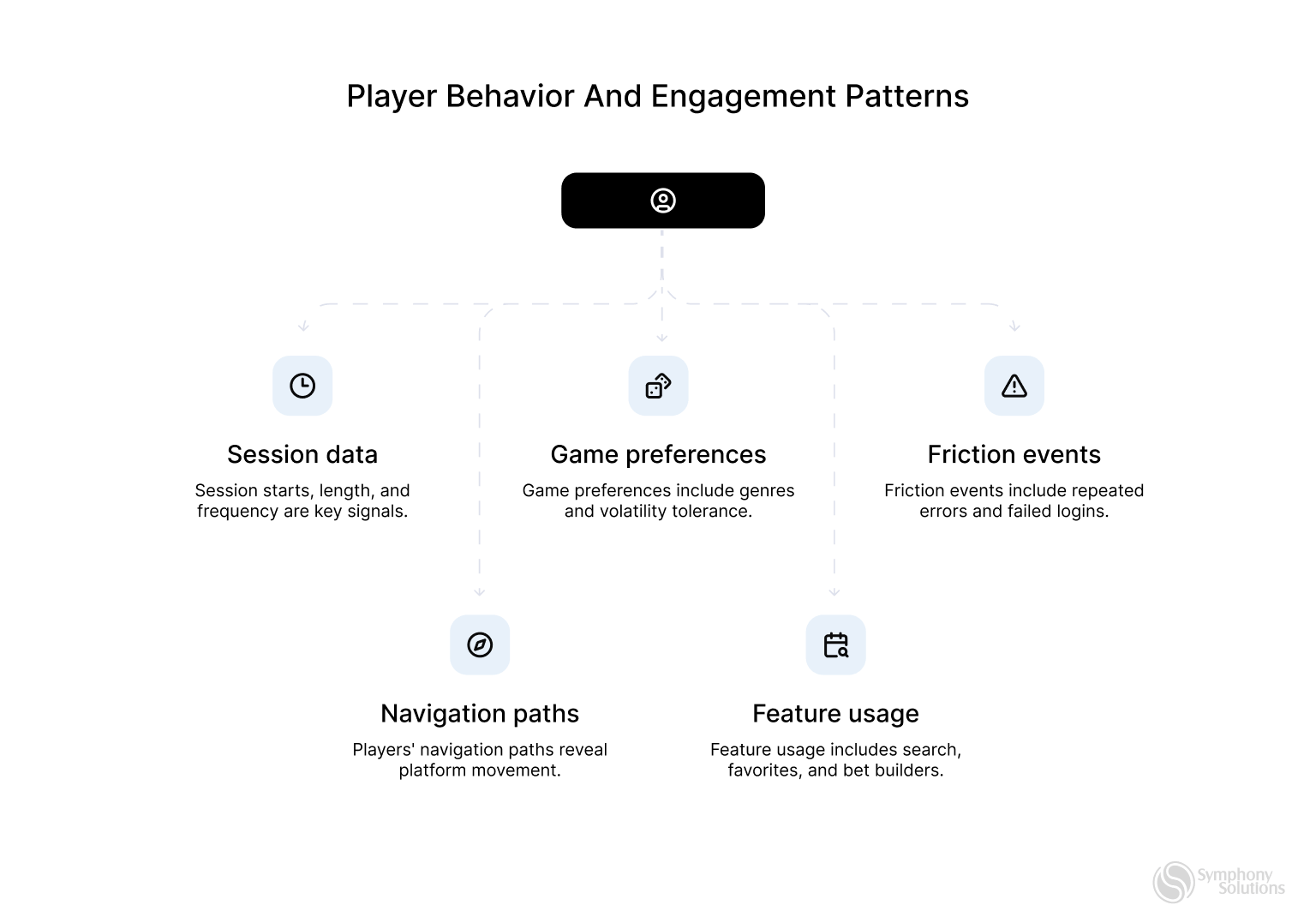
Behavioral data sits at the center of product design and CRM execution. It explains how players actually move through the platform and where experience quality breaks down. Key signals include:
- Session starts, length, and frequency
- Navigation paths, such as lobby > game > cashier > exit
- Game preferences, including genres, volatility tolerance, and live versus RNG
- Feature usage, such as search, favorites, bet builders, cash-out, and boosts
- Friction events, including repeated errors, failed logins, or abrupt exits
However, basic counts alone rarely provide enough insight. More effective models examine sequences (what happens before churn or disengagement) and context, such as device type, time of day, connection quality, or live event timing.
Transaction and betting data
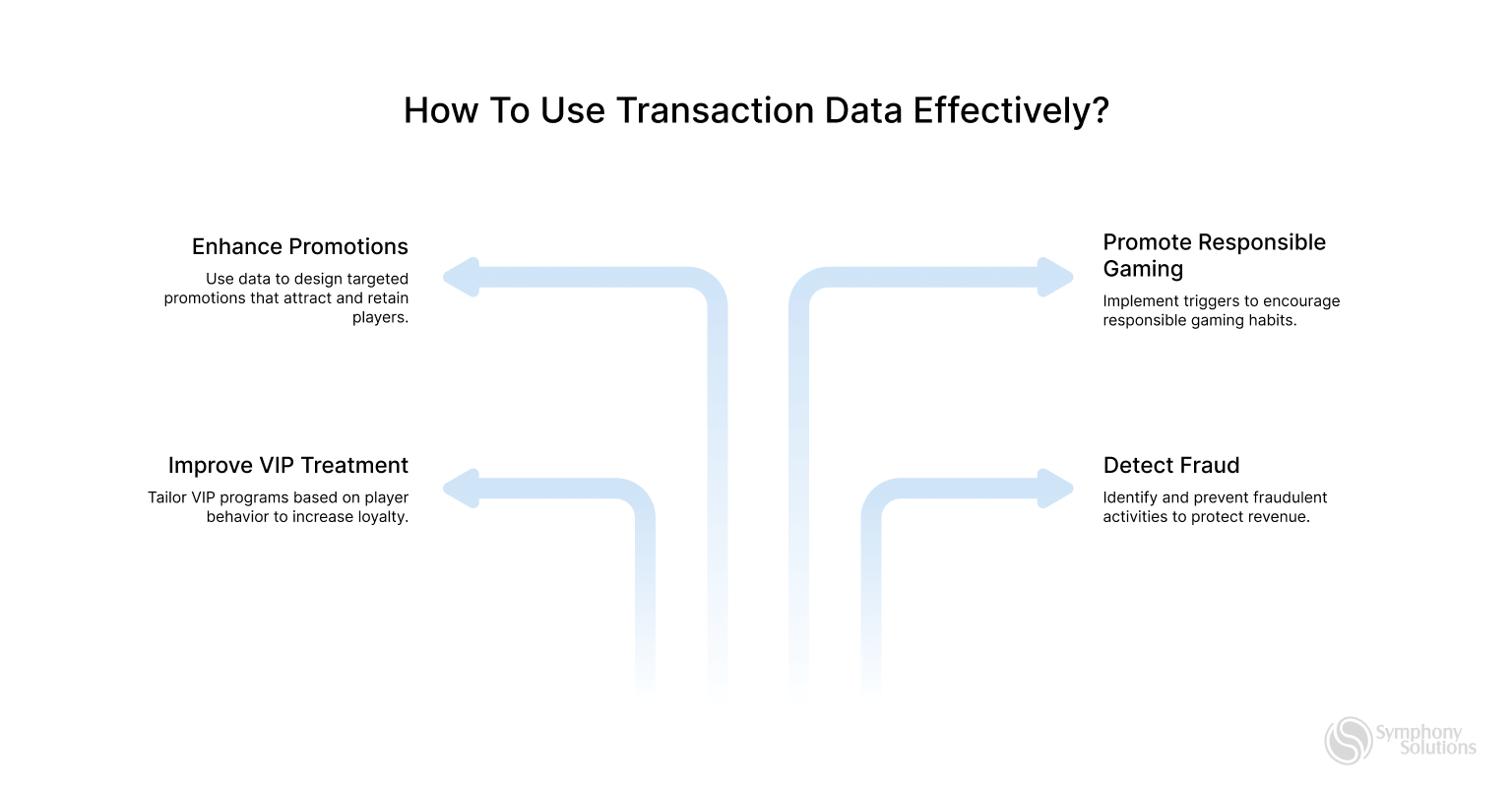
Transaction data is where analytics meets revenue reality. It captures how players fund their activity, manage risk, and respond to incentives. Core signals include:
- Deposits and withdrawals, payment method performance, and failure rates
- Bet sizing and staking patterns
- Win-loss ratios and bankroll volatility
- Bonus costs, wagering progression, and payout timing
- Chargebacks, AML flags, and unusual transaction behavior
Used correctly, this data supports both growth and control. It informs promotion design, VIP treatment rules, fraud detection, and responsible gaming triggers, often within the same decision framework.
Game performance metrics
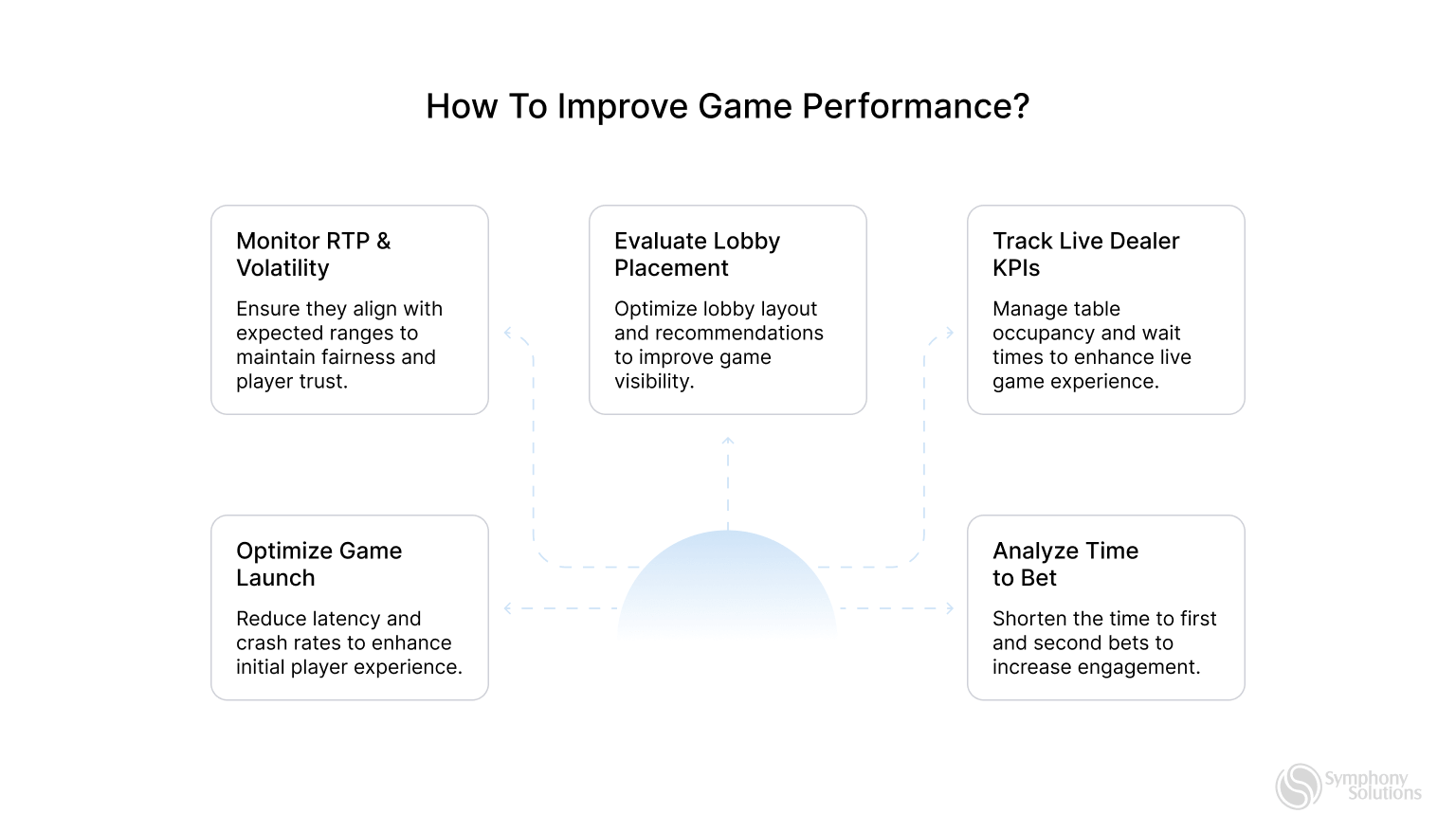
While behavioral data explains player intent, game performance metrics explain how the platform and content perform in response.
For operators, this data covers commercial performance, experience quality, and operational reliability across the game portfolio. Important metrics include:
- Game launch latency and crash rates.
- RTP and volatility behavior relative to expected ranges.
- Time to first bet and time to second session.
- Lobby placement impact, including position, recommendations, and collections.
- Live dealer KPIs, such as table occupancy and wait times.
When real-time analytics is available, teams can identify problems quickly, such as a broken game flow after a provider update or sudden cashier failures.
Together, these data streams explain not just what players do, but how the platform responds at scale. The next step is understanding how this insight translates into better experiences on the player side.
How Analytics Enhances Player Experience
This is where analytics becomes visible to players – not as reports, but as relevance, speed, and reduced friction.
Personalization and tailored recommendations
In iGaming, personalization goes beyond suggesting games. It affects how players move through the platform, which offers they see, and how communication changes over time. Common applications include:
- Adjusting lobby layouts based on actual player preferences.
- Triggering offers based on behavior rather than broad campaigns.
- Adapting UX flows for new players versus experienced users.
- Sending messages through push, email, or in-app channels based on past responses.
Personalization works best when treated as a decision process. Inputs typically include context (such as time or device), inferred intent, player value or risk, and regulatory or budget limits. The shorter the delay between behavior and response, the more effective personalization becomes.
Want to see a practical example? The BetSymphony sportsbook frontend supports configurable player journeys, letting operators tailor experiences and adjust UX elements directly at the UI level. It’s a real-world way to apply these personalization principles.
Predictive analytics for retention and churn reduction
Churn is rarely sudden. It is usually preceded by gradual changes in behavior, such as fewer sessions, payment issues, a shift to lower-engagement games, or increased contact with support.
Predictive analytics helps identify these signals early. The goal is to intervene before disengagement becomes permanent. Effective retention approaches rely on regularly updated churn indicators, clear reasons behind risk scores, and interventions that are tested and measured rather than assumed to work.
Real-time decision-making for better UX
Real-time analytics is not a buzzword in iGaming; it’s a competitive requirement. Players expect immediate feedback: odds changes, cash-out availability, bet settlement updates, and fast cashier responses. Real-time decisioning supports:
- Experience protection: detect latency spikes, provider outages, and failed payments
- Offer timing: deliver a relevant incentive at a moment of drop-off risk
- Fraud controls: block suspicious patterns before they become losses
- Responsible gaming: trigger limit prompts or cooling-off journeys early
To support these use cases, iGaming platforms rely on streaming and low-latency analytics architectures designed for continuous event ingestion, high concurrency, and fast queries across highly dimensional data.
Data-Driven Marketing and Player Acquisition
When the same analytics capabilities are applied beyond UX and operations, they begin to shape how players are acquired, engaged, and retained. In marketing, analytics shifts the focus from volume to efficiency and long-term value.
Segmentation and targeted campaigns
Effective segmentation goes well beyond basic labels like “VIP” or “casual.” High-performing models reflect where players are in their lifecycle, how they engage with different products, and how sensitive they are to incentives. Common dimensions include lifecycle stage, game affinity, bonus sensitivity, payment reliability, and risk tier.
When segmentation is done well, it supports a more disciplined campaign structure. Creative, offers, channels, and timing are aligned to specific segments, then measured and adjusted through a tight feedback loop. This reduces wasted spend and improves relevance without increasing campaign complexity.
Bonus and promotion optimization
Promotions are not free. They represent both a direct cost and a strong behavioral lever, which makes accurate measurement essential. Analytics improves promotion efficiency by answering a small set of practical questions:
- Would the player have deposited without the offer?
- How much incremental value does the bonus generate?
- What abuse signals are present?
- Does the timing match the player’s intent?
Even basic measurement methods (such as holdout groups, uplift modeling, and lifecycle-based testing) can materially improve results. Over time, these practices turn promotional spend from unavoidable leakage into a controllable investment linked to retention and lifetime value.
Using Data Responsibly: Privacy and Compliance
iGaming analytics operates inside a high-trust, high-scrutiny environment. That means privacy and compliance can’t be an afterthought, especially under frameworks like GDPR.
The financial consequences of getting this wrong are well established. GDPR allows administrative fines of up to €20 million or 4% of global annual turnover, and regulators across Europe have shown they are willing to apply them in practice. For example, Croatia’s data protection authority published a case imposing a €380,000 fine on a sports betting company for GDPR-related violations tied to security measures and processing practices.
Avoiding these outcomes, however, depends less on legal interpretation and more on how data is handled day to day. In iGaming, responsible data usage is built around a small set of operational principles, which include:
- Data minimization, collecting only what is necessary
- Purpose limitation, with clear justification for how data is used
- Access controls and audit trails, to restrict and monitor internal use
- Encryption and secure storage to protect sensitive information
- Consent management, where required by regulation
- Defined retention schedules to avoid holding sensitive data indefinitely
Just as importantly, responsible data use extends beyond compliance. Data analytics in iGaming can actively support responsible gaming by enabling earlier detection of risk signals. Behavioral monitoring allows operators to identify warning patterns sooner and intervene more effectively than manual review alone.
Putting these principles into practice requires more than policy. It depends on having the right systems in place.
Tools and Technologies Driving Data-Driven iGaming
Modern iGaming platforms rely on a tightly integrated analytics stack to support day-to-day decision-making. This typically includes CRM, analytics, and predictive systems, with AI applied selectively to improve speed, accuracy, and scale.At a practical level, these systems are built from the following set of components:
- Event tracking and customer data platforms (CDPs) to capture structured behavior and resolve identities across channels.
- Data warehouses or lakehouses to unify data for analysis, modeling, and reporting
- Streaming pipelines to ingest real-time signals such as odds changes, clicks, payments, and gameplay events.
- Business intelligence and product analytics tools for dashboards, funnels, and cohort analysis.
- Machine learning infrastructure to support churn prediction, recommendations, and risk scoring.
- Experimentation frameworks, including A/B testing and feature flags, to validate changes before full rollout.
When this is designed properly, analytics becomes “how the business runs,” not a reporting layer. Symphony Solutions’ data and analytics services emphasize this idea: embedding KPIs, governance, and real-time visibility into operational workflows rather than isolating insight inside dashboards.
BetSymphony Insight: Leveraging analytics within sportsbook and casino platforms
Analytics delivers the most value when it is embedded directly into the product layer. When insights can inform offers, user experience, and operations without long release cycles, teams are able to respond faster to player behavior and changing market conditions.
Platforms like BetSymphony are designed around this principle, giving operators direct control over how analytics informs sportsbook and casino experiences. Rather than treating analytics as a separate reporting function, insight is used to adjust promotions, refine UX, and support operational decisions as they happen.
In practice, platform-level analytics in a sportsbook and casino environment typically includes:
- Unified event data across sportsbook and casino journeys
- Cohort-based retention analysis by product, market, and acquisition channel
- Promotion performance measured against lifetime value, not just redemption
- Real-time alerts for operational issues such as payment failures, latency, or outages
- Risk and responsible gaming monitoring embedded directly into workflows
Across the iGaming industry more broadly, analytics teams are also beginning to use generative AI tools to support analysis and decision-making. These tools are applied on top of existing data foundations to speed up insight discovery – such as exploring data through natural language queries, accelerating analysis cycles, or summarizing complex patterns for faster review.
Final Word
Sustainable growth in iGaming depends on how well operators connect player behavior with timely, informed responses. Data analytics for iGaming underpins that connection. It enables teams to reduce friction, personalize engagement, identify risk earlier, and manage acquisition costs more effectively.
What ultimately separates operators is not how much data they collect, but how consistently those insights are translated into action. When analytics is embedded into everyday decisions and applied responsibly, organisations are better positioned to adapt as markets, regulations, and player expectations continue to change.