Author: Ihor
-

Symphony Solutions Welcomes Kseniya Kobryn as New CEO
Symphony Solutions proudly announces the appointment of Kseniya Kobryn as the new Chief Executive Officer, effective immediately. Kseniya, who has been with Symphony Solutions for nearly nine years and served as Chief Operating Officer for the past five years, now steps into this leadership role following the transition of Theo Schnitfink, the company’s beloved Founder and Chairman. Theo’s vision and leadership have shaped Symphony Solutions into the innovative and inspiring company it is today.
Reflecting on his journey with Symphony Solutions, Theo Schnitfink shared, “Leading Symphony Solutions has been one of the greatest adventures of my life. Building this company from the ground up and seeing it grow has been truly rewarding. Now, it’s time for a new chapter. I have full confidence in Kseniya Kobryn to guide Symphony into the future with fresh ideas and unwavering dedication.”
Although stepping down as CEO, Theo will remain actively involved in Symphony Solutions alongside his wife, Valentina Synenka, as engaged members of the company’s board.
Kseniya Kobryn expressed her excitement and commitment to the company’s future: “It is a moment of great pleasure and honor for me. Being supported by my team, I plan to lead as a servant leader, staying connected to the needs of Symphony Solutions and its people. I am happy, honored, and committed to doing all I can to bring great results for Symphony.”
This leadership transition marks a new chapter for Symphony Solutions, one filled with opportunities for growth and innovation. The entire Symphony team extends deep gratitude to Theo for his visionary leadership and warmly welcomes Kseniya as she embarks on this exciting journey.
-

Guide to Cloud Managed Services for Businesses
Cloud computing has become increasingly popular as businesses and organizations seek its benefits, such as enhanced data security, flexibility, and easy scalability. To fully leverage these advantages without the associated hassles, many companies are now turning to business cloud managed IT services.
According to a Global Forecast report by MarketsandMarkets Research, the market for cloud-managed services is expected to grow significantly, reaching USD 139.4 billion by 2026, up from USD 86.1 billion in 2021.
This trend highlights the importance of managed service providers in helping businesses optimize their cloud operations. Continue reading to learn what you can also gain from these partnerships.

By 2026 cloud managed services market is forecasted to reach 139.4B USD from 86.1B USD as of 2021.
Source: MarketsandMarkets ResearchWhat are Cloud Managed Services?
Cloud-managed services involve partnering with a provider offering comprehensive cloud infrastructure support when a business wants to migrate to the cloud. This includes setting up, maintaining, updating, and troubleshooting your cloud environment. Unlike basic cloud infrastructure providers, managed service providers (MCSPs) offer ongoing management and support beyond the initial setup, covering services like cloud storage, cloud transformation, and cloud-native development.
When and Why Do Businesses Need Them?
Businesses need cloud-managed services to manage the complexities of cloud infrastructure effectively. Managing cloud environments requires continuous monitoring, regular updates, and quick troubleshooting, which can be challenging and resource-intensive for internal teams.
Opting for cloud-managed services helps businesses avoid the difficulties of in-house cloud management, such as unplanned expenses, the need for additional hires, and technical debt. For instance, Symphony Solutions can develop and manage a comprehensive cloud solution, ensuring efficient communication within the cloud infrastructure.
By choosing cloud-managed services, businesses can depend on these expert providers to maintain and optimize their cloud environments. This ensures that the cloud infrastructure remains secure, up-to-date, and efficient, allowing businesses to concentrate on their core operations and strategic objectives.
Benefits of working with a managed cloud services provider (MCSP)
- Predictable spending. Cloud service providers usually offer a subscription plan that may be tailored to your organizational IT needs for the best service-to-price ratio. You may scale your managed cloud team at any time as the need arises. Sometimes, your provider may offer you a credit plan for when your cloud needs change throughout the year. However, this is more applicable to organizations that experience an excessively heavy load at certain times of the year (e.g., Black Friday and Christmas).
- Resource optimization. Your MCSP will provide services that best suit your workloads and planned budget and optimize performance for desired business value outcomes. A good MCSP will keep you clear with regular performance metrics reports, help you configure your managed cloud infrastructure, and constantly improve your solution.
- Robust infrastructure. As part of cloud infrastructure managed services, your MCSP sets up your cloud infrastructure. The service provider helps align your cloud network operations to your business needs, regularly updates and monitors the state of your cloud environment and reports back to you.
- Maintenance. By opting for maintenance with your cloud services provider, you have more options for saving costs on IT expenses. Your MCSP alleviates the technical and financial burden of maintaining your own cloud environment.
- Service level agreements. When you start working with an MCSP, your provider commits to delivering the agreed-upon service levels and ensuring service continuity for your business.
- Quick response time. You can expect 24/7 cloud support and a quick response to any issues with your cloud infrastructure, thus ensuring that your managed cloud applications operate uninterrupted.
- Data safety and recovery. Data loss is a security risk you want to avoid at all costs. With cloud-based managed services, you get regular data backups, quick recovery, and data source reservations.
- Interfacing. Your MCSP handles any issue related to your cloud vendor so that you can focus on your business growth. As certified partners with AWS and GCP, we can ensure the fastest problem resolution, cost control, and automation of critical processes.
- Timely updates. Your MCSP maintains its software and hardware always up to standard, with regular upgrades, personnel training and upskilling, expanding resources, and keeping up with the pace of the cloud market and industry.
- Integrated services. Create your custom cloud environment seamlessly connected to your existing systems. With an MCSP you can be flexible in what cloud solution exactly matches your business objectives, allowing yourself more freedom in prioritizing spending and focusing on growth.
Benefits of working with a managed cloud services provider

When you opt to work with an MSP, you can benefit from having access to a reliable team of cloud experts that handle your cloud environment and help optimize your business operations. Here are just some of the perks of your provider’s team managing cloud infrastructure for your business:
- Predictable spending. Your managed services provider usually offers a subscription plan that may be tailored to your organizational IT needs for the best service to price ratio. You may scale your managed cloud team at any time as the need arises. In some cases, your provider may offer you a credit plan for when your cloud needs change throughout the year. However, this is more applicable to organizations that experience an excessively heavy load at certain times in the year (e.g., Black Friday, Christmas).
- Resource optimization. Your MSP will set you up with services that fit you best in terms of workloads and planned budget, as well as optimize performance for desired business value outcomes. A good managed services provider will keep you in the clear with regular performance metrics reports and help you configure your managed cloud infrastructure and constantly improve your solution.
- Robust infrastructure. As a part of cloud infrastructure managed services your MCSP sets up your cloud infrastructure The service provider helps align your cloud network operations to your business needs, regularly updates and monitors the state of your cloud environment, and reports back to you.
- Maintenance. Opting for maintenance with your cloud services provider, you have more options for saving costs on IT expenses. Your MCSP alleviates you from the burden, technical and financial, of having to maintain your own cloud environment.
- Service level agreements. When you start working with an MCSP, your provider commits to delivering the agreed-upon levels of service and ensuring service continuity for your business.
- Quick response time. You can expect 24/7 cloud support and a quick response to any occurring issues with your cloud infrastructure, thus ensuring that your managed cloud applications operate uninterrupted.
- Data safety and recovery. Data loss is the security risk that you want to avoid at all costs. With cloud-based managed services, you get first of all regular data backups and quick recovery, but also data sources reservation.
- Interfacing. Any issue relating to your cloud vendor is handled by your MCSP, so that you can only focus on your business growth. Being certified partners with AWS and GCP, we can ensure the fastest problem resolution, cost control and automation of any critical processes.
- Timely updates. Your MCSP maintains their software and hardware always up to standard, with regular upgrades, personnel training and upskilling, expanding resources and keeping up with the stride of the cloud market and industry.
- Integrated services. Create your custom cloud environment seamlessly connected to your existing systems. With an MSP you can be flexible in what cloud solution exactly matches your business objectives, allowing yourself more freedom in how to prioritize spending and focus on growth.
Managed cloud services provider vs. Cloud services provider
Cloud service providers offer the tools to create and manage your cloud ecosystem, depending on the individual solution you require. Cloud service providers, such as AWS, Google, and Azure, offer different types of cloud computing for your business needs and support your solution. When you work with an MCSP, you can make use of the actual value of your cloud solution with a long-term perspective.
Your managed cloud services provider offers a higher level of IT support, your MCSP will see to it that all your cloud-related needs are met and you are getting the best service for your money. Your managed cloud provider is going to stay with you for a while, so you should want to know what to expect from this cooperation long-term.
Managed cloud services: What to expect
When you secure yourself a reliable MCSP, you can request any of the following from their range of services:
- Proactive communication and 24/7 cloud support
- System administration and operations
- System monitoring, alerting, and reporting
- Single point of contact for client-facing support
- Backup and disaster recovery
- Database administration
- Developer support and training
- Knowledge database for application for faster issue-solving
- Fast issue solving
- SLA management
This is the baseline of what to expect when choosing to go with managed IT cloud services.

What to consider when choosing your Cloud Managed Services Provider
Are you ready to start your cloud journey with an MCSP? Here are some tips on how to make sure that you find the right match.
- Expertise and certification. When setting up your in-house team, you look for people with the right experience and expertise. It’s the same with cloud service providers, maybe even more so if, with your own team, you may put in buffer time for training and skilling up. With an MCSP, you want to get the solution out of the box. You rely on your provider with every step of the process, leaving little leeway for bad takes. Look for a certified MCSP with solid proof of expertise and credibility, as you want your cloud environment to be managed by a tech team with proper training and experience.
- Tooling and workflows. You want to trust your managed IT cloud services provider that they have the right tools and workflows instated to give you the cloud solution that is the right fit. However, you can also have a say in what and how they do it when choosing your provider. You want a provider that is familiar with the prevalent tooling and workflows in your industry and knows how to work with them to achieve the results you strive for.
- Transparency and control. As already stated, you trust your cloud service provider a lot, as they have full access to your cloud data and are responsible for how it is handled. Achieve transparency in your cooperation with your MCSP and maintain control over the process. Reliable cloud service providers should always alert you of any changes, report issues, show performance metrics, etc.
Our Cloud Managed Services: Benefits of working with Symphony Solutions
Symphony Solutions can help you implement your long-term strategic plans by managing your Cloud ecosystem from deployment to maintenance. Our managed teams comprise experienced Cloud engineers, handpicked to suit your specific needs and vision for the project. Your managed team is a single point of responsibility that maintains a stable cloud environment and controls any possible security or compliance issues before they arise.
What to expect when working with us? The cloud infrastructure managed services that we offer fall under the main categories:
- Incident management for providing SLA-based technical support and initial issue resolution, monitoring status and executing escalated requests.
- Request fulfillment for system configuration, report generation, functional sanity check, etc.
- System monitoring for monitoring system health and business metrics, preventing negative impact on service operation.
- Knowledge management for continuously creating a knowledge base with scenarios for the support team on initial incident management.
These are the managed services that Symphony Solutions offers as your trusted Cloud services provider. Moreover, by bringing the clients together with established teams of experts to provide DevOps services, we fully accommodate the client, whether they are setting out on their cloud transformation journey, require a solid solution for building data warehouses or data lakes, or need an expert team for cloud-native application development. The client benefits from the fast-track delivery of applications as the development team can solely focus on the business objectives while the cloud-managed services team takes care of the system’s health and metrics. This was the case with Goat Interactive when our cloud-managed services team took over managing system monitoring and resolving any and all issues 24/7 without the immediate involvement of the development team.
Summing up
With cloud management services, you can benefit from a secure and flexible solution and know that your MCSP’s team has all hands on board making sure that it’s running smoothly ready to jump in at any sight of trouble. Anything from bug fixes, incident statistics analysis, periodical backups, and other important maintenance operations are covered by your vendor while you can focus on strategic business growth.
FAQs
-

19 Common Cloud Migration Risks and Solutions to Mitigate
Over the past decade, businesses have boosted their investments in IT infrastructure, leading to a notable increase in cloud migration. Projections indicate that the cloud migration services market will expand from $12.54 billion in 2024 to $69.73 billion by 2032, growing at an annual rate of 23.9%.

This growth shows that more companies are leveraging the cloud for its flexibility, scalability, resilience, agility, and enhanced security, making cloud migration a pivotal strategy for many. However, despite these advantages, it’s important to recognize that migrating to the cloud involves certain risks. But, these challenges can be effectively managed and overcome with careful planning and strategy.
Here are some of the most common cloud migration risks and mitigation in cloud computing:
Data governance regulations
Data governance regulations are a major concern for companies, particularly in sensitive sectors like healthcare. These regulations require companies to establish clear frameworks that define data ownership, outline responses to breaches, and ensure proper coordination. A pressing issue for many businesses is understanding how cloud computing services comply with these stringent data protection and privacy rules to safeguard sensitive information effectively.
How to solve this: Many cloud providers are, by default, HIPAA, GDPR, etc. compliant. This makes them a more convenient and sensible option, as it means that a cloud provider worries about compliance, and the company that uses their services is just given a guide on how to maintain this compliance.
You need to have a very clear understanding of your non-functional requirements before the move. Compliance is a part of these requirements and you need to understand what standards the solution must meet. If you’re dealing with an old legacy solution, it could be a good time to consider application modernization, as regulations might have changed since your application was developed. For instance, GDPR was introduced only in 2018, and solutions that have been designed without strong capabilities for personal data management can be non-compliant by design, and now could be the best time to improve it.
Incompatibility of existing architecture
Your existing architecture is one of the most serious concerns that can stall your move. Legacy architecture tends to be complex and oftentimes incompatible with the cloud as it might rely on programming languages, system libraries, or execution environments that are not supported or available in the cloud.
There are cases when a business wants to migrate a legacy system that is going out of support soon but it is tied to, say, integration to hardware in 1000+ restaurants. Moving it to the cloud would automatically mean reinstalling all of this hardware. This would make it not just a move to the cloud, but a global renovation which is not as easy as it may seem.
How to solve it: The solution here is to audit your infrastructure thoroughly and assess which parts of the architecture are interdependent and which make no sense to move to the cloud economically. If the latter is the case, consider building a hybrid cloud model. In this case, the part of the legacy system that is impossible or economically impractical to migrate will remain as it is while everything that can be taken to the cloud is moved. The business logic is to move everything that can be easily transferred.
Loss of data
Another risk of cloud migration that might worry every executive when moving to a new location is the possibility of data being lost, incomplete, or corrupt. Various factors might cause it, such as technical issues, power outages, or human error.
How to solve it: It is always a good practice to create a backup of your files. This should be done regularly, whether you are going through cloud migration. By creating a backup, if you lose all or some part of the data, you will have no problem restoring it. You might even go further with your precautions and have your data stored by multiple cloud providers. In this scenario, you won’t have to worry about unexpected downtime of your provider.
However, it is important to note that data loss, if it occurred, would cause a great calamity. However, it is quite hard to lose data if experts manage your migration risks and mitigation processes.
So the solutions to this problem come down to two actions: create a backup and choose wisely who you trust to perform your cloud migration.
Wasted Cloud Migration Expenses
Cloud migration should consider logical steps, business continuity, and costs. If, for instance, test environments are suspended for several months or even longer and the client keeps paying for them, it’s a serious cost impact. If the move is not planned thoroughly, there are bound to be expenses, the size of which will depend on the scale of the project.
How to solve it: To ensure that you are paying for the services your business needs and uses, employ professionals who will control your spending so you don’t overspend. Another sensible move is to have a cloud readiness assessment checklist with a detailed budget estimation.
Security
Security is at the top of every company’s list regarding cloud migration risks. The main issue is that not all companies (and only a few) are lucky enough to have skilled security experts on their teams.
How to solve it: In the past, it was believed that the cloud was not the most reliable option for security. On the contrary, today, with infrastructure-managed services, industry leaders such as AWS or Microsoft Azure offer greater security if configured correctly. On top of that, cloud services are more stable than your in-house team, which is probably constantly understaffed and limited in its abilities, can achieve. With a cloud, provider security won’t be such a problem that requires reading security releases each month or ensuring all systems are patched. Amazon or any cloud security provider can take on this responsibility much more efficiently than any in-house team.
Regarding cyber-attacks, the cloud has on-demand services like DDoS protection that can be switched on demand when under attack. If the infrastructure under attack is on-premise, you must look for and buy actual hardware, set it up, and install it. This usually takes up to a couple of months, and you will be hacked within hours. So, with all the safety worries around the cloud, it is a more secure option.
Lack of internal IT resources
The complexity of cloud migration often stalls the move despite its numerous advantages and the organization’s willingness. One of the main reasons is the lack of a skillset. Cloud migration risk and mitigation processes can strain your in-house IT staff, especially if it’s missing the right talent or knowledge. This might lead to human error and costly mistakes.
One tricky cloud migration risk is finding the right staff to lead the move effectively.
How to solve this: You can either grow your internal team or turn to third-party vendors in two ways out of this conundrum.
Cultivating your cloud talent internally is a good long-term solution. However, it comes with numerous obstacles. Leading specialists are hard to come by, as the demand for such talent exceeds the supply. Another challenge would be retaining top talent through regular training and continuous learning. But even if these conditions are met, there is always a risk that a leading cloud expert will look for a more challenging or interesting project.
Another option is looking for a trusted vendor to provide dedicated resources for successful cloud migration. They could enhance your IT team with their vast experience and track record of successful cases.
Time and cost of migration
Time and cost spent on cloud migration are another risk factor that has to be considered. Without a detailed audit before the move, any numbers or figures you are promised are a shot in the dark. This means that you can either receive an inflated budget as a precaution or a promise of a moderate cost of migration that can exceed several times.
How to solve this: The migration of legacy systems should start with a detailed audit and inventory and continue with the architecture of the new solution. The migration procedure solution should be the following: You must have a clear migration plan linking your current and target models. This plan should detail what should be migrated, what is considered a success and what is not, the criteria for the next step, etc.
The correct cloud migration service is the following:
- Audit the system’s existing functional and non-functional requirements in its current state.
- Development of the target model – how it should be in the future.
- Detailed transition plan.
Cloud migration is not always about saving money. It’s more about flexibility and elasticity. Companies want to migrate to the cloud mainly because it is better but not cheaper. Any system can be optimized for both costs and other parameters. It is possible to optimize the system cost-efficiently but simultaneously lose elasticity (for instance, if we have significantly more users, then we can process efficiently) or redundancy (if we have requirements for system reliability). It’s all a matter of optimization, but the main value of the cloud is that it gives far more flexibility compared to on-premises.
Ransomware Threats
Cloud environments are particularly attractive to ransomware attackers due to their widespread use and the valuable data they hold. When data is migrated to the cloud, it can become a target for attackers who exploit vulnerabilities to encrypt data and hijack systems, demanding ransom for data release.
How to solve this: To effectively reduce the risk of ransomware attacks, it’s crucial to use strong encryption for data in transit and at rest. Additionally, maintaining regular backups allows you to restore your data without paying a ransom. Advanced intrusion detection systems can alert you to threats early on, and educating your workforce about phishing and other attacks is vital for prevention.
It’s also important to have a detailed incident response plan ready. This plan should outline quick and efficient actions to minimize downtime and manage disruptions, including isolating affected systems, communicating with stakeholders, and restoring operations using clean backups.
Added Latency Issues
The physical distance between client devices and cloud servers can introduce latency, which is the delay before a data transfer begins following an instruction for its transfer. This latency can be particularly problematic for performance-sensitive applications, such as real-time data analytics or online gaming, where minimal delays can degrade user experience and functionality.
How to solve this: Choose cloud data centers close to your main user base, which can significantly cut down data travel time and improve application responsiveness. For applications where latency is particularly critical, consider using hybrid cloud setups. In these setups, latency-sensitive components are kept on-premise while other parts are moved to the cloud, balancing control with scalability.
Another method is edge computing, where data is processed on local devices or nearby nodes instead of distant data centers. This approach cuts down latency and reduces the bandwidth needed, boosting performance and enhancing user satisfaction. By carefully choosing data center locations and combining different cloud and edge computing technologies, businesses can customize their infrastructure to meet specific performance needs and enhance overall efficiency.
Regulatory Compliance Challenges
Navigating regulatory compliance in the cloud is complex due to varied and strict regulations across different industries and regions. These rules dictate how data should be handled, stored, and protected, and failing to comply can lead to heavy penalties. Though broadly capable, many cloud services may not automatically align with specific industry standards or regional laws, presenting a major challenge for organizations.
How to solve this: Organizations must choose cloud providers that offer compliance guarantees or certifications specific to their industry needs. For example, healthcare organizations should select HIPAA-compliant providers to ensure they meet the requirements for protecting patient data. EU businesses should opt for GDPR-compliant providers to protect personal data in line with European regulations.
These providers have invested in obtaining these certifications and maintaining infrastructures and processes that adhere to or exceed the required regulations. By partnering with the right cloud provider, businesses can lessen compliance risks, streamline regulatory management, and focus more on their core operations.
Data Corruption During Transfer
Data corruption during cloud migration is a significant risk, especially during large-scale transfers. Errors in transfer protocols or data conversion processes can compromise data integrity, leading to loss of crucial information, operational disruptions, and substantial recovery costs. The likelihood of these errors increases with the migration’s scale, potentially altering or damaging the data.
How to solve this: To safeguard against data corruption, it’s crucial to implement thorough data integrity checks before, during, and after migration. Employing tools like checksums or cryptographic hashes helps ensure that data remains unchanged and intact throughout the transfer.
These tools create a unique digital fingerprint of the data at its origin, which is then verified upon its arrival at the destination to ensure no changes have occurred during transit. Additionally, robust error-handling procedures should be established to quickly identify, log, and address any issues as they arise. These measures help maintain data integrity, reduce downtime, and expedite the migration process.
Long Migration Process
Migrating to the cloud can be lengthy and disruptive, especially for large enterprises with extensive data and complex systems. If critical services are interrupted, the extended timeframe can lead to inefficiencies, prolonged downtime, and potential business loss. The complexity and volume of data further complicate the transition, challenging smooth operations.
How to solve this: To minimize disruptions during a lengthy cloud migration, it is recommended that a phased migration approach be adopted. This strategy involves categorizing data and applications by their importance to business operations and migrating them in stages, starting with the least critical. This phased approach keeps essential services running without interruption and allows any issues that arise in the early stages to be resolved before more critical systems are migrated.
Additionally, using advanced migration tools can greatly enhance the efficiency of the process. These tools are designed to automate and streamline data transfers, synchronize data across different environments for consistency, and provide real-time monitoring of the migration progress.
Skills Gap
Migrating to cloud-based systems requires specialized knowledge that many organizations lack. This skills gap can cause errors, inefficiencies, longer deployment times, higher costs, and underutilized cloud capabilities. Configuring, securing, and maintaining cloud environments can be daunting without the necessary expertise.
How to solve this: Organizations should consider investing in comprehensive training programs for their current IT staff to overcome this challenge. These programs should cover essential cloud technologies and best practices, equipping employees with the skills to manage cloud migration effectively. Alternatively, hiring external cloud experts or consultants who specialize in cloud migrations can temporarily or continuously bring in the needed expertise.
These professionals can provide valuable guidance, help mitigate risks during the transition, and optimize cloud configurations to suit the organization’s specific needs. Another strategic option is to partner with a managed cloud service provider. Such providers can augment the existing IT team by contributing their specialized cloud knowledge and management services, filling skill gaps, and ensuring an efficient migration process.
API Vulnerabilities
APIs (Application Programming Interfaces) enable integration between software applications and cloud services but pose significant security risks. If not properly secured, APIs can become entry points for attackers to access sensitive data and systems. Vulnerabilities can lead to unauthorized data exposure, manipulation, and other security breaches, potentially causing severe organizational damage.
How to solve: Organizations must implement rigorous API security practices to mitigate the risk of API vulnerabilities effectively. This includes regularly conducting security audits to identify and remediate API architecture and implementation vulnerabilities. Encrypting data in transit is crucial, ensuring data cannot be intercepted during transmission between servers and clients.
Additionally, strict authentication and authorization controls are essential for all API access. This involves deploying robust authentication mechanisms like OAuth or API keys and setting up authorization protocols to control which data and services can be accessed by different users and applications.
Cost Containment Difficulties
While cloud migration often promises cost savings, it can lead to increased expenses without careful planning and management. Inefficiencies such as over-provisioning resources, underutilization, or failing to scale down services when they’re no longer needed can quickly cause costs to spiral. These issues can negate the financial benefits expected from transitioning to the cloud.
How to solve this: To manage and contain costs effectively during and after cloud migration, it is essential to utilize the cost-management tools provided by many cloud platforms. These tools offer real-time resource usage monitoring, giving organizations clear visibility into which resources are used and how much they cost. This information allows companies to make informed decisions about scaling resources up or down based on actual needs rather than estimations.
Additionally, establishing clear policies for resource allocation and de-allocation can help prevent unnecessary expenditures. These policies should specify who is authorized to deploy new resources, under what circumstances resources should be expanded or contracted, and when they should be decommissioned.
Insider Threats
Insider threats pose a significant security risk, especially during cloud transitions. Employees or contractors accessing cloud platforms can cause intentional or accidental data breaches. Malicious actions, like selling sensitive data or simple errors, such as misconfiguring security settings, can compromise data integrity, result in financial losses, and damage an organization’s reputation..
How to solve this: To effectively mitigate the risks associated with insider threats, it’s crucial to implement robust security measures. One of the most effective strategies is enforcing least-privilege access controls. This ensures that individuals only have the access necessary to perform their designated job functions, minimizing the potential damage from compromised or misused accounts.
Regular audits of access logs are also essential, as they help review who accessed what data and when identifying any unusual access patterns or unauthorized attempts to access data. Additionally, employing user behavior analytics can further enhance security. These systems use advanced algorithms to detect anomalous activities that deviate from normal usage patterns, signaling potential insider threats. Such tools can alert security teams in real-time, enabling prompt responses to emerging threats.
Reduced Visibility and Control
Migrating to the cloud can reduce visibility and control over network operations and data systems. Cloud environments abstract many hardware and software layers, making it harder for IT teams to monitor and control resources than on-premise systems. This reduced visibility can complicate security monitoring, compliance auditing, and performance management, increasing the risk of security breaches and inefficiencies.
Solution: Organizations should adopt cloud management platforms to combat the challenges of diminished visibility and control in cloud environments. These platforms are tailored to provide comprehensive monitoring and management capabilities across all cloud services, helping IT teams maintain a centralized overview of their cloud infrastructure. They typically feature tools for real-time monitoring of network traffic, system performance, security alerts, and options for automating routine management tasks. By utilizing these platforms, businesses can regain the necessary oversight to manage security risks effectively, comply with regulatory requirements, and optimize the performance of their cloud operations.
Data Dependencies
Cloud migration can be complicated by the interdependencies between different data sets and applications. The functionality of certain systems may rely on the sequential and accurate migration of interconnected data and applications. If these dependencies are not properly managed, systems may fail to operate as expected in the cloud, leading to significant operational disruptions and delays in achieving full functionality.
How to solve this: To ensure a smooth transition and minimize the risk of operational disruptions during cloud migration, thoroughly map out all data and application dependencies beforehand. This process should involve a detailed analysis of how applications interact with each other and with various data sets, pinpointing any critical sequences needed for migration. This crucial step allows for creating a strategic migration plan that sequences the migration of data and applications to maintain the functionality of dependent systems throughout the process.
Secure Deletion Issues
During cloud migration, it’s crucial to securely delete data from old systems, hardware, and backups to prevent unauthorized access and data breaches. Simply deleting files doesn’t remove the data from storage devices — it just marks the space as available. If not managed correctly, sensitive data could remain accessible and recoverable with specialized software, creating a significant security risk.
How to solve this: To effectively address secure deletion issues, organizations should use professional data-wiping software that meets industry standards for secure data destruction. This software is designed to overwrite data on storage devices multiple times, rendering it irretrievable. It’s also crucial to ensure that all copies of the data, including those stored on backups and temporary storage locations, are permanently removed. This can be achieved through comprehensive audits and by maintaining detailed logs of the deletion process. These steps help ensure compliance with data protection regulations and reduce the risk of data leakage.
Conclusion
Cloud migration offers significant benefits like flexibility and enhanced security, but it comes with risks outlined in this article. Proper planning and implementing strategic measures is essential to minimize any challenges. By doing so, businesses can ensure a smooth transition, maintain data integrity, and optimize operations, ultimately leveraging the full potential of cloud technology for growth and efficiency.
-

Managed IT Services for Healthcare – Everything That Your Healthcare Organization Needs to Know
Today, 84% of hospitals and healthcare centers use cloud services for backup, analytics, and disaster recovery. Additionally, over 76% of them are migrating their IT infrastructure to the cloud. They are turning to managed IT services to ensure a smooth transition and reduce the challenges of self-managing cloud IT infrastructure. This approach helps streamline operations, lower costs, and ensure compliance with industry regulations.
But what exactly do healthcare managed IT services entail? Here is a quick guide to give you a better perspective.

What is Managed IT Services in Healthcare?
Managed IT services for medical practices involves outsourcing a facility’s IT functions and operations to a third party, usually at a lower cost than running an internal department. Third-party service providers for medical managed services are mostly referred to as managed service providers (MSPs).
Healthcare MSPs are responsible for:
System Monitoring
One of the critical IT functions performed by cloud managed services providers is ongoing system monitoring, which includes testing and security checks. For instance, they can manage and monitor your medical application and facilitate the necessary upgrades on a need basis.
Technical Support
MSPs provide 24/7 healthcare it support to ensure that your medical IT infrastructure is up and running year in and year out. The support may extend to regulating identity and access to the platform, checking incidences, and reporting for real-time resolution before they prove costly.
Issue Resolution
Healthcare managed services come with an all-around service desk to facilitate prompt issue resolution. This function can include a general IT help desk, a clinical service desk, and a patient service desk. Both employees and patients can resort to these help desks to have their issues resolved in real time, 24/7.

Top 5 Cloud Managed Services Used in the Healthcare Industry
Some of the most sought-after infrastructure-managed services in the health industry include:
Healthcare & Patient’s Data Backup and Recover
This service is sometimes referred to as operational recovery, which entails building and storing copies of patient information to mitigate losses in anticipation or in the event of a breach. Although healthcare professionals can do this on their own, seeking the services of an MSP is always the prudent solution because third parties have the technical know-how and expertise to do this effectively.
An MSP will build a security-proof strategy that guarantees full data recovery in the event of a breach. Even better, they do this autonomously so that you can focus on other core practice functions, such as following up on patients to enhance their experience and promote quality care. The benefits of a proactive data recovery plan are many, including cost reduction, minimized downtime, and enhanced cybersecurity.
EMR Consulting & Support
Electronic medical records, popularly abbreviated as EMR are critical in running a modern practice. EMR consulting offered by MSPs comes with full-time technical support to minimize downtime in case hitches arise. An MSP gives you access to trained and authorized professionals who can be stationed at your facility and operate as an extended team of your internal department. Alternatively, these professionals might travel to your location from time to time to ensure that the installed EMR hardware works optimally, as designed and intended.
Besides installing innovative hardware to streamline workflows when capturing medical records EMR consulting & support services can extend to configuring:
- Tablet PCs
- Printer, scanners, and fax machines
- A signature pad for electronic signing
Healthcare IT Security
Cloud security in healthcare can be challenging, given that medical practices are regulated by varying rules and provisions that differ from one jurisdiction to another. For instance, the laws guiding the access and storage of medical data in the US are definitely different from the UK’s provisions. With this in mind, healthcare professionals often opt for on-premise data storage solutions to comply with the local laws and regulations.
However, building a custom on-premise IT infrastructure that is fully regulatory compliant when accessing and storing patient information can be pretty daunting. MSPs can help you do that effectively while keeping up with regulatory obligations. At the same time, MSPs can help you build applications that require higher availability than their regular counterparts to guarantee a secure, continuous workflow.
24/7 Network Monitoring
Often designated as 24x7x365, this is a network monitoring service that keeps tabs on your IT infrastructure around the clock, throughout the year. The service, usually offered by a resourceful MSP, extends to server monitoring and real-time desktop support so that issues can be resolved as they arise to ensure business continuity.
Healthcare practices are investing in this service to cushion themselves against unforeseen, but usually targeted and coordinated cyberattacks, ransomware threats, and data breaches. Typically, network practitioners need 24/7 network monitoring to facilitate:
- Patient care quality and continuity
- Centralized medical information for seamless access and management
- Real-time collaboration on multiple, secure devices
- Ongoing medical research and development
- Improved patient experience in online bookings and appointments
Data Migration & Managed Cloud Infrastructure
Businesses understand that cloud computing is the latest tech powering innovation and service delivery in the healthcare industry. However, operating or migrating to the cloud is totally different from what medical practitioners are used to when deploying patient information to legacy systems. It takes an experienced MSP with necessary data migration & cloud infrastructure skills, as well as understanding to do this effectively.
A reputable MSP will perform various functions when shifting your IT functions to cloud infrastructure, including:
- Patient data transfer from legacy systems to the cloud
- Data restructuring for PHI encryption and separation
- Systems and apps restructuring to ensure that they are cloud-native
- Security beef-up through network isolation controls
Data migration to the cloud is an iterative cycle that involves moving data of every application from a primary origin to a centralized cloud destination. Your MSP will leverage machine learning tools to minimize any error or data discrepancies during the entire process.
The Benefits of Managed Services for Healthcare Providers
Managed services for healthcare providers come with a ton of business benefits, including:
Improved Patient Healthcare
Outdated technologies and computer systems are a pain point for any business that wants to streamline its operations and enhance customer experience, healthcare facilities notwithstanding. Moreover, using outdated technologies to manage patient journeys can compromise the quality of healthcare, given that they are unreliable, and in most cases, insecure.
Healthcare managed IT services ensure that your practice leverages up-to-date systems and technology to optimize internal processes and improve patient healthcare in the process. For example, real-time collaborative tools offered by MSPs can increase engagement between staff and patients, even in the instances of remote healthcare provision.
At the same time, managed services can help you increase staff mobility, which in turn offers greater employee satisfaction. A happy staff means optimal service delivery throughout all patient touchpoints.
Security
Security is paramount in healthcare facilities because they often deal with sensitive patient data. Healthcare businesses are typically required to comply with certain rules and regulations to guarantee the privacy, as well as security of patient health data. For instance, practitioners in the US must comply with various federal regulations, such as the Health Insurance Portability and Accountability Act (HIPAA), and the Privacy Rule.
The latter regulation requires healthcare practitioners to safeguard patient data, whether stored in physical or electronic formats. There is also the security law that applies to patient data stored in digital formats. MSPs will help you create unique data encryption processes, as well as implement innovative IT security measures to enhance compliance in these areas.
At the same time, an MSP will offer secure collaboration systems to ensure that hospital staff works together in real-time without jeopardizing the security of patient data. For instance, they can encrypt communication between devices, as well as cloud access to ensure that all patient records are safe.
Cost-Optimization
Any business must always keep its operation costs lower to sustain itself, healthcare centers not being an exemption. With that in mind, it is always the goal of any healthcare service provider to accomplish more on a reasonable budget. But again, doctors and nurses are expected to offer the highest quality of healthcare services as provided by codes of conduct and various regulatory requirements.
MSPs take over IT management and monitoring functions to help you save costs. They can do this at a relatively affordable budget, thanks to economies of scale, since they serve many clients at the same time. Even better, they offer all-around services, such as compliance and security predetermined overhead costs, so that you can plan the budget ahead.
Managed IT services also means you don’t have to hire specialized talents or train the existing internal department on an ongoing basis, saving you from unnecessary costs.
Scalable Infrastructure
Probably the biggest challenge that healthcare businesses face is scalability. For instance, you might have to deal with outdated on-premise data centers, not to mention limited physical space if you are still using legacy systems for data storage. There is also the issue of limited budgets when it comes to technologies that offer limited to zero scalable options. All these obstacles might hinder business growth and impede patient care improvement.
Partnering with an innovative MSP can help you scale rapidly at relatively affordable costs. Your service provider can help you acquire or build custom software to extend your healthcare operations to a cloud-hosted infrastructure. This means that you can hire and train more staff, as well as accommodate a high number of patients on your system.
Business Agility
Business agility entails rapid, ongoing, and systematic adaption to the prevailing industry trends in a bid to maintain a competitive edge over other players. This extends to streamlining strategies that touch on complex and ambiguous, yet critical functions, such as IT operations.
Working with an MSP ensures that your medical practice adopts strategies geared towards business continuity. For example, proactive data recovery plans can ensure that you don’t lose vital patient information in the event of a disaster. There are also proactive security measures that ensure 24/7 compliance so that you don’t get bogged down with unnecessary fines or long-term penalties that might include withdrawal of your practice certificate.
Another MSP function that can help streamline business agility is staffing. An experienced MSP should offer a single point of contact for all your staffing functions, including real-time customer support, account management, or any other role that you want to outsource.
IT Risks for Healthcare Providers and How to Overcome Them
Prevalent risks faced by healthcare providers due to poorly manages IT functions and infrastructure include cyberattacks. A recent survey shows that 83% of physician practices have already experienced some form of cyberattack. These attacks have led to a loss of vital data, including private patient information, lab results, diagnoses, and critical medication lists. The survey also points out that phishing and computer viruses are the most prevalent types of targeted cyberattacks meted out on physician practices.
The healthcare industry still remains one of the most sought-after targets by cybercriminals, given that most practices around this sector still operate on outdated technologies and legacy systems. Most practices are often driven out of business if they can’t honor demands from the cyber attackers, such as paying ransom to recover their lost data.
Fortunately, partnering with an MSP can help you leverage the latest technologies that auto-update to safeguard vital patient data. An experienced service provider can also implement monitoring systems that detect and counteract cybersecurity risks before they result in actual breaches.
How to Choose a Managed Services Provider
Choosing the right managed services provider (MSP) is essential for optimizing cloud operations. Look for an experienced MSP with AWS, Azure, or Google Cloud certifications. They should offer comprehensive services like monitoring, security, data backup, and disaster recovery.
Additionally, ensure they can scale with your business, provide 24/7 support, and follow industry standards for security. Also, the MSP should customize its services to fit your needs and offer transparent, cost-effective pricing.
Best Practices for Managed Services Success
To maximize the benefits of managed services, follow these best practices:
- Define Clear Objectives: Establish what you want to achieve with managed services. Clear goals will guide the selection process and help measure success.
- Maintain Open Communication: Regular communication with your MSP ensures alignment with your business goals. Schedule regular meetings to discuss performance, issues, and future plans.
- Monitor Performance Metrics: Track key performance indicators (KPIs) to assess the effectiveness of the managed services. Metrics like uptime, response time, and issue resolution rates are vital.
- Embrace Collaboration: Treat your MSP as a strategic partner rather than just a service provider. Collaborative relationships foster better results and innovation.
- Continuous Improvement: Encourage your MSP to adopt a proactive approach to improvement. Regularly review and optimize processes and strategies to enhance efficiency.
- Prioritize Security: Ensure that security protocols are robust and up-to-date. Regular security audits and updates are crucial for protecting your data.
- Invest in Training: Educate your internal team about the managed services and how to interact effectively with the MSP. This understanding facilitates smoother collaboration.
- Flexibility and Adaptability: Be open to changes and new technologies. A flexible approach allows you to adapt to evolving business needs and technological advancements.
- Risk Management: Develop a comprehensive risk management strategy. Identify potential risks and work with your MSP to implement mitigation measures.
- Feedback Loop: Establish a feedback loop to continuously gather insights from stakeholders. Use this feedback to make informed decisions and improvements.
Wrapping It Up
Managed IT services are a game-changer for many practices. They take over the tiresome, redundant, yet critical IT functions to let professionals focus on what they do better—providing optimal healthcare while keeping risks at bay. Consult an experienced infrastructure management provider today to find your IT outsourcing options and streamline the workflow in your practice.
-

Symphony TechTalk: Get Ahead in Tech with Architectural Thinking
Your job title doesn’t dictate the extent of your potential in the tech industry. Mark Richards, a hands-on software architect with a storied career in software since 1983, invites you to an online masterclass where architectural thinking breaks down the barriers imposed by job titles. Far from your average tech talk, this session dives into the core principles of architecture and how they can be applied across various tech roles. This session isn’t just for architects; it’s for anyone in tech looking to think bigger and craft smarter, more resilient solutions. Whether you’re a developer, tech lead, or any professional in technology, adopting an architect’s mindset can lead to significantly more innovative projects and impactful solutions. Your opportunity to rethink how you approach software is here.
Watch the event record on YouTube!
What You’ll Learn:
- The indispensable role of architectural thinking in software development.
- The clear distinctions between architecture and design.
- Understanding architectural characteristics: the core of robust software systems.
- Techniques for comprehending the structure of your software solutions.
- Navigating trade-offs with effective strategies.
Who will benefit:
This online masterclass is a golden ticket for tech professionals across all levels seeking to leap forward in their careers by integrating advanced architectural thinking into their work. From understanding the foundational principles of software architecture to applying these concepts in everyday tech roles, this session promises to equip participants with the knowledge and skills to innovate and excel.
- Tech enthusiasts eager to broaden their understanding of architectural thinking in technology;
- Software developers looking to incorporate architectural principles for better software design and functionality;
- Technical leaders and managers aiming to enhance team performance and project outcomes through strategic architectural insights;
- Entrepreneurs and startup founders interested in leveraging architectural thinking to drive their business strategies and product development;
- Product managers, data analysts, and digital marketing professionals who are keen to apply architectural thinking in crafting user-centric products and services;
- Quality Assurance Professionals, DevOps, and Site Reliability Engineers (SREs) looking to understand the architectural aspects that can improve system reliability and efficiency.
Take advantage of this unique opportunity to learn from Mark Richards, a revered figure in the IT architecture domain, and redefine how you approach your tech projects and challenges. Whether you’re looking to refine your technical skills, gain new insights into leading and managing tech teams, or simply looking for inspiration to tackle your next big project, this masterclass is designed to deliver immense value. Join us and step into a world where architectural thinking sets you apart in the tech industry.
Meet our expert:

Mark Richards,
an Icon in the World of IT Architecture
- The visionary behind the Developer to Architect concept.
- Acclaimed author of “Fundamentals of Software Architecture” and “Software Architecture: The Hard Parts”.
- Influential in shaping the skills of hundreds of architects through his work on microservices architectures, service-oriented architectures, and distributed systems across multiple technologies.
- A respected O’Reilly author and speaker.
Space is limited, and the opportunity to learn from a luminary like Mark Richards for free doesn’t come often. Secure your spot today to revolutionize your approach to software architecture. Register today and step into the world of architectural thinking that will set your projects apart!
See you there!
For more information, visit:
Website: Developer to Architect
Books: Mark Richards’ Publications -

Cloud Computing in Healthcare: 9 Benefits of Cloud Computing
Cloud computing is making a big splash in healthcare. Already, 70% of health IT professionals say their organizations are using cloud solutions, and another 20% plan to join them within two years. This shows how fast cloud adoption is growing in healthcare.
The reason behind this shift is clear. Cloud computing can solve problems that are either impossible or too expensive to solve with traditional computing. It offers quick, efficient solutions on a scale we’ve never seen before. Thanks to these advantages, the value of cloud technology in healthcare is expected to hit $89 billion by 2027.
Continue reading to uncover the main advantages of cloud computing in healthcare. We’ll show how it’s revolutionizing the sector by establishing new benchmarks in efficiency, scalability, and innovation.
What is Cloud Computing in Healthcare?
Let’s start from the top, so what is cloud computing? In a word, it’s an on-demand delivery of computing resources, such as data storage, servers, databases, networking capabilities, and applications, over the Internet (“the cloud”) by a cloud services provider. This means, that instead of having to invest in the on-premises equipment, training special staff, and then dealing with maintenance, a healthcare organization can leave it to cloud providers to take care of it.
For a good reason, the applications are much easier to handle when based on serverless architecture. Paying a third party instead of investing in your own on-premises infrastructure sufficiently lowers the IT costs. At the same time, it allows scalability at a greater price, since the company won’t need to pay for the capacity they are not using and can easily scale up or down, as needed. Another competitive advantage of the cloud – is the speed of innovation (I.e., building prototypes or new product features faster).
The application of cloud computing in healthcare has been gaining a lot of traction recently. Whether it’s a part of the organization’s strategic vision of adopting digital transformation or a pressing need due to the changing environment. But if applied correctly, the role of cloud computing in the healthcare department can be quite prominent.
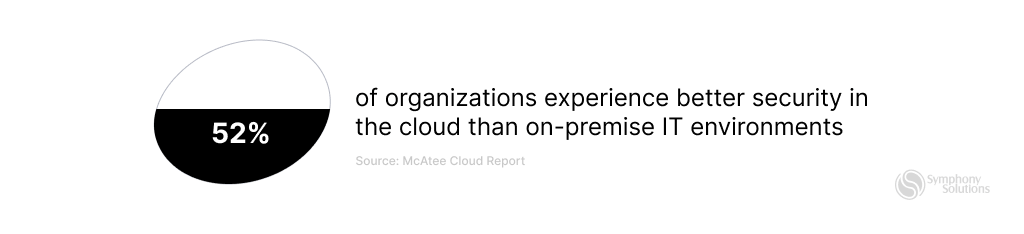
But most importantly, what makes the cloud especially appealing today, is its security. Compared to on-premises, the cloud is considered a more secure option. A new McAfee report reveals that 52% of organizations experience better security in the cloud than on-premises IT environments. Gartner predicts that in the event of a security issue, 95% of them will be the customer’s fault. Thus, making the cloud also the safest choice.
Cloud Computing as a Catalyst for Digital Transformation
With all that cloud has to offer, it is no surprise that it’s at the forefront of digital transformation. And the global Covid pandemic has even further accelerated customer demand for cloud services.
By the end of 2019, many tech experts had already been placing their bets on the cloud to lead the tech trends in the following year. But no one could have predicted back then just how impactful it would become in 2020.
The agility and scalability that the cloud has to offer came especially in handy when organizations across various industries were faced with the new reality. In the first quarter of 2020, cloud spending reached $29 billion, which is 37% higher than over the same period in the previous year. And, of course, it was nowhere near slowing down, as the unexpected mass demand for virtual work had to be backed by secure, reliable, scalable, and naturally, cost-effective off-premises services. While overall, the IT spending in 2020 was on the decline, business was blooming more than ever for the cloud providers with a 19% projected growth, according to Gartner, among a total decline in other sectors of IT spending.
Of course, even before the pandemic, the strategic shift to more flexible pay-as-you-go solutions was on the table for many companies, the Covid-19 crisis only further facilitated this shift.
How Is Cloud Computing Enhancing Healthcare?
Like with many others, the application of cloud computing in the healthcare industry is driving a positive change in numerous ways. Whether it’s to reduce costs and to be able to focus on mission-critical activities by opting for off-premises infrastructure or to tap into highly flexible and customizable services by leveraging cloud storage and computing capabilities.
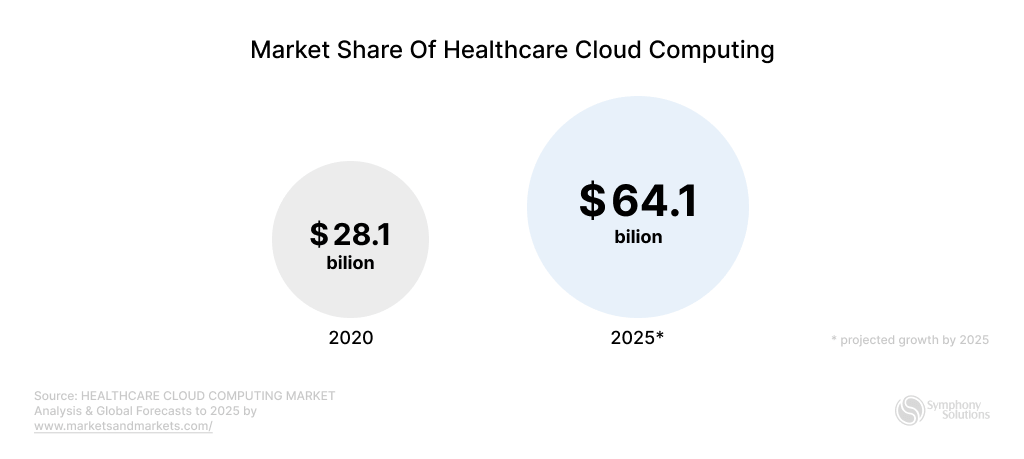
According to a recent report, the market of healthcare cloud computing is projected to grow from $28.1 billion in 2020 to $64.7 billion by 2025, at 18.1% annually during the forecast period. This growth of the cloud in healthcare can be attributed to numerous factors, such as digitalization, technical upgrading, and improving the services and care process. But, of course, like with many other industries in 2020, mass cloud adoption is largely dictated by the Covid-19 crisis and the new reality.
Such features as seamless data storage and backup, as well as the ability to scale up or down, are especially valuable in these uncertain times. But perhaps one of the most valuable assets of cloud technology is in online medical consultations. Social distancing dictates its rules and patients with mild symptoms or trivial medical issues are advised against visiting hospitals and instead to opt for remote consultations via phone calls or video conferencing. This will also likely increase the medical cloud computing market.
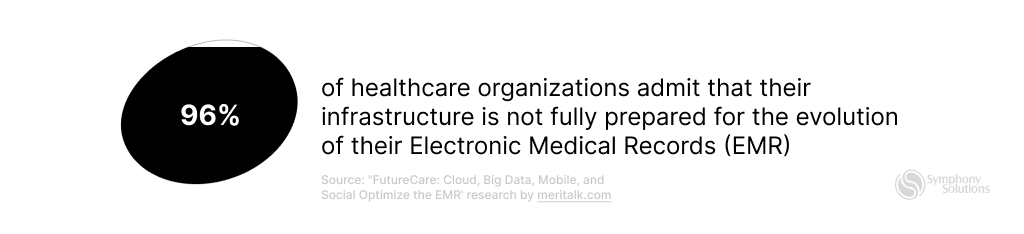
But perhaps, not all healthcare providers are equally ready for mass cloud adoption. A new study, “FutureCare: Cloud, Big Data, Mobile, and Social Optimize the EMR”, reveals that while many providers plan to adopt these technologies in the next two years, at the moment about 96% of healthcare organizations admit that their infrastructure is not fully prepared for the evolution of their Electronic Medical Records (EMR). But on a brighter note, the adoption has been put into motion, with two-thirds of healthcare providers already using the cloud. The majority are running their EMR applications in private clouds (49%), followed by hybrid and public cloud models (35%). The application of cloud computing can help optimize EMR and improve patient care coordination. However, this is only one of the many benefits of cloud computing in healthcare.
The 9 Main Advantages of Cloud Computing for Healthcare
Cost-Effective Data Management
The volumes of digital data that healthcare providers are generating are growing each year. These include Electronic Medical Records, lab tests, prescriptions, and insurance claims. Cloud computing services can help effectively manage these large volumes of data. In this instance, choosing on-premises storage might not be a sound solution. It requires sufficient investments in IT infrastructure as the data load increases. Cloud computing provides larger storage as your data increases. Equally important, cloud-based analytical tools can make more use of data and turn it into actionable insights.
Accelerated Time-to-Market for Medical Services
2020 has been an unprecedented year in many respects. Time was a critical factor in battling the pandemic and building new hospitals, delivering the vaccine on the market, or arranging a safe way of mass testing. Cloud computing is something to be relied on to facilitate delivering important tech solutions on the market faster. For instance, When Spoedtestcorona, a chain of testing centers offering rapid screening tests for COVID-19, was working on providing safe and affordable testing in the Netherlands and Belgium, they were faced with a challenge to deliver a cross-platform web application on a tight schedule. The app was going to minimize human interaction and make testing safe for both patients and medical personnel. By choosing Amazon Web Application services, they were able to deploy the app in the record 2-week deadline, as well as meet high compliance requirements associated with handling personal and medical data.
Enhanced Accessibility through Telehealth
Telehealth is the use of telecommunications technologies to access healthcare services remotely and enhance and manage healthcare delivery and support.
Cloud computing solutions have numerous ways of positively impacting telehealth. The instantly scalable capabilities of the cloud come in handy in unprecedented situations, such as say a global pandemic. Presently, cloud-based telehealth is playing a crucial role in trying to keep the patient load under control by providing medical assistance to patients with mild or medium symptoms at a distance, instead of hospitals. And thus, once again reducing crowds in hospitals and infection rates.
Improving Patient Experience
With the help of cloud computing, doctors and hospitals now have the power to increase patient engagement and give them anywhere anytime access to their medical data, test results, and even doctor’s notes. This gives patients more power and control, as well as making them more educated about their medical conditions.
Additionally, it offers a new level of safety for patients and keeps them from being overprescribed or avoiding unnecessary testing, as doctors can access the history of medical records.
Boosting Collaboration in Healthcare
The implementation of cloud solutions sufficiently boosts collaboration. By storing Electronic Medical Records in the cloud, patients no longer need to have separate medical records at each doctor they visit. Instead, doctors can share information, see the results of previous interactions with other specialists, and even share information. This not only saves time for both patients and their doctors but also facilitates more accurate diagnosis and treatment.
Scalable Computing Resources
Cloud computing allows healthcare organizations to easily scale their IT resources up or down based on current needs. This flexibility means that during times of increased demand, such as a flu outbreak or pandemic, healthcare systems can quickly access additional computing power and storage. Conversely, during quieter periods, they can reduce resources to manage costs more effectively, ensuring they are only paying for what they use.
Advanced-Data Security and Compliance
With cyber threats becoming more sophisticated, cloud providers invest heavily in security technologies and protocols to protect sensitive healthcare data. These cloud platforms often offer higher levels of security and compliance with regulations such as HIPAA in the U.S., compared to what individual healthcare organizations could feasibly implement on their own. This includes encryption, network security, access controls, and regular security audits.
Innovative Health Informatics and Analytics
Cloud computing enables the aggregation and analysis of vast amounts of health data from disparate sources in real time. By leveraging artificial intelligence and machine learning algorithms, healthcare providers can gain insights into patient health trends, disease patterns, and treatment outcomes. This capability supports more informed decision-making and personalized care plans, potentially leading to better patient outcomes and more efficient use of healthcare resources.
Streamlining Administrative Operations
Cloud-based solutions can significantly reduce the administrative burden on healthcare staff by automating many routine tasks such as patient scheduling, billing, and record-keeping. This automation not only increases efficiency and reduces errors but also allows healthcare professionals to spend more time on patient care rather than administrative tasks. Additionally, cloud services can facilitate smoother communication and collaboration between departments and across care teams, further enhancing operational efficiency.
Navigating the Challenges: Security, Privacy, and More
With all the benefits of cloud computing in healthcare, there are still some concerns. The biggest being security and privacy. Patient information is considered highly sensitive and there’s a belief that it is safer when stored on-premises compared to the cloud where it is susceptible to cyber-attacks. Additionally, patients are also concerned about the security of the data they share. Which all boils down to the necessity to maintain high-security standards. But all these relate to managed IT services for healthcare and can be solved with the right approach to that.
Another major concern – is vendor stability, and how reliable they are in the long run. If a vendor goes out of business or stops offering a particular service, this puts important data at risk of being lost.
The level of IT skills necessary to adopt cloud solutions is also on everyone’s mind. The lack of skilled IT professionals is often cited as one of the barriers to cloud adoption.
Luckily, these issues can be solved by carefully examining and choosing infrastracture managed services as well as skilled cloud native development service providers that have solid experience and good track records of implementing cloud solutions in the healthcare industry.
Future Trends and Advancements in Healthcare Cloud Computing
Accelerated Adoption of AI and Machine Learning
The healthcare cloud computing market is set to soar from $39.0 billion in 2022 to $91.3 billion by 2028, marking a Compound Annual Growth Rate (CAGR) of 15.23% between 2023 and 2028. This significant growth is fueled by advancements that facilitate more accurate diagnoses, efficient treatment plans, and overall improved patient outcomes.
Emphasis on Cybersecurity Investments
In the last few years, ransomware has become a major threat to the healthcare sector, involved in 54% of incidents. Patient data, including electronic health records, were the most targeted assets, and nearly half of all incidents (46%) aimed to steal or leak health organizations’ data. This worrying trend is expected to persist. To counteract these growing cyber threats, cloud providers are planning to boost their investment in cybersecurity. This means stronger security measures and stricter compliance standards to protect healthcare data more effectively.
Focus on Data Security
Blockchain technology has been increasingly used in healthcare cloud computing. It offers a more secure and efficient way to store patient data by creating an immutable record of transactions. This approach enhances data integrity, prevents unauthorized access, and allows for real-time updates, ensuring the accuracy and completeness of patient data.
Advances in Interoperability and Data Sharing
The use of cloud medical software has significantly enhanced interoperability among different healthcare systems. This advancement makes it easier to integrate third-party medical applications and access electronic health records, medical histories, appointment schedules and accounts with ease.
The Rise of Edge Computing in Healthcare
According to Polaris Market Research, Edge Computing in healthcare is set to grow at a CAGR of 26.30% until 2032. This will enable real-time data processing at the care delivery site for improved patient monitoring and outcomes. This approach complements cloud computing by facilitating low-latency, high-speed data analysis.
Telehealth and Remote Monitoring’s Next Leap
Telehealth, powered by cloud technology, is set to break boundaries, making healthcare accessible everywhere. The synergy of wearable technology and cloud computing will enable real-time health data streaming, making proactive patient care a reality. This could cut hospital readmissions by up to 7.6%, marking a new era in managing chronic diseases.
Revolutionizing Patient Data Analytics
The future of patient care is personalized, thanks to advanced analytics powered by cloud computing. This will usher in a new age of precision medicine, with treatment plans tailored to individual patient profiles, improving outcomes for chronic diseases and enabling early disease detection like never before.
5G: The New Frontier in Healthcare
With 5G, healthcare cloud computing will achieve unprecedented speed and reliability, erasing physical distances in care delivery. By 2030, expect groundbreaking applications such as remote surgeries and instant emergency responses, thanks to 5G’s capacity to handle bandwidth-intensive services effortlessly.
Augmented Reality: A New Dimension in Healthcare Training
Recently, the University of California, San Francisco study revealed a 20% reduction in surgical complications when surgeons used AR to visualize complex vascular structures during brain surgery. This shows that cloud-supported AR can revolutionize healthcare training, offering immersive experiences that mimic real-life scenarios. This will significantly reduce training costs and improve learning outcomes, making it an indispensable tool in medical education.
Wearable Technology: The Future of Preventive Care
Wearable devices will become even smarter, monitoring health in ways we can barely imagine today. Supported by cloud computing, these devices will offer real-time health insights, fundamentally changing preventive healthcare. The market for these devices is expected to soar, reaching over $428.92 billion by 2030.
Incorporating these updates will provide a more current and comprehensive view of the role and advantages of cloud computing for healthcare.
Conclusion
The application of cloud computing for healthcare can positively impact the industry in numerous ways. From cutting down costs or reducing the time spent to offering organizations much-needed flexibility, scalability, and empowering collaboration between healthcare researchers. The latest reports on the topic show that adopting cloud solutions is something clearly on the table for medical organizations with the main obstacles being either security concerns or a lack of internal technical resources. Choosing the right cloud and healthcare development partner can easily overcome both issues.
FAQs
-

AI Assistants Era in iGaming Industry
On April 11, 5:00 PM CET, join us for an exclusive event where we will dive deep into AI for sports betting and the immense capabilities of AI Assistants for the iGaming industry. We will explore the dynamic interplay between artificial intelligence and the iGaming sector, showcasing the revolutionary impact of AI assistants on enhancing user experiences, operational efficiencies, and market strategies.
Watch the event record on YouTube!
Who will benefit:
- iGaming Industry Professionals: Platform providers, Operators, Sportsbooks, Affiliates, Developers, and Marketers;
- Technology Enthusiasts and Innovators;
- Investors and Entrepreneurs;
- Users and Gaming Enthusiasts.
Agenda:
1. The Future of AI in iGaming: Discover the capabilities of AI for sports betting industry, current trends and future potential.
2. Enhancing User Experience with AI Assistants: How AI assistants are used to personalize user experiences, improve customer service, increase player engagement, optimize internal processes, and create high-level digital marketing.
3. The Challenges of AI Assistants: Discuss the ethical considerations, privacy concerns, and limitations of integrating AI assistants into iGaming.
4. BetHarmony – AI-Powered Assistant for iGaming: Uncover the unique features of BetHarmony and how your business can benefit from having your personal AI assistant.
Meet our experts:

Oleg Chekan
AI Director, Symphony Solutions
With robust financial services and digital marketing expertise, Oleg is a Senior Manager renowned for his proficiency in software product management, machine learning, agile methodologies, DevOps, and Pre-sale activities. He’s committed to driving rapid growth for start-ups and scale-ups.

Eduardo Dos Remedios
VP of iGaming, Symphony Solutions
A distinguished leader and veteran in the iGaming sector, Eduardo has driven success for various brands and operators across Europe, Latin America, and Asia, leveraging his C-level expertise to develop winning brand strategies and execute visionary leadership.
Moderated by Kateryna Motko, Service Delivery Manager at Symphony Solutions, ensuring a smooth and engaging dialogue throughout the event.
Don’t miss this unparalleled opportunity to gain insights from leading experts and engage in discussions on the impact of AI assistants on iGaming.See you!
-

Symphony Solutions is Coming to ICE London 2024
Save the date for 6-8 February 2024 and come see Symphony Solutions at the ExCeL London, where we’ll be attending ICE London, the leading gaming and gambling event bringing together the global community of top iGaming providers and industry innovators for intense three days of actionable insights and valuable networking opportunities.
Symphony Solutions’ team of experts will be there to share the latest of our AI advancements tailored for the online gambling industry, as we are shaping the AI landscape with innovative solutions and technologies:
- AI-Driven Data & Analytics
- Digital Marketing Orchestration with AI Insights
- AI-Enhanced Infrastructure Managed Services
ICE London has prepared an excellent panel of speakers who will unveil what’s to expect in Esports, Sports betting, and Casino in 2024. The event will be hosting innovators and visionaries representing 167 countries:
- 95% decision makers
- 58% international attendees across key industry verticals
- 45% first time attendees
Mingle with industry trailblazers and foster new partnerships. Explore the latest industry trends and nurture progressive ideas. All this and more, we’ll be bringing your way to ICE London 2024!
Find out how you too can tune in to innovation with Symphony Solutions!
Meet our experts

Eduardo dos Remedios
Vice President of Gaming, Symphony Solutions
With a rich legacy in the Gaming sector, Eduardo is a seasoned leader whose expertise has propelled numerous brands and operators to success across Europe, Latin America, and Asia.

Ewelina Antonakos
Business Development Executive, Symphony Solutions
Boasting a diverse industry experience ranging from solar panels to marketing automation, Ewelina has dedicated over 5 of her 8-year career to driving growth within the iGaming and gambling sector.

Sofiya Savka
Engagement Center Director, Symphony Solutions
Experienced and trusted Engagement Center Director, Sofia is working with distributed remote teams on delivering the best experience for our iGaming clients.

Valentina Synenka
Chief Marketing Officer, Symphony Solutions | Founder, SHE. community
With an extensive background in digital marketing, Valentina Synenka brings a wealth of expertise to the iGaming sector through her role as Chief Marketing Officer at Symphony Solutions. Her experience in driving brand visibility, engagement, and sales has positioned Symphony Solutions as a force to reckon with in the iGaming industry.
-

Managing Remote Teams in 2023: Event Overview
The Covid-19 pandemic opened businesses to a new-found concept of remote work that created opportunities for hiring beyond the borders and shifting the corporate world to a virtual company model. Symphony Solutions eagerly embraced the remote mode having previously established delivery centers and teammates worldwide. We investigated new approaches to management with remote teams, learned from our mistakes, and celebrated success stories. And now we can share a few insights on what it entails to manage remote teams in an international company. Symphony Solutions invited our international clients and colleagues to an online event Managing Remote Teams in 2023. Specializing in different areas, they shared their knowledge and expertise in virtual management.
Event experts:
- Amanda Beloy, Chief Executive Officer at Avantage Entertainment, experienced in working with cross-functional teams to deliver quality software satisfying customer needs, worked in different industries such as IT Services & Consulting, Financial Services, Heath Care, iGaming.
- Rodrigo Vega M., Corporate HR Manager at PayPerHead, experienced in HR within manufacturing industries, hospitality during the pandemic, and software development with a focus on iGaming.
- Gordana Andonovska, Service Delivery Manager at Symphony Solutions North Macedonia, experienced in Service Delivery, Project Management, Team Leadership, People Management, and Business Client Relationships; managing multilingual and multinational teams onsite and remotely in different locations worldwide.
What Challenges can You Face while Managing Remote Teams? How do You Handle Them?
- Establishing a core schedule helps align distributed teams and helps them collaborate beyond borders and time zones.
- Sharing responsibilities and assigning meeting roles helps improve remote communication and mitigate the lack of attention and participation.
- Patience and flexibility are key in accommodating people and their different life situations.
- Track productivity and make sure that people are accomplishing their tasks and achieving goals. Have regular check-ins so that people have a way to communicate, and discuss progress, obstacles, and concerns.
- Make sure to unplug at the end of the day and keep a healthy work-life balance.
- Develop skills and competencies regarding acting listening and achieving communication balance. Know how communication is flowing within the team without the risk of micro-managing.
- Tackle the sense of isolation and promote informal communication on a more personal level and make sure everyone feels like part of the team.
- Help people deal with the mental and psychological burden of remote work, and preemptively detect any issues, either individual or interpersonal.
- Build reliability, commitment, and expectations of delivering results to prevent people from abusing the excessive freedom that comes from working from home.
- Engage the IT team to help team members have a reliable work setup at home, resolve any technical issues, and stay connected even when working remotely.
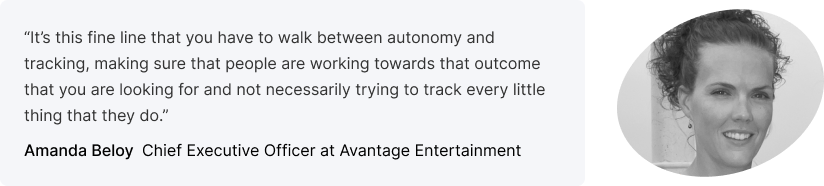
How to Ensure Alignment when Establishing Expectations?
- Alignment should be done on multiple levels, that of company values, project goals, team goals, sprint goals, etc.
- Remove obstacles and set clear expectations for the team.
- Provide training to the team in areas where they are lacking knowledge or require help.
- Encourage the team to be proactive and reach out and ask for help when needed.
- Establish a culture of open communication within the team, and make it acceptable to ask for and provide feedback.
- Onboarding and induction are key to helping people understand their goals and contribution within the team, making them aware of possible challenges and cultural differences, and setting expectations.
- Listen and observe. Have interactions with team members to get a sense of what they are feeling and thinking, and follow up to ensure alignment.

How do You Build an Environment of Trust?
- Delivering on time helps build the trust. The outcomes are the evidence that the company has that you are doing your work.
- Provide flexibility to allow employees to work how they fit within a basic framework.
- Accountability helps build trust. Make sure that middle management is accountable for their teams’ outcomes and the results delivered.
- Timely communication is key in the culture.
- Honesty helps build trust within the team and the company. Allow the team to have that outlet to talk and assume that they have good intentions.
- Improve the work environment. Get information from the team to know what works for them.
- It takes time with remote teams to build trust. Keep inventing new approaches, apply continuous constructive feedback from the team, and celebrate achievements.
Focusing on Outcomes, Activities, or Both?
- Focus on desirable outcomes and agreed upon timeframes. Let the team be empowered and take ownership of how to achieve that.
- Set your team up for success. Give the team the freedom to set their own schedule, solve the problems in the way they think is best.
- Too much focus on the activities may cause “blindness panic” on the part of the supervisor. Guide and provide general criteria, but ultimately, it’s up to the team to decide how they solve the challenges in their work.
How to Bring Creativity and Fun to Remote Teams?
- Be open to figuring out how to be creative and bring fun to your daily work.
- Ask for feedback and suggestions. Let every team member bring their unique perspective.
- Schedule time to socialize. Get together in person.
- Find any reason you can to add fun to your routine. Put some social aspect into your work-related activities.
- Organize online team buildings and theme parties.
- Virtual communities bring an element of fun, socialization, and inclusivity for the teams. Introduce virtual happy hours, coffee breaks, and games.
Micromanaging of Remote Teams. Yes, or No?
- Micromanaging goes against the openness within the company. Allow the team to work as they see fit.
- Micromanagement leads to lower engagement and zaps morale. You are unable to get creativity and innovation.
- Have self-awareness and be cognizant of if you are crossing the line.
- Get peer feedback. Find other ways to address your concerns that may lead you to micromanage. Work in the best interest of your team.
- Micromanagement is the opposite of being Agile. It should be “individuals and interactions over processes and tools.”
Top 3 Expert Tips for Managing Remote Teams in 2023.
Gordana Andonovska:
- Embrace open door policy. Focus on coaching and empowering people, involve them in different initiatives and be an active listener.
- Encourage peer-to-peer support.
- Have one single communication tool to make it easier for everybody.
Rodrigo Vega:
- Prove to everybody that you are reliable and transparent. It’s okay to say “I don’t know.”
- Important issues shouldn’t be discussed in chat or emails. Have a live meeting with the camera on to have a face-to-face interaction.
- Promote open communication. Ask for opinions, comments, and feedbacks, opinions. Everything is valued and we are listening to it.
Amanda Beloy:
- Set boundaries and establish a routine. Have a dedicated work space that you can leave at the end of the day. Have the right equipment to be effective and efficient.
- Schedule time to socialize. Compensate for the social benefits of an office that you miss out on when working remotely.
- Communicate. Make sure that you are reaching out and checking in so that you aren’t left on an island.

Chat Question. How to Fight Fatigue as a Remote Worker?
- Take the time to disconnect and recharge. Make time for yourself.
- Set aside time for your health. Invest in your wellbeing.
- Have a set routine and be more aware of what you are doing, for how long, and how that impacts your wellbeing.
Watch the full-length video recording of the event to get more insights and all the expert takes on remote team management on our YouTube channel. Want to join Symphony Solutions? Check out the open vacancies.
-

BigQuery vs Redshift: Comparing Cloud Data Warehouse Solutions
Data is arguably the digital gold when it comes to running a modern business, given that nearly 60% of companies in the world leverage data analytics to drive processes and optimize costs. Rising trends over the past few years, such as the AWS redshift database have culminated in next-level storage and computation solutions that can help businesses harness the opportunities of big data.
Talking of storage, businesses often turn to a cloud data warehouse solution, which serves as a central repository for all information collected from various sources, both internally and externally. Some of the prevalently used cloud data warehouse solutions include Amazon Redshift and Google BigQuery. But which solution is the best for your scenario? Here is an in-depth look into google BigQuery vs RedShift. Keep reading to stay updated.
What is AWS RedShift?
Redshift is part of Amazon’s cloud architecture service—Amazon Web Services (AWS) which serves as a cloud warehouse solution for businesses that leverage insights from both structured and semi-structured data sets. The primary source code for RedShift was acquired by Amazon from ParAccel, a company that was building ParAccel Analytic Database, based on PostgreSQL. And for that reason, AWS RedShift is technically massively parallel processing (MPP) data warehouse built on a PostgreSQL fork.
However, before we compare BigQuery vs RedShift, it’s important to note that inasmuch as RedShift has a primary commonality with PostgreSQL, it features a unique column structure that leverages distribution styles and keys instead of support indexes to organize data. Moreover, this cloud warehouse solution is a unique query execution engine that deviates from PostgreSQL.
A typical AWS RedShift infrastructure features a cluster, which can include one or multiple computer nodes. To work, a user partitions the computer nodes into slices, which are then allocated a part of the node’s disk space or memory. A user might also need a leader node to coordinate extra nodes, as well as external communication, especially if the cluster is provisioned with multiple nodes.
What is Google Big Query?
BigQuery is an extension of the larger Google Cloud Platform (GCP) infrastructure and serves as a cloud warehouse solution for businesses. Built on top of Dremel technology, this cloud storage is among the pioneering solutions in the market, after Monet DB and C-store. Technically, Dremel serves as a query service for running SQL-like queries for faster, accurate results against large data sets.

Although BigQuery originally kept Dremel’s hybrid SQL language, the solution has since been upgraded to support standard SQL language. GCP BigQuery works alongside other unique systems and technologies to facilitate a typical task execution, including:
- Borg: includes an enterprise cluster management system that assigns resources to Dremel jobs, which are typically computed over Goggle’s REST.
- Colossus: includes a planet-scale storage solution that feeds in data to individual Dremel jobs.
- Juniper: includes an inner data network that facilitates translation and reading of data, as far as Dremel jobs are concerned.
- Capacitor: consists of a columnar storage format for organizing and compressing Dremel job data.
Cloud Data Warehouse Comparison: AWS RedShift vs. Big Query
When comparing BigQuery vs RedShift, it’s important to understand that both are cloud warehouse solutions as a service. However, there is a great difference between redshift and big query, especially when it comes to features, operations, as well as infrastructure. Here is a summarized comparison of cloud data warehouse platform in the two scenarios.

Performance: RedShift vs. BigQuery
Performance is relative in any type of data warehouse solution, the comparison between gcpbigquery vs aws redshift notwithstanding. Typically, performance depends on schema complexity, the size of the user’s data tables, and the number of incoming simultaneous queries, among other factors. Nonetheless, a user might need greater manual configuration to ensure high availability in RedShift than BigQuery. In matters of speed, BigQuery can outperform RedShift, especially if you are leveraging a single dc2. large node.
Pricing Model: Big Query vs. RedShift AWS Pricing / AWS Redshift Costs
Aws RedShift pricing is popular in the market because it covers both storage and computation costs. There are various client options to choose from, including an in-built AWS Nitro System known as RA3, Dense Storage, or even Dense Compute node types.
Although the cheapest node dc2.large features a 160GB storage capacity cost up to $0.25 per hour, clients are advised to estimate their costs for this cloud warehouse solution using the AWS Redshift Pricing Calculator.
On the other hand, Google big query pricing model is pretty complex when compared to the AWS redshift database solution, given that the storage and query costs are separate. Clients can choose from different pricing models, including streaming inserts vs. queries vs. storage API, active vs. long-term, as well as flat-rate vs. on-demand. Users pay up to $0.020 per GB every month for storage and $5 per TB for query. Here is the GCP Pricing Calculator to help you estimate accurate costs.
Some of the Top Companies That Use AWS RedShift
Amazon RedShift serves more than 1500 users, including the following top companies:
- Amazon
- Coinbase
- Phillips
- Yelp
- Liberty Mutual Insurance
Top Companies That Use Google BigQuery
Google BigQuery has over 453 companies using the service, including:
- Spotify
- The New York Times
- Trustpilot
- Stack
- Mollie
Wrap Up: Pros and Cons of RedShift & BigQuery
When comparing BigQuery vs RedShift, it’s right to say that both cloud warehouse solutions are highly scalable on demand and allows businesses of all services to benefit from real-time data analytics at unmatched price-performance. At the same time, the service providers for both these solutions assume the responsibility of managing the database, as well as the infrastructure, allowing clients to focus on core business needs using familiar, or user-friendly SQL.
Running queries on ASW RedShift is also easier, as opposed to Google’s BigQuery, thanks to Amazon’s Spectrum concept that borrows heavily from Oracle external tables. Typically. Users can retrieve and query structure, as well as semi-structured data sets from AWS S3, without necessarily loading the data into RedShift. Moreover, AWS RedShift supports standard SQL queries for the management and execution of machine learning models.
And BigQuery vs RedShift prices, how do they compare? Google big query, pricing is complicated, especially when it comes to query operations, while RedShift’s is straightforward, predictable, and enhances concurrent data usage and analytics. Nonetheless, this shortcoming is probably addressed by the higher level of data warehouse setting and performance control that RedShift offers to users. You can leverage free first-month subscriptions to benchmark the two solutions and determine which one is suitable for your business needs and use cases. You can also contact us for designing a cloud data warehouse solutions.
FAQ on Cloud Data Warehouse Solutions
-

How We Implement Agile Methodology in Our Marketing Team
Agile ways of working are quickly becoming a trend and making rounds across companies, having now seeped into departments and industry sectors that aren’t even directly related to software development. Have you been asking yourself, can Agile be used for non-software projects? Definitely, yes. In fact, it proves to be equally beneficial for non-IT teams, since Agile principles and processes can be just as efficiently applied to marketing, finance, legal, and a variety of other teams and departments within a company. Teams that act in support and are often viewed as supplementary to product development teams within an organization, can greatly benefit from adopting the same principles in work management as their more techy counterparts.
Manifest Agile Marketing
The perks of adopting Agile as your workplace philosophy is in its flexibility and versatile assortment of ideas and concepts. It always comes back to making the most of your time and efforts in order to work as a team and push for the result. Marketers saw these benefits as desirable and so in 2012, an event took place that has since been known as Sprint Zero, where marketers came together to align their vision of Agile in the context of marketing. They have come up with values and principles that were put together in the Agile Marketing Manifesto. Agile ways of working pull you out of a tangent, help you keep the focus on the goal, and know where you are standing in your progress at any given moment. What’s more, it connects the dots between all the diverse parts of a team and makes you operate as a single mechanism, where one gear connects to the other and everything moves in unison.

Marketing teams are now so comfortable with Agile that, according to the 4th Annual State of Agile Marketing Report published by AgileSherpas, in 2021 as many as 51% of marketers were using Agile in their daily work, and out of those over one-half were using a hybrid Agile framework rather than strictly sticking to just one, Scrum or Kanban. This indicates that Agile has already ‘entered the building’ and non-IT teams don’t hesitate to take it as it is and adjust Agile basics to the specifics of their line of work.
Symphony Solutions Does Agile: Our Story
Agile Marketing Genesis: Zero to Hero
Agile is typically used within software development teams as a way to streamline their processes and aim for continuous delivery of updates and new features. That’s what it was initially designed for, so using it as a way of managing non-IT teams requires a creative approach. Having said that, it definitely comes with its benefits and is worth giving a try. The Agile approach can introduce a more efficient and transparent way of working, boost teamwork, and help the team keep their eyes on the goal. Approaching a non-technical team with the intention of introducing Agile, you may expect to run into issues that will be specific to the team, its composition and the practices they have settled in due to the nature of their work and interactions within the team or other departments. In fact, one may come to a curious realization, as was the case with Symphony Solutions Digital Marketing team when they decided to take the leap and go Agile:

Setting Up the Experiment: Initial Steps. Essential Changes
Case in point, we found ourselves with a Digital Marketing cross-functional team that possessed all the skillsets required to deliver the final result, Scrum framework.
- One-week sprints. These are the standard practice in Agile, so it was the expected way to go. What was important though, introducing sprints helped manage the initial existing chaos that was coming from the lack of strictly set expectations and a limit on just how many “fires” exactly a team can deal with realistically. Introducing sprints as a limited chunk of time where the team was expected to deliver tangible results helped tone down the constant sense of urgency and reset with a focus on a realistic goal.
- JIRA Scrum board and backlog can greatly contribute to improving the workflows and setting goals for the sprints. Defining the scope of work for the upcoming sprints and allocating some time for preparations allowed the team to have a wide backlog of tasks ready for pick-up in case any current tasks are blocked or extra capacity opens up at any point during the sprint.
- All ceremonies except refinement were introduced in the team. Agile ceremonies are necessary for the team to be able to follow the principles of this way of working, so the team started right off with daily stand-up meetings, sprint demo, and planning.
- No estimation in the beginning. A good idea is to let the team get familiar with their capabilities, and get a sense of their own capacity for the sprint. Eventually, the team will understand what they can accomplish within the sprint realistically and layer it with the concept of task estimation in Agile.
- Full-time Scrum Master took on the role of helping the team get on with the new practices, and follow the Agile ceremonies.

Early Wins and A-ha Moments
As the Marketing team settled into the new way of working, it soon became evident what works, and what else needs to be introduced or changed. These are some of the observations and conclusions that helped them navigate the changes successfully:
- Stable delivery, even when PO was absent, was a strong argument for the benefits of the ongoing Agile transformation. It became evident that Agile can and does work for non-IT teams and greatly improves their efficiency and output.
- Visibility and constant delivery for all stakeholders is the first and foremost benefit that comes with introducing Agile within a team, be it tech or non-tech.
- Estimation in story points was added as the team eased into its newly established Agile practices.
- Data-driven planning proved to be efficient in setting better estimates and planning the scope of work.
- Monday-Friday work span is hard and can result in work over the weekend.
- Quarterly PI Plannings have been introduced as per the SAFe framework including System Demo and Inspect&Adapt sessions.
- Team growth and other departments were involved in PI plannings, such as Design, Recruitment, People Partners, Sales, and SDO. Coming from the nature of marketing work, it was necessary to establish a strong collaborative workflow with other departments, and show how marketing efforts have a positive impact across the company.

Agile Marketing Level-Up: Do It Harder, Make It Better
After the initial introduction of the Agile way of working and once the team got comfortable with it, it soon became apparent that Agile can and should be adjusted to meet the immediate needs of the team. Setting out on an Agile transformation journey, it was important to understand what it can potentially bring ‘to the table’ of a non-technical team, and that not all ‘gifts’ will be as readily accepted by the team and the established workflow. So, as the marketing team got more comfortable with the Scrum processes and ceremonies, they started introducing little changes to make it more efficient and responsive to the team’s requirements or grievances.

Adjusted Sprint Length: Improved Task Completion Rate
A sprint typically lasts for one to four weeks which is the optimal time sufficient for the team to complete and deliver a part of a bigger project. Depending on the line of work and overall workload, team size and composition, and other factors, it may be beneficial to decide on the length of the sprint, longer or shorter, that allows the team to have deliverables ready by the end of the allocated time period, without being caught off guard with a big chunk of an incomplete task at the end of the sprint.
What we did: Two-week sprints
Agile project management for marketing shows proven efficiency as it gives the team a lot of much-needed flexibility in its work. In this case, Symphony Solutions marketing team started out working in one-week sprints but as the team was growing and expanding its scope of work with new projects and milestones, it soon became noticeable that short sprints with the ever-growing workload lead to a disbalance. It was proving to be increasingly difficult to try and keep up with Agile ceremonies and actually get all the work done with so much time going to meetings and sync-ups. So, the team decided to shift to two-week iterations which allowed for better managing of the workload and dependencies, both inside the team and with other departments, thus allowing to properly focus on priority tasks and improving the overall task completion rate.

Agile Meetings for the Win
The Agile way of working comes with its set of procedures and ceremonies that help the teams power through the backlog of tasks, be on top of their work, and know the status of the tasks at any given time.
What we did: Introducing shorter but more focused meetings
The marketing team decided on making retrospective meetings shorter but focusing on at least one enhancement for the next sprint and their workflow. Sprint retrospectives are conducted every so often, but properly implemented they foster the team to ‘snap back’ to the initial goals and objectives set for the team. The team analyzes the way they work and understand why they were running into the same issues throughout the sprint. Having the layout for the processes and seeing where the team is falling short helps brainstorm new ways to address the team’s shortcomings. Formulating SMART retrospective enhancements is crucial for showcasing the value of this meeting both to the Scrum Team and stakeholders.
Other improvements were deciding to keep stand-ups short and to the point, discuss all dependencies and set goals for the day, so that the team members can continue discussing tasks in detail as the day goes on and work towards accomplishing common goals.
Trust the Experts: Getting an Agile Expert on Board
Agile introduces various frameworks to work with, each having its peculiar characteristics. If Kanban can be pretty straightforward with minimal requirements for adhering to ceremonies or strict role establishment, Scrum is way more structured and depends on efficient planning for each iteration. One works great for mature teams, the other can be taught to teams of any composition and relation to the IT sector. Whatever way you choose to pursue, it’s a good idea to invite an Agile expert to help you get on board with the new way of working.
What we did: Scrum activities Power-up
At some point along the way, the marketing team invited an expert Agile Coach to work alongside the team Scrum Master and join us for standups, sprint demo and planning meetings. The ‘grey cardinal’ observed the team from the inside and helped us coordinate and further improve our Agile processes. Under his guidance, a retrospective meeting was conducted where the team agreed on further steps to take in improving the way they work. This experience helped bring more order into the already established processes, make the meetings more efficient, better understand each one’s capacity when committing to tasks, and align the work in a way to stop starting and instead focus on finishing tasks.
When the World Goes Remote: Adjust and Evolve
The two years spent in Covid-19 lockdown weren’t easy on anyone, and it was definitely the case for collocated Agile teams who, until recently, heavily relied on touch-base and in-person collaboration. As the world embraced remote work and fully shifted to WFH, Symphony Solutions followed suit and with some experience behind our belts nonetheless. Even before the pandemic caught the world in its grip, we had successful experience conducting an online PI planning for distributed teams. Taking that experience and translating it to the realities of the world in lockdown was just a matter of time.
What we did: Remote PI planning
The marketing team has been working with Scrum for quite some time and had established processes with regular PI plannings. However, with the onset of the global health crisis, it was no longer a feasible option. Remote PI planning has been prepared and held instead. The team connected to an online event and used online tools as an equivalent to a physical board typically used. The experience was deemed an overall success and the new practices have been carried on to all the consecutive planning events and meetings. It has been a fairly easy transition for the team since they were already used to working with many of the tools. The change was in making it consistent and a set practice.
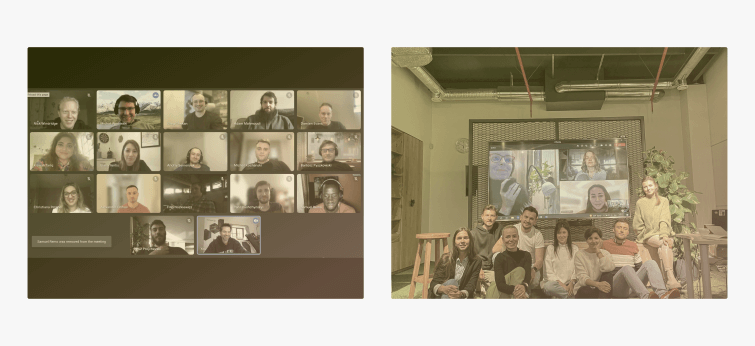
In Conclusion
Symphony Solutions has been successfully applying Agile for non-software teams ever since it first initiated its own Agile transformation a few years back. Over the years, it has proven to be a driver for results and a way for different departments (e.g., marketing and design, marketing and recruitment, etc.) to collaborate and manage dependencies more efficiently.
What could be better proof than the testimonials of our Digital Marketing team specialists and their reflections on working with Agile in mind and at heart? For as long as you set your mind to it and commit to change, a job done in Agile is a job well done.
-

Top DevOps Benefits for Business Efficiency
We are observing a surge in DevOps popularity as more businesses switch their mindset to that of streamlining development and operations, as they wish to enjoy DevOps benefits that come with implementing continuous improvement, automation, innovation, etc. According to Atlassian, a 2020 DevOps Trends Survey showed that responders almost unanimously agreed that DevOps has positively contributed to their organization. With that in mind, it’s easy to see that such a surge in interest is driven by the many benefits of following a DevOps approach, so businesses have a natural inclination to give their Dev and Ops teams a makeover.
What is DevOps? What is DevOps culture?
DevOps can be defined as a workplace culture, prevalent in the software development industry, which is characterized by bringing together development and operations, having the teams work alongside and have a grasp of their entire process from inception to maintenance. Such an approach triggers many beneficial changes in the team’s way of working and approach to product development and delivery, as the focus can be shifted back to the customer and generating maximum value. DevOps dismantles silos and fights dated practices, which were or still are the norm in some industries (e.g., waterfall for healthcare or government projects).
With the adoption of new work culture and philosophy, your transformed DevOps team generates business benefits, such as decreased time to market, efficient business metrics monitoring, cost reduction via automation, increased stability of the product, and more.
Why DevOps is important and its main benefits
The benefits of DevOps can be recognized by what it “brings to the table” in terms of improving development practices and outcomes, as well as how it contributes to your immediate business success. Let’s go over these in more detail.
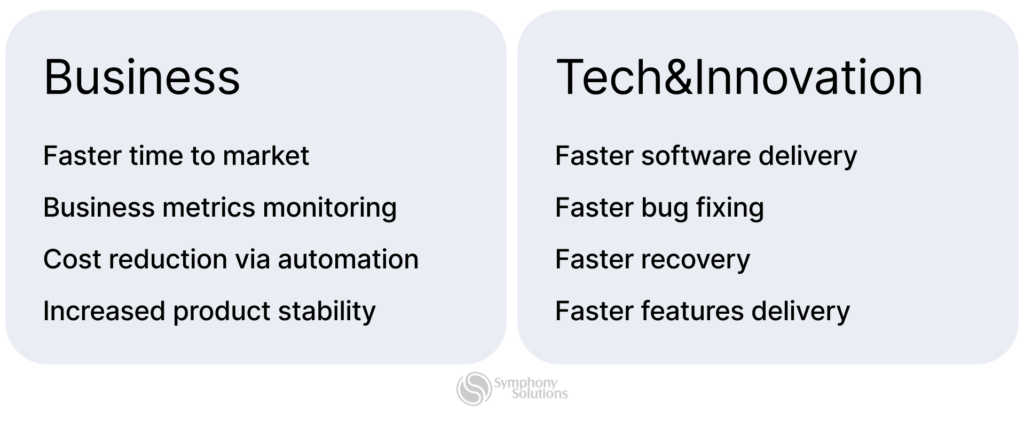
For the business
These are the benefits that will place you on top of the market competition, having a positive impact on your profitability and customer satisfaction.
- Faster time to market is made possible with DevOps working unanimously on product development and deployment, meaning that the actual time it takes to release the product or each new update is drastically reduced. Your teams work in shorter increments with the main objective to create real and immediate value for the client, as opposed to chasing some grandiose vision of a large-scale project. You are shifting the focus to maintaining a more holistic approach to work processes, where Dev and Ops are parts of a whole. Another positive of fast time to market is that you can keep up and overrun competition, and stay on top of innovations and market trends.
- Business metrics monitoring means that your DevOps team is always ready to jump in and fix issues in your system or application as they pop out. This is important to keep the app running and avoiding downtime which otherwise can be harmful as it disrupts the workflow, leads to bad user experience, possible loss of data or expected revenue for business.
- Cost reduction via automation is an integral part of DevOps as you strive to minimize wasteful practices in your workflow. Automation helps establish consistent processes, enables efficient monitoring, continuous improvement, and immediate disaster response.
- Increased product stability is one of the benefits of continuous delivery in DevOps. The uninterrupted cycle of “build-test-deploy” allows your teams to keep their hand on the ‘pulse’ of your product, catch and fix bugs, improve your product and deliver updates regularly.
For tech and innovation
When it comes to improvements on the tech side of things, it’s all about how fast you are able to move on once you get into the DevOps stream of mind.
- Faster software delivery is made possible by working in increments, aligning Dev and Ops parts of software development, deployment, and beyond. Your DevOps team is working toward the goal of delivering a usable product to the client as soon as possible.
- Faster bug fixing comes with the established CI/CD practice. With the aim of continuously providing value, when you deliver the results of your work to the client, it doesn’t mean that you pull to a full stop. DevOps continue improving and adding to the product, deploying new features and updates, thus creating even more value.
- Faster recovery is an essential part of what makes up DevOps. It is possible due to extensive backups and having your team always on the ready. With efficient data monitoring and established procedures for immediate disaster response, your DevOps team can quickly act upon any system inconsistencies.
- Faster features delivery is again the courtesy of CI/CD. Your DevOps team is focused on delivering value to your client fast and then adding to it. Any fixes or updates may be deployed as often as once a day or every few weeks, depending on your established process and how your DevOps team performs.
So, what makes DevOps your winning approach for software delivery?
Where do all these benefits come from exactly? This would be the accumulation of practices implemented within your team that stir them toward the main goal of delivering value, such as continuously integrated operations, CI/CD, consistent communication among different teams, automated management of the infrastructure. This and more helps assess the level of your DevOps maturity and determine how far you have come in your DevOps implementation journey.
DevOps case study for SpoedTestCorona
Symphony Solutions offers to set you up with an expert team to deliver automation of your software operations, deploy higher quality products fast, make it scalable and secure, all the while you can free up costs and time to focus on innovation, brainstorming new features, or exploring ways to disrupt the market. We embrace Agile ways of working, thrive on automation and maxing out your team efficiency.
When SpoedTestCorona partnered up with Symphony Solutions, they were looking for a way to quickly release an innovative healthcare product that would help provide valuable services to people and medical personnel in the wake of the Covid-19 crisis. Symphony Solutions set them up with a DevOps team that got right to it. In just two business days, the team set up a development and production infrastructure, automate it, and within two weeks they were able to launch a cross-platform web application on the market. The extremely tight go-to-market deadline was dictated by the rapidly rising cases and the need to have a reliable and affordable solution for 15-minute testing with results delivered to the user in the app. The DevOps team launched the MVP within the set timeframe, and the website attracted its first clients in the first few days.
Following the success of the SpoedTestCorona project, the client went on to collaborate with the Dutch govenrment on delivering antigen tests for schools in the Netherlands. Symphony Solutions team delivered the B2G solution in record time.
Do you need a DevOps team on your case? Why it’s better to have an established DevOps team
If you are still asking whether or not a DevOps team is something that you need to run a successful business and create unique value for your clients, consider some of the following:
- DevOps is a continuous process of improvement. Dev and Ops work in a fine balance that is required to quickly release functional software or application and continue adding on to it with new features and updates. This requires having an established process and a team that works well together and can collaborate efficiently with other departments. Once you start moving, you can’t trip yourself over because your team is not properly aligned and still finding their footing in DevOps.
- DevOps needs to be an established practice. It’s a pretty straightforward model of communication and cooperation within the team, where everyone needs to be on board. It’s not the case of hiring a person not familiar with DevOps and presenting them with the fact that “that’s what we’re doing around here”. It requires a certain level of commitment and understanding of the DevOps culture.
- The cost of DevOps experts is rapidly growing. And if you’re reading this, then you can have a good guess why – the demand is high, and experts are few. With the current DevOps trends, an expert DevOps engineer is not easy to come by, making them a very valuable asset to the team. Because of this, trying to build your own DevOps team may not be a viable option. That’s why it may be much preferred to opt for DevOps aaS in terms of cost and availability.
In conclusion
If you are looking to optimize your software development life cycle and bring the spotlight back to the customer and creating value for them, you may want to consider DevOps automation. Once you are set with an experienced team, you will soon enough see the benefits of following a DevOps approach. Keep your customers happy by delivering a high-quality product that gets updated and improved upon regularly. Get out of the loop of silos and insufficient team communication, instead opting for streamlined processes and highly efficient collaboration between teams.
Are you considering getting started on your DevOps journey? Symphony Solutions provides DevOps services to set you up with an efficient and experienced team of DevOps engineers who are working within established processes and will carry your business to the top of competition, help you keep up with industry trends and demands, and foster innovation.
-

Forbes Ukraine War Issue: How Symphony Solutions Helps Ukrainian Refugees
Forbes.UA, in a special wartime issue dedicated to the state of Ukrainian war refugees fleeing to Europe, asked IT companies about their response to the sudden and unprecedented attack on the independent state of Ukraine. Symphony Solutions Founder, Theo Schnitfink provided his comment to Forbes.UA about the company’s efforts to help the war-torn Ukraine, where the company has its largest European office in Lviv.
Symphony Solutions has opened its Lviv office to Ukrainians, fleeing the dangerous regions. Theo Schnitfink stayed in the shelter for four days to make sure that the place is set up with comfort and all the necessary amenities for the refugees.
Symphony Solutions shelter in Lviv has welcomed over a hundred refugees. For a while, it also became the office of the international humanitarian organization Doctors Without Borders. The company organized shelters in two other offices in Poland, Krakow and Rzeszow. The shelters welcome people to stay overnight or for a few days.
Since the start of war, Symphony Solutions has raised 800,000 EUR in support of Ukraine’s fight for freedom, with charity initiatives set into action on multiple frontiers. We provide financial and humanitarian aid, informational support, cooperate with international organizations on bringing forth the importance of preserving Ukraine as a strong and sovereign state. Learn more about Symphony Solutions’ initiatives.
1 MLN EUR RAISED IN SUPPORT OF UKRAINE
-

Symphony Solutions Featured in Cybersecurity Article as the Best App Development Service Provider
Symphony Solutions, one of the most trusted service providers in the IT industry has again been recognized for the umpteenth time as a go-to company for business app development needs. Featuring in the latest Cybernews article, Symphony Solutions is applauded as an innovative company that can handle the pressure of shipping great code to production within agreed deadlines. The company is also credited for its focus on cybersecurity mitigation, custom software development, scalability potential, as well as an agile culture in product development.
Symphony Solutions was founded in 2008 as a Cloud and Agile Transformation company, with headquarters in Amsterdam, Netherlands. Today, the company serves and delivers top-tier digital solutions to over 35 happy international clients, including Cloud Technology Partners (CTP), LADBROKES CORAL GROUP, Vivino, and Virtual Stock, among others.
Breaking news, independent research, and product reviews, such as VPN comparisons—are all produced by Cybernews experts to give clients and businesses by extension an overview of the IT services industry, and who to trust when outsourcing time-bound projects. It’s a one-stop media resource for all your “best IT service provider” needs, and you should definitely check them out to get in-depth industry insights.
Thanks to our hard work and constant support, as well as recognition by leading tertiary players in the IT industry, such as Cybernews, Symphony Solutions is now a leader for various services, such as:
- Cloud Solutions
- Omnichannel Orchestration
- iGaming Software Development
- Agile Transformation
- Custom Software Development
Symphony Solutions is a trusted service provider for all your software development, cloud infrastructure, and agile transformation needs. Check out our services for more information.
-

Symphony Solutions Supports UNBROKEN: Bionic Hand Finds Owner
Mykhailo Yurchuk, paratrooper and defender of Ukraine, became the first to receive a bionic hand prosthesis at the National Rehabilitation Center UNBROKEN. Overcoming adversity, Mykhailo is now able to move his robot fingers and gradually gets back the function of his lost limb. His story is one of many to come, as Symphony Solutions continues its support of the rehabilitation center in Lviv, Ukraine.
Symphony Solutions purchased two bionic hands created by an American-Ukrainian company Esper Bionics. The AI-powered prostheses are the latest tech of their kind. Self-learning and highly sensitive, the bionic hands allow the patient to restore fine motor skills and perform daily tasks with ease and precision. This is in contrast to regular prostheses that are limited mainly to cosmetic purposes. The fact that this kind of treatment and rehabilitation can now be provided in Ukraine is astonishing and noteworthy. UNBROKEN doctors expect to create a positive healing environment for the patients since they won’t have to be away from family and loved ones at their most vulnerable.

Symphony Solutions became the first IT company to support the UNBROKEN National Rehabilitation Center, having donated over 100,000 euros to the hospital, aiming to bring our donation to a total of 500,000. This is part of our continuous charity work within the Stand by Ukraine foundation, which provides financial support and humanitarian aid for Ukraine as it’s caught in a brutal war against Russia.
About UNBROKEN National Rehabilitation Center, Ukraine

UNBROKEN is the National Rehabilitation Center created within the First Territorial Medical Association in Lviv. It is a healthcare hub that provides medical treatment by a multidisciplinary team of professional physicians, including physical care, reconstructive surgeries, prosthesis care and manufacturing, psychological and social rehabilitation for patients.
-

DevOps Maturity Assessment: Level Up Your DevOps Processes
DevOps is the product-oriented approach to software development and support that is the current ‘it’ of the industry as it shows high change management effectiveness and perpetuates the culture of constant learning and improvement. Dev and Ops should strive to work as a single organism with a maximized effort and all processes aimed at a common goal – continuously delivering value.
According to the 2021 State of DevOps Report by Puppet, as many as 78% of DevOps practitioners find themselves stuck somewhere in the middle of their DevOps evolution. This shows just how many organizations still have a way to go in reaching the full potential of their DevOps maturity. Still, they get to enjoy the benefits that come along the way:
- easier adaptability to changes,
- improved efficiency,
- easier scalability,
- faster time-to-market,
- enhanced quality,
- and more.
Inevitably, more opportunities for business growth come along the way. If you want your business to reap all the benefits of having mature DevOps processes, it starts with understanding where you are in your DevOps journey so far. And that’s where DevOps maturity model comes into play.
What is DevSecOps Maturity Model?
DevOps maturity model determines how far along you are in your DevOps implementation and lets you map out your further route to perpetuate growth. Essentially, it should tell you how mature your processes are right now, what needs improvement, and how you can get to the next checkpoint in your DevOps maturity journey.
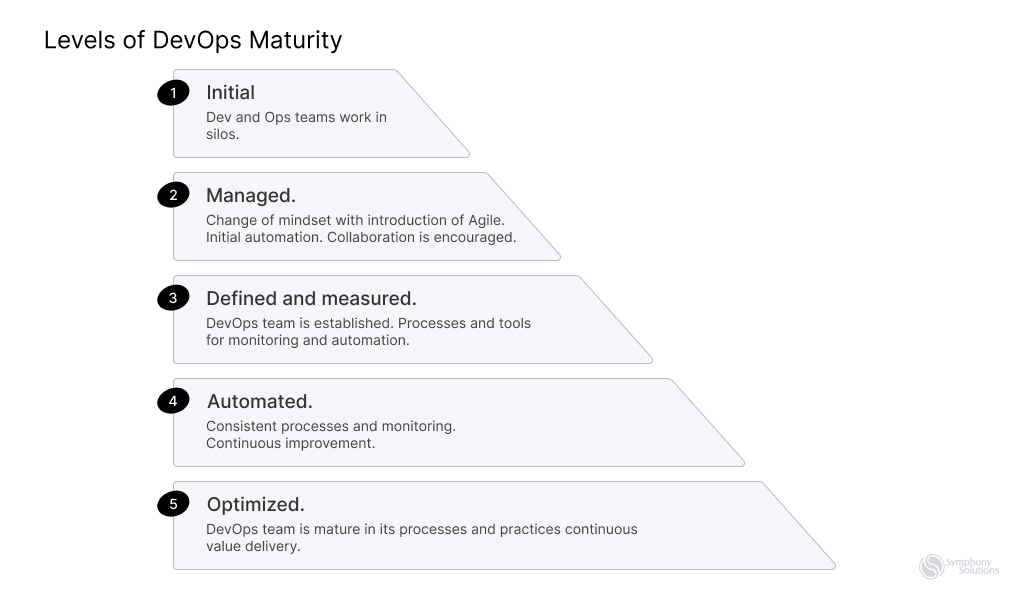
DevOps requires a continuous effort on the part of your team, and you have to understand that this is an ongoing process without a set end-point. An organization can’t just implement it as a one-time action and be done with it. What’s important to understand is that you are setting out on an adventure with your priorities set to delivering value and progressing over time in your processes and output. Therefore, you will want to eventually assess your organization’s DevOps maturity to determine what are your successes, what pitfalls and setbacks you should be aware of, what issues may pop up further along the way, and how you can prepare for them right now.
DevOps is all about embracing that philosophy and changing your mindset to one of continuous growth and evolution of your processes. Understanding your DevOps maturity helps estimate where you are standing and adjust for the future challenges and successes.
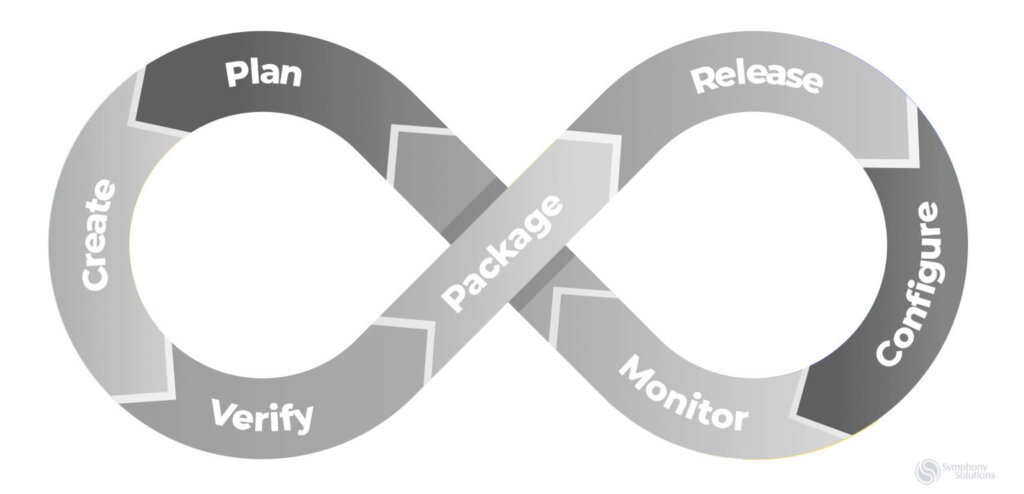
Where are you in your DevOps journey?
How to know if you have successfully taken down the barrier between development and operations? Has your company established mature DevOps processes or are you still struggling to get it off the ground? Knowing the level of your organization’s DevOps maturity is a necessary step in the process that you will have to take. Every organization will eventually find itself at a point where it needs to determine where it’s standing and how to proceed. DevOps maturity is more about getting the right tools. It starts with adopting a culture of continuous change and striving for excellence.
So, how mature is your DevOps team? These are the general cues to tell you your level of DevOps maturity.
DevOps maturity levels
- Level 1. Initial. Dev and Ops teams work in silos.
- Level 2. Managed. Change of mindset with introduction of Agile. Initial automation. Collaboration is encouraged.
- Level 3. Defined and measured. DevOps team is established. Processes and tools for monitoring and automation.
- Level 4. Automated. Consistent processes and monitoring. Continuous improvement.
- Level 5. Optimized. DevOps team is mature in its processes and practices continuous value delivery.
How to measure DevOps maturity
Since you already have an idea of what maturity stands for when it comes to establishing and running DevOps processes, let’s talk about what to look at exactly in terms of processes and procedures, if you need to know where you are standing with your DevOps maturity. Consider what is your state of the art for the following points in our DevOps maturity checklist? How many can you tick off?
DevOps maturity checklist
Automation (CI/CD). To what extent have you embraced automation in your testing, build and deployment operations? Automating the routine tasks allows for optimizing all your processes and minimizing the risk of human error. This helps your team be more efficient and direct their time and efforts towards more complex tasks. Automation is what helps establish a culture of continuous integration (CI) and delivery (CD) and promotes Business Agility.
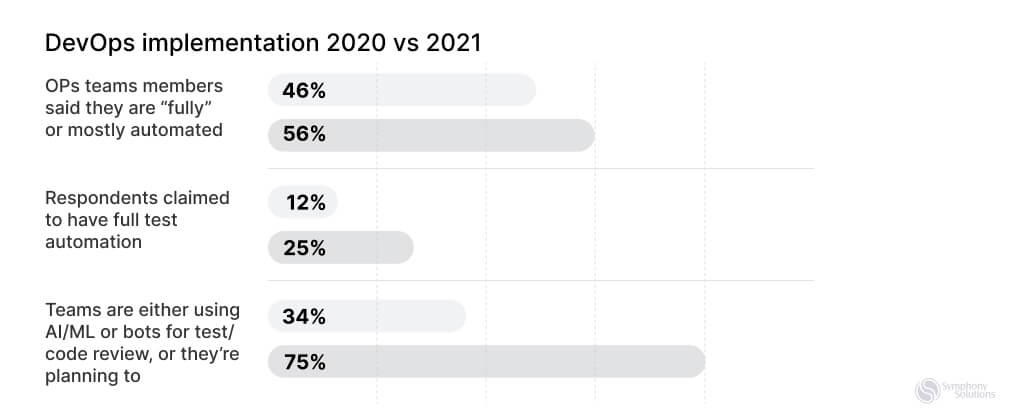
Documentation. Are you consistent with your documentation upkeep? Is it accessible for all team members to use and contribute? Documentation is the gene sequence of your application. Creating sufficient quality documentation of your processes and keeping it up-to-date can be a dealbreaker for your operational efficiency and continuity long term.
Disaster recovery. How ready is your DevOps team, really? What is your established process of disaster recovery and how prepared are your Devs to act upon any signs of system inconsistencies? Do they have an efficient and up-to-date disaster recovery plan? How fast can they apply it in case an incident occurs? Another important point you may want to address is redundancy planning or having all your system components duplicated for easy recovery in case of system failure.
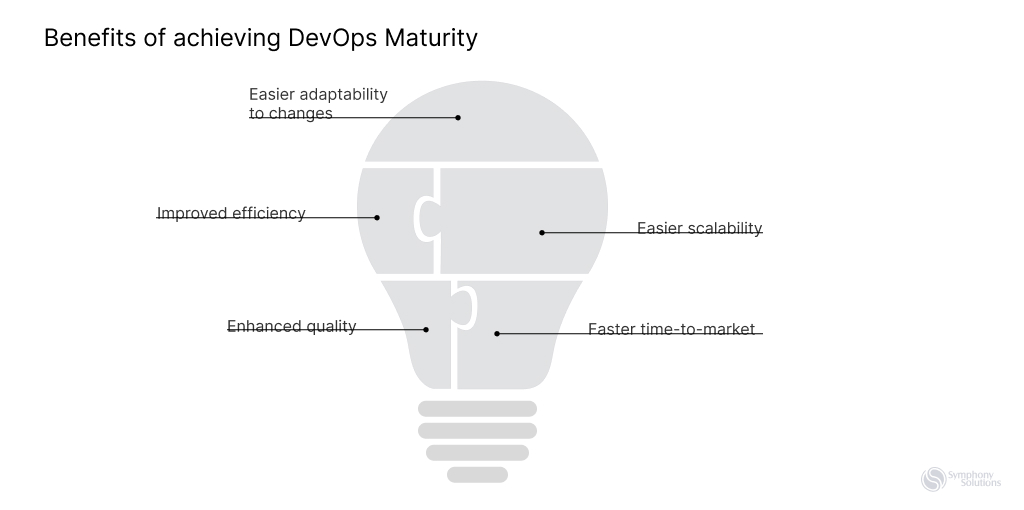
Business metrics monitoring. Another one of those checkpoints that can never be overlooked in DevOps is keeping track of your business metrics and immediately responding to issues just as they occur. After all, the sooner you investigate and get it fixed, the better it is for business continuity and providing good-quality service. In the case with our client Goat Interactive, Symphony Solutions team worked on setting rules for data monitoring and incident response criteria to ensure that the cloud managed services team is able to fix the issues and avoid escalation if possible.
Security. How secure is your software development lifecycle? As you are caught up in the race with competition, it’s easy to swerve off the tracks and leave gaps in your security. DevOps is meant to prevent that with one of its main objectives being setting and following strict security standards at all stages of software development. DevSecOps maturity assessment implementation is a viable option to consider.
DevOps maturity assessment tools
An essential step in your DevOps maturity journey is equipping your team with the right toolset to achieve efficiency and high quality of output. Depending on what task you need to accomplish, you can find the software tools that work best for you and your team.
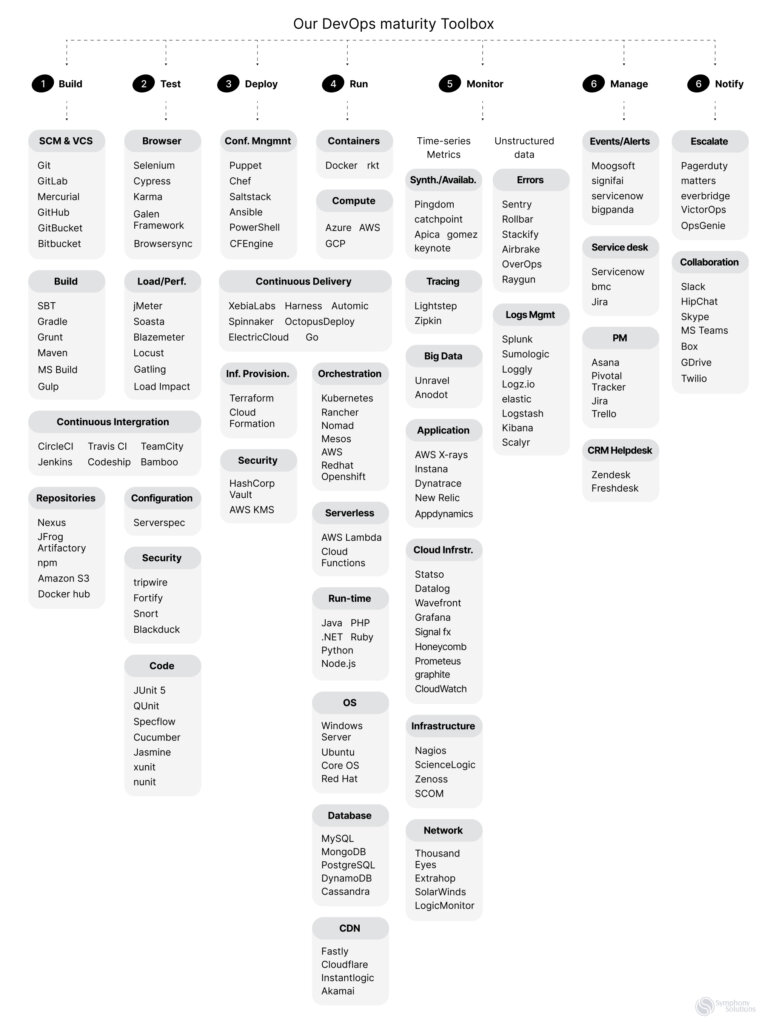
There are no inherently right or wrong tools. There is just what works for you.
Summing up
Sufficient DevOps maturity will allow a company to gain momentum to continuously improve its product and bring software to the market by having solidly established processes with the one goal of delivering value to the customer.
DevOps should be considered separately as its own entity, so you don’t necessarily need to set up your own in-house team in order to benefit from what they can bring to the table. In fact, many would argue that it’s more convenient and hassle-free if you set yourself up with a DevOps managed services team and have them manage your infrastructure. In the long run, you want to have a solid process going for continuous value delivery and know that your DevOps is up to standard compared with what your competitors have to brag about. Where upskilling, team education and consultancy are handled by your service provider.
That’s what is so excellent about setting up your DevOps processes, that you can put your trust into a reliable DevOps services provider and free up your time and brain power to come up with new features for your product, knowing that the process is set and running without a hitch. Symphony Solutions can set you up with an expert team to provide DevOps services – all to put your application delivery on a fast track, up your quality standards, and not blow out a hole in your budget as you’re at it. Carry on delivering value to your clients and know that an expert team of DevOps has got your back when it comes to orchestrating an efficient DevOps strategy for your product development and delivery – from improvements throughout the process to reliable automation of the mundane activities prone to human error.
FAQs
-

Theo Schnitfink for Forbes: Cloud Transformation in the Face of Market Recession: Consider Hiring Services Rather than People
In his Forbes Technology Council column our CEO Theo Schnitfink shares his thoughts on the business prospects in the face of the nearing market recession.
The imminent recession we are slipping into is undeniably on every executive’s mind today. All the macroeconomic signals are indicating that downturn is inevitable. Inflation has spiked to 40-year heights, which caused interest rate expectations to rise suddenly. The more growth-oriented the companies were the more they’ve gone down over the last 6 months. Even the absolute best SaaS companies are experiencing turbulent times.
As a result, the outflow of venture capital funding the startups, including late-stage companies with 100+ and 1000+ employees. There is so much uncertainty, one being the recession, that a lot of venture capital firms are choosing not to invest right and instead wait for more clarity on where the new evaluation levels are going to land.
Considering the situation, hiring new people might not be a good idea for some companies, as it entails a long-term commitment. So instead of hiring people, companies should consider hiring services for a specific problem.
A short article recap:
- Services are more predictable for businesses
- In terms of business continuity, they minimize the impact
- They are more problem-focused and flexible
- They can help speed up the delivery
- Transitioning to a service model is essentially about choosing the engagement model that works the best for your company.
Get the full story, visit Theo’s article on cloud transformation in the face of market recession.
-

Symphony Solutions “Stand by Ukraine” Supports National Rehabilitation Center of Ukraine
Symphony Solutions is among the first businesses to have supported the healthcare initiative to provide medical care and rehabilitation services.
Symphony Solutions is honored to be among the first five companies to endorse this project. The company has already donated 100,000 euros of its own profits as well as funds raised by the Stand by Ukraine charity initiative that will be allocated to purchasing diagnostic and rehabilitation equipment. We have also successfully purchased the two available bionic hand prosthetics created using AI technologies developed by Esper Bionics, an American company with Ukrainian origin. The lightweight self-learning prosthetics will serve as a way to help amputees get back their quality of life and independence. Realistic and high-tech, they leverage AI and enable the patients to regain function and fine motor skills to perform such everyday tasks as writing, playing sports, using tools, etc.

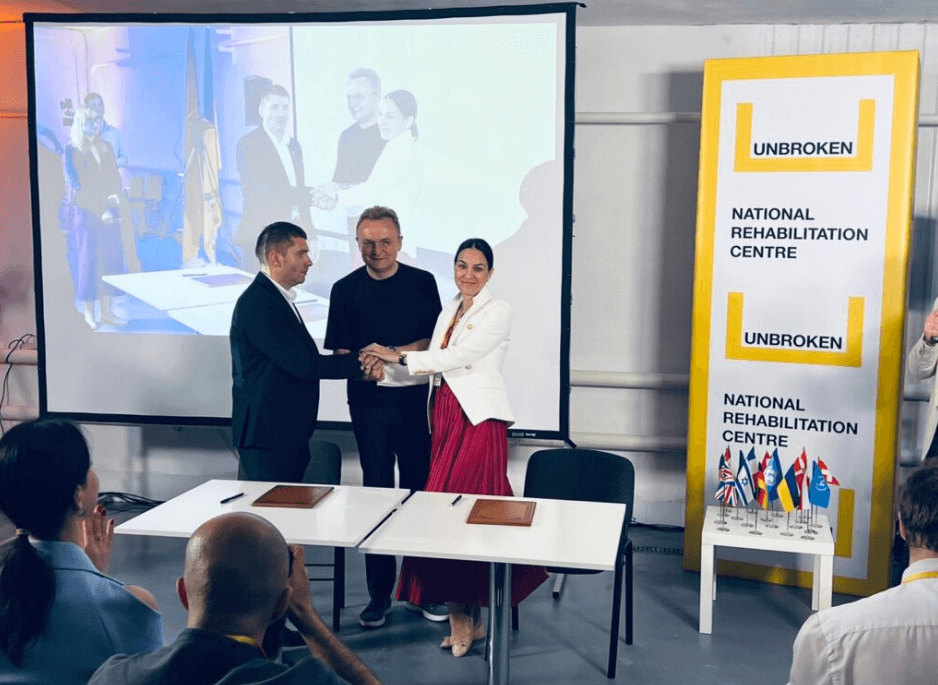
About “Stand by Ukraine” Charity Initiative
Stand by Ukraine was created by Symphony Solutions in the first days of the war in Ukraine as a charity initiative and later set up as foundation, that aims at fundraising donations and helping purchase life-saving medical equipment, protective gear, and humanitarian aid for the Ukrainian military and civilians caught up in the senseless war against Russia.

About National Rehabilitation Center UNBROKEN Ukraine
UNBROKEN is the National Rehabilitation Center for the Ukrainians wounded in the war against Russia, that will be created within the First Territorial Medical Association in Lviv with the support of the Ministry of Health in Ukraine. The rehabilitation center will provide physical care, including reconstructive surgeries, prosthesis care and manufacturing, as well as psychological and social rehabilitation to help patients fully reintegrate into society.

-

Symphony Solutions Acquires an ISO Certificate
On the 7th of July 2022 Symphony Solutions gained the ISO 27001:2013 certification on information security with the scope of certification being cloud and agile transformation services and full life cycle digital development services.
The certification process acquirement started last year March with the Information Security team working to rebuild the way of the working process to suit the certification as well as benefit the company by increasing internal security and information security.
The ISO:27001 certification will win new business opportunities and hone company’s strategic advantage. Not in the least does the ISO 27001 certificate assist Symphony with demonstrating great security practices, subsequently working on improving connections and retaining existing clients, however it likewise gives a proven marketing edge against the competitors. As Cyber assaults are growing in quantity and power daily, and the economic and reputational harm as a result of an ineffectual information security posture may be disastrous. The business now will also comply with business, legal, contractual and regulatory requirements which in fact will make it easier for clients to work with Symphony Solutions. As well as improving the workflow within the company by clearly understanding who is responsible for each information asset and nullifying information related risks.
About ISO 27001:2013 certification
ISO/IEC 27001:2013 specifies the requirements for establishing, implementing, maintaining and continually improving an information security management system within the context of the organization. It also includes requirements for the assessment and treatment of information security risks tailored to the needs of the organization. The requirements set out in ISO/IEC 27001:2013 are generic and are intended to be applicable to all organizations, regardless of type, size or nature.
ISO 27001 framework is a combination of policies and processes for organizations to use. ISO 27001 provides a framework to assist organizations, of any size or any industry, to shield their info during a systematic and efficient way, through the adoption of an info Security Management System (ISMS).
-

4.92 out of 5 Clutch rating: Clients refer Symphony Solutions
Client satisfaction is our highest reward for what we put in to build fulfilling business relations – our expertise, agility, and hard work. That’s why Symphony Solutions is so proud that our clients expressed their willingness to refer Symphony Solutions as a service provider at a whopping 4.92 out of 5 according to the company’s Clutch client rating.
Based on the ratings of twelve of our former and existing clients, the high Clutch rating is the recognition of the high level of service that Symphony Solutions delivers every day. We ‘wear’ the stars proudly and carry on the good attitude into each new partnership and project.
Clients’ trust is the backbone that holds us up and helps set the standard for high-quality service and product delivery. Some clients have only recently got on board with the company, others have been our trusty partners since the inception of Symphony Solutions.
Why is it important? Each new client and project challenge us to create exceptional value. Each success story passes on the good experience, as satisfied clients are happy to refer their partners to the company that they know is ready to take on the job and do it right.
About Clutch.co
Clutch is a leading platform for providing reviews and ratings for IT, Marketing, and Business service providers. Client ratings and testimonies on Clutch provide an insight into the companies’ level of service and established business practices, allowing to get an accurate overview of performance when choosing your reliable service provider.
-

Forbes Article by Theo Schnitfink: How Technology Puts the ‘Care’ in Healthcare
Theo Schnitfink, Founder of Symphony Solutions, shares his thoughts on the role of cloud computing during the pandemic at Forbes Technology Council
Over the last couple of years, the healthcare industry has been under a lot. What with the pandemic, and the incredible strain it has put on the system in the aftermath, the pressure of rapid vaccine development, and issues with an effective response to COVID-19. And even before 2020, the industry has had enough on its plate – much-needed digital transformation, telehealth adoption, not to mention worries over cybersecurity.
But as a silver lining the COVID-19 challenges have led to a speedier digitalization of the industry and one of the cental roles in this process belongs to cloud computing.
A short article recap:
- The adoption of cloud computing has accelerated. What was planned to achieved in 10 years is now a 3-year goal;
- Cloud offers numerous advantages, such as improve IT infrastructure, reduce costs, speed up innovation and much more;
- However, the transition does come with a few challenges, some of the most serious are: security, compliance, culture shift;
- There are numerous healthcare organizations from testing facilities, vaccine development companies to hospital that are successfully leveraging cloud’s capabilities which not only helps their business but also leaves a huge social impact and helps healthcare live up to its name by putting the ‘care’ in healthcare.
Get the full story, visit Theo’s article on cloud computing in healthcare.
You can learn more about digital transformation in healthcare and some impressive success stories in our white paper.
-

Legacy Application Modernization Strategies for Your Business Transformation
As companies strive to keep up with the perpetual churn of the market, they may run into issues with maintaining legacy applications or systems. One thing that you definitely wouldn’t want as a business owner is to drag behind the competition because you heavily rely on using an old system that has seen the highlights of its existence back in the 80s. That’s what legacy applications can be roughly described as.
It may not be obvious, but according to Dell’s market research, an estimated 80% of what companies spend goes to the upkeep of legacy applications. More often than not, this isn’t really justified.

80% of what companies spend goes to the upkeep of legacy applications
Source: Dell’s market researchCompanies rely on legacy applications for running operations with no alternative tech solutions. The price that they have to pay for it, apart from the literal cost of maintaining legacy applications, among other things, is lack of security, non-compliance, risk of losing important data, and overspending on maintaining a system that no longer carries its own weight. What’s even more concerning, the company may begin to stagnate as the limitations of a legacy system render it unable to deliver new features within a reasonable time and budget.
What is legacy application modernization? And what is the goal of it?
Legacy modernization is the process of bringing your business systems up to standard with the latest technological and market demands. As a result, you get a system or an application that is more efficient and compliant with industry regulations. It is able to perform on par with the more technologically advanced competition and deliver on customer expectations.
The ultimate goal of application modernization is to bring forth your digital transformation journey and create a system infrastructure that helps you thrive in the turbulent market. When you take your legacy application through the modernization process, what you achieve is the following:
- Establishing a standard. As the market is changing, so is the understanding of what is “up to standard”.
- Staying competitive is one pursuit of any business that always stays relevant as you operate in a market rather than a vacuum.
- Meeting customer expectations. What value you bring to the customer can rely on you utilizing the latest technologies and making your delivery faster, more reliable, and of the highest quality.
- Utilizing modern technologies to the max. New technologies emerge and change the way business works. Leveraging the advances of modern technologies such as AI, cloud transformation, etc., is good for your competitive advantage.
Why you need legacy system modernization: Benefits for business
Although the old saying goes “don’t fix it if it’s not broken”, it may as well be that this piece of wisdom needs a bit of a shakeup itself. Legacy software modernization benefits the business and introduces a higher standard for the products or services that you provide. Having a sound technological solution comes with its own set of perks.
Security. If you are working with personal data, a legacy system will put you at risk of non-compliance with GDPR, as the security standard and requirement for processing personal data in the EU implemented since May of 2018.
Cost of maintenance. Legacy applications may become a budget burden with overwhelming costs for maintenance that are not reflected in the value that you’re getting out of the application. With modernization you can greatly cut expenses and end up getting more of your money’s worth.
Cost of new feature delivery is incompatible for when you are working with a legacy application or a modern software solution. You may run into issues with finding experts qualified to work with the legacy system and the scarcity of the skill set inevitably drives up the cost.
Addressing technical debt is crucial for maintaining a healthy system. As time goes on, a legacy system will reveal more and more gaps in functionality compared to a modern solution.
Legacy system modernization approaches
When upgrading legacy systems, there are two main routes to take – revolutionary or evolutionary modernization – which differ in scale but should be seen as alternatives rather than the opposite. What approach you choose largely depends on the current state of your legacy system and what goal you pursue in your legacy modernization journey.
Revolutionary modernization
Revolutionary modernization needs to be applied in cases if the system is no longer being supported by the vendor or updated and hence is posing a risk of security breaches or incompliance. These and other reasons lead to your legacy application becoming a risk and further hesitation with modernization can lead to significant loss or damage to your regular business operations. This approach means building ‘from scratch’ a new system that is compliant and relevant to your current tech and business needs.
Pros: Holistic approach, prevents system damage and data loss.
Cons: Expensive, presents risks to business continuity.Evolutionary modernization
The evolutionary approach to legacy modernization is a more gradual process that unfolds over time, giving the organization a chance to weigh all risks and routes, and see to it that your system architecture doesn’t collapse while you’re at it and interrupts regular business processes. For instance, this can mean moving your application to the cloud in “chunks” or individual functional segments.
Pros: Helps avert risks, gradual spending over time.
Cons: Slow, multi-step process.Legacy application modernization strategies
We can define the “five Rs” of legacy application modernization that are the strategies a business can follow on its modernization journey.

- Replace your old legacy application with a new one, that corresponds to your current requirements and business needs. For example, you may want to update and optimize the infrastructure, or migrate an outdated on-premise system to the cloud. This is a fast yet probably the most expensive strategy for legacy application modernization. It runs a risk of losing data or disrupting usual business operations. Smooth replacement can be done with appropriate system assessment and getting on board with a DevOps team that would provide a full scale of services, from cloud native development to cloud managed services.
- Rearchitect and change the code to improve its structure and address existing technical debt. This is a more involved strategy that implies using new technologies and changing parts of the code, mainly on the backend, to enhance system performance. However, it’s not as disruptive and carries less risk than completely rewriting the code or replacing the system altogether. The difficulties that come with this strategy are that there may be limits to what you can do with the existing code.
- Replatform your system in those cases if it’s still able to perform and doesn’t require substantial changes to its structure, functions or features. In this case, you can make the shift to a new platform with minimal changes to the code and preserve the integrity of your legacy system yet benefit from having it run in a new environment (e.g., improved performance and enhanced security with cloud infrastructure). This approach to upgrading legacy systems allows for improving the overall performance with minimal costs and effort.
- Retain your legacy system in case there is no immediate need for a drastic upgrade. However, this strategy is only a short-term solution meaning that there should be a plan further down the line for retirement of the system or merger with a modern solution for your infrastructure. If the latter is the case, you may need to build ‘bridges’ for easier integration down the line.
- Retire the system if you discover that it’s no longer of any benefit to you and it would be better to move your data and users to a system that is already set up with sufficient functionality to carry on business operations as required. You may need a redesign to streamline the data and optimize business processes.
Tips & considerations when choosing a legacy modernization approach
Some things to factor in when deciding on your approach to legacy modernization would be the following:
- Assess your workloads. What is the state of cloud-readiness of your legacy application? Audit your system and determine the excess and business value of your workflows to understand how to approach modernization without business disruptions.
- Architecture. Analyzing your system architecture can help find performance shortcomings and weak points that would benefit from an upgrade.
- Financial load. Is your budget already stretched thin with supporting an outdated and burdensome legacy system? Address your overspending by optimizing resources and investing in future improvements that will alleviate the budget burden and improve ROI.
- What are the migration risks? Are you running into compliance and security risks with your current legacy system? Does it require immediate intervention or if you can approach its modernization more gradually over an extended period of time?
- Operations. Optimize your business operations. Support your teams in acquiring new important skill sets and invest in their training. Improve and modernize business processes.
- Take care of security. How secure is your legacy system and what is the best way to secure it going forward? A system audit may help you assess its current state and find gaps in security. Also, when proceeding with system modernization, see to it that you avoid data loss and exposing your system to possible attacks.
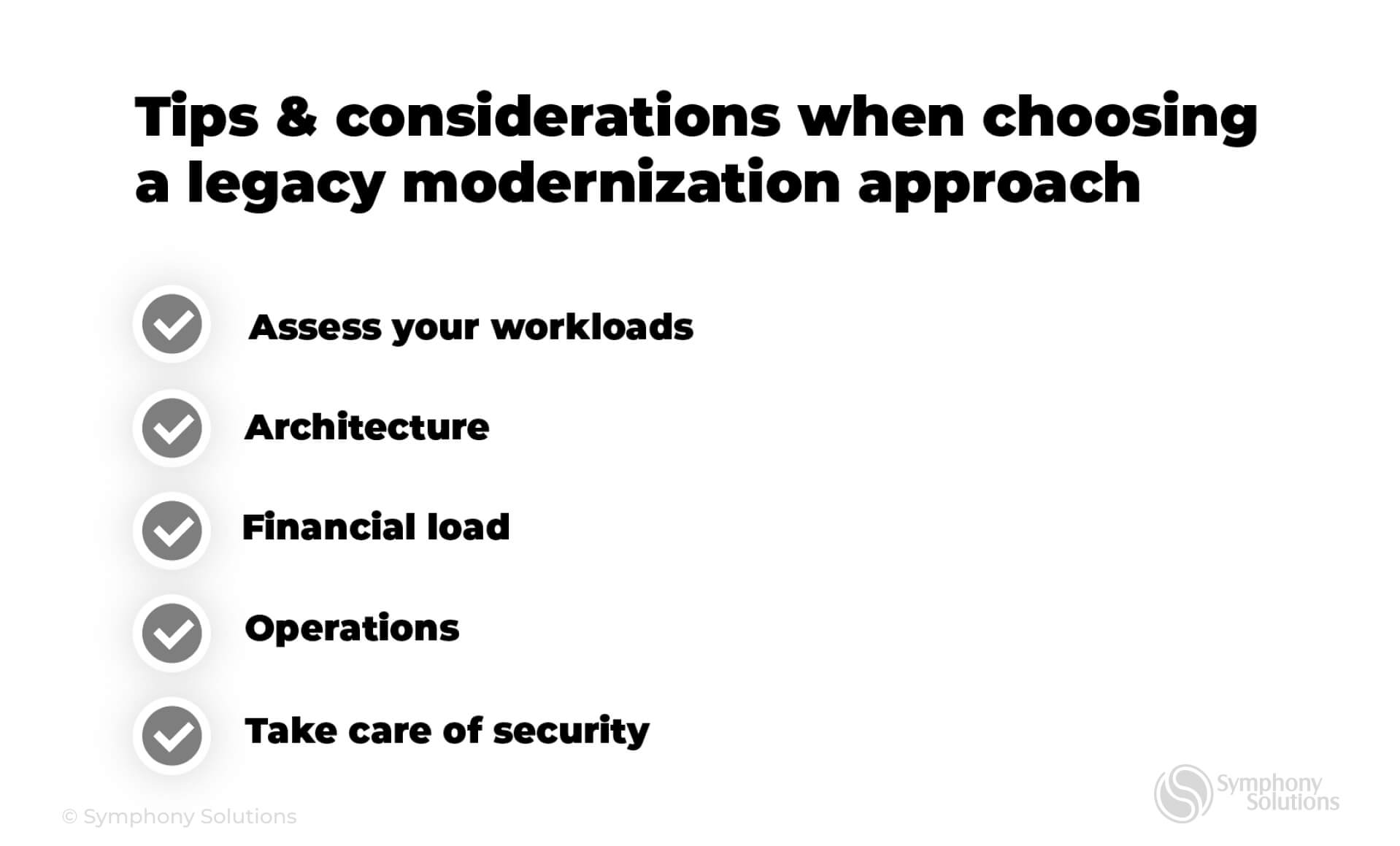
Conclusion
If you’re a long-time runner in the market, you may find yourself using applications or systems that have been serving you for many years but are no longer able to uphold current day industry standards. The best way to make your business compatible in the ever-changing market is to pursue a modernization journey that would help you bring your standards up to par and provide the best quality services for your clients. If you know your business needs and objectives and are aware of risks that come with any drastic changes, or lack thereof, to your business ecosystem, you will be able to pick just the right legacy system modernisation strategy and remain eligible for the ‘race’.
-

SpoedtestCorona Receives Honorable Mention in the Pandemic Response Category of Fast Company’s 2022 World Changing Ideas Awards
SpoedtestCorona, a chain of Covid-19 testing centers that Symphony Solutions has been supporting as a technical partner has been recognized by honorable mention in the pandemic response category of World Changing Ideas 2022.
Fast Company’s World Changing Ideas Awards and its pandemic response category distinguish programs, products, policies and anything else designed with an intention to reduce the health effects of Covid-19 or economic effects of lockdowns during the second year of the pandemic.
SpoedtestCorona app was created to address the urgent need for testing that is accessible, affordable, and allows people to get results in a matter of minutes, not days. Thus, the service provides an extremely reliable rapid test that makes it clear within 15 minutes after the test has been carried out whether there is an infection or not.
Rapid Covid testing service works in 4 simple steps. Via the app, a person can select the location date and time to get tested. All the necessary information and confirmation are then sent by email. At the appointed time the person visits one of our testing facilities to collect nasal and throat swabs. The encrypted email with the test results is sent as soon as possible.
The rapid testing method not only works for the sake of the comfort of an individual who wants to get tested and go on with their life but also allows eliminating the risk of asymptomatic Covid-19 carriers spreading further the virus, endangering people around them without even as much as suspecting it.
Leveraging cloud-native technologies allowed to create a solution that keeps up with the high level of compliance and data security, and is highly scalable taking into account the need to serve corporate customers with thousands of employees to be processed.
About World Changing Ideas Awards
Fast Company’s World Changing Ideas awards honor products, concepts, companies, policies, and designs that are pursuing innovation for the good of society and the planet. 2022 marks a fifth year of honoring large companies, sustainability initiative and any projects that might help solve world problems we are facing.
This year ideas were recognized in 38 categories. The entries were considered by a group of designers, venture capitalists, thinkers, social entrepreneurs and Fast Company editors and were judged on the scale of impact, design, scalability, and ingenuity.
-

Symphony Solutions is shortlisted for the EGR B2B Awards 2022
We are honored to announce that Symphony Solutions has been once again nominated for EGR B2B Awards. This year we will be competing with industry leaders in two categories: Live casino supplier and IT supplier.
The EGR B2B Awards recognize the leading companies in the online gaming industry. It celebrates the major achievements of service providers across all major egaming disciplines. This includes betting and gaming software, networks, mobile, payments, IT and infrastructure.
Over the years Symphony Solutions has proven to be a premier provider of custom iGaming solutions. Our cooperation with leading industry providers and products is a testament to our achievements dedicated to bringing the best iGaming experience on the market. Symphony has also been an EGR nominee last year.The EGR Awards will be hosted in person at The Brewery in London on June 15th, 2022.
About EGR
EGR Global is the online gaming industry’s leading information and membership networking group, combining business-critical news and analysis with a range of prestigious events. Membership to EGR provides businesses with a holistic range of services tailored to suit their needs. EGR Global annually hosts the most prestigious Awards for B2B companies in the iGaming industry.
EGR B2B Awards celebrate the very best of the service providers in iGaming. The nominees compete in 39 categories with four new categories introduced just this year. A team of independent judges is selected, each assigned to a specific market sector aligned to their expertise in a way to avoid a conflict of interests and create a selection process that is objective and unbiased -

Symphony Solutions supports Ukraine. “We will keep going for as long as it’s possible”
By Magdalena Lemanska, Forbes Poland, 06 March 2022

Forbes: Is it possible to run a business as usual in Ukraine? How is your company doing?
We are now living a reality that otherwise would’ve only been found in movies. Lviv, where we have our main delivery center, remains one of the safest places in Ukraine. However, even there people are regularly stuttered by emergency alerts that prompt them to run down to bomb shelters and basements. They live in constant fear. We regularly conduct remote meetings with our people, however, it happens so that they have to stop in the middle of a call because they can hear the alert and need to go seek shelter in a safe space. We also have a team in Kharkiv and the situation there is a lot more serious. Several Symphonians have already been drafted into the army and are fighting in the war. A lot of volunteers joined local territorial defence forces. Thankfully, they are all okay for now. Because it’s pretty much impossible to find an apartment for rent in Lviv right now, we have also launched initiatives to help refugees that are flooding into the city.
What are the initiatives?
Part of our office has now been transformed into a shelter for refugees. We purchased blankets, pillows, and other necessities. In the office, we have a shower, so people can clean themselves up, and in the office cafe, we provide food for the refugees. The initial idea was to make this a place for our own people and their families. We expected them to come en masse to Lviv from the East of Ukraine. Now we take in all refugees since the situation has gotten so dire. Some come only for a few hours, to eat and wash up, some stay for a day or two before they can take off for the border and leave the country. Of course, this is only in regard to women, since men aren’t allowed to leave Ukraine under these circumstances. I’m afraid, that in time our office will become a place of permanent stay for many of these people. And eventually, we will no longer be able to accept anyone new coming in.
Are the teams working as usual?
Yes, we are trying to work and manage the company as normal, at the same time, we continue to function in a state of crisis. Every morning there is a crisis team meeting. My managers touch base with their teams daily, wherever people may be scattered around Ukraine, and that is over 200 people that you have to stay in touch and talk to personally to know what is the situation on their side and how they’re doing. We ask if they plan on relocating and if yes, where to.
We have also split our daily meetings into two parts. At first, people in meetings would mainly talk about how they feel in the current situation and about safety. So we’ve taken that into account. Now, we start off briefly reporting on the situation and our people’s safety, then we talk about work – that’s what it means to work in crisis mode.
We have a lot of people in Kyiv and many other places around the country. Since the times of pandemic that made it a “thing” to work remotely – a lot of people are in other countries, such as Azerbaijan and Nigeria. Many of our Ukrainian teammates don’t want to leave their homes. These are very brave people.
What are your clients doing in this situation?
Almost all are contacting us asking if there is any way they can help and how we are doing. We have even started sending out a special newsletter biweekly with a general update on what is going on. Our latest issue was on the topic of what are various ways they could help us since we see this question pop up most frequently. I suggested donating to the Ukrainian army, which now has a dedicated bank account set up by the National Bank of Ukraine. We have made available a bank account where we are accepting donations that later go to our charity initiatives. Moreover, I have appealed to our clients to consider completely cutting ties with contractors and suppliers in Russia. The majority of our clients react very positively to all of the initiatives. Many offered Symphonians who work for their projects relocation to their offices abroad so that they could work from there. For the time being, of course, this is all in regard to women only. In Lviv, many people are opening up their doors to their entire families and friends who are escaping the war-ridden areas. I’m truly impressed by his unity and the will to support others.
In Poland, it’s all the same.
From what I know from my Ukrainian friends, they are really impressed by how they are treated on the Polish border. People bring food, provide care and transportation to any place in Poland. I’m really touched by this. We are also helping our Symphonians who want to move to a different country and continue working – we help them leave the country and find a place to stay once they are on the other side of the border. We also spend our own funds on purchasing any equipment that we can get for the army right now. After a hard pandemic time, the company was suffering financial losses, but it’s been turning out profit again since December. Right now, I have to make sure that the company is functioning at the current level since the entire profit that we generate is donated back to support Ukrainians. We ask our people to try and work, regardless of the stress of their everyday life right now, because it is very important to keep the economy running.
That is our fight – some fight on the battlefield, others work so that they have the means to help those suffering in this war.
In a situation like this, work can probably give you some sense of ‘normal’.
Yes, however, the most important thing right now is the safety of our people – only once that is secured, we can care about the company being able to function as normal. Our people can work from home, everyone has VPN, so they can do it from any country in the world. The key factor for us is good internet access. We know that Elon Musk is doing a lot of good in this regard, however, the first Starlink antennas are only accessible to the military and government for now. Internet access systems are the key for us today.
If the situation gets any worse, are your delivery centers in Poland and Macedonia ready to take in people from those other offices?
Yes, some of them have already taken up this decision. I’ve personally talked to people convincing them to consider moving, even before the war broke out. They could go work in our Polish office or in any of our clients’ offices. However, for the most part, people didn’t want to take up the opportunity, even though I argued that once they decide to make the move, they may find themselves in a 40-kilometre queue to the border. I’m not glad to admit that I was right. Now, many people want to get out but for a number of reasons they can’t. Part of our people made the move just in time, although that’s the minority.
For how long are you ready to go on in this mode?
It could’ve been longer if it weren’t for COVID-19, which exhausted all of our reserves and profits. But I intend to keep up this mode of work for as long as possible. For as long as people can work and complete their tasks, the business will keep going. Under the circumstances that we have today, I think, I could go on indefinitely. However, a lot depends on how many Symphonians will have to get drafted into the army. For now, it’s just a few people, but if it’s a hundred, I won’t be able to afford their regular salaries the way I can do it right now. Then, I will probably have to convince the team to give up a part of their salaries across the entire company. There are decent salaries in the IT field right now, so the question will be whether or not people will cling to them at any cost, or if they will choose employment security that would allow everyone to maintain the livelihoods of their families. And I would like you to stress one more thing on my behalf.
What is it?
I’m calling on everyone involved to stop collaborating with Russian companies. We only had one such client, a Russian-American company, which with time transferred to the US but kept its Russian management. We have terminated our contract with them. Shell, Disney, Mastercard, Visa and many other big companies stopped providing their services to Russians. That’s as much as we can do to completely isolate that country. Of course, there are many people amongst Russians who had no say in this situation but unfortunately, these are the consequences of mutual responsibility. We need to send a very clear message to Vladimir Putin that what is happening now in Ukraine needs to be stopped as soon as possible.
-

Symphony Solutions to Attend ICE London 2022
Symphony Solutions, a premier provider of Cloud and Agile solutions in iGaming, is set to attend ICE London 2022. The event will take place at ExCel London on 12-14 April 2022.
ICE London is the largest global gathering of gaming operators in Europe. It gathers leaders, decision-makers, technology experts and policy regulators from all over the world. This year’s event resumes after last year’s hiatus due to the pandemic. It is set to attract 450+ exhibitors from 50+ countries. The attendee will witness thousands of products and hundreds of product launches during these three days.
Over the years Symphony has developed an extensive expertise in the iGaming domain. We’ve collaborated with numerous top-tier Sports and Betting providers to bring their vision to life using the latest tech. Together with our clients, we’ve successfully launched numerous products by leveraging cloud computing solutions, agile methodology and service design, as well as built omnichannel experience for their players.
Symphony Solutions looks forwards to joining the conversation, meeting current and potential clients and pick up where we left off during the last event in 2020.
Meet our experts

Eduardo dos Remedios
VP of iGaming at Symphony Solutions
A true leader and veteran in the iGaming industry, he has contributed to the success of numerous brands and operators throughout Europe, Latin America and Asia.

Chuck Robinson
iGaming Development Lead at Symphony Solutions
Experienced iGaming industry specialist that continues to assist operators and providers up their game. Focusing on Europe, Africa and North America.

Oleg Chekan
Head of technical Pre-sale and Service Delivery Manager at Symphony Solutions
Oleg is a Cloud Solution Architect that has designed and delivered the platform. Experienced in product development for security, gaming, fintech and healthcare business domains.

Magdalena Bochenska
Service Delivery Manager at Symphony Solutions
Experienced resourcing manager and talent partner with long history of working in the IT industry. Last couple of years strongly supporting iGaming industry, providing understanding of needs and fulfilling them with available talents.
-

Symphonians volunteer for Ukraine: Our stories
As Ukraine is being devastated by the Russian enemy, we stand together as a united front and reach out our hearts and helping hands to people in need. In this regard, Symphonians are amazing people who never give up in the direst of circumstances. They not only stay on top of their projects but are actively involved in the life of the community.
Everyone’s fight is different. While our brave warriors are keeping a stronghold on all fronts, we can secure them from the back and take care of one another. Every soul is precious, every life is sacred. It is our duty and mission to find our place in the turmoil and make a personal contribution, however big or small. Little strokes fell great oaks.
Let’s hear from our Symphony Heroes in the Rear, doing their part on the rear front for the sake of Ukrainians and the Ukrainian Armed Forces.
The long drive to war
The unprovoked and senseless war was something that we never wanted to expect, we couldn’t let ourselves believe that this is a possibility until the early morning of February 24th. Yet Russia’s aggression must have felt different for the many military families of Ukraine. Maryna Shulga, Release Manager at Symphony Solutions, shares her perspective:

Defending Ukraine in the rear
While some Symphonians joined the military or were drafted into the army, many didn’t lag behind and became part of the local territorial defence forces. Oleksii Tretiak, Service Delivery Manager at Symphony Solutions, is one of such heroes in the rear:
It’s our part to save our home
The theme of unity is what helps many get by and have the strength to face another day. Everyone’s contribution counts towards victory. Everyone helps in their own way. Tetyana Slezinska, Service Delivery Manager at Symphony Solutions, tells her story:
Supporting the Armed Forces of Ukraine
While we take care of the people displaced by the war, we never forget about our brave warriors who are fighting off the vicious attacks of the Russian army. In whichever way we can support them, whatever equipment or aid we can find and provide. Oleksandr Vilchynskyy, Lead DevOps Engineer at Symphony Solutions, tells how helped his friends set off for the front:

Not everyone can pick up a rifle though. Yet there are so many other ways we can help without necessarily launching into battle. Oleksandr’s fight continued on the information front:
Still, the job of a volunteer never ends. From evaluating people to purchasing equipment and weaving masking nets – all this is done alongside regular work. Is it hard? Of course! But Oleksandr finds the time and resources to do what he needs to do:
While Ukrainian warriors are fighting off the intruder, they maintain their high spirits and a good sense of humour, Oleksandr shares:
While the fight is continuing on the frontlines, all we have left to do is to keep a strong and secured rear for our army. And then again we can think about supporting the economy and our life after the victory:
Family is all that really matters
There is so much that Symphonians are doing right now, and still, so much more we can do. But at the end of the day, we all think about reuniting with our families and going back to the time when we can once again live under the peaceful blue sky of Ukraine. Dmytro Gaviuk, Senior Go Software Engineer at Symphony Solutions, is brief and precise in his words, but we can all agree with his sentiment:
Friends in need
Symphonians’ stories are truly inspirational in showing how everyone can find their calling and be an important part of our community, of this battle for the good. And all this goes way beyond Ukraine, as we have friends and family from around the globe responding to our urgent calls for help and just being there for us. Marta Khoma, Training Management/Onboarding Specialist at Symphony Solutions, found her own way to volunteer and contribute to Ukraine’s fight for freedom and she has some good friends helping along the way:

These are just some of the stories of our amazing volunteers here at Symphony Solutions. The bottom line is that we stay united and do whatever we can, whether it’s staying close to our families and friends, helping out strangers who have found themselves in difficult circumstances, being the mediators for our foreign friends who want to send help, or providing for the needs of the Ukrainian Armed Forces. There is so much that we do or still have yet to do. Together we are strong and persistent! Stay tuned for more stories from Symphonians.
-

Symphony Solutions Launches “Stand by Ukraine” Charity Initiative
Symphony Solutions “Stand by Ukraine” charity initiative is dedicated to raising funds and providing humanitarian and emergency aid to Ukraine.
As you are reading this, Ukraine is in the midst of a senseless war, which has disrupted the normal way of life – infrastructure, postal services, commerce. Ukrainians may be fine with provisions for now, but we can’t be sure about tomorrow. We refuse to wait till tomorrow. We take up initiative in purchasing emergency aids and shipping them off to Ukraine right now. Let’s make it so that there is a tomorrow.
Why we have launched this initiative
Symphony Solutions is a Dutch IT company with delivery centers around Europe, but its biggest one is in Lviv, Ukraine. That should have said it all, yet there is so much more to it.
Symphony Solutions has been operating in Ukraine since 2008, but our heartfelt relationship with the country started a long time before that, ever since Theo Schnitfink, founder and CEO, first had the idea to take his great vision of a company to this country and let the talented Ukrainian IT crowd bring it to fruition.
History repeats itself
We have been through so much together. We hoped that the horror would be maintained and stagnate in 2014. It was then that Russia first started showing its aggression towards Ukraine and weaving lies about the nature of the conflict. For eight years, Ukraine was forced into a hybrid war. Ukrainians never asked for it, but Russia has a track record.
Since the start of the hybrid war of 2014, Symphony Solutions has been supporting the 80th Air Assault Brigade and donating to their needs. It was our duty and contribution to the fight for regaining a sovereign and peaceful Ukraine.
Then, February 24th happened. Since the start of the full-scale Russian invasion, Symphony Solutions has doubled and tripled its charitable activities. Now, as Ukraine is fighting off the aggressive and unprovoked attack, we can’t stand in the back and watch the world begin to fall into ashes.

Some of our latest initiatives
We take action immediately. Symphony Solutions couldn’t stay idle and watch as Ukrainian’s suffering seemed to be doubling by the hour. Here are some of the already undertaken initiatives:
35K€ raised among Symphonains in a few days
Symphonians and the company collectively raised over 35K euros as emergency help to support the 80th Air Assault Brigade, the Unity Fund created for the sake of Symphonians, who joined the army or territorial defence force, and for other urgent needs. We continue running the fundraiser internally and allocate the funds to further support various charity causes and the Ukrainian Army.Profit donated
The company decided to donate all profits generated in Ukraine.
Shelter&Relocate
Symphony Solutions has turned its Lviv office into a shelter for people being displaced by the war. Close to 100 people from Kyiv, Kharkiv, and other Ukrainian cities have stayed there and were provided with a comfortable bed, hot food, and all the necessities. We help transport Symphonians and their families (women and children) over the border with Poland, where they get assistance with temporary apartments or permanent relocation. Poland offices in Kraków and Rzeszow are in the process of being turned into safety shelters and will be welcoming people in the nearest time.It’s a war on truth
Disinformation distress is wreaking havoc all over the internet. Standing up for truth and stopping the lies is another fight worth having. Since day one of the escalation, we have been launching promo campaigns aimed at Europe and Belarus to bring awareness of the situation and raise funds for Ukrainian Army. Our next campaign is asking for a ‘green corridor’ to evacuate Ukrainians trapped in Volnovakha, Schastia, Nova Kakhovka, and other cities. This fight will be silent but we are persistent.These are just some of our initiatives. Symphonians are volunteering and dedicating their time to helping displaced Ukrainians with transportation, informational support, working at volunteer centers, and just being there as an extra pair of helping hands. We are strong and united!
Donate to Symphony Solutions charity initiative “Stand by Ukraine” and contribute to providing humanitarian aid to Ukraine.
-

Digital Transformation in Healthcare: How Cloud Computing Helps Tackle Urgent Social Needs
In Brief:
- Patients, their health needs and goals are at the center of healthcare today.
- Three main technologies that are turning around healthcare, making it human-centric, and bringing patients and doctors closer are: cloud computing, artificial intelligence (AI), and virtual care delivery.
- The application of cloud computing in healthcare can help cut down costs, reduce the time spent on development, or offer organizations much-needed flexibility, scalability, and empower collaboration between healthcare researchers.
- Cloud computing has shown to be effective tool in the face of urgent social needs such as helping with the development of Covid-19 vaccines or elevating the quality of healthcare by moving it online.
The Healthcare industry has experienced an immense amount of pressure from the Covid-19. In a relatively short period that the pandemic has been raging it has forced the industry to change in various ways, rethink what’s important, or better say who – a patient. But for better or worse, it has turned out to be the driver of much-needed change for healthcare.
Digital transformation tends to be a sore topic not only for healthcare but for businesses across all industries. Though companies and their executives generally acknowledge the need to adapt to the digital age, only a few truly understand what it entails.
But getting to the root of the question requires time, that’s why digitalization was considered nice to have but generally put somewhere at the bottom of a to-do list. A powerful force that is driving healthcare digital transformation today is cloud computing.
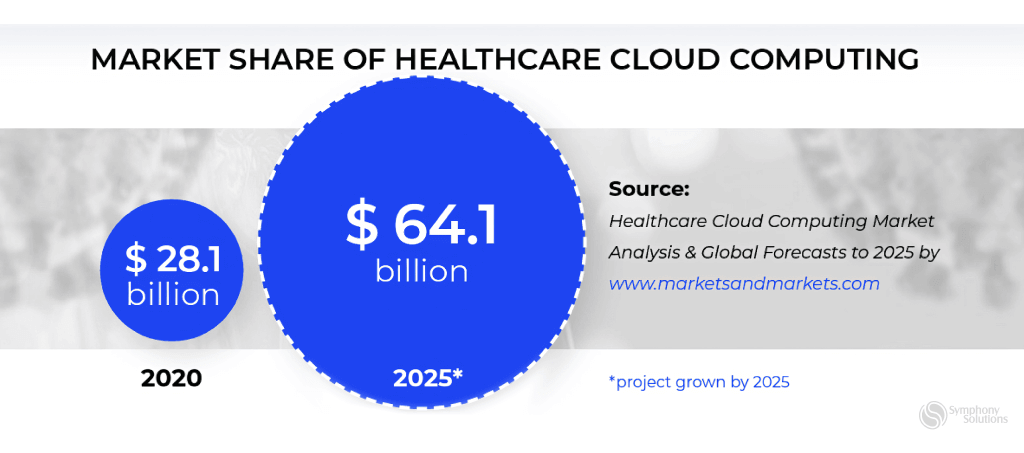
In this white paper we will discuss the state of healthcare today, the main problems digital transformation is trying to solve, and what stands in the way. And will cover how cloud computing is helping in the face of urgent social needs by facilitating the development of vaccines or helping elevate healthcare by moving it online.
And as a final example, we talk about our own success story – how with the help of the AWS cloud platform we were able to deliver a Covid-19 testing platform in the record 2 weeks.
Download the paper to get the full story and a free strategy consultation with our cloud experts to discuss the next steps on your cloud transformation journey.
-

Cloud Software Development: Why It’s Worth Investing and Best Practices
Cloud software development, once a trendy and somewhat distant technology, has become an integral part of any business that is serious about its future. Since the Covid-19 crisis cloud development market has witnessed even further growth. In its annual Internet Report, Cisco estimates that by 2021, 94% of workloads and compute instances will be processed by cloud data centers and only 6% by traditional data centers. Another mind-boggling prediction comes from the Data Attack Surface Report, which states that in less than 5 years half of the world’s data will be stored in the cloud.

Another contributing factor to the ever-growing popularity of the cloud is the rise of remote work. Since spring 2020 with the pandemic, lockdowns, and social distancing, many aspects of our lives have changed. The way we work included. And today, almost 34% of employees say they prefer to work remotely and may quit their job if forced to return to the offices.
Among organizations that choose cloud software development, 92% are at least “somewhat” in the cloud. Meaning they’re utilizing multiple cloud service providers, for instance, AWS and Google Cloud Platform. That way, if one of their services is temporarily unavailable, they can switch to a working backup for disaster recovery.
But with all the advantages, many enterprises face challenges when moving to the cloud, the top three being issues with the security, managing of cloud spending, and governance. In fact, according to Statista’s 2019-2020 report on the challenges and risks of cloud computing, 30% of business owners complain that roughly 30% of their cloud budget goes to waste. But it doesn’t have to. In this article, we will guide you through what is cloud computing and cloud native development how it differs from traditional software development, what are the key component of cloud-native development, its main advantages, and risks.
What is cloud computing, its types
Cloud computing refers to the delivery of a range of services, such as servers, storage, databases, software, networking, analytics, by the means of the Internet, via “the cloud” as a cost-saving, agile and flexible solution and to bring innovation.
But not all the clouds are made the same, to understand which one is the right solution for your business needs, you need to discern between various models, types of deployments, and services.
The three ways of deploying cloud computing services are by the means of public, private, or hybrid cloud.

- Public cloud – with this cloud computing model, third-party cloud providers own and manage the computing resources such as servers, storage any hardware or software. The services that vendors offer might be free or subscription-based and are most suited for predictable computing needs, software development, or testing. It offers great technical agility for a good price. However, as a downside, the public cloud comes with a lack of security and cost control and pretty minimal technical control as well.
- Private cloud – refers to any cloud solution used exclusively by a certain business or an organization. With this model, the computing resources are located either on-premise or operated by third-party service providers. The private cloud is a perfect fit for government projects or highly regulated industries. For companies that require full control and security of their workloads or large enterprises. With this model, you can count on a dedicated and secure environment, flexibility, scalability, and efficient performance. But naturally, it comes with an outstanding bill.
- Hybrid cloud – combines both public and private cloud solutions, with data and applications shared between them. This gives the organization better flexibility, helps optimize existing infrastructure, scale with security, and takes into account compliance. Hybrid cloud is a good choice for organizations that operate. On various levels and face different compliance, security, or performance requirements. Or if you approach cloud investment with a strategic foresight in mind, trying to devise the best cloud service, delivery model. However, this approach adds a level of complexity, as you’ll have to manage and operate a mix of architectures. On top of that, navigating between the public and private cloud might result in some wasteful spending.
Cloud-based or cloud-native application development?
Another important aspect to consider, whether you want to go for a cloud-native or cloud-based development. Though often confused as they share some characteristics, the two differ in important ways.
Cloud development or cloud-based development refers to writing code in the cloud by the means of a browser or online interface connected to a cloud-based infrastructure.
While cloud-native software development is a specific type of cloud development that is container-based, dynamically orchestrated, and uses microservices architecture. The container-based and dynamically orchestrated nature of cloud-native applications makes them a subset of cloud-based apps. For instance, in such aspects as high availability or elastic scalability. While the microservices nature of cloud-native apps helps in delivering updates, some enhancements, or debugging. Thus, this approach nurtures the implementation of CI/CD processes and DevOps culture.
Types of cloud services
There’s a wide variety of cloud services available on the market. To have a clear picture of what exactly you need from cloud software development and how it can help you achieve your business goals, it’s important to know what these services are and how they differ. Generally, most cloud services fall into one of the following categories: infrastructure as a service (IaaS), platform as a service (PaaS), or software as a service (SaaS). Together they are often referred to as the cloud computing stack as they build on top of one another.

- Infrastructure as a service (IaaS)
Offers essential resources, such as storage, servers, network, on-demand on a pay-as-you-go basis. IaaS helps reduce on-premises data centers maintenance, as well as saves money spent on hardware. At the same time, it gives the flexibility you need to scale the resources on-demand and saves money by avoiding expenses on buying and managing physical servers and data center infrastructure. Each of these resources is offered as a separate service that you pay for as long as you need.
- Platform as a service (PaaS)
Provides complete development and deployment environment in the cloud. Much like IaaS, it includes the infrastructure resources (I.e. storage, servers, networking) but also middleware, development tools, database management systems, BI services, etc. It supports the complete development lifecycle, from building and testing to deploying, updating, and managing. Cloud services providers offer PaaS resources on a pay-as-you-go basis which helps to avoid unnecessary expenses related to buying and managing software licenses, app infrastructure, and other resources.
- Software as a service (SaaS)
Allows using a cloud-based app over the Internet without having to download, install or run it on the computer. The most widespread example of SaaS solutions would be Microsoft Office 365 or Gmail. It offers a complete solution for the end-users. For the business, it means renting the use of the solution that can be accessed over the Internet. The main advantages of this type of solution are compatibility, accessibility, and operational management. All of the underlying infrastructure, application software, data, and middleware are located in the cloud service provider’s data centers. The latter manages the hardware and software, as well as ensures the security of the solution.
Cloud application development best practices
Cloud-native application components
So what constitutes a cloud application? Here are some key components that together make up cloud-native development:

- Containers
- Microservices
- DevOps processes
- APIs
- Serverless architecture
- CI/CD pipeline
- Containers
Containers are a staple of cloud-native development. They provide the application with libraries, lightweight runtime, and dependencies that allow for application portability, meaning it can run as a stand-alone environment and be moved in and out of the cloud. Containers offer additional mobility and allow developers to effortlessly release and update apps, as well as focus more closely on the app itself, while the infrastructure is in hands of the operations team. Container orchestration is the management of these deployments across the enterprise.
- Microservices
With the traditional, monolithic application development, the development, deployment, and management of the app are easier at the initial stages. But the bigger the app, the harder it is to solve any problems or add new features. That’s where the microservice-based approach to software development comes in. It breaks down an app into the smallest components, microservices, that are independent of each other but work together towards the same tasks. Microservices usually run in containers which makes them an application payload for a container. This allows adding new features or functionality more quickly and easily, as well as minimizes the risks.
- DevOps
As with any application development, one of the important components is the people and the automation processes that help them work together. To make this collaboration more efficient, cloud-native development adopts a DevOps culture. DevOps as an approach to software development and a new management culture adopt certain practices and work environment that supported by tool allows organization achieves their business goals faster and without the compromising the high-quality standards. By automating the software development routine, it reduces the time and effort typically spent on manual tasks.
- APIs
Application programming interfaces (APIs) are sets of tools, definitions, and protocols that integrate, communicate and connect application software with services with simplicity, flexibility, safety, and control and without having to build new connectivity infrastructure. APIs can be private (only used internally), partnered (shared only with specific partners), or public (allow third parties to develop apps and interact with your APIs).
- Serverless
Serverless architecture means that you don’t have to manage any servers, virtual machines, or containers. Despite what the name might suggest, there are still servers, of course, but the task of handling them falls on your cloud infrastructure provider. This allows you to execute the code in a form of functions at automatically provisioned infrastructure and environment. Any major cloud provider offers serverless nowadays: AWS Lambda, Google Cloud Functions, Microsoft Azure Functions, IBM/Apache’s OpenWhisk or OpenFaaS which is opensource under Linux Foundation governance.
- CI/CD
Establishing continuous integration and continuous delivery processes is the essence of DevOps and cloud-native development. With a CI/CD pipeline, a series of steps are performed to deliver a new version of the software. It introduces automation and monitoring to improve application development, at the integration and testing stages, as well as delivery and deployment. The main advantage of this approach is in the better quality of applications, and faster and more stable updates.
Choosing cloud vendors
Another important step on your cloud journey is choosing a reliable cloud services provider. Luckily, there’s plenty to choose from. The ‘big three’ are Amazon Web Services (AWS), Google Cloud Platform (GCP), and Microsoft Azure.

AWS has been on the market the longest and currently dominates it with a 32% market share, followed by Microsoft which has 18%, and Google – 6%, as a recent report suggests. Other reliable cloud providers worth considering are IBM Cloud, Oracle, Heroku, Rackspace.
With so many to choose from, today companies often opt for using additional cloud providers, not to replace one with another but to cover different requirements, such as costs, managing risks, etc.
Why go for cloud software development: key advantages
As more and more organizations choose to adopt cloud, here are some of the deciding factors for opting for cloud software development:
- Reduced cost
As cloud application development operates on the pay-as-you-go model, it means that you will be paying only for the cloud services that you are using. This allows to control expenses and not overspend where there’s no need. At the same time this approach requires to take into account carefully cost modelling during solution architecture design.
- Increased flexibility
With cloud software development, cloud scalability is a part of the package, which means that you can easily scale up or down if need be.
- Better agility
Another innate feature of cloud development – CI/CD means that developers can rapidly test and introduce new features in mere minutes or hours, not weeks or months, which nurtures innovation and helps beat the competition.
- Fast disaster recovery
Cloud’s ability to bounce back rapidly in case of meltdown adds up to the business’s ability to be more competitive and offer a better quality of services for their clients. To have this advantage in full, solution should follow IaC(Infrastructure-as-Code) principles which means that all the IT infrastructure components to be deployed in programmatic way.
- Effective collaboration
Communication and sharing within the organization are also sufficiently improved with cloud computing, as anyone related to the project can easily access the same files from any location. This, in turn, improves collaboration and internal processes.
Before you move to the cloud: challenges of cloud software development
But with all fairness, it is also important to note the challenges that might come up on your cloud transformation journey. Here’s what you need to be aware of:
- Security concerns
Although most of the security heavy lifting is done by the cloud services provider, security is still a top priority and concern. Depending on the domain you are operating in and the level of sensibility of your data, you might need to consider a hybrid or multilevel type of cloud, with workloads being split between public and private clouds.
- Culture shift
Cloud software development brings a lot of relatively innovative ideas to what you’d consider a standard approach to software development, for instance, the adoption of DevOps culture. This inevitably leads to some reorganization within the structure, shifting of some roles and responsibilities which will require strong management skills.
- Compliance
Another top concern when moving your product to the cloud is meeting GDPR and other security regulations that you will have to look closely into. At the same time such regulations valid for on-premises traditional solutions as well.
- Finding the right talent
If your team hasn’t got previous experience in working with cloud development, you might want to consider looking for a software development partner that will help you handle all the issues and challenges that might arise on your way and help with an efficient time and cost-effective transition to the cloud.
Conclusion
Cloud native development has been the talk of the town and one of the leading tech trends for several years now and with everything happening in the world and the continued need for businesses to go online and digitalize, it will remain that way. This can be easily explained, cloud software development comes with numerous benefits such as extended flexibility, scalability, effective use of the resources, and speed of innovation. However, it comes with some challenges as well. You will have to be prepared to deal with various APIs integrations, planning of data architecture, as well as dealing with security and compliance.
Symphony Solutions, as a trusted cloud software development partner, can help you make the most out of this technology and make your cloud adoption a smooth journey. -

Accelerate Time to Hire: 4 Solutions for Vetting Technical Talent
Your company is expected to move more quickly than ever before in order to remain ahead of your competitors. With countless priorities to juggle, allocating time to source, onboard, build and scale an engineering team that will get you where you need to go can feel like a daunting project. Add in the fact that the current market is extremely volatile and your challenges have increased by a quantum factor.
The state of the hiring market, especially when it comes to recruiting software engineers, has been shifting with the onset of pandemic restrictions as many qualified software developers opt to work remotely and experience more freedom to choose companies and what they are offered. What may seem like a lucrative career prospect for talent, poses a risk for recruiters who suddenly find themselves fighting over candidates and struggling to fill positions. In fact, CodinGame surveyed 15k developers and HR managers and discovered that 61% of recruiters have said that finding tech talent is their biggest challenge for recruitment in 2021.

61% of surveyed HR managers say finding tech talent is the biggest challenge for recruitment in 2021.
Source: CodinGame’s researchModern-day market software developer hiring challenges
The tech hiring market of 2021 is volatile as demand for talent is rising higher than ever. Here are just some of the challenges that recruiters face on a daily basis:
- Each potential candidate is being approached by many different recruiters every week. Even if you are able to engage candidates and make them interested in the role and the company, it is a challenge not to lose them.
- The longer the process the more likely candidates are to drop off. It’s important to optimize the process and make it as fast as possible, especially when it comes to final decisions.
- The more steps in the process, the higher the risk of losing candidates. Every step increases the time it takes from approaching a candidate to making a decision about hiring them. Take too long and by the time that you’re ready to make an offer they will have been picked up by another company.
Expanding on the challenge of the multi-step hiring process, it’s often the case when another company has to be involved. Once the client company comes into the picture and wants to take an active part in hiring, it adds to the number of steps and makes the process even longer. Then you may run into issues with scheduling; interviewing takes time, especially if there are several rounds. All the while the risk of the candidate dropping out increases.
In the current climate, a protracted multi-step process is no longer a viable option. If you really want to succeed, you need to take a different route in the hiring process.
Setting your team up for success is a challenge of its own. But first, you need a team that is up for the challenge. Let’s go over a few ways how you can optimize your software developer hiring process reflecting on the current realities.
Solution 1: Fewer steps
The reality of the hiring market is that if you start off the recruitment process with ten candidates, by the end of the first week you will lose two of them. By the end of the second week, another two will be gone. And by the end of week 3, you’ll be lucky to have even one left. It may be tempting to keep a big pool of candidates and have something to choose from. But with how fast people now tend to move from one position to another, you have to think fast and not keep your candidates waiting, lest someone else will snatch them right from under your nose.
One way to deal with this is to have team interviews instead of multiple rounds of interviews for your candidate with each department or interviewer.
Pros:
- It’s a faster process if instead of four separate interviews you have one with different interviewers.
- Involving more people in the interview helps reduce or entirely avoid bias in the hiring process.
- Team interviews help make the hiring process more streamlined and consistent.
- Candidates are introduced to company culture.
Cons:
- Each interviewer has a limited time to talk to the candidate and cannot go deeper on some topics.
- More stress inducing for the candidate and may result in poor outcomes.
- Team interviews require more preparation make sure they are well-structured and questions aren’t overlapping.
- Interviewers see other interviewers react to the candidate and this may influence their judgement.
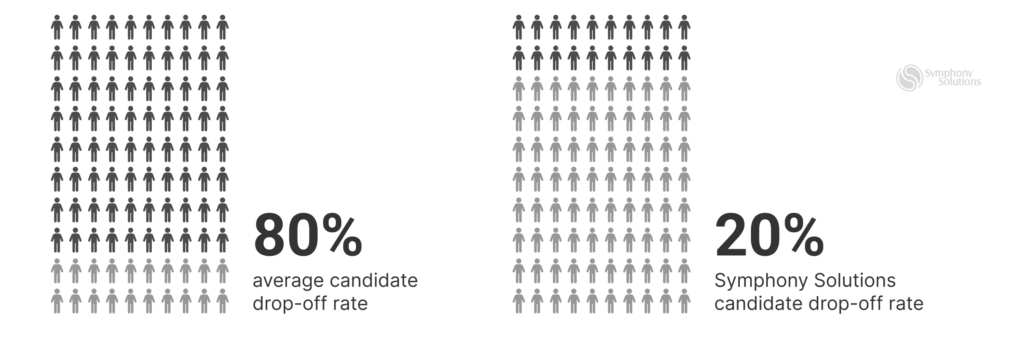
Solution 2: Speed it up
The hiring process may consist of multiple steps, each one requiring feedback on the candidate’s performance. It’s often the case that it takes days if not weeks to hear back from all people involved, since interviewers and hiring managers are already as busy as it gets. This may be addressed by building awareness in the company so that everyone knew the importance of fast feedback, perceiving it as part of the company culture.
As practice shows, this is something absolutely realistic and achievable once you set up the process. We see more and more companies making the offers within one day, so that is something to consider.
Pros:
- Fast turnaround means lesser risk of losing a valuable candidate in the process.
- More efficient and productive hiring.
- Quick feedback provides good candidate experience as it shows your commitment and that you treat them as a partner.
Cons:
- If the hiring process is rushed, there’s always a risk of hiring someone who isn’t the right fit for the project or the company.
- Risk of miscommunication.
Solution 3: Efficiency
Be efficient and make sure there is no time wasted in the process. During the interview, interviewers should only ask questions that matter and that help them assess the candidate. Make sure it’s not some casual chit-chat about nothing. Interviewers should be properly prepared to talk to the candidate, i.e. they know the role, get familiar the candidate’s CV upfront, etc.
Pros:
- Interviews are more to the point, so you may discuss the position and the project in more detail and nuance.
- Interviewee gets a more realistic impression of the company and what the role is about.
Cons:
- Some candidates may prefer a more personal approach to interviewing and may view your to-the-point attitude as cold or robotic. This way you may deter talented candidates from your project and opt for a better cultural fit.
Solution 4: Trust the vendor
As you are looking to find your “dream team”, you may want to get involved in the hiring process and get to know what people you are going to be working with. However, this will mean extra steps and longer process. Realistically, there are no companies that can do it all within one week if the client must be involved.
There is another way to efficient recruitment with fast turnaround. Essentially, you will get the best results and most impact if you trust your vendor to handle the process. If fully responsible for the hiring process, their first priority is to put together a team that is efficient and just right for your needs, and they will not let exceptional talent slip past them.
In a 2019 article, Glassdoor touched on some woes of recruitment and noted that the average candidate drop-off rate can be as high as 80%. All of this is attributed to the slow and complicated hiring process paired up with a high number of applicants. An optimized process where the vendor takes the lead shows a completely different picture. Summing up the last quarter of 2021, we saw a drop-off rate of 25%.
Pros:
- It’s the fastest way to set up your team and start on the project.
- Significantly reduced candidate drop-off rate.
- You are not losing potential strong hires.
- Vendor with strong experience in hiring engineers can provide great candidate experience that strengthens your employer brand.
Cons:
- You don’t get to control the entire process and may find it difficult to completely rely on someone else to make final hiring decisions. This can be addressed by finding a vendor that you can truly trust with the process and know to deliver on their promises.
In conclusion
All things considered, the point stands. When starting on a new project, it’s best to let your vendor handle the entire hiring process from start to finish. This way they can quickly put together a team that will work well together. That is what brings the best results in a fast-moving market with vigorous competition.
Finding just one right person can be tough, setting up a whole team is a challenge not for the faint of heart. At Symphony Solutions we want to give you the experience of getting on board with a team that is right for you. Read more about our services or contact us to inquire about how we can help you build your dedicated team fast.
-

Symphony Solutions wins Health Tech Digital Awards 2021
Symphony Solutions is announced the winner of Health Tech Digital Awards 2021 for the Best COVID-19 Solution for Community Care with the project Spoedtestcorona Application for Rapid COVID Testing.
Health Tech Digital Award 2021 received a record number of applicants, and the winners were selected by the board members of Health Tech Digital. Symphony Solutions received high recognition for its contribution to addressing the global health crisis.
Symphony Solutions has been working in close cooperation with Spoedtestcorona Nederland, a chain of testing centers for rapid Covid-19 testing, since 2019. Through leveraging cloud technologies, the company created an application that allows to register for the test and get results with minimal human contact necessary, manage sensitive medical data and deliver a scalable solution. Spoedtestcorona provides 15-minute screening tests to individuals and companies in the Netherlands and Belgium. Since their launch in the late 2020, they have made over 1.5 million tests across 35 testing facilities. Spoedtestcorona collaborates with Netherlands governmental portals and provided tests to schools, other institutions, and big public events.
About Health Tech Digital
Health Tech Digital is a digital health magazine dedicated to UK healthcare technology, digital health and NHS technology news and information. Health Tech Digital Awards were established in 2019 to recognize and celebrate the advancements of software development and technology solutions for the healthcare sector in the UK and worldwide. The winners receive a customised trophy award in the post and digital badge.
