Author: yevhentanchik

  • 24 Data Engineering Best Practices for Your Business 

    24 Data Engineering Best Practices for Your Business 

    Data is key to making informed decisions for businesses. It helps businesses answer some of the most burning questions about their customers, how much it costs to acquire a new customer, or how to improve their products or services. Furthermore, the amount of data produced today is growing exponentially. In fact, 90% of the data existing today has been created over the last two years. 

    As businesses rely more on their data at their fingertips, data engineering is becoming quite prominent. In this article we will review data engineering best practices worth considering today. But let’s start from the top. 

    What is data engineering and some of its main components

    Data engineering is the process of making sense of large amounts of data. It collects raw data from various sources and transforms it to make it accessible and usable to data scientists and other end users within the organization. 

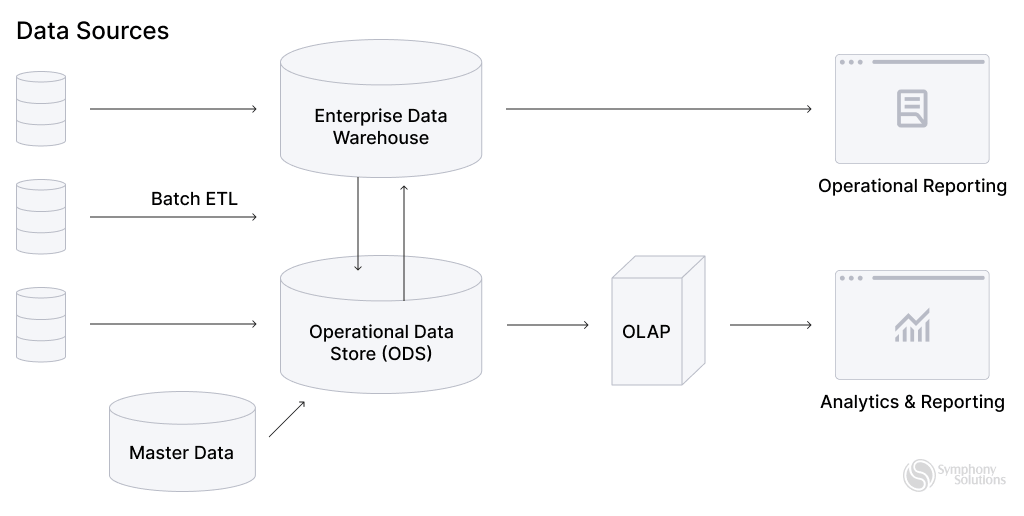
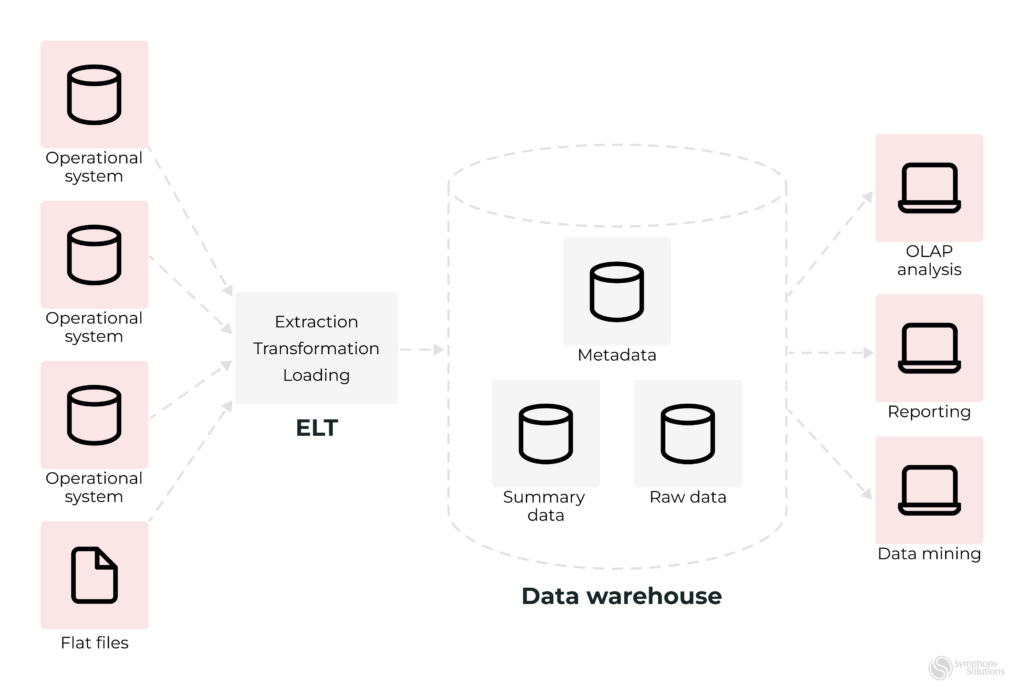
     Hybrid architecture for common DWH solution

    Without this structuring, companies’ large amounts of data are useless as they can’t be used to drive conclusions or affect decisions. Data engineering concepts provide valuable insights into available data that can substantially impact a company’s growth, predict future trends, or understand network interactions. 

    Additionally, data engineering considers the end-to-end process as data pipelines that transform and transport data to present it in a form that can be analyzed and used to drive some insights. The pipelines take data from one or various sources and collect them in a single warehouse to consolidate one single source of truth. 

    front-back-room

    The common elements of the data pipeline are: 

    • Source(s) – one or various sources that data comes from, such as database management systems (e.g., MySQL), CRMs (e.g., Salesforce, HubSpot), ERPs, some SM management tools, or even IoT devices. 
    • Processing steps involve extracting data from the sources, transforming and manipulating it according to business needs, and then depositing it at its destination. 
    • Destination – is typically a data warehouse or data lake, a place where data arrives after being processed. 

    Building a data-first company starts with organizing your data and its various sources. Data engineers here play a strategic role, having the capability to harness the full potential of data and how it affects the entire organization. When it comes to making the most of your data, there are some best practices in data engineering to follow: 

    data engineering components

    24 best practices in data engineering 

    Data engineering involves creating and managing systems for collecting, storing, and analyzing large volumes of data. Here are the best practices to ensure data is accessible, reliable, and ready for analysis: 

    Make use of functional programming 

    Functional programming is a perfect choice when working with data. ETL (Extract, Transform, Load) is challenging, often time-consuming, and hard to operate, advance, and troubleshoot. Applying a functional programming paradigm brings a lot of clarity to the process, which is essential for large volumes of data. Additionally, it enables the creation of code that can be reused across multiple data engineering tasks. 

    Practice modularity 

    Building a data processing flow in small, modular steps is another best practice in data quality and quality engineering. Modularity means that each process step is focused on a specific problem, making code easier to read, reuse, and test. Modules can also be easily adapted independently, which is especially useful as the project grows. Modules built with a set of inputs and outputs suitable for numerous contexts will make data pipelines clean and easy to understand from the outside, and thus, they can be easily reused in the future. 

    Follow proper naming convention and proper documentation 

    Proper naming conventions and documentation are sound data engineering principles that can help a team be on the same page and collaborate more effectively. This is especially useful when the owner cannot make changes or modifications. Make it a rule inside the team to provide proper explanatory descriptions of pipelines, jobs, components, and use cases it might solve. 

    When it comes to naming, strive to name the objects in a way that makes it clear to a new person who might join the team and avoid confusing abbreviations. As for creating useful documentation, it should focus on explaining the intent behind what the code is doing rather than stating the obvious. 

    Select the right tool for data wrangling 

    With the large amounts of data and data sources that keep growing, it’s extremely important to keep the data clean and organized for easy access and analysis. A data wrangling tool can tackle any inconsistencies in data and transform distinct entities, for instance, fields, rows, or data values within a data set, making them easier to use. The clean is the data you feed, the data and more accurate insights you can expect. Data wrangling tools can help detect, drop and correct records prepared for the data engineering pipeline. 

    Strive for easy-to-maintain code 

    Being clear and concise are the principles that also apply when writing code. Making it readable and easy to follow is a good practice that will help everyone on the team to work with it in the future. Some of the best code development principles to follow here are: 

    • DRY (Don’t repeat yourself) aims to reduce the repetition of software patterns and code duplication by replacing them with abstractions to avoid redundancy. 
    • KISS (keep it simple, stupid) strives to keep the code clean and understandable. The principle suggests keeping the methods small, never more than 40-50 lines. Each method should only solve one problem. A method with many conditions should be broken down into smaller methods. Thus, it will be easier to read, maintain, and potentially debug faster. 

    Use common data design patterns 

    Data design patterns are repeatable solutions to common, occurring problems in software design. They provide a problem-solving template that could be used as a basis for designing a solution. Creating data design patterns provides techniques, tools, and processes that could speed up the development process. Patterns can help keep track of the existing types and counts of data pipelines and simplify communication between developers by using well-known and understood names. 

    Build scalable data pipeline architecture 

    Useful insights and analytics rely on efficient data pipelines. The ability to scale as data sources increase is detrimental here. That’s why building pipelines that can be easily modified and scaled is a good practice. This practice is called DevOps for data or “DataOps” and focuses on delivering value faster by using automation and sometimes AI to build continuous integration, delivery, and deployment in the data pipeline. Embracing DataOps will improve the usability and value of data and make it more reliable and accessible. 

    Ensure the reliability of your data pipeline 

    Ensure monitoring and alerting are built-in to get notified when your data pipeline fails. Focusing on the reliability of your data engineering pipeline by regularly checking error notifications ensures consistency and proactive security. This way, the quality of data can be easily identified and monitored. 

    Follow some general coding principles 

    Some general best coding practices can also be applied to data engineering, such as avoiding hard or dead code. To utilize the code base in different environments in the future, avoid hard coding values. Instead, make your pipelines configurable. Another good practice is avoiding keeping someone’s abandoned code. Removing it will help keep the code base clean and easy to understand for other developers in the future. 

    Set security policy for data 

    To prevent any potential security or regulatory issues, data owners or producers need to recognize and set data sensitivity and accessibility. How the data is used, who uses it, and where it’s shared should be clear. Some steps for setting the security policy for your data include classifying data sensitivity, developing a data usage policy, monitoring access to sensitive data, physical security of data, using endpoint security systems for protection, policy documentation, employee training, and multi-factor authentication.  

    Optimize Cloud Costs 

    Regularly review and optimize cloud resource usage to control costs and ensure you’re not overspending on unused or underutilized resources. This involves using cost-management tools provided by cloud platforms to monitor usage patterns and identify areas for savings. Additionally, implementing policies for efficient resource allocation and deallocation can help prevent unnecessary expenditures. 

    Implement Version Control 

    Use version control systems like Git to manage changes in your data engineering projects, ensuring you can track changes and collaborate effectively. Version control allows multiple team members to work on the same project without overwriting each other’s work. It also provides a history of changes, which is invaluable for debugging and understanding the evolution of the project. 

    Manage Incidents Efficiently 

    A robust incident management process is essential for quickly identifying, responding to, and resolving issues in your data pipelines. This includes setting up monitoring and alerting systems to detect failures and anomalies. A well-defined incident management plan ensures that issues are documented, prioritized, and resolved efficiently to minimize downtime and maintain data integrity. 

    Automate Data Pipelines and Monitoring 

    Implement automation for data pipelines and monitoring to improve efficiency and reduce the risk of human error. Automation tools can handle repetitive tasks, ensure data quality, and provide real-time monitoring. By automating these processes, you can achieve faster deployment times, consistent performance, and more reliable data management. 

    Focus on Business Value 

    Ensure that your data engineering efforts are aligned with business objectives to deliver maximum value to the organization. This involves understanding the business’s key metrics and goals and designing data solutions that provide actionable insights. Data engineers can help drive strategic decision-making and improve overall business performance by focusing on business value. 

    Avoid Data Duplicates with Idempotent Pipelines 

    Design your pipelines to be idempotent to prevent data duplication and ensure consistent results. An idempotent operation produces the same result even if executed multiple times. This approach helps maintain data integrity and simplifies error handling, making it easier to recover from failures without introducing duplicate data. 

    Track Pipeline Metadata for Easier Debugging 

    Keep detailed metadata about pipeline runs to make debugging and tracking easier. Metadata should include information about the timing, method, and data content processed in each run. This transparency helps identify issues quickly and provides a clear audit trail, essential for troubleshooting and compliance. 

    Use Airflow for Workflow Management 

    Apache Airflow is a powerful tool for orchestrating complex data workflows. It allows you to define, schedule, and monitor data pipelines through a user-friendly interface. Airflow helps manage dependencies, track progress, and handle failures effectively, ensuring smooth data pipeline operations. 

    Ensure Data Quality 

    Implement data quality checks to ensure that data is valid before it is exposed to end-users. High-quality data is crucial for reliable insights and decision-making. Use tools and processes to validate, cleanse, and monitor data quality continuously. 

    Implement Thorough Testing 

    Regular testing of data pipelines is essential to ensure they function as expected. Implement unit tests, integration tests, and performance tests to validate data transformation logic, check for errors, and ensure pipelines can handle expected loads. 

    Optimize Heavy Computational Tasks 

    Pay attention to where the heavy lifting occurs in your data pipeline. Ensure that computationally intensive tasks are optimized and placed appropriately, either in the cloud or on-premise, to balance cost and performance effectively. 

    Embrace DataOps 

    DataOps focuses on improving collaboration, integration, and automation of data workflows. By adopting DataOps practices, you can enhance the efficiency, reliability, and scalability of your data engineering processes, leading to better data management and faster delivery of insights. 

    Use Standard Data Transformation Patterns 

    Apply standard patterns for data transformation to ensure consistency and efficiency. These patterns help maintain a clear structure and logic in your data pipelines, making them easier to understand, maintain, and scale. 

    Leverage AI in Data Engineering 

    Artificial Intelligence (AI) can significantly enhance data engineering by automating data processing tasks, optimizing data pipelines, and providing advanced analytics. Incorporate AI tools and techniques to improve efficiency, accuracy, and scalability in your data workflows. 

    The Future of Data Engineering: AI, IoT, and Cloud Computing 

    The future of data engineering is being reshaped by Artificial Intelligence (AI), the Internet of Things (IoT), and Cloud Computing, promising significant advancements in efficiency and innovation. 

    Artificial Intelligence (AI) is set to automate and enhance data analysis, enabling faster and more accurate insights from vast datasets. It will play a crucial role in real-time analytics and predictive modeling, streamlining the data engineering process. 

    Internet of Things (IoT) integration is providing a constant stream of real-time data from connected devices. This surge in data will necessitate advanced data engineering techniques to manage and derive value from diverse information sources. 

    Cloud Computing offers scalable and efficient data storage and processing solutions. It’s evolving to integrate AI and machine learning, simplifying data engineering tasks and enabling sophisticated data analysis. 

    In essence, the combination of these technologies will transform data engineering, enabling businesses to handle complex data more efficiently and drive data-centric decision-making. 

    The Takeaway 

    Data engineering, significantly impacted by technologies such as cloud computing, IoT, and artificial intelligence, is evolving at an unprecedented speed. The decisions you make regarding your data pipeline can drastically influence your business’s profitability, growth, and potential for losses. Adhering to data engineering best practices is essential to avoid increased expenses and time spent on unnecessary tasks. If you are interested in building a reliable data pipeline that aligns with your business goals, our expert data engineers are here to assist you. Don’t hesitate to contact us with any questions you might have, or to get started on developing a data pipeline tailored to your needs. 

    Ready to transform your data management strategy? Visit our Data Analytics Services Page now to learn more about our solutions and take the first step towards efficient and impactful data engineering. 

    FAQs

  • Data Engineering Concepts, Approaches, Data Pipeline, Data Warehouse

    Data Engineering Concepts, Approaches, Data Pipeline, Data Warehouse

    Data-centric insights and capabilities are the drivers of digital transformation and automation in any organization. But still, only 30% of organizations have a meticulous data strategy, and only 29% of businesses achieve full digital transformation with data engineering concepts.

    Nonetheless, the data engineering discipline cannot be overlooked, thanks to its various business benefits. This guide highlights the basics of data engineering concepts, and approaches, as well as the flow process and nuances of data pipeline and data warehouse infrastructures. Keep reading to learn more.

    What is Data Engineering Concepts? 

    Basic concepts in data engineering entail leveraging manual and automated operations to build systems and protocols that support a seamless flow and access to information in an organization. Businesses usually employ specialized talents known as data engineers to perform this duty. A critical aspect of this process is data governance, which ensures data availability, usability, integrity, and security. 

    Key concepts in data engineering include: 

    • Data Cleansing: Removing inaccuracies and inconsistencies from data to improve its quality. 
    • Data Modeling: Designing data structures representing business processes and supporting data analytics. 
    • Data Pipeline: Automated workflows that move data from one system to another for processing and storage. 
    • Data Security: Implementing measures to protect data from unauthorized access and breaches. 
    • Data Warehouse: Centralized repositories for storing large volumes of structured data, optimized for querying and analysis. 
    • Data Lake: A storage repository that holds vast amounts of raw data in its native format until needed. 
    • Data Accessibility: Ensuring data is easily accessible to authorized users when needed. 
    • Big Data: Handling and analyzing extremely large datasets that traditional data processing software cannot manage efficiently. 
    • Cloud Engineering: Designing and managing scalable, reliable cloud-based data systems. 
    • Machine Learning: Utilizing algorithms and statistical models enables systems to learn from data and make predictions or decisions. 
    • Programming Languages: Languages like Python, SQL, and Java are used for building and managing data systems. 

    What are the 5 Vs of Data Engineering? 

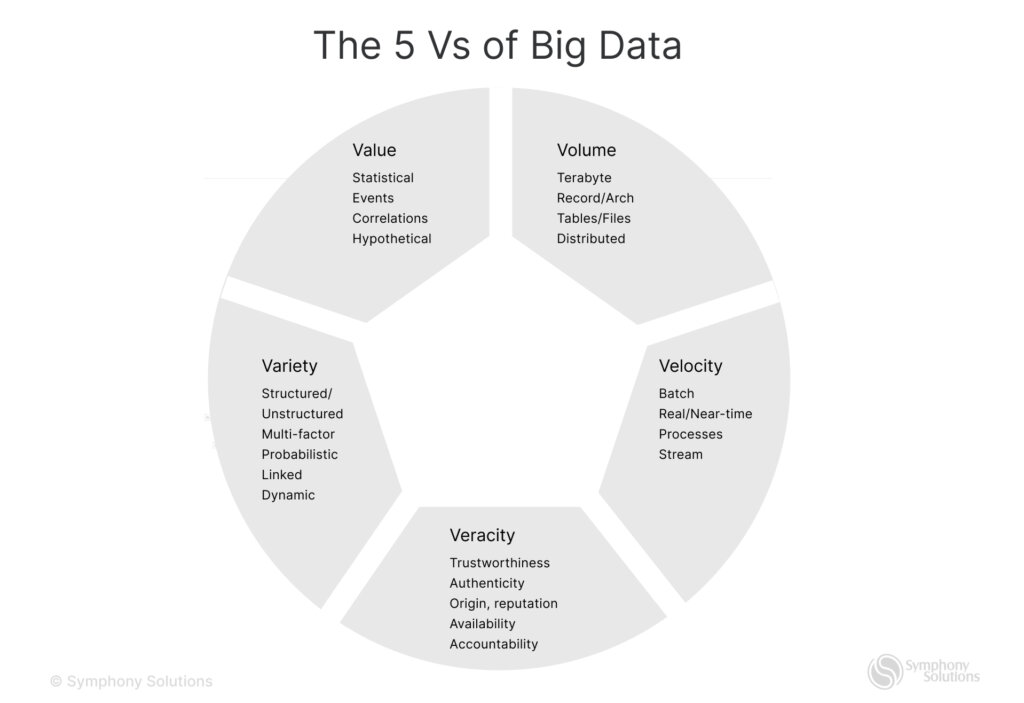
    The 5 Vs of data engineering represent key dimensions that describe the challenges and opportunities associated with big data. These are: 

    1. Volume: Refers to the vast amounts of data generated every second. Data engineers must design systems that can efficiently store and process these large datasets.
    2. Velocity: Describes the speed at which data is generated, collected, and processed. Effective data engineering ensures that data flows swiftly through the system for real-time analytics and decision-making. 
    3. Variety: Involves the different types of data sources and formats, such as structured, unstructured, and semi-structured data. Data engineers need to integrate these diverse data types into a cohesive system. 
    4. Veracity: Pertains to the accuracy and reliability of data. Ensuring high data quality and integrity is crucial for making informed business decisions. 
    5. Value: Represents the potential insights and benefits derived from data. The ultimate goal of data engineering processes is to extract meaningful and actionable insights that drive business value. 

    Data Engineering vs. Data Science

    Although some people might unknowingly use data engineering and data science interchangeably, the two are different. Data engineering tech stack is a component of data science technology but often exists alongside the latter alongside modern business operations.

    Here is a tabular representation of data engineering vs. data science

    Data Engineering Data Science 
    Takes a technical approach Takes a business-oriented approach 
    ETL approach Machine learning and deep learning approach 
    Algorithm-Based Statistical-Based 
    Focuses on processing large data sets Focuses on driving predictive analytics 
    Focuses on data extraction Focuses on data analysis 

    What is Data Engineering Process?

    A typical data engineering process includes:

    • Data Flow: This process enhances a standard data flow through a data pipeline to streamline data-driven models, such as ML models for real-time analysis.
    • Data Normalization and Modeling: This process entails transforming data into easily accessible and usable formats to drive business decisions.
    • Data Cleaning: Data cleaning elminiates incorrectly formated, incomplete, or corrupted data from a data set when merging multiple data sources.
    • Data Accessibility: This includes enhancing the experience of data access, as well as visualization using custom tools, charts, and illustrations.

    Skills and Roles of a Data Engineer 

    You already know the meaning of what is data engineering, but what are the skills and roles of a data engineer? A data engineer is responsible for designing, building, and maintaining data pipelines that enable an organization’s flow and access to data. Key skills include proficiency in programming languages such as Python, SQL, and Java; knowledge of data warehousing solutions like AWS Redshift or Google BigQuery; and expertise in ETL (Extract, Transform, Load) processes. They also need strong problem-solving abilities and a deep understanding of data governance to ensure quality and compliance. 

    skills of a engineer

    What is a Data Pipeline? 

    As the name suggests, this includes big data tools and protocols that move data from one storage system to another, usually for further storage or handling. The technology combines data from multiple sources by capturing and transferring it into another tool, app, or database for seamless access by collaborating teams. 

    Also, a data pipeline is one of the fundamentals of data engineering basic concepts. An experienced data engineer, well-versed in programming skills and technologies, must build one that can power around-the-clock data exchange. 

    Other business applications include: 

    • Data migration to the cloud and data warehouse 
    • Data integration from IoT systems or interconnected devices 
    • Data centralization to drive business decisions 
    • Data wrangling, especially in machine learning projects 

    What is the ETL process in data engineering?

    ETL is the most prevalent and sought-after data pipeline architecture by businesses with a custom-built enterprise data warehouse or data mart. A typical data architecture provides a detailed and exact description of the component’s arrangement, enabling real-time raw data extraction, processing, and information delivery. 

    That said, here are the steps of the ETL data pipeline: 

    Extracting Data 

    This is the first step, where raw data is retrieved from multiple incoming channels, such as social media and business websites. Data engineers usually program codes to run scheduled data extraction cycles for specific periods. 

    Transforming Data 

    This step involves modifying raw and inconsistent data extracted at the first stage of the ETL data pipeline. Data engineers usually transform and segregate the data in different formats, sizes, or colors for optimal querying and analysis. Typically, this stage ensures the collected data is easily usable and discoverable. 

    Loading Data 

    Data extraction and transformation are followed by loading the usable data into various destinations. Some data engineers prefer using Hadoop or a relational database management system (RDBMS). 

    A complete ETL data pipeline process can be followed by storage in another system, where key organization leaders can access the same for business intelligence analysis, report generation, and visual creation. 

    Data Pipeline Challenges 

    Data pipelines are beneficial to businesses in many ways, especially when it comes to real-time and predictive analytics. However, building a custom or standard one can be daunting, especially for first-time organizations. Here are the five prevalent challenges: 

    Data Placement 

    Businesses need to store their data in the right format and in the right location to enhance seamless access and usability. Making the right decision can be challenging, given that businesses must use multiple tools and connect them to numerous data stores and formats, especially if they harness big data’s full power. 

    Data Hosting 

    Data hosting can be done in the cloud or on-premise. Choosing the right hosting service can be challenging, especially if you have to modify the data into a specific format. That’s why some organizations choose to self-host their servers, but this option also comes with operating systems, latency requirements, and memory and disk challenges. 

    Data Scaling 

    Data scaling can be challenging, given that modern businesses handle up to 2.5 quintillion bytes of data generated by consumers every day. At the same time, the number of data sources, whether sensors or IoT devices, may increase unexpectedly. With this in mind, organizations should have data storage options that are automatically scalable. 

    However, data scaling issues are more challenging among organizations that use on-premise storage solutions. For instance, overwhelming data velocity and volume sharding and replication create more space for incoming data. In the long haul, these processes can prove costly in terms of operations because a single technical hitch can mean hours of troubleshooting the whole system. 

    Data Flexibility 

    The system relies on the entire ETL (Extract-Transform-Load) process. Although this process is often meticulous, a single hitch in one step can cause hours of downtime, which can affect data quality. The situation even gets trickier if a business deals with dynamic data sources and events, which might mean setting up schemas for real-time data analytics. At the same time, an ETL data pipeline used for data analytics must be optimally elastic for compatibility with various data types and schemas. 

    Data Migration 

    Data migration techniques depend on how an organization uses its data. However, most businesses migrate their data during off-peak periods, such as at night, to minimize unnecessary downtime. Although this might sound convenient, it gets challenging when it comes to real-time analytics, as the migrated data will be from the previous day. 

    Data Warehouse Definition 

    A data warehouse is a central repository, usually a relational database, modified and optimized to support data reading, aggregation, and querying. Although traditional databases only support structured data formatted in tables, modern applications can support structured and unstructured data formats. Unstructured data, in this case, includes information formatted and presented as images, PDF files, or even audio files. 

    These data banks act as a single point of truth and information in an organization. Unlike retrieving data from multiple storage, data warehousing allows business analysts to report similar results and create near-accurate metrics for predictive analytics. 

    Understanding Data Warehouse Architecture 

    A typical architecture includes three basic components: 

    Data Warehouse Storage 

    A central repository or database is the bloodline of a custom or standard data warehouse architect, as all business data is stored there. Business leaders and other employees can access the data storage to draw valuable insights from its contents. They also have the option of either on-premise or cloud-based data storage. 

    The former option is ideal for organizations that want to process data at high querying speeds and uncompromised security. On the other hand, cloud-based data banks support automatic scalability and any data structure. They are also relatively affordable than their on-premise counterparts. 

    Some data architects might also help you build collective storage options that run parallel as a centralized warehouse. This approach is usually ideal when enhancing scalability. 

    Metadata 

    Metadata contains the information and guidelines for changing and processing data when loading it into a warehouse environment. 

    Access Tools 

    These are tools integrated into the warehouse architecture to facilitate access to and interactions of the stored data with end-users. Based on the model, these tools might include querying, reporting, or data mining tools. 

    Management Tools 

    Data warehouse tools help businesses perform automated administrative duties. 

    Data Marts 

    Data marts are smaller warehouses usually employed by big organizations using enterprise-scale warehouses. They come in handy when an organization wants to segment its data. For instance, marketing and sales data can be stored in different data marts to facilitate easy access by the relevant departments. 

    Data marts exist in three prevalent types including: 

    • Hybrid data marts 
    • Independent data marts 
    • Dependent data marts 

    OLAP and OLAP Cubes 

    OLAP is a simple abbreviation for Online Analytical Processing. This computational program allows business analysts and data engineers to take a multidimensional approach to data analysis. In other words, this tech helps organizations vast data from different angles, unlike OLTP. 

    OLAP cubes are multidimensional structures that represent data. Unlike traditional database representation (usually in rows and columns), which can be generated automatically, OLAP cubes must be custom-built for individual reporting and analytical querying. 

    Big Data Concepts 

    Big data engineering concepts are built around the four Vs: volume, velocity, variety, and veracity. The architecture used in big data applications varies with the amount of data involved. Organizations that employ big data technology usually use a data lake instead of a traditional database to power the infrastructure. 

    Prevalent big data concepts include: 

    • Data Lake 
    • Hadoop 
    • Enterprise Data Hub 

    Data Architecture as a Service 

    Data architecture-as-a-service is an approach business data users take to circumvent data bottlenecks by building local repositories. Typically, the process doesn’t sacrifice enterprise data integrity or consistency. This service can be an extension data model or a self-service data engineering approach. 

    The Takeaway 

    In today’s data-driven world, we are all surrounded by data in every aspect of life. To keep up and stay ahead of the curve, you must be able to manage your data. Take advantage of the insights provided in this article in your business. 

    FAQs

  • AI in Power BI: Transforming Business Intelligence with Advanced Analytics 

    AI in Power BI: Transforming Business Intelligence with Advanced Analytics 

    Studies reveal that 80% of executives expect AI to have a big impact on their businesses, but less than half believe they have the necessary capabilities to harness its benefits. This gap shows a clear need for better tools such as Power BI.  

    ceo analytics in ai

    Power BI, one of the top business intelligence tools, now includes AI capabilities to uncover insights and guide business decisions. This integration helps organizations use AI effectively and stay competitive in a fast-changing market. 

    Learn more about AI in Power BI in this guide to better find hidden patterns and make confident data-driven choices. 

    What is AI in Business Intelligence? 

    AI in business intelligence integrates artificial intelligence with BI tools to improve data analysis and decision-making. It automates data processing, predicts trends, and uses natural language for easy interaction. Moreover, it enhances data visualization and offers personalized insights based on user roles. This integration helps organizations quickly uncover valuable information, make informed decisions, and stay competitive in the market. 

    The Role of AI in Power BI 

    AI-in-Power-BI

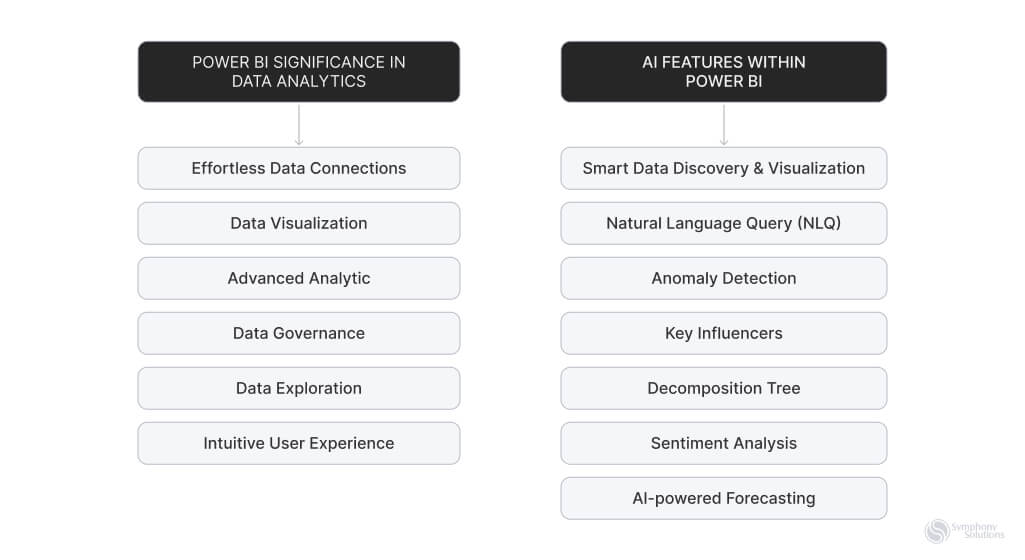
    Power BI, recognized as a premier platform in Gartner’s 2023 Magic Quadrant for Analytic and Business Intelligence (ABI), is a set of business intelligence (BI) tools created by Microsoft. This tool enables users to turn raw data into clear, actionable insights, and plays a huge role in modern data analytics. Here’s how: 

    • Data Connections. Power BI seamlessly connects to various data sources, streamlining data import and export for reports and dashboards. This ensures users have access to the most up-to-date information. 
    • Data Visualization. Power BI boasts a rich library of customizable visuals, allowing users to create clear and engaging narratives from their data. Custom visuals and tools like Zebra BI further extend its creative potential. 
    • Advanced Analytics. Power BI goes beyond visualization. It enriches data through transformation and integration with other Microsoft suite tools. This means even more  advanced analytics and data-driven decision-making. 
    • Data Governance. Robust data control and management features ensure data security, compliance, and authorized access, maintaining data integrity. 
    • Data Exploration. Extensive data exploration options and automated queries empower users to uncover hidden patterns and conduct thorough analyses, fostering a deeper understanding of their data. 
    • Intuitive User Experience. Power BI’s user-friendly interface allows users of all technical backgrounds to navigate effortlessly, create reports, and derive valuable insights with minimal training. 

    Now, while Power BI offers incredible data visualizations and robust analytical capabilities; AI offers deeper insights into customer behaviors, operational efficiencies, and emerging market opportunities. Integrating these two technologies, Power BI AI, enhances data analytics in numerous areas, including: 

    • Smart Data Discovery and Visualization. Gone are the days of manual data exploration. AI can now automatically discover hidden patterns and trends within your data and even suggest relevant visualizations to represent the insights best. 
    • Natural Language Query (NLQ). Ditch the complex queries! Ask your questions in plain English, and Power BI’s AI will instantly retrieve the answers and insights you seek from your data. 
    • Anomaly Detection. AI acts as a vigilant watchdog, automatically identifying unusual data points or patterns that might require further investigation. This proactive approach empowers you to address potential issues before they escalate. 
    • Key Influencers. Understanding what drives your metrics is crucial. AI in Power BI surfaces the key factors influencing specific metrics within your visualizations, providing valuable context and enabling data-driven decisions. 
    • Decomposition Tree. This AI-powered visualization tool facilitates root cause analysis. It allows you to drill down into complex data sets and uncover the underlying factors contributing to specific outcomes. 
    • Sentiment Analysis. Power BI’s synergy with AI can improve customer experience. Analyze the sentiment within your text data (like customer reviews) – without writing a single line of code! Power BI’s AI handles the heavy-lifting, providing valuable insights into customer sentiment. 
    • AI-powered Forecasting. Leverage the power of AI to generate forecasts directly within Power BI. This functionality empowers you to plan for the future with greater confidence based on data-driven insights. 

    Integrating AI into Power BI 

    Incorporating AI into Power BI enhances its capabilities, allowing users to leverage machine learning models to gain deeper insights and make more informed decisions. Here’s a detailed guide on how to get this done. 

    Use Text Analytics and Vision 

    Text Analytics and Vision features from Azure Cognitive Services can be used to enrich your data in Power Query. These features include. 

    • Sentiment Analysis. This function evaluates text input and returns a sentiment score for each document, ranging from 0 (negative) to 1 (positive). It is useful for detecting sentiment in social media, customer reviews, and discussion forums. 
    • Key Phrase Extraction. This function evaluates unstructured text and returns a list of key phrases. It works best with larger chunks of text. 
    • Language Detection. This function detects the language of the text input and returns the language name and ISO identifier. 
    • Image Tagging. This function tags images based on recognizable objects, living beings, scenery, and actions. It requires an image URL or a base-64 field as input. 

    These transformations run on the Power BI service and require Power BI Premium. The execution of these functions does not need a separate Azure Cognitive Services subscription. 

    Enable AI Workloads 

    To use Text Analytics and Vision features, you need to enable AI workloads in Power BI Premium capacities. Follow these steps. 

    • Go to the admin portal and select the capacity you want to configure. 
    • In the capacity settings, enable the AI workload in the workloads section. 
    • Define the maximum amount of memory for the AI workload (recommended limit is 20%). 

    Enabling AI workloads ensures that the necessary resources are allocated for running Cognitive Services. 

    Invoke AI Functions in Power Query Editor 

    To apply AI functions in Power Query Editor. 

    • Open Power Query Editor in Power BI Desktop. 
    • Select the Text Analytics or Vision button from the Home or Add Column tabs. 
    • Choose the desired function (e.g., Sentiment Analysis, Key Phrase Extraction) and specify the data column you want to transform. 
    • Apply the function to add the results as a new column in your dataset. 

    For example, to perform sentiment analysis. 

    • Select the “Score Sentiment” function. 
    • Choose the text column to analyze. 
    • Specify the language if required. 
    • Click “Apply” to add the sentiment scores as a new column. 

    Use Azure Machine Learning Models 

    To further enhance data analysis, integrate custom machine learning models from Azure Machine Learning. 

    • Grant Access. Get access to the Azure Machine Learning model via the Azure portal. Ensure you have Read access to the Azure subscription and the specific Machine Learning workspace. 
    • Invoke Models. In Power Query Editor, select the Azure Machine Learning button from the Home or Add Column tabs. All accessible models will be listed as Power Query functions. You can specify any data column as an input for these models. 

    For example, to use an Azure Machine Learning model. 

    • Select the Azure Machine Learning button. 
    • Choose the model and specify the input columns. 
    • Click “OK” to preview the model’s output as a new column. 

    Power BI automatically batches access requests to the Azure Machine Learning model for better performance. 

    Manage Premium Capacity 

    To ensure optimal performance, monitor and manage the impact of AI workloads on your Premium capacity. 

    • Select Capacity. Report authors can choose the Premium capacity on which to run AI Insights. By default, Power BI selects the first created capacity accessible to the user. 
    • Monitor with Capacity Metrics App. Use the Microsoft Fabric Capacity Metrics app to monitor memory consumption by AI workloads. If memory usage reaches the limit, consider increasing the limit or moving some workspaces to different capacities. 

    Using Artificial Intelligence with Power BI allows you to revolutionize your data analytics by employing powerful machine learning models and algorithms. Used properly, the current options available for AI in Power BI—Text Analytics, Vision functions, and Azure Machine Learning models—can help you improve your data preparation, analysis, and visualization operations. 

    The Future of AI in Data Analytics 

    Artificial intelligence and data analytics are a perfect pair. Currently, 48% of businesses use AI to enhance data analytics for insights and decision-making. The future promises even greater transformative potential for AI in data analytics and Power BI, such as: 

    • AI-Powered Automation. AI will automate more data preparation tasks, making data analysis accessible to a wider range of users, including those without extensive technical expertise. 
    • Explainable AI (XAI). Advancements in XAI will make AI models more transparent and trustworthy, allowing users to understand how AI arrives at its conclusions. This will foster wider adoption and trust in AI-driven insights. 
    • Causal AI. AI will move beyond correlation to understand causation, helping us not only identify what’s happening but also why it’s happening. This will enable more effective decision-making. 
    • Cognitive Analytics. This emerging field combines AI and machine learning techniques with cognitive science to understand information in a way similar to how humans do. Cognitive analytics can analyze vast amounts of data, including text, images, and audio, to extract meaning and context, leading to a more comprehensive understanding of the information. 

    There’s more, though. Power BI and similar data visualization tools can expect a significant transformation with the advancement of AI. Some possible trends are: 

    • Conversational Analytics. AI will revolutionize how we interact with data. Imagine chatting within Power BI, asking and getting answers to your questions in natural language and dynamically generating reports based on your conversation. This will make data analysis accessible to a wider audience and foster deeper exploration of data insights. 
    • Data Storytelling. Power BI will leverage AI to automate data storytelling, generating clear and concise narratives from complex datasets. AI will identify key insights, trends, and relationships within the data and translate them into a compelling story, aiding communication and understanding for non-technical audiences. 
    • Gamification of Data Analysis. Power Bi gamification may soon become a popular activity. Imagine earning points, badges, and rewards for completing data analysis tasks or achieving specific goals. This will make data analysis more engaging, especially for younger generations or those who find traditional data exploration tedious. 
    • Integrating VR and VR. We may very well see the integration of VR/ AR with Power BI. Imagine stepping into a virtual environment where you can interact with your data in 3D visualizations. This immersive experience can provide deeper understanding and uncover hidden patterns within complex datasets. 

    Conclusion 

    Many organizations already use AI for business process automation, which is why using it for business intelligence is such a great idea.  

    AI in Power BI opens new frontiers in business intelligence, empowering organizations to glean deeper insights from their data. From automating tasks to generating insightful narratives and facilitating natural language conversations with your data, this synergy unlocks a whole new level of analytical power. Imagine the efficiency gains and deeper insights you could achieve! 

    At Symphony Solutions, we can help you achieve this with our AI services and BI expertise. We deliver tailored solutions and have a proven track record of empowering clients to leverage data for growth through our data analytics services. Let’s work together to enhance your BI processes with AI and unlock your data’s true potential. 

    FAQs

  • How to Build a Data Warehouse: Steps, Components, and Considerations 

    How to Build a Data Warehouse: Steps, Components, and Considerations 

    The ability to efficiently manage and analyze vast amounts of information has become a cornerstone of modern business success. At the heart of this capability is the data warehouse — a centralized repository designed to store, manage, and analyze large datasets. This resource has become so integral to today’s businesses that its global market is projected to grow from US$10.01 billion in 2024 to US$16.94 billion by 2029. 

    global-market-for-data-warehouse

    Considering the many benefits of data warehousing driving this growth, it’s essential to know how to leverage this powerful solution. In this article, we’ll look at how to build a data warehouse, focusing on the processes, tools, and best practices for creating a robust, scalable, and efficient solution. 

    Read on! 

    What Is a Data Warehouse, and Why Build One? 

    A data warehouse is a centralized repository designed to store structured data from multiple sources. It helps organizations gather, organize, and analyze huge amounts of data so they can make smart decisions. 

    Companies typically invest in designing a data warehouse for: 

    • Enhanced Business Intelligence. Data warehouses centralize data, empowering businesses to conduct advanced queries and glean deeper insights through analytics. 
    • Historical Insights. Using historical data allows businesses to make educated decisions, learn from previous experiences, and uncover trends that are critical for strategic planning. 
    • Competitive Edge. Data warehouses enable faster and more comprehensive data analysis, giving businesses a competitive advantage in making timely decisions and adapting to market dynamics. 
    • Agility and Innovation. Data warehouses promote agility and innovation by giving rapid access to reliable data, allowing businesses to respond quickly to challenges and opportunities. 
    • Cost Efficiency and Compliance. Data warehouses help ensure regulatory compliance through accurate and auditable data. 
    • Enhanced Efficiency. Workers can find information more rapidly thanks to data warehouses’ streamlined data access and retrieval, which boosts corporate productivity overall. 

    Some people tend to confuse data warehouses and data lakes. This is understandable, considering that they are both data storage options. However, they serve different functions and have distinct characteristics. 

    Let’s differentiate between them. 

    Feature Data Warehouse Data Lake 
    Structure Stores structured data that has been cleaned and processed, ready for analysis based on established business needs. Stores raw data in its native format (structured, semi-structured, and unstructured) 
    Use Case Business intelligence, data visualization, analytics, and reporting. Big data processing, machine learning, predictive, and advanced analytics. 
    Performance Optimized for read-heavy operations and complex queries. Optimized for large-scale storage, requires more processing for queries
    Storage Cost Typically more expensive due to structured data storage. Generally more cost-effective for large volumes of diverse data. 
    Data Processing ETL (Extract, Transform, Load). ELT (Extract, Load, Transform). 

    The table above highlights the fundamental distinctions between data warehouses and data lakes, allowing you to better appreciate their relative capabilities and optimal use cases. 

    Core Components of Data Warehouse Architecture 

    Knowing how to implement a data warehouse starts with understanding its components. A typical data warehouse consists of four major components: a central database, ETL tools, metadata, and access tools. Together, these components allow you to find data and analyze results quickly. 

    A Central Database 

    The central database serves as a data warehouse’s primary storage component. This is where data from various sources—structured, semi-structured, and unstructured data, such as text documents and images—is integrated and stored. 

    It is important to point out that while a database and a data warehouse are both essential in business information management, they are not the same. Read our comparative review of databases vs. data warehouses to understand the distinctions between these two technologies. 

    ETL (Extract, Transform, Load) Tools 

    ETL tools are data integration tools used to extract data from diverse source systems, convert it to a standardized format, and load it into the central database. These tools perform operations such as extraction, data cleansing, data normalization, and data mapping, ensuring that the content in the data warehouse is correct and consistent. 

    Metadata 

    This refers to data about your data. It defines the structure, quality, and provenance of data kept in a warehouse. This covers data definitions, attributes, quality rules, and relationships. There are two types: business metadata, which provides context to the data, and technical metadata, which explains how to access and locate data. Understanding metadata is critical to successful data governance, discovery, and integration. 

    Access Tools 

    These are tools that enable authorized users to interact with the contents of the data warehouse. Access tools, which include query and reporting tools, application development tools, data mining tools, and OLAP tools, allow users to obtain data, generate reports, and create visualizations. 

    Approaches to Building a Data Warehouse 

    Knowing how to build a data warehouse starts with knowing the approaches used. Let’s look at the top options. 

    Inmon’s Approach 

    Bill Inmon invented the Enterprise Warehouse, a comprehensive method for creating data warehouses. This technique delivers a centralized, integrated repository for all your organizational data. 

    Features 

    • Emphasizes a highly standardized structure in order to reduce redundant information and improve data consistency. 
    • Involves thorough transformation and integration of data from various sources before loading it into the warehouse. 
    • Suited for large organizations with complex data requirements. 
    • Due to its complexity, extract, Transform, and Load (ETL) processes require significant investment. 

    Kimball’s Approach 

    Kimball’s approach, by Ralph Kimball, is a model that focuses on smaller, subject-specific data marts, which are tailored for specific business areas or user groups. 

    Features 

    • Uses denormalized schemas designed to be intuitive for business users to query and analyze. 
    • Focuses on creating data marts for distinct business functions or departments. It allows for faster development and easier maintenance. 
    • Aligns closely with business requirements, ensuring the data warehouse serves practical needs. 

    Data Vault Model 

    The Data Vault model, created by Dan Linstedt, comprises parts of both the Inmon and Kimball techniques, providing a flexible and scalable solution for today’s data warehousing requirements. 

    Features 

    • Uses a hub-and-spoke architecture to store business keys in hubs, relationships in links, and descriptive attributes in satellites. 
    • Celebrated for its flexibility and scalability, the data vault model is suitable for dynamic data requirements. 
    • Stores raw data with minimal transformation, enhancing traceability and auditability. 
    • Simplifies the integration of new data sources with minimal disruption to source systems. 

    Choosing the right approach depends on your organization’s specific needs related to data complexity, agility, and scalability. 

    Inmon’s approach is ideal for complicated reporting that requires a centralized source of truth and the ability to handle large ETL procedures. 

    Kimball’s method is perfect if you value rapid deployment, easy data access, and alignment with specific business requirements. 

    The Data Vault method is excellent if you need a highly scalable and adaptive solution for raw data storage and integration in a constantly changing environment. 

    Build the Data Warehouse Step-by-Step 

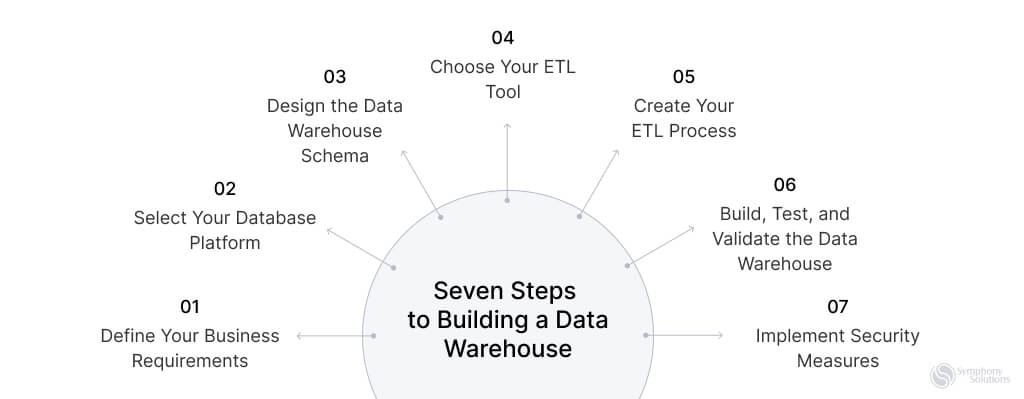
    So, what process is used to create a data warehouse? When building a data warehouse, it’s essential to follow a structured approach that meets business needs and supports informed decision-making. Here’s what to know. 

    steps-to-build-data-warehouse

    Define Your Business Requirements 

    Outlining your business requirements and goals clearly is an important first step when it comes to how to create a data warehouse. This step ensures that the data warehouse is custom-tailored to suit your precise requirements. 

    Select Your Database Platform 

    Selecting the appropriate database platform is crucial for scalability, performance, and security. Explore options like SQL Server, Oracle, MongoDB, PostgreSQL, and Cloud SQL. Factors like data volume, query speed, integration capabilities, and costs should all be taken into account. 

    Design the Data Warehouse Schema 

    Next is designing the schema of your data warehouse. Organize your data to facilitate easy retrieval and analysis. Consider data types, relationships between entities, and the amount of information in your dataset. A well-designed schema allows for the simple integration of new information, quick queries, strong governance, and security mechanisms. 

    Choose Your ETL Tool 

    The Extract, Transform, Load (ETL) processes play a crucial role in loading and transforming data effectively. This is why, when choosing, you must look for the option that aligns with your requirements. Some of the best ETL tools include Informatica and Talend, or cloud-based tools like AWS Glue. Evaluate factors like user-friendliness, scalability, and compatibility with various data sources. 

    Create Your ETL Process 

    Define connections from source systems along with mapping out data flows and transformation rules. It’s imperative that the ETL process maintains accuracy and reliability in handling information. 

    Build, Test, and Validate the Data Warehouse 

    By now, you must have decided whether to go for an on-premise system or a cloud-based warehouse. If you’re leaning towards cloud-based options, it’s worth conducting a BigQuery vs. Redshift comparison, two top choices, to aid your decision-making process. This stage also involves establishing server infrastructure, organizing storage solutions, and loading data into the target database. Be sure to validate the warehouse against business requirements to ensure that it delivers the expected results. 

    We recommend reading our article on the best cloud data warehouse comparison for a more comprehensive overview of the different cloud data warehouses available. 

    Implement Security Measures 

    Protect sensitive information using encryption techniques and access controls. Also, implement regular monitoring to stay updated on potential threats.  

    Building a data warehouse from scratch is a multi-stage process that needs meticulous planning and execution. It is also critical to collaborate with a reputable technical partner. This is the most effective method for ensuring the success of your project. 

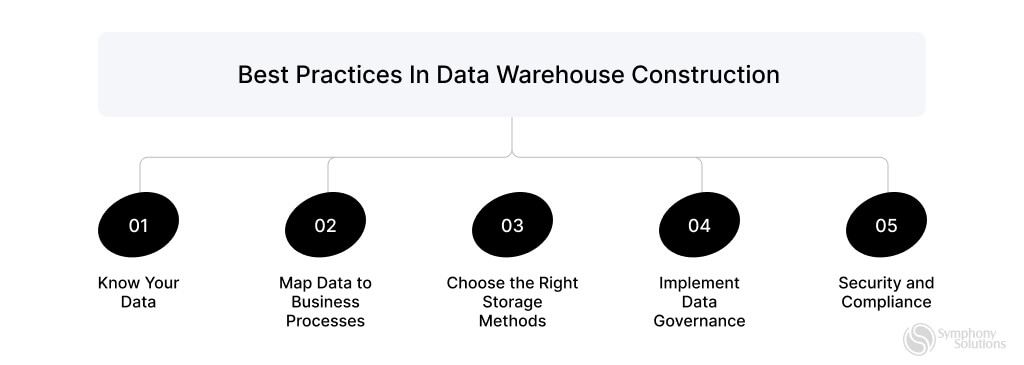
    Best Practices in Data Warehouse Construction 

    best-practices-in-data-warehouse-constructions

    To maintain data accuracy and build a warehouse that effectively supports your business needs, it is important to follow some best practices. Here’s what to know. 

    Know Your Data 

    Begin by thoroughly understanding your data — its sources, structure, and potential accuracy issues. Detailed metadata provides clarity on each data piece’s meaning and context. 

    Map Data to Business Processes 

    In collaboration with stakeholders, map data to business processes. This alignment ensures that collected data directly supports business objectives, enhancing its relevance and usability. 

    Choose the Right Storage Methods 

    Choose databases and storage solutions based on speed, cost, and scalability. Organize data for easy access and usability to improve retrieval efficiency. 

    Implement Data Governance 

    Establish robust data governance frameworks that align with organizational goals and regulatory requirements. Monitor data quality, implement cleansing processes, and maintain high standards of accuracy and reliability. 

    Security and Compliance 

    Prioritize security with stringent access controls and data encryption (in transit and at rest). Regularly audit access logs to detect and respond to security incidents promptly, ensuring compliance with regulations like GDPR or CCPA. 

    By following these practices, you enhance data accuracy, warehouse efficiency, and compliance with industry standards. 

    Our Expertise 

    Symphony Solutions boast a team of skilled professionals who can make your data warehouse project a resounding success. Our team have successfully implemented data warehouse solutions across various industries, leveraging the latest technologies and best practices. 

    Recently, a leading casino gaming developer partnered with Symphony Solutions to develop a data warehouse solution with a scalable data Ingestion process. The primary challenge was designing a solution for a product still in development. Other challenges included integrating data from various vendors and creating a scalable batch data ingestion process that ensures scalability for future near real-time data. 

    We successfully addressed these challenges by leveraging technologies like EventBridge, Kinesis Firehose, and Redshift COPY to streamline data ingestion. The result was a powerful tool that enabled the client to gain insights into its business and drive growth. 

    We can bring this same expertise to your data warehouse setup, creating a robust, scalable, and high-performing data warehouse that drives informed decision-making and strategic success. 

    Get in touch today. 

    Conclusion 

    Building a modern data warehouse is a strategic endeavor that empowers businesses to harness their data for insightful decision-making and competitive advantage. This process involves careful planning, selecting the right architectural approach, and integrating key components such as a central database, ETL tools, metadata, and access tools.  

    Whether adopting Inmon’s top-down method for a comprehensive, enterprise-wide solution, Kimball’s bottom-up approach for quicker, department-focused results, or the Data Vault model for agility and scalability, the importance of best practices and ongoing management cannot be overstated. 

    It is also important to work with an expert team that knows how to build a data warehouse successfully. This is where Symphony Solutions excels. 

    Our cloud data warehouse engineering services start from requirement analysis and design to implementation and ongoing support, ensuring our clients achieve their data management and analytical goals efficiently and effectively. 

    Discuss your data needs with us! 

    FAQs 

  • Enterprise Data Management Best Practices for Success 

    Enterprise Data Management Best Practices for Success 

    Given that over 95% of organizations view data management as a major challenge and that poor data handling can cut operational efficiency by 21%, the need to adopt best practices is clear and urgent. 

    Best practices in enterprise data management help companies maintain accurate and secure data, enhancing operational efficiency. Moreover, by standardizing how data is collected, stored, and analyzed, businesses can ensure its reliability. This approach not only aids in making informed decisions but also ensures adherence to regulatory standards. 

    This article will take you through the ins and outs of Enterprise Data Management, covering its development, key components, advantages, and effective strategies. We’ll also show you how to put these practices into action to stay ahead in the competitive landscape. 

    global-business-market

    Understanding Enterprise Data Management 

    Enterprise Data Management is a strategic approach that helps businesses organize, manage, and use their data assets efficiently. It’s crucial for creating a unified and clear view of a company’s data. This exercise is fast becoming a key component of contemporary business intelligence and data visualization practices. 

    Evolution of EDM: 

    EDM has evolved alongside technology and the rising impact of Big Data solutions in healthcare, manufacturing, and many other sectors. What began as simple data storage and retrieval has expanded to include: 

    • Data Governance: Ensuring data is accurate and accessible. 
    • Quality Control: Keeping data reliable and intact. 
    • Integration: Merging data from different sources smoothly. 
    • Security: Safeguarding data from unauthorized access. 

    Analytics: Using data to make insightful decisions. 

    Today, businesses are using data as a strategic asset to get ahead of the competition. This approach is aiding them in navigating through digital transformation, enabling the use of data to: 

    • Improve operations,  
    • Drive innovation, 
    • Adapt to changes in the market. 

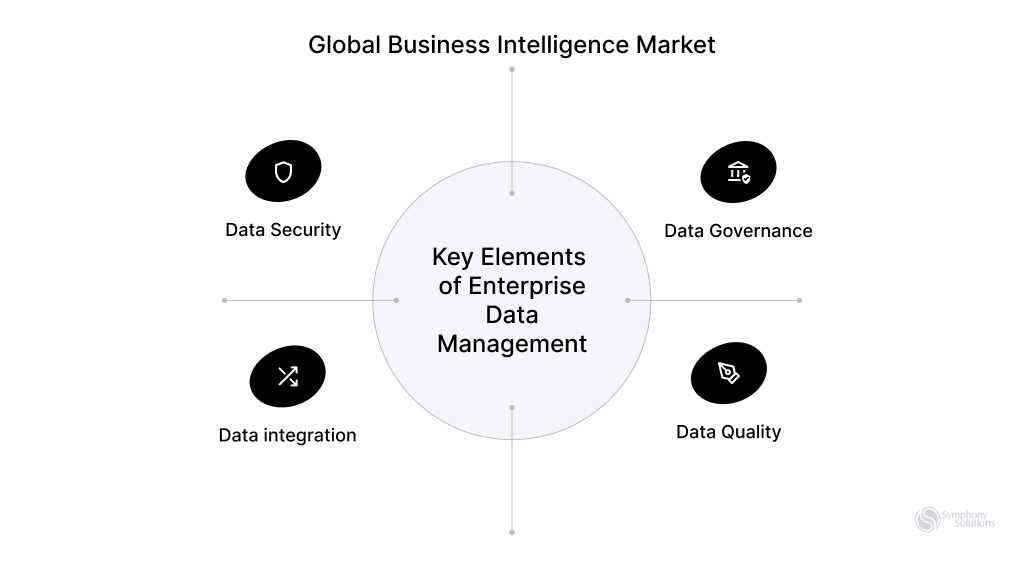
    What Are the Key Elements of Enterprise Data Management? 

    The key elements of enterprise data management form the foundation of a successful data strategy. Let’s take a closer look. 

    key-elements-of-enterprise-data-management

    Data Governance  

    What is the enterprise data management data governance? It involves setting policies and procedures that govern data management across the organization. Data across the enterprise is managed consistently and in compliance with both internal standards and external regulations.  

    Data governance provides a framework for data ownership, roles, responsibilities, and standards, ensuring accountability and proper management of data assets. Companies that implement a Data Governance program see a 2% quicker data analysis and a 31% boost in confidence regarding the quality of their data. 

    Data Quality  

    Focuses on the accuracy, completeness, and reliability of data. Ensuring data is accurate, complete, and reliable is crucial, especially since 54% of businesses see data quality as their top challenge in marketing. This involves using specific processes and tech to fix any data issues, making sure it’s ready for use in decision-making and operations. High-quality data is essential for reliable analytics and reporting, highlighting its importance in effective marketing strategies. 

    Data Integration 

    Refers to the process of combining data from different sources to provide a unified, consistent, and comprehensive view. This is essential for organizations that rely on various systems and applications, enabling them to aggregate and harmonize data for better analysis and insight.  

    Data integration is vital because 40% of projects fail due to the inability to effectively combine and utilize different data sets. 

    Data Security 

    Addresses the protection of data from unauthorized access, breaches, and theft. It involves implementing measures such as encryption, access controls, and audit trails to safeguard data privacy and compliance with data protection laws. These elements are interconnected, creating a cohesive data management ecosystem within an enterprise.  

    • Data governance sets the stage for quality, integration, and security practices, ensuring that data not only meets standards but also supports organizational objectives.
    • Data quality ensures that the integrated data is accurate and reliable.  
    • Data security protects all valuable information.  

    Together, these elements enable organizations to harness the full potential of their data, driving efficiency, innovation, and competitive advantage. 

    Benefits of Robust Enterprise Data Management Solution 

    benefits-of-enterprise-data-solution

    A robust enterprise data management system brings a multitude of benefits of enterprise data management. These include: 

    Strategic Benefits 

    Effective data management empowers informed decision-making and fosters agility and innovation within organizations. For instance, Netflix leverages its vast data on viewer habits to make informed decisions on content creation and acquisitions, leading to the production of popular shows and a strong competitive position in the streaming industry. 

    Operational Benefits 

    Today, over 41% of businesses extensively use automation across various functions. When data processes are automated, it enhances efficiency, productivity, and profitability across the board.  

    Case in point, in 2023, JPMorgan Chase leveraged its 500 petabytes of data across 300 use cases in production. This significantly boosted its business value. Streamlining processes reduces manual labor and errors. It significantly improves operational workflows and leads to smoother execution and higher customer satisfaction.  

    Financial Benefits 

    Financially, EDM contributes to both cost reduction and revenue growth. By optimizing data storage, retrieval, and processing, organizations can significantly cut costs. Moreover, accurate data management helps avoid penalties for non-compliance with regulations.  

    A prime example of financial gain through data management is Amazon’s recommendation engine, which accounts for 35% of its sales by offering tailored product suggestions to customers, thus directly impacting the company’s bottom line. 

    Components of Enterprise Data Management Strategy 

    An effective data management platform encompasses several key components that work together within the broader enterprise data management framework. These components include: 

    Data Architecture: Refers to the blueprint that outlines how data is managed across the organization. It defines the structure for collecting, storing, processing, and accessing data. This architecture ensures that data flows seamlessly between systems and processes, maintaining consistency and supporting scalability. It’s the foundation upon which data management practices are built, guiding the integration of data across diverse business environments. 

    Databases: These are the storage systems where data is held. They are crucial for organizing data in a structured way, making it easily retrievable and manageable. Databases support day-to-day operations by providing a reliable mechanism for data entry, storage, and retrieval, ensuring that data is accessible and secure. 

    Data Warehousing: There is a difference between Database Vs. Data Warehouse. Data Warehousing involves the consolidation of data from multiple sources into a single repository, designed for query and analysis. It supports decision-making processes by providing a centralized, consistent data source. Data warehousing enables complex analyses and reporting, making it easier for organizations to extract insights from their data, identify trends, and make strategic decisions. 

    Data Analytics: This is the process of examining data sets to conclude the information they contain. It involves applying statistical analysis and other analytical techniques to uncover patterns, correlations, and insights that can inform business strategies. Data analytics services turn raw data into valuable insights, driving innovation, optimizing operations, and enhancing customer experiences. 

    Data Management Best Practices for Enterprises 

    Here are 10 best practices for enterprise data management, along with their relevance and tips for implementation: 

    • Data Standardization: Establishing uniform formats for data ensures consistency across the organization, facilitating easier data integration and analysis. Implement by defining clear data entry standards and training staff on these guidelines. 
    • Regular Audits: Conducting periodic reviews of data and processes helps identify and rectify inconsistencies, outdated information, or security vulnerabilities. Schedule regular audits and use automated tools to streamline this process. 
    • Compliance Checks: Staying abreast of and complying with relevant data protection regulations (such as GDPR or HIPAA) protects the organization from legal penalties and enhances consumer trust. Implement compliance checks by continuously monitoring regulatory updates and assessing data practices against these standards. 
    • Advanced Tools for Data Analytics: Utilizing sophisticated analytics tools like AI tools for enterprise enables deeper insights into data, driving better business decisions. Choose tools that align with your business needs and ensure staff are adequately trained to use them. 
    • Data Governance Framework: Implementing a governance framework ensures clear policies and responsibilities around data management. Start by appointing a data governance team responsible for developing and enforcing data policies. 
    • Quality Control Measures: Ensuring data accuracy and cleanliness through regular quality checks prevents errors and improves reliability. Implement automated tools to detect and correct data anomalies. 
    • Data Integration Practices: Integrating data from various sources into a cohesive system enhances analysis capabilities. Use integration tools and platforms to ensure smooth data consolidation. 
    • Robust Data Security Measures: Protecting data from unauthorized access and breaches is critical. Implement strong encryption, access controls, and regular security training for employees. 
    • Employee Training and Awareness: Educating employees to understand the role of data science in healthcare or any industry involved. This allows them to learn about the importance of data management and security reducing risks of data mishandling. Eventually, it creates a culture of data awareness. 
    • Continuous Improvement Process: Data management strategies should evolve with changing business needs and technological advancements. Establish a process for ongoing evaluation and adaptation of data practices. 

    Roles and Responsibilities 

    Who’s in charge of enterprise data management and what do they do? 

    Data Managers are tasked with the day-to-day management of data, ensuring its accuracy, accessibility, and quality. They oversee data collection, storage, and retrieval processes, and work closely with IT to implement data policies and procedures. Their role also involves coordinating with different departments to ensure data consistency and compliance across the organization. 

    Chief Data Officers (CDOs) provide strategic leadership for enterprise data management and analytics. They are responsible for developing and executing data strategies that align with the organization’s goals. CDOs advocate for data as a strategic asset, driving data governance, and ensuring that data management practices support business objectives. They also play a key role in fostering a data-driven culture within the organization. 

    IT Personnel are crucial for the technical aspects of EDM, including the design, implementation, and maintenance of data systems and architecture. They ensure the security and integrity of data, manage data-related technologies and provide support for data analytics and reporting tools. 

    Skill Sets and Qualifications for Effective Data Management 

    Successful EDM leaders combine deep technical knowledge in data management and analytics with strategic thinking to align data practices with business goals. They excel in analyzing data for insights and are skilled communicators, able to explain complex data concepts in simple terms, and work well with teams.  

    They’re also adept at managing change within organizations. Typically, these leaders have advanced degrees in fields related to technology or data science, often supplemented by specific certifications in data management. 

    Implementing Data Management Best Practices 

    Implementing data management best practices within an enterprise setting requires a structured approach to ensure success and sustainability. Here’s a step-by-step guide to help you navigate this process, along with insights into common challenges and effective solutions. 

    1. Outline goals, and standards for data standardization, integration, security, and analytics. 
    2. Define roles and oversee strategy execution. 
    3. Enforce consistent formats and quality across the organization. 
    4. Implement encryption, access controls, and conduct regular audits. 
    5. Choose tools for analytics, quality control, and integration. 
    6. Provide ongoing training on data management and security. 
    7. Ensure standards are met and assess effectiveness. 
    8. Constantly evaluate and refine practices. 
    9. Keep a close watch and make necessary adjustments. 

    Common Challenges and Solutions 

    Common data management challenges include resistance to change, security risks, data quality issues, lack of expertise, and data silos. To address these, highlight the benefits and involve employees in new practices, strengthen security, and provide ongoing training. Additionally, use automated controls and audits to ensure data quality, invest in training or hire experts to fill knowledge gaps, and use integration tools while promoting teamwork to break down data silos. 

    Conclusion 

    Mastering an enterprise data management system is crucial for businesses aiming to use their data for strategic gains. To stay ahead of your competition, embrace best practices like data standardization, conducting regular audits, and utilizing advanced analytics tools. Moreover, understand the critical roles within data management, such as data managers and CDOs to achieve excellence in operations. 

    By staying adaptable and forward-thinking in managing data, you can enjoy new growth avenues and improved operational efficiency. 

    At Symphony Solutions, we specialize in the management of enterprise data analytics. We offer top tier data analytics services that equip businesses with the insights and tools needed to maximize their data’s value. Our expertise in the latest technologies and methodologies ensures your data management strategy is robust, effective, and ready for future advancements. If you have been considering data migration, partnering with us also means we can assist with planning and implementation to propel your business toward sustained success. 

    Frequently Asked Questions  

  • Mastering Customer Data Platform Architecture: Marketing Success Guide 

    Mastering Customer Data Platform Architecture: Marketing Success Guide 

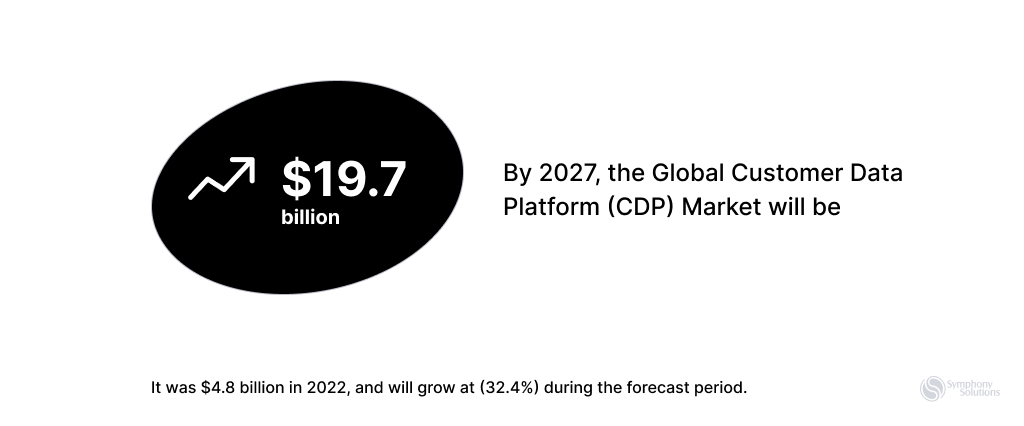
    The Customer Data Platform (CDP) market, which stood at $4.8 billion, could grow to $19.7 billion by 2027 at 32.4% CAGR. This growth is driven by the shift in digital marketing towards using first-party data. With the rising need to efficiently handle huge volumes of data from various sources, businesses are turning to CDPs and understanding the customer data platform architecture than ever before.

    platform-CDP-market

    A Customer Data Platform (CDP) is a software system that collects and combines customer data from many sources into one detailed database. This database is very important for various systems and activities related to marketing. The core of a CDP is its architecture – the technical structure and blueprint that guide how it’s built and works. This architecture is crucial for making sure the CDP connects well with other systems and manages data effectively 

    Read on for valuable insights. 

    Understanding the Customer Data Platform Architecture 

    The CDP architecture typically comprises six key components. These components work together to provide a single customer perspective, enabling businesses to get insights and provide individualized experiences. Let’s look at these components one after another. 

    • Logical Ingestion: This is where data enters the CDP, collated from diverse sources like cloud, on-premises, streaming data, file stores, SaaS connectors, and APIs. 
    • Logical Storage: This is responsible for structuring and storing the ingested data in three areas – Raw Zone (original, immutable data), Clean Zone (transformed data with basic validations), and Curated Zone (organized, ready-for-use data). 
    • Logical Cataloging: This component indexes and categorizes data for efficient use, facilitating marketers and analysts in finding relevant information. 
    • Logical Processing: Transforms raw data for analytics and marketing. This stage or process involves validation, identity resolution, segmentation, normalization, profile aggregation, and cloud machine learning
    • Logical Consumption: This element focuses on making insights from processed data available for various use cases, such as marketing campaigns, personalization, and analytics. 
    • Logical Security and Governance: Ensures the security, compliance, and authorized access of customer data, in line with available regulations. 

    Comparative Analysis: CDP vs. DMP vs. CRM 

    CDP, DMP, and CRM all deal with customer data, so it’s important to understand how they differ. The table below highlights the distinction between these different platforms, so you discover which one might be the perfect fit for your business needs. 

    Customer Data Platform (CDP) Data Management Platform (DMP) Customer Relationship Management (CRM) 
    Scope and Functionality Unifies customer data for comprehensive profiles Collects and manages third-party data for ads Manages customer relationships and interactions 
    Goal/ Use Case Connecting digital behaviors to in-person CX Efficient targeted advertising Manage and nurture existing customers and leads 
    Data Source  Primarily first-party data Anonymous, third-party data First-, second-, and third-party data 
    Data Integration Integrates data from various sources (website, app visits, CRM) for a comprehensive customer profile Focuses on third-party data integration for targeted advertising Handles internal customer data such as purchase history and customer interactions with limited integration 
    Data Governance and Security Emphasizes data governance and security Prioritizes data security, may have limitations Provides security measures, focuses on internal data 
    Why Choose Best for improving internal processes and customer experience Best for improving digital advertising efforts Best for managing and nurturing customer relationships 

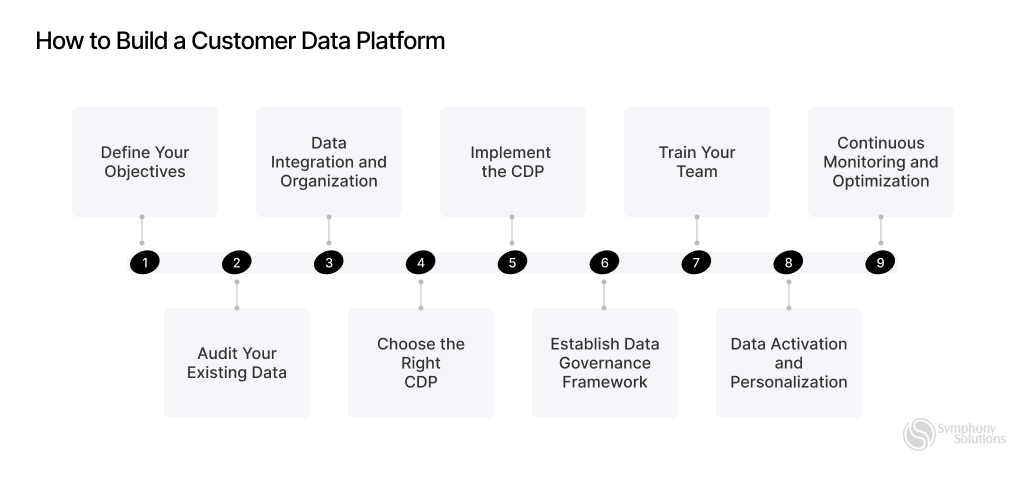
    Building a Customer Data Platform 

    Building data platform for customers is crucial in today’s marketing landscape. Follow this step-by-step guide to ensure a seamless process. 

    Benefits-of-Integrating-AI-into-Customer-Experience

    Define Your Objectives 

    Establish clear, quantifiable objectives from the get-go. Are you looking to increase revenue, boost customer involvement, or increase marketing efficiency? Your CDP’s general functionality and design will be determined by these objectives. 

    Audit Your Existing Data 

    Next, inventory all the data sources, including website analytics tools, marketing automation platforms, and CRM systems. Determine the essential data elements that will help you shape your CDP. 

    Data Integration and Organization 

    Decide next on the data organization and storage within the CDP. Whether it’s data replication, data orchestration, or point-to-point integration, select the right data integration strategy. This step is crucial for smooth data management. 

    Choose the Right CDP for Your Business 

    Selecting the right Customer Data Platform (CDP) is a crucial step in enhancing your data management strategy. However, generic CDPs may only partially meet your specific needs. That’s where partnering with a trusted custom software development company like Symphony Solutions for customer data platform development becomes essential.  

    Here’s why custom software development is pivotal for unlocking the complete potential of your CDP: 

    • Integration: A CDP that is designed for you, in line with your unique requirements is easy to seamlessly integrate with your existing infrastructure. All the relevant aspects will be considered during the audit stage, ensuring a smooth workflow without disruptions. 
    • Scalability: As your business expands, so do your data engineering needs. Applying data engineering best practices allows a custom-developed CDP to efficiently scale with your growing business needs without sacrificing performance. 
    • Security: Protecting sensitive customer data is paramount. Your CDP built by the Symphony team comes with robust security measures, ensuring compliance with industry standards and regulations while safeguarding against potential threats. 
    • Usability: Off-the-shelf solutions may not align perfectly with your team’s workflow or user experience expectations. A Symphony Solution-developed CDP will be tailored to meet your specific usability requirements, enhancing efficiency and user satisfaction. 
    • Support: A dedicated support system is vital for the ongoing success of your CDP implementation. Custom software developers offer personalized support, promptly addressing any issues and ensuring optimal CDP functionality, minimizing downtime and disruptions. 

    Implementing the CDP 

    Once you’ve selected and tailored your CDP, seamlessly integrate it into your business infrastructure. Ensure all functionalities work smoothly. If your in-house team cannot handle this, then a reliable partner like Symphony Solutions can help out 

    Establishing Data Governance Framework 

    Develop a structured framework for managing and governing data within the CDP. Define roles, set data quality standards, and establish processes for data handling and compliance. 

    Train Your Team 

    Educate your team on how to properly use the customer data platform architecture and framework, including interpreting the platform architecture diagram (visual representation), accessing and interpreting customer insights, utilizing platform features, and following data governance protocols. Again, a reliable tech partner can work with you to ensure that your in-house team is trained and equipped to properly use the system. 

    Data Activation and Personalization 

    Activate your data by integrating the CDP with operational tools like ad platforms, lifecycle marketing tools, or CRMs. Define data points to sync with your destination effortlessly. 

    Continuous Monitoring and Optimization 

    Implement ongoing monitoring to track CDP performance and optimize processes based on insights, technological advancements, and changing business requirements. 

    Achieving Effective Identity Resolution 

    In CDPs, identity resolution links various identifiers and data points to create unified customer profiles. This overcomes challenges related to fragmented data and multiple touchpoints, ensuring a seamless understanding of individual customer journeys. 

    For example, when a customer engages with the brand through different channels—website, in-store purchases, and mobile app interactions—the CDP gathers and organizes data from these interactions, ensuring a unified customer identity across all touchpoints. This integration enhances the overall customer experience. 

    CDPs leverage specialized algorithms to match and link customer data from different sources—email addresses, phone numbers, or device IDs—creating comprehensive customer profiles.  

    By following these steps, you’ll know how to build a customer data platform aligning with your business needs, maximizing big data opportunities, and contributing to strategic objectives. As you can see, constructing the CDP itself can be challenging, and buying ready-made may not work for your business, emphasizing the importance of working with a reliable software company like Symphony Solutions. 

    Partnering with Symphony Solutions for data platform development means selecting a trusted collaborator dedicated to crafting software that meets and exceeds your expectations.  

    Benefits and Use Cases of Customer Data Platforms 

    Integrating a Customer Data Platform (CDP) can bring numerous benefits to businesses. Some of these benefits are explained below. 

    Get-Your-Data-Migration-Plan-Right-the-First-Time

    Unified Customer View 

    A CDP streamlines customer data from diverse touchpoints, providing a centralized hub for a comprehensive overview of each customer’s interactions and preferences. This consolidated view not only deepens understanding but also amplifies personalization. Studies reveal that businesses leveraging centralized customer data witness efficiency gains of 64% and a robust 57% boost in business growth. 

    Elevated Customer Engagement 

    According to recent research, CDPs significantly improve the customer experience by 73%. Businesses use this tool to closely monitor client behavior and preferences, fine-tuning their communication and marketing strategies. This accuracy leads to more focused and individualized interactions, improving consumer engagement and satisfaction. 

    Data Precision and Quality 

    CDPs serve an important role in maintaining clean and correct customer data, resolving identity issues, and reducing duplication. This ensures that organizations have access to reliable information, reducing the chance of mistakes in decision-making. A significant 56% of C-Suite executives underline the crucial relevance of data in decision-making, with 82% saying that high-quality data provides a competitive advantage. 

    Agility in Decision-Making 

    Access to real-time data enables organizations to make quick and educated choices. Whether responding to market changes or modifying marketing strategies, the timely insights supplied by a CDP help to improve overall business agility. According to a worldwide survey of marketing experts, 60% of respondents prefer to make decisions based on consumer data. 

    Compliance and Data Security 

    Gartner predicts that by the end of 2024, 75% of the world’s population will be subject to current privacy standards. Compliance is vital. CDPs, luckily, include extensive security and compliance capabilities, ensuring that companies handle consumer data following legislation. This increases confidence and helps prevent any legal entanglements. 

    Customer Retention and Loyalty 

    CDP’s personalized interactions help to dramatically boost client retention and loyalty. Understanding and addressing specific consumer demands foster long-term connections, transforming them into brand ambassadors. According to the CDP Institute, client retention makes up 61% of CDP’s use cases or goals. 

    Innovation and Future-Proofing 

    According to 59.5% of executives, data is the most important engine of corporate innovation. Staying on the cutting edge of data-driven technology is critical for future-proofing operations and remaining competitive in an ever-changing marketplace. CDPs provide a solid framework for using data to develop innovative consumer interaction strategies. 

    Customer-Centric Approach 

    With 61% of respondents emphasizing customer service when choosing a CDP, it is clear that a CDP places the consumer at the heart of corporate operations. This guarantees that choices and initiatives mirror customer requirements and preferences, resulting in better connections and greater customer satisfaction. 

    Conclusion 

    Harnessing customer data is crucial for today’s businesses striving to stand out in the competitive market. By unlocking the potential in a customer data platform, businesses gain the ability to make well-informed decisions and fuel their growth. To make the most of this tech, though, working with a reliable data platform architect is vital. This is where we come in at Symphony Solutions. 

    At Symphony Solutions, we boast a wealth of experience in cloud application development services, data and analytics, artificial intelligence, digital marketing, and the full software development lifecycle. We can create CDPs that seamlessly align with your unique needs by drawing on our extensive knowledge and skills in these domains. 

    Our comprehensive solutions seamlessly integrate into your existing systems, ensuring adaptability and scalability. Plus, our AI and data analytics services will significantly enhance the predictive capabilities of your customer data platform architecture and keep your business ahead of emerging customer trends. 

    FAQs 

  • A Comprehensive Guide to Business Intelligence and Data Visualization 

    A Comprehensive Guide to Business Intelligence and Data Visualization 

    The business intelligence (BI) and data visualization sectors are growing at an unprecedent rate. According to statistics, they could reach market values of $54.27 billion and $22.13 billion, respectively, by 2030. For businesses, this growth means interpreting complex datasets and uncovering essential insights will only become much easier. By using BI and data visualization tools, companies will be able to make more informed decisions to stay ahead of competition. 

    Global business intelligence market

    In this article, we’ll reveal the specific roles of enterprise business intelligence and data visualization. We will also highlight the reasons and methods for integrating them into your business strategy to maintain competitiveness. For those new to the field, familiarize yourself with essential terminology by clicking here for a glossary of terms. 

    Let’s begin. 

    Introduction to Business Intelligence 

    Let’s start by defining business intelligence. 

    Business intelligence (BI) is using technology and tools to analyze, process, and present raw data to support informed decision-making within an organization. 

    benefits of bi data visualization

    The origin of BI can be traced to the 1960s and 70s with Decision Support Systems (DSS) and Executive Information Systems (EIS). Then came data warehousing and online analytical processing (OLAP) in the 80s and 90s. These laid the foundation for modern BI. The 2000s introduced self-service BI data visualization tools and cloud-based analytics, democratizing access to data insights. 

    Now, let’s break down why BI matters for today’s businesses: 

    1. Data Integration. BI pulls data from different sources across a company—like databases, spreadsheets, and applications—and brings it together in one place for analysis. 
    2. Data Analysis. It makes it easier for organizations to sift through large amounts of data, and find trends, patterns, correlations, and anomalies that can guide decision-making. 
    3. Reporting and Visualization. BI platforms create reports, dashboards, and visualizations that make complex data easy to understand. This helps everyone involved quickly grasp insights and make informed choices. 
    4. Predictive Analytics. Organizations can harness the power of BI to use advanced analytics techniques, such as predictive modeling and data mining, forecasting future trends based on past data. 
    5. Performance Management. BI keeps track of key performance indicators (KPIs) and metrics, helping monitor progress toward company goals and objectives. 
    6. Decision Support. Decision-makers can leverage BI for timely, accurate, and relevant information to support strategic, tactical, and day-to-day decisions.

    Overall, BI is a game-changer for modern businesses. It’s all about using data to innovate, make better decisions, and stay ahead in today’s fast-paced business world. 

    The Role of Data in Business Intelligence 

    Data is possibly the most important component of any Business Intelligence (BI), serving as its foundation. It’s the raw material from which businesses derive insights for informed decision-making. Collected from sources like internal databases and real-time feeds, data undergoes processing, cleaning, and transformation before analytical tools uncover valuable insights. 

    There are two main types of data used in business intelligence. 

    structured vs unstructured data

    Structured Data 

    Structured data follows specific patterns and resides in databases or warehouses. Examples include customer records and financial metrics. Analyzing structured data involves traditional techniques like SQL queries. The distinction between databases vs data warehouses lies in their functionality and scope. The former is for transactional use while the later is for analytical purposes. 

    Unstructured Data 

    Unstructured data can be complex and need more organization. Examples include text documents, social media feeds, and multimedia files. Despite the complexity, it is increasingly popular, accounting for approximately 90% of global data generated. 

    Integration of Structured and Unstructured Data 

    These days, data extends beyond structured and unstructured. Combining both structured and unstructured in semi-structured data offers a comprehensive view of operations. This integration enables data-driven decisions across departments and functions. 

    Core Components of Business Intelligence Systems 

    Understanding the important components of BI systems is important for organizations that want to leverage data effectively. Let’s break them down. 

    core components of business intelligence system
    • Data Sources. This includes internal databases, spreadsheets, social media, and CRM platforms. BI systems collect and verify information from these sources. 
    • Data Warehouses. Data is stored and organized in a key repository for easy access and integration. Ensuring consistency across datasets is one of the benefits of data warehouses
    • Data Integration. Combining information from multiple sources directly into a single source of truth ensures compatibility and consistency. This is where data extraction, transformation, and loading (ETL) or real-time data integration happens. The good thing is that there are dozens of ETL tools to help. 
    • Data Analysis. This involves using statistical strategies and algorithms to examine records and uncover patterns and trends for informed decisions. This component covers descriptive, diagnostic, predictive, and prescriptive analytics. 
    • Reporting. This is a visual representation of analyzed data. They allow users to monitor key performance indicators (KPIs) and track progress towards business objectives. 
    • Data Governance. This component encompasses policies and procedures that govern the use of data to ensure security, compliance, and privacy. 
    • Data Mining. Here is where hidden patterns from datasets are extracted to reveal valuable insights using statistical techniques and predictive modeling. 
    • Data Visualization. Visualization helps translate complex data into easy-to-understand visual representations using charts, graphs, and infographics that enhance data comprehension. 
    • Data Security. This component involves implementing measures such as encryption, access controls, and audits to protect data from unauthorized access and breaches. 

    Data Visualization: Turning Numbers into Knowledge 

    Data visualization, an essential part of enterprise business intelligence, simplifies data and presents it visually to help businesses make informed decisions. Patterns and trends that might be overlooked in raw data will be revealed by converting data into charts, tables, graphs, and infographics. 

    Science is there to back it up. The brain processes visuals faster – about 60,000 times faster than textual content! We also remember 65% of what we see compared to just 10% of what we hear. So, presenting data visually engages the brain’s visual processing power, making information less difficult to recognize and recall. In this way, decision-making is faster and more certain. 

    Here are some key benefits. 

    1. Clear Insight. Visuals help spot patterns and trends easily, making data more understandable. 
    2. Interactivity. Data visualization allows users to play with the data, like filtering or sorting, improving analysis. 
    3. Sharing Insights. It enables easy sharing of insights, promoting collaboration and informed decisions. 
    4. User-Friendly. Visuals use colors, shapes, and sizes to convey information intuitively, making data more accessible. 

    Principles of Effective Data Visualization 

    Data visualization can be either effective or ineffective. 

    • Effective Visualization. A clear bar chart showing monthly sales trends, with labeled axes and a concise title, facilitating quick interpretation. 
    • Ineffective Visualization. A cluttered pie chart displaying multiple categories with similar colors, lacking clear labels and a legend. 

    It is crucial to ensure that your visualizations are effective to facilitate better decision-making. Here are 6 design principles that can help. 

    • Clarity. Keep things crystal clear. Cut out unnecessary clutter, use concise titles and labels, and arrange your data logically. This ensures your audience gets the point without any confusion. 
    • Simplicity. Make complex data easy to digest. Trim down the info, skip the jargon, and use straightforward visuals. The simpler, the better. 
    • Accuracy. Ensure that your data is represented truthfully and without distortion. Double-check your sources, validate your findings, and avoid misleading visualizations. 
    • Efficiency. Get to the point fast. Use suitable chart types, trim out unnecessary details, and offer quick summaries. Save time and get the message across ASAP. 
    • Aesthetics. Looks matter. Choose pleasing colors, clean typography, and maintain visual harmony. Good aesthetics make data more engaging and memorable. 
    • Accessibility. Make sure everyone can access and use the data. Use alt text, offer keyboard navigation, and consider color schemes for those with visual impairments. 

    Tools and Technologies in BI and Data Visualization 

    When looking to leverage BI and data visualization, there are dozens of tools to choose from. Here, we review some of the top options on the market. 

    Power BI 

    Microsoft Power BI is a top tool for business intelligence and data visualization. Easily connect, transform, and visualize data with its user-friendly interface. Generate charts, graphs, and dashboards effortlessly. 

    Key Features: 

    • Insights from Large Datasets 
    • Custom Visualizations with R and Python 
    • Data Transformation with Power Query 
    • Mobile App Access 
    • Integration with Microsoft Products 

    Tableau 

    Tableau is a powerful BI tool known for interactive analysis and stunning visualizations. It’s flexible with options for desktop, cloud, or on-site deployment. Tableau offers visualization options like Bar, Line, Area, Pie Charts, Treemaps, Scatter Plots, and more. 

    Key Features: 

    • Real-time Analytics 
    • Intuitive Dashboard Creation 
    • Versatile Data Source Connectivity 
    • Role-based Permissions 
    • Simple Sharing and Collaboration 
    • Mobile Accessibility 

    Zoho Analytics 

    Zoho Analytics is a comprehensive BI and data visualization tool. It offers drag-and-drop report generation functionality and AI-driven insights with smooth integration. Choose from a variety of data integration and robust collaborative features visualization options, such as pie charts, line charts, and bar graphs. 

    Key Features: 

    • Visual Analysis 
    • Augmented Analytics 
    • Collaborative Analytics 
    • Data Storytelling 
    • Mobility 

    Looker Studio 

    Looker Studio is an advanced analytics, customization, and real-time collaboration BI tool. Formerly Google Data Studio, Looker Studio provides a wide range of visualization options including Cartesian, Pie/Donut, Progression Charts, Text/Tables, Maps, and custom visualizations. 

    Key Features: 

    • Advanced Filtering 
    • LookML Modeling 
    • Google Services Integration 
    • Automated Scheduling 
    • Support for 50+ SQLs and Databases 
    • Looker Studio API 

    Integrating BI and Data Visualization in Business Strategy 

    Integrating business intelligence (BI) and data visualization into your enterprise strategy is essential. Here’s how to do it successfully. 

    • Align Objectives. Start by identifying your key strategic goals. Then, see how BI and data visualization can support these objectives. This ensures that your analytics efforts are targeted at addressing important business challenges and opportunities. 
    • Engage Stakeholders. Get various departments involved in the BI implementation process. Understanding their needs and requirements allows you to avoid unexpected issues and find practical solutions. According to a recent poll of almost 80% of CEOs, involving stakeholders in digital transformation helped them recognize issues and come up with workable solutions. Collaboration and communication are key. 
    • Promote User Adoption. Make sure your employees are comfortable using enterprise business intelligence solutions. Offer training programs, user-friendly interfaces, and ongoing support. Highlighting success stories and demonstrating the value of BI through tangible outcomes can encourage broader adoption throughout the organization. 
    Feature/ 
    Creteria 
    Power BI Tableu Zoho Analytics Looker Studio 
    Cost Affordable with free and premium plans. Higher cost with various licensing options. Competitive pricing with free and premium tiers. Free to use, with Google Cloud storage costs. 
    Ease of Use User-friendly interface suitable for beginners and professionals. Steep learning curve but powerful for data analysts. Intuitive for users with drag-and-drop functionality. User-friendly with seamless integration into Google ecosystem. 
    Feature Set -Insights from large datasets 
    – Custom visualizations 
    – Data transformation 
    – Mobile app access 
    -Integration with Microsoft products 
    – Real-time analytics 
    – Intuitive dashboard creation 
    – Versatile data source connectivity 
    – Role-based permissions 
    – Mobile accessibility 
    -Visual analysis 
    – Augmented analytics 
    – Collaborative analytics 
    – Data storytelling 
    – Mobility 
    – Advanced filtering 
    – LookML modeling 
    – Google services integration 
    – Automated scheduling 
    – Support for 50+ SQLs and databases 
    Typical Use Cases Best for businesses embedded in the Microsoft ecosystem looking for a comprehensive BI solution. Ideal for data-heavy organizations requiring deep analytics and complex visualizations. Suitable for small to medium businesses needing affordable, easy-to-use analytics solutions. Perfect for users heavily invested in Google’s ecosystem needing straightforward, collaborative data analysis. 

    Data Visualization Best Practices 

    Creating effective data visualizations is key in business intelligence (BI) platforms. These visuals help users understand complex data and make smart decisions. To make your visualizations impactful, follow these tips: 

    data visualization best practices
    • Choose the Right Chart. Pick the best chart type for your data. Line charts for trends, bar charts for comparisons, etc. 
    • Use Color Wisely. Make sure colors make sense and are clear, especially for color-blind users. 
    • Add Data Labels. Include labels for clarity, like names, values, or dates. 
    • Optimize Font. Use readable font sizes and styles, avoiding extremes. 
    • Be Consistent. Stick to the same formatting style for a cohesive look. 
    • Test Thoroughly. Make sure your visualization works well across different devices and accurately represents your data. 

    It is also important to consider your target audience when doing data visualization. 

    • Expert Users: Use advanced chart types for complex data. 
    • Non-Experts: Keep it simple with clear labels and familiar charts. 
    • Mobile Users: Optimize for smaller screens with larger fonts and simplified designs. 

    By following these tips and considering your audience, you’ll create data visualizations that drive informed decisions in BI platforms. 

    Conclusion 

    Business Intelligence (BI) and data visualization are vital in today’s data-focused world. They assist in uncovering valuable insights from data, improving efficiency, and customer experiences, and gaining a competitive advantage. 

    At Symphony Solutions, we know firsthand how powerful enterprise business intelligence and data visualization can be. Our data analytics services have empowered numerous clients to leverage their data for growth. Partner with us to unlock your data’s potential and make smart decisions for success.  

    Glossary of Key Technical Terms 

    BI (Business Intelligence) 

    BI is like a detective tool for businesses, analyzing data from sources like sales reports to answer questions such as “Why are sales dropping?” Example: A coffee shop uses BI to decide to add oat milk based on customer preference trends. 

    OLAP (Online Analytical Processing) 

    OLAP lets you analyze data from many perspectives quickly. Example: A principal uses OLAP to examine test scores by subject and teacher to identify areas for improvement. 

    SQL (Structured Query Language) 

    SQL is the language used to query databases. Example: A pizza shop owner uses SQL to find out which pizza toppings are most popular. 

    ETL (Extract, Transform, Load) 

    ETL moves and refines data from multiple sources into a single database. Example: A business combines online and in-store sales data to analyze total sales figures. 

    Data Warehouse 

    A data warehouse stores a company’s historical data in an organized manner for analysis. Example: A retailer stores years of purchase data to predict future trends. 

    Data Mining 

    Data mining finds hidden patterns in large data sets. Example: Netflix uses data mining to recommend shows based on viewing patterns. 

    Data Visualization 

    Data visualization makes complex data easy to understand through visuals like charts. Example: A fitness app uses graphs to show your exercise patterns. 

    Predictive Analytics 

    Predictive analytics uses past data to forecast future events. Example: A clothing brand predicts increased sweater sales in November and stocks up accordingly. 

    KPI (Key Performance Indicator) 

    KPIs measure how well a business is achieving its goals. Example: A blogger tracks monthly website visitors to gauge readership growth. 

    CRM (Customer Relationship Management) 

    CRM systems manage all customer interactions and data. Example: A real estate agent uses CRM to track client preferences and viewed properties. 

    FAQs

  • How to Maximize AI’s Potential with Data Analytics & Power BI 

    How to Maximize AI’s Potential with Data Analytics & Power BI 

    Data can be very powerful in business, but only if you can effectively analyze it. With the advent of AI services 2024, organizations now possess unprecedented capabilities to efficiently extract meaningful insights. In fact, 73% of data and analytics decision-makers are already building AI technologies to help unlock the full potential of their data and maintain a competitive edge. 

    the impact of ai on data and analyst

    In this article, we will explore AI in Data Analytics services and Power BI. We will highlight how this technology can improve data analysis for better business decisions. 

    Read on. 

    Understanding AI Analytics 

    AI analytics involves using AI techniques, data preparation for machine learning, and natural language processing to improve how we collect, organize, and understand large amounts of data. In the following sections, we will explore the key elements of AI in data analytics, providing a comprehensive overview of its components and their significance in the field. 

    Some of the key elements of AI in data analytics include: 

    • Machine Learning Algorithms: Core for learning and prediction. 
    • Natural Language Processing: Enables interaction with textual data. 
    • Data Preprocessing: Cleans and organizes raw data. 
    • Predictive Analytics: Forecasts trends based on historical and real-time data. 
    • Pattern Recognition: Identifies hidden insights in datasets. 
    • Big Data Processing: Handles large datasets efficiently. 
    • Real-time Analytics: Provides up-to-the-minute insights. 
    • Data Visualization: Transforms complex data into visuals. 
    • Continuous Learning: Adapts and improves over time. 

    AI in data analytics leverages these elements and algorithms to go beyond traditional data analytics methods. It helps reveal hidden patterns predict trends, and suggest actions based on analyzed data. This is particularly important where big data shapes business strategies and customer insights. 

    AI Analytics vs. Traditional Analytics 

    ai-analytics-vs-traditional-analytics

    To properly understand AI analytics, we need to look at where it stands in the context of traditional methods. The table below breaks things down succinctly: 

    Traditional Data Analytics AI Data Analytics 
    Data Handling Uses tools like SQL and Excel for structured data Employs machine learning to process both structured and unstructured data, identifying intricate patterns
    Automation and Learning Relies on manual processes and predefined queries Automates analysis and decision-making through continuous learning from data patterns 
    Predictive Capabilities Relies on past data, and may not predict future trends well Leverages machine learning for precise predictions using both historical and real-time data 
    Gathering Insights Relies on dashboards with visuals for human interpretation, making them inflexible Allows users to dynamically request and work with information without technical help; can interpret images, equations, graphs, and charts for diverse insights. For example ChatGPT Vision

    The Importance of AI in Uncovering Insights from Data 

    The Importance of AI in Uncovering Insights from Data 

    The role of AI in extracting insights from data cannot be denied. Here are key aspects highlighting this significance: 

    1. Automation: AI-powered tools can handle big data in real-time, automating tasks like data cleaning and processing. It reduces the need for intensive human labor and saves time and resources for data analysts and scientists. Furthermore, AI processes data quickly, allowing for faster results than traditional methods. This speed enhances decision-making, providing more time to act on insights and predictions.
    2. Competitive Edge: AI-driven analytics provides businesses with predictive insights and real-time data. This means swift decision-making and strategic planning that outpaces competitors. According to Harvard Business Review, companies leveraging AI to enhance predictions, improve efficiency, and optimize real-time pricing or stock control, thus maintaining a competitive edge.  
    3. Data-Driven Decision-Making: Leveraging AI-driven data insights empowers businesses to make improved choices supported by facts and not intuition—leading to success on multiple fronts. Research backs this up: Being data-driven gives companies a 5% boost in productivity and a 6% increase in profitability compared to their competitors. Also, organizations are 23 times more likely to gain customers and 19 times more likely to achieve profitability. 
    4. Anomaly Detection: Businesses can easily sift through vast amounts of data to identify fraud. However, as data continues to grow, it becomes too much to handle manually. That’s where AI comes in. AI can identify unusual patterns or deviations in data, indicating potential issues such as fraud or system glitches. Take Spotify as an example. They leverage AI to scrutinize uploaded songs to detect fraud or spot songwriter plagiarism. This proactive identification helps prevent potential risks and threats. 
    5. Effective Risk Management: AI analytics enhance risk management models and help formulate more intelligent strategies. By looking at past data and recognizing patterns, AI helps predict potential risks, allowing organizations to take timely and well-informed actions. This approach reduces the impact of unexpected events on business operations. When we integrate advanced predictive analytics into our risk management strategies, we create a stronger and more adaptable framework to tackle changing challenges. 
    6. Predictive Analytics: AI’s predictive analytics capabilities help organizations stay ahead by anticipating market movements, recognizing consumer preferences, identifying possible dangers, and projecting future trends and results. Take Bank of America, for example. They employ predictive analytics to increase equity capital market (ECM) transactions demand. The bank can identify the best investors for a transaction by assessing variables such as previous deal involvement, trading activity, and market data. This tailored strategy enhances decision-making and makes their proposals more successful. 
    7. Personalized Insights: AI data analytics lets organizations better understand their customers by evaluating data from several sources. This enables customized and targeted interactions depending on client behavior and preferences. In areas where tailored content is critical, such as e-commerce, entertainment, and social media, AI discovers patterns and trends to guarantee that businesses give what their consumers want most. This not only increases interaction but also improves overall consumer satisfaction. 
    8. Sentiment Analysis: Sentiment analysis and language processing are vital aspects of AI that boost data analysis. They examine social media posts, customer reviews, and other texts to understand feelings and opinions. AI algorithms can distinguish between different types of sentiments. It provides companies with insights into their brand and product perception. This enables organizations to measure customer satisfaction, spot emerging trends, and make decisions based on data. Netflix is a prime example of a company leveraging AI for sentiment analysis. They use it to understand viewer intentions and enhance the experience. 

    Common AI Techniques in Data Analysis 

    Here are some common techniques you can use to implement AI for data analytics. 

    Machine Learning 

    Machine learning (ML), a subset of AI, uses algorithms and statistical models to help computers learn from data. Instead of explicit programming, it enables systems to identify patterns and make predictions or decisions. By analyzing big datasets, ML uncovers hidden patterns, helping businesses make informed, data-driven decisions. 

    Neural Networks 

    Modeled after the human brain, neural networks learn and recognize patterns using interconnected artificial neurons. They excel in tasks like image recognition, speech processing, and recommendation systems, and do well in handling complex data for insightful results. 

    Predictive Analytics 

    This method uses past data and statistical algorithms to predict future events or behaviors. It forecasts trends, identifies risks, and optimizes business processes. Predictive analytics is also invaluable in detecting fraud. 

    Computer Vision 

    A subset of artificial intelligence, computer vision enables computers to understand visual details. It plays a vital role in data analysis, allowing machines to process images, videos, and 3D representations.  

    These are just a few examples. As technology advances, data analytics AI will play a bigger role in fostering innovation and transforming global industries. 

    AI Analytics in Action: Examples and Use Cases 

    AI in data analytics holds a lot of value for many industries. Here’s how AI data analytics is transforming decision-making in finance, retail, healthcare, supply chain, and many more. 

    Insurance 

    Insurance businesses use AI data analytics to boost efficiency and revenues. They use machine learning algorithms to analyze historical data, detect risk trends, anticipate claims, and fine-tune pricing tactics. Predictive analytics enables insurers to segment clients based on risk, preferences, and purchasing history. This enables individualized pricing and targeted marketing. 

    Financial Services 

    Financial institutions employ AI data to detect fraud, identify market trends, and forecast client behavior. This promotes proactive risk management and regulatory compliance. They also use AI algorithms to analyze a large amount of financial data, for valuable investment insights and trading strategies. 

    Manufacturing and Supply Chain 

    AI analytics predict demand, optimize inventory, and prevent stockouts in manufacturing and supply chains. This saves costs and makes customers happier. 

    These AI algorithms analyze data from sensors, IoT devices, and production systems. They find defects, identify patterns, and improve quality control, reducing product recalls and enhancing brand image. AI algorithms also study historical data, supplier performance, and market trends for better supply chain planning. This ensures efficient resource allocation and minimizes disruptions. 

    Retail and E-commerce 

    Retail and online stores use AI analytics to personalize customer experiences, boost engagement, and make better decisions. AI algorithms examine how customers behave, what they like, and what they’ve bought before, suggesting personalized product recommendations. This not only boosts conversion rates but also strengthens customer loyalty. 

    To improve pricing strategies, machine learning models examine competition prices, market trends, and customer behavior. Also, predictive analytics identifies high-value clients so that vendors may create customized offers and campaigns to increase their lifetime value. 

    Healthcare 

    AI and data analytics in healthcare have been helping providers offer personalized care, boost efficiency, and simplify processes. This tech extracts insights from medical records, aiding clinical decisions, research, and personalized treatment. Healthcare practitioners leverage machine learning to predict patient outcomes, spot complications, and suggest personalized treatment plans, making care safer and improving quality. 

    These are just a few ways AI data analytics innovate and transform industries. As AI evolves, we anticipate more exciting uses and applications, benefiting organizations in different sectors. 

    Conclusion 

    AI has changed the game in data analytics, making it better at analyzing loads of data and improving decision-making. It’s not just about numbers; AI brings fresh ideas and boosts business success, from predicting trends to personalized marketing. 

    In today’s data-driven business landscape, using AI for data analytics is essential for smart decision-making. The key is partnering with a reliable AI expert. 

    Symphony Solutions excels in artificial intelligence and data analytics. Our dedicated team specializes in advanced AI development, ensuring your organization achieves transformative results and stays ahead. 

    FAQs 

  • How Data Science Plays a Role in Healthcare Advancement 

    How Data Science Plays a Role in Healthcare Advancement 

    The data science market is on the rise. From a value of USD 25.37 billion in 2020, it’s predicted to soar to USD 224.58 billion by 2028. Much of this growth is largely due to the adoption of advanced analytics and AI, especially in healthcare. 

    Data Science in healthcare analyzes large datasets to provide valuable insights. Using a mix of statistics, data tools, and computer science, it identifies patterns and forecasts trends. In healthcare, this means better early detection of diseases, more accurate diagnoses, and personalized treatments. It also improves hospital efficiency, leading to quicker patient care.  

    Data science in Healthcare

    This article will cover the role and impact of data science in healthcare. We’ll explore how analytics tools and artificial intelligence, changes healthcare for the better. By the end, you’ll see the importance of data analytics in improving patient care.  

    What’s the Role of a Data Scientist in Healthcare? 

    In healthcare, a data scientist manages and distributes data sourced from patients, healthcare providers, researchers, and government agencies. They play a vital role in transferring information, be it on an individual patient level, ensuring doctors have the right data, or on a global scale, sharing critical insights about new diseases. Let’s go deeper. 

    Data Collection from Patients 

    Healthcare data scientists play a pivotal role in collaborating with medical professionals. They gather a vast array of patient data, from comprehensive medical histories and vital signs to treatment records and genomic data. But their responsibility doesn’t stop at just collecting data.  

    They also ensure its accuracy, completeness, and integrity, understanding that high-quality data is the bedrock of reliable analysis. By integrating these datasets into a cloud data warehouse, businesses can benefit significantly. This system streamlines data storage and retrieval processes while offering enhanced scalability and security. 

    Structuring and Sorting Data 

    Once the data is collected, healthcare data scientists engage in data cleaning and transformation processes. This involves removing inconsistencies and structuring the data in a way that is conducive to further analysis. Properly structured data sets the stage for meaningful insights and effective decision-making. 

    Needs Analysis for Hospitals 

    Healthcare data scientists play an integral role in understanding the unique challenges faced by hospitals and healthcare institutions. By immersing themselves in the healthcare environment, they gain insights into the pain points and obstacles that could benefit from data-driven solutions. Importantly, they recognize that each hospital may have distinct needs, and they tailor data analytics strategies accordingly. This customized approach ensures that data-driven solutions are aligned with specific hospital requirements. 

    The State of Data Scientist

    Data Analytics Using Various Tools 

    One of the core competencies of healthcare data scientists lies in their ability to employ a wide range of analytical tools. These tools encompass statistical techniques, machine learning algorithms, and other data science methodologies. By leveraging these tools, data scientists extract valuable insights from complex healthcare data, helping healthcare organizations make informed decisions and drive improvements.  

    Implementing Algorithms for Insight Extraction 

    Healthcare data scientists are at the forefront of big data technology implementation in healthcare case study. They excel in algorithm development, crafting and implementing custom algorithms to analyze intricate healthcare datasets. These algorithms are meticulously designed to uncover hidden patterns, relationships, and trends within the data. The ultimate objective is to extract actionable insights that can inform decision-making and instigate positive transformations within the healthcare system. 

    Healthcare data scientists excel in algorithm development. They craft and implement custom algorithms to analyze intricate healthcare datasets. These algorithms are designed to uncover hidden patterns, relationships, and trends within the data. The goal is to extract actionable insights that can inform decision-making and drive positive changes within the healthcare system. 

    Building Predictive Models 

    In collaboration with development teams, healthcare data scientists embark on the creation of predictive models. These models are capable of forecasting critical healthcare outcomes, such as disease outbreaks, patient prognoses, and resource allocation needs.  

    Predictive analytics, a key component of their work, empowers healthcare organizations to proactively address healthcare challenges and enhance patient care. As of February 2022, 92%, 79%, 66%, and 66% of healthcare leaders surveyed in Singapore, China, Brazil, US respectively reported high adoption of predictive analytics, emphasizing its transformative role in healthcare management. 

    Adoption of predictive analytics in Healthcare

    Benefits of Data Science in Healthcare 

    Now that you understand role of data science in health care, let’s explore the benefits: 

    Efficiency in Workflow  

    Data Science streamlines the workflow of the healthcare system by optimizing various processes. For instance, predictive analytics can forecast patient admissions, helping hospitals allocate resources efficiently. This ensures that staff and facilities are available when needed, reducing bottlenecks and improving patient care. 

    Drug Development  

    Another importance of data science in healthcare is that it accelerates drug development by analyzing vast datasets to identify potential drug candidates and predict their efficacy. For instance, researchers can use machine learning algorithms to analyze genomic data and identify drug targets. This leads to faster drug discovery and the development of more effective treatments. 

    Top benefits of big data in healthcare

    Cost Reduction  

    Data Science plays a pivotal role in cost reduction. By analyzing patient data, healthcare providers can identify high-risk individuals and intervene early, preventing costly hospitalizations. Additionally, data-driven insights can optimize supply chain management, reducing wastage and expenses. 

    Risk Mitigation  

    Data Science helps reduce the risk of treatment failure. Machine learning models can analyze patient data to predict treatment outcomes, allowing healthcare providers to adjust treatment plans proactively. This minimizes the chances of adverse events and improves patient safety. 

    Timely and Precise Treatment 

    Data Science empowers healthcare professionals to provide timely and precise treatments. For example, wearable devices and real-time data analysis can monitor patients remotely, allowing doctors to intervene promptly if any health parameters deviate from normal ranges. 

    Enhanced Diagnostic Accuracy  

    Data-driven algorithms can enhance diagnostic accuracy. Radiology, for instance, benefits from deep learning models that assist radiologists in detecting abnormalities in medical images like X-rays and MRIs. This reduces the chances of misdiagnosis and ensures patients receive appropriate treatment. 

    Emergency Avoidance  

    Data Science helps avoid unnecessary emergencies due to the non-availability of doctors. Telemedicine platforms, supported by data analytics, enable remote consultations. Patients can receive timely medical advice without the need for physical presence, reducing the burden on emergency departments. 

    Reduced Patient Waiting Times 

    Data Science significantly improves patient care, optimizing patient schedules and appointment bookings. For instance, hospitals can use predictive analytics to forecast patient arrivals and allocate appointment slots accordingly. This minimizes patient waiting times, enhancing the overall patient experience. 

    Major Application and Use Cases of Data Science in Healthcare 

    Here are the data science applications in healthcare: 

    Medical Image Analysis  

    Medical imaging, like X-ray CT, PET, and MRI, lets doctors see inside our bodies without surgery. The application of data science in medicine is making this even better. It helps solve problems with image quality and size. Plus, with tools like supervised learning, images are processed faster and more clearly. By using data science in medicine, doctors can compare new and old images to make better decisions about our health. 

    Data Science in Genomics  

    Emerging technologies, like advanced genomic profiling, offer fresh insights into genomics. However, the speed at which we generate genetic data now outpaces our ability to organize it. This is partly because our data structuring hasn’t evolved as quickly as our collection methods. While healthcare data science holds promise, its true value lies in interpreting the data effectively.  

    Key challenges in genomics include understanding human genetic variations and their patient impact, and pinpointing genetic markers influencing drug reactions. The DNA Nanopore Sequencer is a game-changer in this space. It aids in early patient care, helping prevent conditions like septic shock. Additionally, it accelerates genetic sequencing, streamlines data processing, and offers advanced data management and algorithms. 

    Data Science in Healthcare

    Drug Research  

    Historically, drug development, involving millions of test cases, took over a decade. However, with the integration of data science in healthcare projects, this process has been significantly expedited. Advancements in Data Science now allow for the analysis of vast test case data in just weeks. This swift evaluation determines drug efficacy, facilitating the introduction of validated medicines or vaccines in less than a year. The pharmaceutical sector’s rapid progression is credited to breakthroughs in Data Science and Machine Learning 

    Virtual Assistance 

    Data Science-driven virtual assistance applications are revolutionizing healthcare. These platforms diagnose potential ailments based on patient-inputted symptoms and recommend tailored treatments. They also curate treatment plans and send medication reminders, ensuring adherence and reducing oversights. Such tools are especially valuable for patients with psychological conditions, offering structured routines from medication to exercise. An example is Woebot, a Stanford-developed chatbot, which aids in mental well-being. 

    Predictive Analytics in Healthcare 

    Predictive analytics is one of the game changing applications of data science in healthcare. Predictive analytics uses data science models to analyze historical patient data to forecast disease outbreaks, patient readmissions, and resource requirements. For example, predictive analytics can help hospitals allocate staff and resources more efficiently during flu seasons. 

    Data Management and Governance  

    Healthcare organizations handle vast amounts of sensitive patient data. Utilizing data science for healthcare methodologies and applications, these institutions can achieve secure data management and governance. Data Science ensures data integrity, compliance with regulations like HIPAA, and protects patient privacy. Moreover, it assists in creating data pipelines for efficient data flow within healthcare systems. 

    Data Science Application in the Future of Healthcare 

    According to Statista, the market share of analytics services is projected to exceed 42% by 2025. This shows that data science will continue to play a pivotal role in shaping the healthcare landscape. Understanding data science in healthcare benefits challenges and opportunities is crucial for stakeholders. Here is a glimpse into the future of data science in healthcare: 

    Collaborative Data Science for Healthcare

    Technological Advancements  

    With rapid advancements in technology, Data Science in healthcare will continue to push boundaries. The integration of healthcare data, artificial intelligence, machine learning, and quantum computing will lead to even more precise diagnostics, personalized treatments, and drug discoveries. For instance, AI-driven medical robots could perform surgeries with unparalleled precision, while predictive models will become more accurate in forecasting disease outbreaks. 

    Digitalization  

    The healthcare sector is undergoing a digital revolution. Electronic Health Records (EHRs), wearable devices, and telemedicine are becoming ubiquitous. Data Science will be instrumental in extracting insights from this vast pool of digital health data. It will enable continuous monitoring of patient health, early disease detection, and personalized wellness plans, all from the comfort of one’s smartphone. 

    Need for Reducing Treatment Costs and Duration  

    The rising cost of healthcare is a global concern. Data Science will be instrumental in cost containment by identifying inefficiencies in healthcare delivery, optimizing resource allocation, and reducing treatment costs. For instance, predictive models can help identify cost-effective treatment options, reducing the financial burden on patients and healthcare systems. 

    Handling Large Populations  

    Healthcare systems worldwide are grappling with the challenges posed by aging populations and the increasing prevalence of chronic diseases. Data Science will aid in population health management by predicting disease trends, designing targeted interventions, and improving preventative care. It will enable healthcare providers to proactively address the needs of large and diverse patient populations. 

    Conclusion 

    Data Science is revolutionizing healthcare by streamlining operations, enhancing diagnostics, and reducing costs. From in-depth medical image analysis to expediting drug discoveries, it stands as a pivotal force behind contemporary healthcare breakthroughs. Its prowess not only uplifts patient care but also forecasts disease patterns and expands healthcare reach.  

    Building on this momentum, Symphony Solutions, renowned for its expertise in app development and data analytics consulting, is leading the way in this transformative era. Partnering with Symphony provides healthcare organizations the leverage to harness critical insights, foster innovation, and confidently address the complexities of tomorrow’s healthcare landscape. 

  • Considerations, Drivers, and Strategies of a Successful Data Migration Plan  

    Considerations, Drivers, and Strategies of a Successful Data Migration Plan  

    It’s no longer a debate as to whether businesses should migrate their data to the cloud. To date, over 60% of corporate data is stored in the cloud, a twofold increase over the last seven years. For many organizations, drafting and executing a data migration plan from on-premises to the cloud opens a new business world of increased flexibility, optimized operating costs, heightened security, and continuity in the event of a disaster.  

    A data migration plan is an all-around strategy with a clear roadmap on how to move business information from one environment to another. A typical plan highlights the approach and execution, and validates the overall data migration process to ensure a smooth transition. The primary role of creating the plan is to ensure the process of moving data is safe and secure without disrupting normal business operations. But even so,  trusted industry insights reveal that organizations are still struggling with making the transition more effective —only 36% of data migration projects are executed within the forecasted budget, and only 46% turn out to be successful within the set deadline.  

    While it’s commendable that some companies are able to conquer the last mile of data migration and drive desirable business outcomes, these numbers subtly show a dismal success rate. So, how do you create a successful data migration plan from the onset? Here is an in-depth guide on how to conduct a data migration with careful planning. We also highlight prevalent methodologies and the common mistakes to avoid. Let’s dive in.  

    Types of Data Migration  

    migration triggers

    There are three types of enterprise-wide data migration approaches, including:  

    On-Premises to Cloud Data Migration  

    On-premises to cloud data migration is the process of moving business information from the organization’s local infrastructure, such as in-house data centers and servers, to a cloud environment. Implementing cloud migration is a go-to option if your company wants to enhance business agility and flexibility. With your applications and corporate information in the cloud, employees can access important resources from anywhere, facilitating new engagement models, such as remote collaboration.  

    pros of cloud migration

    Moving business information from on-premise storage to the cloud is also a viable approach if you want to attain greater scalability and resource optimization. This is because cloud computing allows your company to scale or cut down storage and computing resources as much as required, depending on the prevailing market demand. Additionally, this translates to switching your business model from capital expenditure to operational expenditure, which can significantly cut operating costs in the long run.  

    Another benefit of migrating corporate data from on-premises storage to the cloud is assured disaster recovery and business continuity. Depending on your cloud partner, you can access robust backup and recovery solutions for mitigating cybersecurity concerns and downtime in the event of a disaster or complete system failure.  

    Cloud-to-Cloud Data Migration  

    While many businesses are in the race to migrate to the cloud for the first time, some companies have been there for years and might consider exploring the prospects of a new service provider. As the name suggests, a cloud-to-cloud data migration approach entails moving unstructured business data from one cloud storage to another. On a small scale, look at it as transferring business files from Google Drive to Dropbox or any other combination of cloud storage platforms.  

    cloud-data-migration

    Implementing a cloud-to-cloud data migration strategy is ideal:  

    • When diversifying or mitigating vendor risk: It makes sense to consider switching to another cloud platform if you want to negotiate better terms and mitigate vendor lock-in risks. Also, you would consider the move if the target service provider offers specialized services that give your business an upper hand over the competition.  
    • When optimizing operating costs or performance: The target service provider you’re eyeing might offer optimized performance features at relatively cost-friendly paid plans, prompting you to switch. Again, the need to negotiate better service-level agreements (SLAs) that are commensurate with the value of your money might also drive you to take this approach.  
    • When meeting regulatory or compliance requirements: You might want to migrate your business data from one region to another within the infrastructure of the same service provider to meet certain compliance and regulatory requirements. This approach is especially viable if your business branches out to a jurisdiction with stringent data governance and sovereignty laws.  

    Cloud to On-Premises Data Migration 

    Cloud to on-premises data migration entails transferring an organization’s digital assets, such as corporate data, business applications, and workloads, from a vendor-owned cloud platform to local infrastructure. While shifting from cloud to on-premises solutions is uncommon in the modern business landscape, you might find the approach to be a viable option in specific scenarios, such as:  

    • Changing business needs: Every business is unique and may undergo changes from time to time. In some cases, the foregoing business need might demand the organization to gain more control over corporate data or applications. And if you want to meet those requirements or customize the infrastructure, moving the data to on-premises might be the suitable approach.  
    • Regulatory compliance: In certain jurisdictions or highly regulated industries, governments and compliance bodies may require organizations to store sensitive customer data or applications on-premises. In that case, migrating from the cloud to local storage will ensure that you comply with these laws and provisions. 
    • Cost optimization: Although switching to a cloud environment offers immediate business benefits like flexibility and scalability, there are some cases where the long-term costs cut into the benefits. And if that’s your present situation, going back to the on-premises infrastructure might translate to cost-saving opportunities.  

    Prevalent Data Migration Methods  

    Another critical aspect of migration planning is choosing the right data migration methodology. While this ultimately depends on the intricate needs of your company and the goal you want to achieve in the long haul, there are basically two options when it comes to data migration techniques. They include:  

    Big Bang Migration 

    Also known as the cut-over approach, Big Bang migration entails moving all business data from the current storage to a new environment in a single process. Owing to the scope of work involved in this technique, it’s important to plan extensively and coordinate effectively for a smooth transition within the shortest time possible. In fact, doing it as fast as possible should be the goal, given that the technique involves shutting down the entire system and operations before implementation.  

    converted system

    Because of this risk, Big Bang migration should be implemented during off-peak hours, such as public holidays or weekends, when you least expect customers to use the system. The risk also makes the technique suitable for smaller organizations that serve a regional clientele base and relatively want to move smaller amounts of data. In other words, it’s not suitable if your business model cannot sustain a complete system downtime at any moment.  

    Trickle Migration 

    As the name suggests, the trickle technique is an approach involving phased or iterative data migration steps. Unlike the Big Bang technique, the trickle migration approach allows you to transfer data in small increments while the business system is still operating and running concurrently with the migration process. The same also applies to IT functionalities, allowing you to migrate gradually over time and make adjustments in the course as much as needed.  

    But while this technique reduces the impact on operations and enhances proactive risk mitigation, it has drawbacks as well. For instance, the costs of maintaining parallel operations in the source system and the target environment while moving data gradually can add up pretty quickly and overrun your budget. You might also have to deal with co-existence complexity when it comes to integration or managing data synchronization. For these reasons, the technique is suitable for enterprise organizations that can’t afford any system downtime.  

    A Step-by-step Process of Data Migration  

    Understanding the data migration process is another critical aspect of successful planning. While this may vary depending on the amount and type of data that you want to transfer, here is a typical process of data migration:  

    Step 1: Identify the Data Format, Location, and Sensitivity  

    The first step involves identifying the type of data that you want to migrate, as well as its current location and level of sensitivity. By having a clear understanding of this information, you can plan for the migration with robust security measures in mind and prevent critical errors from happening during the process.  

    Step 2: Define the Project’s Size and Scope  

    After establishing the properties of the data to be migrated, define the scope of the project, duration, and budget. Establishing clear goals around these parameters will help you plan and execute the migration effectively. It will also help explain the whole process to the non-technical C-level executive and business stakeholders. A data migration plan template can be used to organize these details 

    Step 3: Backup All Data  

    Ensure that you back up all data, preferably in multiple locations, including cloud storage. By doing so, you’ll be able to retrieve original files, especially if you encounter technical challenges during or after the migration. This may include missing, corrupted, or incomplete files. 

    Step 4: Assess the Requirements Needed for Successful Migration  

    A typical process of moving data from a target source to a new environment can be demanding. Assess whether you have all the necessary resources — personnel, tools, and technology – to complete the migration on the first attempt. At this stage, you should determine whether you need to hire experts or acquire third-party tools 

    Step 5: Execute the Data Migration Plan  

    Following your detailed data migration plan, start executing the process by allowing the right system permissions required to extract information from the source and export it to the preparation environment. This will allow you to clean the data and transform it into the required format. Then export the clean data to the target environment and monitor the process throughout to identify and resolve any technical glitches that may arise.  

    Step 6: Test 

    After executing the actual migration, it’s important to ensure that all data was moved from the source to the target environment without any loss of connectivity between the systems involved. To account for this, it will help if you conduct several high-level tests, from the system and unit to volume, batch, and web-based application evaluations.  

    Step 7: Audit, Validate, and Implement Maintenance  

    Even with successful testing results, it’s important to conclude the migration process with a thorough audit of the system to validate whether the project will truly yield the benefits of a cloud-first strategy, such as cloud native development. To validate this, watch out for any missing, incomplete, or corrupted data set and restore the respective files from your backup.  

    Best Practices for Data Migration Planning  

    Now that you understand the typical process of data migration, what are some of the best practices to have in mind before commencing the project? Best practices entail acceptable and industry-recognized guidelines, techniques, or methods developed on the basis of extensive research and proven experiences.  

    To ensure that the process is as seamless as possible, with the highest degree of success, it will help if you:  

    Set Up a Dedicated Team to Manage the Project 

    As noted earlier, data migration can be a complicated process, especially if you intend to move voluminous data sets from legacy system sources. Given the dedication and attention that this project requires, it’s prudent to set up a dedicated team to oversee it from the start to the end. The team can comprise your in-house data engineering experts and any other external specialist required for successful implementation. 

    Backup All Data Before Migration  

    Another best practice for data migration is backup. By backing up the data in multiple locations where you can easily retrieve it, you’ll be assured of business continuity in the event of a disaster or cyberattack. And on top of protecting your information from getting lost during the migration process, backing up the data gives you the luxury of rollback capabilities. This means you can always revert to the pre-migration state and fine-tune the plan in case the first attempt doesn’t go as intended.  

    Raise the Quality Standards of the Data  

    The main reason why you’re migrating from on-premises storage to a cloud environment is probably to enjoy the benefits of the cloud-first approach, such as scalability and advanced data analytics services. However, this won’t be possible if you migrate poor-quality data. With this in mind, it is crucial to identify and rectify any quality inconsistencies before moving the data. This will improve data integrity and overall decision-making processes to help you harness new business opportunities in the future.  

    Establish Data Governance  

    Establishing data governance practices to guide the project during, before, and after migration is important, especially if you’re going to maintain data quality assurance. Data governance enactment also establishes stewardship and agreed-upon responsibilities, ensuring 100% accountability when it comes to risk management and data protection. Moreover, establishing data governance puts you on the good side of regulatory compliance, especially in stringent provisions such as the General Data Protection Regulation (GDPR).  

    Conduct As Many Tests as Needed  

    Lastly, data migration isn’t a plug-and-play tech process, especially if you’re moving enterprise information in iterative phases. To ensure that everything goes as intended, test the migration process at every phase, from planning and design stages and execution and maintenance. The goal is to ensure that all risks are accounted for and the process runs as smoothly as possible.  

    Common Data Migration Planning Mistakes  

    Prevalent mistakes to avoid when creating a data migration plan include:  

    • Not involving business users from the start: Business users should be involved from the onset because they possess valuable insights into the type of data that is set to be migrated, its quality, structure, and level of importance to the organization. If you fail to involve business stakeholders, user acceptance and adoption rates will drop drastically after implementation.  
    • Not preparing your source data: Analyzing the source data for thorough cleaning and preparation streamlines the overall migration process and guarantees data quality in the target environment or system. Inconsistent data preparation will not only result in integrity issues but also extend timelines and increase costs.  
    • Not establishing sustainable governance: Data governance helps you establish the frameworks for overseeing data management, security, and compliance beyond migration. Neglecting sustainable data governance from the onset can result in long-term repercussions, such as security loopholes and data integrity concerns.   
    • Not testing and validating: Testing and validation are critical aspects of data migration planning as they help you identify any potential issues that may jeopardize desired results post-migration. Failure to test the plan, the migration will likely end in data loss, improper data mapping, or extensive database corrupting, ultimately bringing business operations to a standstill.  

    Wrapping Up  

    It’s important for organizations to consider their unique position in terms of data security, compliance, performance, and scalability before creating a comprehensive data migration plan and executing it. Additionally, it’s prudent to seek professional guidance from cloud migration experts, especially if you’re going to avoid common planning and migration mistakes in the first round.  

  • Improving Patient Care With Data Analytics in Healthcare 

    Improving Patient Care With Data Analytics in Healthcare 

    Analytics in healthcare refers to the use of data, statistical methods, and quantitative analysis to gain valuable insights and thus facilitate and improve the decision-making process. It involves collecting and analyzing data from various sources, such as electronic health records (EHRs), clinical research studies, data generated from medical claims etc.  

    As organizations and industries grow to be more reliant on data when it comes to making a decision, the role of data analytics in healthcare becomes quite prominent. In fact, in pre-COVID-19 times a survey showed that 84% of healthcare executives predicted it to play a key role in their organization’s business strategy in the nearest future. But when the world was hit with the global pandemic, it truly showed how impactful it can be in healthcare.  

    When push came to shove during the COVID-19 pandemic, healthcare providers had to quickly adapt to the changing circumstances and find new ways to optimize patient care. Data analytics stepped in in numerous ways, such as developing predictive models to forecast the spread of the virus and predicting the demand for healthcare services, allowing providers to plan and allocate resources accordingly. Analytics was also used to monitor patient outcomes and identify risk factors for severe illness, enabling providers to intervene early and improve patient outcomes. It has also played a key role in the development and distribution of vaccines.  

    COVID-19 aside, importance of data analytics in healthcare manifests in various other ways. It can help predict patient outcomes, monitor progress, as well as improve health outcomes, reduce healthcare costs or improve operational facilities and much more.  

    importance-of-analytics

    With all that it has to offer to the improved patient care, let’s take a closer look on how data analytics can be leveraged in healthcare. 

    The Main Types of Analytics in Healthcare  

    There are three main types of analytics used in healthcare: descriptive analytics, predictive analytics, and prescriptive analytics. 

    • Descriptive Analytics: Descriptive analytics involves analyzing past data to understand what has happened. This type of analytics is often used to identify patterns or trends in large datasets. For instance, it can help medical providers identify the most common medical conditions among patients or to track patient outcomes over time. 
    • Predictive Analytics: Predictive analytics involves using past data to make predictions about future events. Predictive analytics in healthcare is often used to identify patients who are at risk of developing certain medical conditions or to forecast healthcare resource needs. For example, healthcare providers may use predictive analytics to identify patients who are at risk of developing diabetes. According to American Hospital Assocation research, he use of predictive analytics can reduce hospital readmissions by up to 50% 
    • Prescriptive Analytics: Prescriptive analytics involves using data to make recommendations about future actions. This type of analytics is often used to help healthcare providers make decisions about treatment options or to optimize resource allocation. For example, prescriptive analytics can help healthcare providers determine the most effective treatment plan for individual patients or allocate resources to hospitals based on predicted demand. 

    Each of these three types use different analytics tools but together they are capable of helping healthcare providers make data-driven decisions and improve patient outcomes. 

    The Roadmap to Becoming More Analytically Mature 

    To better analyze vast amounts of data healthcare organizations have on their hands and consequently improve patient care, identify areas of improvement, or reduce healthcare costs and work on patient safety, they should strive to become more analytically mature. This can be achieved by following a framework such as the HAAM framework.  

    publicly cohort and metric definition

    The Healthcare Analytics Adoption Framework was created back in 2002 by Dale Sanders, Chief Technology Officer at Health Catalyst. Its goal is to guide health systems through the process of becoming analytically mature. It comprises the following five steps:  

    • The first step is focused on complying with regulatory and compliance measures, such as following regulations set by government agencies. This step is important to ensure that the health system is meeting basic standards. 
    • The second step involves accreditation, which means meeting the standards set by professional societies, such as the Joint Commission, which is an organization that accredits healthcare organizations. 
    • The third step is about meeting financial incentives set by payers, such as insurance companies. This step is important because it helps the health system remain financially viable. 
    • The fourth step is where healthcare organizations focus on using analytics to meet financial incentives offered by payers, such as insurance companies or government programs. 
    • The final step is focused on making evidence-based medicine a routine practice throughout the organization, which means that everyone in the health system is consistently following best practices. 

    By following the steps in the framework, healthcare organizations can ensure that they are meeting regulatory and compliance measures, implementing evidence-based medicine, and making it a routine practice throughout the organization. This can help to improve patient safety, reduce healthcare costs, and increase efficiency.  

    Benefits of Data Analytics for Healthcare Organizations and Patient Care 

    As healthcare systems continue to face a range of challenges, the use of data analytics in healthcare has proven to be a powerful tool that can result in: 

    • Improved Patient Outcomes 

    By using data analytics, healthcare organizations can identify patterns and trends in patient data to inform clinical decision-making and improve patient outcomes. A study revealed that using predictive analytics to identify patients at high risk for sepsis reduced sepsis-related mortality rates by 53%. 

    • Disease Risk Assessment 

    Data analytics can help healthcare organizations predict a patient’s vulnerability to a particular medical condition by analyzing data from various sources, such as medical records, patient demographics, lab results, and lifestyle factors. By identifying patterns and trends in this data, machine learning algorithms can generate predictive models that can be used to assess a patient’s risk for developing a particular medical condition. 

    • Improved Health Insurance Rates and Outcomes 

    Similarly, for health insurance companies it can help analyze data, identify patterns, and set more accurate rates. Insurers can adjust rates based on healthcare service needs of individuals with chronic conditions. By identifying high-risk individuals, insurers can provide interventions that prevent hospitalizations and reduce healthcare costs for both patients and insurers. 

    • Enhanced Scheduling Efficiency 

    By analyzing historical data on patient volumes and staff availability, data analytics can improve scheduling for both patients and staff and predict future demand. With accurate forecasting of patient demand, healthcare organizations can optimize staffing levels and reduce wait times for patients. Additionally, the use of data analytics in healthcare can identify patterns in patient scheduling, such as frequent cancellations or no-shows, and suggest solutions to reduce these issues.  

    • Optimized Resource Allocation 

    Using data analytics to identify patterns and trends in data can inform decisions about staffing, equipment, and supplies, optimizing resource allocation in the healthcare sector. For example, it can be used to predict patient demand for certain procedures or services, allowing healthcare organizations to allocate staff and resources accordingly. Analytics can also help identify areas where resources are being underutilized, allowing healthcare organizations to make necessary adjustments to improve efficiency and reduce costs.  

    • Improved Decision-Making 

    And finally, it can help healthcare organizations make more efficient decisions by providing them with accurate and timely insights. For example, data analytics can help hospitals and clinics monitor patient wait times, identify bottlenecks, and allocate resources more effectively to reduce wait times. At the business level, data analytics can help identify areas for cost savings, such as by optimizing supply chain management or reducing readmission rates. 

    For patient care using analytics in healthcare translates into:  

    • Streamlining operations: Healthcare analytics can help streamline operations by identifying inefficiencies and areas for improvement. For example, data analytics can help identify bottlenecks in patient flow, enabling healthcare organizations to optimize staffing and improve patient throughput. 
    • Using predictive analytics to reduce hospitalizations: By analyzing patient data, healthcare organizations can identify individuals at high risk for hospitalization and provide targeted interventions to prevent hospitalization. For example, predictive analytics can be used to identify patients with chronic conditions who are at risk for complications, allowing healthcare providers to intervene early and prevent hospitalization. 
    • Improving care while reducing costs: Data analytics can help healthcare organizations provide high-quality care while reducing costs. For instance, analytics can be used to identify opportunities to reduce waste and improve efficiency, such as by optimizing staffing levels or reducing unnecessary testing. 
    • Limiting intensive care stays: By using analytics to identify patients at high risk for ICU stays, healthcare organizations can intervene early and provide targeted interventions to prevent the need for intensive care. This can help reduce healthcare costs and improve patient outcomes. 
    • Improving collaborative data exchanges: Healthcare analytics can help facilitate data exchanges between different healthcare providers, enabling more collaborative care. For example, by sharing patient data between primary care providers and specialists, healthcare organizations can provide more coordinated and effective care. 
    • Enhancing cross-functional cooperation: By breaking down data silos and promoting cross-functional cooperation, healthcare analytics can help improve patient care. For instance, by sharing data between clinical and administrative departments, healthcare organizations can identify areas for improvement and implement more effective interventions. 

    Challenges of Using Patient Data in Healthcare Analytics 

    Data analytics has the potential to revolutionize patient care in the healthcare industry, but there are several challenges associated with using patient data for analytics. These challenges must be addressed to ensure that patient data is used effectively and ethically to improve healthcare outcomes.  

    • Data privacy and security: Healthcare organizations need to ensure that patient data is protected and secure, and that they comply with relevant privacy regulations, such as HIPAA. The challenge is to balance data security with the need for accessibility and usability. Organizations can address this challenge by implementing robust data security measures, such as data encryption, multi-factor authentication, and access controls, and ensuring that all staff members are trained in data security protocols. 
    • Data quality: Healthcare data is often incomplete, inconsistent, and fragmented across different systems, which can make it challenging to extract meaningful insights. To address this challenge, healthcare organizations can implement data quality improvement processes, such as data standardization, data cleansing, and data normalization, to ensure that data is accurate and complete. 
    • Data integration: Healthcare data is often stored in disparate systems, which can make it difficult to integrate and analyze. To address this challenge, healthcare organizations can invest in data integration technologies, such as enterprise data warehouses, to bring together data from different sources and make it more accessible for analysis. 
    • Data interpretation: Analyzing healthcare data requires expertise in both data analysis and clinical practices, and there is often a need to involve both clinical and data analytics experts in the process. To address this challenge, healthcare organizations can create cross-functional teams with a combination of clinical and data analytics expertise to ensure that data is analyzed effectively and that insights are translated into actionable interventions. 
    • Data governance: There is a need for clear policies and processes for managing and using patient data, including consent and data sharing agreements. Healthcare organizations can address this challenge by implementing strong data governance frameworks that outline policies, processes, and roles and responsibilities related to data management and use. 
    • Resistance to change: Implementing data analytics in healthcare organizations often requires changes to existing processes and workflows, which can be met with resistance from staff and clinicians who are accustomed to traditional methods. Healthcare organizations can address this challenge by involving staff and clinicians in the design and implementation of data analytics initiatives and providing training and support to help them adapt to new processes. 
    • Fragmented patient care refers to the fact that patient data is often siloed in different systems and not easily shared across providers, which can make it difficult to get a complete picture of a patient’s health history. To address this challenge, healthcare organizations can invest in interoperability technologies that allow for the sharing of patient data across different systems and providers. 
    • Capturing accurate data can be a challenge due to errors in data entry, incomplete or outdated records, and variations in how data is collected and recorded across different providers and systems. To address this challenge, healthcare organizations can implement data validation processes, such as real-time data checks, to ensure that data is accurate and complete. 
    • Document processing and analysis refer to the challenge of extracting meaningful information from unstructured data sources, such as doctors’ notes and medical reports, which can be time-consuming and require advanced natural language processing (NLP) tools. Healthcare organizations can address this challenge by investing in NLP technologies and creating processes to ensure that unstructured data is captured and processed effectively. 
    • Data visualization is the challenge of presenting complex healthcare data in a way that is easy to understand and interpret, which requires skill and expertise in data visualization techniques and tools. To address this challenge, healthcare organizations can invest in data visualization technologies and tools, and work with data visualization experts to ensure that data is presented in a clear and meaningful way. 

    Applications of Data Analytics in Healthcare 

    To further stress it’s importance, let’s explore some real-life examples of data analytics in healthcare and how it’s shaping and impacting the industry today:  

    Predictive Analytics for Patient Monitoring 

    A great example of predictive analytics in healthcare is utilizing data analytics to monitor patients and predict health complications. For example, the healthcare researchers developed an algorithm that analyzes electronic health records (EHRs) to identify patients at risk of developing sepsis hours before symptoms appear, allowing for early intervention. 

    Targeted Therapies With Data Analytics 

    Similarly, data analytics is aiding in the advancement of precision medicine, which tailors medical treatments to individual patients based on their genetic makeup, lifestyle, and environmental factors. For example, the Precision Medicine Initiative by the National Institutes of Health (NIH) collects vast amounts of genomic and clinical data to develop targeted therapies for various diseases, including cancer. 

    Real-time Disease Surveillance 

    Another important application of data analytics in healthcare is for monitoring and tracking the spread of infectious diseases. For instance, during the COVID-19 pandemic, data analytics tools were employed to analyze and visualize real-time data on infection rates, hospitalizations, and mortality, aiding in decision-making and resource allocation. 

    Wearable Devices and Remote Monitoring 

    The rise of wearable devices, such as fitness trackers and smartwatches, has enabled the collection of real-time health data. This data can hold answers to numerous questions and thus enhance patient treatment. The information can be analyzed to provide insights into individuals’ health conditions and allowing for remote monitoring of chronic diseases. Research on remote health monitoring through wearable sensors suggests a cost-effective solution to provide healthcare services to the elderly, allowing them to stay at home and improving accessibility to healthcare 

    The integration of data analytics, Artificial Intelligence, and Machine Learning in healthcare heralds a promising future where personalized medicine, improved remote monitoring, insightful clinical decision support, streamlined operations, advanced diagnostic capabilities, and accelerated drug discovery become the norm. These technologies, while not without challenges such as data privacy and the need for regulatory frameworks, have the potential to revolutionize healthcare, making it more efficient and patient-centric. The future of healthcare, thus, appears to be increasingly digital and data-driven, and we stand on the cusp of significant transformation towards enhanced patient outcomes. 

    The transformative impact of data analytics in healthcare has the vast potential to improve patient outcomes and reduce healthcare costs. Combined with Artificial Intelligence, and Machine Learning, it heralds a promising future where personalized medicine, improved remote monitoring, insightful clinical decision support, streamlined operations, advanced diagnostic capabilities, and accelerated drug discovery become the norm. These technologies, while not without challenges such as data privacy and the need for regulatory frameworks, have the potential to truly revolutionize healthcare, making it more efficient and patient-centric. The future of healthcare, thus, appears to be increasingly digital and data-driven, and we stand on the cusp of significant transformation towards enhanced patient outcomes. 

    If you are interested in learning more about how data and analytics can help your healthcare organization, check our data and analytics services. With our expertise in healthcare analytics and data management, Symphony Solutions can help you unlock the full potential of your healthcare data and drive better patient outcomes. 

  • How Data Warehousing Can Benefit a Data-Driven Organization 

    How Data Warehousing Can Benefit a Data-Driven Organization 

    Data warehousing in data and analytics is becoming widely adopted and increasingly important. According to Allied Market Research, the global data warehousing market is poised to grow at a compound annual growth rate of 10.7% and reach $51.18 billion by 2028. But why exactly are businesses flocking toward data warehouses? The answer lies in the transformational power they possess. 

    As a centralized and consolidated data management concept, data warehousing redefines how businesses collect, store, and leverage large data sets from internal and external sources. It encompasses data extraction from multiple operating systems and transformation into standard, structured formats. The transformed data is then loaded into a centralized repository known as a data warehouse, which is technically specialized integrated storage for querying and analyzing the information using dimensional models, such as star or snowflake schema.  

    With a data warehouse, business leaders can have a clearer view of their organization’s data, providing a foundation for advanced integrations, analytics, business intelligence, and prudent decision-making processes. This article highlights the concept of real-time data warehousing for business intelligence in detail and how it can add value to your organization. Keep reading to learn more.  

    Role of Data Warehousing in Business Intelligence 

    Data warehousing (DW) is a core component of business intelligence (BI) architecture that enhances various data management processes, including:  

    Organization 

    Data warehousing extends to the extraction, transformation, and loading (ETL) process for extracting, integrating, and harmonizing data from multiple source systems. This process organizes diverse data sets to remediate inconsistencies and standardize them for further business analysis.   

    Cleaning  

    Data warehousing involves various data quality improvement steps during the ETL process, such as cleansing, validation, and enrichment. This allows your team to identify and resolve erroneous, incomplete, or inconsistent data sets for accurate insights and decision-making processes.  

    Storage  

    As noted earlier, DW solutions serve as a centralized repository for consolidating an organization’s data from multiple internal sources. Technically, a data warehouse integrates business information from CRM systems, transactional databases, sales reports, or any other data source into a single database.   

    Extraction of Useful Business Information  

    Data warehouses are inherently built to optimize data analysis through aggregation, complex queries, or multidimensional analysis. With these approaches, businesses can expedite the process of ad-hoc querying to explore and analyze voluminous data sets and extract useful information based on patterns, trends, and insights.  

    What Are the Components of BI and DW?  

    BI and DW are broad terms that refer to the overall process of storing an organization’s data in external or external sources. This process focuses on analyzing the data using BI tools to generate actionable insights.  

    components of WH

    There are various data engineering components that make BI and DW serve business goals better, including:  

    Data Collection 

    As the name suggests, this component involves collecting business information from various sources, whether internal or external. Organizations can capture valuable data for future analysis and decision-making from web analytics, transactional operating systems, surveys, social media, and customer interactions, among other sources. This process can be achieved using APIs and web scraping tools.  

    Data Integration and Storage 

    After collection, the data is integrated and stored in a centralized database, in this case, a data warehouse. Data engineers can use various integration tools, such as Oracle Data Integrator (ODI), to combine information from diverse sources and transform it into a standardized format for quality consistency.  

    Data Analysis 

    Another BI and DW component is data analysis, which entails applying a range of analytical tools and techniques to extract meaningful insights from structured data. Prevalent practices for this component include forecasting, statistical analysis, and trend identification using reporting tools that reveal patterns and correlations in data.  

    Data Distribution 

    The data analysis won’t be beneficial business-wise unless the findings are passed on and disseminated to key stakeholders within the company. The data distribution component leverages various techniques, such as dashboard reporting and data visualization tools, to supply managers and other decision-makers with real-time insights and reports.  

    Business Decisions 

    The ultimate goal of real-time data warehousing for business intelligence is to facilitate data-driven decision-making processes across the organization. This BI and DW component involves leveraging the insights and analysis derived at the analytics stage to drive prudent business decisions. For instance, the insights can be used to solve current challenges, optimize operational processes, identify new opportunities, allocate company resources, or set strategic goals.   

    Why You Need to Implement Data Warehousing into BI Architecture  

    Business Intelligence (BI) architecture refers to the standards, structure, policies, and predefined design principles that oversee the implementation of a BI system in an organization. It’s worth noting that BI architecture wouldn’t serve desired business goals effectively without data warehousing, and vice versa. That said, here are reasons why you need to implement data warehousing into BI architecture:  

    Task Automation 

    DW enhances the automation of data collection, integration, transformation, and storage, eliminating the need for manual data management tasks. This saves time and effort while minimizing the risks of human errors.  

    Increased Efficiency 

    The concept of DW includes a centralized, optimized repository for streamlined data access, analysis, and reporting. This means data teams can extract both integrated and pre-processed business information from the database swiftly and with greater efficiency without the need for querying multiple disparate sources. With this approach, organizations can enhance overall operational efficiency and decision-making processes.  

    Accuracy of Data Use 

    Data warehousing helps organizations enhance the reliability and accuracy of the data they pump into Business Intelligence. This is because the concept integrates and transforms data from multiple sources into consistent quality, standard, and structure to eliminate discrepancies. Moreover, consolidating information in a healthcare data warehouse enhances a unified view of the data across the board for improved accuracy during analysis and reporting.  

    Cost Savings 

    Implementing data warehousing for business intelligence specialization means organizations can save hardware, software, and maintenance costs associated with managing multiple storage solutions or setting up separate data marts. And on top of that, DW enhances efficient data analysis, which can translate to cost savings in terms of informed operational decision-making or optimized resource allocation.  

    The Benefits of Data Warehousing for Business 

    benefits of WH

    Owing to the more unpredictable than ever business climate and customer demand, business leaders need actionable data that can shift the course of their organizations on a dime. Cloud data warehousing can match you with aspiration and result in a ton of other business benefits:  

    Better Data Quality 

    The fact the US economy loses up to $3.1 trillion per year due to bad data underscores the implicating ramifications of inconsistent data quality within organizations. The data warehousing concept extends to standardized data integration and transformation processes that ensure quality and structure consistency, regardless of the source. The result is a reliable and trustworthy centralized repository for real-time analytics and optimized decision-making.  

    Better Business Perspectives 

    DW links data management programs to business priorities, offering a unified enterprise view of the entire operations. This approach enables cross-functional analysis of financial indicators, market trends, and consumer behavior to give business leaders a broader perspective of their organization’s operational performance. Besides strengthening business acumen, better perspectives will point the organization to new opportunities.  

    Increased Operational Efficiency 

    According to 53% of IT leaders, hybrid and multi-cloud data warehouse solutions are among the most important trends to implement in today’s business landscape—for several reasons, among them increased operational efficiency. DW includes centralized storage for faster and optimized access to pre-processed and integrated data. This means a swift retrieval for enhanced efficiency in data analysis and reporting, as well as broader decision-making.  

    Informed Decision Making 

    Data warehousing gives organizations access to reliable, accurate, and up-to-date business data for faster and data-driven decision-making processes. For instance, business intelligence and data warehousing is used for comparing current data against historical information to identify trends, patterns, or correlations that can improve a company’s overall approach to decision-making.  

    Increased Client Satisfaction 

    With a well-implemented data warehousing strategy, organizations can collect and analyze customer data from all touchpoints to better understand their behaviors, tastes, preferences, and needs. These insights are handy in personalizing offers or improving products and services, translating to enhanced client satisfaction and loyalty.  

    Enhanced Business Intelligence 

    As a core component of BI systems, data warehousing facilitates the overall top three business intelligence trends—in-depth data analysis, reporting, and visualization, empowering business leaders to draw meaningful insights from voluminous data sets. Valuable insights extracted from the BI system can be deployed for strategic planning and performance monitoring to fortify overall business intelligence.  

    Saves Time 

    One of the top business benefits of data warehousing is the automation of core data handling tasks, such as integration, transformation, and storage, saving organizations the time and effort of manual management. Insights from Forbes reveal that in the conventional 40-hour work week, automation can save employees up to 6 weeks of time annually. Your employees can reinvest this time into career development or use it to pursue personal growth opportunities.  

    Generate a High ROI 

    The first-ever and most referenced study on the ROI of data warehousing conducted among 62 organizations reveals a return on investment of 401% over a three-year timeframe. Implementing DW enables organizations to leverage their data assets more efficiently for optimized operational efficiency and decision-making, leading to better business outcomes and a high ROI.  

    Cost Effectiveness 

    While setting up a data warehouse, whether cloud or on-premise, can demand a significant upfront investment, DW consolidated business data to cut the costs of acquiring and maintaining multiple storage solutions. This also means reduced hardware costs, translating to an overall cost-effective administrative overhead in the long haul. Remember, there are various types of cloud data warehouses to choose from—you should get an option that matches your budget.  

    Competitive Advantage 

    The concept of data warehousing empowers organizations to leverage big data for an overall competitive edge in their respective industries. Recent industry insights reveal that 83% of companies acknowledge pursuing big data to leap-frog the competition. This is because big data implementation enhances business intelligence and the utility of external data assets for improved decision-making and faster response to market changes.  

    When Does Your Organization Need Data Warehousing? 

    Although data warehousing should be a go-to strategy for any organization that wants to augment agility and competes favorably, there are scenarios where implementing the solution results in instant business benefits. For example, you’ll need data warehousing for business intelligence: 

    • As information volume rises: expanding data volume comes with management and analytics challenges. DW offers a scalable solution that can efficiently organize, manage, and analyze growing data for future analytics.  
    • When workflows require querying data from disparate sources: data warehousing integrated data from different sources before transforming and consolidating it in a centralized repository, this makes it easier to query and analyze the information, source notwithstanding.  
    • When data exists in different formats: DW is essential if your business is dealing with data stored in different formats. For instance, an organization with structured data stored in databases and unstructured data stored in spreadsheets should implement DW to transform and standardize these diverse formats into one schema for improved analysis and reporting.  

    Types of Businesses That Can Leverage Data Warehousing for Their Operations  

    With the growth of data and internet access, any organization can tap into real-time analytics for insight-driven decisions and business processes. Industries that can benefit immensely from DWH include:  

    • Retailers: retail businesses can leverage DWH to analyze customer trends and behavior, customize marketing campaigns, segment target audiences, and streamline inventory management.  
    • Distributors: distributors can use a data warehouse to connect procurement, logistics, and distribution data for optimized supply chain management.  
    • Manufacturers: manufacturing companies can tap into DWH to modernize supply chain management, manage quality control data effectively, monitor equipment performance, and streamline production processes.  
    • Pharmaceutical developers: safety is a critical concern for pharmaceutical developers, and data warehousing can assist with product traceability by integrating data at different stages of development.  
    • Food producers: a DW combines data from different databases to help food producers analyze structured information for better consumer insights and demand planning.  
    • Federal government: with a data warehouse, federal governments can integrate data from a range of domains, sectors, and policy-making bodies to unravel trends and predict future outcomes.  
    • State government: state governments can leverage DWH to collect and integrate vast data sets from multiple agencies and departments, a consolidation that will drive comprehensive analysis and reporting.  
    • Local government: local government solutions can use a data warehouse to integrate data from security and surveillance systems to take proactive actions and deter crime before they happen.  
    • IT developers: A data warehouse can be a handy testing and development environment for IT companies as it offers a controlled and isolated architecture for maximizing data integrity.  
    • Hotels: hotel companies can use a data warehouse to integrate customer data from reservation operating systems or online review forums for further analysis.  
    • Casinos: casinos can implement DWH to integrate data from various revenue sources, whether slot games, gaming tables, or restaurant venues, for optimized revenue management.  
    • E-commerce: eCommerce business owners can use data warehousing to better understand the needs and preferences of their customers for personalized shopping experiences.  

    Factors to Consider When Designing a Data Warehouse 

    Designing the architecture of a data warehouse can be a complex, lengthy, and dynamic process that varies with the varying needs of different organizations. However, some factors cut across all projects and are key to consider: 

    Business Requirement 

    Among the foremost factors to consider when designing a data warehouse are the business requirements and objectives that the solution intends to address. This means specifying the type of data needed, as well as the analysis and reporting objectives. It is also imperative to have the input of all key stakeholders while assessing the business requirements to ensure that the data warehouse meets mutual needs and goals.  

    Cost Estimation 

    It’s important to consider the expenses of various phases of data warehousing, including designing, implementation, and maintenance. Other cost factors to have in mind are personnel resources, hardware and software expenses, and potential future expansion expenses. However, while estimating DW cost, it’s important to balance cost and value by prioritizing functionalities that add more value to your organization in terms of current needs.   

    Capability 

    This factor entails evaluating the technical capabilities of the data warehouse to gauge whether they match the business requirements. For instance, you can assess the solution to determine if its capabilities meet your organization’s data integration, transformation, and modeling needs. Some of the factors to consider while doing this evaluation include the demand for real-time or batch processing, as well as data volume and complexity.  

    Accessibility & Speed 

    In a recent survey, 52% of IT leaders identify swift accessibility and faster analytics as the key items in their data warehousing strategies. It is crucial to design a data warehouse that supports faster and more efficient information retrieval and analysis. With this in mind, it will help if you make allowances for a range of factors that impact accessibility and speed, such as caching mechanisms, indexing strategies, and query optimization techniques. Balancing these factors, among others, such as portioning methods, will balance the need for swift access to the data warehouse, providing a responsive user experience.  

    Scalability 

    Setting up a scalable data warehouse is essential as this enhances the organization’s ability to accommodate future growth needs and expand data volumes. For enhanced adaptability, take into account the potential growth rate of user demand and the need for integrating new data sources. It will also help if you consider scalability in terms of processing speed, storage costs, and hardware infrastructure for greater flexibility in handling growing data volumes without sacrificing performance.  

    Data Warehouse Use Cases That Can Add Value to Your Business 

    DWH enables organizations to leverage their data assets effectively, opening up endless opportunities and possibilities for driving growth, streamlining operational efficiency, and enhancing customer experiences. Here are examples of data warehouse use cases that can add value to your business:  

    Understanding Customer Behavior  

    By running real-time analytics on large data sets stored in their data warehouses, organizations can access valuable insights that reveal the behavior of their target audience in terms of needs, preferences, and trends. Other insights that can be drawn from data analysis to understand customer behavior better include demographics, interactions, and purchase history for personalized product offerings, optimized marketing campaigns, and improved customer segmentation.  

    Sales Pattern Analysis 

    A data warehouse unifies sales data from multiple sources for in-depth sales performance analysis across varying product groups or customer segments. With a 360° view of sales patterns around different products across all markets, your organization can streamline inventory management and seize cross-selling or upselling opportunities to stimulate overall sales. This also enhances data-driven decision-making when it comes to promotional and pricing strategies.  

    Market Research and Analysis  

    Data warehousing integrates external market data in your organization’s centralized repository for in-depth analysis and research. Examples of external data sources that can be integrated into a data warehouse include customer surveys, industry reports, or even social media trends. By analyzing this market information, your business can draw comprehensive insights into market expectations, target audience preferences, and competitor analysis for more informed decisions and greater agility.  

    Conclusion  

    Business leaders rely on real-time insights drawn from reports, dashboards, or analytic tools for ongoing business performance monitoring, marketing, enhancing customer experience, and prudent decision-making. However, in the wake of a flattering economy coupled with heightened technology and dynamic macro factors, data-driven organizations must rethink their approach to data management. Data warehousing consolidates data sources to gather, integrate, and organize information for quick retrieval and real-time analysis. This enhances decision-making processes for faster time-to-market and response to market changes, giving your organization an upper hand over the competition.  

  • Health Data Integration: The Ultimate Guide for Your Business 

    Health Data Integration: The Ultimate Guide for Your Business 

    The rapidly growing healthcare sector creates an abundance of personal user data that gets recorded every time a patient crosses paths with the healthcare system during doctor checkups and running tests, and now this includes also data that is collected from wearable medical devices. According to a research article published in Internal Medicine Journal, the amount of health data is expected to increase by 36% by the year 2025. The rise of telehealth calls for an urgent need to incorporate data integration solutions to help manage the growing data ‘Everest’ and facilitate better health-related decision-making, both on an individual and global level.  

    health_data_integration_article

    What is Data Integration? Importance of Data Integration in Healthcare 

    So, what is Data Integration in healthcare? All the information regarding patient health and wellbeing, diagnostics, treatment, procedures, and much more – medical records are created on many touchpoints when the patient is interacting with the healthcare system.

    Data integration in the healthcare industry is a matter of gathering all the dispersed health records coming from different sources and transforming them in a way to make them more useable. This makes it so that the data follows the patient – whether they switch between healthcare providers, file for insurance, or seek out a second opinion – all the data is available and ready to use for informed decision-making. On a larger scale, data integration draws a vivid picture of population health, which becomes crucial in addressing critical situations, e.g., monitoring disease prevalence in the population or dealing with the Covid-19 health crisis.

    With technological advancements changing the way health facilities work and inevitably leading to the globalization of healthcare, data integration becomes more and more important in making the data accessible to decision-makers in the strive for better health outcomes for all. 

    what_is_data_integration_article


    Benefits of Healthcare Data Integration and Interoperability 

    The importance of data integration in healthcare is undeniable when talking about a person’s life and well-being and understanding how much of it relies on collecting accurate and exhaustive data on the condition, treatment plans, and outcomes. But that’s just the first self-evident benefit. 

    benefits_of_healthcare_data_integration

    Improved Unification of Systems

    Data integration stands for the unification of systems where the data is recorded and preserved. Unified data is easier to transfer and use regardless of when and how the original records were created, and whether it was collected by a healthcare professional or through a wearable device. 

    Consolidated Population Health Data 

    With consolidated data on disease prevalence and patterns, healthcare professionals are able to track and observe fluctuations in population health, which can be especially useful when talking about disease control and prevention, life expectancy and public health, vulnerable populations, etc. 

    Improved Collaboration Across Departments 

    Taking care of a patient is always a team effort. Medical cases often require getting multiple departments on board, starting from admitting the patient, testing and diagnosis, treatment plan and prescriptions, and down to insurance and billing. Data integration helps create a continuous information flow and makes interactions within and around the healthcare system more time efficient and supports better patient care. 

    Boost in Efficiency and Productivity 

    If the data is always available, it makes it easier for the healthcare provider to be on top of the patient’s case, offer the appropriate treatment, and hope for positive outcomes. Efficient patient care from the very beginning helps reduce redundancy and cut expenses. On a larger scale, when healthcare facilities improve their efficiency, more patients can be seen and treated, and there is a better grasp of public health overall. 

    Improved Data Quality 

    Data integration helps reduce the number of integration errors, as well as the time spent correcting said errors. High-quality, accurate, up-to-date data is collected and stored in data lakes or data warehouses. 

    Actionable Insights for Better Decision-Making 

    Sufficient high-quality data available during treatment helps improve patient care long-term. Furthermore, actionable insights can be used for efficient business decision-making in the context of public health, drive innovations and healthcare industry transformation. 

    Data Integration Challenges in Healthcare 

    Industry-specific challenges may arise when introducing data integration for healthcare.  

    health_data_integration_challenges

    Lack of Standardization 

    This challenge stems from the need to work with a lot of historical data, that is being collected continuously and requires it to be consolidated to make it easier to access and use. In order to address this challenge, some level of standardization has to be introduced with standardized data formats and data handling processes. 

    Data Privacy and Confidentiality 

    Healthcare data is more often than not personal and sensitive, which means that high levels of security are a must. Healthcare providers need to abide by the laws and regulations that protect an individual’s right to privacy and dignity, i.e., HIPPA. This needs to be accounted for when handling large amounts of health data to provide secure data storage and prevent data leaks or unauthorized access. 

    Ever-Growing Pool of Data Sources 

    Data inconsistency becomes a challenge of its own when we work with multiple data sources across applications and devices. 

    Healthcare providers face these challenges daily as public health isn’t something that can be postponed until we have better solutions or more advanced technologies. Therefore, health organizations make the most of the innovations and solutions that are already available and stay alert to the always changing and evolving state of modern technology. 

    Healthcare Data Integration Best Practices 

    health_data_integration_best_practice

    Invest in Cloud Computing 

    Leveraging cloud technologies helps healthcare organizations manage the vast amounts of sensitive data that are generated daily. Cloud computing in healthcare helps reduce costs while maintaining high security and regulatory standards, as well as improves collaboration through efficient data integration. Patients receive a better experience in the course of diagnostics and treatment as the cloud makes medical services more widely accessible, reduces waiting time, and decreases the need for in-person consultations with the imminent spread of telehealth. 

    Leverage Data Lakes and Data Warehouses 

    Consider the benefits of data lakes and data warehouses for storing, managing, and processing data in healthcare. Data lakes are a cost-effective and scalable solution for working with large amounts of unstructured data. For a more hands-on approach, data warehouses can provide more control over data integration and analysis, as well as eliminate data silos and bottlenecks. Leveraging data warehouses in the cloud can support efficient decision-making and improve business performance. 

    Consider the Types of Data Worth Collecting

    Healthcare professionals should be mindful of what data is being collected and processed. This will help us better understand where the data comes from, how it may be used, and how it should be maintained and updated. This approach may help avoid hoarding more data than necessary, improve data integration practices, and provide better healthcare services to the patients. 

    Stay Up to Date With the Latest Compliance Regulations

    The healthcare industry required medical institutions and organizations to maintain a high standard of data security. Compliance with regulations is required for patient protection and maintaining best practices. 

    Summing Up 

    Data integration is essential to help streamline and consolidate healthcare data in all its abundance and find optimal solutions for secure data storage and usage. Unified health data facilitates better business decision-making in the healthcare sector and leads to better patient outcomes. 

    Having garnered solid experience working with healthcare projects, Symphony Solutions can provide you with expert Data Analytics services to help you achieve your business objectives.

    FAQs

  • Leveraging a Data Warehouse in Healthcare: Architecture, Features, Benefits, and Implementation Challenges   

    Leveraging a Data Warehouse in Healthcare: Architecture, Features, Benefits, and Implementation Challenges   

    The healthcare industry is experiencing a digital revolution, with professionals handling up to 19 terabytes of clinical data every year. While this trend has the potential to fuel a remarkable transformation, it presents some challenges, too, especially when it comes to storage and management. For instance, this data is often stored across a variety of legacy systems that don’t communicate with each other seamlessly.  

    To fend off healthcare data disparities, medical organizations have long been turning to data management and data analytics service providers. The aim? Bring siloed data together into single, consolidated storage—a healthcare data warehouse—and use it to draw insights. This article takes an in-depth look into enterprise healthcare data warehousing, market opportunities, architecture, benefits, and implementation challenges. Keep reading to stay updated.   

    Healthcare Data Warehouse Market Opportunity  

    global healthcare data storage market

    Source 

    The global healthcare data warehousing market is expanding at an impressive annual growth rate of 10.7%, and experts project it to reach $6.12 billion by the end of 2027. Some of the factors that will drive this steady growth rate include: 

    • The need for healthcare organizations around the world to upgrade their storage IT infrastructure to meet the needs of a bulging industry  
    • The rising volume of digital data generated in healthcare institutions 
    • The popularity of innovative cloud data storage solutions that integrate seamlessly with electronic health records (EHR) and computerized provider order entries (CPOE)  
    • The gradual acceptance of hybrid data storage solutions in the healthcare industry  
    • The implementation of disruptive technologies, such as artificial intelligence (AI), big data, and the Internet of Things (IoT) 

    Healthcare Data Warehouse Solution Architecture  

    Before looking into the architecture of a typical data warehouse for healthcare, it’s worth noting that ideal solutions for organizations vary depending on several factors. This includes the size of the organization, specialization, or even specific business goals. Nonetheless, organizations often opt for enterprise-wide solutions with the following data warehouse architecture:  

    leverraging_data

    Source 

    Data Source Layer 

    The layer that handles incoming information from multiple internal and external data sources. This might include clinical, research, admin, or even patient-generated information from EHR, content management systems (CMS), claim management systems, or pharmacy management systems, among other sources.  

    Staging Area 

    The staging area of a healthcare warehousing solution offers intermediate temporary storage for incoming data sets from multiple sources before they undergo the ETL (extract, transform, load) or ELT (extract, load, transform) processes. The ETL or ELT process then combines the information into a single, consistent data set.  

    Data Storage Layer  

    This layer of a healthcare DWH solution serves as a centralized storage for structured data. Structured data includes information relating to multiple subject matters or a set of departmental subsets known as data marts. A data mart is a stand-alone repository of information dedicated to a single healthcare domain or department.  

    Small-scale healthcare facilities that want to improve certain operations over a short duration can also employ data marts. For instance, the model can help healthcare professionals feed and analyze specific chronic diseases or insurance claims when targeting critical cases.  

    Analytics and BI 

    The data analytics and business intelligence functions come with a host of intuitive features, such as reporting, dashboarding, and visualization, that drive predictive, prescriptive, or descriptive analytics.   

    The Main Features of a Healthcare Data Warehouse Solution  

    Healthcare information is sensitive by nature, calling for proper handling at all stages, whether gathering, viewing, or processing for analytics by data engineers. For this primary reason, any solution for data warehousing in healthcare should come with certain core features, including:  

    Data Integrity  

    Any data set, whether stored in a warehouse or any other solution, is only valuable to an organization if it’s correct, clear, unambiguous, and transformed under established healthcare data modeling (tech). Healthcare data warehouse solutions foster data integrity through ELT or ETL processes. An organization chooses to implement ELT or ETL, depending on the type of healthcare solutions they run on top of a data warehouse.  

    In the ELT approach, data sets are transformed after reaching the DWH. On the other hand, the ETL process transforms a data set before it reaches a target system. However, it’s worth noting that ETL processes are more time-intensive, and the processing speed might decline with increasing data volume, as opposed to ELT.  

    Data Security & Compliance  

    State, federal, and industry-specific regulations require healthcare facilities to take certain measures in a bid to safeguard personally identifiable medical data from unauthorized access or use. An innovative healthcare enterprise data warehouse can help foster data security and compliance in many ways, including:  

    • Implementing raw-level permissions by account or user clearance to ensure that specific data entries are only accessible to certain levels of users 
    • Setting up permissions at the business intelligence and data analytics level to ensure that sensitive medical information isn’t displayed on the dashboard carelessly  
    • Implementing all-around data management strategies and governance policies, such as pre-defined access rights, deter unauthorized viewing or use of sensitive patient information   

    Data Storage  

    Healthcare data warehouse solutions offer storage for historical, integrated, or summarized medical information. Besides offering on-premise, cloud, or hybrid storage environment options, a DWH also features metadata and Protected Health Information (PHI) storage.  

    Database Performance and Reliability  

    Healthcare information requires glitch-free manipulation processes, especially if it’s coming from linked medical devices, such as wearables. An innovative healthcare DWH solution comes with a host of performance and reliability features that facilitates seamless data querying, transmission, and retrieval. They include:  

    • Bitmap indexing for reducing the response time of ad hoc queries and enhancing performance  
    • Elastic cloud resources for scaling storage and computation power dynamically, depending on the foregoing workload demands  
    • Automated data backups to facilitate seamless recovery in the event of unforeseen calamities  

    The Benefits of Healthcare Data Warehouse  

    Now that you understand what is a data warehouse, how beneficial is this solution when it comes to healthcare services provision? What is the ultimate outcome of a data warehouse? Especially when implemented the right way? Well, for starters, having this solution in your healthcare facility will drive the following:  

    Data-Driven Labor Management 

    If there is one hard lesson that the healthcare industry learned from the Covid-19 pandemic is the importance of preparing for a foreseen calamity. Cloud data warehouse solutions enable predictive analytics for data-driven decision-making when it comes to current and future labor management. For instance, you can get insights into historical labor patterns within your organization or area of specialization to understand the patterns that are likely to remain steady or change in the near future. With this approach, you can enhance hiring efficiency.  

    Decreased Healthcare Operation Cost  

    A recent study estimates that about one-third of the US population can hardly meet their healthcare costs, not to mention out-of-pocket expenses. Fortunately, an innovative data repository such as a data warehouse solution can facilitate seamless information sharing across the board, enabling institutions to provide accurate care, which can help patients minimize hospital visits.  

    Similarly, DWH solutions for healthcare enhance the use of disruptive concepts, such as machine learning models that can help practitioners provide preventive care and ultimately mitigate unnecessary admissions.    

    Improved Patient Experience and Health Outcome  

    One of the key benefits of enterprise data warehouse in healthcare is that the solution can help improve patient experiences and health outcomes. For instance, doctors and nurses can access historical and real-time information simultaneously thanks to the solution’s prompt and accurate reporting. Quick access to relevant patient information via the BI dashboarding tool, such as missed medication or re-admission, can help providers enhance patient experience and improve long-term outcomes.     

    Improved Healthcare Resource Management  

    Actionable data insights from a data warehouse solution reveal individual departments or programs with the highest business impact in your organization. With this information, healthcare facility managers can accurately discern where to allocate sizeable capital or human resources.  

    Important Data Warehouse Integrations to Implement  

    It’s imperative to consider and implement various integrations for data warehousing in healthcare, especially if you’re going to maximize the solution’s value and cost-efficiency. That said, it will help if you integrate the following:  

    Data Lake  

    leveranging_data_warehouse

    Source  

    A data lake is a relatively affordable repository that provides storage for unstructured and semi-structured data sets before they are queried in the data warehouse. Moreover, data lakes can also provide raw data for training multiple machine learning models. Typical information stored in a data lake might include video recordings, images, or real-time data from medical wearables.  

    Machine Learning  

    The data lake gives users raw data for training machine learning (ML) models. To complement this, you’ll need to integrate ML software with your medical data warehousing solution for clinical information. Training ML models for real-time data analytics can facilitate the delivery of personalized healthcare, in-depth analysis of medical images, or even the prediction of clinical outcomes.  

    BI Software  

    As noted earlier, data is more valuable when it provides actionable insights. Integrating a self-service business intelligence (BI) software helps healthcare organizations to perform descriptive analytics on clean and unstructured data stored in the DWH for prudent decision-making. BI software also enables visualization, automated reporting, and interactive dashboarding to power various healthcare information functions.  

    Challenges of Implementing Data Warehouse in Hospitals  

    Now that you’re accustomed to the benefits of various data warehouse healthcare examples, it’s ideal to understand the challenges that come with implementation as well. Here are some of the concerns that you need to pay attention to.  

    Data Storage and Quality in Hospitals  

    Traditional storage solutions, such as relational databases, can hardly facilitate the storage of massive healthcare information unless you employ other storage and calculation technologies, such as supercomputers. For instance, a digital medical image or omics data set can fulfill the criterion of volumetry but not that of variability.   

    Structure and Interoperability of Hospital Health Data 

    The concept of data science has proven to be instrumental in helping the industry structure and standardize healthcare information. Unfortunately, the concept isn’t enough to attain uniform heterogeneity, structure, and interoperability, given that it requires wide-scale mobilization of data producers to analyze the same and draw actionable insights. In other words, transforming data from multiple sources or producers to meet a specific standard is incredibly taxing.  

    With that in mind, it will help if you build a reliable ELT or ETL pipeline that seamlessly integrates with third-party tools. Alternatively, you can partner with healthcare data warehouse vendors who support HL7 compatibility when migrating data.  

    Regulatory and Ethical Requirements for Hospital DWH 

    Although the exploitation of actionable and relevant health data plays a key role in driving industry progress and medical innovation, it raises legitimate ethical and regulatory concerns. Like other examples of data warehouse in healthcare, your solution must comply with stringent rules that regulate the processing of patients’ personal health information. For instance, the General Data Protection Regulation (GDPR) specifies the following legal framework for hospital data warehouse solutions:  

    • Ensure governance 
    • Describe the nature of the data contained in the DWH  
    • Assumes the obligation to inform patients about the gathering and use of their personal information  
    • Provide arrangements for patients to exercise their rights of access and opposition  

    In the US, organizations must comply with the Health Insurance Portability and Accountability Act (HIPAA when implementing a data warehouse solution, especially when their business models necessitate sharing patient information with third parties and other stakeholders. Nonetheless, the risks of non-compliance can be minimized by working with a technology partner who leverages the right tech stack alongside best practices to deliver a fully-functional data warehouse solution.   

    Wrapping It Up  

    All over the world, healthcare organizations and research institutions are aiming to build a big data exchange ecosystem that links all players in the care continuum with reliable, real-time, and actionable information. Implementing a data warehouse solution at the organization or facility level eases the journey to achieving this overarching vision.  

    The rising popularity of innovative tools like Fast Healthcare Interoperability Resource (FHIR) and public Application Programming Interfaces (APIs) also make it easier for technology partners like Symphony Solutions to share data seamlessly and securely. Contact us today for a free consultation on cloud data warehouse implementation.  

  • Best ETL Tools in 2023 

    Best ETL Tools in 2023 

    According to big data statistics, data creation, capturing, copying, and consumption increased from 1.2 trillion gigabytes to almost 60 trillion gigabytes (about 5000%) between 2010 and 2020. 

    For organizations, this data includes a wide range of information covering customers, employees, products, and services, which must be standardized and shared among various teams and systems. Partners and vendors may even have access to this data. 

    As the volume of data uses continues to grow, ETL tools (Extract, Transform, Load) have become an increasingly popular method for organizations looking to keep up with the demand for more timely and accurate insights.  

    In this article, we’ve compiled a list of the best ETL tools for 2022 so that you can choose the one that best suits your business needs. 

    What Are ETL Tools? 

    datasourse_article_best_etl_tools

    ETL is the process of extracting data from multiple sources, transforming it into a new format, and loading it into a data warehouse or other storage. Data can be extracted from different types of databases, files, and applications. 

    An ETL tool helps to automate this process via three core functions:  

    • Extraction of data from underlying data sources.  
    • Data transformation to meet the criteria for enterprise repositories like data warehouses.  
    • Data loading into target destination. 

    These tools help to transform, cleanse and consolidate data from multiple sources, but can also be used in other scenarios where complex data transformation is required. 

    Types of ETL Tools 

    There are a few different types of ETL tools available on the market, each with its own set of features and benefits. Here is a brief overview of some of the most popular types of ETL tools: 

    Open Source ETL Tools 

    These tools are typically community-developed and supported, free to download and use, and offer a wide range of features. There are several open-source ETL tools available, such as Talend, Pentaho, and Jaspersoft ETL.  

    Apache Airflow is also worthy of mention. While not an ETL tool per se, Apache Airflow can assist you in automating the extract, transform, and load (ETL) process. This open source platform enables the development, scheduling, and monitoring of batch-oriented workflows in ETL pipelines using Directed Acyclic Graphs (DAGs). 

    One of the main benefits of using an open-source ETL tool is that you have the freedom to customize the tool to suit your specific needs. 

    Enterprise Software ETL Tools 

    Enterprise software ETL tools are commercial products that are typically developed and supported by a vendor. They are usually more feature-rich and comprehensive than open-source ETL tools, but they can also be more expensive. One of the most popular enterprise ETL tools is Informatica PowerCenter.  

    Cloud-Based ETL Tools 

    Cloud ETL tools are tools that are hosted in the cloud. They are typically pay-as-you-go services, so you only pay for the resources you use. One of the most popular cloud-based ETL tools is Amazon Glue.  

    Custom ETL Tools 

    Custom ETL tools are designed to meet the specific needs of a business. They are often more complex and require more technical expertise to use. However, they can be customized to exactly match a business’s needs, which can make them well worth the investment. 

    Best ETL Tools in the Market 

    best_etl_tools_in_the_market

    Here are some of the popular ETL tools you can use to make a difference in your organization. 

    Google Cloud Dataflow 

    Google Dataflow is a serverless ETL solution that allows pipelines to be executed within the Google Cloud Platform environment. It transforms and enhances data in both batch (historical) and stream (real-time) modes. 

    Apache Beam is at the heart of Dataflow. An open-source pipeline definition tool for batch and streaming data, Apache Beam provides all the essential components for defining pipelines, executing them locally, and deploying on Cloud Dataflow. 

    Amazon Kinesis, Apache Storm, Apache Spark, and Facebook Flux are among the software frameworks and services supported by Google Cloud Dataflow. 

    If you are looking for a tool to complement dataflow, then you should look at Cloud Data Fusion framework by Google. Based on the open source pipeline development tool CDAP, data fusion provides a simple drag and drop user interface to design data pipelines. Google cloud data fusion boasts additional features like metadata management and data lineage. 

    AWS Glue 

    AWS Glue is a serverless ETL solution that simplifies the discovery, preparation, movement, and integration of data from many sources. It has applications in analytics, machine learning, and app development. 

    AWS Glue facilitates your ETL jobs by leveraging other AWS services. It invokes API operations to transform your data, generate runtime logs, save your job logic, and generate notifications to assist you in monitoring your job runs. 

    According to PeerSpot, AWS Glue is the second-best option for cloud data integration technologies. 

    Azure Data Factory 

    Azure Data Factory is a cloud-based data integration service that allows you to create data-driven workflows to orchestrate and automate data movement and data transformation.  

    It supports a wide range of data sources, including on-premises sources such as SQL Server and Oracle, as well as cloud-based sources such as Azure SQL Database and Azure Blob storage. It also includes a built-in visual monitor that makes it easy to create and monitor ETL pipelines. 

    Azure Data Factory was ranked #1 for top Data Integration Tools and #2 for top Cloud Data Warehouse Tools according to PeerSpot. 

    Stitch 

    Stitch is a cloud-based ETL tool that offers a simple, powerful, and easy-to-use web interface. It includes a data warehouse integrator that allows you to quickly and easily connect to your data sources and a transformation engine that lets you easily transform and manipulate your data in a way that is useful and compatible with your destination.  

    Stitch also offers a variety of features, including support for SQL and MongoDB, transparent data pipelines, and a flexible pricing model.  

    The G2 community has given Stitch generally positive reviews

    Oracle Data Integrator 

    Oracle Data Integrator is a powerful, enterprise-grade ETL tool that offers a wide range of features and capabilities. It includes a drag-and-drop interface that makes it easy to create and edit data transformations, and a wide range of connectors to connect to data sources.  

    Oracle Data Integrator is one of the best ETL tools for big data. It also offers support for data masking (for data residing in flat files, XML files, or RDBMS). Oracle Data Integrator also has an active integration platform that supports three types of data integration: data-based, event-based, and service-based. 

    Oracle Data Integrator (ODI) has an overall score of 8.2 out of 10 and is the fourth-ranked product among Data Integration Tools on PeerSpot. 

    IBM DataStage 

    IBM DataStage is a high-performance ETL tool that helps to move data from one source to another. It can also be used for data integration, data warehousing, and business intelligence.  

    It has a very powerful GUI, which allows users to design their job steps that move data from source systems to target systems and easily manage the entire process. The tool is available in two versions: on-premise and cloud. 

    There are about 13,087 companies using Datastage including the Bank of America. 

    SAS Data Management 

    SAS Data Management is another popular ETL tool that can be used for data integration between multiple sources such as databases, spreadsheets, and web services. It allows users to create and modify data management processes using a visual, end-to-end event designer.  

    This tool also provides several user-friendly features including drag-and-drop functionality and the ability to practically link any source or target data repository and to distribute data integration tasks across any ecosystem. 

    On PeerSpot’s list of the top Data Integration Tools, SAS Data Management is placed as the #19 solution

    Singer 

    Singer is a free and open-source data extraction tool that enables users to extract data from a variety of sources called taps, including relational databases, MySQL, Amazon S3, and Facebook.  

    Singer provides a more straightforward solution to unifying your data operations, eliminating the need to write your software to handle data sources. 

    Hadoop 

    Hadoop is an open-source framework that is used for data processing and storage in big data applications. Not many people believe it belongs on an ETL tool list, but it can help with the ETL process. Hadoop provides tools for extracting data from source systems like log files, machine data, or online databases and loading it into Hadoop on time.  

    Studies show that before the end of 2022, 8% of organizations will have deployed at least one Hadoop initiative. 

    Dataddo 

    Using Dataddo, you can integrate and manage cloud applications, dashboarding tools, data warehouses, and data lakes without needing to write code.  

    Dataddo comes in three variants:  

    • Data to Dashboards, which enables users to send data from online sources straight to dashboarding apps like Tableau, Power BI, and Google Data Studio. 
    • Data anywhere, which allows users to transfer data from one location to another, including from applications to warehouses, from warehouses back into apps, and from one warehouse to another. 
    • Headless Data Integration, which allows enterprises to create their data products via the Dataddo API. 

    Dataddo experienced a 20% increase in 2021 and currently supports over 17,000 businesses and people, including Twitter and Uber Eats. 

    Informatica PowerCenter 

    Informatica PowerCenter is an ETL solution used to extract, transform, and load data from several heterogeneous sources. 

    It delivers a rich range of functionality such as data operations at the row level, data integration from various structured, semi-structured, or unstructured platforms, and data operation scheduling. It also includes metadata, which preserves information about the data operations. 

    One of the most popular ETL tools in the world, Informatica PowerCenter is ranked #2 by PeerSpot in both the top data integration tools and the top data visualization tools categories. 

    Fivetran 

    Fivetran delivers automated data integration and ready-to-use connections that automatically detect when schemas and APIs change, delivering consistent, dependable data access.  

    Fivetran optimizes the quality of data-driven insights by continually syncing data from various sources to any destination so that people can work with the most up-to-date information available. Fivetran supports in-warehouse transformations and provides source-specific analytics templates to expedite analytics. 

    Gartner recognizes Fivetran as a Niche Player in its Magic Quadrant for Data Integration. 

    Pentaho Data Integration 

    Pentaho Data Integration (PDI) provides robust Extraction, Transformation, and Loading (ETL) functionality using a revolutionary, metadata-driven methodology. 

    PDI incorporates Kitchen, a task and transformation runner, and Spoon, a graphical user interface for designing such jobs and transformations. 

    This intuitive, graphical, drag-and-drop design environment is easy to use and requires less time to master. Pentaho Data Integration is increasingly being chosen by enterprises over conventional, bespoke ETL or data integration products. 

    According to Enlyft, there are 13,030 brands using PDI including Red Hat and California State University. 

    Use Cases For Top ETL Tools 

    As we have already established, in the world of data, Extract, Transform, Load (ETL) tools play a vital role. However, because no two solutions are the same, it is important that you fully understand your business needs, goals, and priorities in other to identify the one that works for you.  

    Considering the ETL tool comparison above, this next section covers 8 top solutions and the kind of user groups that will be interested in each one.  

    • IBM DataStage: Enterprise organizations with 1,000 workers or more, as well as businesses in the financial services sector. This platform is especially useful for businesses that deal with large data sets and have several data rules in place. 
    • Talend: Companies of any size that prefer an open-source solution. It is also perfect for companies looking for a simple-to-use tool, thanks to its user-friendly GUI and built-in integration. 
    • Azure Data Factory: Enterprises with more than 1,000 workers are the most likely to adopt Azure ETL tools. These businesses naturally handle a lot of data and employ huge employees. It is ideal for organizations looking for a solution to load data from several ERP systems into Azure Synapse for reporting. 
    • Stitch: Organizations that favor open-source software that enables simple integration with a variety of sources. It is also ideal for businesses that want a straightforward ELT approach and don’t need sophisticated transformations. 
    • AWS Glue: For organizations that predominantly use ETL and prefer to execute their processes on a serverless Apache Spark-based infrastructure 
    • Informatica PowerCenter: For organizations looking to process semi-structured and structured files for data warehouse loading and reporting. For the most part, these are usually big businesses with sizable expenditures and strict performance requirements. However, it works for small companies too. 
    • Oracle Data Integrator: Companies that specialize in data warehousing, data migration, big data integration, master data management, and application integration. Perfect for businesses searching for a solution that effortlessly connects to several databases such as MySql, SQL Server, and others. 
    • Fivetran: Any organization that needs dependable and timely data through a secure pipeline. Companies who want to supplement their existing contemporary data stacks and ETL procedures. Ideal for enterprises wishing to replicate existing apps, workflows, and databases into a cloud data warehouse in a seamless manner. 

    Concluding Remarks 

    There you have it. The best ETL tools for 2022.  

    These solutions are available in several flavors to satisfy the demands of both large and small businesses but the best one for you will depend on factors unique to your organization including data needs, company size, number of features, and budget.  

    If you are looking for a solution that is tailor-made for your company alone, then you should consider investing in a custom tool. This is where we can help. 

    Symphony Solutions provide custom enterprise software development. With more than 10 years of serving growth-oriented clients, we have the skills, expertise, and resources to deliver the solution you need. 

    To have an idea of what we can do, check out this case study: Enabling Business to Make the Right Decisions on Time by Building a Centralized Data Management Solution.  

    Get in touch today for a no-obligation quote. We would be happy to help you find the right solution for your needs. 

    FAQs

  • Top 10 Big Data Solutions in Healthcare 

    Top 10 Big Data Solutions in Healthcare 

    The healthcare industry has seen a lot of technological advancements in recent years—from telemedicine to medical imagery, nanotechnology, 3D printing, artificial intelligence, and lots more. Now big data solutions are revolutionizing the industry. 

    The evidence can be found in the numbers. For instance, as of 2021, approximately 78% and 96% of all office-based physicians and non-federal acute care hospitals respectively implemented a certified EHR ( a significant source of big data in the healthcare sector). 

    But what is big data in healthcare? 

    Big data is any large amount of data that has been collated digitally and can be analyzed to provide insights and improve decision-making.  

    top_big_data_solutions_in_healthcare_image

    In the healthcare industry, this data is collated from a variety of medical sources, including electronic health records, clinical trials, genomic data, wearable devices, and patient portals. This data can be analyzed to help in hospital administration and improving patient care. 

    Big data analytics is so important in providing improved care delivery and long-term solutions that global spending in this area is expected to reach $105.73 billion by 2030 – an increase of 13.85% from 2022 figures.  

    In this article, we will explain the use of big data in healthcare and the role these applications play in improving the quality of life for patients. 

    An Implementation Process of How Big Data is Used in Healthcare 

    dw_analyst_articles

    Seeing how big data is increasingly becoming a key part of healthcare, how do you go about implementing a big data strategy in your organization? 

    There are a few key steps you need to take: 

    • Define your goals. What do you want to achieve with big data? 
    • Collect the right data. You need to have the right data sets to achieve your goals. 

    Note that you also need to have the proper infrastructure in place to collate and support big data. This means having the hardware, software, and personnel necessary to store, process, and analyze large data sets.  

    • Analyze the data. This is where you start to see the patterns and trends in the data. 
    • Next, you need to have data-driven decision-making processes in place. This means using data to inform decisions about everything from patient care to business operations.  
    • And finally, you need to have a plan for how you will implement the changes you’ve decided on thanks to the insight gained from big data analysis. 

    Big data is a big opportunity for healthcare. But it’s also a big challenge. Implementing a strategy for the use of big data in healthcare is not something that can be done overnight. You will likely need the services of a healthcare software development company to get things done right. 

    What are the Benefits of Big Data Analytics in Healthcare? 

    The benefits of big data analytics in healthcare are many. Some of the top ones are: 

    Reduced Cost 

    The biggest benefit of big data analytics in healthcare is that it can reduce the cost of healthcare by a large margin. One study estimates $300 billion per year. 

    Big data analytics can help hospitals identify patterns in patient information that can be used to predict which patients will need more treatment or are at risk for medical error – which could also lower costs.  

    This type of predictive analysis would also allow hospitals to adjust their staffing levels so resources aren’t wasted on unnecessary tests or procedures. 

    Reduced Medical Error 

    Big data solutions can reduce medical errors by identifying potential issues with treatments or treatments themselves before they occur. Machine learning algorithms help identify potential risks associated with prescribed medications so that doctors can make informed decisions about prescribing them or not in certain cases. 

    This type of analysis could prevent additional trauma from being caused by poor treatment decisions — and could even save lives in the process. 

    Informed Decision Making Around Diagnosis and Treatment 

    Big data analytics can also benefit patients by informing physicians about how best to treat their conditions based on the information they have available through their patient records — including genetic testing results and other health history information — allowing them to make more informed decisions about treatment options based on their patient’s individual needs 

    Advancement in the Health Sector.  

    Big data analytics leads to advancements in medicine and health that were never possible before such as precision medicine, personalized medicine, and telemedicine/ telehealth services. 

    Some of the Big Data Solutions/ Applications in Healthcare  

    The impact of big data in healthcare is far-reaching. It helps to solve a lot of problems that would have been impossible in the past. Some of these solutions and applications are: 

    some_of_the_big_data_solutions

    Patient Prediction for Improved Staffing 

    One major problem hospital administrators/ shift managers face is determining how many people should be on duty at a given period or risk running up unnecessary labor costs.  

    Big data analytics solves this problem by using predictive modeling to identify patients who are at risk of falling and being injured.  

    According to an Intel study, four hospitals in the Assistance Publique-Hôpitaux de Paris are predicting how many patients will be at each facility on a daily and hourly basis based on a variety of data sources including years’ worth of hospital admission records. 

    This information can help hospital administrators better assess staffing requirements during peak times. 

    Improved Drug Prescription Process 

    The application of big data analytics in healthcare can improve the efficiency of drug prescription processes by identifying potential adverse events that may occur during a patient’s treatment with a particular medication or combination of medications.  

    This information can be used by doctors to make more informed decisions about which drugs are best suited for their patients as well as to predict the possibility of drug addiction or misuse. 

    Self-Harm & Suicide Prevention 

    According to WHO data, one person commits suicide every forty seconds in different parts of the world. Additionally, 17% of people will self-harm at some point in their lives. While these numbers are alarming, big data analytics can help in these areas.  

    Healthcare organizations can use big data analysis to help identify patients at risk of suicide and self-harm and create the necessary personalized intervention to help.  

    One big data in healthcare case study in the area of suicide prevention was conducted by Mental Health Research Network and led by Kaiser Permanente researchers. Using EHR information and questionnaire data, they can accurately identify individuals with an elevated risk of suicide attempts. 

    Supply Chain Management 

    One of the largest challenges facing healthcare organizations is managing their supply chain, which involves managing multiple suppliers, and the flow of materials throughout the supply chain.  

    The ability to track all these elements and integrate them into a single database helps organizations optimize their supply chain processes. 

    In addition, it is possible to use big data analytics to predict demand for certain products based on historical patterns, allowing organizations to plan for shortages or surpluses. 

    Improve Telemedicine 

    Telemedicine saves patients and their family members time and money by eliminating unnecessary travel. But for telemedicine to work, it relies on health informatics, which involves data acquisition, data storage, data display, and processing, as well as data transfer. Not surprisingly, the basis of health informatics can be found in technologies such as big data and cloud computing. 

    Risk & Disease Management 

    Traditionally, healthcare management has been a reactive process — one that responds to the occurrence of a disease or injury. Big data solutions now make it possible to proactively manage risks and prevent future adverse events using predictive models.  

    Healthcare institutions can provide accurate preventative care by analyzing information such as symptoms, frequency of medical visits, and medication type, among others. This ultimately reduces the number of hospital admissions. 

    Enhanced Medical Imaging 

    One of the best application of big data analytics in healthcare example is in the area of medical imaging. Big data allows physicians to make more informed decisions about patient care in less time. 

    By applying advanced analytics techniques such as machine learning algorithms and neural networks to medical imaging, converting millions of images and pixels to data radiologists can use, it is possible to improve diagnosis and treatment options for patients with a wide range of conditions leading to better outcomes 

    Predictive Analytics in Healthcare 

    Predictive analytics is becoming an integral component of modern healthcare due to its ability to identify patterns in patient behaviors and data. 

    Thanks to big data application in healthcare, organizations are now able to use predictive analytics to deliver improved clinical prediction, resource acquisition, and allocation, patient engagement, more tailored and effective patient care, early medical interventions, seamless hospital administration, and lower healthcare costs.  

    Reduce Fraud and Enhance Security 

    Analytics tools can help to reduce fraud in healthcare, including in the processing of insurance claims. This will lead to a decrease in healthcare budget waste, lower healthcare costs, and better patient outcomes.  

    Another application of big data in healthcare is in the area of security as it helps organizations identify threats and vulnerabilities earlier than they would otherwise be able to do on their own. Healthcare organizations that can detect a cyber-attack in real-time and respond quickly enough to stop it can prevent a financial loss of about $10.1 million

    To Manage and Track Diseases 

    Data analytics can be very instrumental in tracking and managing diseases. For example, data analytics tremendously helped health in tracking the spread of COVID in real-time. Data from medical records and individual human behaviors were able to show how fast it evolved under different situations, as well as the impact it had on different world economies. 

    The insight from the data gotten played a huge role in helping to subdue the spread of the virus and create vaccines to help mitigate its effects.  

    End Note 

    There you have it. The top 10 big data solutions for healthcare. 

    As you can see from the examples of big data in healthcare covered in this article, there is so much big data analytics can do to improve healthcare service delivery. If you are looking to make big data work for your organization, you are on the right page. 

    Symphony Solutions has a proven track record of helping the healthcare sector with solutions optimized for big data.  

    Contact us today to see how we can help you. 

  • Best Cloud Data Warehouse Comparison – Top Solutions for 2023 

    Best Cloud Data Warehouse Comparison – Top Solutions for 2023 

    Data warehouses are increasingly becoming a necessity for businesses that want to make insight-driven decisions. A 2021 study by Flexera found that 54% of organizations now employ data warehouses as their preferred data solution. And out of that figure, over 30% of businesses witness exponential growth. 

    Are you looking for the best cloud data warehouse in 2023?  

    In this comprehensive cloud data warehouse comparison, we’ll compare and provide pros and cons for main data warehouses solutions – looking at Snowflake vs Redshift vs Bigquery, as well as Microsoft Azure, YellowBrick Data, and a few others. We’ll also cover their features, pricing, and performance to help you choose the best one for your needs. 

    What is a Data Warehouse? 

    top_solutions_for_2023_image

    Data warehouse cloud solutions are a central repository for all the data that an organization collects, processes, and analyzes. The key features of data warehouse applications include the ability to store multiple types of data in one place and the ability to create customised analytics or visualisation based on the stored data. 

    Cloud vs Data Warehouse Platforms 

    On-premise data warehouse platforms are still a very popular choice for many organizations. They allow you to keep your data in-house, and protected from external threats, and you can integrate new tools as they become available. 

    On the other hand, cloud-based data warehouse services are convenient, and scalable, provide access to a wider range of resources and are often more cost-effective than on-premise data warehouses.  

    But that’s not all. Studies have shown that cloud data warehouses perform so well and have a 99.99% data availability and fault tolerance at any given time. 

    Best Cloud Data Warehouse Platforms for 2023 Compared 

    extraction_transformation_loading

    Snowflake Cloud Data Warehouse 

    Snowflake is a fully managed Cloud Data Warehouse that is available to customers as either Software-as-a-Service (SaaS) or Database-as-a-Service (DaaS). 

    With Snowflake, businesses can deploy computing resources from several cloud suppliers simultaneously without impacting the performance of the data warehouse. 

    Features

    • Provides real-time, available data that can be shared across business units and stakeholders without having to copy or move existing data. 
    • Apps like Tableau can be connected using ODBC, JDBC,.NET, PHP, and Node.js drivers. 
    • 3rd-party connections for BI and ETL tools. 
    • It is compatible with a wide range of third-party solutions, including those related to data management and analytics. 
    • The “Time Travel” feature allows users to access historical data, useful for restoring a deleted file. 

    Price

    The cost of a snowflake is determined by how much data is stored and compute time. It starts at $2.00 per credit. 

    Ease of Use

    A key feature of Snowflake is its intuitive and easy-to-use user interface. The service allows you to quickly set up compute clusters of any size and spin them up and down automatically without impacting other tasks. 

    Execution Speed

    Snowflake has the ability to handle up to 60 million rows of data within 2 to 10 seconds

    Popularity:  

    Snowflake has a market share of 20.11% in the data-warehousing sector and is used by over 6,800 customers. It was named number one in Forbes’ “Cloud 100” rankings in 2020 and was recognized as a significant provider in 2021 Cloud Data Warehouse

    AWS Redshift 

    Redshift is a data warehouse service from Amazon Web Services (AWS). It’s a fully managed, petabyte-scale, fully relational database with many features for data warehousing and analytics. Redshift helps you to analyze large-scale data faster and works well when it comes to migrating data to the cloud in bulk. 

    Features

    • Limitless concurrency. 
    • Flexible querying of data with SQL (including big data). 
    • Near-unlimited agile scalability. 
    • Accommodates big data workloads with the Advanced Query Accelerator, result caching, materialized views, and ML-based workload management. 
    • Possibility to pay separately for compute and managed storage (RA3 node type). 

    Price

    AWS Redshift lets you start small at $0.25 per hour and scale up based on the amount of data and the number of concurrent users you have. 

    Ease of Use

    Redshift has one of the easiest ecosystems on the market. Additionally, the AWS Management Console allows users to easily add, remove, or scale the Amazon Redshift clusters up or down with the click of a button. 

    Execution Speed

    According to Amazon, AWS Redshift is faster than Azure, taking 25 minutes to run the same set of queries that Azure did in 6.4 hours. 

    Popularity:  

    Amazon Redshift is a popular cloud data warehouse architecture used by at least 10,496 companies daily to analyze exabytes of data.  

    Google Cloud Data Warehouse (BigQuery Data Warehouse) 

    BigQuery is a scalable, serverless cloud data warehouse solution made available via the Google cloud platform.  

    It includes an efficient in-memory data analysis engine, machine learning built-in, and robust streaming ingestion that takes and analyzes data in real time. With BigQuery, you can perform SQL queries on petabytes of data and receive results with the least amount of delay 

    Features

    • Apache Big Data ecosystem integration. 
    • Data analysis across multiple cloud platforms. 
    • Built-in ML Integration. 
    • In-memory analysis. 
    • Automated Data Transfer. 
    • Support for Java, Python, T-SQL, C#, Go, PHP, Node.js, and Ruby. 

    Price

    BigQuery presently charges a fixed monthly fee of $0.02 per GB of stored data. Streaming inserts cost $0.01/200 MB, whereas query performance costs $5/TB, with the first TB/month free (pay-as-you-go). 

    Ease of Use

    BigQuery is relatively easy to use. With CSV, ORC, Avro, Parquet, or JSON as inputs, you can be up and running quickly. 

    Execution Speed

    Google BigQuery is one of the fastest analytics databases available. Using its SQL query engine, you can run queries on terabytes and petabytes of data almost instantly. 

    Popularity:  

    BigQuery is a well-known solution for large enterprises and is currently recognized as the eighth-best Cloud Data Warehouse solution by Peerspot. Enlyft estimates that 7,928 businesses use Google BigQuery as part of their IT stacks. In 2021, BigQuery was named a Leader in The Forrester WaveTM: Cloud Data Warehouse

    Azure Cloud Data Warehouse (Azure Synapse) 

    Azure Synapse is an unlimited analytics solution that combines Big Data analytics and business data warehousing. Serverless or provisioned resources can be used, allowing you to query data according to your needs. 

    Features

    • Always-on encryption 
    • Azure Active Directory authentication 
    • Incorporates cloud data warehousing, dashboards, and machine learning analytics in one workspace. 
    • Supports many scripting languages, including Java, Python, Scala, .Net, R, SQL, T-SQL, and Spark SQL. 
    • Allows for simple connectivity with Microsoft and Azure technologies. 

    Price

    On-demand price ranges from $1.20/hour (DW100c) to $360/hour (DW30000c). However, reserved instances can save up to 65%. (in a 3-year term). 

    Ease of Use

    Synapse, like SQL Server, is straightforward to understand and use, according to a user review on Gartner. Performance tuning remains a problem. 

    Execution Speed

    Azure Synapse Analytics is said to be 14 times quicker and 94% cheaper than other cloud providers. 

    Popularity:  

    Microsoft Azure Synapse Analytics is frequently compared to Snowflake and is ranked third among the best cloud data warehouse services. It is also popular with major enterprises, with over 5349 customers worldwide. 

    IBM 

    With IBM Db2 Warehouse on Cloud, you’ll receive a fully managed, elastic cloud data warehouse that provides storage and compute scalability. You can boost your analytics and machine learning workloads by using its efficient columnar data store, adaptive compression, and in-memory processing. 

    Features

    • Lightning-fast speed 
    • Compatibility with existing Oracle apps 
    • Scale computing and storage independently. 
    • Fine-grained access control 
    • Highly available architecture with geo-replicated backups built-in 
    • Compatible with on-premises data warehouses  

    Price

    IBM Db2 Warehouse on Cloud comes in different tiers or plans, with the smallest Flex one starting at USD 898/month and the biggest Flex Performance for AWS at  USD 13,651/month. 

    Ease of Use

    According to a user review on Gartner, IBM Db2 Warehouse on Cloud is easy to use and has an incredible support team. 

    Execution Speed

    IBM Db2 Warehouse on Cloud is fast, safe, and reliable. In fact, machine learning capabilities mean that users can speed up and improve analytics seamlessly. 

    Popularity:  

    IBM Db2 is one of the best solutions for data warehousing according to the Summer 2022 Grid Report. TrustRadius also rate it as the top cloud data warehouse for DBaaS, relational databases, data warehousing, and cloud data warehousing. 

    SAP Data Warehouse Cloud 

    SAP Data combines data and analytics in a multi-cloud solution comprising data integration, database, data warehouse, and advanced analytics for the data-driven organization. This software as a service (SaaS) enables you to have a better understanding of your company data and make informed decisions based on the latest information. 

    Features

    • Customized space management for your company’s requirements. 
    • Access data from on-premises and cloud sources, including SAP and non-SAP. 
    • Flexibility while using data builder to change data models. 
    • Use your preferred SQL tool or BI clients, or connect your self-contained SAP Analytics Cloud solution. 

    Price

    SAP Data Warehouse Cloud starts at $1 per Capacity Unit / Month 

    Ease of Use

    SAP Data Warehouse Cloud is easy to use and can be quickly incorporated into an existing ecosystem. Integration is simple for both cloud and on-premise systems.  

    Execution Speed

    SAP HANA Cloud powers SAP Data Warehouse Cloud. As a result, the processing time is cut, from hours to only seconds. 

    Popularity:  

    According to Slintel, the number of companies currently using SAP Data Warehouse Cloud is estimated at 1677. SAP Data Warehouse Cloud has also earned the TrustRadius Awards for Best Value in the Cloud Data Warehouse, Best Feature Set, and Best Relationship categories. 

    Teradata 

    Teradata Vantage is a multi-cloud data platform that connects and analyzes all kinds of enterprise data – from lakes to warehouses to analytics. Vantage provides unlimited intelligence for your business supported by hybrid multi-cloud environments and flexible pricing.  

    Features

    • Ability to work with the Teradata SQL Engine. 
    • Massive Parallel Processing architecture. 
    • Excellent business intelligence and machine learning analytics. 
    • Extremely scalable 
    • Excellent dependability for data backup and recovery. 

    Price

    Teradata VantageCloud has several cloud pricing options. 

    Pay only for what you require and receive the lowest possible cost at scale. It has a free trial so you can try it before you buy. 

    Ease of Use

    Based on user reviews on Capterra, Vantage scored 4.1 stars on ease of use. 

    Execution Speed

    According to a Capterra user review, no alternative can compete with Teradata’s parallel processing and speed. 

    Popularity:  

    In the 2021 Gartner Critical Capabilities for Cloud Database Management Systems for Analytical Use Cases, Teradata Vantage ranked first across all four use cases. 

    In the 2021 Gartner® Magic Quadrant for Cloud Database Management Systems, it was also recognized as a Cloud Database Management Leader

    Yellowbrick Data 

    Yellowbrick Data Warehouse is a contemporary, elastic data warehouse that works on-premises and in the cloud, with independent storage and computing. It provides simplicity, reliability, and scalability wherever you need it, whether in public or private clouds, or edge networks. 

    Features

    • Available on-premises as well as on AWS, Azure, and Google Cloud. 
    • Can ensure sub-second response times when running complicated queries at a petabyte scale. 
    • Able to offer business-critical services with thousands of concurrent users at an enterprise level. 
    • Backups for data preservation and asynchronous replication for disaster recovery. 

    Price

    Standard Service Plan starts at $10,000/month for on-premise deployment or in the cloud. 

    Ease of Use

    Yellowbrick scored 9.7 on G2 for its ease of use. 

    Execution Speed

    Yellowbrick is extremely fast. It delivers parallel processing, columnar storage, and high-speed data transfers from disk directly to your CPU.  

    Popularity:  

    Yellowbrick has a net promoter score (NPS) of 91 and was awarded a “Contender” in the Forrester Wave for Cloud Data Warehouses in the first quarter of 2021. It was also recognized as an “Outperformer” by GigaOm in its 2021 Radar Report for Data Warehouses. 

    Panoply 

    Panoply is a cloud-based data management platform that combines data warehousing with AI-powered data processing to deliver a user-friendly data analysis infrastructure. It allows users to explore data using search query language, then analyzes and visualize it. 

    Features

    • Automates data analysis. 
    • Manages all areas of data collecting and data warehouse management. 
    • Its user-friendly interface allows you to analyze data without writing any code. 
    • Its ETL partner network allows for integration with 200+ data sources. 

    Price

    You can choose between a monthly contract and an annual contract. The monthly contract starts at $399 per month for the lite plan. 

    Ease of Use

    Panoply is simple to set up and requires no technical knowledge. In fact, one user claims that Panoply is simpler than Redshift

    Execution Speed

    Panoply is known to be quite fast. It enhances query times by automating data-engineering maintenance operations and automatically optimizes data storage based on use statistics. 

    Popularity:  

    G2Crowd recognized panoply as a High Performer (the sole business in this category), and it also received top marks for “Fastest Implementation,” “Easiest Setup,” and “Most Implementable”, all in 2019. 

    Oracle Cloud Data Warehouse (ADW) 

    Oracle’s Autonomous Data Warehouse (ADW) is a cloud data warehouse that manages all data warehousing operations. Oracle ADW offers extensive automation of functions such as data security, administration, provisioning, scalability, and backups. 

    Features

    • Designed to load massive volumes of data and conduct sophisticated queries without the need for human intervention 
    • Can be scaled automatically or manually 
    • Delivers real-time statistic updates and automatic index management 
    • Oracle REST Data Services (ORDS), Oracle Application Express (APEX), and Oracle Database Actions are among the built-in technologies. 
    • Can be adjusted to include various user types and query numerous workloads. 

    Price

    The infrastructure you choose will affect the price of Oracle ADW. But the starting price is $1.3441 per unit. 

    Ease of Use

    Oracle ADW offers a number of unique characteristics that have significant advantages in terms of usability. Managing it takes a lot less time. 

    Execution Speed

    Exadata is used to run Autonomous Databases. This speeds things up considerably. Exadata improves database workloads without requiring any human intervention or modification of SQL queries.  

    Popularity:  

    Oracle products are well-known and trusted all over the world, and Oracle ADW is no exception. 

    It was named by Wikibon as the most effective Tier-1 Cloud Database Platform

    In the 2020 Gartner “Critical Capabilities for Cloud Database Management Systems for Operational Use Cases” study, it received the top scores across all four Use Cases. 

    Conclusion 

    As you can see, there are many excellent cloud data warehouse solutions available for businesses in 2023. It is therefore important to carefully consider the specific needs and requirements of your organization before making a decision. 

    Some top options to consider include Amazon Redshift, Google BigQuery, and Snowflake. Each of these platforms offers a unique set of features and benefits, but your choice will depend on a variety of factors, including your budget, data volume and complexity, and desired level of performance and scalability. 

    Confused about your options? Symphony Solutions can help.  

    Not only can we help you determine the right solution that ticks all the boxes for your business needs, We will also deploy it, train your team and constantly check to ensure everything checks out.  

    But thats not all. We can also help you transfer from one tech to another. This is a very important move when you have outgrown your current solution. 

    Get in touch today for more information and a no-obligation quote. 

    FAQs

  • Benefits of Cloud Data Warehouse for Your Business

    Benefits of Cloud Data Warehouse for Your Business

    According to Cision, the cloud data warehouse market share is expected to grow by $10.42bn in 5 years—between 2021 and 2026. These statistics paint a clear picture of the exponential growth of cloud-based solutions, which are fast displacing their on-premise counterparts that were the hottest thing in tech just a couple of years ago.

    Businesses moving towards cloud data warehouse solutions isn’t a mere coincidence. What entrepreneurs find attractive is the technology’s ability to support business intelligence as well as its efficiency. It’s also designed for aggressive data growth, making it the perfect choice for enterprises looking to scale in the future.

    This article focuses on traditional data warehouse vs cloud data warehouse, digging deeper into the benefits of the latter and sharing insights as to why your company should consider migrating to a cloud-based solution.

    But first…

    What is a Cloud Data Warehouse? 

    A cloud data warehouse is a system in the public cloud that gathers, stores, and manages crucial business data. It’s a centralized repository for information collected from various disparate systems that entrepreneurs can leverage to gain invaluable insights into business processes.

    what_is_a_cloud_data_warehouse

    With organizations generating huge amounts of data, entrepreneurs are increasingly turning to cloud-based data warehouse services to address their data storage and analytics needs. Furthermore, these systems undergo regular upgrades to facilitate the storage of big data as well as faster processing, making them a perfect fit for SMEs and established brands. Thanks to data engineering, companies also enjoy easier access to disparate data, improving their analytical capabilities which translates to informed business intelligence insights and ultimately, an increase in net earnings.

    Major Differences Between Cloud Data Warehouses and On-premises

    Since data warehouse solutions are a mainstream technology and essential for business growth, entrepreneurs will often ponder whether to create it on-premises or in the cloud.

    Below we are going to look at their differentiating factors, helping you decide which is the best approach.

    Let’s delve into the specifics.

    On-premises Data Warehouses

    • Complete control over the tech stack

    On-premises data warehouses allow organizations to use their desired tech stacks. That means that a company can use software applications and hardware of their choice, and give access to whoever they deem fit.

    For instance, if the system suffers downtime, the relevant in-house IT specialists will handle the issue quickly and will not need the help of third parties as is the case with cloud-based systems.

    • Local speed and performance

    Since on-premises warehouse systems work locally, they rarely experience network latency – even if the server is off-site. However, note that impeccable performance (in this case) is not always guaranteed.

    Even with minimal delays in network communication, the company may experience subpar system performance as a result of low memory mediums, improperly working hardware and misconfigured servers.

    • Governance and regulatory compliance

    Entrepreneurs who choose on-premises solutions are responsible for all or a significantly large portion of the system’s governance and regulatory compliance. As such, they will not have any problems, for instance, identifying data location which is among the GDPR requirements.

    This also means that these companies will need to single-handedly monitor security performance which requires substantial resources and can be overwhelming especially for enterprises.

    Cloud-based Data Warehouse Solutions

    • On-demand scalability

    The exploding popularity of cloud data warehouse platforms is a result of the ability to grow and shrink data management to meet the changing business demands. Such elasticity is vital for growing businesses as it allows them to efficiently handle their growing workload.

    • Cost efficiency

    Cloud data warehouses reduce the need for hardware and other expenses related to setting up servers – meaning lower initial capital investments. It also has fewer labor and maintenance demands, allowing the company to enjoy extensive financial savings.

    • Bundled capabilities such as IAM and analytics

    With a cloud-based data warehouse, people in business can harness the power of other robust cloud services, including but not limited to data analytics, virtual computing, identity, and access management services, VPNs, CDNs, and auto-scaling services.

    • Security

    Since data security is a top business concern, top cloud data warehouse providers leverage tech solutions, and implement policies and procedures to protect these systems and their associated data. They actively stay true to the core principles of information security and governance as well as support regulatory compliance to provide best-in-class security.

    • System uptime and availability

    When signing up for cloud services, users expect impressive system uptime with minimal network interruptions, and this is what they get. Generally, reputable cloud data warehouse providers guarantee clients service level agreements of not less than 99.9% availability for their services. Meaning, the total hours of system downtime in a year should be 9 hours or less.

    To facilitate reliable services, cloud providers will go a notch higher to implement the right tools and resources, as well as engage the help of professional cloud developers to ensure data accessibility during unprecedented disruptions. That way, authorized users can access company data remotely 24/7.

    Benefits of Cloud Data Warehouse for Your Business 

    As illustrated above there are numerous benefits of a data warehouse set up in the cloud.

    • Scalability and Elasticity

    Generally, cloud computing leverages IT resources and infrastructure that can be expanded or decreased to address company needs. And the data warehouse cloud architecture is not any different as it will handle increased workloads without crashing or experiencing performance issues.

    The cloud DWH system is also elastic. This means entrepreneurs can increase or decrease data storage and management resources in line with business demands. And this is done without affecting cloud operations.

    Such elasticity allows the system to seamlessly adapt to the organization’s changing workloads throughout the year, boosting and lessening resources as needed. Seasonal businesses particularly appreciate this feature as they do not pay for the unused capacity.

    • Accessibility

    Cloud systems were built for universal accessibility. As long as you have an internet connection, you can access data at any time and from across the globe.

    • And the best thing?

    Providers put security protocols in place that allowed only authorized persons to access this data. The system maintains data integrity even with multiple people working on the same data simultaneously.

    • Integration

    Since data warehouses gather data from various sources, improving connectivity between these systems is imperative. Cloud-based data warehouse solutions harness the power of modern-day technologies and tools to integrate with third-party applications. The applications you choose depend on your business needs and existing infrastructure.

    As a result, companies enjoy the flexibility that comes with robust data management solutions, which optimize business processes – ultimately translating to workplace efficiency and an increased competitive edge.

    what_is_a_cloud_data_warehouse
    • Data Storage

    Data storage is one of the major challenges companies face as they expand business operations. Many companies will need to purchase high-tech servers to serve as additional storage, which can be expensive.

    As such, many companies are choosing cloud-based data warehouse systems as they offer a variety of remote storage options to suit your organization’s storage needs. They are also cheaper compared to buying physical storage infrastructure. Furthermore, businesses can manage storage capacities, adjusting to their current workload which, in turn, ensures long-term savings.

    • Performance

    Cloud DWH platforms outperform their on-premises counterparts in that they have better network performance. They can easily process large volumes of data without delay and boast impressive system uptimes.

    To ensure customer satisfaction, cloud DWH providers perform regular automatic performance upgrades. Meaning, you will always enjoy optimal services with minimal to no lag times.

    Besides, DWH set up on the cloud offers automatic scaling, a feature many enterprises find appealing. During times when operations are at peak level, the business can scale as high as it can, boosting performance.

    • Effective Disaster Recovery

    Human error, malware, software corruption, and hackers might cause data loss, bringing business operations to its knees. Luckily, cloud DWH platforms offer regular backups that keep company information secure without the need. Besides, recovery is fast and easy, ensuring business continuity.

    Why Your Company Should Consider Migrating to a Cloud Data Warehouse

    Switching to cloud data warehouses is a strategic move as it uses information that would otherwise be stuck in silos. The company’s marketing, finance, sales, and logistics department can then leverage information from the different data points to create reports and for other analytical purposes.

    Furthermore, having a data warehouse in the cloud boosts business performance and allows faster data processing, which effectively minimizes bottlenecks. Providers also invest in multi-layered security protocols that keep information secure. Additionally, it is more cost-effective than on-premises solutions and supports scalability, whether your data needs dip or rise.

    End Note

    From the above insights about on premise and cloud-based solutions data warehouse, we can unanimously conclude that the latter carries the day. They are beneficial for business intelligence automatically giving you a competitive advantage.

    When your business is ready to take this bold yet essential move, Symphony will hold your hand.

    We are a reliable partner, offering robust cloud data warehouse consulting services to scale your business to the next level. As full-cycle DWH development experts, we will build an effective strategy customized to your company’s needs. Our agile IT professionals will migrate your data in minutes, help you scale as needed, and optimize system performance.

    Contact us for more information.

  • Challenges of Managing Big Data Opportunities

    Challenges of Managing Big Data Opportunities

    Although many people might be new to the concept of big data, the world of business is not. Recent figures show that the big data analytics market will peak at $103 billion by 2023, given that 97.2% of organizations are already investing in big data, alongside artificial intelligence (AI). What’s more, giant data-driven companies, such as Netflix reportedly save up to $1 billion per year on customer retention, thanks to big data analytics.

    However, as profitable and insightful as big data seems, it doesn’t come without drawbacks. This article highlights everything that you need to know about this trend, including the challenges of big data and how to overcome them as an organization. Keep reading to learn more.

    What is Big Data?

    Simply put, big data refers to voluminous amounts of data that increase exponentially with time, hence difficult or nigh impossible to process with traditional methods. For this reason, the benefits of big data are unrivalled when it comes to generating real-time business insights for marketing campaigns, machine learning based on big dataset, predictive modeling, or any function that requires a better understanding of dynamic consumer behaviors.

    major_data_sources

    The 5 Vs of Big Data

    Although big data mimics various characteristics, there are 5 prevalent traits, dubbed the 5 Vs, that make this concept stand out from standard data sets. It is some of these traits, such as volume and velocity that create issues in big data. That said, let’s explore each trait in detail:

    Volume

    The concept itself is primarily known as big data, thanks to the massive amounts of data volume involved. It is the volume of data that classifies a particular set of information as “big data” or not. Online businesses started dealing with big data when the number of internet users surpassed the 1-billion mark in 2005. To put it into better perspective, experts project that the amount of created and replicated data on the internet will likely grow beyond 180 zettabytes over the next five years.

    Velocity

    Velocity translates to the high speed at which big data is collected from various sources. For some organizations, focusing on velocity gives them a greater competitive edge in terms of real-time analytics to understand and meet the prevailing demand. Typically, big data should be available at the right time to help organizations draw the right business insights from it. Take a time-bound event and a food restaurant as an example. Consumer data with regard to the event will only be useful during the function. After that, the data might not be that important, unless for promoting upcoming event sales.

    the_5_vs_big_data

    Variety

    The variety trait depicts the heterogeneous nature of big data sources, which can be structured, semi-structured, or unstructured altogether. Regardless of the type of data, their sources can emanate from either within the enterprises (in-house systems and devices), or external collection points, such as IoT devices and social networks. The data source can have varying layers that offer different values to the underlying organization. As noted, variety can be segmented into:

    • Structured Data: This data is organized in predefined length, volume, as well as format.
    • Semi-structured Data: This data is semi-organized and doesn’t conform fully to the predefined formal data format. A great example of this type of data includes information on work logs.
    • Unstructured Data: This is unorganized data, probably collected for the first time. Examples include images, texts, and videos.

    Veracity

    Veracity can loosely be translated to quality. The organization has collected voluminous data from multiple sources at high speeds, but is it accurate enough to draw insights from? Veracity creates both big data opportunities and challenges in many ways. For instance, inasmuch as big data is beneficial, too much of it can create confusion. At the same time, less amount of data means businesses can’t draw full insights from it. Big data veracity can be credited to several disparate data types and sources associated with the whole concept.

    Value

    All the above four Vs boil down to the ultimate V of big data, which stays on top of the concept’s pyramid—value. Businesses can spend considerable resources at the above stages, but the ultimate goal is to draw value, by leveraging insights to offer customers what they need, at the right time. That said, businesses should convert big data into something that adds value to their operations, whether it’s insights, patterns, or trends.

    Prevalent Big Data Challenges and How to Solve Them

    Challenges of big data engineering and analytics tend to center around how businesses can establish and extract value from the same. Once that is defined, big data issues can be converted into opportunities that businesses can explore for growth and greater customer satisfaction. Here is an overview of the challenges of utilizing big data in the public sector and how to overcome them.

    Insufficient Awareness, Understanding, and Education

    Change is often scary, but inevitable and beneficial along the way of its implementation. A good number of organizations cannot benefit from the opportunities and challenges presented by big data, simply because they don’t understand how the concept works and applies in business scenarios. For instance, when employees don’t understand data storage and how to use databases, retrieving big data and drawing insights from the same will be nigh impossible.

    Solution

    Organizations should embrace big data conferences and seminars and make it the initiative for everyone on their teams to participate. Most importantly, big data training should be inculcated in all levels of the company, from the bottom to the top, especially in departments that regularly deal with data, such as marketing, product innovation, and sales.

    Big Data Challenges in Healthcare

    The benefits of big data cannot be overemphasized in the healthcare industry. Thanks to real-time analytics from big data, medical providers can offer optimum healthcare, expand the in-depth of their research, as well as manage chronic conditions, such as cancer easily. However, these functions are typically plagued by various challenges with big data, such as aggregation and data cleaning, given that the medical industry relies on accuracy.

    Solution

    Healthcare centers and service providers alike should devise better methods of aggregating and cleaning patient records from multiple sources such as session notes, wearables, and medical history databases. For cleaning, service providers should turn to both manual and automated processes that follow logic rules to enhance quality consistency. They can also leverage medical imaging technologies for better aggregation and storage.

    big_data_challenges

    Hiring and Retaining Workers with Big Data Skills

    Leveraging big data analytics on an enterprise scale requires various professionals, such as data engineers, data scientists, as well as data analysts. However, finding, hiring, and retaining these professionals can be challenging due to the growing talent shortage in specialist IT roles. At the same time, the readily available professionals may demand steep compensation, especially if they are going to work on long-term projects.

    Solution

    Businesses are opting for new recruitment models, such as outstaffing and dedicated teams to hire big data professionals, without spending significant time and resources. Alternately, some organizations are also resorting to custom AI-powered big data analytics tools to automate some IT roles that are hard to fill due to acute talent shortages.

    Dealing with Data Integration and Preparation Complexities

    Businesses collect mind-boggling amounts of data every day, which extend beyond 2.5 quintillion bytes. This data is collected from all online and offline sources that you can think about, including ERP applications, email systems, customer and employee logs, presentations, and even business reports. Combining and preparing data from these sources for big data applications can be pretty daunting for many businesses.

    Solution

    These challenges in big data can be addressed by employing various data integration and preparation tools, such as:

    • Centerprise Data Integrator
    • IBM InfoSphere
    • Microsoft SQL QlikView
    • ArcESB
    • Informatica PowerCenter
    • Symphony Solutions

    Storage and Data Security

    Among the top big data risks and challenges that businesses have to deal with, daily include storage and security. The amount of information that organizations store in databases and data centers is growing exponentially, making them challenging to handle. At the same time, businesses that leverage big data insights are growing, which translates to rapidly increasing unstructured data sources. A data storage solution that is challenging to handle also implicates various cybersecurity threats.

    Solution

    Businesses can turn to modern data handling techniques to significantly reduce the size of big data before storage. These techniques include compression for reducing the number of bits in a data set, deduplication to eliminate duplicates from a knowledge set, or even tiering for data storage on multiple tiers. After that, an organization can leverage real-time data analytics to reveal cybersecurity risks and mitigate them before they manifest. Alternatively, businesses can expand their cybersecurity teams to enhance the safety of their big data.

    Case Studies of Big Data Challenges and Opportunities

    Businesses are already using big data to optimize their operations and speed up the time to market for their innovative products, especially in the healthcare industry. Here are some use cases of how Symphony Solutions helps businesses overcome the challenges of big data:

    Use Case 1: Improving Accuracy in Big Data

    Our client Goat Interactive uses Google Tag Manager for tracking data and conversations associated with its third-party affiliate partners. However, the growing amount of data in the African sports industry called for an upgrade in the client’s existing solutions for web data and analytics. Another challenge was data loss or data inaccuracy, thanks to the growing number of multiple affiliate parties that complicated tagging in the over 20 GTM containers.

    The experts at Symphony Solutions solved these challenges by adopting GTM server-side implementations and successfully migrating the entire data within three months. This was followed by GTM container configuration and front-end development to enable server-side tagging implementation, which increased the client’s dimension for measuring performance without compromising user experience.

    Use Case 2: Data Segregation and Storage in a Big Data Environment

    A global pharmaceutical and biotech process research reaches out to us, seeking to replace its outmoded practices tied to email information transfers, as well as network sharing of files stored in multiple independent systems. Our experts started the job by creating an agreed-on Managed Product Development engagement model, before designing a cloud-native solution that:

    • Organized information to make it easily retrievable
    • Enhances the migration of files via a web-based solution
    • Facilitates the designing of the best product prototype

    Sum Up: Big Data is Valuable, Not Challenging

    The current business landscape is highly digitized, from the consumer to the top levels of management in organizations. This means newer data sources will keep emerging, creating more big data opportunities and challenges. Leverage this guide to know how to overcome the challenges in big data by conducting staff training, hiring the right people, implementing cybersecurity risks, and aggregating your information for easier retrieval and analytics. Contact us today to get insider insights into big data engineering services and associated applications, such as data lakes and data warehouses.

    FAQ on Managing Big Data

  • Preparing Your Dataset for Machine Learning on Data Warehouse 

    Preparing Your Dataset for Machine Learning on Data Warehouse 

    Data preparation for machine learning is non-negotiable, especially in today’s world where virtually all business operations are data-driven. According to a recent IDC market research report, the volume of data collected in the next three years will be more than what businesses collected in the last three decades!
    With massive amounts of data generated today, maintaining data quality is no easy task. However, it doesn’t have to be. In this eye-opening guide, we will walk you through how to prepare data for machine learning, as early as now before your data sets become overwhelming. Read on!

    What is Data Preparation for Machine Learning?

    Data preparation or data pre-processing is the process of gathering and combining raw data before structuring and organizing it for business analysts to run it through machine learning algorithms. Data preparation is the most basic step when a business is trying to solve real-world challenges faced by consumers through data engineering and machine learning applications.

    plan of data analysis


    Preparing data for machine learning is important because:

    ML Algorithms Work with Numbers
    A typical data set is usually presented in numerous tables featuring rows and columns, although every type of data might have different variables. For instance, some data types may have numeric variables, such as integers, percentages, rates, or even ranks. Other prevalent variables used in data presentation include names and categories, or binary options such as true or false.

    However, machine learning algorithms only work with numeric data. Technically, these algorithms take numerical inputs and give predictions (output) in numbers. That’s why data scientists usually view ML data as vectors and matrices.

    Businesses Must Meet the Requirements of ML Algorithms
    Businesses have a plethora of options when it comes to choosing a machine learning algorithm, depending on the foregoing predictive modeling project. That said, these algorithms have distinct requirements, as well as expectations when it comes to data input.

    For instance, an algorithm, such as a linear machine model might require a specific probability distribution (Gaussian) for each input and target variable. In that case, machine learning data preparation will help change the input variables to match Gaussian probability distribution, or change the ML algorithm altogether to reconfigure data input expectations.

    Machine Learning Definition, Goals, and Types

    Machine learning, popularly abbreviated as ML is a special artificial intelligence (AI) tech that empowers software applications to give nearly accurate predictive outcomes, without necessarily programming them. The goal of this tech is to optimize computer systems to become smarter and more intelligent with little to zero human interference. Typically, this entails building programs that can handle specific practical learning tasks. Another goal for ML is to come up with elaborate computations of human learning processes and perform programmed simulations based on them.

    machine-learning-types

    There are three types of machine learning, including:

    Supervised Learning

    According to Gartner, supervised learning will probably be the most prevalent machine learning among enterprise IT leaders throughout 2022 and beyond. As the name suggests, the machine is supervised while learning as the data scientists feed in the algorithm information.

    Supervised learning works by feeding pairs of historical input and output data to ML algorithms, which creates an output that is nearly as accurate as the desired outcome. Prevalent algorithms used in supervised learning ML include neural networks and linear regression.

    This type of ML is used in various real-world use cases, such as:

    • Determination of low-risk and high-risk loan applicants
    • Prediction of future real estate prices
    • Determination of disease risk factors
    • Prediction of failures in a system’s mechanical parts
    • Revealing fraudulent bank transactions
    Unsupervised Learning

    Unsupervised learning is common in ML applications that seek to identify various data patterns in a set and draw conclusive insights from them. Unlike supervised learning, this ML doesn’t require constant human intervention to learn. Instead, it automatically detects less obvious patterns in a data set using a host of algorithms, such as Hidden Markov models, hierarchical clustering, or even k-means.

    Unsupervised learning ML is instrumental in creating predictive models. Examples of its uses cases in real-world scenarios include:

    • Inventory clustering based on manufacturing or sales metrics
    • Customer grouping based on purchase history and trends
    • Segmenting correlations in customer data
    Reinforced Learning

    Reinforced learning is probably the closest ML that mimics how humans learn. Typically, the leveraged algorithm learns through direct interactions with the environment in question, to give a positive or negative reward. Prevalent algorithms used in reinforced learning include Q-learning, temporal difference, or even deep adversarial networks.

    However, reinforced learning isn’t a go-to ML application for many organizations because it requires enormous computation power to execute. But at the same time reinforced learning requires less human supervision, making it ideal when working on unlabeled data sets.

    Although real-world use cases for reinforced learning are still a work in progress, some examples include:

    • Teaching cars to drive or park autonomously
    • Dynamic traffic lights control to ease jam congestion
    • Robotics training using raw video images for systems to simulate what they see

    How to Prepare Data for Machine Learning – Best Practices

    Data preparation for machine learning can be an in-house DIY task or an outsourced data engineering service, depending on the company policy and the amount of data that you are dealing with. Nonetheless, you can prepare data for machine learning in the following simple steps:

    Problem Formulation
    Which problem is your business trying to solve? Getting an answer to this question will not only help you prepare data the right way but also build a successful ML model by understanding what and how to do it.

    You can do this by going back to the basics, away from data. Spend quality time with the professionals within the domain in question to get a better understanding of the problems being solved. After that, use your findings to formulate a hypothesis of the factors and forces in play to determine which type of data you are going to capture or focus on. This will help you come up with a practical machine learning problem to be solved.

    Data Collection and Discovery
    Your data science team will proceed to collect and discover various data sets after establishing the real problem to be solved. This phase includes capturing various data sources from within the enterprise and third parties as well. An important factor, this process shouldn’t only focus on what the data ought to represent. Instead, it should also extend to reveal what the data might mean, especially when leveraged in different contexts. This is not to forget any factor that might have biased the data.

    Determining any bias, and its extent at data collection points will help mitigate biases in the ML in the long haul. Let’s assume you want to create a machine learning model that predicts consumer behavior. In that case, you can investigate bias by establishing whether the data was collected from diverse customer bases, perspectives, as well as geographical locations.

    Data Cleansing and Validation
    After investigating bias, it’s time to determine whether you have clean data that will give you the highest quality information to drive key decisions in your organization. Innovative data cleansing and validation tools, as well as techniques, can help you spot outliers, anomalies, inconsistencies, or even missing sets of data altogether. This will in turn help you to factor in missing values as neutrals or mitigate their impact on the final ML model.

    Raw Uncompressed Data Backup
    Raw uncompressed data is just as important as structured data since it might contain vital information about your brand. In that case, you would want to back it up before sorting and structuring. Moreover, raw data is the foundation of any downstream analysis when it comes to implementing machine learning models in your organization.

    Also, it’s worth noting that some variables in raw uncompressed data such as time points in interviews are unique and nigh impossible to reproduce. With this in mind, you’d want to back it up as well.

    Data Structuring
    Once you are satisfied with the type and volume of data, it will now help if you structure it before employing preferred ML algorithms. Typically any ML algorithm will work better and effectively if your data is structured into various categories, as opposed to simply uploading it in raw numbers. Prevalent effective practices, but often overlooked when preparing data for machine learning are data smoothing and binning continuous features.

    Smoothing as a continuous feature enhances denoising raw data by imposing casual assumptions in data extractions processes. This practice points out relationships in ordered data sets to give an easy-to-follow and understand order among data sets. Binning on the other hand structures data sets into bins using equi-statistical methods.

    Other practices for data structuring in preparation for ML application include:

    • Data reduction
    • Data normalization
    • Data segmentation, based on training and testing ML models

    Feature Engineering and Selection
    This is the last stage in data preprocessing before delving deeper into building an effective machine learning model. Feature engineering entails creating or topping up new variables to enhance the ML model’s output. For instance, a data scientist may extract, aggregate, or even decompose various variables from a data set before transforming the features depending on probability distributions.

    Feature selection in this case entails pinpointing the relevant features to focus on and doing away with the non-essential ones. Inasmuch as a feature might look promising, it’s your responsibility to ensure that it doesn’t bring model training and over-lifting challenges when analyzing new data.

    Sum Up

    Machine learning data preparation will help you build a successful ML model to drive key decisions in your organization. This guide explains the practices in a basic, layman’s language However, in the real sense, it takes an experienced data scientist or even a team of experts to do it effectively. That said, never hesitate to seek professional help when preparing data for machine learning. Contact us today and find out how our data experts can be of help.
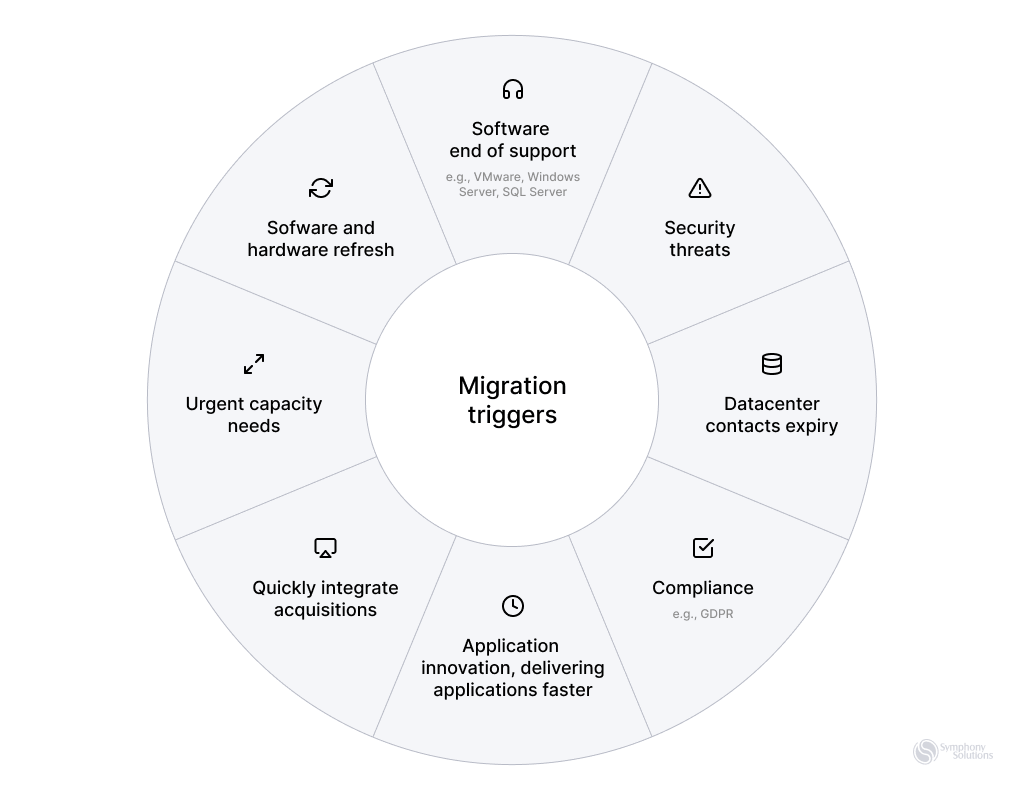
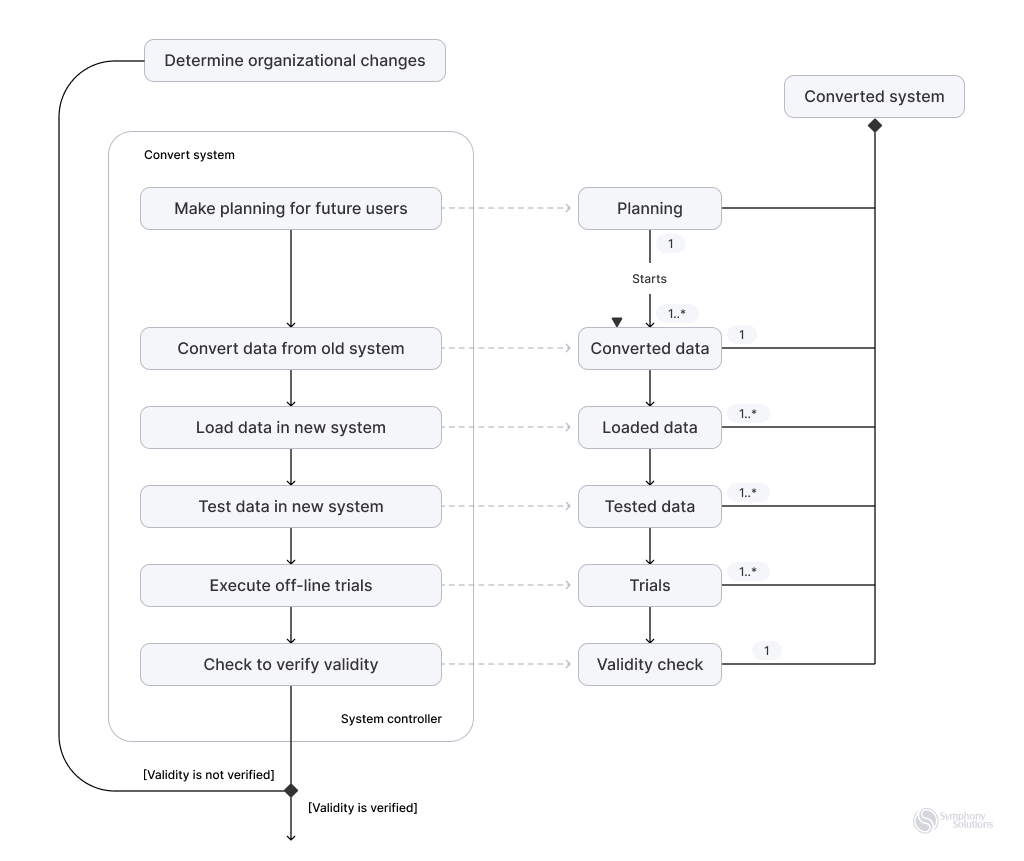
    FAQs on Dataset for Machine Learning on Data Warehouse

    Cross Industry Standard Process for Data Mining (CRISP-DM)

    The CRISP-DM process serves as the foundation for nearly all data science processes, and comprises of six sequential steps, including:

    Business understanding
    This phase entails understanding particular business objectives before determining and setting up data mining goals. You’ll also determine whether the needed resources are available to meet the set project requirements, as well as perform a cost-benefit analysis on the whole project plan.

    business understanding to deployment

    Data understanding
    After understanding the business needs, you’ll need to determine and analyze the data sets to be mined, in line with the project goals. This would mean describing data in terms of format and field identities, exploring data through visualization, and verifying the same to enhance quality consistency.

    Data preparation
    Data preparation, also known as data munging in the CRISP-DM process follows these steps:

    • Data selection
    • Data cleaning
    • Data construction
    • Data integration
    • Data formatting

    Modeling
    This phase entails building and assessing multiple data models. It include four steps:

    • Model technique selection based on neural net or regression algorithms
    • Test design generation by splitting data into training, test, and validation sets
    • Model development using a preferred code language
    • Model assessment based on domain knowledge

    Evaluation
    This phase evaluates whether the constructed model is in line with the forgoing business needs and requirements. Besides evaluating the results in the previous phase, you’ll also need to review the entire process and ensure that they were correctly executed. After that, you’ll be in a better position to determine which next steps to follow, whether its deployment, further iteration or even start an entirely new project altogether.

    Deployment
    Deployment depends on the prevailing business requirements. It can be as simple as coming up with a generalized report or as complex as initiating multiple data mining processes. Either way, you’ll need to plan, monitor, review, and offer ongoing maintenance.