Author: olesiaprots

  • The Rise and Significance of Managed Team Augmentation 

    The Rise and Significance of Managed Team Augmentation 

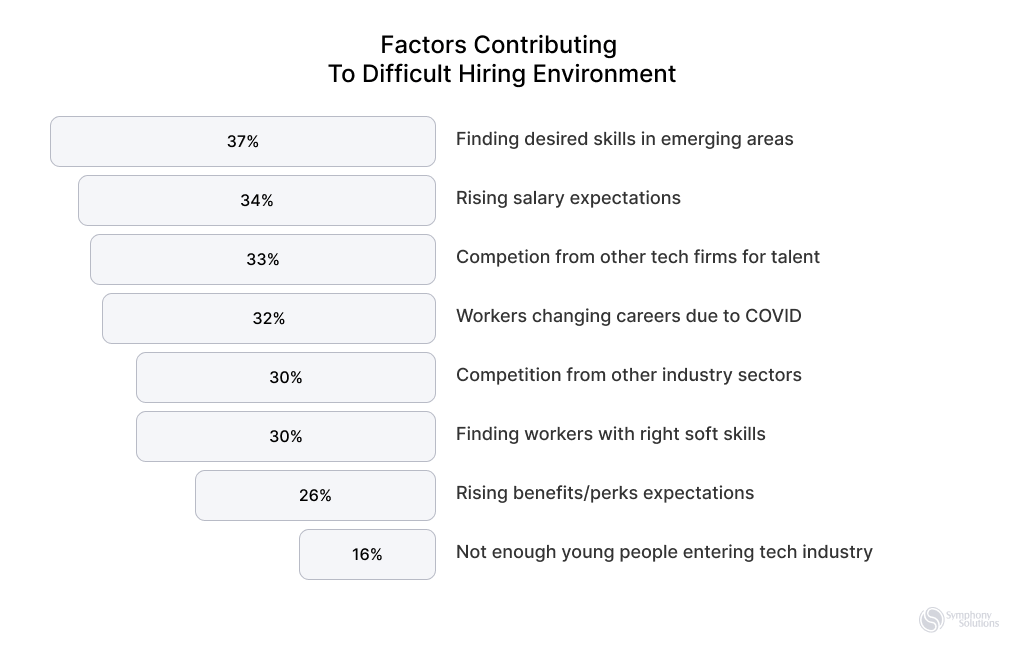
    Acquiring top-tier talent remains a significant challenge in modern business, and the numbers reflect the struggle. According to Forbes, 36% of HR leaders report they don’t have the necessary resources to attract, let alone manage premier talent. This resource constraint underscores the need for a creative solution — Managed Team Augmentation

    But what is managed team augmentation, and how can it revolutionize your talent acquisition and management approach?  

    This article will delve deep into this innovative strategy, exploring its fundamental principles, benefits, and real-world applications. By the end, you’ll understand how Managed Team Augmentation can empower your organization to remain agile and competitive in a rapidly changing market. 

    Continue reading. 

    What is Team Augmentation? 
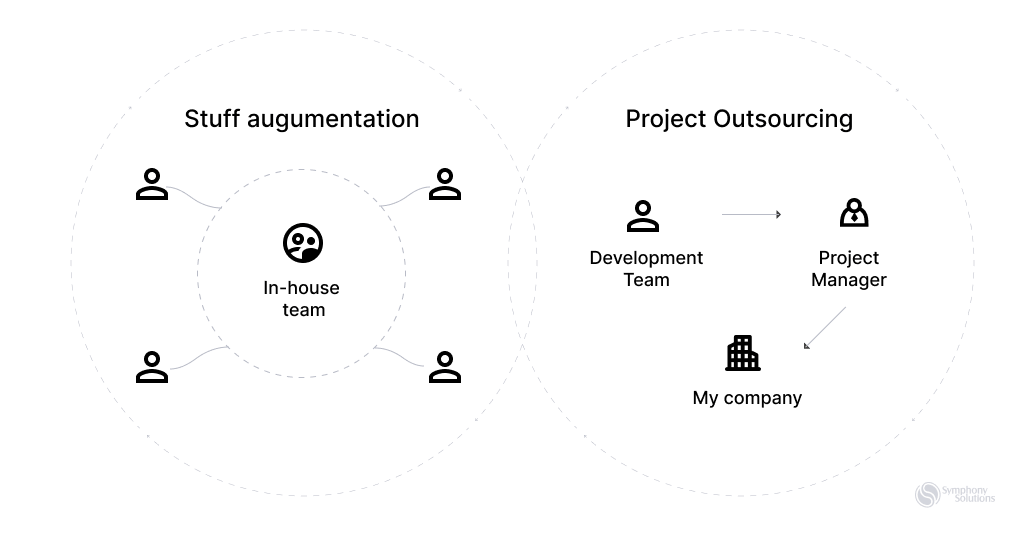
    stuff augmentation and project outsourcings

    Team augmentation is a method that allows businesses to strengthen their existing teams by adding skilled professionals from third-party providers. This strategy offers the flexibility to scale teams based on varying project needs and provides access to specialized expertise that might be challenging to find in-house.  

    …And managed team augmentation? 

    With Managed Team Augmentation, this process is streamlined, ensuring that these external professionals blend seamlessly with the existing team. Moreover, the third-party provider typically handles different responsibilities, such as payroll and HR, freeing clients to focus on other equally important aspects of their operations. 

    By adopting Managed Team Augmentation, companies can maintain a sharp focus on their core competencies. This approach minimizes administrative overhead and reduces the challenges associated with traditional hiring. Furthermore, it facilitates the rapid integration of skilled professionals, allowing the core team to zero in on strategic tasks and essential business operations. 

    Managed Team Augmentation vs. Staff Augmentation vs. IT Outsourcing 

    Initially, it might appear that managed team augmentation, staff augmentation, and IT outsourcing are interchangeable terms. However, they each offer distinct approaches to enhancing a company’s workforce with external expertise. 
    Managed Team Augmentation vs. Staff Augmentation vs. IT Outsourcing

    This table concisely compares the three approaches, making it easier to understand their key differences and select the most suitable one for a specific business situation:


    Managed Team Augmentation Staff Augmentation IT Outsourcing 
    Management and Oversight We oversee select team members; client and designated manager lead.  The client manages the team The external provider manages the team 
    Scope of Engagement Involves supplementing a project with a dedicated team that often focuses on end-to-end projects Focused on adding skills/resources to an existing team Contracts specific functions or projects to experts 
    Flexibility Highly adaptable to changing needs. The provider can adjust team size and composition Offers flexibility but may be less adaptable Adaptability depends on the outsourcing contract 
    Expertise and Skillsets  The external provider actively selects and manages the team The client selects individual team members Provider selects based on project type and specialized expertise 
    Cost Structure Pricing is often project-based or  milestone-based Pricing is typically hourly or monthly rates Offers various pricing models, including fixed contracts or outcome-based 
    Risk and Responsibility Team productivity is largely the client’s responsibility, especially regarding management and oversight. The client retains most project-related risks The provider is responsible for the team’s productivity 
    Communication and Collaboration  Communication is streamlined through the service provider Communication is more decentralized, with the client leading interactions Involves elaborate communication and collaboration due to geographic differences 

    The Current Need for Managed Team Augmentation 

    Managed team augmentation is becoming increasingly crucial for businesses for the following reasons: 

    Technological Advancements 

    Managed team augmentation empowers companies to quickly assimilate dedicated teams, perfectly aligning with their in-house workforce. By doing so, businesses ensure they are consistently ahead of technological trends and equipped with the agility to scale at pace. This adaptability is crucial in maintaining a competitive edge in our increasingly tech-driven business landscape. 

    Bridging Skill Deficits 

    In some instances, internal teams might lack the expertise required for a project. Managed team augmentation offers a pragmatic solution to this challenge. By leveraging this approach, companies can tap into a reservoir of external expertise tailored to their unique project needs. This assures project success and eliminates the logistical and financial challenges of extensive training or new permanent hires. 

    A Multi-faceted Approach to Benefits 

    Managed teams offer streamlined project management, risk-sharing, flexible pricing, simplified communication, and a hands-off or quasi-hands-off managerial system. These benefits align with the diverse needs of businesses seeking efficient and cost-effective talent acquisition and project execution. 

    Tapping into Specialized Talent Pool 

    Managed team augmentation is like having access to a vast talent pool. It allows organizations to hire technical experts with unique skills and perspectives to enhance complex projects. 

    Scalability and Adaptive Resourcing 

    One of the standout features of managed team augmentation is its inherent scalability. Projects often evolve, and with them, their requirements. The ability to swiftly and seamlessly adjust team sizes and competencies is no longer just a luxury — it’s a necessity. This scalability in hiring and adaptability keeps companies agile and ahead of the curve. 
    The Current Need for Managed Team Augmentation

    A Cost-Effective Approach to Talent Acquisition 

    Managed team augmentation offers a budget-friendly solution. Its flexible pricing options based on project goals or specific milestones are especially beneficial for startups and small businesses. This method also lets companies tap into top-notch talent without the long-term financial commitments of standard hiring practices. 

    Accelerating Project Delivery 

    Speed is the currency of today’s business realm. Managed team augmentation amplifies project pace by melding external specialists with internal teams, potentially operating around the clock. This synergy trims down project durations, fostering enhanced productivity — thus providing a time-to-market advantage, which is crucial in a competitive marketplace. 

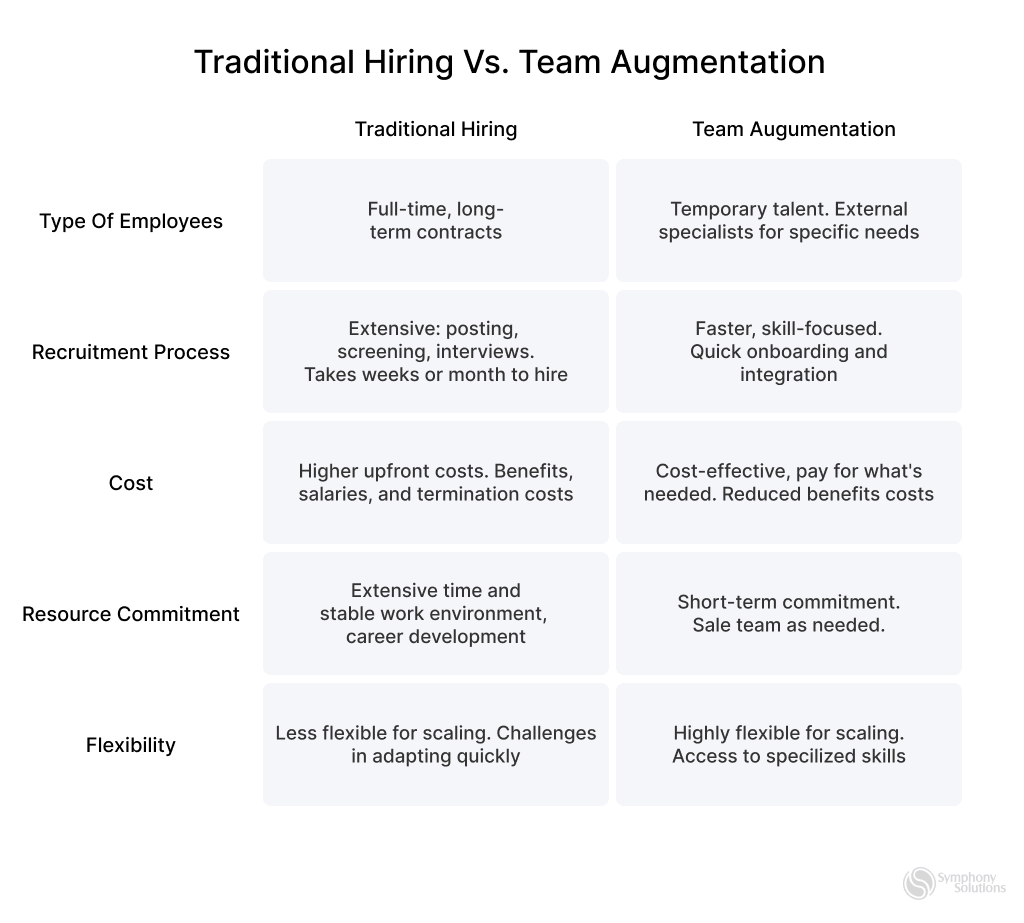
    Explore the differences between traditional hiring and team augmentation to make informed decisions for your IT projects.
    Managed Team Augmentation vs. Staff Augmentation vs. IT Outsourcing

    Mechanics of Managed Team Augmentation 

    So, what does building a managed team entail? As already established, this process is entirely handled by the service provider. Here’s what to expect: 

    Evaluating Company Needs 

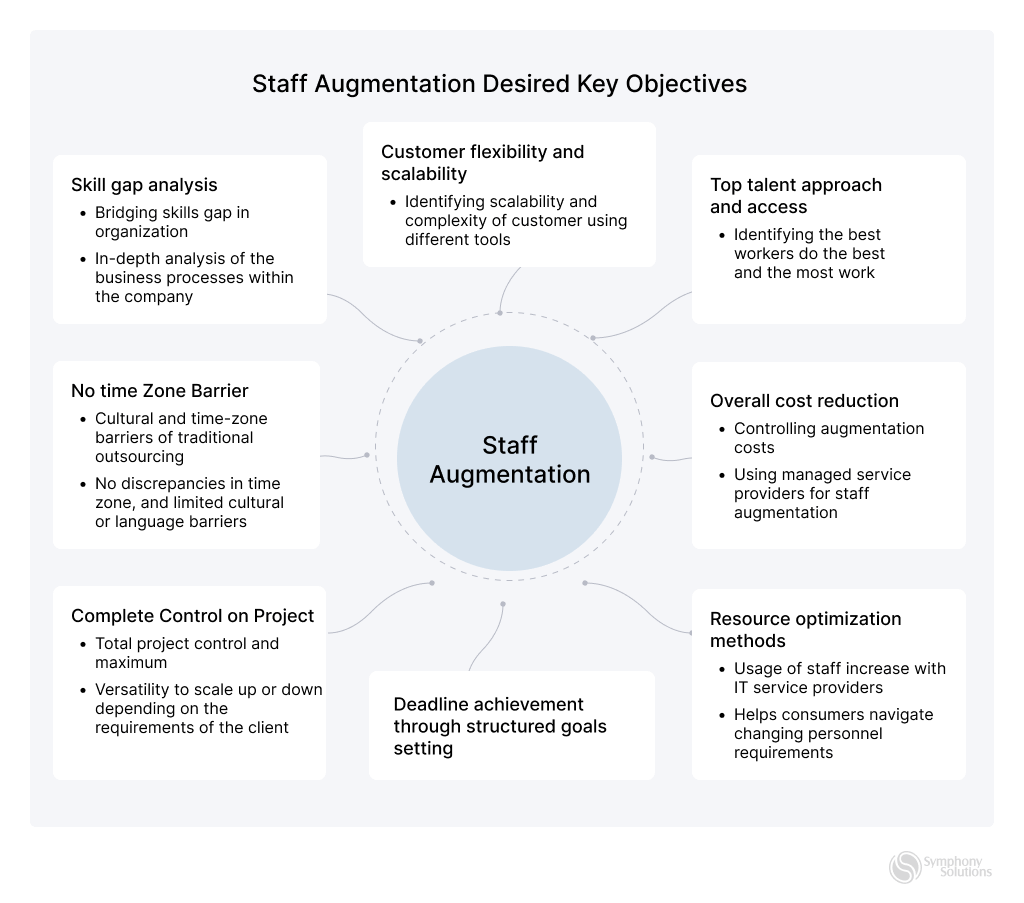
    This first step involves an initial assessment to identify the project requirements or areas where additional expertise is required. The process may include analyzing in-house teams, identifying skill gaps, and determining the scope and duration of the necessary augmentation. 
    staff augmentation desired key objectives

    Talent Matching 

    Once the company’s requirements have been defined, talent matchmaking is next. This phase involves sourcing individuals or teams with the essential skills and expertise to fill identified gaps. The service provider conducts interviews and evaluates qualifications and experience to determine the perfect match for the client. 

    Melding Augmented Teams with Existing Units 

    After talent matching, the focus shifts to team integration. This step entails defining clear roles and responsibilities, facilitating necessary training or onboarding, merging the augmented teams with the existing units within the organization, and fostering a collaborative work environment. The aim is to create a unified, cohesive team capable of working harmoniously towards the company’s objectives. 

    Tracking and Feedback 

    The final step involves tracking and feedback. Here, the service provider puts in place a system that helps to monitor and maintain the dedicated team’s efficiency. Regular team performance monitoring ensures they meet client expectations and deliver desired results. The goal is to sustain high efficiency and effectiveness throughout the project. 

    If you’re in the market for the perfect partner to assist you in building and managing an augmented team to complement your in-house talent, look no further.  

    Symphony Solutions boasts a proven track record of seamlessly building, integrating, and managing skilled professionals within organizations. You can rely on our team augmentation services to bridge gaps and elevate your team’s capabilities, ultimately ensuring success in your projects. 

    Choosing the Ideal Partner for Managed Team Augmentation 
    key considerations for choosing managed team augmentation partner

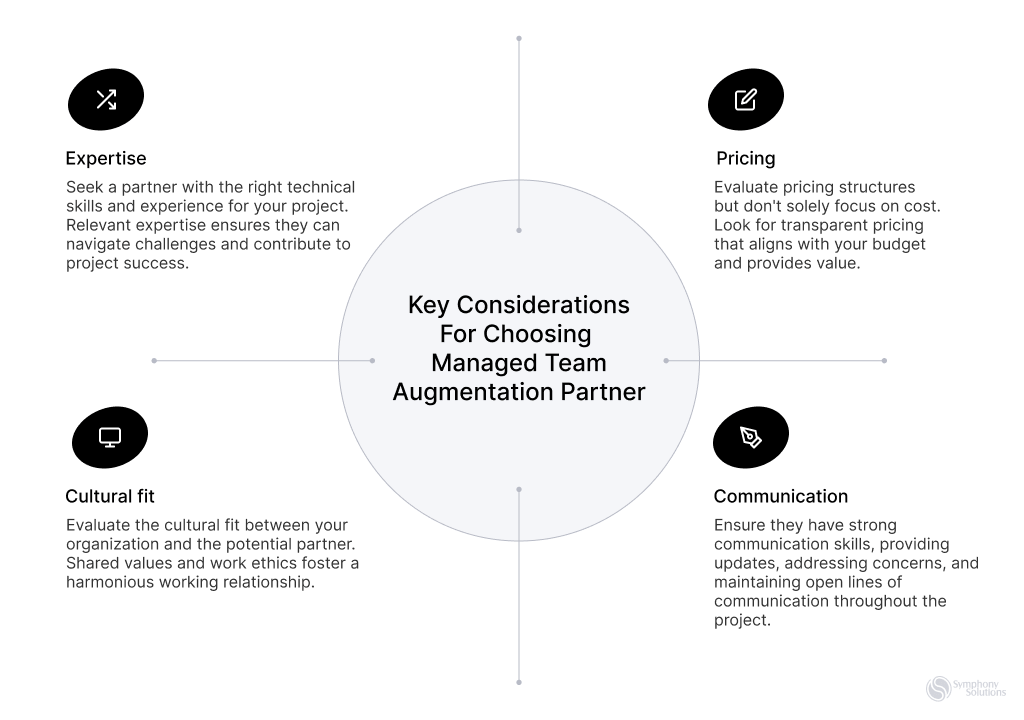
    Managed team augmentation can help your business grow, but choosing the right partner is crucial. Here are essential factors to consider when selecting a partner to enhance your in-house team. 

    Considerations for Choosing the Ideal Managed Team Augmentation Partner

    This chart shows critical considerations—Expertise, Communication, Cultural Fit, and Pricing—essential for selecting the ideal partner to enhance your team and project success. 

    The Power of Reviews and Case Studies: What to Look For 

    Reviews and case studies in hiring can also provide valuable insights into partner capabilities and client satisfaction. Here’s how to go about it: 

    • Read reviews from previous clients to understand their experiences working with the potential partner.  
    • Look for patterns or recurring themes in the feedback to gauge the partner’s strengths and weaknesses.  
    • Positive reviews highlighting excellent communication, technical expertise, and successful project outcomes indicate a reliable partner. 
    • Examine case studies that showcase the partner’s previous projects and achievements.  
    • Pay attention to projects similar to yours and assess their ability to deliver results within the desired timeframe and budget.  

    A partner with a strong track record of successful projects demonstrates their ability to meet client expectations and deliver high-quality work. 

    Challenges in Team Augmentation and Strategies to Overcome Them 

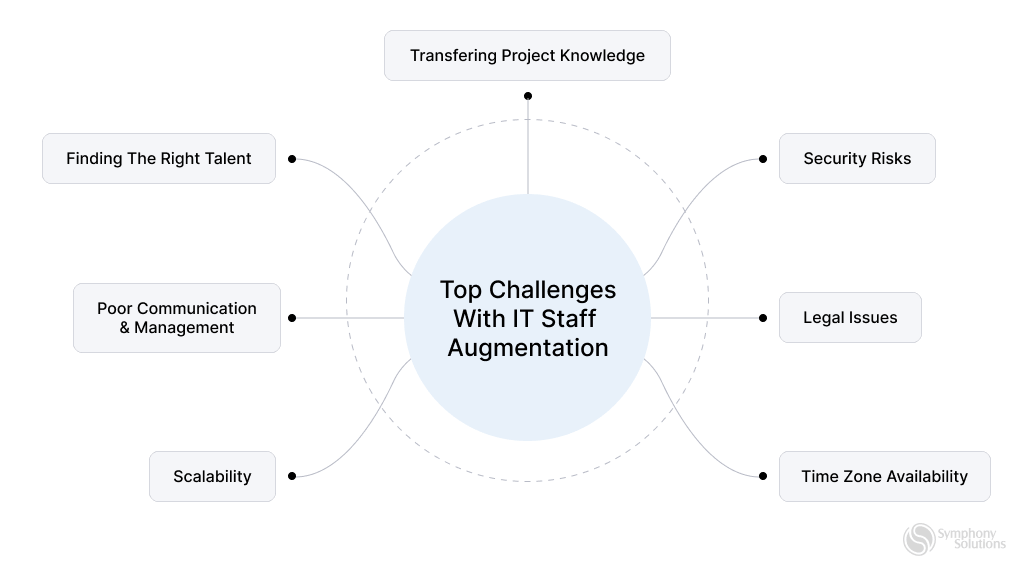
    Like most effective strategies, there are particular challenges with implementing IT team augmentation that organizations looking to leverage this model should be aware of. Here are some key challenges and their solutions. 

    Common Pitfalls and Solutions 

    Table showing the common challenges faced in technical team augmentation and the strategic solutions to solving them:

    Challenges Strategies to Overcome Them 
    Integration Difficulties Foster open communication 
    Provide cultural awareness training 
    Establish clear roles and responsibilities 
    Skill Mismatch Clearly define skill requirements 
    Collaborate with specialized staffing agencies 
    Remote Collaboration Implement robust collaboration tools 
    Establish regular communication protocols 
    Schedule frequent virtual meetings 
    Maintaining Motivation Conduct team-building activities 
    Recognize and reward achievements
    Align project goals with individual motivations
    Quality Assurance Implement quality control processes
    Conduct regular reviews and assessments
    Provide constructive feedback
    Legal and Compliance Issues Consult legal experts
    Establish clear contracts
    Stay updated on relevant regulations
    Scalability Challenges Maintain flexibility in contracts
    Work with agencies offering rapid scalability
    Security Concerns Establish robust data security protocols
    Conduct regular security audits
    Communication and Time Zone Differences Establish a clear communication plan
    Schedule overlapping working hours
    Use collaboration tools to bridge time zone gaps

    Case Study 

    Wondering whether managed team augmentation is the best option for your business? Discover how this company harnessed the power of team augmentation to overcome challenges and achieve remarkable success in their projects. 

    How KTO Group leveraged managed team augmentation to access niche skills 

    The KTO Group, a global gambling operator, focuses on delivering exceptional online gambling experiences using in-house built technology. 

    End Note: Reflecting on Managed Team Augmentation 

    Managed team augmentation represents the future of the modern workplace. According to Statista, hiring for highly specialized positions in big data/ analytics, cyber security, and DevOps may be challenging in the coming years. This flexible workforce strategy will allow organizations to access these specialized skills, scale resources, and reduce costs while prioritizing seamless team integration, collaboration, and quality assurance. 

    As more organizations adopt this model, we can expect to see the emergence of specialized talent marketplaces, increased reliance on AI and automation, data-driven decision-making, an enhanced focus on cybersecurity, the proliferation of hybrid work models, and a greater emphasis on multicultural teams. These trends will further improve the effectiveness of augmented teams in our ever-evolving work landscape. 

    Conclusion 

    The adaptability, cost-efficiency, and access to specialized skills of software team augmentation make it a cornerstone in modern business strategy.  

    As you explore this approach, remember that choosing the right partner is vital. Symphony Solutions is your top choice for managed team augmentation, offering tailored solutions to empower your success. Contact Symphony Solutions to elevate your projects and stay ahead in today’s competitive business landscape. 

    FAQs

  • Agile Implementation in Team: Methodology, Models, Processes & Tools

    Agile Implementation in Team: Methodology, Models, Processes & Tools

    The more companies testify to the benefits of implementing the Agile ways of working into their daily life, the more popular and mainstream it grows. It has become the new corporate lifestyle and comfortably found a place in many industries. The positively new mindset manifested in the Agile workflow gives companies that competitive edge that defies traditional project management and methodologies. If you’re not Agile, are you even trying? 

    Organizational transition to Agile makes your business flexible to customer’s needs and requirements. It helps you churn out ready-to-use projects fast without a loss in quality. In fact, with this approach, you can give the clients just what they desire all the while building a strong bond. And, when it comes to team management, it is aimed at nurturing self-sufficient teams with a high level of personal responsibility and commitment to a common cause. 

    Principles and practices to implement your Agile methodology right 

    The efficient implementation of the Agile methodology in the team starts with the understanding that all further practices should be centered around and designed with the right mindset in tow. If your team has already adopted the Agile mindset, you’ll find this part easy. First, you’d want to have set up some of the main keystones based on Agile values and principles: 

    • Transparency. The team greatly benefits from being well-informed about the state of the project at any stage of development.  
    • Responsiveness to change. Adaptability and flexibility is the essence of Agile. The team needs to remain flexible to any changes that may be requested by the client. 
    • Team Collaboration. As many people are involved in the development of the product and there are dependencies that can hinder someone’s work, close collaboration is a must. 
    • Improvement loop. One of essential Agile practices is having a continuous feedback loop that allows the team to improve the product upon each iteration by implementing relevant feedback from the client and always keeping the product quality in check. 

    How to implement Agile in a team 

    When you are new to Agile and consider transitioning your team to this new way of working, start by introducing your team to the concepts and help them adjust while you are on your way of Agile implementation. 
    As your team settles in, you may run into some issues and challenges. Most commonly when an issue arises it’s because there is a communication gap somewhere in the team and you’re not properly following the rules that you’ve set for yourself. 

    Here are a few quick tips that will help you address this:  

    • Educate the team. Introduce your team to the basic concepts and principles of the Agile iterative process, team roles, events and ceremonies, artifacts and tools to use in their daily work. 
    • Involve the team in creating the Product Backlog, so that they understand the scope of work ahead of them, be realistic in their planning, take into account delivery times and dependencies. 
    • Communicate clearly within the team, keep all the processes transparent and support efficient flow of information and knowledge. Anything that’s going on in the team that in any way affects the delivery of the project needs to be communicated and addressed. Whatever blockers or hindrances come up, they need to be sorted immediately to avoid escalation of any issues and failed delivery. 
    • Take responsibility. Agile teams are different from traditional ones in the way that they are self-sufficient and don’t require excessive management from the top. As a team member, you should not only be interested in delivering your part of the work. There are dependencies and a lot of collaboration involved. Think about how you are going to deliver the product as a whole and work from there. 
    • Improve the process continuously. This is exactly why you hold Retrospective meetings after each sprint. Make good use of this time and dig deep into why your team is performing as it is. Encourage everyone to participate and bring new ideas to the table on how you can improve as a team. Always seek to improve your performance, gain new knowledge and valuable insights, apply new knowledge to your work. 
    • Implement feedback loops as an essential part in creating your efficient Agile workflow. You want to receive regular feedback on the completed work and adjust accordingly. It helps make sure that you keep a clear vision of the goal you are pursuing at all times. This way you will know that the team will deliver exactly what the client wants. 
    • Choose the right tools. There is an abundance of tools that can accommodate the work of an Agile team and facilitate Agile ceremonies. Pick the ones that work best for you. 

    It’s all in the word. If you want to be Agile, first you’ll have to be agile – in your work and communication, responsibilities and initiatives. Create a team that lives by these same principles and truly commits to what they are doing.  
    So, what do we mean when referring to Agile project management? How do you get on with it? How do you even get started? Let’s explore your options. 

    Scrum and Kanban: The two main Agile frameworks 

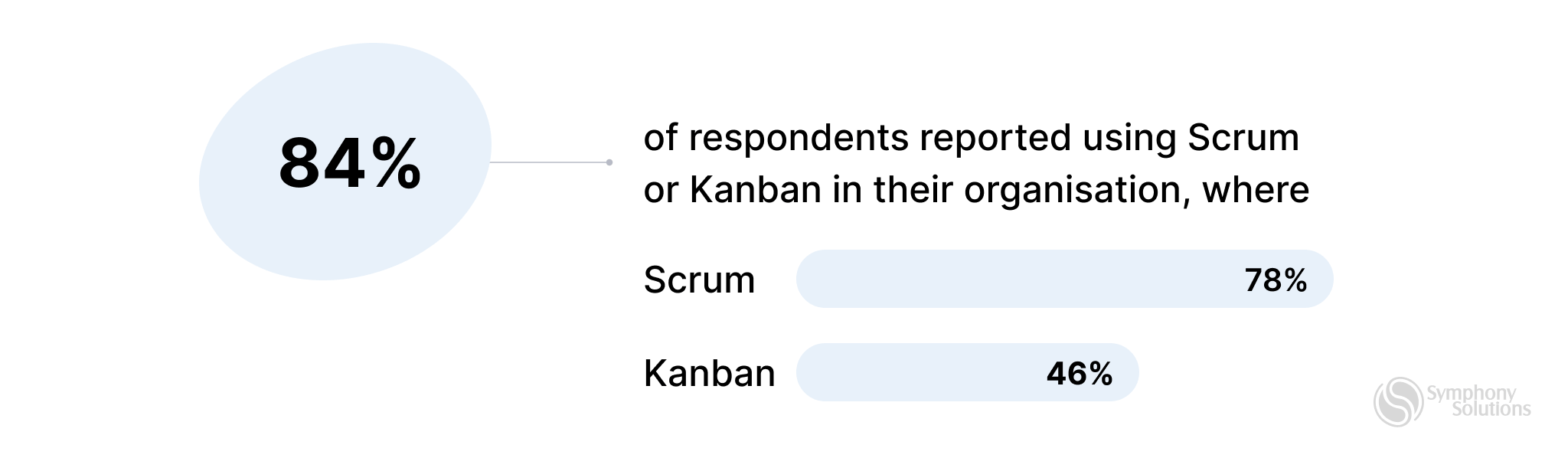
    Agile can be regarded as an umbrella term for different frameworks, models and methodologies that have the team work in an iterative way and put a stress on flexibility and frequent delivery. Two of the main Agile frameworks are Scrum and Kanban. Your Agile team can stick to using one framework or combine a few as it suits their work process. In fact, in the State of Agile report 2021 the overwhelming majority of responders, namely 66%, reported using Scrum as their preferred framework and 15% use some combination of Scrum and another model.

    Agile methodology statistics

    Scrum is your go-to framework if you can expect a lot of change in requirements as the project progresses. It gives a lot of room for change and flexibility with some usable part being delivered every few weeks, or a sprint. At the end of each sprint, the client gets to see some results of the work done and give feedback to be implemented going further.
    The Kanban framework presents complex information in a visual manner and is focused on evolutionary process improvement. It helps visualize the scope of work and avoid potential bottlenecks by managing the flow and limiting the work in progress. 
    Let’s take a closer look at what the two frameworks constitute and see how your team can implement them to better manage their workflow. 

    Getting started with Scrum: ceremonies and artifacts 

    To have your workflow run smoothly in Agile, the team coordinates its work around Agile ceremonies and artifacts that tend to set the tone for productive team collaboration. 
    Agile artifacts, which inherently belong to the Scrum framework, represent the value that the team commits to create and deliver: 

    • Product Backlog. The initial stage of every product development is creating a backlog of tasks that cover the scope of the work to be delivered. As you progress in your work on the project, the product backlog may expand and change, with the ideas being fleshed out reflecting the client feedback. It’s important to be precise in defining the items in the backlog, know the scope of work that needs to be done, and have the project manager set priorities. 
    • Sprint Backlog is a list of tasks that the team commits to completing in a sprint. The items are selected from the general Product Backlog. The team sets a goal for the sprint and has an action plan for how to approach the scope of work determined. Achieving the Sprint goal is a team effort and requires everyone to be on board. This means that everyone needs to be aware of their dependencies and focus on avoiding or eradicating blockers and bringing the tasks to completion rather than only keeping your personal to-do list in check. 
    • Increment is a single step in achieving the Product goal. Each increment builds up to the entire project. It needs to be usable for the client and provide a certain value. The team may work on multiple Increments within a single sprint, and several Backlog items constitute an Increment. 

    The ceremonies used in Agile are formally organized events purposed for the team to check the progress on the current Increment, detect and address blockers, adapt Scrum artifacts and adjust their processes contained within a sprint. 

    scrum process on project

    These are the Scrum ceremonies, as follows: 

    • Standups are daily Agile meetings that are a check-in point for the team when they can communicate and review the current status of tasks. This is the time to address any blockers or dependencies that need to be accounted for.
    • Sprint Review and Planning are two events in Scrum that are closely correlated. Sprint Planning is when the team picks up the backlog items for the upcoming sprint and determines their goal, whereas Sprint Review is the team reporting on a sprint well-done. Or, more realistically, reporting on any issues that may have come up in the sprint and determining how to avoid them in the future. At this point, Product Backlog may be adjusted.  
    • Retrospective meetings are another type of Agile ceremonies held regularly for the whole team. The meeting is aimed at reviewing the team’s performance in the finished sprint, acknowledging what was done right, detecting possible issues and finding solutions to be implemented in the future to improve the team’s output. 

    Getting started with Kanban: ceremonies and artifacts 

    The Kanban system doesn’t generally mandate any specific ceremonies that are characteristic of the framework, but rather uses a customized mixture of ceremonies. Kanban works well when it is used alongside Scrum. It is meant to optimize the flow of work in the value stream, which is done through a set of practices, some of which are the following: 

    • Presenting the flow in a visual way. This is done with the aid of a Kanban board, a physical or digital board that helps visualize the scope of work and see the progress on the project at any given moment. The Kanban board is used by moving cards containing items of work through the stages of “To-Do”, “In Progress” and to “Done”. This way, you can see the workload, level of completion, bottlenecks, etc. 
    • Limiting the work in process (WIP). This means setting a limit on the number of work items the team is working on at any stage of the project. Limiting WIP allows the team to better manage their workload, detect and mitigate bottlenecks, and complete the tasks faster. 
    • Striving to improve the process. As Kanban is used in a fast-paced work environment with rapidly changing priorities, the team will need to continuously improve their processes to keep up with the pace. The team will greatly benefit from using metrics like throughput, lead or cycle time, etc. 
    • Implementing a continuous feedback loop. This can be done in the form of meetings (Kanban Cadences) where your client get to share their input regarding the project, areas of concern and see what can be improved. The team then can analyse the input and decide on what steps to take to implement the client feedback. 
    • Establishing explicit process policies. A Kanban team should have set rules for their work processes and agree on how to determine if a work item is ready to be moved to the next stage. 
    kanban process

    As you can see, the Kanban methodology in practice has minimal requirements to make it work. Within the Kanban framework, there are no explicitly predefined artifacts. Arguably, some consider an artifact anything that is generated as you are implementing the methodology and there’s some discussion on what is an artifact in Kanban exactly, but the methodology itself doesn’t specifically identify any of such requirements. 
    When it comes to ceremonies, there are no fixed time slots to be used for planning or reviewing tasks and the workflow. There are however Kanban Cadences, a proposed series of meetings at different levels (team level or service-oriented). The team can decide on what cadences will be beneficial to their workflow, organize them regularly or on demand. 
    Having said that, Kanban would fit best a mature team that feels comfortable working with all the flexibility that the framework provides, and in fact benefits from it due to the nature of its work. A Kanban team is a self-sufficient entity that evolves and progresses in its processes organically. 

    Agile tools for successful methodology implementation 

    It may be helpful to use Agile workflow tools to accommodate your team. These can be web applications and services to facilitate efficient team communication, task tracking, file sharing and storage that allows multiple team members to work on files simultaneously. Generally, the team picks a combination of tools and leverages it to get the most out of available functionality and streamline the work processes. 
    Here is a comprehensive list of tools that you might want to consider using for your team. Of course, you may discover that your team prefers something different and stick to that. 

    • Jira is a task management tool that is widely used for tracking progress in a sprint. It has a Kanban board where the team can visually show their status with basic workflow states like To Do, In Progress, Under Review, Done. 
    • MS SharePoint is a web-based platform for team collaboration that is integrated with MS Office.  
    • Google Docs is similar to SharePoint but it’s powered by Google and can be used independently with your already existing Gmail account. 
    • Bugzilla is a bug-tracking tool specifically targeted at assisting in the development process, mostly used by test and software engineers.
    agile tools in agile workflow
    Source: the 14 Annual State of Agile Report by Digital AI 

    Even if your team is fully or partially remote, Agile is probably the best model to be chosen for team workflow. Read more about helpful tools and tips for distributed Agile project management.  

    Summary 

    Establishing an Agile development workflow can become the competitive advantage that will help you get more business and increase the satisfaction of your already existing clients. Developing workflow processes with Agile at heart, helped Casumo to get better results through improving collaboration with technical teams and being consistent when delivering value to the customer.  

    With the integrated Agile in practice, the teams are able to create a product that hits just the right spot when it comes to customer’s needs and wants and they do it fast. If you want to follow the lead and turn your team Agile, consider inviting an expert to provide Agile implementation consultancy and mentoring to help you get the processes going and support you through the transitional period. You may find yourself at the start of an exciting journey that will eventually come to change the core essence of the way you work. It takes only a few days or weeks to establish the Agile process but it takes months or even years to master it and make the team fluent in operating within it. But once you’ve got it, you’ll never want to go back. 

  • Managing a Distributed Agile Team while Overcoming Challenges & Risks

    Managing a Distributed Agile Team while Overcoming Challenges & Risks

    As the current trends show, this is just the right time to get on board with remote work for your software development teams. If in the past, you would usually hear of distributed teams in terms of outsourcing, with the way the world is turning in the new Covid reality, working remotely is becoming part of the new normal and is likely here to stay. And with Agile becoming the preferred way of working in many companies both in IT and other industries, the next logical thing would be to implement its principles for setting up distributed Agile team management. 

    Agile and distributed teams incompatible? 

    So, what is a distributed Agile team anyway? From the sound of it, the phrase may just as well be an oxymoron. However, practice shows that even such things as Agile team management and distributed teams can be quite compatible, as long as you know what you are dealing with. 

    Agile derives a lot of its strengths from the principle of continuous interpersonal communication. The flow of information never stops within an Agile team. You want all team members to be aware of the project status, possible blockers and dependencies. Product Owner keeps stakeholders informed. Whatever goes south in a team, there is someone ready to pick it up and carry on with the tasks, by all means necessary, and with their eyes on the shared goal of continuous delivery, constant improvement and growth. 

    Agile is big on clear communication and teamwork. It’s what makes it possible for the team to quickly show results of their work, be it an MVP or a prototype. In some cases, like with MVP for SpoedTest Corona project, the client was able to see the first useable version of the project within just two and a half weeks since the start of the collaboration with our remote development team. Fast information exchange, mutual responsibility and commitment to a common cause – all this makes Agile development possible. 

    In this case scenario, one should think, is it then even possible to have an Agile team when the people are not always in close proximity to one another?  

    The answer is simple. Of course, it is possible and it’s happening all around the Agile world. Adopting Agile for traditional teams just as for distributed teams is feasible, as long as you set up your processes right, know what pitfalls to look out for, look at the example of companies that are already doing it successfully and adapt it to your company’s and project’s needs. Adjust for the specifics that come with being “distributed” and you’re good to go. 

    Benefits of Agile for distributed team management 

    Using Agile for distributed teams may be just the thing that sets them up for success. Implementing it is more than just ticking the right boxes off the list. It’s about adopting an Agile mindset that is the driving force in the company’s transformation eventually leading to business agility. 

    Agile puts an emphasis on self-sufficient and organized teams. Every team member takes responsibility for the project’s successful completion and delivery to the client instead of solely focusing on their personal tasks. This is one of the key factors for distributed agile success. 

    An Agile team is set to continuously improve and evolve. Each person looks at the bigger picture with one goal in mind – timely delivery of a working product. The trick is to remember that you are working in the context of distributed Agile delivery, but as practice shows, this is not only manageable but comes with its own perks and advantages. 

    How to organize distributed Agile development 

    Managing a remote team in most cases is not drastically different from working in co-located teams. It’s mostly about finding the balance, setting clear goals and deadlines, and accommodating an uninterrupted information flow between teams to manage dependencies. 

    Remote Agile team roles and responsibilities 

    The optimal team size in Agile is 3 to 9 people, which is equally applied for both distributed and non-distributed teams. The reason for this being that Agile heavily relies on constant information flow and communication and in big teams it tends to become complicated. 

    biggest struggle with work remotely

    Team roles in a remote team are no different than team roles in a traditional Agile team. 

    Although, it is recommended to put some thought into balancing out team composition across locations. Generally, it is not advised to divide the distributed teams by function but rather by feature. This means that you shouldn’t keep all developers in one place and testers somewhere completely different. This would make it more difficult to consolidate different lines of work. It’s good to have a team that is able to operate as an independent unit when the need should arise. 

    Also, different countries have their own regional differences in terms of public holidays, as well as unforeseeable situations when you may find an entire office from a certain location unable to work due to a natural disaster or political instabilities. 

    Tasks and backlog management 

    When working with both in-house and remote teams, the workload should be evenly distributed. Remember, that remote teams are not an appendix to the main office, but treat them as equals and show appreciation for their contribution to the project. 

    When it comes to distributed agile development, it’s important to ensure that there are no delays with co-dependent teams in delivering on their part. The team should be realistic about the user stories they commit to in terms of dependencies and on-time delivery. Because of this, it may be advisable to reconsider committing to complex user stories that may require a lot of input and contribution from remote team members. These complex stories may be broken down into smaller and more manageable sizes. 

    A self-manageable team should be able to continue working on tasks without major delays. The backlog should be created with this in mind. 

    Agile activities and events for distributed teams 

    In order to accommodate the work of a remote team, extra effort goes into organizing the Agile workflow and introducing tools to facilitate communication, planning and collaboration. Properly organized, these ceremonies work great for managing workload with distributed teams. 

    Daily stand-ups are just a routine for co-located teams but become a crucial point of contact when you are working remotely. This is the time when team members report on their tasks in progress and communicate issues or blockers. To make the best of this time, you can also talk about other tasks that you have planned for the sprint or in your backlog. Team members should be asked some “burning” questions: 

    • Do you need input? Who can assist you with that? 
    • Do you have any blockers? Are you blocking someone else’s work? 
    • Will you be able to pick up these tasks once done with the current work? 

    Keep in mind that if you need someone else’s contribution to continue working on your tasks, the person might not be immediately available, so address these moments beforehand. 

    To accommodate Agile ceremonies, remote teams may use video conferencing software and screen sharing. Of course, it helps to have an uninterrupted internet connection and good quality sound equipment.  

    This works just as well for daily meetings, as for weekly sprint reviews and even retrospective meetings, with the difference being in the scope of work that you are looking back at. It may require some time to set up virtual tools, whiteboards and breakout rooms, etc. But in the long run, teams often opt to switch to using these tools for all their work and planning even if they’re co-located. It is more convenient and you don’t end up doing double the work, like when you do your planning on a wall with sticky notes only then to transfer it into a spreadsheet. 

    An interesting fact is that some companies have even successfully conducted full-on PI plannings for distributed teams with remarkable results. This doesn’t go to say that in-person events are redundant. Socialization is usually a big part of PI planning as it helps establish good relations within the team and for distributed teams that are brought to the location specifically for the event. But if meeting in-person is not an option, it is possible to get it done with a virtual agile team without too many losses. 

    Agile events and activities and goals

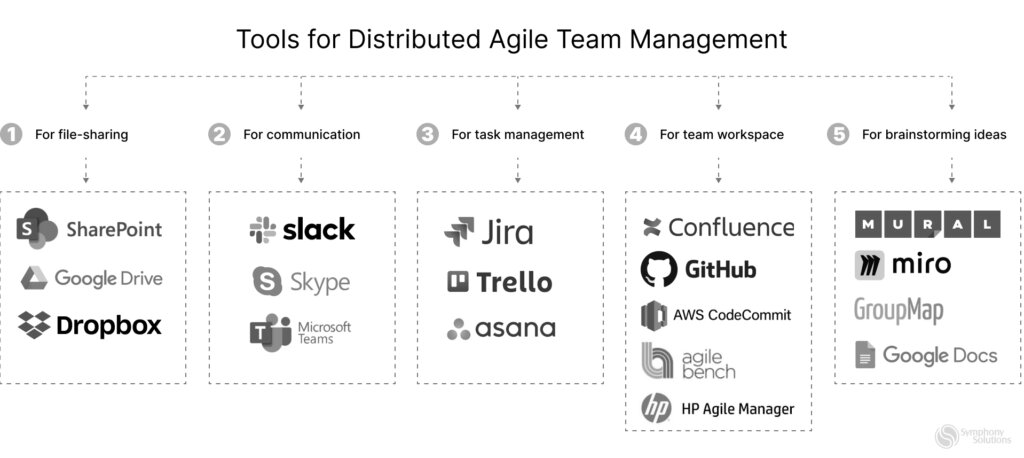
    Tools and practices for distributed Agile development 

    File-sharing 
    Coming back to the daily grind, distributed teams benefit from setting up a file-sharing network. Multiple people should be able to access and work on the files if necessary, so it makes all the sense to use a cloud-based storage service. 

    Tools to check out: 

    • MS SharePoint 
    • Google Drive 
    • Dropbox 

    Communication 
    For communicating throughout the day, teams can use instant messengers. This can be either person-to-person or group chats, conference calls, etc. With some tools like MS Teams, you can schedule calls in advance and even see the other person’s available time slots. 

    Tools to check out: 

    • Slack 
    • Skype 
    • MS Teams 

    Task management 
    Agile teams regularly use services to track tasks in a sprint and manage the workload on a weekly or bi-weekly basis depending on how long is the sprint. 

    Tools to check out: 

    • Jira 
    • Trello 
    • Asana 

    Team workspace 
    The team can create something like a wiki to be the single source of information and all updates on the project. Code documentation, although not a priority according to the Agile manifesto, for distributed teams may replace the need for in-person communication or calls and meetings to discuss the code. Another important purpose of a shared team workspace would be source code management and version control. 

    Tools to check out: 

    • Confluence 
    • GitHub 
    • AWS CodeCommit 
    • Agile Bench 
    • Agile Manager 

    Brainstorming Ideas  
    The tools for idea brainstorming and collaboration are a must for any distributed team. They serve as a whiteboard where anyone can add ideas, map different items, comment, and offer many more features that make remote collaboration more effective. There are a bunch of tools that can serve this purpose: 

    • MURAL 
    • Miro 
    • GroupMap 
    • Google Docs 

    A good practice is to use a combination of tools that best suits your project’s purposes and the teams’ needs. This way you can greatly improve your output and the quality of work. For instance, having proper documentation and governance for QA and software development process in place allowed VirtualStock team to deliver new product release every two weeks

    Tools for distributed Agile team management

    Distributed vs Traditional team management: Challenges and risks 

    Working with distributed teams may pose some challenges and risks compared to traditional teams, which should be addressed to help remote team members ease into the work process and avoid unnecessary clashes due to inherent differences. 

    Communication gaps come as the most commonly occurring issue for remote teams. When not working in-person, it takes effort to organize efficient communication. You’ll have to schedule a call instead of just walking by your coworker’s desk. You may get delayed replies to your emails or messages. Worst case scenario, you’ll have a time-sensitive task or an urgent question and won’t be able to contact your colleague on the spot. The more people are involved in communication, the more complicated it becomes. Efficient communication for remote teams requires diligence and time management, collaboration and at times compromises. 

    Cultural differences is another challenge that may seem unlikely but good to account for when managing distributed teams. This may manifest itself in how people with different cultural backgrounds approach their tasks if they have respect for deadlines, subordination and formal or informal communication. There are nuances in different situations and it’s important to respect other cultures. However, the best practice would be to find a common ground that could be expressed in the company culture shared across locations. 

    Time zones come as a big challenge for the effective organization of team communication. A difference in time may mean that your team member from the other end of the world may be getting valuable input from you on the project when they are already done for the day, while you are just up and about to start the day. If any urgent issues occur, it may be hard to get a hold of people at short notice, unlike with traditional teams when you can walk right up to your coworker’s desk. 

    This can be helped by excessive planning around different time zones and finding time slots with overlapping working hours that are suitable for everyone involved. Consistency with schedules, timely communication ahead of the deadline, making sure that there is a time bumper for unforeseeable situations, clearly communicating your needs may be helpful as well. 

    Tips for distributed Agile team management 

    We have mentioned and suggested possible solutions for all the big-picture issues that may come in the way of the efficient work of your team. Here are a few more quick tips that you might find helpful for managing your distributed Agile teams: 

    • Build a team that works well together. Your team should bring together people who show a high level of professionalism, who are motivated and committed to the common goal, etc. 
    • Build trust and transparency. This can be obtained with proper reporting and efficient information flows. 
    • Make communication as easy as possible. This means efficient time management and scheduling, finding the right tools and encouraging your team to use them. 
    • Co-locate development teams with their Product Owner. As mentioned above, teams work best if they are able to be self-sufficient and function without any restraints or major dependencies. A Product Owner can play a big role in achieving this for your remote development team. 
    • Get training from an Agile coach not when you’re in the bottleneck, but on the start. Training for all teams helps to understand for every member Agile practices better, his/her role within Agile process and act better as a team then. Also, the neutral view and recommendations from a third-party expert can reveal for you many insights and points to improve your team efficiency. As it was in the case when our Agile experts conducted training for Casumo’s team that helped them achieve more efficient collaboration.  
    • Organize offline activities and events. If possible, find the time to bring your team together. Let them mingle and build a relationship. 
    • Minimize delays and wait times. At daily stand-ups address not only your work for the day but issues that may hinder your work tomorrow and further down the week. Be aware of possible dependencies and blockers. 

    Summary 

    Although designed originally for close in-person cooperation, Agile gives distributed teams the means to manage their workflow and address all the shortcoming of working remotely. Distributed development best practices correlate with many Agile principles and when equipped with the right tools, remote Agile teams are empowered to accelerate development and put out top-quality software on the market as fast as co-located teams with a bonus of smart budgeting and saved costs from engaging teams from other countries. 

    So don’t hesitate to step into Agile, as its benefits are obvious. Even in case, you feel struggling with implementing it, check our Agile consulting services that help to implement Agile in your team and organization considering the specifics of your project and industry. 

  • What’s in a Skill: Periodic Table [Matrix] of Scrum Master Competencies

    What’s in a Skill: Periodic Table [Matrix] of Scrum Master Competencies

    Going through my personal Agile journey as a Scrum Master led me to some conclusions that this role (accountability according to the new Scrum Guide) is a combination of soft and technical skills. Some of them you can learn and develop from the courses and books, and some are very hard to acquire and it might take ages to master them. I would like to share my findings in the form of a Periodical Table. Similarly to Mendeleev, it came to me in my night dreams and those competencies started popping up and taking their respective places.  

    A competency or a skill is a very far-reaching concept. Does It mean technical or soft skills? Is it something inherent or can it be developed over time and with effort? And what about personality traits? Where do they fall in the equation? 

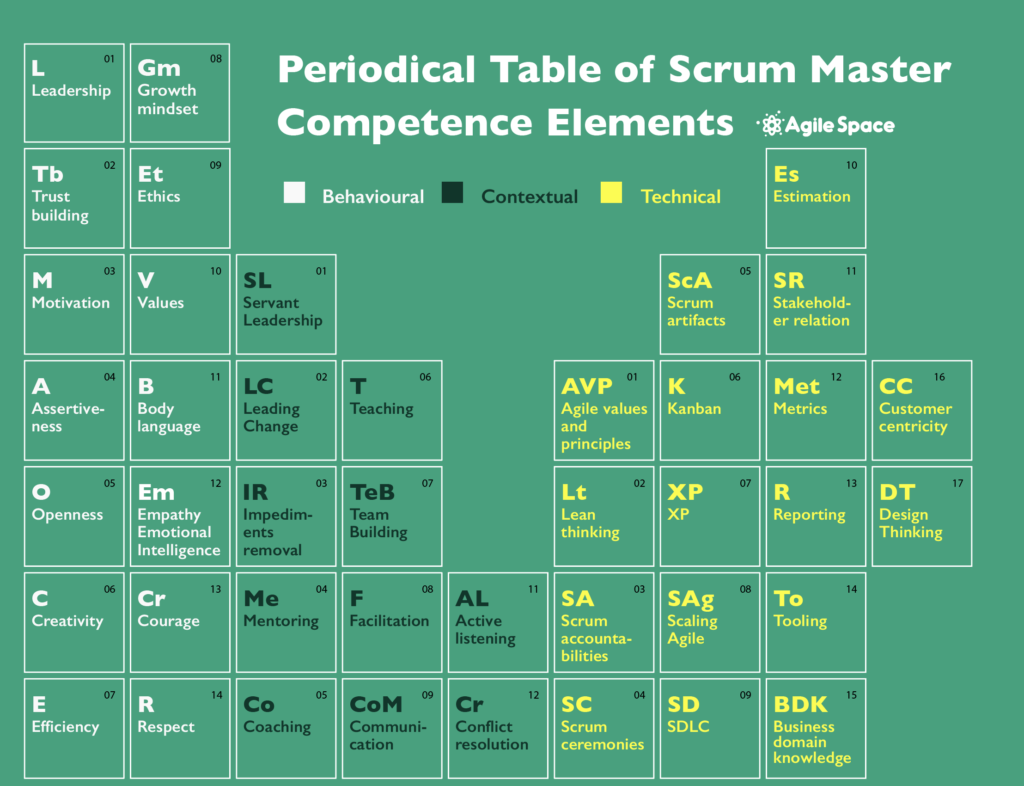
    When it comes to Scrum Master competencies, you can distinguish them by placing the skills and traits into three categories, i.e. Behavioral, Contextual, Technical. A good set of well-developed competencies will have the Scrum Master right in place in a team. Depending on specifics of your company or team, your list of SM skills and competencies may vary and you may have a different focus for your particular needs. However, a rule of thumb would be to strive to be a well-rounded personality with a good grasp on each of the categories. Find your balance and figure out what works for you and your team. 

    You can see a general overview of the core competencies for a Scrum Master in the “periodic table” of Scrum Master Competence Elements. 

    scrum master skills & competency matrix

    Let’s take a closer look at the elements that make up the Scrum Master competency matrix and what they constitute, which ones you may be lacking and what you can do to further develop your skills to become successful in your role as a Scrum Master. 

    Behavioural 

    Any Scrum Master’s job largely revolves around communication and resolving issues that come up in the working process. In this regard, it helps to have a strong set of personal traits and values that help the Scrum Master become the beacon of reason in the team. The trusty leader that looks out for the team’s best interest. Someone who is trusted and can be relied on. Behavioural competencies mostly result from your personality – a combination of nature and nurture. However, you can strengthen these skills with self-reflection and personal development. 

    1. Leadership skills are a requirement that comes with Scrum Master responsibilities. Although they are not in the position of a project manager, the team still strongly depends on efficient leadership from the Scrum Master in following the Agile practices and managing workload or any conflicting situations that may arise no matter the nature. 
    2. Trust building. Since the Scrum Master acts as a mediator between the team, the Product Owner, and the stakeholders, it’s important for him to be able to build and maintain trust. This will build up to other skills required to manage a Scrum team. Essentially, any efficient communication and collaboration should start with trust. 
    3. Motivation is good to have when you want to get your work done. Even more so, if you want to get other people to do their work. 
    4. Assertiveness constitutes how you express your confidence remaining respectful, yet not being a pushover. This is an important trait in a professional setting, especially for navigating stressful situations. 
    5. Openness is an essential trait for a good leader. It means that you acknowledge different opinions and experiences and don’t restrict yourself to only what you know to be fact. It is crucial when it comes to introducing change and innovation. 
    6. Creativity is a tricky skill to have. Is it innate or something that you can learn? Hone your creative mind, use it for problem-solving and to inspire others. 
    7. Efficiency is valued in any team member. A Scrum Master that knows how to accomplish their tasks efficiently, will know how to require the same from their team. 
    8. Growth mindset in an Agile setting is the force that drives positive change and helps take any difficulty as an opportunity to learn. This is what a Scrum Master would want to transmit to their team by their own example. 
    9. Ethics in business appropriate the practices and behaviors to confront any possibly controversial subjects. Scrum Master exhibiting strong business ethics sets the standard for the whole team. 
    10. Values make up a person. Having strong personal values helps you earn people’s trust and respect and become a good leader for the team. 
    11. Body language can say a lot about a person. It can be a strong and expressive tool for non-verbal communication expressed with posture, facial expressions, hand gestures. As a Scrum Master, you should be aware of what signals you are sending with your body language, just as well as be able to read the room and pick up on these signals coming from your team members. 
    12. Empathy and Emotional Intelligence help you build personal connections with people and it can be learned by observing people, initiating conversations, being an active and attentive listener, recognizing their emotional needs. 
    13. Courage can be expressed in your ability to introduce change that some may find risky, make judgement calls and take responsibility whatever the outcome. 
    14. Respect is the backbone of all teamwork that goes both ways. A Scrum Master needs the team’s respect, and just as well should show respect for any individual team member.  

    Contextual 

    A Scrum Master is only as good as their team is. It’s important for them to establish good relationships within the team, encourage open communication and facilitate their work. Contextual competencies focus on the role of the Scrum Master as the leader and facilitator. So let’s see what elements in the Scrum Master skills matrix are helpful for this: 

    1. Servant Leadership. Lead by example, be leveled with your team, and they will follow. Ask yourself what you can do for your team right now and do it. 
    2. Leading Change may come as a tricky endeavor. Not everyone wants to leave their comfort zone and risk failing. As a Scrum Master, you should be able to deal with that and introduce change to your team as an exciting opportunity. 
    3. Impediments removal required the Scrum Master to handle the team’s dependencies and blockers. They should be able to address these issues in a team and help rearrange workload or handle any communication with the people involved to find a solution. 
    4. Mentoring means becoming a good role model and encouraging your team to overcome any hardships, either by offering sound advice, sharing your own experience, or providing support. 
    5. Coaching in the context of Scrum Master’s duties constitutes prompting the team to discover their potential, improve collaboration, develop their skills and knowledge, and learn how to be self-sufficient. 
    6. Teaching means that you can put aside your personal experience and opinion and share the knowledge remaining objective and unbiased. 
    7. Team Building is something that a good Scrum Master will encourage and facilitate to establish interpersonal relationships in the team, teach them trust and improve teamwork. 
    8. Facilitation is probably one of the most important responsibilities of a Scrum Master. Your top priority should always be to create the right kind of environment for sharing ideas and finding solutions to problems. 
    9. Communication should always be efficient and timely. It’s a competency that is crucial for a Scrum Master as they not only need to approach their own team members, but act as a bridge for them and stakeholders or teams they are dependable on. 
    10. Active listening is one of the essential traits of a good leader that helps create good communication. However, don’t use that as just a trick, lest it may backfire on you. Engage in the conversation without judgement or offering unsolicited advice. Not just listen, but hear what the other person is saying. 
    11. Conflict resolution comes with the job description. Whenever the team starts to get entangled in drama, Scrum Master has to sense the conflict before it starts to escalate or sometimes initiate one when avoiding conflict gets the team stuck in a rut.

    Technical

    In this regard, you can distinguish between competencies that have to do directly with practicing Agile and those related to software development. Generally, the Scrum Master isn’t required to have a background in software development but if they do, it only works to the benefit of the team and their own. Thus, the Scrum Master should be proficient in the following: 

    1. Agile values and principles defined in the Agile Manifesto, are the foundation of the Agile philosophy that sets up the standard for teams who want to practice Agile. 
    2. Lean thinking provides a purposeful way of thinking regarding the team activity in terms of value streams and flows, aimed at achieving sustainable growth, elimination of waste, and client satisfaction.  
    3. Scrum accountabilities. Each Agile team member carries accountability within their role. For the Scrum Master this would be the team’s good understanding and efficient application of Scrum principles and practices. 
    4. Scrum ceremonies are the events that help the team plan their workload, review the job done, and act as checkpoints in between. The Scrum Master’s job is to ensure that this time is used efficiently and with purpose. 
    5. Scrum artifacts are the Product Backlog, Sprint Backlog, and Product Increment. Scrum Master assists Product Owner with the Product backlog and helps the team manage the workload through applying Scrum principles. 
    6. Kanban is a popular framework that encourages transparent communication and uses visual aids for streamlining work processes. Kanban elements are widely used in Agile teams to better manage backlog and work in progress.
    7. XP or extreme programming is a type of Agile software development that advocates for short development cycles with frequent releases. There are many XP practices and SM has to know the best cases for their successful implementation. 
    8. Scaling Agile comes into picture when the organisation is growing exponentially and thus requires an altered approach and new process dynamics for Agile to remain efficient large-scale. Scaled Agile Framework (SAFe) is used for large enterprises. This introduces new levels of collaboration for the Scrum Master, e.g. Scrum of Scrums. 
    9. SDLC or Software Development Lifecycle is the process used for software development that typically encompasses planning, design, development, testing, and deployment with further maintenance. Different SDLC models should be distinguished (Waterfall, Agile, RAD, etc.). 
    10. Estimation gives the team an idea of the scope of work to be done. A Scrum Master looks to it that task estimation is realistic and the workload manageable. 
    11. Stakeholder relation is of utmost importance when the team relies on their input or feedback to efficiently complete their tasks. Although, mostly the communication with stakeholders goes through Product Owner, the Scrum Master plays an important supporting role. 
    12. Metrics, such as velocity, throughput, sprint burndown, code coverage, etc., are collected and analyzed in order to identify the team’s weak spots and improve the processes. 
    13. Reporting is necessary for keeping track of the work processes and results, it promotes continuous improvement. Scrum Master is responsible for reporting within the scope of the team’s efficient application of Agile practices. 
    14. Tooling. There is a broad selection of tools to support the Agile way of working. Scrum Master makes sure that the team has the right Agile tools and uses them with sufficient benefit to their work process and staying true to Agile principles. 
    15. Business domain knowledge for Scrum Master assists in better understanding of the business processes, how it should translate to the team’s commitments and interactions with stakeholders. 
    16. Customer centricity is important on any level of an organization. See to it that your team remembers that the end goal of any project is ultimately to achieve customer satisfaction. 
    17. Design Thinking is an approach to problem solving that has distinct user-centric practices in its heart. Design Thinking and Scrum show great potential when used in tandem.

    Conclusion 

    Whether you are only contemplating how to become a Scrum Master or already have some experience in the role, you should know your strong sides and what could use some improvement. The Scrum Master skills and competencies that make up a truly great Scrum Master, offer up a broad range of possibilities for personal and professional development. It takes a strong personality and proficiency in both technical and soft skills, great communicational skills and the ability to analyze and see your own faults, being self-critical enough to know where and how to make a change.

    If you’ve really got what it takes, your opportunities are beyond comprehensible. You can get a nice boost through passing professional training or obtaining Scrum Master certification, and it only gets more exciting from there on out. The world is changing. Industries and markets are changing. And so are companies and people. The role of a Scrum Master perfectly encompasses what it means to be the driving lever in this change and facilitate and accommodate teams to succeed.

    FAQ on Scrum master roles and responsibilities 

  • 21 Agile Metrics: Why You Should Care & Tips to Make them Work

    21 Agile Metrics: Why You Should Care & Tips to Make them Work

    Companies left and right are leveraging the Agile approach for their business. In this regard, Agile metrics play an important role in keeping track of progress and ensuring that the implemented principles bring positive change in the software development life cycle (SDLC).  

    These are a set of standardized measurements that help assess team productivity on different stages of the SDLC. Furthermore, the metrics in Agile software development are essential in monitoring product quality. A well-managed efficient team puts out high-quality software that fully meets the client requirements and does that in a timely manner. That is the essence of software development that brings client satisfaction and drives profits. 

    Agile metrics and measurements help keep in check: 

    • Team performance.
    • Product quality.
    • Delivery time.
    • Dependencies, and more. 

    Measuring the metrics in Agile is equally important to help the team be accountable for the work being done, keep the client informed, streamline the processes, and manage blockers and dependencies better, with the ultimate goal to deliver a high-quality product and maximize client satisfaction. 

    Types of Agile Metrics  

    We can distinguish three types of Agile metrics: 

    • Lean metrics – used to monitor and optimize processes in physical manufacturing of products (continuous quality, eliminate waste, etc.). 
    • Kanban metrics – these are Agile software development metrics to manage team performance and on-time delivery. 
    • Scrum metrics – most common to use in software development to measure performance and deliverables. 

    Agile metrics may deal with completely different aspects of a project life cycle. That’s why it makes sense to group various metrics into categories:  

    • project management.
    • product quality.
    • team performance.
    • customer satisfaction.
    • Agile productivity metrics, and so on.  
    Agile metrics types

    Having some kind of structure makes it easier to collect and analyze the results, and subsequently, use these metrics to help promote better quality work and higher productivity for the team. 

    The combination of metrics you will be measuring and processing depends on your objectives – what conclusions are you seeking to draw from your analysis? It’s important to understand the end goal to not only pick the right metrics to measure, but also make the best of the results of the analysis. Let’s look at some Agile metrics examples, and you decide what works best for you. 

    Agile Project Management Metrics 

    In project management, Agile metrics help keep track of how efficiently the team is managing the workload on the given project, team productivity and time management. Or, in simple words, how much work in what amount of time can be done to show tangible results. 

    • Cycle and Lead time are Lean metrics that help measure the speed of delivery. Lead time is from the moment the company receives an order to the time of delivery, including all the processing time. Cycle time improves on that metric and helps get a precise insight on the process as it includes the time from when the task is active to review. Teams with short cycle time are highly effective. Consistency is also important as it helps predict and plan out future work. 
    • Agile Velocity measures how much work a team is able to complete within a sprint on average. It is measured in hours or story points. Velocity tends to improve with time. This metric also shows how efficiently the team is able to work with the backlog. Tracking velocity helps understand when team performance starts suffering and take action in order to address any problems that may arise. 
    • Control chart shows the cycle time of a single task, meaning how much time passed from the moment the task was taken “in progress” to when it was “complete”. Short cycle time means a high throughput and consistency helps predict deliveries with precision. In the best-case scenario, the team strives to have short and consistent cycle time in every sprint. 
    • Throughput otherwise known as deployment frequency helps assess how many tasks can be processed in a specific time period, or story points per iteration. It shows team productivity and helps understand how it relates to business performance. This metric works best when combined with other metrics. 
    • Work In Progress (WIP) tracking helps keep in check delivery speed and keep the team’s focus on tasks that need to be completed before new ones can be started. This helps improve  delivery time and better manage dependencies. 
    • Work Item Age shows how much time a task spends in progress, from start to completion. It helps understand and analyze your performance on your tasks, how fast the work progresses. It’s measured using the aging work in progress chart. 
    • Flow Efficiency helps detect where the task is stuck and take measures to reduce waiting periods that may occur between different stages of a task. 
    • Blocked time accounts for blockers on tasks due to dependencies. If a team member cannot proceed with the task for some reason, a blocker is put on the task until it is resolved. 
    • Sprint Burndown Report measures the time and work left to complete a task during a sprint. It is presented in a simple chart showing time on X-axis and the work progress on Y-axis. The workload is estimated at the beginning of a sprint and is measured in hours or story points. The team works on completing the estimated workload by the end of the sprint. Similarly, Epic and Release Burndown metrics help track the progress of the team with the focus on the larger picture. Working with these metrics will be more complicated as there are many epics in a sprint and multiple versions of a product. 
    • Cumulative Flow Diagram shows the number of issues that the team is working on over time. It illustrates how consistent the workflow is across the team. Ideally, the flow should be smooth. Any ideations may indicate where bottlenecks are formed or that the team’s workflow capacity is higher than expected. Analyzing this data helps better manage workflow and eliminate bottlenecks. 
    • Value Delivery. Each requirement has an assigned value to it that is expressed in dollars or points system and determined by the project manager. High value features are top priority for the team in the development process. The team should work on delivering the most value to the client. Otherwise, the product won’t have the functionality that the end-user needs and makes use of. This not only has an adverse effect on client satisfaction but is a direct cause for a decrease in expected profits. 
    • Cost Estimation. To make it worthwhile for the client, the cost of production should be taken into consideration. This means, how the planned budget compares to costs actually spent. How it changes over time. Tracking this metric helps understand if the client is overspending, will he be able to make profit once the product is released. Generally, the cost of production decreases with each consecutive phase of the project, while the value added goes up. 

    Agile Quality Metrics 

    Frequently releasing products and hitting all the milestones won’t mean much if the quality of the product is lacking. That’s why it’s important to efficiently apply QA approaches with proper Agile metrics in mind for the project’s overall success. First and foremost, they help determine if the developed product is free of errors that may render it unusable or cause any disruptions in user experience. Agile development quality metrics help predict whether or not the client will derive satisfaction from the product. 

    • Code Coverage metric shows what percentage of the code is covered in unit tests. It is a good indicator of the team’s progress. However, it should be mentioned that high code coverage doesn’t equal high quality. Use a combination of metrics to reliably assess the quality of the software. 
    • Static and Dynamic Code Analysis lets you evaluate the quality of the source code with the difference being in whether or not you are running the software. Analyzing the code allows you to detect bugs and security soft spots, and build a product with clean code. This process can be partly or completely automated. Analyzing static code plays a major role in assuring code quality, however, dynamic code analysis shouldn’t be dismissed as it helps detect defects that appear when the software is running. 
    • Failed Deployments helps assess the overall number of deployments in relation to testing and production environments, the reliability of these environments. This metric is valuable in determining when the release is ready to go into production. 
    • Escaped Defects metrics help assess the quality of the product by stating the number of bugs in a build that is in production. Bugs, although inevitable, pose a risk if they are not addressed prior to release. 
    • Automated Test Coverage metric is similar to code coverage, however, its sole focus is on automation. The metric measures the percentage of code that is covered by automated tests. Test automation is important in providing continuous delivery and reducing time required for testing. 
    • Net Promoter Scores helps assess customer satisfaction and loyalty. It measures how willing the customer will be to recommend your service or product on a scale from -100 to 100. 

    If you still hesitate whether or not you should spend time and efforts on applying all these metrics, read about the case on how implementing QA metrics and processes radically improved product quality for PLM Solutions and helped them get new clients.  

    Agile Team Metrics 

    Agile team metrics help monitor performance and see where Agile team structure and efficiency can be improved. Many of these overlap with Agile project metrics. Looking over the team’s wellbeing can also help in addressing issues when it comes to team morale and motivation. 

    • Agile Performance Metrics can be roughly narrowed down to productivity, quality, stability and predictability measurements, which, in turn, are expressed through some of the above-mentioned metrics, like escaped defect rate, planned-to-done ratio, cycle time, etc. All the metrics combined help assess the team performance and output, or to say it simply – Is the job done? Is it delivered on time? and, Is it any good? If the answer is “yes” to all the questions, the team is performing well. As already mentioned, many metrics tend to overlap and should be looked at in a broader context. This is especially the case with team performance, as product quality and delivery directly rely on the team output. 
    • Happiness Metric and Team Morale. There is no one certain way to measure team happiness or do it in an objective and unbiased way. What you can do is to ask the team members to rate their level of happiness on a scale from 1 to 5 and offer a few open questions regarding what they like or dislike about team dynamics, what could be done to improve the situation, and the like. Arguably, it could be more effective to measure team morale, as in how team members fit in the team, are they proud of the work they are doing, are they enthusiastic and motivated to come to work every morning, do they see a purpose in what they do. 

    What makes the metrics work 

    As you can tell, there is a lot to measure in a team’s work but this does not necessarily mean that all these numbers are required to help the team be successful. The general overview of Agile metrics touches upon all possible project and team composition specifics. Naturally, not all will apply to your case in particular. You only really need to track those metrics that apply to the team and project that you are working on. 

    Having said that, once you know what to look for, metrics are easy to calculate and understand. It’s enough to set up the process once and keep up at it. But regular assessment and analysis of the collected data greatly accommodate the team’s work. And while some metrics may be hit or miss, there are some that will work for your benefit no matter the scope or industry. 

    The annual State of Agile report delved into the question of what indicates that an Agile project is successful. Out of an extensive list, the actual value delivered to the client and customer satisfaction are the two Agile metrics most often cited by respondents, year after year. This makes all the sense, as the entire point of a commercial project is to drive profits and engage users that will like the product enough to stick with it for years to come. 

    Сommonly used Agile metrics
    Сommonly used Agile metrics in project management

    Source: State of Agile

    Once you know that you are building the right product, something that your customers will actually like and buy, you can focus on improving team performance in terms of quality, timely delivery and cost-efficiency. 

    Here are a few more tips to help you leverage tracking metrics for Agile projects: 

    • Record context as well. Without context, metrics are nothing but a bunch of lifeless stats. As we work on real projects with real-life people, it’s understandable that there will always be a bigger picture behind the numbers. Inquire about the context that comes with the measured results and draw your conclusion from that. 
    • Use metrics in tandem. One isolated measurement doesn’t show the full picture. That’s why it makes sense to observe metrics and how they behave in tandem with one another. You may notice how metrics correlate and work together, what combination of factors may apply to change in team performance or product quality. 
    • Cause-effect bias. It’s also important to remember that correlation does not imply causation. So, stay critical in your analysis, don’t jump to rushed conclusions, and understand what you are looking at. 

    To conclude 

    When implementing a new Agile way of working, it’s wise to try and be meticulous in what changes you are introducing into your work processes and how they affect the team and the quality of their output. That is the purpose of Agile metrics, whether these are Agile performance metrics, project management and quality, or even team happiness. All that can be measured and analyzed, brings orderliness and regularity into your day-to-day work, ultimately reducing chaos. Plan for future successes step by step, know that you have it under control, and use the advantages of being an Agile organization to the fullest. However, if you are still in the early stages of adopting the ways of Agile and feel overwhelmed, don’t hesitate to seek some guidance. Professional consulting of our SAFe certified experts can help you implement Agile in your team and set up the processes for metrics analysis in your business practices to make it work for you. 

  • Agile Team Structure in Software Development

    Agile Team Structure in Software Development

    As the market and industries progress and evolve, more companies tend to adopt the Agile way of working with a positively new approach to project management which allows them to reap many benefits, such as being more responsive to immediate client needs, optimizing product development process, decreasing time to market, and the like. If done right, the company gets a highly efficient Scrum team that delivers real tangible results fast.

    Agile software development team structure balances out the talents, creating a close-knit and result-oriented team that works towards achieving a common goal. Such a team may become the market advantage that places the company above competitors that are sticking to the old ways of working or are still in the transition period in their transformation. 

    Agile software development team structure balances out the talents, creating a close-knit and result-oriented team that works towards achieving a common goal. Such a team may become the market advantage that places the company above competitors that are sticking to the old ways of working or are still in the transition period in their transformation. 
    What makes a team Agile? What is the best composition for the team? What roles and responsibilities are carried out by each member? Let’s look into the topic of what makes up an Agile team. 

    Approaches to Agile Team Structure 

    Before talking about Scrum team structure, we have to remember that the end result is to get together people who will work well together, not requiring excessive support or control. At the end of the day, the team has to be self-manageable and self-sufficient. It’s a good idea to involve experts for coaching in the early steps of the team’s Agile journey if the need may arise. As example, our Scrum experts provided an Agile coaching training for Casumo team, that allowed a large cross-functional team to develop and start implement an action plan for becoming more collaborative and focused on one goal.  

    Scrum team composition undergoes change as the team matures and evolves in its Agile adoption. The longer people work as one team, the better they become, the more defined the team structure becomes. Depending on skill levels and expertise of each member, a few approaches to how an Agile team may be structured are defined: 

    • Generalist Team consists of people with broad skill sets and experience, responsibilities including end-to-end product development. This approach is common for outsourcing companies. A generalist team usually consists of people highly competent and independent in their work. On the contrary, it may lack experts in a narrow field, which means sometimes an expert has to be involved from outside the team as development is already in progress. 
    • Domain Specialist Agile Team has expert specialists with specific skill sets in narrow fields. Every team member is responsible for one part of the project. This is common for software development teams where the team can quickly build complex products because they have experts with profound knowledge in the subject. Components are built individually so there may be a lack of alignment. Some other difficulties the team may face are lack of general knowledge, communication gaps. 
    • Hybrid Team is a combination of generalist and specialist. This is a high-quality separate component, integrated system. A hybrid team is high-performing and effective in development. However, it may be difficult to coordinate. Using hybrid teams for software development may be time-consuming and expensive. 

    Then there are teams which are still in the process of transitioning to Agile. For big teams there may be sub-teams that operate as independent units. As observed, most companies are generalist teams which tend to create an environment in which people thrive, become self-sufficient, and learn how to take up responsibility.

    Agile Team Key Characteristics

    In order to understand how an Agile team differs from a traditional software development team, it’s good to take a look at some characteristics that are specific to an Agile team: 

    • Self-managing  

    In an Agile team, responsibilities are clearly defined, each member of the team equally contributes to the tasks and takes responsibility for the successful and timely delivery. There is no hierarchical order in the team composition or management. Solutions are achieved with joint effort and so that everyone involved is satisfied with the solution. Scrum master usually guides discussions and sees to scrum ceremonies being performed in a proper way, that everyone adheres to established rules and procedures. The team comes to a solution that everyone agrees with. Product owner sets priorities. 

    • Cross-functional  

    It should have sufficient knowledge to deliver a working product. This includes UX/UI, QA, integration, etc. This means not that any one member of the team should be able to deliver the product start to finish entirely on their own, but rather that all team members should work as a team, complement one another in skills and knowledge and work towards achieving the goals set for the team. This is not always realistic, especially if you are working with a small team, so introducing an SME may be a solution. 

    • Co-located or Distributed 

    If a team is in the same location at all times, communication is immediate and adept. A team distributed across locations may face some difficulties but this is not at all uncommon. With proper tools and preparation, they can work just as efficient, starting from online PI planning for distributed teams to daily work on the project. 

    • Dedicated  

    Every member of the Agile team should be fully dedicated to the project. It’s preferable to have all team members work exclusively for one project. This helps avoid distractions and delays in delivery of the product as developers don’t have to manage multiple projects at once. Focused undivided attention to the project results in better quality product and timely delivery, it helps with self-management and urges to take up responsibility for the project’s success. 

    • Long-lived 

    A team that has been together for a long time, works well together. Newly formed teams may need training and time to get fully aligned. Each change in its composition may also mean time for adjustment. 

    • Compact 

    The recommended size of an Agile team is within the range of 3 to 9 people. This minimizes the number of moving parts, making working in sync easier. Each team member is responsible for critical tasks and supports each other to meet deadlines. 

    How Traditional Software Development Team Differs from Agile Software Development Team

    Traditional software development team Agile software development team 
    1.Business analyst (BA), Project Manager (PM), UX Designer,
    Developers (front-end, back-end), Quality Assurance Engineer (QA) 
    Product Owner (PO), Scrum Master (SM), Developers 
    2.top-down project management self-managed and self-organized 
    3.PM responsible for the project completion every team member takes up responsibility for completing tasks 
    4.multiple projects simultaneously one project at a time
    5.individual performance team performance 
    6.big teams (size not strictly limited)preferably small teams of 3-9 people
    7.distinct roles and job titles cross-functional teams with diverse skill sets
    8.employees are human resources employees are talents
    9.team metrics not clearly defined or not tracked at allcommon Agile metrics to track team performance, product quality, etc.

    Agile Software Development Team Roles and Accountabilities

    In Agile development, a typical Scrum team size should be 3 to 9 people. Scrum defines three major roles in an Agile team, that of Product Owner (PO), Scrum Master (SM), and Product Development team. Then you also have your Stakeholders, Business Analysts (BA), and Subject Matter Experts (SME). All the people involved share different roles and take responsibility for some part of the delivery process. 

    agile team roles and responsibilities

    Let’s take a closer look at what should be the Scrum team roles and accountabilities: 

    • Product Owner manages the stakeholders and is responsible for making sure that the product meets all client requirements. PO manages the product backlog. 
    • Scrum Master is the process owner. The role of the SM is to make sure that everyone on the team abides by Scrum rules and procedures. 
    • Developers. These are in-house or dedicated developers working on the project in close cooperation including front-end, back-end developers, QAs, UX designers. 

    The specificity of the product that is being developed may dictate what additional project team roles need to be introduced. SME is invited to work on a project if their specific skills or qualifications are required but the involvement is not substantial or long enough to justify a full-time hire on the team. SME may be a member of a different Scrum team, and any member of your team may be an SME for another team on a different project. SMEs are involved in a project but all responsibility for the project’s success lies on the team doing the work. It’s preferable that an SME is dedicated to one team instead of getting involved with multiple teams simultaneously. 

    Business Analysts may also be of use for a Scrum team as they help gather requirements and may have the knowledge and experience that a Scrum team may find useful. However, the team should closely work with business, therefore a BA may come as a hindrance to smooth collaboration. In a Scrum team, the person responsible for the requirements is the PO. BA can support the PO and the team. 

    In Scrum, it’s highly undesirable to have temporary team members as it creates confusion and risks. Try to keep the team small and simple, introduce change gradually. This way you will get a process that is fine-tuned to work well together and efficiently carry out their Agile team roles and responsibilities. 

    What Benefits You Get from Having Agile Software Development Team on Your Project 

    The benefits of having an Agile team working on software development stem from the Agile mindset adoption which determines how the team approaches the project and takes responsibility for the job well done. It’s all in the values and principles that ingrain a certain feeling of personal responsibility and have each team member interested in a successful delivery. 

    Some benefits of having an effective Agile team are as follows: 

    • Good communication and effective collaboration are important parts of teamwork. Team members make it clear what they are working on and inform of any blockers. As the delivery is dependent on many people, continuous communication assures that dependencies are well managed and any issues are immediately addressed. 
    • Common goalSpecifics of an Agile team is that all team members are focused and work hand-in-hand on achieving the same goal. It goes beyond making sure that your own part of the job is done. An Agile team manages dependencies and oversees that there is good collaboration and tasks that involve multiple people are completed and don’t become stagnant. 
    • Well-defined responsibilities. Every member of the team knows their scope of work and what part of the project they are responsible for. Roles and expectations are clearly defined from the start. 
    • Strong team culture. This is what Agile is all about. It’s values and principles lay out the foundation for a company culture that is healthy and goal-oriented. Adopting the Agile approach and being part of the Agile culture creates an atmosphere of mutual respect and support. It is the recipe for efficient teamwork. 
    • No need to be overbearing and controlling as the team is interested in doing the job right and delivering good results. This helps save time and focus on business objectives. 
    • Flexibility and responsiveness to change. The essence of Agile is being flexible to change and making adjustments to the project as new client requirements arise. This being the norm in an Agile development process, the team is responsive to client feedback and needs less time to adapt. Such flexibility positively affects product quality and delivery time, saves money – the later on in the development process, the harder and more expensive it is to introduce changes – making this a big business advantage. 
    • Better product quality. Since an Agile team is ready to implement change and conducts quality testing all throughout the development process, this makes the end-product high-quality and corresponding to requirements and industry standards. The team achieves that by creating an efficient feedback loop and maintaining continuous communication with the client – upon each iteration the client is presented with a built increment and gives feedback which is then used to adjust the work. 
    • Saved expensesWith an Agile team everyone has a clear understanding of what should be done and alongside iterative development and frequent delivery, all major changes to the project can be done early on in the development process. This greatly saves expenses as compared to cases of miscommunication or when requirements are not properly set from the very beginning and can’t be overviewed prior to the end of development, as is the case with traditional software development model.

    Summary 

    An Agile team is sleek and streamlined in structure, with every member of the team like a gear that fits right inside the mechanism – nothing more and nothing less. This ensures that the job is being done in accordance to all requirements and delivered on time. At the same time, team resources are used wisely and not wasted, which translates to time, effort and skill. Knowledge sharing is greatly encouraged, thus, creating a dynamic environment of constant growth and support where each team member gets to bring something to the table and grow in their own expertise.  

    If you’ve decided to implement Agile for your software development or even a non-tech team but are hesitant where to start, feel free to reach out to us. Our experts with help you with Agile consulting and coaching or set up an Agile training session to establish the process best suitable for your team. 

  • Definitive Guide to Building Agile Transformation Roadmap

    Definitive Guide to Building Agile Transformation Roadmap

    Agile is steadily spreading its ideology through business and industries, going beyond IT and software development companies.

    A recent study by McKinsey & Company on over 2,000 global respondents shows that a successful agile transformation delivers up to 30% gains in employee engagement, operational efficiency, and customer satisfaction. At the same time, organizations that take an agile approach to projects can deliver 5-10 times faster, turbocharging innovation to match or beat the competition. In other words, a successful agile transformation puts your business in a better position of being a top-quartile performer, especially among competitors who are yet to take the approach.

    From these trends, it’s evident that an agile organization stays on track, while making the customers happy—the ingredients of running a competitive organization. But how do you get started with this approach and transcend to new working cultures? Here is an elaborate guide on implementing a successful agile transformation roadmap in 10 simple steps. Keep reading to learn more.

    What is Agile transformation 

    Agile transformation entails transitioning an entire company’s ideals and nature to a nimble, reactive culture that is based on agile principles to stimulate business change. Contrary to what many people think of an agile approach, the strategy goes beyond implementing agile software development technologies in an organization. The goal of any agile transformation is to revamp the whole company mindset and environment to embrace creativity and innovation, as well as reduce unnecessary management layers by empowering employees to think independently.

    Some companies start out as Agile. For some, it takes a journey to come to the point where they can truly be an Agile company. Agile transformation journey takes a traditional company through a series of steps to adopt new Agile ways of working, which sometimes implies as much as changing the mindset by which the company exists, putting Agile values and principles at its core.

    Where there’s a journey, there’s a road to be taken

    An Agile transformation roadmap may help a traditional company set out on its way to adopting the Agile principles. A roadmap is not entirely a plan, but it lays out the milestones to head toward and roadblocks to try to avoid. Tailored to the specific needs of any given company, a transformation roadmap defines Agile steps to give the company an idea of how to approach its transformation. If done right, it helps align the teams involved and smoothly roll out the Agile transformation plan.

    Reasons to adopt Agile in an organization 

    A company should consider introducing some Agile steps in optimizing its work if it:

    • can’t keep up with customer demands and industry trends
    • doesn’t have an effective method of implementing customer feedback
    • product delivery or service takes too long

    However, as good as it may sound, change in the ways the company is working may disrupt the usual workflows and be a cause for concern. It is especially the case for large enterprises which consist of dozens of departments and have thousands of people whose livelihood depends on the profitability and competitive advantage of the company.

    Some companies may want to try out Agile by first introducing it on a smaller scale: on a department, team, or individual level. If proven successful, this may expand to the entire company. The further Agile transition depends on how efficiently it’s implemented and operating in pockets.

    Agile transformation should be done meticulously and through meticulous assessment and analysis. Upon examination, an Agile consultant may advise which course to take in the company’s Agile transformation. As an example of this, when Symphony Solutions Lean Agile Center of Excellence (LACE) office accommodated Casumo introducing the Agile approach on all levels of the company, they took the already existing Scrum basics course and adjusted it to the specific company needs. As the case study suggests, the company had a series of practical training courses carried out for teams, product management and leadership. This ensured a deeper approach and a more wholesome and all-encompassing transformation journey.

    To stay on top of the competition, a company needs to continuously learn and improve, adapt to change, and keep a steady focus on the goal, which should always be client satisfaction. This flexibility to change and adaptability stands at the core of the Agile approach.

    Agile transformation real benefits in practice 

    The Agile approach is quickly extending to companies and industries beyond IT with SAFe being a popular methodology to apply for scaling business. The business benefits of embracing the Agile mindset are unprecedented as it shows to directly impact how companies grow in business value, increase customer satisfaction and subsequently drive profits. In the next few years, Agile approach implemented on an enterprise level is expected to grow to 32%, as noted in KPMG Global Agile Survey 2019.

    Companies stated that they pursue the transition to Agile approach to benefit from:

    • It strains to keep up with the prevailing customer demands and industry trends
    • It takes longer than necessary to deliver products and services to end users
    • It can’t garner customer feedback effectively to draw insights
    Agile transformation real benefits in practice -image

    A cultural shift is recognized as the main challenging factor in an Agile transformation by over 59% of those surveyed. However, taking into account that most of the respondents (81%) only started their Agile journey within the last three years, the tendency may be expected to improve over time. Noteworthy is that among these respondents an overarching majority plan to implement Agile on enterprise level in the foreseeable future.

    agile-transformation-article-image

    Overall, it’s a generally well received and desirable approach that companies strive to adopt. It’s safe to say that the majority recognizes the benefits that are brought about by the introduction of the Agile approach, so it’s here to stay in the long run.

    10 Steps to building an Agile transformation roadmap

    10 Steps to building an Agile transformation roadmap-image

    The complete transformation journey may take a lot more than ten steps, but you need to start somewhere. Here are some essential tips to get you set up and running.

    Do an assessment 

    Analyzing where the company stands in terms of structure, workflows, performance, etc., helps determine the starting point in the transformation process and come up with an Agile transformation strategy. 

    Adjust your mindset 

    For an established company, it may be hard to jump right into the new way of running things. Taking upon an Agile mindset may help make the transition smoother. 

    Address employees’ apprehensions 

    Before you can even start implementing the roadmap, Agile concepts and principles need to be well-received and accepted by the people who will be doing all the work. That’s why it is important to address any concerns and questions coming from employees. This comes hand in hand with adopting an Agile mindset – Agile can only work on company level if every person involved understands the principles and is guided by Agile values. 

    Invest in coaching 

    If you want to engage all company levels in the Agile transformation, it makes sense to invest in expert coaching. An Agile coach can be of much help, starting from introducing each team to the basics of Agile and Scrum, to setting up the processes, to assisting in Agile activities up until the team is self-sufficient and capable of taking up more initiative and responsibility for the successful completion of the project. Moreover, investing in Agile coaching helps you save expenses in the long run. For example, having timely applied Agile coaching allowed Ladbrokes Coral to reduce time to market by 32 days and have efficient, cost-effective delivery. 

    Narrow down your vision 

    A distinctive characteristic of Agile thinking is being able to set your eyes on a concrete goal of completing the task and delivering usable results to the client. This means that having one task with dependencies brought to completion is oftentimes more important than focusing on multiple of your personal tasks. So, the question is not “How do I finish my tasks?” but “How do we finish and deliver this task to the client?” 

    Seek competent guidance 

    Efficient leadership and guidance are important for the successful implementation of the Agile approach. The leadership needs to have a clear vision, define where the company is heading in the transformation journey. Likewise, competent guidance from an Agile coach is what can boost the company in the initial steps of its transformation and see to it that the team is well-equipped, aligned, and able to further operate independently. 

    Empower team self-governance 

    Having teams reach self-sufficiency is one of the goals of Agile coaching. The Agile mindset promotes democratic decision-making and effective self-management. 

    Continuous communication 

    This should be achieved within the team, for distributed teams, and with the customer. As the Agile approach means high responsiveness to change, flexibility to customer feedback and fast delivery, effective communication is a way to achieve this. Daily stand-ups, retrospective meetings, sprint demos, online PI planning for distributed teams: all these are Agile events that contribute to effective communication in Agile teams. 

    Here are some tips on how to improve communication across your organization in preparation for a successful Agile transformation project: 

    • Start your communication with the “Why” to be clear and honest about the strategy’s expectations 
    • Set up multiple communication channels to accommodate employee preferences, as well as increased volume of communications 
    • Display formidable agility throughout internal communications 
    • Apply “MVP” thinking in your daily meetings and routine FAQ (frequently asked questions by employees) sessions 
    • Communicate more frequently with leaders, so that they can pass the same trend down the management hierarchies 

    Change management strategy 

    An Agile management differs from that in a traditional company, in a way that a greater role is given to self-organization, accountability and responsibility of each member of an Agile team

    Accountability and remediation 

    There should be clear metrics to measure progress and analyze the efficiency of the implemented changes. Each team member should take on a proactive role in self-organization and increasing value-added to the common goal. 

    Roadblocks and pitfalls to avoid on your journey to Business Agility

    Any change rarely comes easy, so it’s important to be aware of difficulties that the team may face in the process. Generally, all that may get in the way of a company’s transformation journey, comes down to a few main roadblocks: 

    • Culture. A set of values and principles build up the core of the Agile approach. The transformation is a lot about embracing the specific mindset, way of thinking in different categories. So, problems may arise if the company has a strong culture that opposes the very principles of the Agile approach. 
    • Lack of alignment. Teamwork and accountability play a big role in adopting the Agile approach. The more teams are involved, the more dependencies, the more important it is to have good alignment within the team and across teams. 
    • Unclear vision. To get to your goal, you have to set your eyes on it and know how to get it. Clearly defined goals and a transformation roadmap may help in this regard. 
    • Availability of tools. Lack of proper tools may hinder the teams from successfully completing tasks, efficiently communicate, track progress. An Agile coach may introduce the teams to the right tools and train you how to make good use of them. 
    • Scaling beyond team level. Whenever there’s a need to scale up, difficulties are expected. SAFe is a framework that helps bring alignment across organization and guides the company in scaling Agile practices. 

    These and other difficulties, however, are possible to overcome as long as the team has good guidance and is set to succeed. With the prevalence of the Agile approach and its future prospects, there is no reason for resistance in the company’s transformation. At the end of the day, everyone who want to stay relevant on the market, will have to learn to adapt and embrace the new world. 

    To conclude

    With Agile, everything needs to be better and faster. The sooner the clients get to see and make use of what they’re paying for, the better. The Agile approach empowers the contractor to deliver tangible results to the client in mere weeks, creating minimum viable products sometimes as soon as two weeks into development. The company that has successfully completed its Agile transformation, bears a great competitive advantage in the rapidly changing and highly demanding market.

    With optimized processes and maximized efficiency, the journey from an idea to an actual product now takes weeks, instead of months or years.

     Just about any company can achieve such astounding results by resorting to Agile Transformation services, that encompass all the phases of the transition, leading a company through assessment, to training and implementation, certification, up until the point when the teams become self-sufficient. 

    FAQ on Agile Transformation 

  • Agile Mindset to Drive Your Business Results

    Agile Mindset to Drive Your Business Results

    Agile mindset, also referred to as a “growth mindset”, is a system of beliefs applied to a working environment that appeals to the notion of continuous change with the main focus on delivering value to the customer. In contrast to a “fixed mindset”, when you are set in your ways as an expert and do what you know to give predetermined results, agile is all about embracing the change and facing whatever challenges arise on every stage of the project lifecycle. 

    Incorporating agile thinking into your core beliefs opens you up to the idea that you will always continue to learn and grow as a professional. It encourages you to discover alternative and better ways to deliver results, eradicates the stigma of making mistakes and introduces you to the option of learning from your failures instead. 

    Why does it matter to be “agile”?

    It’s all about flexibility, creativity and commitment. 

    To put things into perspective, imagine the following scenario. You start off with a new client, determine requirements for the project, agree on a budget and set a deadline. All is well, until you meet again when the time of the delivery comes and suddenly all sorts of questions start popping out seemingly out of nowhere. 

    The client wasn’t entirely definite in their wants for the project when you first started out. Now, seeing the delivered product, they realise that they want something different. 

    Upon delivery, turns out that the client wanted more or different functionality, all of which tugs on the budget limits. 

    The client is no longer enthusiastic about this project, but wouldn’t mind working on something else. 

    The list can go on, but the point is that there was a big leap from the start till the end of the project, and the client couldn’t control what was going on in between and come up with better ideas on the go. 

    As a result, the client isn’t happy, you have to start over, and the team is demotivated, because all of their hard work went to waste. These examples uncover the pitfalls in project management, team alignment, client communication, and so on. 

    In short, you want to be agile because it makes you: 

    • Flexible to change 
    • Resistant to uncertainty and/or failure 
    • Deliver value to the client early and consistently 
    • Motivated and responsible to get the job done 
    • Self-organized and mindful of your input in the project 

    To sum up, according to PwC research Agile projects are 28% more successful than traditional projects which is a substantial difference. 

    Key Agile values and principles

    Whether you’re just considering a switch to agile ways of working, or you’ve been in the game for a while, you’ll want to incorporate some changes into your day-to-day work life. 

    A group of software development practitioners took it upon themselves to define the agile values and principles in the Agile Manifesto. These rules, however, are not supposed to be perceived as set in stone. They can be used as guidance for those who are still finding their way to agility. 

    The four values of Agile Manifesto:

    • Individuals and interactions over processes and tools. 
    • Working software over comprehensive documentation. 
    • Customer collaboration over contract negotiation.
    • Responding to change over following a plan. 

    These values lay out the foundation of an agile working environment and address the way you interact with your team or customers, how you go about accomplishing what needs to be done and set priorities for the project. Perceive them as the stepping stones on your company’s way to business agility. These are the essence of what it means to be agile, setting the precedent for your further Agile Transformation. 

    Furthermore, the Agile Manifesto outlines the twelve principles as a fundamental guidance to teams in pursuit of business agility. 

    The 12 Agile principles to follow:

    1. Early and continuous delivery of value to satisfy the customer.  
    2. Responsiveness to changing requirements on all stages of development. 3.
    3. Frequent delivery of working product. Strive to deliver results in increments in a short timeframe of a few weeks to months. 
    4. Daily collaboration of business and developers. 
    5. Motivation and individual responsibility. Create the environment, support, trust people to get the job done. 
    6. Face-to-face communication. 
    7. Working software is the measure for progress. 
    8. Sustainability. 
    9. Technical excellence and good design. 
    10. Simplicity. 
    11. Self-organizing teams. 
    12. Reflecting on the work done and adjusting accordingly. 

    A team that adheres to these principles, is focused on a common goal to satisfy the customer and builds a relationship with both clients and within the team, based on mutual respect and active cooperation. 

    Seeking for the optimal way to deliver results, the team is constantly improving and growing with time and experience. The process is organic because you improve in small increments. The team is encouraged to learn from their mistakes. As a team member, you learn to be accountable to yourself and the team. 

    And, of course, the main focus is to deliver value, therefore when the need arises, the team needs to be flexible to change and focus on the main priority. 

    Agile vs. Waterfall

    Agile is often places as opposite to the traditional Waterfall methodology. The waterfall model is linear and predominantly deadline-based, which means that the project is broken down and executed in a sequence of consecutive steps which are all performed one after the other. The client can see the working product only at the end of the entire cycle, as opposed to agile, where usable output is delivered upon every sprint and making changes as the project progresses is allowed and encouraged. 

    However, it’s important to recognize when agile is appropriate in any given situation. Agile works great for startups where it’s important to keep a fast pace and remain flexible to changes as the team’s main objective is to create a minimal viable product (MVP). On the contrary, big companies that operate using the waterfall method, may not be as quick to accept agile as the main methodology on scale. However, it may show positive results when introduced in small teams or individually. 

    Agile may be adopted on an individual, team or organizational level. If you are not sure if this approach is suitable for your company, try starting small with one team and test how they are able to adapt their work to the agile principles. This may be the case for big companies, which traditionally operate in the Waterfall methodology. 

    Finally, to assure that Agile should be continuously implemented in the team regardless of size or type, look over the statistics according to the Standish Group Chaos Study: 

    Agile vs. Waterfall methodologies comparison

    Benefits of adopting an agile mindset for your organization

    The many benefits of lean agile make it a desirable model of working that goes beyond software development – starting from agile modeling which precurses effective development, to agile management that is applied to management processes and project management in particular, and even agile learning that puts into use agile concepts of iterative delivery for learning. 

    • Reduced risk and better decision-making. The team works in sprints, evaluating and responding to feedback at each point. This allows for less risk, quick and democratic decision making. 
    • Transparency and visibility. Improved tracking and visibility of the project. 
    • Continuous improvement. An agile team is ever-changing and growing its experience over time. Learning from mistakes is greatly encouraged. 
    • It’s all about adding value. The main focus of this mindset is to deliver value to the customer. 
    • Collaborative work. In Agile, team works towards a common goal. Communication is very important both within the team and with the customer. 
    • Cost-effective. The methodology allows to reduce the cost of change that is implemented early on in the project and not when the work is almost or completely done. As result, it saves a lot of expenses for the business. Moreover, Agile approach in the organization increases its revenue, as the team is more efficient and the product has higher quality. Additionally, read the case of the assessment and Agile implementation for BleXr and how it helped them to achieve double-digit revenue growth.

    How to develop an agile mindset on personal and team levels?

    Are you now considering making a change in your work environment and benefit from introducing some agile concepts into your daily work and project management? If so, here are some tips to get you started: 

    1. Analyze where you are standing and find opportunities to introduce the agile approach where possible. Let go of old ideas and concepts that aren’t working or could be replaced with more efficient ways.
    2. Accept change and adapt quickly. Consider possible consequences and act accordingly.
    3. Reflect on your experience to gain insight.
    4. See how you can make agile a part of your company culture.
    5. Remember that customer comes first! Stay in touch with them and be responsive to their needs.
    6. Make transparent reporting a priority. Encourage your team to take responsibility, admit to their struggles and shortcomings and see it as a learning opportunity. Let the team see their progress over time.
    7. Define team milestones and comprehensive Agile transformation plan.
    8. Build a highly collaborative relationship within the team. An agile team is eager to share knowledge and help other team members be fully equipped to deal with problems and tasks.
    9. Welcome diversity of thought and perspective. Create cross-functional teams where each member of the team adds unique value to the project.
    10. Continually deliver usable output – the product should deliver value from the onset.
    11. And don’t forget to have fun! Effective communication outside of work boosts motivation and makes a tight-knit team that works well together. 

    To conclude

    Over the last decade we are observing a great uprise of a new philosophy of the workplace which is designed to make the team maximize the value that they bring to the customer, as the central figure of business. As the marketplace changes, so do the key players. Agile mindset is what can help the team continuously improve and be responsive to the needs of the customer.  

    If you consider switching your business to Agile, but don’t know where to start, reach out to us. We have years of domain experience with different company types and can provide you with Agile consulting service and a plan to implement Agile smoothly for your business purposes. 

  • Remote PI Planning for Distributed Teams in Enterprise Level Company

    Remote PI Planning for Distributed Teams in Enterprise Level Company

    PI plannings are an integral part of the Scaled Agile Framework (SAFe) , even more so for big enterprises with teams distributed across multiple locations and time zones. In the business context, this means that the teams, alongside business owners and stakeholders, determine the scope of the project as well as its business value, discuss risks and dependencies, and plan out in detail their work for the next PI.

    The client would hold PI planning events in London, bringing together sometimes up to two hundred people from all around Europe and spending the whole of two days planning, establishing cross-team relationships, and not to forget having fun. However, in the wake of the Coronavirus crisis and complete ban on travel, we were presented with a new challenge to overcome.

    Remote SAFe PI Planning Event Preparation 

    A lot of effort went into the preparation of the online PI planning, which was a major factor in its success, allowing for smooth collaboration across all locations. It was a challenge in and of itself, as the remote teams had to be flexible and adapt to the situation with the news regarding the quarantine changing by the hour.   

    When talking about what exactly was done, first of all, there was a PI planning preparation checklist compiled of all the things necessary for the PI planning event. There needed to be an online alternative to whatever would usually be readily available offline – boards and artefacts, rooms for team breakouts, teamwork and face-to-face communication. Then the teams decided on who would be responsible for moderating the meetings, how to organize all the calls.  

    Luckily, there were online tools available that could be easily integrated with apps which agile teams use for project management or communication. Some needed minor adjustments, to set them up for the online event. For instance, a separate channel of communication was created for each individual team, as well as chats for product owners and business analysts. There was a list of virtual “rooms” so that you could easily navigate between team chats and be kept in the picture. Then there was the agenda with all the major meetings scheduled ahead of time.  

    Remote PI Planning Agenda and How it happened 

    The PI planning event took place over two days and followed the agenda that was sent out to all the teams ahead of time.  

    Agile team plaining

    Day 1: Draft Plans, MS Teams, and Big Agile 

    The first day of the PI planning started with an introductory word from the business owners, followed by the Strategy and Vision presentation, and an overview of the logistics of the day. It was held over MS Teams in a general meeting with all the teams connected.  

    The next six hours were dedicated to team breakouts which shifted to individual MS Teams channels. Each team worked with the program backlog, breaking down features into user stories, planning out the future sprints, constituting the Program Increment, and setting feature delivery dates for all the tasks. 

    A new addition in the online PI planning was the introduction of the Big Agile tool, which was integrated with Jira and allowed to work with all the individual team projects on one program board. The managers and product owners added all the features, PI objectives and priorities to the board.  

    Every two hours there would be a Scrum of Scrums meeting, a scaled agile practice allowing the Scrum Masters of all the teams to communicate their dependencies, check if everything was going according to plan, track the features being added to the general board in Big Agile.  

    The teams drafted the future sprints by the end of the first day. During the review meeting, the drafts were presented to the business owners and stakeholders who asked their questions and adjusted priorities.  

    Day 2: Final Plan, Presentation, and Vision for the Future

    The next day was dedicated to finishing up the draft plans, double-checking everything and making some last-minute changes according to the approved priorities. There was another program board presentation for teams who’d adjusted their plans, but for the most part, the main chunk of the planning was done on the first day.  

    The Gallery walk was realized in the form of a presentation, containing all the PI objectives, with upper management and stakeholders determining the business value for the project in alignment with the client’s strategic vision in the given business context.  

    Lastly, the teams looked at the potential program risks and assigned the owners to each blocker. The PI planning ended with a confidence vote, to see if everyone involved was on board with the plan and ready to commit to the scope of work, defined for the upcoming PI. 

    Tools used for remote PI Planning

    • Jira is the number one tool for project management and team collaboration, widely used as a way to introduce scaled agile principles in project execution. Agile teams are already using it daily to manage epics and features, keep a program backlog, and track their stories and tasks in each sprint. It’s visual, intuitive and easy to use. In Jira, you can see the whole scope of the work that needs to be done, know what your teammates are working on and see all the dependencies and blockers right away. If used correctly, Jira allows you to organize your workload and always be exactly on track with your tasks.  
    • Big Agile came into play as this is a tool that can be integrated with multiple Jira projects. It gives the complete picture on all levels, accumulating Jira projects from all the teams involved in PI planning and summarizing them into one program board. In real-time, teams can determine the PI objectives, plan for the upcoming sprints and manage dependencies across all teams. In the previous PI planning, Big Agile has already been considered as a tool to keep track of the results of the planning. However, with the need to transfer the PI planning event to online mode in its entirety, the teams ended up using the full functionality of the tool, which proved to be very effective and time-saving. 
    • MS Teams is a platform for team communication in chats and video meetings, with a multitude of other useful features and integrations, which can pretty much be the starting point of your every working day. Having used it before as a hub for teamwork, now MS Teams is even more relevant to help keep the teams in touch and aware of the current processes within the team and across the company. It was only natural to use it for video calls and meetings in the PI planning as every Symphonian is already an active MS Teams user (or should be, for that matter). For this PI planning, individual MS Teams channels were created for each team, that were used for conducting team breakout sessions.  
    • Voting Poker is a web application, introduced as a replacement for the confidence vote that usually takes place at the end of the PI planning and is aimed at determining how confident the teams are for the upcoming Program Increment and if the results are satisfactory, what concerns may be raised in regards to the successful implementation of the project plans.  

    Post PI Planning 

    All in all, the online PI Planning event was a success. With diligence and dedication, all the teams managed to coordinate their efforts and communicate effectively, even when separated by distance and circumstances.  

    SAFe PI Planning for Distributed Teams

    What Is the Goal of the PI Planning Event? And why Plan at All?

    PI planning is short for Program Increment planning. It’s an indispensable part of SAFe, aimed at bringing together distributed teams across all locations in a face-to-face event. The goal of the PI Planning event is to establish dependencies and open communication lines for distributed teams to iterate as much as needed. On top of that it harmonizes the project’s vision and updates the roadmap for faster product development and release.

    When conducting PI planning with SAFe for distributed teams, it’s preferable to bring all the teams to one location. If teams are dispersed across different locations, you need to account for differences in time zones, it makes the arrangements more complicated, and as a rule, we try to avoid all unnecessary complexity.  

    It’s common for the teams to travel to one destination for the duration of the PI planning event. However, resorting to online means of communication like calls and video-conferences during a PI planning isn’t completely unheard of. This can happen for a variety of reasons: difficulties with obtaining visas, financial constraints, travel restrictions, inability to coordinate transportation of large teams across multiple locations. Organizing and conducting PI planning completely in online mode is more relevant now than ever, with the restrictions and even complete travel bans in the wake of the Coronavirus crisis.  

    With the need to abruptly transfer the PI planning to online mode, the teams faced with a new challenge and had to think and act fast. At the same time, it was a chance to prove that SAFe PI planning could be done in such dire circumstances and that it can be not much different from an offline event.  

    PI Planning Online: Pros and Cons

    So, as you can see, there’s no need in discussing the need for a PI planning as per se, however, how you are going to conduct it may result in an array of challenges to overcome. Having successfully accomplished a remote PI planning, we can reflect on the experience. 

    Pros  

    • With proper pre-planning, remote PI Planning is just as efficient as offline events  
    • Fewer distractions. Easier to focus on work.  
    • Everyone is involved in the planning. When on-call, people don’t talk over one another and take turns to present their parts.  
    • It’s convenient to have all PI objectives summarized in a presentation.  
    • Teams have access to the program board all the time. They can see the whole scope of work, all the features and dependencies.  
    • Easy to follow the agenda and make sure you take everything into account.  
    • Using online tools made the planning process easier and more efficient – all the changes can be added online, no need to walk up to a board and fidget with sticky notes.  
    • Pre-planning alongside using online tools made for a faster and easier planning for the upcoming PI.  
    • No expenses for transportation, accommodation, catering. Everyone is working remotely from the comfort of their home.  

    Cons

    • The more teams are involved in PI planning, the more complicated it becomes.  
    • It may be hard to coordinate teams with many dependencies.  
    • You couldn’t clearly see the program risks from the board. 
    • If calls and meetings aren’t planned on the agenda, it may be difficult to get all the people on the call. 
    • No way to step aside to have a quick word with someone, every call needs to be agreed on or scheduled. 
    • Harder to conduct confidence vote with remote teams. 
    • Everything felt very casual, no after-party. 

    Lessons Learned

    Looking back at the conducted event and the PI plan that it resulted in, we can draw a conclusion:  

    • A bit of preparation goes a long way.  
    • It’s important to find the right tools that suit your needs.  
    • Collaboration and communication are of highest priority when working towards a common goal. 

    Of course, we’re not looking to completely replace a collocated PI planning. Being burdened by the current situation, we were happy to find a workaround and successfully carry it out. However, nothing can be quite the same as working side-by-side with your colleagues. 

    Interpersonal communication gives you a sense of belonging with other teams. You’re not only following out a plan but feel a strong responsibility to people, you’ve built quality connections with. This is a completely different level of professional relations that cannot be achieved solely through means of online communication. 

    All teams went to great effort to prepare the remote SAFe PI Planning. With a bit of quick wit and flexibility, the planning was conducted without a hitch and the teams are well-prepared for their next PI planning. 

    FAQ on Remote PI Planning