
LACE team knows a lot about change. LACE is the Lean-Agile Center of Excellence in Symphony Solutions, an IT company that provides software development services to our clients. LACE is the cross-functional Lean-Agile change management team. We work by SAFe. Our team is being involved to support our clients’ transformational initiatives towards Lean-Agile ways of working. We cover the full cycle of organizational shift to Lean-Agile – from assessment, training, process, technology, tooling, to culture and governance changes needed to achieve the business benefits of Agile transformation.
We have walked the talk of Agile transformation with many clients that operate in gaming, e-learning, healthcare, e-commerce and other. Below are described the critical things that we believe make the success of Agile transformation.
Agile is about small iterative rounds of change. Yet integral approach is as important as ever
Agile transformation is the change process. The process, not a one-time event. If you wish to achieve profound progress in Agile adoption in your teams, don’t do training first. Develop a broader roadmap.
Though Agile is about short iterative series of changes, these have to happen within a defined streamline.
For us in LACE transformation team, the approach that we use with our clients and that has proven to work the best – is the Agile Transformation roadmap, described below.

This roadmap has served us and our numerous partners well in our journeys to Agile transformation. This said, below you will see that application of this roadmap may vary depending on the client’s needs, business operating reality, internal practices and compliance requirements, and last but hugely important – on our clients’ organizational culture.
Clear problem definition saves tons of money, and sets up a vision of success
We always recommend our clients to start with assessment of their organizational readiness for Agile transformation. Beginning with the end on mind, that is what a good assessment helps us achieve.
On the stage of assessment, we define what are the key impediments of Agile transformation in a given organization, both known to company leadership and the hidden ones. We also map the low-hanging fruit that may be utilized as first wins in the transformation journey.
What exactly do we research on assessment stage?
Our typical list of questions that we ask cover the areas below.
When we conduct discovery phase with the client, together we define how deep the investigation should go in each of the chapters below. Our usual assessment tools are interviews, questionnaires and focus groups.
Depending on the client and on their particular change agenda, we may choose to go as deep as ‘anthropological studies’ with the teams, where we participate to team meetings across the business that is about to undergo Agile transformation.
We collect the insights below not from the words of executives and team leads, but rather from our real-life observations on how teams create added value and achieve on goals.
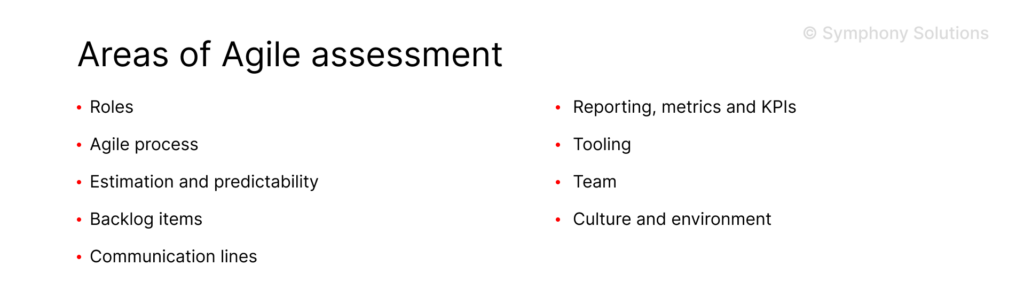
We know we have done a good job in assessment, when we understand how Agile practices may be applied to the work of the concrete business that we are now helping transform.
Surprisingly enough, or maybe not so surprisingly any longer, leaders only cannot provide the most crucial insight that LACE team needs during Assessment stage. So our deep and sincere call to all professionals developing the Agile transformation roadmap – don’t stop on executives’ level! Leaders know a lot, they decide on success of Transformation efforts.
Yet the success itself is defined by Agile transformation adopters that live outside the board rooms. Knowing their pain points, motivations, hopes and struggles – this is the insight that will define your Agile transformation success.
Setting the common ground by proper education of involved stakeholders
Agile is such a buzzword in the modern world. It is being used so frequently that everyone is already having their own interpretation of Agile. The very common risk that we in LACE transformation team have faced regularly, is different stakeholders having different common grounds and meanings when talking about principles of Agile transformation. That is why we recommend to train all the stakeholders and to set the common grounds for the change that we want to do.
LACE works by SAFe, an Agile methodology that has been the first to adopt a well-rounded approach to stakeholders’ education.
We not only provide classic Agile training to Scrum masters and Product owners. In our training portfolio, we have trainings for teams that are shifting to Agile, as well as to Agile leaders.
The latter education of leaders proves to be immensely important. More often than not Agile Leadership is the bottleneck in an organization wishing to undergo Agile Transformation. As usually the urge and energy to go Agile, comes from a particular business unit, some area of organization that is usually on frontiers of the VUCA world. In almost every organization we see business divisions that do not follow or interpret differently the Agile philosophy. When not addressed timely, misalignment in leadership team results in a bunch of roadblocks later in Agile Transformation journey.
In LACE, our standard Agile training portfolio consists of the following trainings below. Depending on our clients’ needs, we either deliver training ‘from the shelf’ (yet less frequently these days) or tailor our programs to the clients’ needs. We do practice collabs with the third-party training providers, as well as with internal L&D departments on the client’s side, in order to set up training programs that address exact needs for Agile transformation.
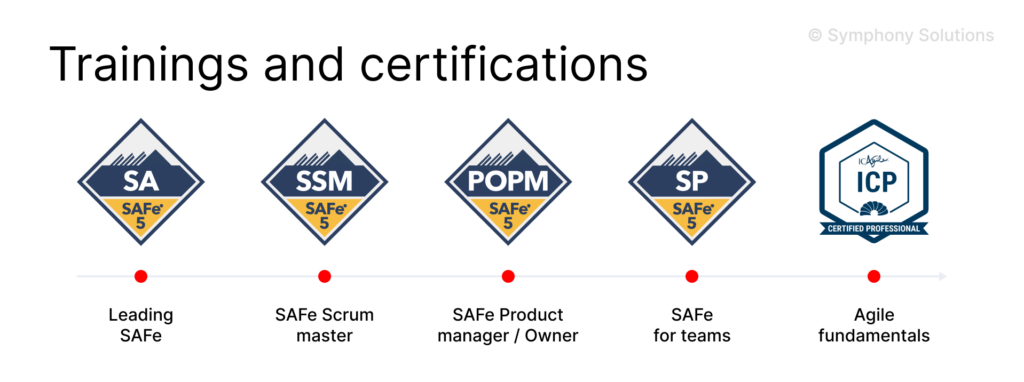
As to the format, we offer both online and on-premise training. Below you may find more detailed information on learning options available.
ON-LINE
- Agile Basics, duration 4 hours.
- Scrum Basics, duration 1 day.
- Organization Agility training for Business), duration 6 hours.
- Agile Product Management, duration 5 hours.
- Organizational Agility Course, duration 2 days.
OFF-LINE
- Scrum Basics.
- Agile Fundamentals (with certification).
- Leading SAFe (with certification).
- SAFe for Teams (with certification).
- SAFe PO/PM (with certification).
- SAFe SM (with certification).
- Management 3.0 (with certification).
Remember, the training is important, as it sets the common ground for further change. If there is one most valuable step to consider in training Agile – consider this. Always make sure that all of your key stakeholders are properly trained and equipped with knowledge for the Agile Transformation journey.
Knowledge provides the mental capacity to do change, tools empower the actual change
The essential part of Agile transformation is for LACE team to audit and adjust tools that are available in the organization, to serve the needs of the new Agile teams. The very first thing that we do, is we explore the tools that are already adopted and being successfully used by our client’s organization.
Agile can be practiced even with the whiteboards, or so the prophets say. In our experience, it is frequently possible to utilize the client’s existing toolset, in order to get Agile transformation going. In case it is not possible, we do help the client to properly select and set up the tooling that will serve their Agile transformation needs.
Tooling is the driver of successful Agile transformation. There is a ‘yet’ here, though. Transformation results are to serve the common business goals, which are usually being planned, tracked and achieved with the set tools. Whenever possible, try to utilize the existing tools for Agile Transformation goals. Don’t run for funky new tools just for the sake of novelty, this is our advice here.
When the elements are set, it is time to get the process going
We think that the entire meaning of Agile transformation boils down to how effectively the Agile processes are being adopted by the teams that are in the transformation process. The results of previous steps – assessment, training, tooling, can be seen on this stage very vividly.
On the process setting stage, LACE team takes care of setting up the Agile rituals, Agile meetings like PI Planning even for distributed team, on making sure that teams practice what they have learned and the tools are being used in the way they have been intended to.
In our experience, for organizations that undergo fundamental Agile transformation, Retrospective is the hardest process innovation that they go through. The teams that have never practiced Agile before, need the most careful nurture from LACE team, on the way they learn from own experiences.
Though not always the case, yet with majority of our clients it has been necessary to set up team space and time to reflect on past performance; it took most daring efforts to help the team start using the time and space to reflect on their performance; and most of the struggles and proud achievements we have had with the empowered teams that grasped the meaning of iterative improvement and the true ‘by the book’ value that Agile brings.
In essence, process setting provides sense to all previous steps in Agile transformation, making sure that the individual puzzles of the Agile journey are put together and start functioning.
Culture eats everything for breakfast
The topic of organizational culture deserves a whole separate post by itself. In the experiences with our clients, LACE team has always paid very deliberate attention to the way in which things are being done in organization. As the strongest wind that propels the success of Agile Transformation efforts, as well as most difficult impediments – they all come from the hidden and unwritten norms that exist in the company.
To tell the truth, there has yet never been a client for which we did not do change initiative. Yet for some of our clients we did have to change the scope, or amount of educational and communicational activities, in order to get change going.
The culture thing is the most difficult to understand for an external consultant. So it has always been one of the most deeply researched questions on the assessment stage of Agile transformation.
Remember, culture eats the strategy for breakfast. Or frankly, it eats everything for breakfast. Make sure that you navigate well in organizational culture of your client, as this may be the question of life or death for your Agile transformation initiatives.
Blossom comes from a good seed, properly planted, and deliberately cared for
We have started this article with one fundamental truth that has proven so many times for us – transformation is the process, not a one-time event. In order for Agile transformation to work, it needs to be deliberately, attentively and resourcefully nurtured.
Having set up all the processes well brings a great level of enthusiasm to the teams. This in return brings early wins and fuels more adopters of Agile transformation. Yet we have noticed that with time the energy level drops, and there is a risk (at least for some categories of Agile adopters) to come back to the old ways of doing things.
That is why the crucial step for Agile transformation happens actually after the Agile transformation. We in LACE call it Agile coaching. This is a very individualized process of our consultants supporting the concrete use cases and challenges that concrete teams face when gaining their first experience with Agile.
We know, no systematization on this stage. Our coaches come back to every team individually, empathize with their particular struggles and support their unique successes, with the aim to obtain a side-view on how the teams may sustain the Agile transformation for achieving results on their level.
As LACE team has experienced this multiple times with our clients: when Agile becomes the way we do things over here, when Agile is not the way we do things, when it is a philosophy of ours – the change has been achieved. And the organization of yours is equipped with Agile ways of creating the value, which is the competitive advantage in the VUCA world we live.
To conclude, big changes are difficult, costly and very consuming exercise. In the modern world, changes are inevitable. Agile Transformation provides a toolkit to your business that may help you to have change not as a grand costly project, rather to have change as an on-going iterative evolutionary process. This, in essence, may help your firm to stay in line with the market changes and to deliver the best possible product or service to your clients in every given point of time.
